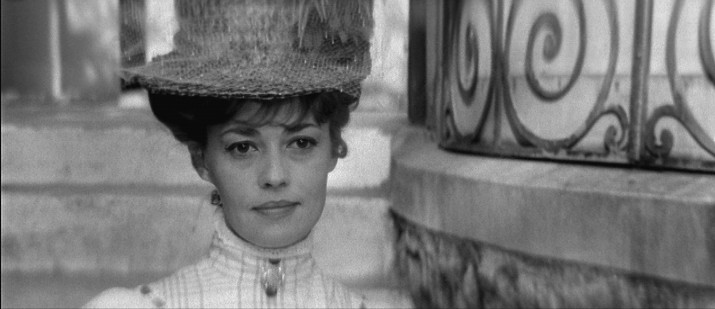
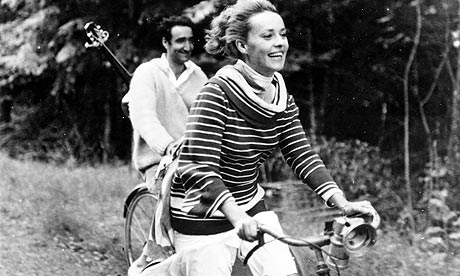
"Jules et Jim" aka "Jules and Jim" (François Truffaut, 1962) If only the folkies who saw "Jules and Jim" in 1962 had read it correctly, maybe the free-love era might not have overcompensated with drugs and disco in the '70's.
But, I'm getting ahead of myself.
Truffaut's third film is a sprawling time-spanner that starts in 1916 and falls just short of World War II and tells the story of a menage a trois that can't be managed by the partcipants. Jules and Jim (Oskar Werner, Henri Serre) are two life-long friends, whose friednship is complicated by war and the woman, Catherine (Jeanne Moreau) who comes between them. Their bohemian life-style flaunts society's more's, but living without rules means walking an imaginary line while drunk—even if you knew where you were going, you're unsure of how to get there.
The two boy-men (one French, one Austrian, which makes things difficult during the First World War) live an apparently work-free life pursuing art, until they encounter a Greek statue with a magnetic smile—on a whim they seek it out—only to see it appear in the flesh on Catherine. Both men are drawn to her, but Jules—the one unlucky in love—wins her, while the non-committal Jim hangs back and observes and, as always, bides his time.
He observes, but he doesn't see. Catherine is fascinating, but there's a shadow to that smile. She lives in the moment, and her mood can swing with the wind. She carries vitriol (sulfuric acid) for "lying eyes." And it's too soon in the relationship for him to make anything of the fact that she catches her dress on fire while burning love letters. Jim snuffs it out before there can be a complete "Bonfire of the Vanities."
On one of their excursions, Catherine dresses in men's clothing and draws on a moustache. On this particular outing, she will be a man, living a man's life. But she's already doing it, making her rules, living by them and chucking them when they restrict her, the men following her because they can't keep up with her instincts. It will intensify when she marries Jules after the war, becoming the dominant one in the marriage, Jules almost slavishly putting up with her infidelities, brought on by the yoke of motherhood. For all the perfect happiness they seek outside of conformity, they end up perfectly miserable, and when Jim and Catherine begin an affair, something psychic snaps.
For being a part of the French "New Wave," it is very much a cautionary tale (taken from the novel by Henri-Pierre Roché), old-fashioned in its insights warning of the dangers of an unconventional life-style.* Made on a limited budget, but with a large scope, Truffaut makes use of news-reels and other period chronicles (and movie-tropes like irises and wipes) to create a multi-media presentation of the period, and Truffaut starts his movie hyper-kinetically to show the puppyishness of youth, then gradually tapers the speed off to show the arc of a love affair and a life.
That arc has only one way to go, and it leaves all three adrift: Jim, his choices taken away from him, Catherine, her freedom from her, and Jules loses the captains of his fate.
Un sourire peut enchanter mais également séduire. Prenez l'attention.
* And, "of course," the woman is "the problem," but she is also the driving force—the vitality—that informs the lives of two rootless and feckless men.

1.jpg)