Showing posts with label Classic. Show all posts

Tuesday, February 5, 2013

The Three Musketeers (1948)

The Three Musketeers (George Sidney, 1948) Every few years, a new generation has to put their imprint on Alexander Dumas' adventure tale on the chicaneries and hidden agendas during the rule of King Louis XIII and Cardinal Richelieu, when it seems everyone was challenging the rule of theocracy masquerading as monarchy.  Every time, a group of four actors can be found to collaborate rather than hog the show, a new version is produced and a different spin is put on the first part of the d'Artagnan Romances, telling of a sword-skilled Gascony bumpkin who goes to Paris to join the King's Musketeers of the Guard—knights on the cusp of a new technology who prefer their battles to be sharp and personal—and learns the ways of the world in love, loss, and politics and how they all cross swords.

My favorite version is still Richard Lester's one-and-a-half film epic The Three Musketeers: The Queen's Diamonds and The Four Musketeers: Milady's Revenge for their bawdy humor, down and dirty sword fights and occasional stunt-casting, breezily written by George MacDonald Fraser, lovingly photographed by David Watkin, and (for the first one) cheekily scored by Michele LeGrand in his mock heroic style.

But there have been so many others, going back to the silent era.  One of the oddest, despite being a fairly straight adaptation is the Technicolor M-G-M version from 1948, starring Gene Kelly as d'Artagnan, high in the step and long in the tooth, where the fights are choreographed more as dance in natural settings.  All movie fights are choreographed to some extent, but the '48 version of "3M" has a particularly dancerly feel with Kelly.  There's a "lark" aspect to the whole thing, with a winking feel as if to say "isn't this all preposterous?"  It feels even more so in Kelly's love scenes with June Allyson playing Constance, confidante to the Queen (Angela Lansbury) and daughter (in this one) of his landlord.  Their scenes have a campy, artificial leaning, layered over with a version of Tchaikovsky's "Romeo and Juliet" theme, which was probably a cliche for love in '48.  It makes any emotional investment in the romance so much embarrassing vapor.

Impressive cast, though, with Lana Turner top-lined (probably to assuage her fears that it was a secondary role) as the villanous Milady deWinter, Vincent Price is finely oily as Prime Minister Richelieu (evidently he was defrocked for the film, owing to pressure from the Catholic Church), Van Heflin a good, but not great Athos, Gig Young as Porthos, and Keenan Wynn providing comedy as d'Artagnan's servant Planchet.

And it has one scene that makes the highlight reels—Kelly's tribute to Douglas Fairbanks, vaulting over French roof-tops to rescue his lady-love.  It's nicely staged athleticism, marking a sharp contrast to the play-acting of the rest of the film.

Monday, February 4, 2008

All the King's Men (1948)

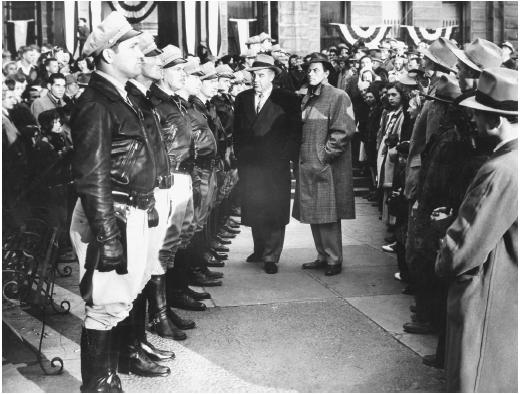
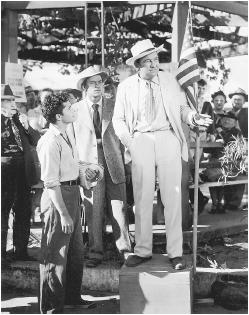
"All the King's Men" (Robert Rossen, 1948) The Oscar-winner for Best Picture of 1949 and it's hard to argue. Rossen's adaptation of Robert Penn Warren's Pulitzer Prize-winning novel about the corrupting powers of politics, it boasts two powerful (and Oscar-winning)performances: Broderick Crawford as innocent-turned-player Willie Stark and Mercedes McCambridge as his cynical-to-the-marrow political assistant. McCambridge is so good and so inventive that she might just as well have been given the statue for the next five years. Would that the other performances have been as electric as these two, but one could say that they shine even more brightly next to the lesser lights. It's particularly interesting to see Crawford so restrained at the beginning of the film, but once he sees how the game is played he turns on the after-burners and soars over everybody else in the frame with him. Mention should be made of the ocassional glimpses of a documentary style in the rally scenes amid the more traditionally blocked studio framing. And the film may seem a bit abrupt in places--but that's because Rossen, determined to get the film below two hours, gave his editor instructions to take most of the scenes and cut precisely thirty seconds from the front of it and thirty seconds from the back (making sure not to clip off any dialog). What was left was the hard nugget of the scene's core and "All the King's Men" feels more brutal in its pace and attitude because of this uncompromising strategy.

Sunday, February 3, 2008

The Wages of Fear

"The Wages of Fear " (Henri-Georges Clouzot, 1952) Some movies are so good they defy time, place and stay universally fresh, seemingly like they were made yesterday. Clouzot's "The Wages of Fear" is that kind of movie, and I would call it the best film 0f 2007 if it was released today instead of 1952. It tells the story of four vagrants scratching out a living in a South American village existing in the shadow (and under the thumb) of an American oil company. One of the distant oil rigs goes up in flames, and these four are hired to drive two trucks of nitro-glycerin over unforgiving roads to the inferno to snuff it out. Why take on this task? $2,000 per man--enough money to fly out and make a new life. Why these four? They're not union workers, and should they die--the odds are fifty/fifty, hence the two trucks--they have no families who might sue or require compensation.

It's a neat little trap, and that doesn't cover the obstacles that Nature (and uncaring road-workers!) have along the way. All these desperate times call for desperate measures and the efforts taken can be undone in the blink of an eye, or a flash of fire. For the four, the journey strips them down to their real selves, all pretense and masks disappear in the face of impossible challenges that must be overcome, and the looming threat of death riding behind them. The wages of fear may be death, but "The Wages of Fear' is a bleak metaphor for life itself.

All of this is played out over a blasted landscape, the results of the presence of Big Oil, and the journey feels like going back through time as well as space, through the spare white jail-bars of a denuded forest, back to the primordial ooze and finally ending up in Hell. By the end one can't help wonder if the fate of Nature and the nature of Fate are intertwined. Except for one fairly amateurish performance this is a near-perfect movie.

Monday, January 14, 2008

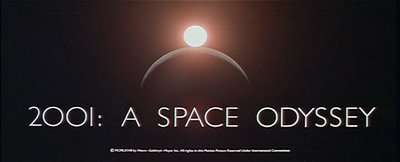
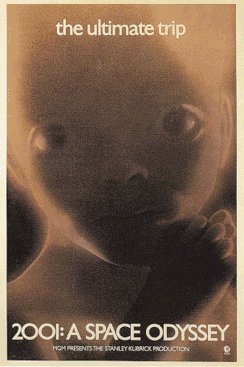
2001: A Space Odyssey


Why is “2001” my favorite film?

1. It completely does away with the three-act play structure that hems in most films. It’s four acts—like a symphony.

2. It contains very little dialog, and insists on telling its story (about discovering extraterrestial life) and providing key dramatic information visually and aurally—something that too few films actually try to do--fully utilizing the stregths of the medium.

3. It dispenses with the traditional sense of screen-acting which depends on emoting high-points (which is not standard drama, but is, in fact, melodrama), that has long been the crutch of what is considered great screen acting.

4. It comes up with a rather nifty solution for the Evolution versus Creation argument, which is: “Why can’t it be a little bit of both?” Trust
Kubrick to answer a question with another question.

5. It is that very rare item in movie history—a true Science Fiction film. It is not a standard genre film (ie. a western or detective story) set in the future with gadgets, like “
Star Wars” or “Close Encounters” or “Blade Runner” or “Outland” or “Forbidden Planet.” There are no comfortable, reliable concepts in “2001.” It asks audiences to consider the unconsiderable and make leaps of knowledge and faith. And it doesn’t wait for that audience to catch up, despite protestations of a “glacial” pace.

6. It obeys the rules of space and uses them dramatically. There is no sound in space. Trips in space take a long time. Isolation is a problem. Don’t get caught without your helmet. Ask your computer how its doing every so often. When you're dining over at a stranger's house, don't break the crystal. If a black monolith crosses your path, don't reach for it unless you're prepared for your life to change. Rules like that...

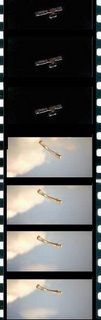
7. It takes advantage of the one unique element that separates film-making from any other artform, and presents the single greatest edit in movie history. To wit:


My Dad took me and my friend Jerry Fortune to see "2001: A Space Odyssey" on my thirteenth birthday. I was a space kid. I lived and breathed the Apollo program. I knew every Astronaut’s name and every mission. What went right and what went wrong. The names of landing sites and prominent craters nearby.

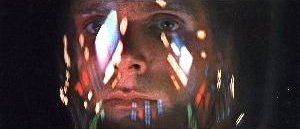
But I couldn’t make heads or tails out of this movie. Like my father, I “liked the middle parts,” but I couldn’t figure out what was up with the monkeys, what all that wierd screaming was about, what was with those streamers when they get to Jupiter, who was the old guy and what was that baby at the end?

I mean, huh?

I was determined to figure it out. It was a space-movie for cryin’ out loud. And, at that time, they only came around once in a blue moon (the last being “
Planet of the Apes,” hardly a space-movie) and I wasn’t going to waste this one.

So it made me dig. I researched. I found out it had to do with the search for extra-terrestrial life (it did?), then I read Clarke’s book, and although Clarke and Kubrick deviated quite a bit, it let me in to what Kubrick was trying to communicate.

Then I got it. It made me realize why he did what he did, why he chose particular scenes to portray, why he framed shots the way he did, and what he could get away with without making his movie look stupid. For Kubrick, a suggestion was better than hitting you over the head by showing bug-eyed children in baggy suits and rubber masks ala Spielberg. There was no narrator to tell you what it all meant (Kubrick had cut out a prologue of talking heads discussing E.T. concepts). The film-maker trusted that his audience would figure it out. Some did.* Some just liked all the colors.

And it left a lot of people (including one thirteen year old and a good number of complacent critics) in the moon-dust.

It still boggles this mind that Kubrick was able to take Arthur Clarke’s slim concept in “The Sentinel” (alien beings leave a "burglar" alarm of sorts on the Moon), and take it to a logical beginning, wrap it in mythic proportions and take it to an inevitable, and, for me, heroic, end. It still is one of the few movies that purport to be science fiction with a deep sense of mystery and wonder, even a kind of visual poetry--something its sequel, the literal-minded “2010,” dispensed with to its drab, short-shelf-lifed detriment.

Where did that inspiration come from? How did those concepts appear? For me, the movie fits the description of the Black Monolith in the film (and are its last spoken words) “It’s origin and purpose, still a total mystery.”

I may have seen "2001: A Space Odyssey" over a hundred times, and it never, ever bores me or fails to thrill me.

Such is the power of this movie over me.


* A site that "explains" "2001" and touches on some philosophical aspects


Anytime Movies are movies I can watch anytime, anywhere. If I see a second of it, I can identify it. If it shows up on television, my attention is focused on it until the conclusion. Sometimes it’s the direction, sometimes it’s the writing, some times it’s the acting, sometimes it’s just the idea behind it, but these are the movies I can watch again and again and never tire of them. There are ten (kinda). This is Number 1.


1. 2001: A Space Odyssey


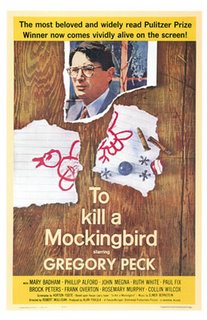
To Kill a Mockingbird

What is it about this film that puts it on so many favorites lists. Horton Foote’s masterful telescoping of Harper Lee’s frail, powerful novel? The fact that, as movie adaptations go, this is certainly one of the best? That it has an impeccably picked cast, directed to feel absolutely real, including three of the best child-performances in all of movies, by one of the best directors of actors, Robert Mulligan? The beautiful, fragile score by Elmer Bernstein, certainly contributes.

I remember seeing “
To Kill A Mockingbird” when I was seven years old, and not “getting it” much. I remember being annoyed with my Mom for trying to cover my eyes during the “scary” parts—although Robert Duvall as “Boo” Radley did genuinely creep me out back then (in fact, he still does, a bit). I didn’t “get” the dog-shooting (“He won’t kill a mockingbird, but he’ll sure-as-shootin' kill a dog!”) But I remember that it was a scary movie for a kid. In the film, the night was so dark, and any light cast spooky elongated shadows and trees moved and leaves rustled. The World seemed restless and alive when it should have been still and asleep. It was a world that, under the pretense of peace and calm, seethed with menace and dread just under the surface.

And that’s the key, I think. There seemed to be, in the movie, at least, a sense that the tremulous world was lurching and struggling to change—that the very earth was metamorphosing and demanding it, while the people entwined in that world, moved along, oblivious to the change, holding onto a complacent life that would inevitably end. At the same time, “Mockingbird” has the feel of nostalgia—the palpable sense that life flows through our fingers like sand, and that we’re always in danger of losing that life we hold precious.

But you don’t think of these things when you’re a child. Summers are endless. Life is eternal. If born into a nurturing, protecting household (and that is key) there is the illusion that the world is benign and all things are possible…under heaven.

Heaven is a concept easily grasped by a child. If you’ve been “good” in your life, as a reward after death, you go to a “good” place to spend Eternity. In the years of growth, a child struggles to understand its world and to assert itself in an environment it has no control over. In a world too complex to understand, the concept of Heaven is a comfort to a child. It’s simple. It’s uncomplicated. It’s black and white. Like Good and Bad.

Like integrity.

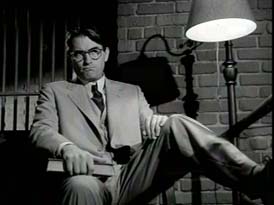
Atticus Finch (Gregory Peck) awaits a lynch-mob, that to his initial dismay and then wonder is shamed and turned away by his own children

The children in “To Kill a Mockingbird” learn the world isn’t nearly as simple as they thought. That the Radley “kid” may not be the evil thing they whisper about in the dark before they go to sleep. That other peoples’ lives may not resemble their own. That their father is many things—but he is also fallible. Jem breaks down when Tom Robinson is convicted of raping a white woman, but I would doubt that he’s crying for Robinson. He’s crying for his father’s failure—a disappointment as palpable as his father being not willing to play football for the Methodists. Jem and Scout are too young to understand the idea of integrity. No, that's not quite accurate. They’re too young to understand the pressures of a world where integrity might be compromised. And they’re too young to understand that their father’s belief in right and good could actually cause them harm. But it is that integrity that makes their father dependable, despite the tragedies of the summer. It is that integrity in a fragile, changing world that will sustain and endure and remain a constant as sure as the north star in the void. And that echoes long in our minds at the end of the film with its last line of narration: “He would be in Jem’s room all night. An he would be there when Jem waked up in the morning.”

When the American Film Institute held a vote for the cinema’s best hero, the honor did not go to the Sergent Yorks or the Skywalkers or the Bonds or any of the roles played by Eastwood, Willis or Schwarzenegger. It went to a character of gentle heroics who in the course of the movie only fires one shot, who does not raise a hand in anger, and with jaw set and quiet voice does what he knows to be right. It was a shock that Atticus Finch would be voted the greatest movie hero, but it was the best choice possible, and legitimized the idea of holding such a silly poll in the first place.


Stephen Frankfurt's evocative title sequence.
Music by Elmer Bernstein


Anytime Movies are movies I can watch anytime, anywhere. If I see a second of it, I can identify it. If it shows up on television, my attention is focused on it until the conclusion. Sometimes it's the direction, sometimes it's the writing, sometimes it's the acting, sometimes it's just the idea behind it, but these are the movies I can watch again and again and never tire of them. There are ten. This is Number 9.

2. Citizen Kane
3. Once Upon a Time in the West
4. -Only Angels Have Wings
5.
The Searchers
6.
Mr. Smith Goes to Washington
7.
Chinatown
8.
American Graffiti
9. To Kill a Mockingbird
10.
Goldfinger

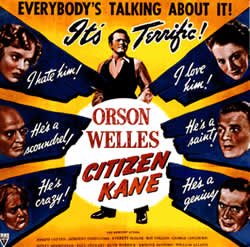
Citizen Kane

So obvious a choice.

Yet “Citizen Kane” (or RKO 281) has been fielding off re-appraisals and critical backlash since the day of its premiere. Is it really "the greatest American film ever made?"

Yes.


So far….

Part of the argument against it is that it can’t be since it was the product of a 26 year old who had never made a film before. But
Orson Welles was a 26 year old who grew up pampered and precocious—who read Shakespeare at an age when other kids are reading Seuss. As a teen he made his way in the world by his brio and his considerable talents and his nerve to try just about anything. He was an artistic sociopath who staged alternative Shakespeare productions and avant-garde radio plays for years before be given, as Kane puts it, “the candy store”—a carte blanche contract with a film studio to make any film of his choice, any way he wanted with final cut and a stipulation that said no one could alter it in any way in perpetuity (This is the reason why Turner Broadcasting in its rush to colorize movies could never put so much as a pink pixel to “Citizen Kane.” Some contract!). With it, he gathered his seasoned Mercury Theater actors (some of whom would go onto major Hollywood careers), one of the most innovative and painterly cinematographers, Gregg Toland, young, daring editor Robert Wise, the arrogant and brilliant composer Bernard Herrmann, and the amazing technical crew at RKO who produced such amazing feats as “King Kong” and the Astaire-Rogers musicals and turned them loose on Herman Mankiewicz’s long-in-the-planning screenplay that he believed could never be produced.

Out of all that talent at the top of its game, Welles produced the best American movie ever made, and as a reward he was never allowed that freedom again. Ever.

No good movie goes unpunished.

His next film, “
The Magnificent Ambersons” was a more mature and accomplished–looking film, but RKO chopped it up. re-shot the ending into a certain incomprehensibility and threw it on the bottom of a cheesey double bill. Welles’ Falstaff movie “The Chimes at Midnight” was the project closest to his heart, and might be better if not for the logistical and technical hurdles Welles had to jump in order to make it.

But “Kane” is the grail—the stuff of legend, and has been looked on ever since with avarice by would-be auteurs with more guts than talent, and therein lies the danger. That reputation could make "Kane" as cold and lifeless as one of the statues in Xanadu’s basement. It’s actually more like one of Susan Alexander Kane’s puzzles—intricate and maybe unsolvable without a lot of effort. There’s one shot where Welles shows his hand. It occurs after Susan has left him, accompanied by the screeching cockatiel superimposed on the screen (“I wanted to wake the audience up at that point,” Welles joked. Really, Orson? Right there?) and right after he trashes her room—destroying the acquisitions of her life—and Kane picks up the snow-globe that will fall from his hand at his death. “Rosebud,” he murmurs (both times) and then walks as in a daze out of her room, into the hall, and past the servants. He then crosses through a mirrored hallway that reflects an endless line of Kanes that recede and disappear. After Kane (and his many reflections) has passed, the camera then pushes into the mirror and out of the reverie of the butler (“Sentimental fella, aren’t you?” “Mmm. Yes and no.”)


That shot is the exit from the worlds of memory through which we have seen many reflections of Kane—the house of mirrors that makes up the bulk of “Citizen Kane,” the movie. It is also our last image of Kane, himself, in the film. He’s talked about through to the end, of course, but that splintered mirror-shot is our final impression of him (Kane—and Welles—are not even seen in the End Credits review of actors). At that point it becomes clear (as crystal) that the entire film is like that hall of mirrors that reflected back the aspects of Kane important to each narrator—a process that began with the newsreel that quickly jumped through the highlights of Kane’s life as a public figure and set up the film’s surface mystery—what is the meaning of Kane’s last word (and so serves as a stand-in for “who was Kane, really?”).

In the course of the various reflections there are all sorts of legerdemain—little tricks and in-jokes—that Welles, who was an amateur magician, clearly loved pulling off even if an audience didn’t immediately “get” them. One of my favorites is the craning shot through the model of the “El Rancho” nightclub where Susan Alexander performs and drinks herself into a stupor every night. The night of Thompson’s first visit it’s storming outside and flashes of lightning hide the camera’s passage through the roof sign and through the glass transom into the nightclub inside. When, half the movie later, we again travel through that transom it’s broken—presumably by our first trip through it. In the film’s original framing (unfortunately not in the DVD presentation) there is the slightest nudge of the camera to the right in the rather severe shot of Mrs. Kane signing little Charles away to the banker, and we see, just on the edge of the frame, that significant snow-globe that keeps popping up in dramatic moments. In the newsreel there is a shot of a newspaper of the entire Kane family. Later in the film, we actually see that shot being taken. Another is the way Kane’s hectoring “Sing-Siiiiing!” to “Boss” Jim Gettys is cut off by a shutting door, but continues by a braying car-horn out on the street. These are little filigrees to the grand architecture of lighting, framing and editing tricks that Welles and his crew pull off.*

But that central question “who was Kane?” is purposely never answered, not by a word, not by an object, and not by a person. In the end, the film says that it can’t solve the problem, that it can only present it, and leave us with the acknowledgement of its complexity.

So what are we left with as the remnants of Kane and his life fly up from the furnace of Xanadu? An answer to the mystery of "Rosebud," but not an answer to the man. For Kane was many things, but as Kane himself passed judgment on himself, he was never great. Given gifts that many of us will never ever have, he ultimately squandered them. Insular, wasteful, in his house of mirrors, he is left alone to contemplate himself.

We all have our gifts. What do we do with them? “Citizen Kane” is like that glass globe that we can peer inside and see the illusion of life…and consider our own lives. And in the end we are left with its final image to contemplate, and one may consider that Kane was a master illusionist himself, pretending greatness where there was none, and utilizing the very same tools used by those other illusionists—magicians and very young film directors--to create those illusions.

Those tools being smoke…and mirrors.


* Orson Welles is unique in the group of directors of movies that I’ve seen in that every time I exit from a new film of his, I come out looking at the world with new eyes…or with a new perception of the old world--one that seems filled with possibilities.


Anytime Movies are movies I can watch anytime, anywhere. If I see a second of it, I can identify it. If it shows up on television, my attention is focused on it until the conclusion. Sometimes it’s the direction, sometimes it’s the writing, some times it’s the acting, sometimes it’s just the idea behind it, but these are the movies I can watch again and again and never tire of them. There are ten. This is Number 2.

2. Citizen Kane
3. Once Upon a Time in the West
4. -Only Angels Have Wings
5. The Searchers
6. Mr. Smith Goes to Washington
7. Chinatown
8. American Graffiti

10. Goldfinger

Once Upon A Time In The West

Landscapes.

That’s what’s featured in
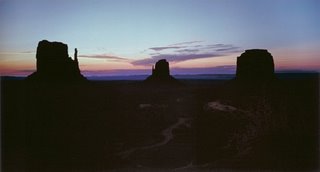
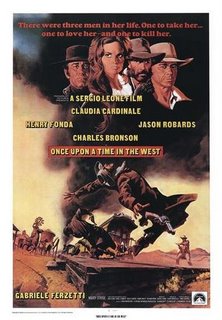
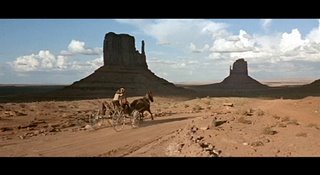
Sergio Leone’s “Once Upon a Time in the West.” Whether it’s the vast, aboriginal spaces of Monument Valley—an affectionate genuflection to the films of John Ford—or the intricately chiseled planes of the faces of Charles Bronson and Henry Fonda, you spend a lot of time looking at both in “Once….”, as well as deep close-ups on the faces of Jason Robards and Claudia Cardinale. There is one shot where Bronson ever so slowly relaxes a smile out of existence. It’s one of those shots where you don’t know what’s happening until it’s happened, Bronson does it so subtly. It’s one of the things I look forward to in the Dance of Death of “Once Upon a Time in the West.” Here are some others:

1. “Looks Like We’re Shy One Horse…” The first twelve minutes. A dilapidated train station in the middle of nowhere. Three long-coated bad-men wait for a train. They while away the time, each in their own unique fashion. Driven mostly by sound and filmed in extreme close-ups, the sequence, accompanied by the homely squeak of a windmill--one of the out-sized sound effects typical of Leone’s westerns--and the jokey placement of the credits, rolls on and on until a confrontation ends explosively. It’s an opening of great economy and intricate film-making. Few words are spoken throughout. I’ve shown students this sequence to show just how much presence and atmosphere simple sound effects can bring to a scene. Here’s the ending of the sequence. It’s just the opening gambit in a plot by two men who are playing against each other. It will take the entire movie to explain why.


2. “You Don’t Know How To Play” The gist of “Once Upon a Time in the West” is a chess game with lives and futures as the playing pieces. As scripted by Sergio Leone and his co-scenarists--the soon to be master of Italian horror films
Dario Argento and the young Bernardo Bertolucci--the movie is a series of moves and counter-moves by the antagonists, each one trying to tame the frontier in their own way, and taking their own sweet time about it. Each has to make the pieces fall their way. For the first-time viewer it can be maddening following the strategems of the four participants in the story, but by the end the motivations and loyalties--or lack of them-- become clear.
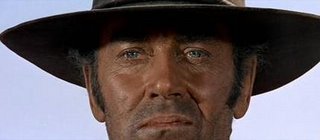

3. “People Scare Easier When They’re Dyin’” The villain of the piece is the meanest, rottenest most conniving scumbag to ever walk a dusty street and spit on it. “Frank” is a sadist who smiles when he kills and for the first time in his life he has a patron with a vision—one big enough for Frank to start to see how there might be such a thing as a future, and that one man can own it. He just can’t understand why people are getting in his way.
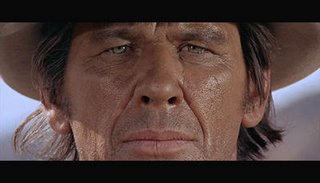


4. “Instead of Talking, He Plays. And When He Better Play, He Talks.” The composer and the director did it backwards. Ennio Morricone wrote the music for the film first and Leone built his sequences around the music, playing it on-set to establish mood. There are two spectacular pay-offs--one in the previously mentioned Monument Valley sequence. But the other is at a train station where Claudia Cardinale, has just arrived from New Orleans to find no one to meet her. After a long wait (which is actually mercifully short for a Leone western) she decides to hire passage. Sounds disappear as she is seen through a station window talking to an official, and then the camera HEAVES up and over the roof, and in a burst of music reveals a burgeoning western town full of life and activity. It’s as if all of America is presented in that one astounding crane shot. My wife audibly gasped when she saw the shot in some movie clip program on TV, so stunning is the effect. And more than a little of the power of that shot is due to Morricone’s music and the angelic voice of Edda Dell’Orso, wordlessly cooing an ode to the country and to the protagonist around whom the movie and the future hinges.
5. “Ma’am, It Seems To Me You Ain’t Caught The Idea” For the first time in a Leone western, a woman is the hero, but like her predecessor—The Man with No Name—she is flawed, and has some learning to do, and it’s up to Leone’s trio of men – another man with no name using the names of dead men, a wolf-like vagabond-thief, and the villain, Frank—to push, prod, blackmail, challenge and coerce her into a new role. It’s a role each man knows they’ll have no part of and that, for a time, she is reluctant to fulfill. In the last shot of the film, she is seen bringing water to the railroad work-crew who will be bringing people and prosperity to what will be her town. It may seem a servile role, but as we pull away and follow the disappearing tracks to the frontier, leaving her to her future, she begins to bark orders, to direct and take charge. Her station will become a cornerstone of the push west. “This movie drips with testosterone,” a colleague once told me after a screening. Yes, but Leone includes a healthy shot of estrogen as, for the first time, he is dealing with a story that not only leaves the past behind, but also looks forward to the future.

Anytime Movies are movies I can watch anytime, anywhere. If I see a second of it, I can identify it. If it shows up on television, my attention is focused on it until the conclusion. Sometimes it's the direction, sometimes it's the writing, sometimes it's the acting, sometimes it's just the idea behind it, but these are the movies I can watch again and again and never tire of them. There are ten. This is Number 3.


III: Once Upon a Time In the West


IV: -Only Angels Have Wings


V: The Searchers


VII: Chinatown


VIII: American Graffiti


X: Goldfinger

The Searchers

It’s a film that chills me right down to my bones and makes me cry every single time. It throws itself into the deepest pits of despair and within moments, prat-falls into low comedy. It’s a western…about race relations, and in the house of mirrors of a “genre” piece deflects the self-righteous tone of a sermon. It stares into the soul of people at their worst, and exults in their best.

It is arguably
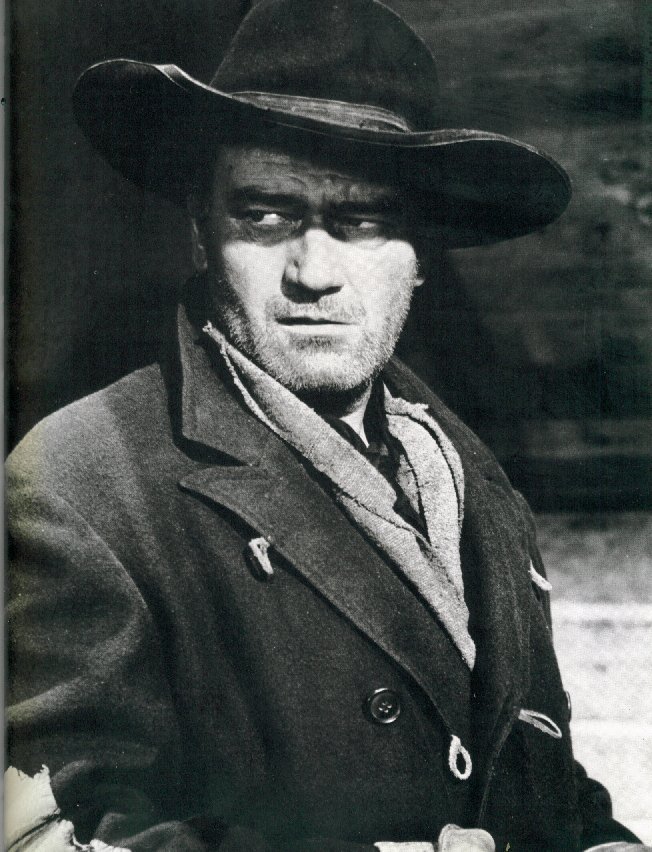
John Ford’s best film (and he made many great ones). It is inarguably John Wayne's finest performance on-screen, while completely working against the image that Marion Morrison built as “John Wayne.”

Oh no. We’re talking about “
The Searchers”—a “western” made during the somnambulant 50’s …and with John Wayne, ferchrissakes! How corny can you get?

Back up, pilgrim.

“The Searchers” has just been re-released (to mark its 50th anniversary) in a
gloriously re-mastered DVD, and has come under critical review for being too corny, too obvious, and more than a little dated. Worse still, it has been branded a “film-school darling” that has skated too long on an undeserved reputation as a masterpiece.

Bullshit.

Like
Pauline Kael’s faulty detective work dissecting “Citizen Kane” and Elvis Mitchell’s naïve un-analysis of “2001,” the work in Slate smacks of a critic either looking for something to write about or make a name for themselves bucking “conventional wisdom.” Having to spend a summer reviewing the third X-Men movie, the fifth “Superman” opus AND an entirely superfluous “Pirates of the Caribbean” sequel is bound to make anyone crabby.

But it shouldn’t lower one’s standards, and there’s enough slip-shod work in the article to indicate that’s the case. At the very least, it’s a terrible gloss-over.

“The Searchers” is a masterpiece—the culmination of decades of film-making experience that John Ford had accumulated since the silent era—while crystallizing Ford’s growing disenchantment with the Myth of the West. In a time when westerns were still basically built around the simplistic formula of “Cowboys vs. Indians,” Ford was starting to speak out more explicitly for the latter sixteen years before such accepted “consciousness-raising” films as “Little Big Man” or “Soldier Blue.” Like any masterpiece, it displays the sum of a body of work and breaks new ground, paving the way for the future.

“The Searchers” tells the story of an obsessive 10 year hunt for a lone family member taken in a violent Comanche raid. It’s led by the worst person possible: the child’s uncle--a hate-obsessed confederate soldier, self-exiled from his family, who still carries his saber on his hip, bitterness in his soul and his heart on his sleeve. Mix in a venomous race-hatred for all non-whites and you have the most flawed anti-hero to appear in movies. Ethan Edwards starts his search to bring his niece back alive, but as the years pass and she matures, he gives her up as one of the Enemy, and sets out to kill her. At the center of the film’s black heart is that most archaic and useless word: miscegenation.

It’s rough stuff. Rougher still are the attitudes of the settlers towards the Indians that border on hysteria. There’s a haunting scene late in the film where Edwards and his fellow traveler (played by future Captain Pike and “Teenage Jesus,”
Jeffrey Hunter) ride into a fort on the Trail of Tears to inspect some white women who have been captured by the Cavalry. “It’s hard to believe they’re white” a sergeant says. “They ain’t white,” spits Edwards, and at the sound of a shriek from one of the women, he turns to look at her. Ford trucks in the camera fast onto Wayne’s face (mirroring the shot he used to introduce Wayne in their first film together, “Stagecoach”) and it’s amazing. Wayne was always blessed with a mug that the camera loved*—it could read every emotion that played across it--and in a performance minus the “hero façade” and that turns on the full after-burners that usually blew his co-stars off the screen, this one quiet moment radiates a combination of hate, disgust…and abject fear. No words need to be said to make the point.

And yet, for all its depths of despair amid bloodshed and the race-hysteria swirling around that most antiquated and completely useless term “miscegenation”—Ford tries to balance it with entertainment. That’s quite the tight-rope walk. But then, it’s not a sermon. It’s a Western. Ford was never so pretentious to be caught lecturing. He’d say if you want to send a message, use the Pony Express. Better to sneak the lessons into the fabric of the story, and distract with shenanigans about wayward lovers, goony old men, and green cavalrymen with pointy swords. One of the incidents involves the unintended marriage of Hunter’s character to a portly Indian maid. It’s the source of raunch comedy in the vein of Ford’s “The Quiet Man”—all roughhouse and bad taste. But when Ford’s good guys “The Cavalry” dessimate a Native village and the luckless character along with it, Hunter is left to ask “What’d they have to killer her for? She never hurt anybody!” The question hangs in the air with indictments all around.

“The Searchers” begins and ends with a black screen. In the beginning, the blackness gives way to the vast magical vista of Monument Valley (which figures in two of my anytime movies. If God lives anywhere on Earth, I think it’s on that vast acreage of land overseen by the Navajo) that to Garry Wills suggests an irising lens, but to these eyes seems more of a proscenium arch. At the end it shuts out Ethan Edwards who is left out of the warmth of a family embrace to wander the desert (Of course, Wayne’s character is going to come in eventually and eat…but Ford chooses to leave Edwards outside). His prejudice does not belong with home and hearth...and society…and Civilization. Yet it is also Ford’s choice to leave the character alive, the wolf always at the door.

It’s as if having made his plea for tolerance, Ford cautions us that it will always exist, somewhere.

Will we ever lose the hate?

“That’ll be the day.”


* Screenwriter Robert Towne has a better term for it, the "camera-love" phrase implying a happy accident that doesn't give enough credit to the actors, their craft and experience. He says that actors like Wayne, Henry Fonda, and Gary Cooper are "ruthlessly efficient" in that they can communicate differing emotions with an economy of expression. The words are particularly apt for Wayne's performance in "The Searchers."


Anytime Movies are movies I can watch anytime, anywhere. If I see a second of it, I can identify it. If it shows up on television, my attention is focused on it until the conclusion. Sometimes it’s the direction, sometimes it’s the writing, sometimes it’s the acting, sometimes it’s just the idea behind it, but these are the movies I can watch again and again and never tire of them. There are ten. This is Number 5.

V: The Searchers