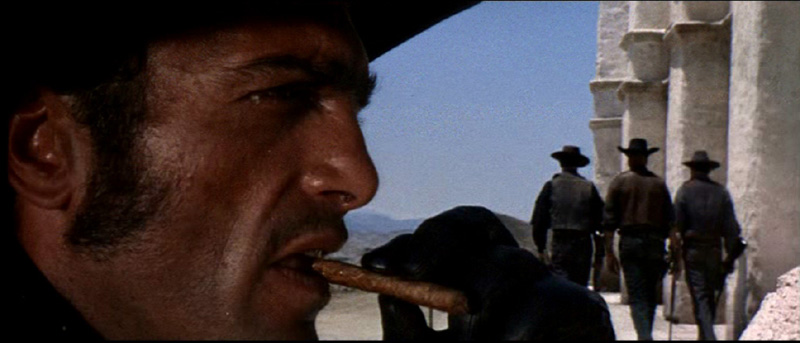
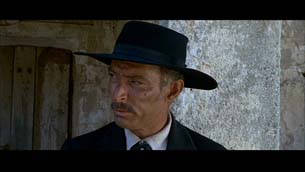
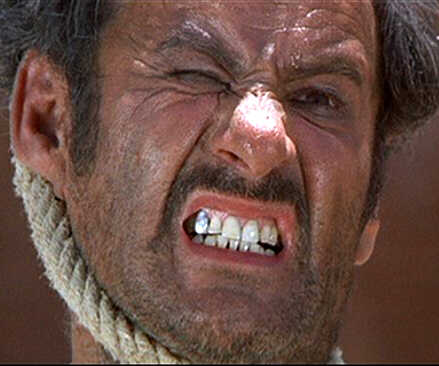
In my childhood, America was like a religion. Then, real-life Americans abruptly entered my life - in jeeps - and upset all my dreams. I found them very energetic, but also very deceptive. They were no longer the Americans of the West. They were soldiers like any others...materialists, possessive, keen on pleasures and earthly goods
One of those directors who made very few films during the course of his successful film-making career, Sergio Leone still made a lasting impression with the films that he did make, each one becoming grander and more epic in scope. Starting out as an assistant director for Fellini and others, he advanced through the ranks of the Italian cinema until he achieved a solo directing career and began to turn a fresh eye towards the genres that he loved as a child, primarily westerns and gangster films. His work during the 60's making the seminal films that would spawn the genre known as "spaghetti westerns" bent perceptions of western films while simultaneously paying tribute to the films of the past. While busting the myth of the traditional western, Leone would create worlds that seemed to breathe a more authentic view of the time and place that made up the collective "West" (even though filming mostly in Spain) and altered the artistic landscape of the genre, whether it was in the clapboard and adobe rusticity of his corners of semi-civilization, or the dust-encrusted crags of the planes of the human face. His films were bold, expansive, subversive and larger than life, much like the director himself, who established a distinctive style that resists duplication, despite the almost slavish attempts by those who've known him only by his films.
 |
| Leone films come full-circle by having its climax in a makeshift arena. This, from For a Few Dollars More. |
Let us say that I am a disillusioned socialist. To the point of becoming an anarchist. But because I have a conscience, I'm a moderate anarchist who doesn't go about throwing bombs...I mean, I've experienced just about all the untruths there are in life. So what remains in the end? The family. Which is the final archetype - handed down from prehistory...What else is there? Friendship. And that is all. I'm a pessimist by nature. With John Ford, people look out of the window with hope. Me, I show people who are scared to even open the door. And if they do, they tend to get a bullet right between the eyes. But that's how it is.
----------------------------------------------------------------------------------------------------
 sandal epic starring smiling Rory Calhoun as "Dario," who is caught up in the internecine politics and plotting that comes with the building of the great Colossus statue. There is much "spartacus-ian" action among crew-cutted gladiators, who, even though they are the greatest warriors also seem to be the most oppressed. When Dario is captured and held prisoner, his friends try to save him by setting up a phalanx to try and storm the mighty Colossus but are set back when the head spews out flaming pink gouts of boiling oil. "Your companions are inordinate cowards" says the villain. Eh? What was that? Still, for Leone's first full directing job, rather than merely doing pick-up and second unit shots, there is a lot of eye-popping camera work that predicts some of his work in the near-future. The script is nothing much, and the acting pretty appalling, but if you turn off the sound, and just take in the pictures there is some interesting work going on there.
A Fistful of Dollars(aka Per un Pugno di Dollari)(1964)
 International fame came to Sergio Leone for this filmed-in-Spain re-telling of Yojimbo as a Spanish western with an all-Italian cast...with one major exception. Clint Eastwood, recognizing the Kurosawa roots took a chance on the film and its unheard of director (re-named "Bob Robertson" in the initial American United Artists release), and devised a rough, amoral screen persona with an almost Buster Keaton-ish sense of timing and lack of expression. Called "The Man with No Name" in the ads (actually, he has a name in all three Leone films, "Joe" in this one), Eastwood's character arrives with a vague past, but an expert's gun-hand and proceeds to ingratiate himself with two warring factions for the control of San Miguel. Everything about this film is a little different. Leone's framing of scenes is formal, with an eye towards humor, but also brutality. Long lens vistas are intercut with bulging, sweating close-ups that fill the frame with depth. His sense of timing is to draw out the show-downs with dialogue and humor, and then release with a fast display of gunfire. And Leone's sense of design called for rough-timber exteriors and interiors with spare accoutrements. Those elements would be stretched further in the inevitable next film, as the film made money internationally, and, surprisingly, in the United States.
And it made Clint Eastwood a star, especially in his home-country.
 |
| "Y'see, my mule don't like people laughin'.." The odd humor and emblematic close-up from A Fistful of Dollars |
 For a Few Dollars More (aka Per Qualche Dollaro in Più)(1965) The qualities that made A Fistful of Dollars stand out are still very present in its follow-up (you can't really call it a sequel) For a Few Dollars More. Kurosawa is no longer the direct inspiration as an original story is told, although it's a revenge tale that feels like a Myth of the past.
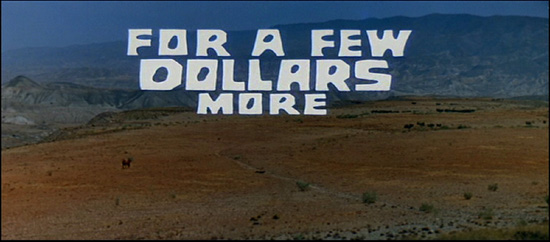
For a Few Dollars More begins with a static shot of a desert valley dotted with scrub, a lone man on horseback riding in the distance--a speck in the grand vista. On the soundtrack an unseen man is whistling, humming and loading a gun. Finally, there is a shot. The rider is knocked off horse-back, falling dead as the horse gallops away in a straight line back the way it came. Then the credits begin with another Ennio Morricone whistling theme* with electric guitar and chanting male chorus, as one by one the credits are shot like metal ducks in a gallery. It's a funny, simple sequence. Funnier still when you realize it's just a long shot of a man falling off a horse. It's the dubbed-in sound that makes the sequence and Leone is having fun with it, as he does throughout the movie.
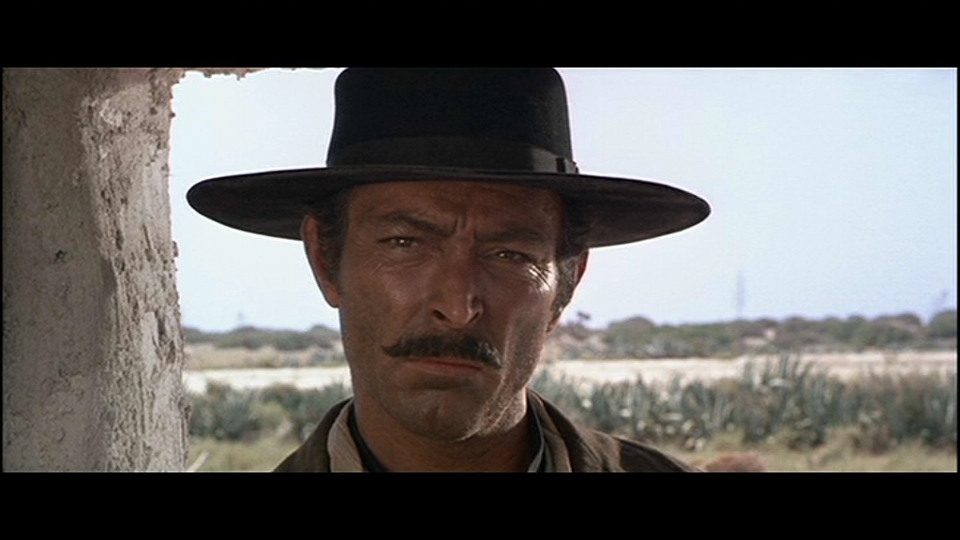
Each set-piece has its own peculiarity and joke, be it in character, framing or timing. Leone's rough westerns are being sand-papered down with more humor, and an ever-increasing gallery of plug-uglies (Eastwood says each one of Leone's faces "have seen pain"), including Lee Van Cleef as the bible-reading, armed-for-every-occassion bounty hunter Col. Mortimer,** who runs a parallel path with "The Man With No Name" (named "Manco" in this one) for ever-increasing rewards, until both men set their sites on the dope-smoking laughing psychotic El Indio (Gian Maria Volonte)."When two hunters go after the same prey, one of them might get shot in the back," warns Mortimer. Same prey, but for differing reasons, and that reason is displayed in what would become one of Leone's recurring gambits--recurring surreal flash-back sequences giving little bits of information to the audience that are only fully revealed at the end. In "For a Few Dollars More" Leone pitted his amoral "Man" against a man of principle and found them both equal adversaries, though Col. Mortimer's values are of relgion and family--themes that would start to dominate Leone's greedy action films in the years to come.

And that's what's different about this Leone film. In the foreground is the fight for gold, with the war (in the form of General Sibley's disasterous western front), getting progressively bigger and taking over the movie, the backdrop to the action. Wherever they go, the three run into wounded soldiers, decimated towns, and finally a bridge that provides the daily excuse for a useless slaughter. What they may be doing is simple greed, but for Leone the war is the biggest obscenity and the most useless folly of all. Even Lee Van Cleef's "bad" man is given a moment to shake his head in disgust at the carnage. And the three, good, bad and ugly, take turns in blue and gray to get through the madness and make their way to their plot of gold.
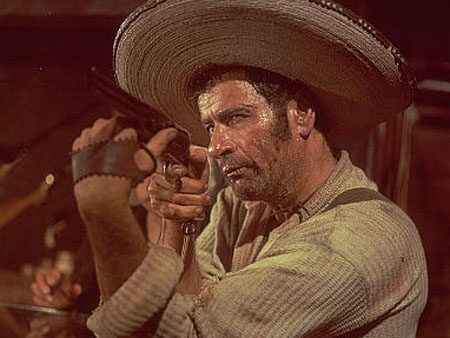
Leone makes his filming strategy known at the first shot--a desolate, craggy hill-scape that is suddenly eclipsed by the heaving into frame of the head of a Leone extra. He's just there to be shot, along with two other men on the opposite side of town. Their target is Tuco Ramirez, "the ugly," (each character is introduced in turn--next Lee Van Cleef's "bad" man, then Eastwood's semi-"good" man--in sequences that overall take about thirty minutes of screen-time) and, played by Eli Wallach, its the actor's big chance to create something far removed from his Hollywood or Actor's Studio roles, or even his mexican bandit from The Magnificent Seven, another "westernization" of a Kurosawa film. Wallach loved playing Tuco (although it was dangerous quite a few times--Eastwood, the veteran, was his guardian angel, telling him what he should avoid) and Leone clearly enjoyed the larger-than-life, explosive bandit, giving Tuco some of his own boisterous personality. The first half of the film is Tuco's, and noting that his character was becoming less and less integral to Leone's films, Eastwood walked away from that phase of his career, although he would again be offered lead roles in Leone's next two films. For Eastwood, three was the charm.
Three is also the number of hours the original cut of The Good, The Bad and The Ugly ran during its first run in Italy, but for its American run, United Artists chose to cut close to forty minutes from the film, taking out linking material and some anti-war statements, while leaving in the bridge sequence, and keeping Tuco's long run in the cemetery at film's end. Evidently those were considered "action" sequences and so survived the editor's axe. But it left some gaps in continuity, which didn't enhance the reputation of the genre. But The Good, The Bad and The Ugly was a major success for United Artists, Leone and Eastwood (who owned a percentage of the film). Leone was evolving as a film-maker. Now he was no longer content to make his movies. They had to be bigger in scope ("Leone wanted to be David Lean," Eastwood says now), and have a message. The Good, The Bad and The Ugly showed soldiers chewed up in the machinery of fool-hardy generals, the hypocrisy of respectable members of society like merchants and priests and even had moving moments of sentimentality that made the films richer. Leone was at the top of his game, but he hadn't reached what he wanted to achieve--respectability.
 |
| The final duel in another arena, this time, conveniently in a graveyard. The Good, The Bad, and The Ugly |

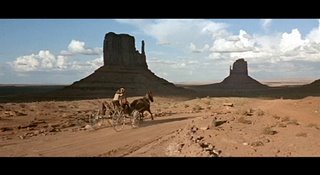
Once Upon a Time in the West (aka C'era una Volta il West) (1969) We've already talked about Leone's masterpiece here. And subsequent viewings are just as rich if not more so--it's rare to keep watching a movie and keep seeing small details that keep telling you more and more. And with the book-ends of The Good, The Bad, and the Ugly and Giù La Testa, one can see how disciplined Leone the artist had become. For Once Upon a Time in the West, the first of three movies to bear that myth-framing title at one time or another, has as taut a script as Leone ever had, composed of self-contained sequences of ten to 20 minutes in length, like a series of box-cars on the train that is both the promise and death of the West. Each scene (excepting the auction of the McBain ranch) is an insular nugget of the chain in the story of the four individuals stalking each other and angling for position to each own a piece of the burgeoning America.
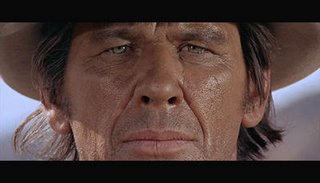
Like the director he so admired, John Ford, Leone knows that the building of something comes at the cost of something else, like freedom or the virginal expanse of territory left unmarred, to be replaced by wagon-ruts and hypocrisy of civilization. Leone's last shot goes from the birth of an American boom-town and pans away to the shot that has ended the previous Leone westerns, a lone horse-man riding out over the plain until he's lost in the landscape. It would be Leone's last western (he would produce others), and that shot swinging from his heroine's building of a settlement, and his hero's exile to the wild says something about Leone's divided loyalties. His core values are to family (both Jill (Claudia Cardinale) and "Harmonica" (Charles Bronson, playing another Man with No Name) have families taken from them and it's what spurs both their actions), but he wistfully follows the cowboy-loner out to desert. The one dream dies as another comes a-borning.
And Leone, as John Ford before him, was beginning to see the myth of building the West, as simply that, a myth. The struggle of Jill McBain to keep what is rightfully hers rather than have it be stolen by the Forces of Progress and Business comes from a mixture of instinctual orneriness (Cheyenne, played by Jason Robards) and pre-meditated spite (Harmonica), straddling the fence of the law. That stake must be established as well when it's encroached by a force that thinks nothing of killing women and children. The New World, if it is to grow, has no place for that.
Leone had ten million dollars to spend on ...in the West and when Paramount saw what he had spent it on, they were shocked--no stars big in this country (except for Henry Fonda,*** and well...that had its own problems) and another length approaching three hours. The movie was, again, shortened considerably, though not as badly as GB&U. It did well in Europe, but not in the United States, but it has achieved a well-deserved cult status. Leone's next film would not be so lucky.
 |
| Jill (Claudia Cardinale) contemplates her fate lying in her empty wedding bed in OUATITW. It will be echoed at the end of OUATIA. |

Duck, you Sucker aka A Fistful of Dynamite, aka Once Upon a Time in the Revolution (aka Giù la Testa)(1971) The missing Leone--the one that's been given the least amount of attention, and, as a result of it, was the most mutilated of his films for the longest period of time and the least understood. At one time called "The Two Johnnies," and in Italy, Giù la Testa--or simply "drop your head"*** Leone based his second myth-busting film on the glories of revolution. American audiences didn't see it, but Leone started the film with a quotation from Chairman Mao: "Revolution is not an elegant tea party...or writing an essay. A revolution...is an act of violence."
The radical left had been exploding bombs in his beloved Rome. and although he sympathised with their politics (growing up under the thumb of Mussolini) all Leone could see was rhetoric and destruction and broken bodies. His tale of Juan Miranda, a mexican bandit who gets caught up in the revolution (who might just as well be "Son of Tuco," the part was written for Eli Wallach, but played by Rod Steiger) and John Mallory, late of the IRA (written for Jason Robards, but James Coburn got the part), de-glamorizes the myth of revolutionaries. Juan and his robber-family are in sympathy with the idealists wanting to depose the regime but they're basically in it for the cash, and there are too many foreign players on both sides encouraging the fight for their own ends and ideals. John is in hiding from Ireland and his past (revealed slowly and cryptically in a Leone flash-back, the final part of which was hacked out of American prints, making John's story meaningless) has one eye on terrorist activities and the other on possible turn-coats in the ranks, something he knows far too well. Juan, owing to circumstance, becomes a hero of the revolution, but he's not so driven by idealism as John. "After all the speeches and the celebrations, what has happened to the poor people? They're all dead!" Again, for Leone, myths are to be shattered, hypocrisy exposed, and family is all, but at risk. But the action-adventure "spaghetti-western" crowd were being catered to, and some of Leone's meditations on the subject were cut when brought to America.
 Once Upon a Time in America (1985) Long in the gestation process what ultimately became Once upon a Time in America started out as Leone's re-working of the classic gangster movie. Basing it on Harry Grey's "The Hoods," Leone labored for a decade on the screenplay (nine writers worked on it, including, for a time, Norman Mailer) before being satisfied enough to start filming in the burroughs of New York. He had a pick of the best actors in Hollywood, all wanting to work for the now-legendary director, including Robert De Niro, Elizabeth McGovern, James Woods, Joe Pesci, Treat Williams, Tuesday Weld, Burt Young, Louise Fletcher (her part was cut totally) and a young Jennifer Connelly. There are rumors of Leone's initial 4 1/2 hour version with Fletcher's part still in existence, but none have turned up. The first version I saw debuted at the Seattle International Film Festival, and it was a disaster--an incomprehensible mess that ran for 2 1/3 jarring hours. This was Paramount Pictures' bastardized re-editing of the film (by ninety minutes!) putting the film in chronological order, blasting apart Leone's intricate jigsaw puzzle editing that see-sawed back and forth between past and present as the elderly De Niro character, "Noodles," comes out of hiding (this time self-imposed) to find answers to questions that have haunted his middle-age years. Even though one could see glimpses of genius in the individual set-pieces, The Paramount version seemed interminable. Three years later seeing the fuller Leone cut of 3 hours, 49 minutes, it felt like it ran much less than that (shorter than even the Paramount hack-job), the director's deliberate pacing and master story-telling making it a film of remembrance and melancholy regret, blunting the crude and brutal actions of its younger gang (including murder, robbery, rum-running, rape and a politically-motivated case of baby-switching) in a gauze of memory. It just goes to show what a master film-maker Leone was and how he could shape so long a film and make it seem briefer than the same material less an hour and a half! It may not be everybody's glass of illegal hootch, and there are elements that shock and offend (Leone's films always go beyond the tastes of the day in which they were made), But Leone's grand scheme for the storyline of Once Upon a Time in America is a romantic's recreation of a time of extravagance and an era that feels glossy only in hindsight. But it is also of dreams unfulfilled and regrets of a life wasted, whether it is one of fortune or one of exile. And it is one of friendship and betrayal, and how the two often go hand-in-hand. It would be Sergio Leone's last movie, and a sad October-morning of a film from the director who chose to remake and change every genre he grew up loving.
It is doubtful that a more complete version of the film will ever be seen.
 |
| Robert De Niro (in flashback) in an opium den awaiting narcotic bliss at the end of Once Upon a Time in America |
My life, my reading, everything about me revolves around the cinema. So for me, cinema is life, and vice-versa.
----------------------------------------------------------------------------------------------------
** Eastwood says that Leone, John Ford-obsessive that he was, wanted Henry Fonda as Mortimer, and when he went to Hollywood for casting, he came up with Lee Van Cleef, who'd appeared in Ford's The Man Who Shot Liberty Valance as well as High Noon. Leone liked Van Cleef's distinctive hawk-face, that he was missing the tip of a middle finger on his right hand, and that he had eyes that, according to Leone, "burned through the screen."
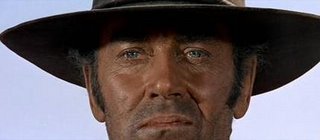
*** Leone had always wanted to work with Fonda, and tried to cast him as Col. Mortimer in For a Few Dollars More. Fonda was still unsure about doing ...in the West and called up Eli Wallach, who told Fonda "Do it! You'll have the time of your life!" Intrigued, Fonda prepared for the role of "Frank," by being made up to look like John Wilkes Booth, complete with brown contact lenses to muddy up his piercing blue eyes. According to Fonda's autobiography, when Leone saw this make-up, he pitched a fit "Blue eyes! Blue eyes!" he yelled in broken English pointing at Fonda. What Leone wanted was the audience gasp when the camera turned and saw that it was Henry Fonda. Fonda called "Frank" one of his favorite roles, and worked again with producer Leone making My Name is Nobody with Terence Hill.
*** In his book "Pieces of Time" Peter Bogdanovich talks about how he was briefly in negotiations to direct this film, and his meeting with Leone did not go well. Leone kept insisting that his new title Duck, You Sucker was a common phrase in America. "Duck-a, you Sucker, you say alla time, no?" To which Bogdanovich could only look at him and say: "...no?"
All the Leone sources say the two parted ways over "creative differences." That may have been the start of it.