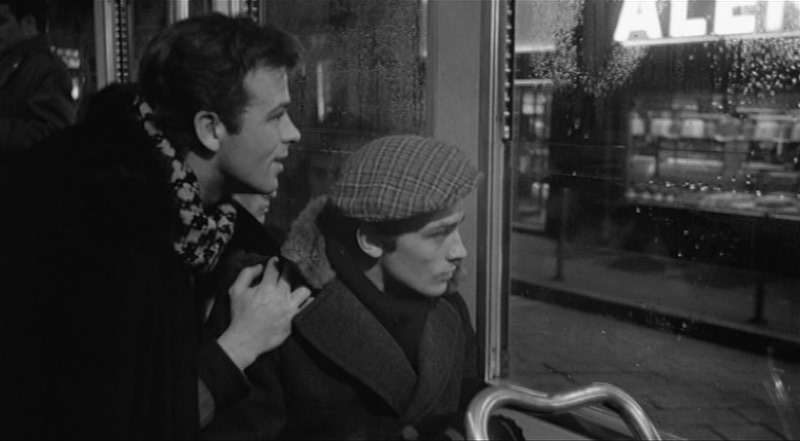
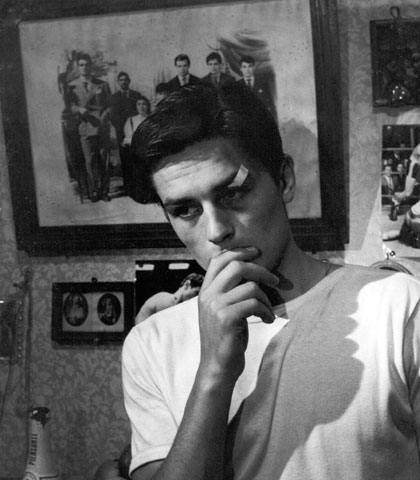
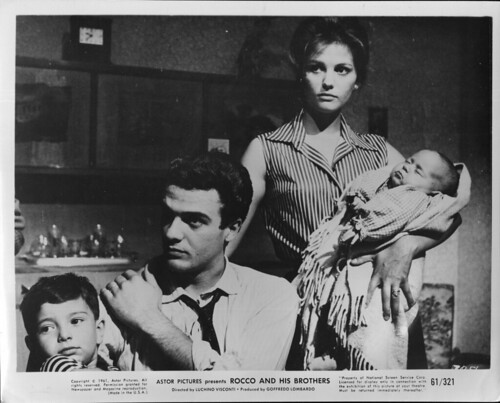
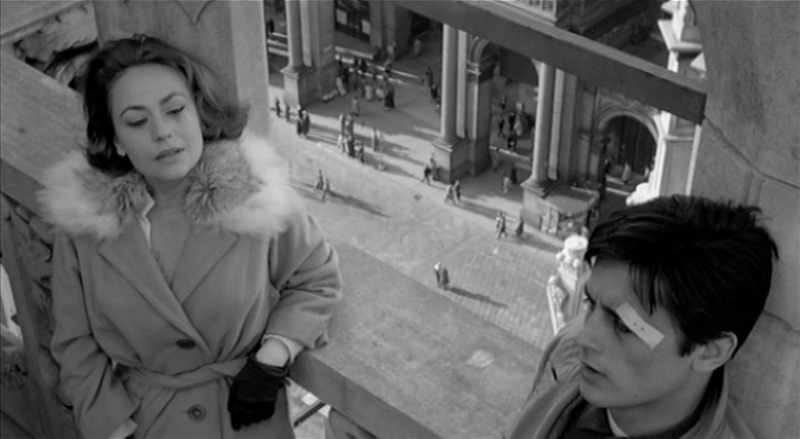
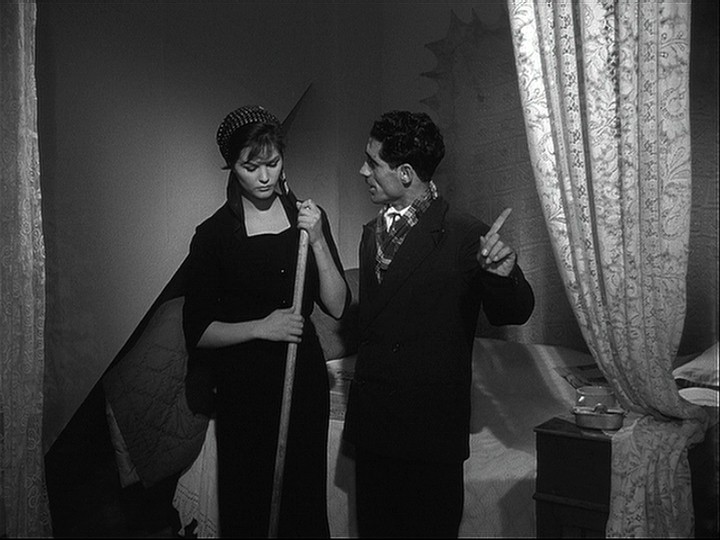
 "Rocco and His Brothers" aka "Rocco e i suo fratelli" (Luchino Visconti, 1960) The Parondi family moves up to Northern Italy from the country and they find simultaneous success and tragedy in the city. It's the immigrant's story: they move to make a better life and the choices they make are wholly determined by their conditions. The widow Parondi (Katina Paxinou) moves her brood to Milano, where eldest son Vincenzo (Spiros Focás) is guest of honor at an engagement party for his intended, Ginetta (Claudia Cardinale). The family swoops in and North/South prejudices erupt and break up the party. The worst news for Vincenzo is, as eldest, he has to provide for them and arranges a short term rental that he plans to break the lease on, so they can be kicked out and depend on government housing. From there, the brothers must find work and make a life for themselves.
But it's tough to be a saint in the city. The film is divided into chapters for each brother, starting with Vincenzo, then the mercurial Simone (Renato Salvatori), good-hearted Rocco (Alain Delon), practical Ciro (Max Cartier) and the innocent Luca (Rocco Vidolazzi) who looks up to them all. Simone and Rocco take the fast money way out, going into the traditional immigrant sport—boxing—and its underworld of shady characters, Ciro gets an auto-workers job, while Vince ignores his mother's objections, marries Ginetta and moves out. Each brother, in turn, finds their escape from family, even Rocco whose mission seems to be to keep the family intact. The brothers are wholly unprepared for the city and their separate ways of dealing leads to internal conflict and strife, with the women in their lives often being the ones chewed up in their machinations.
It's not just the 3-hour length and terrific Nino Rota score that suggest it, but you look at Visconti's direction of "Rocco and His Brothers" and you see the playbook Francis Ford Coppola used for "The Godfather:" the half-lit sets, the faces emerging from darkness, the "communal" shots where a lot happens in long takes of activity, the simultaneous staging of triumph and tragedy, and the bursts of violence communicated with a minute pre-echo of dread. That "Rocco" matches so many of "The Godfather's" themes—the passing of old traditions in modern times, the splintering of the family, the immigrant's plight, and the futility of good intentions—one can see how film-buff Coppola was inspired to make a silk purse out of Mario Puzo's best-selling sow's ear.
Wednesday, August 26, 2009
Rocco and His Brothers








Friday, May 22, 2009
Anytime Movies Reloaded: Once Upon a Time in the West
It's Spring-Break for me. Times are busy. The Summer Movie Season is already begun (and I'll be writing about the new ones) and the Film Festivals are grinding away like creaky mills separating wheat from chaff. It's as good a time as any to re-boot a feature I started years ago, when it was suggested I do a "Top Ten" List.
I don't like those: they're rather arbitrary; they pit films against each other, and there's always one or two that should be on the list that aren't because something better shoved it down the trash-bin.
So, I came up with this: "Anytime" Movies.
Anytime Movies are the movies I can watch anytime, anywhere. If I see a second of it, I can identify it. If it shows up on television, my attention is focused on it until the conclusion. Sometimes it’s the direction, sometimes it’s the writing, sometimes it’s the acting, sometimes it’s just the idea behind it, but these are the movies I can watch again and again (and again!) and never tire of them. There are ten (kinda). They're not in any particular order, but the #1 movie IS the #1 movie.
 Landscapes.
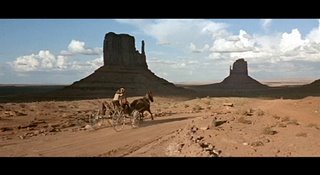
That’s what’s featured in Sergio Leone’s “Once Upon a Time in the West.” Whether it’s the vast, aboriginal spaces of Monument Valley—an affectionate genuflection to the films of John Ford—or the intricately chiseled planes of the faces of Charles Bronson and Henry Fonda—you spend a lot of time looking at both in “Once….”—as well as deep close-ups of the faces of Jason Robards and Claudia Cardinale. There is one shot where Bronson ever so slowly relaxes a smile out of existence. Bronson does it so subtly you don’t know what’s happening until it’s happened. It’s one of the things I look forward to in the Dance of Death of “Once Upon a Time in the West.” Here are some others:
1. “Looks Like We’re Shy One Horse…” The first twelve minutes. A dilapidated train station in the middle of nowhere. Three long-coated bad-men wait for a train. They while away the time, each in their own unique fashion. Driven mostly by sound and filmed in extreme close-ups, the sequence, accompanied by the homely squeak of a windmill—one of the out-sized sound effects typical of Leone’s westerns—and the jokey placement of the credits, rolls on and on until a confrontation ends explosively. It’s an opening of great economy and intricate film-making. Few words are spoken throughout. I’ve shown students this sequence to show just how much presence and atmosphere simple sound effects can bring to a scene. Here’s the ending of the sequence. It’s just the opening gambit in a plot by two men who are playing against each other. It will take the entire movie to explain why.


2. “You Don’t Know How To Play” The gist of “Once Upon a Time in the West” is a chess game with lives and futures as the playing pieces. As scripted by Sergio Leone and his co-scenarists--the soon to be master of Italian horror films Dario Argento and the young Bernardo Bertolucci--the movie is a series of moves and counter-moves by the antagonists, each one trying to tame the frontier in their own way, and taking their own sweet time about it. Each has to make the pieces fall their way. For the first-time viewer it can be maddening following the strategems of the four participants in the story, but by the end the motivations and loyalties—or lack of them—become clear.
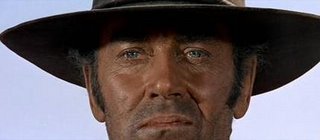
3. “People Scare Easier When They’re Dyin’” The villain of the piece is the meanest, rottenest most conniving scumbag to ever walk a dusty street and spit on it. “Frank” is a sadist who smiles when he kills and for the first time in his life he has a patron with a vision—one big enough for Frank to start to see how there might be such a thing as a future, and that one man can own it. He just can’t understand why people are getting in his way.
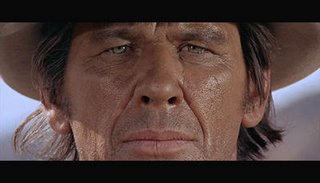
4. “Instead of Talking, He Plays. And When He Better Play, He Talks.” The composer and the director did it backwards. Ennio Morricone wrote the music for the film first and Leone built his sequences around the music, playing it on-set to establish mood. There are two spectacular pay-offs--one in the previously mentioned Monument Valley sequence. But the other is at a train station where Claudia Cardinale, has just arrived from New Orleans to find no one to meet her. After a long wait (which is actually mercifully short for a Leone western) she decides to hire passage. Sounds disappear as she is seen through a station window talking to an official, and then the camera HEAVES up and over the roof, and in a burst of music reveals a burgeoning western town full of life and activity. It’s as if all of America is presented in that one astounding crane shot. My wife audibly gasped when she saw the shot in some movie clip program on TV, so stunning is the effect. And more than a little of the power of that shot is due to Morricone’s music and the angelic voice of Edda Dell’Orso, wordlessly cooing an ode to the country and to the protagonist around whom the movie and the future hinges.


5. “Ma’am, It Seems To Me You Ain’t Caught The Idea” For the first time in a Leone western, a woman is the hero, but like her predecessor—"The Man with No Name"—she is flawed and has some learning to do, and it’s up to Leone’s trio of men – another man with no name (going under the aliases of dead men), a wolf-like vagabond-thief, and the villain, Frank—to push, prod, blackmail, challenge and coerce her into a new role. It’s a role each man knows they’ll have no part of, and that, for a time, she is reluctant to fulfill. In the last shot of the film, she is seen bringing water to the railroad work-crew who will be bringing people and prosperity to what will be her town. It may seem a servile role, but as we pull away and follow the disappearing tracks to the frontier, leaving her to her future, she begins to bark orders, to direct and take charge. Her station will become a cornerstone of the push west. “This movie drips with testosterone,” a colleague once told me after a screening. Yes, but Leone includes a healthy shot of estrogen as, for the first time, he is dealing with a story that not only leaves the past behind, but also looks forward to the future.


Once Upon a Time In the West
-Only Angels Have Wings
The Searchers
Chinatown
Mr. Smith Goes to Washington
American Graffiti
To Kill a Mockingbird
Goldfinger
Bonus: Edge of Darkness
Tomorrow: Robots that go clunk!
Sunday: A "Scene" for Memorial Day
Monday: Our annual (now) Memorial Day War Movie review
Next week: We wrap up "Anytime Movies," bid them adieu, and start afresh.
Saturday, April 25, 2009
Big Deal on Madonna Street
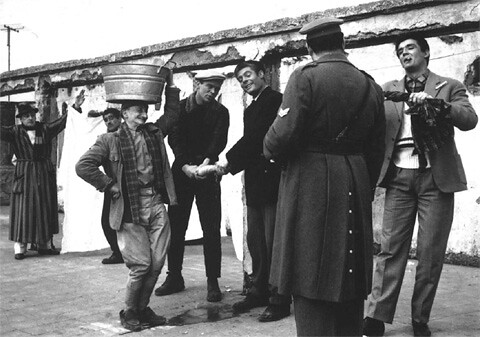
 "Big Deal on Madonna Street" aka "I Solti Ignotti" (Mario Monicelli, 1958) Italian caper film that's as much a spoof of caper films as it is the real deal. Neighborhood heisters team up to break in to a pawn-shop and the usual complications ensue between clashes of ego's, incompetence, prison stints by proxy, art-film reconnaissance of the target and the very real treasure of a virgin's love.

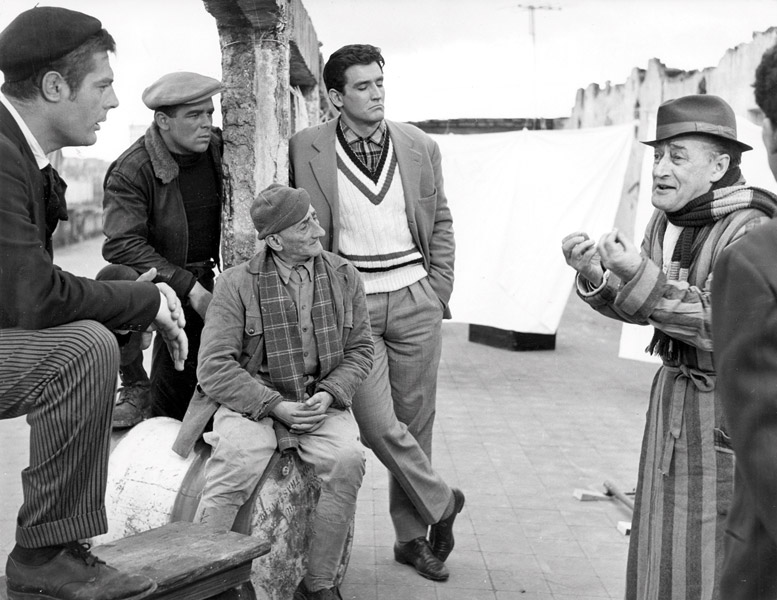


"Big Deal on Madonna Street" (the "big deal" is meant to be sarcastic, as in "Big Deal, you know how to operate a camera!") is filled with established and future stars of the Italian cinema (Totò, Marcello Mastroianni, Renato Salvatore, Vittorio Gassman, Claudia Cardinale, many of whom became stars because of this film) and is done in the neo-realist style of post-war Italian classics as "The Bicycle Thief" (a style that is spoofed in the course of the film, as well). Coming as it did, following the sensation that "Rififi" generated, resuscitating the career of Jules Dassin (Dassin made his own caper spoof "Topkapi" six years later). Like links in an elaborate knock-over plot, films influence films and keep the genre going to such contemporary examples as "Mission: Impossible," "Reservoir Dogs," and Steven Soderbergh's "Ocean" movies.



Thursday, November 27, 2008
The Leopard
"The Leopard" aka "Il Gattopardo" (Luchino Visconti, 1963) I've seen "The Leopard" only once. Its beauties compel further viewings with which more of the complexities of the work will become apparent. One can't wait to get started. * Sydney Pollack supervised the dubbed version, and even he acknowledged it hurt the movie. One of the odd things about it is Lancaster's performance: He's actually better dubbed in Italian with a different, gruffer voice, rather than the soft, smokey baritone of his own voice. In fact, the combination of Lancaster's screen-work and substituted voice combine to make the greatest performance he never gave!
Epic.
Extraordinarily epic.
Exquisite three hour film (that is, if you watch the original Italian, rather than the edited, dubbed American version*) of the change-over from one generation of Italian artistocracy to one with fewer ties to the past, amidst a changing landscape that will ultimately change fortunes. Don Salina (Burt Lancaster) is a prince of the old lineage observing the change that will ultimately overthrow the government and his rights to power, even as he sees the old ways and traditions begin to erode in the rise of his nephew Tancredi Falconeri (Alain Delon) who chooses to marry below his station to the manipulative Angelica (Claudia Cardinale). In one of the many allusions to the animal kingdom, Don Salina fears that his generation of leopards is being handed over to jackals.
In its timeline and its scope, it could be labeled the Italian "Gone With the Wind." Certainly the care and attention to detail that director Visconti, Director of Photography Giuseppe Rotunno, and Production Designer Mario Garbuglia brought to bare can be compared to the extravagance of the American epic. But it's a smarter, richer film—a far better film—with layered subtleties that GWTW never aspired to.
Visconti had a special affinity for the material. Like the author of the original novel, Giuseppe Tomasi di Lampedusa, the director was born to the aristocracy. He knew its joys and pleasures and tastes, and he follows Lampedusa's celebration of that life in its recognition. But Visconti became a Marxist, so he looks at the excesses and hypocrises with less sentiment than Lampedusa does. But, he also acknowledges that change ultimately doesn't change much where fortunes are involved.
Contained here are some of the beautiful images that Visconti, Rotunno, and Garbuglia composed, rich in color and detail like fine paintings. But they're in motion and filled with life and portent and commentary.


Films like "The Leopard" are why one falls in love with the medium in the first place.


Monday, January 14, 2008
Once Upon A Time In The West
Landscapes.That’s what’s featured in Sergio Leone’s “Once Upon a Time in the West.” Whether it’s the vast, aboriginal spaces of Monument Valley—an affectionate genuflection to the films of John Ford—or the intricately chiseled planes of the faces of Charles Bronson and Henry Fonda, you spend a lot of time looking at both in “Once….”, as well as deep close-ups on the faces of Jason Robards and Claudia Cardinale. There is one shot where Bronson ever so slowly relaxes a smile out of existence. It’s one of those shots where you don’t know what’s happening until it’s happened, Bronson does it so subtly. It’s one of the things I look forward to in the Dance of Death of “Once Upon a Time in the West.” Here are some others:
1. “Looks Like We’re Shy One Horse…” The first twelve minutes. A dilapidated train station in the middle of nowhere. Three long-coated bad-men wait for a train. They while away the time, each in their own unique fashion. Driven mostly by sound and filmed in extreme close-ups, the sequence, accompanied by the homely squeak of a windmill--one of the out-sized sound effects typical of Leone’s westerns--and the jokey placement of the credits, rolls on and on until a confrontation ends explosively. It’s an opening of great economy and intricate film-making. Few words are spoken throughout. I’ve shown students this sequence to show just how much presence and atmosphere simple sound effects can bring to a scene. Here’s the ending of the sequence. It’s just the opening gambit in a plot by two men who are playing against each other. It will take the entire movie to explain why.
2. “You Don’t Know How To Play” The gist of “Once Upon a Time in the West” is a chess game with lives and futures as the playing pieces. As scripted by Sergio Leone and his co-scenarists--the soon to be master of Italian horror films Dario Argento and the young Bernardo Bertolucci--the movie is a series of moves and counter-moves by the antagonists, each one trying to tame the frontier in their own way, and taking their own sweet time about it. Each has to make the pieces fall their way. For the first-time viewer it can be maddening following the strategems of the four participants in the story, but by the end the motivations and loyalties--or lack of them-- become clear.
3. “People Scare Easier When They’re Dyin’” The villain of the piece is the meanest, rottenest most conniving scumbag to ever walk a dusty street and spit on it. “Frank” is a sadist who smiles when he kills and for the first time in his life he has a patron with a vision—one big enough for Frank to start to see how there might be such a thing as a future, and that one man can own it. He just can’t understand why people are getting in his way.
4. “Instead of Talking, He Plays. And When He Better Play, He Talks.” The composer and the director did it backwards. Ennio Morricone wrote the music for the film first and Leone built his sequences around the music, playing it on-set to establish mood. There are two spectacular pay-offs--one in the previously mentioned Monument Valley sequence. But the other is at a train station where Claudia Cardinale, has just arrived from New Orleans to find no one to meet her. After a long wait (which is actually mercifully short for a Leone western) she decides to hire passage. Sounds disappear as she is seen through a station window talking to an official, and then the camera HEAVES up and over the roof, and in a burst of music reveals a burgeoning western town full of life and activity. It’s as if all of America is presented in that one astounding crane shot. My wife audibly gasped when she saw the shot in some movie clip program on TV, so stunning is the effect. And more than a little of the power of that shot is due to Morricone’s music and the angelic voice of Edda Dell’Orso, wordlessly cooing an ode to the country and to the protagonist around whom the movie and the future hinges. 5. “Ma’am, It Seems To Me You Ain’t Caught The Idea” For the first time in a Leone western, a woman is the hero, but like her predecessor—The Man with No Name—she is flawed, and has some learning to do, and it’s up to Leone’s trio of men – another man with no name using the names of dead men, a wolf-like vagabond-thief, and the villain, Frank—to push, prod, blackmail, challenge and coerce her into a new role. It’s a role each man knows they’ll have no part of and that, for a time, she is reluctant to fulfill. In the last shot of the film, she is seen bringing water to the railroad work-crew who will be bringing people and prosperity to what will be her town. It may seem a servile role, but as we pull away and follow the disappearing tracks to the frontier, leaving her to her future, she begins to bark orders, to direct and take charge. Her station will become a cornerstone of the push west. “This movie drips with testosterone,” a colleague once told me after a screening. Yes, but Leone includes a healthy shot of estrogen as, for the first time, he is dealing with a story that not only leaves the past behind, but also looks forward to the future.
Anytime Movies are movies I can watch anytime, anywhere. If I see a second of it, I can identify it. If it shows up on television, my attention is focused on it until the conclusion. Sometimes it's the direction, sometimes it's the writing, sometimes it's the acting, sometimes it's just the idea behind it, but these are the movies I can watch again and again and never tire of them. There are ten. This is Number 3.
III: Once Upon a Time In the West