For Want of a Nail....
or
The Sound of Slamming Chadors
With all the talk about Iran's nuclear capabilities, here's a brilliant film about Iran's equally volatile nuclear families.
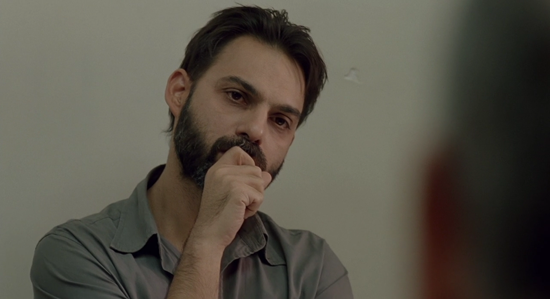
It begins as Nader (Peyman Moadi) and Simin (Leila Hatami) are petitioning for a divorce, bickering over the issues that are causing the rift. Simin wants to leave the country, and finally has the opportunity to do so within a 40 day time-limit. She wants Nader and their daughter Termeh (Sarina Farhadi) to come with her, but he will not—he is chief caretaker for his father, suffering from Alzheimer's, and he will not give up his responsibilities, and as the head of the household, he will not let the daughter leave, either. And yet the whole point of Simin trying to get them out of the country is for Termeh to have a better chance at life, without the bitter subjugation of women and the yoke of Sharia law...not that she can say that in court (of course).
It's a case of "He said/She said" that plays out with complications, obfuscations, deflections, feints, irrelevancies, and opinions posing as facts, and no choices about anything. They have reached an impasse—she wants them to leave, and he feels he can't leave—and so petitioning for divorce is the only way for her to leave, but she must do so without the daughter. He won't let the daughter go, as long as he needs help taking care of Dad, and so...hence, the petition for a divorce.
The scene is played in a long (but complicatedly acted) two-shot of the couple facing the camera explaining the situation, bickering back and forth and pleading their case before an unseen magistrate...or uncaring bureaucrat...and, owing to the camera position, us, putting the audience in the uncomfortable position of sharing that man's perspective. We're hearing all of this for the first time (as is he) and as the mire they're in increases, one wonders how it could possibly be resolved, even if, to the magistrate, it is "a small problem," insufficient to grant a divorce, but enough for the couple to take the matter into their own hands for A Separation (or جدایی نادر از سیمین , or Jodái-e Náder az Simin, or "The Separation of Nader from Simin").
That act complicates things further: Nader has to work, Termeh attends school, and Simin's absence leaves Dad alone and unmanaged for a dangerous amount of time. Simin suggests hiring a care-taker, and they hire Razieh (Sareh Bayat)—poor, pregnant, with six year old daughter in tow, and working without her unemployed husband's permission (he's played, in a tough role to make sympathetic, by Shahab Hosseini)—who, before long, is overwhelmed with her duties, but must continue with them to provide for her family.
Now, bear in mind, I've just described the first fifteen minutes of the movie, which twists and turns into more complications, altercations, and incarcerations, in what seem to be an insolvable cluster of traps within traps involving duty and responsibility, ideology over practicality, patriarchal authority over common sense, and the inexorable demand of law to tidy things up by whatever means seems to be easier and more expeditious at that moment in time, with the volume and volubility increasing over time until the tension is ready to be snapped by anything, like the upsettlingly loud violence suggested by the sound of Nader and Simin's rattlingly concussive front door. If this were a comedy, it would be one of the "incredible mess" variety, where everything collapses of its own weight and complexity, and only when those affected from it emerge, dusty and disheveled and with nothing left to lose, does the madness of the situation become apparent to them.
But, this isn't a comedy. It feels like real life, whether Persian or American, and makes one realize that there's more in common than what separates the two countries, and the whole thing plays out like an expansion of that first scene—unsolvable, intractable, frustrating—not a vicious circle, but a vicious triangulation...with very sharp damaging points.
And it's not a comedy because no one, not anybody, comes to their senses.
It's the stuff of great drama, even tragedy, and were it to originate in the U.S., it might be subject to the dramaturgy that always makes me want to put my head in my hands and burble (half-jokingly) "why doesn't everybody just get a good night's sleep?" But, the thought never crosses the mind watching this understated, deceptively low-key presentation, subtly and artfully processing the hysterics of the situation, and channelling it into Art. It's devastating. And A Separation is right up there with The Tree of Life and The Descendants as one of my favorite films of the year—each taking on the subject of (as Warren Beatty, of all people, described it) "the sanctity of Family" and finding distinct ways to present it.
A Separation is a Full-Price Ticket.
Wednesday, March 14, 2012
A Separation

Thursday, June 23, 2011
Bridesmaids
"The Miss of Sisyphus"
or
"Wiiging Out"
First off, Kristen Wiig is scary. She's scary funny. And scary smart. It's an almost sure thing that she'll be the best thing in whatever she appears in (certainly that was true of MacGruber). She has no Dolby and no squelch in her comedy, the filters are off, and she's not afraid to look like a doofus. In fact, I don't think she's afraid of anything.
And because she co-wrote this and is primarily the focus for the vast majority of Bridesmaids, it is a pretty funny, raunchy comedy of the "incredible mess" variety. And who doesn't want to see a wedding fail (especially if its not yours)? That's the premise behind this film (for better and for worse), and I've been to and/or been involved in enough weddings to know that this could easily have been a documentary.* The various rituals and ceremonies that precede, pre-function and prevaricate the actual hitching of one individual to another, are enough to wreck any marriage before it begins, and I'll frequently pontificate that if you survive the wedding, the marriage just might make it.**
And I've been to one wedding where in the course of the pre-functions, the Maid of Honor was replaced in the Bride's affections by another friend, as happens here. It happens.
Said Maid of Honor, who by herself is an "Incredible Mess," is Annie (Wiig), who has zero self-esteem, is dating a self-absorbed creep (naturally, as he's a man, played by an uncredited Jon Hamm—who, bless him, seems to be having fun)—except it's not really dating so much as an empty sexual convenience, she's lost her specialty bakery business, and is working at a jewelry store, where her tirades about the impermanence of all relationships has a tendency to drive the customers away. Her mother (Jill Clayburgh—her last role before she died of cancer) wants her to move in with her "before she hits rock-bottom," because her room-mates are British and creepy. At least she has her best friend Lillian (Maya Rudolph), who is always good for a meltdown de-briefing.
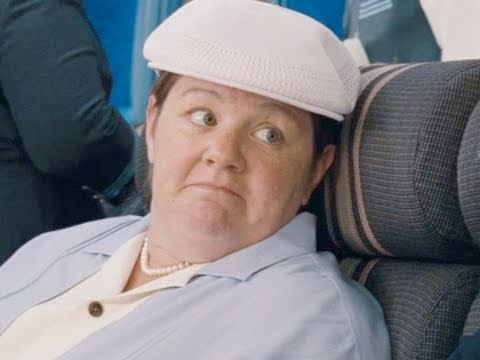
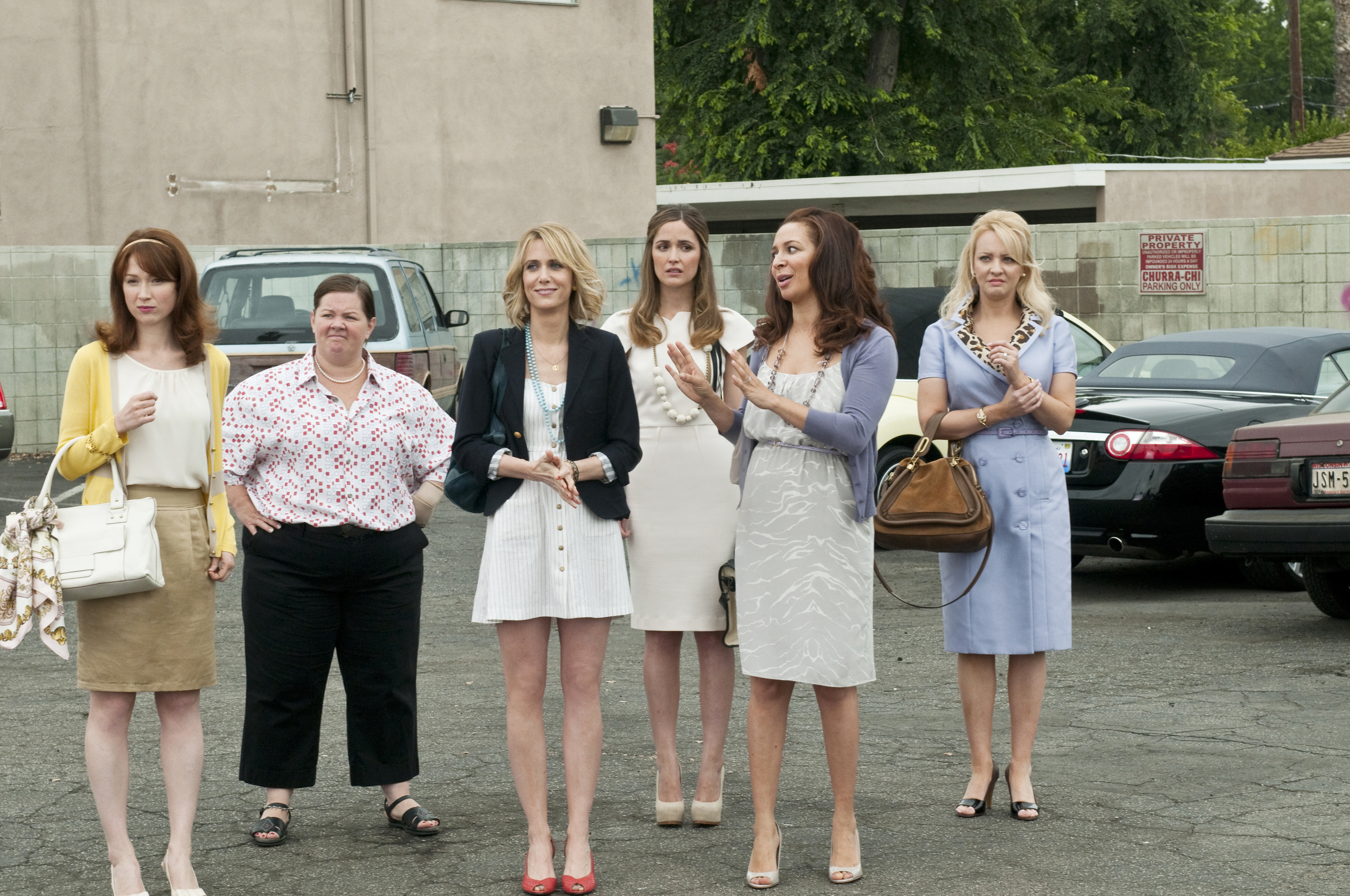
That is, until Lillian announces her engagement and asks Annie to be the M of H. Then, like a black hole, the downward spiral that is Annie's life starts to suck in the wedding arrangements, as well. She gets together the other bridesmaids: Rita (Wendi McLendon-Covey), a bitter wife with two problematic kids; Becca (Ellie Kemper) a chirpy newlywed; Megan (Melissa McCarthy—hilarious and fearless), the groom's sister; and Helen (Rose Byrne), a trophy-wife, who is needy, tries too hard, and is aggressively perfect. This eclectic gaggle of women are tough to corral and all approach life and their duties to the bride-to-be differently, leaving the slightly scattered Annie dishonored and in their wake of agendas. In her desperate attempt to get them all on the same page (or even in the same dress-style), she only makes things worse, especially for herself. The only non-crumbling structure in the whole disaster area that is her life is a state patrol trooper (Chris O'Dowd—think the looks of Tim Allen, the charm of Judge Reinhold, and the accent of Craig Ferguson) but that gets doused as well. Pretty soon, rock-bottom seems like a pretty stable place to be, as she loses everything, even an invitation to the wedding.
This would be intolerably sad, if the cast and writers didn't make it so hellaciously funny, in a surprising, raunchy manner that rains humiliation down on everyone, the highlight (possibly) being the visit to a posh, expensive bridal shop after a dysentery-inducing exotic pre-function. It's cruel...like watching a train-wreck, where all the passengers were caught in the bathroom, but it is funny—humor, one must caution, being subjective.
I'd be heartily recommending this movie*** if it didn't go all-"Oprah" in the last section, with a tone-scrambling heart-felt ending that one is just not prepared for, and it also coasts on my most hated of rom-com tropes—"all she needs is a good man. Really? I'd've said a good psychotherapist.
But, until that time, Bridesmaids is the most snortingly funny disaster movie I've seen in a long time.
Bridesmaids is a really good Rental.
* I just had a two-hour conversation with someone who participated in a recent June wedding, where everything went flawlessly, but the backstage story was an on-going apocalyptic disaster from start to finish.
** That's an incredibly sunny view, considering I've been married twice. On the other hand, there was one wedding I went to where the bride and groom were already arguing...at the altar. The reception was dominated by placing wagers on how long it would last.
*** And have, to two gals who wanted a movie-night and were, understandably, less-than-thrilled with the current movie selection. They couldn't be two more different people. Both loved it.







Tuesday, November 2, 2010
You Will Meet a Talk Dark Stranger

"Man Makes Plans. God Laughs."
or
"The 'Thing Without Feathers' Turns Out to be My Nephew."
With a title like You Will Meet a Tall Dark Stranger, you know this won't be one of Woody Allen's autobiographical tales. The Woodman never strays too far from All Things Woody, his characters usually being scrambled aspects of himself, with one character being a direct comic stand-in. The likes of Kenneth Branagh, Mia Farrow, John Cusack, Larry David and Edward Norton have all been past dopple-neuroti-gangers for the writer-director. Rarely has there been a film of his without one.
This is one of those rare films, although one could say this tangled web of London residents could all be aspects of Allen's personality, with the closest being (maybe) Anthony Hopkins' Senior Fool. One needs a play-book to keep everybody in this rondeau straight, although they are all in each others' orbits. Start with Hopkins' Alfie—married to Helena (Gemma Jones), parents of Sally (Naomi Watts), wife of Roy (Josh Brolin). Alfie, going through his "middle-age crazy" period, divorces Helena, sending her to a faux psychic (Pauline Collins) in her grief. This all upsets Sally, who's trying to make ends meet working for a gallery owner, Greg (Antonio Banderas) while her husband is becoming frayed trying to write a follow-up to his previous publishing success. Basically, everyone's in the weeds, and it's not long before everybody decides that somebody else's grass in better than their own. Soon Da is marrying a call-girl/"actress" (Lucy Punch), Roy is pursuing a neighbor he keeps oggling through his window (Freida Pinto), and Sally starts to have feelings for her boss, as her feelings for Roy start to wane.
Allen starts and ends the movie with Leon Redbone warbling "When You Wish Upon a Star," and begins with Helena visiting a psychic, making one think that instead of a rating designation ("R," btw), it should have a sign saying "Abandon All Hope, Ye Who Sit in the Auditorium." That he equates spiritualism as just a more rigorous form of "hoping against hope" (when the two are merely con-games with different sources—second-hand or internal) is dispiriting, and though it's a continuation of his life-view—"full of loneliness, and misery, and suffering, and unhappiness, and it's all over much too quickly"—there isn't the shrugging whimsey that serves as a warming punch-line this time.
For it may be true, as Emily Dickinson says, that "Hope is a thing without feathers" (and Allen's screwball lateral to that is the second title for this review), and "if wishes were horses, beggars would ride," I tend to take the more optimistic view. Yes, there will always be poor (because Jesus tells me so) without a nagging destiny, that's no reason that, even though their feet are perpetually on the ground, they shouldn't be reaching for the stars.
Because there will always be stars, too, even if we don't see them, and even if we're not looking for them. It's why I keep looking up at them. It's why Woody Allen keeps making movies.
Maybe his next one will be better. I hope.
You Will Meet a Tall Dark Stranger is a Rental.
Thursday, April 22, 2010
Date Night
 "2007 Must-See TV > 2010 Musty Movie"
Want to know how to ruin your date night?
Go see this movie. But don't be surprised if your date walks out faster than Cybill Shepherd did in "Taxi Driver." Boasting a superb cast and wasting them, "Date Night" is a rough assemblage of ad-libbed scenes (the writer is credited as Josh Klausner, who was no doubt at the premiere hoping to recognize one of his lines) in a comedy of the "Incredible Mess" genre—the one where no matter what the characters do, it always comes out worse. Think "The Out of Towners" (any version).
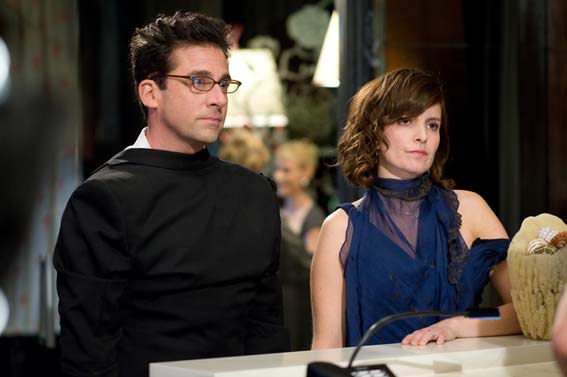
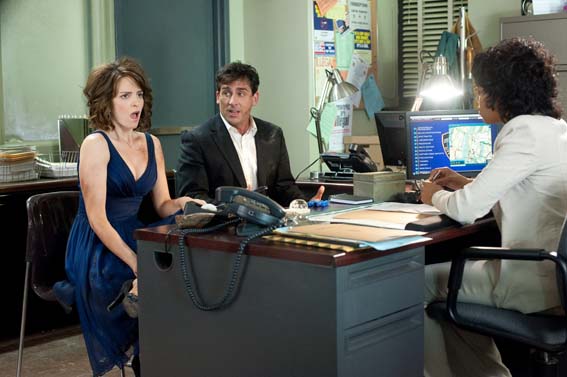
Meet the Fosters. Phil (Steve Carell) is a tax accountant and Claire (Tina Fey) is an insurance agent. They have careers, two kids, and a marriage where the spark has been doused. One night a week, the sitter stays with the kids so they can have a "date night," but it's usually a dinner and a show, turn in early, avoid sex, and transition from quiet desperation to quiet unconsciousness. Get up. Work. Eat. Sleep. Get up. Work. Rinse and Repeat. Their "Get Up and Go"....already divorced them.
At the weekly meeting of the book-club, their friends Haley and Brad (Kristen Wiig and Mark Ruffalo, both criminally under-utilized) confide that they're separating, inspiring the Fosters to try to put a little more zing into their marriage, which translates to going to New York for the evening to a snooty seafood restaurant impossible to get into.
Hilarity ensues.
One wishes. Look, Carell and Fey are incredible performers and superb writers...given time. But to ask them to go off-the-cuff and improvise through their scenes is asking a bit much. Everything feels a little half-baked and tentative, like we're not even getting the rehearsals but the blocking meeting. There is nothing here that matches what each of them can do on "The Office" and "30 Rock." Carell looks a little desperate (and plays scenes the way Steve Carell the comedian would, but not a tax preparer) and Fey's unfocused, like she's waiting for inspiration. When they connect, they do well, but there's not much they can do besides mug through car-chases and while being chased by Bad Men With Guns. They, too, are under-utilized and they're in the entire movie.
But, no one is used well. I'll see any movie with Taraji P. Henson in it and she tries to liven up her role as a police detective, but it's an underwritten role, that's mostly filler. Also, poorly served are...fine character actors like Ray Liotta and William Fichtner. There's a half-way funny scene featuring James Franco and Mila Kunis (!!) as bickering scum-bags, but even that goes nowhere. Mark Wahlberg is also on-hand—Wahlberg can be terrific, I thought he was the best thing in "The Departed"—but there's nothing for him to do but wander through his scenes with his shirt off. Lauren Weedman and G4's Olivia Munn have cameos, but blink and they're gone.
It is a shame that the major networks felt the pressure of cable and DVD output and cancelled of all their slots for, say, "NBC Wednesday Night at the Movies," because this type of lack-luster show-case for Network Stars to "do something different" would have been far more appropriate there, rather than as a feature film release.
At least, then, you wouldn't have to pay to see it.
"Date Night" is a Cable-Watcher.





Saturday, June 27, 2009
The Hangover
 "Stooges...in the 21st Cen-tu-ry!!!"
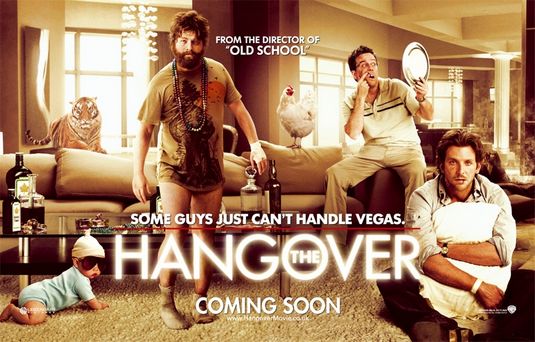
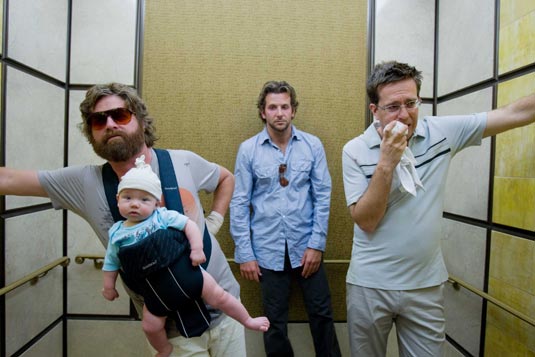
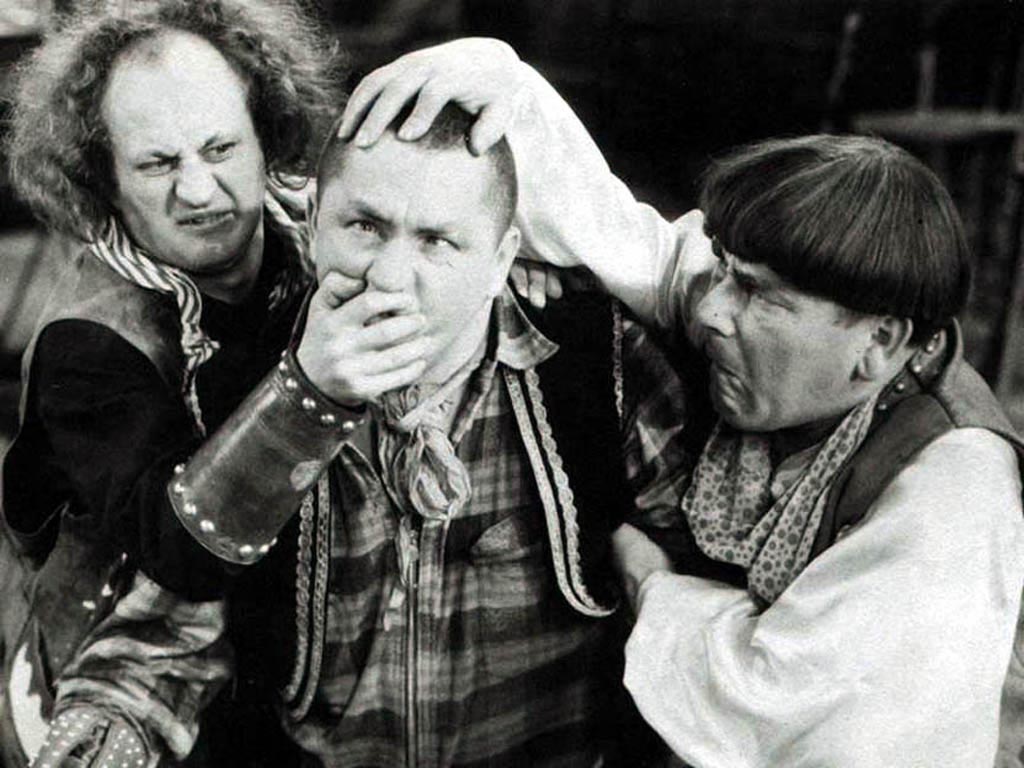
I'm being perfectly serious when I say that "The Hangover" is a smutty, gonzo version of "The Three Stooges." The Todd Phillips comedy (and it is very funny...in a frattish vein) is about four guys making a road-trip to Las Vegas for a bachelor party. Onboard are the prospective groom, Doug (Justin Bartha), his buddies Phil (Bradley Cooper), a less-than-committed grade school teacher, and Dr. Stu (Ed Helms), a dentist in a relationship that would set anyone's teeth on edge, and Doug's prospective bro-in-law, Alan (Zach Galifianakis), a train wreck of arrested development... in fact he has been arrested, and has to stay at least 200 yards from any school...or Chuck E. Cheese.
The boys make it to Vegas, and after a rooftop toast atop Caesar's Palace, things go black. When they wake up in the expensive suite they've rented for the night, the place is a shambles—Hunter Thompson would throw them out—Stu's missing a tooth, a couch is smouldering, there's a chicken wandering the premises, Phil has a hospital bracelet on his wrist, there's a tiger in the bathroom, a baby in the closet, and when the valet brings up their car...it's a police cruiser. No one can remember...in their throbbing heads...how all this happened.
Oh! And Doug also appears to be missing.
Good thing, too, or there'd be no movie. Estimating that they have a "12 hour window of opportunity" for losing Doug, they begin to re-trace their steps, and the situation and the night's shenanigans get increasingly bizarre. In fact, you could say "The Hangover" may be the Ultimate "Incredible Mess" movie (if "Dr. Strangelove" weren't already there) and, as I say, it might as well be The Stooges as the remaining trio fall into the traditional Stooge roles. Phil is Moe, the abusive authority figure, Stu is Larry the Whiner of the group, and Alan is the off-kilter Curley, the brother-in-law from another planet.
Along the way, they also have to find parents for the baby, an owner for the tiger, and try and get Dad-in-law's prized car back in one piece...paying for the suite would be nice, too. Oh, and Stu—who's on a short leash—can't let his disapproving fiancee know that they went to Vegas, rather than the tour of wine country that he told her.
And...they have a deadline: they have to get back for the wedding (hopefully with the groom).
Lest anyone get the impression that my Stooge analogy means it's rollicking fun for the whole family, no-no-no-no-no-no-no-no-no-no-no-no-no-no-noooooooooo! Amidst all the slapstick (a couple people get hit in the head with a car-door... including the baby) there's a pervasive stream of obscenity and extreme tastelessness, just this side of a Kevin Smith movie (hey...Vegas). The good news is Phillips has good comic timing—things pay off very well and the performers maximize the dialogue—Ed Helms has never been this funny—and, as a bonus, they've found a decent role for Heather Graham...who stays mostly clothed!
In Hollywood (or Vegas), that's almost a miracle.
"The Hangover" is a Rental








Saturday, April 25, 2009
Big Deal on Madonna Street
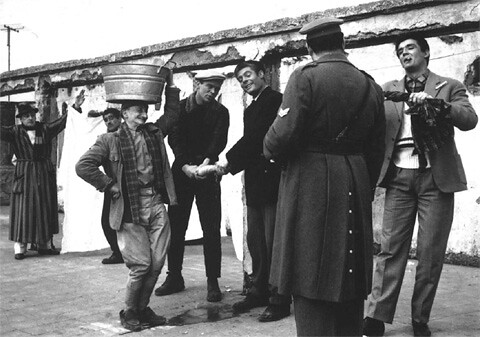
 "Big Deal on Madonna Street" aka "I Solti Ignotti" (Mario Monicelli, 1958) Italian caper film that's as much a spoof of caper films as it is the real deal. Neighborhood heisters team up to break in to a pawn-shop and the usual complications ensue between clashes of ego's, incompetence, prison stints by proxy, art-film reconnaissance of the target and the very real treasure of a virgin's love.

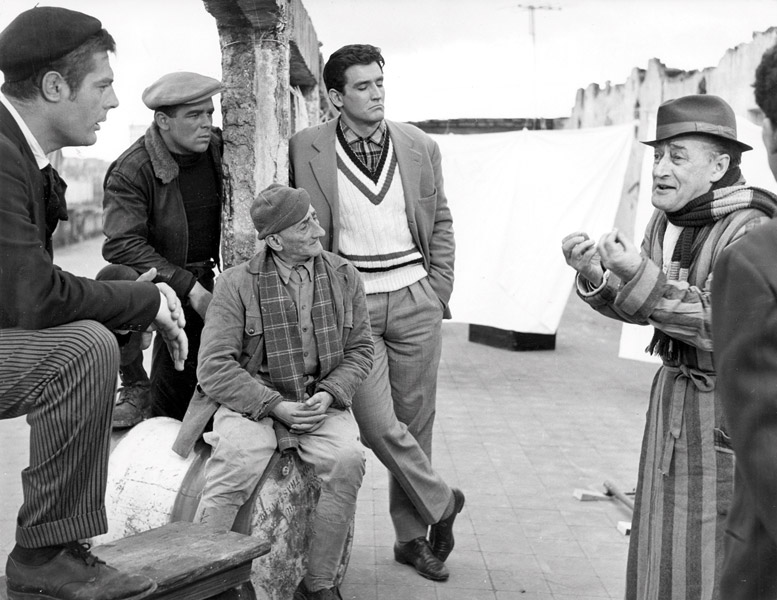


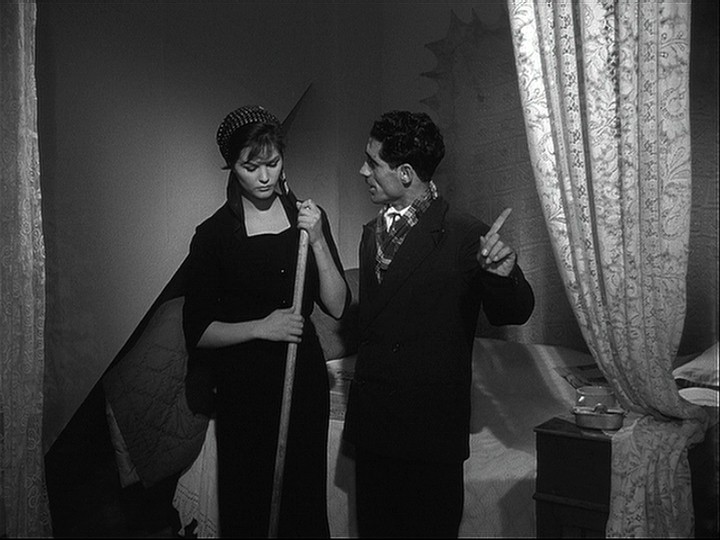
"Big Deal on Madonna Street" (the "big deal" is meant to be sarcastic, as in "Big Deal, you know how to operate a camera!") is filled with established and future stars of the Italian cinema (Totò, Marcello Mastroianni, Renato Salvatore, Vittorio Gassman, Claudia Cardinale, many of whom became stars because of this film) and is done in the neo-realist style of post-war Italian classics as "The Bicycle Thief" (a style that is spoofed in the course of the film, as well). Coming as it did, following the sensation that "Rififi" generated, resuscitating the career of Jules Dassin (Dassin made his own caper spoof "Topkapi" six years later). Like links in an elaborate knock-over plot, films influence films and keep the genre going to such contemporary examples as "Mission: Impossible," "Reservoir Dogs," and Steven Soderbergh's "Ocean" movies.