Showing posts with label Jason Robards. Show all posts

Wednesday, December 7, 2011

Tora! Tora! Tora!

Tora! Tora! Tora! aka (トラ・トラ・トラ!)(Kinji Fukasaku/Toshio Masuda/Richard Fleischer, 1970) "The American Pacific Fleet was attacked and partially destroyed by Japan on . . . Sunday Morning December 7, 1941. This attack led to the entering of the United States into World War II. All of the events and characters depicted are true to historical fact."  20th Century Fox's former studio head Darryl F. Zanuck had served in the second World War, and spent his senior years at 20th by the overseeing of large movies showcasing major battles of that war, his most prominent being The Longest Day, based on Cornelius Ryan's book documenting the Normandy Invasion.  But, in 1966 plans were put in place to make an historically accurate film about the Pearl Harbor attack, based on Ladislas Farago's "The Broken Seal."  Ambitious in its scope, the film would be made with both Japanese and American crews, and for a great deal of the pre-production the man in charge of the Japanese unit was  director Akira Kurosawa.  Kurosawa agreed to the film, thinking that David Lean was making the American section, but when he discovered it was, instead, Richard Fleischer, the Japanese master bent some rules in order to allow himself to be "fired" from the film.  He was replaced by two directors known to be as efficient and workmanlike at bringing films in on-time and under-budget as Fleischer.  The intention was not to make great art, but to make an historically accurate film, devoid of trumped-up drama (From Here to Eternity had done that already) and stick to the main subject of the planning and execution of the attack.

The result, although accurate, is rather flat.  Fleischer's American scenes seem drab and stale and, peopled with character actors like Jason Robards, E.G. Marshall, Joseph Cotten and Martin Balsam, lacking in star power.*  The Japanese sequences, perhaps because they have less of an American film studio-feel, seem to have more verve and energy...and better performances.  The movie seems to reflect the situation of the real life events: the Japanese have all the bright ideas, while the Americans have the lethargy associated with "a sleeping giant."** Still, the battle sequences and attack footage is extraordinarily well done, a combination of L.B. Abbott's and A.D. Flowers' model work and the Fox Studio's sometimes hair-raising practical effects crews and stuntmen.

I attended the premiere of Tora! Tora! Tora! with my family at a special showing at the old Paramount theater in Seattle.  It was a special preview for the local chapter of the Pearl Harbor Survivors local chapter, of which my father, John Wilson, late of the U.S.S. Missouri, was a member.  The only story my Father ever told of the war was the events of December 7th, when he was waiting on the dock of the U.S.S. Arizona to attend on-board church services with his friend, Howie Whims, who, for whatever reason, was late.  Were it not for his buddy's tardiness, my Father would have been onboard the doomed Arizona at the time of the attack, and likely might have joined the ranks of the sailors who are still entombed there.***

It was an odd thing sitting in that audience with that audience.  29 year previously, they had witnessed the true horrific events of what was being fictionalized on screen.  The mistakes made (by both sides) that made the devastation so complete was laid out for all to see.  But, however good the effects and pyrotechnics, they couldn't recreate the carnage of that day: the deafening noise, the stench of burning oil that enveloped Pearl for weeks, the bodies, the desperation.  The sight of good friends and comrades-in-arms caught in the gears of the attack and lost forever.**** 

The retired sailors sat stonily, watching the film—no doubt poor competition for the memories unreeling in their own heads and hearts and souls.  There was a smattering of applause when a Japanese zero was shot down, but it was unenthusiastic, hardly celebratory.  For them, it was a film about—and I say this hopefully—the worst day of their life.  However artfully done, however accurately portrayed, who would want to sit through that?  As Sam Fuller succinctly put it in The Big Red One, "Surviving is the only glory in war."  I hope, on that day, they could appreciate their own glory.


* Actually, it's not a bad strategy.  Less attention is paid to the actors on-screen to the advantage of the story.  Films such as Zanuck's The Longest Day or A Bridge Too Far become parlor games after awhile ("Look!  There's Sal Mineo and Richard Beymer! Isn't Gene Hackman in this movie?")

** That's taken from the thing the movie is most famous for—Yamamoto's assessment of the attack ("I fear all we have done is to awaken a sleeping giant and fill him with a terrible resolve").  Even Michael Bay's Pearl Harbor used it.  It's a good line, making the Imperial General seem both presecient and tragic.  Unfortunately, it appears that, historically, Yamamoto never actually said it.

*** It's one of the reasons I have no patience with Michael Bay's post-Titanic disaster, Pearl Harbor: there is one shot, meticulously recreated, following the path of the most damaging bomb that struck the ship—one of those CGI-sailors scrambling for cover below could likely be my Father, and it irks me that Bay's sensibilities had more gung-ho enthusiasm for the bombs than for the victims.

**** Those sailors' names are etched in stone at the Pearl Harbor Memorial, which is constructed over the still capsized hulk of the Arizona, which still burbles oil to the surface to this day.  But, there's another section, a more recent section, with fresher names cut into the rectangular portal that leads under the surface to the Arizona.  It's for survivors of the attack, who after living through the war, living a full life with wives and families, still chose as their final resting place the ship in the Harbor where they lost so many friends.  I never fully understood "survivor's guilt" until I saw that.

Thursday, January 13, 2011

Julia


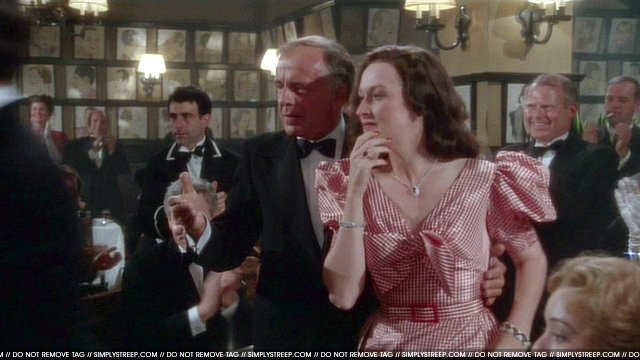
Julia (Fred Zinnemann, 1977) Alvin Sargent's literate, excellent screenplay begins with the aged Lillian Hellman sitting in a boat at twilight, fishing, while over the soundtrack the voice of Jane Fonda  (playing Hellman) talks of the phenomenon of some paintings that reveal earlier paintings below the surface pigments—"pentimento," because the canvas "remembers."

The story that makes the spine of this film is much in dispute.  Hellman swears it occurred exactly as she wrote about it, but that the woman, Julia (Vanessa Redgrave), seems to have disappeared without a trace of documentation that she ever existed, makes one suspect.  Hellman was a writer, above all—a dramatist.  She would not be the first to sacrifice the truth for a better story. It may be a case of a story shining through the layers of artistry, like pentimento.

In the film, Hellman recounts her girl-school friendship with the free-spirited Julia, and how they parted: Julia to study in Vienna, Lily to study in the States and pursue both a writing career and a long affair with writer Dashiell Hammett (Jason Robards).  The two keep in touch, but the free-spirited Julia becomes involved in anti-fascist groups, making her a target for assault.  Hellman uses a world-tour after her Broadway successes to sidetrack to Austria to try to find her friend, who is hiding from the authorities, who, if they catch her, will most assuredly kill her.

It boasts a great cast (both Robards and Redgrave deservedly won Supporting Oscars), with Maximilian Schell, Hal Holbrook, and, in her film debut, a young brunette actress named Meryl Streep.*  Zinnemann's direction is unfussy skipping back in memory, and recounting the desperate times.  The film was edited by Walter Murch, one of his first editing jobs that did not entail working for school-chums like Francis Coppola and George Lucas

This was the favorite film of the girl I was dating in college; we must have seen it five times or so, images, situations and lines of dialogue all burned into my memory, like etchings on a canvas.


* Her blonde hair was dyed for the part.  And she was great, right from the start.  I still remember, burned into my mind, how Streep turned a parting compliment into a dismissal: "You look very slim, Lillian..."

Friday, May 22, 2009

Anytime Movies Reloaded: Once Upon a Time in the West

It's Spring-Break for me. Times are busy. The Summer Movie Season is already begun (and I'll be writing about the new ones) and the Film Festivals are grinding away like creaky mills separating wheat from chaff. It's as good a time as any to re-boot a feature I started years ago, when it was suggested I do a "Top Ten" List.

I don't like those: they're rather arbitrary; they pit films against each other, and there's always one or two that should be on the list that aren't because something better shoved it down the trash-bin.

So, I came up with this: "Anytime" Movies.

Anytime Movies are the movies I can watch anytime, anywhere. If I see a second of it, I can identify it. If it shows up on television, my attention is focused on it until the conclusion. Sometimes it’s the direction, sometimes it’s the writing, sometimes it’s the acting, sometimes it’s just the idea behind it, but these are the movies I can watch again and again (and again!) and never tire of them. There are ten (kinda). They're not in any particular order, but the #1 movie IS the #1 movie.


Landscapes.

That’s what’s featured in
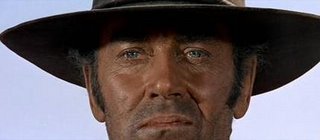
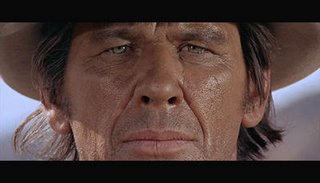
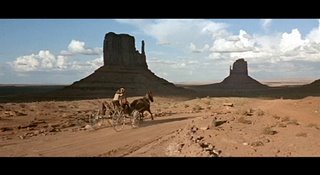
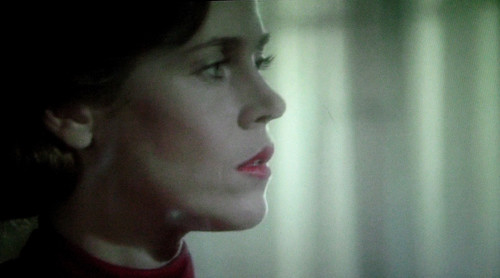
Sergio Leone’s “Once Upon a Time in the West.” Whether it’s the vast, aboriginal spaces of Monument Valley—an affectionate genuflection to the films of John Ford—or the intricately chiseled planes of the faces of Charles Bronson and Henry Fonda—you spend a lot of time looking at both in “Once….”—as well as deep close-ups of the faces of Jason Robards and Claudia Cardinale. There is one shot where Bronson ever so slowly relaxes a smile out of existence. Bronson does it so subtly you don’t know what’s happening until it’s happened. It’s one of the things I look forward to in the Dance of Death of “Once Upon a Time in the West.” Here are some others:


1. “Looks Like We’re Shy One Horse…” The first twelve minutes. A dilapidated train station in the middle of nowhere. Three long-coated bad-men wait for a train. They while away the time, each in their own unique fashion. Driven mostly by sound and filmed in extreme close-ups, the sequence, accompanied by the homely squeak of a windmill—one of the out-sized sound effects typical of Leone’s westerns—and the jokey placement of the credits, rolls on and on until a confrontation ends explosively. It’s an opening of great economy and intricate film-making. Few words are spoken throughout. I’ve shown students this sequence to show just how much presence and atmosphere simple sound effects can bring to a scene. Here’s the ending of the sequence. It’s just the opening gambit in a plot by two men who are playing against each other. It will take the entire movie to explain why.


2. “You Don’t Know How To Play” The gist of “Once Upon a Time in the West” is a chess game with lives and futures as the playing pieces. As scripted by Sergio Leone and his co-scenarists--the soon to be master of Italian horror films Dario Argento and the young Bernardo Bertolucci--the movie is a series of moves and counter-moves by the antagonists, each one trying to tame the frontier in their own way, and taking their own sweet time about it. Each has to make the pieces fall their way. For the first-time viewer it can be maddening following the strategems of the four participants in the story, but by the end the motivations and loyalties—or lack of them—become clear.


3. “People Scare Easier When They’re Dyin’” The villain of the piece is the meanest, rottenest most conniving scumbag to ever walk a dusty street and spit on it. “Frank” is a sadist who smiles when he kills and for the first time in his life he has a patron with a vision—one big enough for Frank to start to see how there might be such a thing as a future, and that one man can own it. He just can’t understand why people are getting in his way.


4. “Instead of Talking, He Plays. And When He Better Play, He Talks.” The composer and the director did it backwards.
Ennio Morricone wrote the music for the film first and Leone built his sequences around the music, playing it on-set to establish mood. There are two spectacular pay-offs--one in the previously mentioned Monument Valley sequence. But the other is at a train station where Claudia Cardinale, has just arrived from New Orleans to find no one to meet her. After a long wait (which is actually mercifully short for a Leone western) she decides to hire passage. Sounds disappear as she is seen through a station window talking to an official, and then the camera HEAVES up and over the roof, and in a burst of music reveals a burgeoning western town full of life and activity. It’s as if all of America is presented in that one astounding crane shot. My wife audibly gasped when she saw the shot in some movie clip program on TV, so stunning is the effect. And more than a little of the power of that shot is due to Morricone’s music and the angelic voice of Edda Dell’Orso, wordlessly cooing an ode to the country and to the protagonist around whom the movie and the future hinges.


5. “Ma’am, It Seems To Me You Ain’t Caught The Idea” For the first time in a Leone western, a woman is the hero, but like her predecessor—"The Man with No Name"—she is flawed and has some learning to do, and it’s up to Leone’s trio of men – another man with no name (going under the aliases of dead men), a wolf-like vagabond-thief, and the villain, Frank—to push, prod, blackmail, challenge and coerce her into a new role. It’s a role each man knows they’ll have no part of, and that, for a time, she is reluctant to fulfill. In the last shot of the film, she is seen bringing water to the railroad work-crew who will be bringing people and prosperity to what will be her town. It may seem a servile role, but as we pull away and follow the disappearing tracks to the frontier, leaving her to her future, she begins to bark orders, to direct and take charge. Her station will become a cornerstone of the push west. “This movie drips with testosterone,” a colleague once told me after a screening. Yes, but Leone includes a healthy shot of estrogen as, for the first time, he is dealing with a story that not only leaves the past behind, but also looks forward to the future.


Once Upon a Time In the West
-Only Angels Have Wings
The Searchers
Chinatown
Mr. Smith Goes to Washington
American Graffiti
To Kill a Mockingbird
Goldfinger
Bonus: Edge of Darkness

Tomorrow: Robots that go clunk!
Sunday: A "Scene" for Memorial Day
Monday: Our annual (now) Memorial Day War Movie review
Next week: We wrap up "Anytime Movies," bid them adieu, and start afresh.

Saturday, October 18, 2008

A Boy and His Dog

"A Boy and His Dog" (L.Q. Jones, 1975) L.Q. Jones is most well-known as a quirky character actor, usually playing rangy, seedy types for the likes of Sam Peckinpah--he was part of Peckinpah's stock company--and Robert Altman--he played the character based on Chet Atkins in Altman's last film, "A Prairie Home Companion."

But in 1975, he also directed a low-budget high-concept picture based on a classic sci-fi story written by
Harlan Ellison. The story, "Blood's a Rover,"* tells the story of a young adult male in a post-apocalyptic world whose only companion is a telepathic dog, or "Rover," named "Blood." Blood sniffs out food and women for Vic to attack, reads minds, and communicates telepathically with "Vic." It's a bizarre story with an odd little twist, and is one of Ellison's best-known tales.

The film Jones made of it is satiric, savage, sassy, and right on the edge of burlesque as Vic (a very young, pre-"Miami Vice" Don Johnson, and his pooch(voiced by Tim McIntire) roam the post-nuclear countryside that bears a passing resemblance to the world of "Mad Max,"** with mutants and squalor. At one point, Vic is lured by one of his female conquests to an underground society of American nostalgists led by Jason Robards, who appear to have stepped right out of the River City, Iowa of "The Music Man,"*** except for the deranged robots, goon squads, and the man-milking machines (the society is sterile). Vic must make a choice between this semblance of civilization and the scorched-earth policies above ground.

Ellison's attitude towards it is rather strange, initially saying that it was a good adaptation, but then turning on it as mysoginistic (especially for its gut-crunching last line). An odd sentiment from the story's creator as that is all reflected in his yarn in the first place. And yet Ellison has gone on and produced sequels to the original story without any attempt to disown the political incorrectness of the original. I guess he felt Jones was too blase about subjects Ellison had second thoughts about. Still, Jones' vision of a post holocaust nuclear society has stayed relevent for decades--as the poster says "it's a future you may live to see!"


* Taken from a line from A.E. Housman's "A Shropshire Lad"

** Jones' post-apocalyptic garage-sale look preceded "Mad Max" by three years, and "The Road Warrior," which it resembles by five years.

***All of these residents are heavily made-up in what I thought at the time was clown make-up, but I realize now is reflective of the look of rosey-cheeked painted-over family portraits. The undergrounders are heavily made-up to compensate for the lack of sun.

Monday, January 14, 2008

Once Upon A Time In The West

Landscapes.

That’s what’s featured in
Sergio Leone’s “Once Upon a Time in the West.” Whether it’s the vast, aboriginal spaces of Monument Valley—an affectionate genuflection to the films of John Ford—or the intricately chiseled planes of the faces of Charles Bronson and Henry Fonda, you spend a lot of time looking at both in “Once….”, as well as deep close-ups on the faces of Jason Robards and Claudia Cardinale. There is one shot where Bronson ever so slowly relaxes a smile out of existence. It’s one of those shots where you don’t know what’s happening until it’s happened, Bronson does it so subtly. It’s one of the things I look forward to in the Dance of Death of “Once Upon a Time in the West.” Here are some others:

1. “Looks Like We’re Shy One Horse…” The first twelve minutes. A dilapidated train station in the middle of nowhere. Three long-coated bad-men wait for a train. They while away the time, each in their own unique fashion. Driven mostly by sound and filmed in extreme close-ups, the sequence, accompanied by the homely squeak of a windmill--one of the out-sized sound effects typical of Leone’s westerns--and the jokey placement of the credits, rolls on and on until a confrontation ends explosively. It’s an opening of great economy and intricate film-making. Few words are spoken throughout. I’ve shown students this sequence to show just how much presence and atmosphere simple sound effects can bring to a scene. Here’s the ending of the sequence. It’s just the opening gambit in a plot by two men who are playing against each other. It will take the entire movie to explain why.


2. “You Don’t Know How To Play” The gist of “Once Upon a Time in the West” is a chess game with lives and futures as the playing pieces. As scripted by Sergio Leone and his co-scenarists--the soon to be master of Italian horror films
Dario Argento and the young Bernardo Bertolucci--the movie is a series of moves and counter-moves by the antagonists, each one trying to tame the frontier in their own way, and taking their own sweet time about it. Each has to make the pieces fall their way. For the first-time viewer it can be maddening following the strategems of the four participants in the story, but by the end the motivations and loyalties--or lack of them-- become clear.


3. “People Scare Easier When They’re Dyin’” The villain of the piece is the meanest, rottenest most conniving scumbag to ever walk a dusty street and spit on it. “Frank” is a sadist who smiles when he kills and for the first time in his life he has a patron with a vision—one big enough for Frank to start to see how there might be such a thing as a future, and that one man can own it. He just can’t understand why people are getting in his way.


4. “Instead of Talking, He Plays. And When He Better Play, He Talks.” The composer and the director did it backwards. Ennio Morricone wrote the music for the film first and Leone built his sequences around the music, playing it on-set to establish mood. There are two spectacular pay-offs--one in the previously mentioned Monument Valley sequence. But the other is at a train station where Claudia Cardinale, has just arrived from New Orleans to find no one to meet her. After a long wait (which is actually mercifully short for a Leone western) she decides to hire passage. Sounds disappear as she is seen through a station window talking to an official, and then the camera HEAVES up and over the roof, and in a burst of music reveals a burgeoning western town full of life and activity. It’s as if all of America is presented in that one astounding crane shot. My wife audibly gasped when she saw the shot in some movie clip program on TV, so stunning is the effect. And more than a little of the power of that shot is due to Morricone’s music and the angelic voice of Edda Dell’Orso, wordlessly cooing an ode to the country and to the protagonist around whom the movie and the future hinges.
5. “Ma’am, It Seems To Me You Ain’t Caught The Idea” For the first time in a Leone western, a woman is the hero, but like her predecessor—The Man with No Name—she is flawed, and has some learning to do, and it’s up to Leone’s trio of men – another man with no name using the names of dead men, a wolf-like vagabond-thief, and the villain, Frank—to push, prod, blackmail, challenge and coerce her into a new role. It’s a role each man knows they’ll have no part of and that, for a time, she is reluctant to fulfill. In the last shot of the film, she is seen bringing water to the railroad work-crew who will be bringing people and prosperity to what will be her town. It may seem a servile role, but as we pull away and follow the disappearing tracks to the frontier, leaving her to her future, she begins to bark orders, to direct and take charge. Her station will become a cornerstone of the push west. “This movie drips with testosterone,” a colleague once told me after a screening. Yes, but Leone includes a healthy shot of estrogen as, for the first time, he is dealing with a story that not only leaves the past behind, but also looks forward to the future.


Anytime Movies are movies I can watch anytime, anywhere. If I see a second of it, I can identify it. If it shows up on television, my attention is focused on it until the conclusion. Sometimes it's the direction, sometimes it's the writing, sometimes it's the acting, sometimes it's just the idea behind it, but these are the movies I can watch again and again and never tire of them. There are ten. This is Number 3.


III: Once Upon a Time In the West


IV: -Only Angels Have Wings


V: The Searchers


VII: Chinatown


VIII: American Graffiti


X: Goldfinger