
The Day of the Jackal (Fred Zinnemann, 1973) Not to be confused with the lousy 1997 retread (rather than remake)The Jackal with Bruce Willis and a ludicrously accented Richard Gere "acting the maggot" that was dumbed down for its target audience (Assassinate General DeGaulle? Who's that? Make it the First Lady, instead).
This one actually is based on the Frederick Forsythe best-seller, and done in as nondescript a way as possible, almost a prettified documentary style lacking stars (although Michael Lonsdale and Edward Fox would emerge from it with solid character-actor careers), but adhering stoically to the plot and its amoral assassin (Fox), both as cold as they come.
The Jackal is teflon—never been photographed, only rumors to his existence, but, he is hired to take out France's President by a cadre of disgraced French Foreign Legion Generals. Their own clumsy attempt having, failed they turn to an outsider, anonymous, unknown but to have been involved with earlier assassinations. Because it is a once-in-a-lifetime "hit," he demands half a million dollars on which to retire.
The movie then runs along two parallel paths of suspense, as the Jackal arms, plans, and sneaks his way into France, while the authorities, led by the cool-as-a-cucumber-sandwich Lebel (Lonsdale), after hearing rumors about an attempt, try to find information within their own circle about a man that no one has seen.
They might as well be chasing a ghost. The Jackal assumes identities, habits and companions, then discards them like an unneeded skin as he moves inexorably to a point in time and place that only he knows, with murderous equipment well-hidden, to meet his target. He is one man. But, the police and government authorities are many, though at times it seems less an advantage. What is fascinating is the amoral methods of the two opponents, Jackal and Lebel. The former is a determined sociopath, leaving a trail of bodies that are found only days behind him, while Lebel, entrusted with the life of the most powerful man in France, has no qualms about disrupting those of others, refusing to let decorum, jurisdiction, or bureaucratic bumbledom stand in his way. He is, after all, fighting someone he doesn't know to prevent a crime he doesn't know where or when.
The script (by Kenneth Ross) is also morally ambiguous—not commenting either way on the actions of hunter and hunted. In one astounding scene (only in that it is not astounding at all), The Jackal discards a temporary lover in a manner that seems like an embrace, only her stillness informs that she is, in fact, deceased. Cerebrally chilly, and damned clever, the absence of stars might have made it less successful at the box-office (Michael Caine, Jack Nicholson, and Roger Moore were considered potential Jackals, but the producers went with the less-well-known Fox so he could "blend"), but The Day of the Jackal is still a film exercise in meticulous suspense, and becomes the novel well.
Showing posts with label Fred Zinnemann. Show all posts
Showing posts with label Fred Zinnemann. Show all posts
Wednesday, January 19, 2011
The Day of the Jackal


Thursday, January 13, 2011
Julia

Julia (Fred Zinnemann, 1977) Alvin Sargent's literate, excellent screenplay begins with the aged Lillian Hellman sitting in a boat at twilight, fishing, while over the soundtrack the voice of Jane Fonda (playing Hellman) talks of the phenomenon of some paintings that reveal earlier paintings below the surface pigments—"pentimento," because the canvas "remembers."

The story that makes the spine of this film is much in dispute. Hellman swears it occurred exactly as she wrote about it, but that the woman, Julia (Vanessa Redgrave), seems to have disappeared without a trace of documentation that she ever existed, makes one suspect. Hellman was a writer, above all—a dramatist. She would not be the first to sacrifice the truth for a better story. It may be a case of a story shining through the layers of artistry, like pentimento.

In the film, Hellman recounts her girl-school friendship with the free-spirited Julia, and how they parted: Julia to study in Vienna, Lily to study in the States and pursue both a writing career and a long affair with writer Dashiell Hammett (Jason Robards). The two keep in touch, but the free-spirited Julia becomes involved in anti-fascist groups, making her a target for assault. Hellman uses a world-tour after her Broadway successes to sidetrack to Austria to try to find her friend, who is hiding from the authorities, who, if they catch her, will most assuredly kill her.


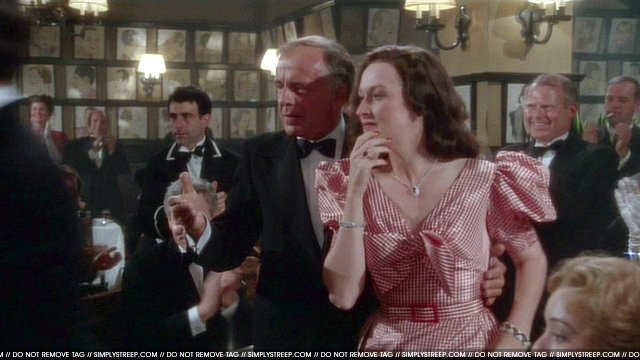
It boasts a great cast (both Robards and Redgrave deservedly won Supporting Oscars), with Maximilian Schell, Hal Holbrook, and, in her film debut, a young brunette actress named Meryl Streep.* Zinnemann's direction is unfussy skipping back in memory, and recounting the desperate times. The film was edited by Walter Murch, one of his first editing jobs that did not entail working for school-chums like Francis Coppola and George Lucas.


This was the favorite film of the girl I was dating in college; we must have seen it five times or so, images, situations and lines of dialogue all burned into my memory, like etchings on a canvas.
* Her blonde hair was dyed for the part. And she was great, right from the start. I still remember, burned into my mind, how Streep turned a parting compliment into a dismissal: "You look very slim, Lillian..."
Subscribe to:
Posts (Atom)