Showing posts with label 1963. Show all posts

Wednesday, May 2, 2012

La Jetée

La Jetée (Chris Marker, 1963) Court-métrage.  Court examen. Les images fixes.  En noir et blanc.  Sci-Fi.  L'avenir.  Post-Apocalypse.  Bunker vie. Expérimentation.  Les sujets humains.  Voyage dans le temps.  La plupart des fous.  Un homme ne fonctionne pas.  Revient en arrièredansle temps.  Lesmesures préventives.  Rencontre d'une mémoire.  Tombe amoureux.  Impossible d'arrêter l'inévitable.  La futilité de bonnes intentions.

Finis.

La Jetée was the inspiration for Terry Gilliam's 12 Monkeys, which expanded the story-line, threw in some complicating issues about insanity and the perception of it, and one character that provided Brad Pitt an opportunity to work way-too hard playing crazy—this was during his early experimental "stretching" phase—which managed to fool the Motion Picture Academy enough to get him a best supporting actor nomination.  He needn't have bothered.

La Jetée already proves the lesson.

Faites-en plus en faisant moins. 


Tuesday, April 24, 2012

It Happened at the World's Fair

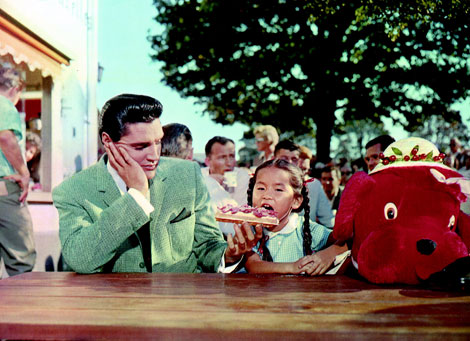
It Happened at the World's Fair (Norman Taurog, 1963) I'm something of a lunkhead about Elvis Presley, even though I grew up in the Elvisian Era.  Fact is, I was born into the Presley presence—he was a fact of life and nothing revolutionary to me, and by the time I was actually cognizant of him, aware, he had moved on from being a rock n' roll revolutionary to being something of a lounge lizard.  He'd evolved on to the Hollywood Elvis period, where there was less emphasis on picking good material and taking chances and more on banking on his success and name recognition, while also taking the edge off his persona to be more acceptable to "Mom and Dad America."  The films started out somewhat inspired, even special, then settled into a pattern of sticking the King into formula scenarios pulled from the screenwriters' template that had the feel (and factory precision) of romance novels.  They did the job, but had all the nutritional and aesthetic value of a TV-dinner, circa 1960.

Culturally, the U.S. had swiveled away from mambo (Castro's overthrow of Cuba being the main reason, as well as the inevitable momentum of faddishness) and gone Polynesian—the American Eagle had sunk its claws into Hawaii permanently, folding it into statehood, and Tiki had started to invade American dens and Trader Vic's was the big restaurant.  At the same time, Seattle was looking to the future, Sputnik having launched America's fledgling space program into a panicky orbit, and the plastic revolution bombarding American kitchens.  City fathers (one of whom was my father's employer) started a campaign to bring another World's Fair to the home of Boeing (its first being the Alaska-Yukon-Pacific Exhibition in 1910—on the site of what is now the University of Washington).  This one would be more forward thinking, embracing science and technology, and the 1962 Seattle World's fair was dubbed "Century 21."  It was surprisingly successful, managing to turn the city's "Warren Avenue slum" where the Armory was housed into a central hub of the downtown era...and—a rarity for World's Fairs—turn a profit.

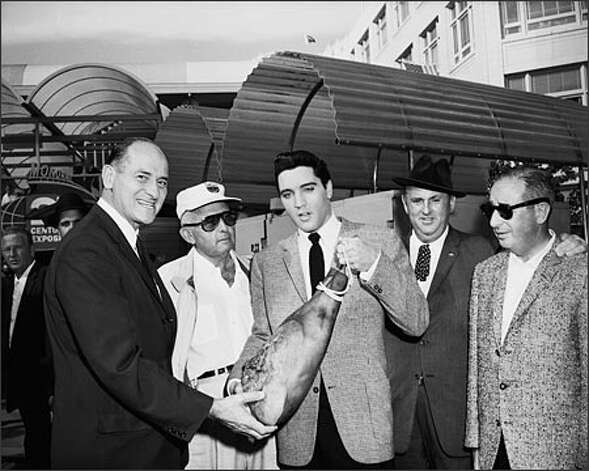
The organizers were particularly good at attracting celebrities and entertainers to the Fair, and only the Cuban Missile Crisis kept President Kennedy from officiating over the closing ceremonies.  They even managed to make a movie deal with M-G-M for Elvis to make a movie, no doubt paying the studio a handsome sum for the privilege, while also getting some of the corporate sponsors of the Fair to contribute towards the film (probably the reason why G-M's "car of the future" figures so prominently in the film—for no apparent reason).  If it was to promote tourism and the Fair, they might have worked out the timeline a little better—The film opened in April of 1963, six months after it had closed!

It Happened at the World's Fair (It's rather tough to determine what "it" is) is a fairly lousy Presley programmer, short of plot (Elvis is a pilot of a crop-duster, in partnership with Gary Lockwood, and gambling debts force them to try and raise money to buy their plane "Bessie" back) but it's the gristliest of connective tissue between songs that were barely charting and love scenes for the fans.  Director Norman Taurog was an efficient, if uninspired, director who moved from silent pictures through studio series—his peak years were directing the Martin and Lewis comedies before Lewis got the directing bug—who could be counted on to bring things in on-time and under-budget.  He was good at logistics, and managed to keep the studio accountants happy that his films were managed enough to be able to make a profit at the box-office.  And his experience with comedies made him a good candidate for making things light and airy and moving fast.

Which is what this one needed.  Seeing it as a kid, I thought it was the dullest thing in the world and needed more shots of The Space Needle and, frankly, The Fair.  Seeing it as an adult is a grim experience when noting that your tastes haven't changed much.  There are faint flashes of wit once in awhile, but it goes without for long stretches of obvious, perfunctory film-making.  But, face it, the thing was a commercial enterprise that had outlived its usefulness except to sell records for M-G-M, rather than break them.  It does have one oddity worth noting for trivialists: in the role of a kid who kicks Elvis in the shins (to fake an injury to see a pretty nurse) is Kurt Russell, who would play Presley in John Carpenter's biographical film (produced by the late Dick Clark, by the way).

The Seattle World's Fair opened 50 years ago, this past weekend.


Thursday, November 27, 2008

The Leopard

"The Leopard" aka "Il Gattopardo" (Luchino Visconti, 1963)

Epic.

Extraordinarily epic.

Exquisite three hour film (that is, if you watch the original Italian, rather than
the edited, dubbed American version*) of the change-over from one generation of Italian artistocracy to one with fewer ties to the past, amidst a changing landscape that will ultimately change fortunes. Don Salina (Burt Lancaster) is a prince of the old lineage observing the change that will ultimately overthrow the government and his rights to power, even as he sees the old ways and traditions begin to erode in the rise of his nephew Tancredi Falconeri (Alain Delon) who chooses to marry below his station to the manipulative Angelica (Claudia Cardinale). In one of the many allusions to the animal kingdom, Don Salina fears that his generation of leopards is being handed over to jackals.

In its timeline and its scope, it could be labeled the Italian "Gone With the Wind." Certainly the care and attention to detail that director Visconti, Director of Photography Giuseppe Rotunno, and Production Designer Mario Garbuglia brought to bare can be compared to the extravagance of the American epic. But it's a smarter, richer film—a far better film—with layered subtleties that GWTW never aspired to.

Visconti had a special affinity for the material. Like the author of the original novel, Giuseppe Tomasi di Lampedusa, the director was born to the aristocracy. He knew its joys and pleasures and tastes, and he follows Lampedusa's celebration of that life in its recognition. But Visconti became a Marxist, so he looks at the excesses and hypocrises with less sentiment than Lampedusa does. But, he also acknowledges that change ultimately doesn't change much where fortunes are involved.

Contained here are some of the beautiful images that Visconti, Rotunno, and Garbuglia composed, rich in color and detail like fine paintings. But they're in motion and filled with life and portent and commentary.

I've seen "The Leopard" only once. Its beauties compel further viewings with which more of the complexities of the work will become apparent. One can't wait to get started.

Films like "The Leopard" are why one falls in love with the medium in the first place.

* Sydney Pollack supervised the dubbed version, and even he acknowledged it hurt the movie. One of the odd things about it is Lancaster's performance: He's actually better dubbed in Italian with a different, gruffer voice, rather than the soft, smokey baritone of his own voice. In fact, the combination of Lancaster's screen-work and substituted voice combine to make the greatest performance he never gave!


Wednesday, July 30, 2008

Olde Review: The Fire Within

This was part of a series of reviews of the ASUW Film series back in the '70's. Except for some punctuation, I haven't changed anything from the way it was presented, giving the kid I was back in the '70's a break. Any stray thoughts and updates I've included with the inevitable asterisked post-scripts.

This Saturday's ASUW films in 130 Kane are billed under the theme "The Tragedy of the Spirit" and the two films are Louis Malle's "The Fire Within" and Ingmar Bergman's "Persona."


"The Fire Within" aka "Le Feu Follet"(Louis Malle, 1963) "The Fire Within" was advertised as "a psychological thriller," which is a totally mis-leading label. It is not a thriller at all, but a study. A study of a man cured of alcoholism and, of his past life. I tell you this only because if you go to "The Fire Within" expecting something along the lines of a "Marnie," you are going to be sorely disappointed, and such a reaction does not allow a fast shift og the emotional gears in order to appreciate what is there. Just a warning to put you in a proper frame of mind.

Anyway, through a long stay at a rest clinic the man has dried out, sheltered from the environment that had led him to the irresponsibility of his previous life, but clinging to that shelter, fearing to leave it for fear of what he would find outside. After some bolstering he does go out in search of friends, of companionship, of the past he has lost. Life is moving too slowly for him, with too much mediocrity and too little love, and as he goes from friend to friend, his spirit slips away from him, beyond his control.

Louis Malle who directed "The Fire Within," also directed the documentary "Phantom India" which was shown a couple weeks back,* and he shoots this film in much the same way--no real sets are used, but the odd little details of life around us are focussed upon, giving the film a sense of reality, of it actually happening.

Broadcast on KCMU-FM on October 29th, 1975

Okay. Confession time. What I'm not saying in this review--trying very hard not to say--is that I hate sitting through Louis Malle films. I just despise it. I haven't seen one in 20 years (the man died in 1995), but each of his films was a bit of a drag--"Lacombe, Lucien," "Phantom India," "Pretty Baby." I just finished watching "Night Moves" in which detective Harry Moseby begs off going to see the new "Roehmer film" because he says "it's like watching paint dry." That's how I feel about Malle. I remember at this time (1975), I went around joking that "the perfect Louis Malle film would be two guys sitting in a room talking, one camera." And in 1981, Malle made essentially that (though with more than one camera) with "My Dinner with Andre" (which I actually liked, come to think of it).

One day, I need to be sat down in front of the TV with a strong drink, strapped down and made to watch "Atlantic City" or "The Lovers," or "Crackers," "Vanya on 42nd Street"--I'd like to see that, actually, or "Damage" or "Au revoir, les enfants." Maybe the years will have mellowed me, or given me life-experience or patience enough to appreciate his work. But with so many films I haven't seen, and my past experience, Malle always gets pushed to the bottom of the pile.

C'est la vie.

* Yeah, I'll get to it.

Friday, July 11, 2008

Olde Review: The Haunting

This was part of a series of reviews of the ASUW Film series back in the '70's. Except for some punctuation, I haven't changed anything from the way it was presented, giving the kid I was back in the '70's a break. Any stray thoughts and updates I've included with the inevitable asterisked post-scripts.

"The Haunting"* (Robert Wise, 1963) Robert Wise, who directed "The Haunting" is a supreme craftsman of film. he was formerly a film editor, one of the men who pasted "Citizen Kane" together, in fact, and thus knows how to compose his shots to make interesting stretches of film. He knows how to manipulate an audience, how to shock, how to fool. He can direct your attention to what he wants you to see. He is also quite adept at using special effects, thus he can pull off such projects as "The Day the Earth Stood Still," "West Side Story," "The Andromeda Strain," and "The Haunting." However, when it came to characterization, Wise usually falls flat on his face,** as was evident in "West Side Story," The Sound of Music," and "Two People." So, what you have in Robert wise is the perfect disaster-movie director, and he fulfilled that label when he directed "The Hindenburg" last year. I can guarantee that your spine will be pleasantly chilled by "The Haunting."

Unlike "Rosemary's Baby," "The Haunting" does take place in odd, creepy surroundings--The Olde Hill House--and you have such things as a creaky metal circular stairway, convenient for a suicide, whispering corridors. Take a brodding mansion, some brutal situations, and some brutish ghosts and one quakingly susceptible person and you have the formula for this type of gothic. Whether its successful or not depends on whether the director can stir them up to make them a) original, which is unlikely, or b) scary, which you can do in a myriad number of ways, cinematically. Although "The Haunting" is not really the former, it is certainly the latter, so you might want to take a spare hand along Saturday night to clutch.

Maybe not. You see, there's a situation where....well, I'm not going to give it away. Find out for yourself, and...sleep well Saturday night.

Broadcast on KCMU-FM on October 22 and 23rd, 1976.

My criticism of Wise's ability with actors is unfair and untrue. He tended to cast talented actors when he could, and "The Haunting" is full of them--Richard Johnson, Claire Bloom, and Julie Harris, along with Russ Tamblyn (from "West Side Story") and Lois Maxwell. "The Haunting" still holds up as a chilling film, and it's because of the way Wise (and scenarist Nelso Gidding) set the movie up with a prologue outlining the sad history of "Hill House." The one section I still recall vividly is the long camera lift going up the circular stairs preceding a suicide victim's climb, then their feet dropping into frame, and Wise then double-timing back down those stairs. It just creeps you out and prepares you for further shocks in other rooms.

Wise shoots in black-and-white, all the better to photograph shadows in, and cranks up the sound design of the creaks, moans, whispers and poundings reverberating down the corridors. Wise wracks nerves expertly, and manipulates the audience, pushing the cliched tropes of The Old Dark House as far as they can go. Plus, he's the master of the shock-cut, both the set-up and the execution. Wise could do anything, in any genre, and was one of the great craftsmen of the American cinema.


* Not to be confused with the inadequate 1999 remake produced by Steven Spielberg and directed by Jan de Bont. Those two thought you could create the same creepiness in vivid color and with digital effects....Kids!

** Oh, I don't know. "West Side Story" boasts a lot of fine performances--it's
Richard Beymer's Tony that's the exception. And while Christopher Plummer is at his most...restrained in "The Sound of Music," everyone else is fine. The quartet of researchers in "The Andromeda Strain" are more full developed than Michael Crichton's original characters, and one can't forget Paul Newman's work as Rocky Graziano in "Somebody Up There Likes Me," Steve McQueen, Richard Attenborough, Richard Crenna, and Mako in "The Sand Pebbles," Susan Hayward in "I Want To Live," and William Shatner in "Star Trek: The Motion Picture"... Whoops, killed that argument!

Wednesday, May 7, 2008

Shock Corridor

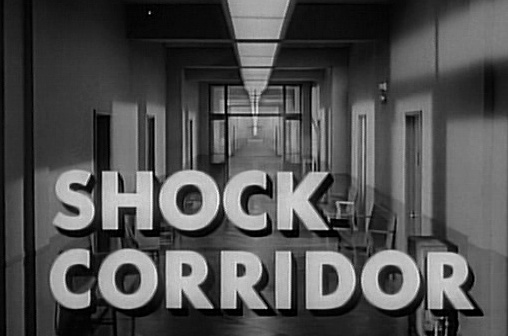
Shock Corridor (Samuel Fuller, 1963) If ever there was a title that needed an exclamation mark at the end of it, this was it. But, if you know Sam Fuller, gritty maverick director, and what he was trying to do with this bottom-of-the-barrel-budgeted pot-boiler, you know he probably wanted to call it simply "The Street," the nick-name for the communal "hallway" where the inmates of an insane asylum meet and greet...and interact, sometimes explosively, and reflect the madness of the world outside its walls.


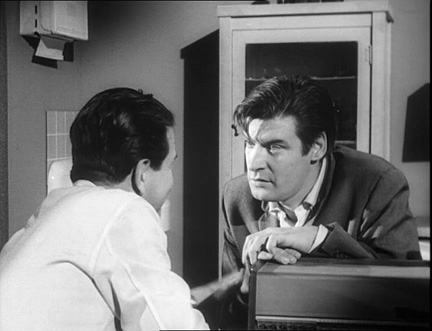
Reporter Johnny Barrett (Peter Breck, sometimes good, sometimes bad) is investigating the murder of a patient at an asylum, looking for an expose to win a Pulitzer. he's been training for a year to pull the wool over the diplomas of those weisenheimer shrinks so he can get inside. His editor, "Swannee," is all for it, but his stripper girl-friend Cathy (Constance Towers) thinks it's a bad, bad idea...real bad. But she plays along, posing as the worried sister whose fear of Johnny's "affections" creates the police report that sends him up (This is one of those police departments that doesn't do background checks, or investigations of any kind). Johnny's encarcerated as a sex maniac, and we're thrown into the sordid exploitation stuff of sadistic guards, colorful loonies, and perversions. At one point, Johnny stumbles upon the woman's ward (Fuller cuts to a bug-eyed Barrett, realizing his situation and in echoe-y voice-over says one, hilarious word--"Nympho's!") and then is set upon, "Daughters of Dracula"-style in a genuinely creepy scene. Fuller walks a razor-thin line of silly exploitation and truly daring social commentary that slaps you across the face, and you realize--he's serious! Sure, Cathy gets a performance scene as a stripper--although she it's a rather stodgy dance routine with a torch-song to go along with it (she's Mrs. Sam Fuller, after all, gotta keep the wife happy), but once we know one psychosis from another, and Johnny starts to interview the witnesses to the murder, Fuller starts doing something deeper than giving jollies to the mouth-breathers. His three murder witnesses are all victim's of the State's insanities. There's Stuart (James Best) a Korean war vet and victim of brainwashing but, as it's made clear, he's just as brainwashed by the racist upbringing he recieved growing up in the South. Then there's Boden (Gene Evans) genius missile engineer, whose so unhinged by the Mutually Assured Destruction scenarios his inventions have been targetted for, that he cracks to the abilities of a six year old child, capable only of drawing and playing hide-and-seek (although it looks suspiciously like duck and cover the way he plays it). Finally, in easily the best performance of the movie, is Hari Rhodes as Trent, a former student, allowed at gun-point to attend a previously integrated college, and in his efforts to be five times better than the white students, cracks under the pressure, becoming as bigotted as the protesters who tried to keep him out. Where Evans and Best can't seem to hurdle a mental block from turning their roles into melodrama, Rhodes plays it absolutely straight and he's the guy you remember.


Does all this actually lead to finding out who the murderer is, and what happens to Johnny? Well, I think you can guess given Fuller's cynical view of things. But he's trying to do more with it, and equate the U.S. circa 1963 with the trappings of an insane asylum. That's a brave statement, especially for a B-movie exploitation pic. But that's usually where Fuller preferred to be. He could rise above his genre and budget. There are times when the dialog tries so hard to rise above its exploitation roots and prove that it's read a book or two that it approaches Ed Wood ponderousness. But the trunk of the thing is a joy to behold, despite all the cheap tinsel and gaudy patter.


And along the way, Fuller scores a few hits against the psychiatric profession: the first shot is of a psychologist straightening his crooked diploma, and at one point during his psych evaluation, the prepped Johnny thinks "This is where he's going to ask if I hear voices.." and the shrink asks, "Johnny, do you ever hear voices?" It's a funny scene, but it also shows the limitations of the profession's pigeon-holing of individuals. (Hey, Tom Cruise! I got your next remake project for ya!)

Ultimately, History is the judge. This cheap little grindhouse flick is part of the National Film Registry. That's not voices you hear. It's the echoing cackle of Sam Fuller.