"Death Proof" (Quentin Tarantino, 2007) Part of the "Grindhouse" doube-bill imagined by Robert Rodriguez and Tarantino in 2007. Rodriguez's feature "Planet Terror" was such an object of loathing on my part that I was in no hurry to see Tarentino's half, not being a fan of Tarantino's body of work, but liking a couple of his films.
Goes to show you. Don't take anything for granted.
"Death Proof" is such a luxurious exercise in emulating "bad girl" exploitation movies that it manages to rise above the material and actually prove a well-constructed, well-considered and deliriously fine thrill-ride. It's so good, that it fails miserably at its intention of posing as a B-movie.
This is a problem?
Directed and photographed by Tarantino (and very well, as he gets shots that look extremely dangerous to achieve), the flick tells the story of Stuntman Mike (Kurt Russell) who targets girls in cars for murderous collisions. Done in long, long disciplined takes the girl-packs are followed through their paces by the audience and stalking Mike: first, a bevy of Austin, Texas girl-friends of morning DJ Jungle Jill (Sydney Poitier) who proceed to get wasted and meet up Mike on a dark street; then, a clutch of movie-crew women in Tennesee led by hair-stylist Kim (Rosario Dawson), and a couple of stunt women. This scenario is in marked contrast to the first, which ended in an orgiastic car-crash, this second is a white-knuckle chase.
It could be seen as a "Don't Drink and Drive" warning. It could be a "girl-power" statement (it certainly is that). It could be a flipped digit to those all-powerful-stalker movies. But whatever it is, Tarentino pulls out all the action stops, creating some of the most reckless sequences put on film (the stunt Union must love him), with techniques borrowed from a number of acknowledged directors in the credits.
It could also be a love letter to stunt-woman Zoe Bell (the credits say "Zoë Bell as Herself"). Bell, who was the stunt double for "Xena: Warrior Princess" and did the elaborate "Bride" stunt sequences for "Kill Bill" does some extremely agitating work in "Death-Proof," as an Australian stunt-woman who is in the unfortunate position of riding the hood of a car when the women encounter Stuntman Mike on a lonely (and seemingly endless) stretch of dirt road. No, you haven't seen anything like it.
Now, there are some irritating things: a couple of the actresses (Rose McGowan and Tracie Thoms) don't know sub-tle acting techniques—and neither does Tarantino in another of his grand-standing cameos—but Bell, Russell and Dawson compensate mightily doing great work. There's a breaking of the fourth wall that's a little too cute and creepy. Tarantino overdoes the false scratches and imperfections to try and achieve an old movie effect (at one point, an entire reel is in black and white), a bit of dialogue is repeated in a bad edit (anyone who could make a film this good wouldn't make that mistake). But these are minor considerations in great work.
In my laceration of "Planet Terror," I wrote about the aspirations of artists trying to recreate the "crap of their youth," which they enjoyed, in an attempt to recreate the experience for a new generation:
I know what they were going for in "Grindhouse." They were trying to go back to the "C"-movie days of double-bill films that tried to eke out a profit by appealing to the lowest common denominator--the kids-and-cretins-circuit—something that Dimension Films,"Grindhouse's" distributor, routinely does, as well. Some of the greatest directors of movies—some of the brightest—honed their craft in the AIP's and worse. But once they got their chops, they stopped making crap. They aspired. They wanted more. Only someone of limited creativity (or a moron...or a deeply cynical artist) would knowingly aspire to garbage, and so reluctantly, I'm bestowing that label to Robert Rodriguez--the "deeply cynical artist" one, as he's very creative, and certainly not a moron. Left to his own devices, Rodriguez can do some entertaining work--the El Mariachi films, the "Spy Kids" films, and they're made with an economy that's something short of miraculous--but team him with his mentor, Quentin Tarantino and it all turns to shit (QT has a mercifully brief role in "Planet Terror," as an over-acting rapist, where he proves, once again, that he's the male equivalent of Pia Zadora). The guy's got the chops, no doubt about it. But he has one thing missing in his many talents--taste. They don't teach that at film school, and you can't get it at the video store. "Taste" is what you get when you aspire, and it can even be with the schlockiest material known to man ("Touch of Evil," "Psycho," "The Godfather"...I can go on and on about artists who reached to make a silk purse out of a sow's ear), but to revel in schlock, to aspire to it...and have the results be so ...marginal, so ...bad, and not even in a funny way, but pitiable, well, you start to wonder what it is you saw in these guys before.
Tarantino saw the schlock, loved it, and in his attempt to recreate it, surpassed it, improved it, and passed along his love to the audience, validating it. He got the formula exactly right.
Bravo.
Bravo and "wow." *

Good Will Hunting.
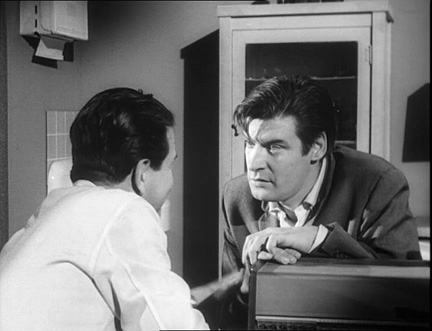
Kurt Russell breaks a lot of things in "Death-Proof" including the "Fourth Wall."
* Yeah, yeah—loved it, sure. But, lest you go rushing out expecting a masterpiece of art, this caveat: It's an exploitation film. That means there's going to be something that offends...well, just about everybody (including folks who get off on exploitation films!) It's just part of the Grand Scheme of "Death Proof."
(Wilhelm alert @ 00:51:23)