Showing posts with label Kurt Russell. Show all posts

Tuesday, April 24, 2012

It Happened at the World's Fair

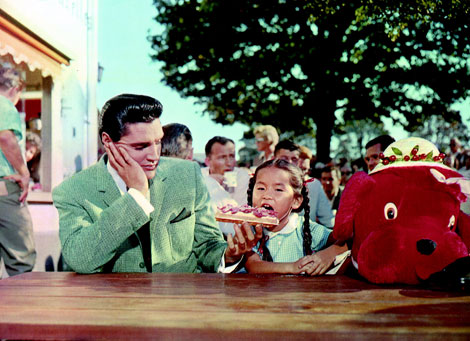
It Happened at the World's Fair (Norman Taurog, 1963) I'm something of a lunkhead about Elvis Presley, even though I grew up in the Elvisian Era.  Fact is, I was born into the Presley presence—he was a fact of life and nothing revolutionary to me, and by the time I was actually cognizant of him, aware, he had moved on from being a rock n' roll revolutionary to being something of a lounge lizard.  He'd evolved on to the Hollywood Elvis period, where there was less emphasis on picking good material and taking chances and more on banking on his success and name recognition, while also taking the edge off his persona to be more acceptable to "Mom and Dad America."  The films started out somewhat inspired, even special, then settled into a pattern of sticking the King into formula scenarios pulled from the screenwriters' template that had the feel (and factory precision) of romance novels.  They did the job, but had all the nutritional and aesthetic value of a TV-dinner, circa 1960.

Culturally, the U.S. had swiveled away from mambo (Castro's overthrow of Cuba being the main reason, as well as the inevitable momentum of faddishness) and gone Polynesian—the American Eagle had sunk its claws into Hawaii permanently, folding it into statehood, and Tiki had started to invade American dens and Trader Vic's was the big restaurant.  At the same time, Seattle was looking to the future, Sputnik having launched America's fledgling space program into a panicky orbit, and the plastic revolution bombarding American kitchens.  City fathers (one of whom was my father's employer) started a campaign to bring another World's Fair to the home of Boeing (its first being the Alaska-Yukon-Pacific Exhibition in 1910—on the site of what is now the University of Washington).  This one would be more forward thinking, embracing science and technology, and the 1962 Seattle World's fair was dubbed "Century 21."  It was surprisingly successful, managing to turn the city's "Warren Avenue slum" where the Armory was housed into a central hub of the downtown era...and—a rarity for World's Fairs—turn a profit.

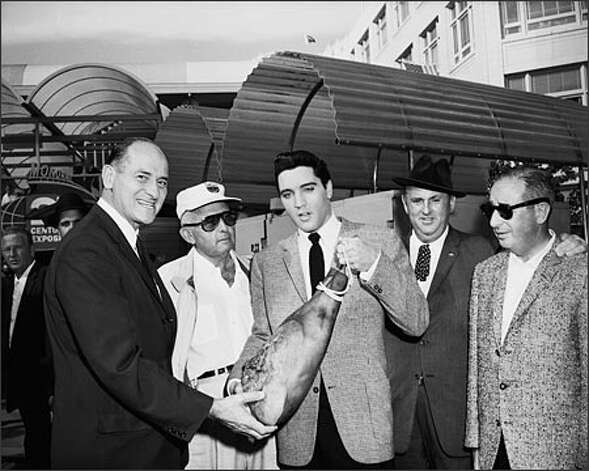
The organizers were particularly good at attracting celebrities and entertainers to the Fair, and only the Cuban Missile Crisis kept President Kennedy from officiating over the closing ceremonies.  They even managed to make a movie deal with M-G-M for Elvis to make a movie, no doubt paying the studio a handsome sum for the privilege, while also getting some of the corporate sponsors of the Fair to contribute towards the film (probably the reason why G-M's "car of the future" figures so prominently in the film—for no apparent reason).  If it was to promote tourism and the Fair, they might have worked out the timeline a little better—The film opened in April of 1963, six months after it had closed!

It Happened at the World's Fair (It's rather tough to determine what "it" is) is a fairly lousy Presley programmer, short of plot (Elvis is a pilot of a crop-duster, in partnership with Gary Lockwood, and gambling debts force them to try and raise money to buy their plane "Bessie" back) but it's the gristliest of connective tissue between songs that were barely charting and love scenes for the fans.  Director Norman Taurog was an efficient, if uninspired, director who moved from silent pictures through studio series—his peak years were directing the Martin and Lewis comedies before Lewis got the directing bug—who could be counted on to bring things in on-time and under-budget.  He was good at logistics, and managed to keep the studio accountants happy that his films were managed enough to be able to make a profit at the box-office.  And his experience with comedies made him a good candidate for making things light and airy and moving fast.

Which is what this one needed.  Seeing it as a kid, I thought it was the dullest thing in the world and needed more shots of The Space Needle and, frankly, The Fair.  Seeing it as an adult is a grim experience when noting that your tastes haven't changed much.  There are faint flashes of wit once in awhile, but it goes without for long stretches of obvious, perfunctory film-making.  But, face it, the thing was a commercial enterprise that had outlived its usefulness except to sell records for M-G-M, rather than break them.  It does have one oddity worth noting for trivialists: in the role of a kid who kicks Elvis in the shins (to fake an injury to see a pretty nurse) is Kurt Russell, who would play Presley in John Carpenter's biographical film (produced by the late Dick Clark, by the way).

The Seattle World's Fair opened 50 years ago, this past weekend.


Saturday, October 29, 2011

Now I've Seen Every "Thing" Department

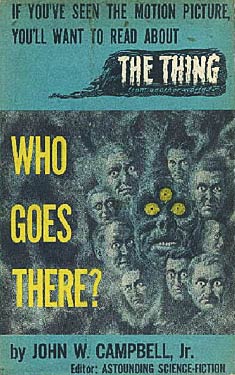
"Who Goes There?" by Don Stuart (a pseudonym for sci-fi pioneer John W. Campbell) is one of the acknowledged great stories in speculative fiction.  Part science-fiction, part horror and part psychological thriller, it tells of an isolated Antarctic research facility that discovers a flying saucer long buried in the ice.  Investigation leads to finding the saucer's sole inhabitant not too far away and taking the BEM-sicle back to the Ice Station for analysis.  Of course, it escapes and this particular ET has a special talent—it can "pretend" to be anyone it has killed and "absorbed."  Hiding in plain sight, the "Thing" starts picking off the scientists one by one, while the humans among them start to worry which of their (dwindling) number could be the wolf in sheep's clothing.  Paranoia strikes deep, but "The Thing" strikes deeper, able to replicate the men down to their blood-cells, which provides them with a nifty test to see who's genuine and who's a "Thing"-a-ma-job—take a blood-sample and dip a hot wire into it, and the alien-cells react and start to metamorphose, while the human hemoglobin merely sizzles.


Eventually, the alien is trapped by the scientists, while it is constructing an anti-grav ship to escape, forcing it outside into the cold, where it is torched by the scientists.  Humanity triumphs that the alien has been thwarted from fleeing or spreading itself to another outpost.  All's right with the world, especially considering that no other visit has occurred since the first ship crashed twenty million years before.  No other invasion is expected anytime soon.  The end.

From its origins in the August 1938 issue of "Astounding Stories," the tight, compact story was first adapted for the screen by Charles Lederer (with assists from Ben Hecht) and the film's producer, one of the great directors of American film, who put such a personal stamp on the film that, to this day, there is debate about just how much work on it the listed director of record actually did.  And that man's influence has taken over the DNA of his film's clones, so powerful is his influence and legacy.


The researchers take a measurement of the saucer.
Hawksian team-work in The Thing (from Another World)


The Thing (From Another World) (Christian Nyby, 1951).  Yes, it says "Christian Nyby" in the credits, but the film is such a prime example of Executive Producer Howard Hawks' style that folks just assume he had a hand in directing it, as well.  He almost certainly re-wrote the script, as it crackles with wit, banter, and includes the requisite "Hawks woman" who's tough enough to play with "the boys."  In fact, the dialogue and human interplay are better than the film deserves and is more entertaining than the "monster movie" that is at its frozen core. 

Hawks puts it in the arctic, then tossed out Campbell's psychological element—his military/scientific crew are Hawksian professionals and suspicions about each other would drive a wedge into that mix (it's enough that one scientist want to emphasize research over self-preservation to cause some heated exchanges*), fraying the team-spirit necessary for to get through the crisis and the simple goal of staying alive.  Nope.  It's simple.  The "Thing" is bad.  "It" wants to kill us.  We kill "it" before "it" kills us.  Research?  That's what autopsies are for!

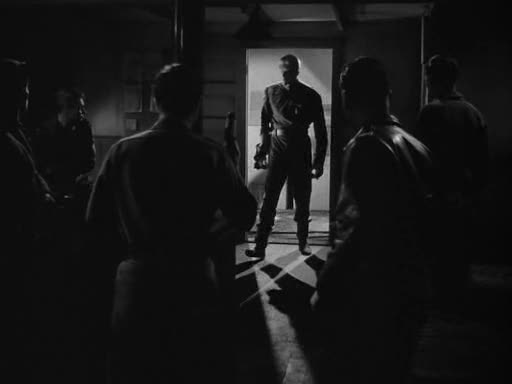
So, The Thing (From Another World) is much more of a monster movie than the study of paranoia the story is.  Teamwork towards a common goal is emphasized—you can say that a lot of Hawks' films are analogies to the disparate gypsy-camp of film-makers working together to create a single film—and it boils down to survival.  Besides the interplay of the characters, the film also boasts some iconic scenes: the Air Force officers and scientists spreading out on the ice to determine the size of the saucer; the sight of "the creature" (explained in simple unscientific jargon by one of the researchers as "an intellectual carrot") silhouetted in light as it kinetically bursts open the door of the room hiding the crew; the truly eerie scene of growing blood-sucking creature-clones like they were lethal daisies.

The Thing (From Another World) is a tough, no-nonsense monster movie with sides clearly drawn: us against them.  But the only hint of the original tale's paranoia comes from the film's final line: "Watch the skies!"


Braised carrots are on the menu at the arctic station tonight.
James Arness (in a role he hated) gets fried in The Thing (From Another World)


The Thing (John Carpenter, 1982) Carpenter has long been a disciple of Howard Hawks (his Assault on Precinct 13 is an urban remake of Rio Bravo, and Halloween is merely The Thing in costume), so it was only natural that he would take on the sole horror movie in Hawks' CV.  Bill Lancaster's script hews a little closer to Campbell's story, re-introducing the character conflicts and the assimilating alien (and eliminating Hawks' lone female character, making the station very much a "boys' club," comprised of Carpenter's "go-to" top-liner Kurt Russell—as chopper pilot McReady—and a "who's who" of veteran '80's character actors, Wilford Brimley, T.K. Carter, David Clennon, Richard Dysart, Charles Hallahan, Donald Moffat, Keith David, and Richard Masur).  In the Hawks version it was "us against them;" with Carpenter, it's back to "we have met the enemy, and he could be one of us."


Kurt Russell as MacReady in Carpenter's version


The tone is decidedly different, too.  Carpenter's film is dark and brooding and creepy, punctuated by sequences of crazily unnerving violence concocted by make-up wizard Rob Bottin's creative realizations of the creature's ability to turn any part of a human's anatomy into a potential source of weapon or defense.  It's icky and gooey and strangely goofy to see heads sprouting spider legs and skittering through the facility, or to see the detached head of one of the researchers pull itself along by whipping its tongue around a table leg and pulling itself out of harm's way.


Rob Bottin's creature creations for The Thing (1982) emphasize
a strange versatility when utilizing its human hosts.

Ultimately, though, for all the anarchic lunacy of the monster sequences, the movie boils down to a claustrophobic, paranoid fight between the men amongst themselves in their search for who is the monster among them, and Carpenter ends the film on a decidedly down note as the survivors of the carnage eye each other, each suspecting the other of being a creature, while they await certain death from the freezing elements, their previously secure station decimated by the events of the previous hours, providing no safety, no sanctuary or any warmth.  There are no winners in the decidedly small intergalactic battle zone.   And, though we're left with no ending and only a stalemate, we can be assured there will be no survivors, either.  Any victory is hollow, and one is left pondering if any "thing" human came out of it.


The Thing (Matthijs van Heijningen Jr., 2011) A direct prequel to Carpenter's film,** but basically the same plot.  Spaceship found.  Creature in the ice.  Thaws out.  Starts absorbing people.  What's interesting is that van Heijningen also pays tribute to Hawks, by turning the sex-tables on the story, making paleontologist Kate Lloyd (Mary Elizabeth Winstead from Scott Pilgrim, who looks unnervingly like Zooey Deschanel and can rock a flame-thrower) the "guy-in-charge" after the official authority structure breaks down.  Just as Hawks up-ended The Front Page by casting Rosalind Russell in one of the men's roles for His Girl Friday, van Heijningen provides an interesting dynamic by putting a woman in control of a station full of panicking men.

One doesn't have to have seen the Carpenter version to appreciate what is going on in the film, but if one has there are touchstones that one can appreciate (and check off if one is a "completist" or continuity-obsessive) along the way—especially at the end once the credits have started rolling—there's the merged double-creature that is briefly seen in the earlier film, the axe in the door, the suicide, the fleeing dog pursued by snipers.  But, the giddy, manic quality of the creature-creations has been muted for straight-out horror effects—van Heijningen even has a cheap-shot "Boo" effect early on that still makes one jump—but Carpenter's (and Campbell's) blood-test sequence is neatly sabotaged for a simpler, more organic, and slightly creepier, test that anticipates a potential attack every time someone opens their mouth.

It does its job well, but one is left feeling it really wasn't necessary to make this entry, as it its only function seems to be to ride the coat-tails of its predecessor and fill in some blanks of an already competent version that left some audience-members behind (in the same way that 2010 did for 2001).


Kate Lloyd (Mary Elizabeth Winstead) rocks a flame-thrower.

* And we all know how disastrous heated exchanges can be at an ice-station!

** The film literally ends where Carpenter's begins, with a Norwegian helicopter  and gunman chasing a dog over the Antarctic wastes.


Wednesday, August 11, 2010

Executive Decision


"Executive Decision" (Stuart Baird, 1996) Good "bottled" actioner on many fronts: one of the better pre-911 films that used terrorist hijacking as a plot-point, superstar editor Stuart Baird's best film as a director, and probably the best movie Steven Seagal ever appeared in.  It's also a tense film with a superb cast that will keep you on tenderhooks until the last moment.


A Boeing 747 domestic airliner is hijacked from Europe, heading for the U.S.  Intel expert Dr. David Grant (Kurt Russell) suspects a powerful chemical agent is on-board that the terrorists will slam into a major city, wiping out its population.  Special Forces Lt. Colonel Austin Travis (Seagal) has been burned on Grant's reports before, and insists that he accompany his team of wet-ops (Joe Morton, John Leguiziamo, B.D. Wong) on a mission to take back the airplane and take out the terrorists (led by David Suchet, whose baleful expressions betray none of the glint he brings to Agatha Christie's Poirot).


It may be the best decision he never wanted to make.  Grant may be a fish out of water in the field, but as a beginning flying student, he at least has some core competency in the simultaneously wide open spaces and cramped environs of an airplane.  Still, the mission's going to be tough to do in-flight.  But, a prototype stealth-plane with collar could be sent up to rendezvous with the 747 unseen, allowing the team to slip on-board undetected...that is, according to its "blue-sky" engineer Dennis Cahill (Oliver Platt).  There is no other choice but to take a flyer and make the attempt.  But, of course, complications arise, not the least of which are the buffeting forces that aren't antcipated when the tiny "Remora" shuttle is attached to the gargantuan air-ship. 


The hectic transfer creates an untenable situation for the ops team: one of their experts is critically injured, the command position must be filled by Grant and Cahill (who were never supposed to be on the hi-jacked plane), and their communication gear is compromised so they ahve no way of relaying information back to Washington, who are on a parallel course to track, and possibly, shoot down the plane before it enters U.S. air-space.  The Special Forces are therefore forced to move forward with their plans, operating in a communications blackout, and in the dim confines of the 747's infrastructure, in order to save the plane and their own lives.   With help from one particularly plucky air hostess (Halle Berry—the hysterical Marla Maples Trump is no help at all*) the team must first identify the hi-jackers, secure the nerve gas, dodge the fighters, and get the plane down safely.

Even before the events of 9/11 (or even because of them), it's a smart, interesting, tense little film that sets up an impossible mission, and throws as many complicating hurdles at the SF crew before it can be resolved.  It's a disaster movie, so things go disasterously, the stakes rising as the plane edges towards the East Coast.  Russell (who's always a welcome presence in a film) makes for a believable "only-book-smart" field-man, effectively giving audience-intel through the "what the hell" panic behind his spectacles, and the superb supporting cast all create characters you care about and root for.  A great combination of tense action with good, no-nonsense writing that never cuts the audience or the movie any slack.


* "You're fired, honey..."

Wednesday, June 3, 2009

Death Proof

"Death Proof" (Quentin Tarantino, 2007) Part of the "Grindhouse" doube-bill imagined by Robert Rodriguez and Tarantino in 2007. Rodriguez's feature "Planet Terror" was such an object of loathing on my part that I was in no hurry to see Tarentino's half, not being a fan of Tarantino's body of work, but liking a couple of his films.

Goes to show you. Don't take anything for granted.

"
Death Proof" is such a luxurious exercise in emulating "bad girl" exploitation movies that it manages to rise above the material and actually prove a well-constructed, well-considered and deliriously fine thrill-ride. It's so good, that it fails miserably at its intention of posing as a B-movie.

This is a problem?

Directed and photographed by Tarantino (and very well, as he gets shots that look extremely dangerous to achieve), the flick tells the story of Stuntman Mike (
Kurt Russell) who targets girls in cars for murderous collisions. Done in long, long disciplined takes the girl-packs are followed through their paces by the audience and stalking Mike: first, a bevy of Austin, Texas girl-friends of morning DJ Jungle Jill (Sydney Poitier) who proceed to get wasted and meet up Mike on a dark street; then, a clutch of movie-crew women in Tennesee led by hair-stylist Kim (Rosario Dawson), and a couple of stunt women. This scenario is in marked contrast to the first, which ended in an orgiastic car-crash, this second is a white-knuckle chase.

It could be seen as a "Don't Drink and Drive" warning. It could be a "girl-power" statement (it certainly is that). It could be a flipped digit to those all-powerful-stalker movies. But whatever it is, Tarentino pulls out all the action stops, creating some of the most reckless sequences put on film (the stunt Union must love him), with techniques borrowed from a number of acknowledged directors in the credits.

It could also be a love letter to stunt-woman
Zoe Bell (the credits say "Zoƫ Bell as Herself"). Bell, who was the stunt double for "Xena: Warrior Princess" and did the elaborate "Bride" stunt sequences for "Kill Bill" does some extremely agitating work in "Death-Proof," as an Australian stunt-woman who is in the unfortunate position of riding the hood of a car when the women encounter Stuntman Mike on a lonely (and seemingly endless) stretch of dirt road. No, you haven't seen anything like it.

Now, there are some irritating things: a couple of the actresses (
Rose McGowan and Tracie Thoms) don't know sub-tle acting techniques—and neither does Tarantino in another of his grand-standing cameos—but Bell, Russell and Dawson compensate mightily doing great work. There's a breaking of the fourth wall that's a little too cute and creepy. Tarantino overdoes the false scratches and imperfections to try and achieve an old movie effect (at one point, an entire reel is in black and white), a bit of dialogue is repeated in a bad edit (anyone who could make a film this good wouldn't make that mistake). But these are minor considerations in great work.
In my laceration of "Planet Terror," I wrote about the aspirations of artists trying to recreate the "crap of their youth," which they enjoyed, in an attempt to recreate the experience for a new generation:
I know what they were going for in "Grindhouse." They were trying to go back to the "C"-movie days of double-bill films that tried to eke out a profit by appealing to the lowest common denominator--the kids-and-cretins-circuit—something that Dimension Films,"Grindhouse's" distributor, routinely does, as well. Some of the greatest directors of movies—some of the brightest—honed their craft in the AIP's and worse. But once they got their chops, they stopped making crap. They aspired. They wanted more. Only someone of limited creativity (or a moron...or a deeply cynical artist) would knowingly aspire to garbage, and so reluctantly, I'm bestowing that label to Robert Rodriguez--the "deeply cynical artist" one, as he's very creative, and certainly not a moron. Left to his own devices, Rodriguez can do some entertaining work--the El Mariachi films, the "Spy Kids" films, and they're made with an economy that's something short of miraculous--but team him with his mentor, Quentin Tarantino and it all turns to shit (QT has a mercifully brief role in "Planet Terror," as an over-acting rapist, where he proves, once again, that he's the male equivalent of Pia Zadora). The guy's got the chops, no doubt about it. But he has one thing missing in his many talents--taste. They don't teach that at film school, and you can't get it at the video store. "Taste" is what you get when you aspire, and it can even be with the schlockiest material known to man ("Touch of Evil," "Psycho," "The Godfather"...I can go on and on about artists who reached to make a silk purse out of a sow's ear), but to revel in schlock, to aspire to it...and have the results be so ...marginal, so ...bad, and not even in a funny way, but pitiable, well, you start to wonder what it is you saw in these guys before.

Tarantino saw the schlock, loved it, and in his attempt to recreate it, surpassed it, improved it, and passed along his love to the audience, validating it. He got the formula exactly right.

Bravo.

Bravo and "wow." *


Good Will Hunting.
Kurt Russell breaks a lot of things in "Death-Proof" including the "Fourth Wall.
"


* Yeah, yeah—loved it, sure. But, lest you go rushing out expecting a masterpiece of art, this caveat: It's an exploitation film. That means there's going to be something that offends...well, just about everybody (including folks who get off on exploitation films!) It's just part of the Grand Scheme of "Death Proof."

(Wilhelm alert @ 00:51:23)