Showing posts with label Gary Lockwood. Show all posts

Tuesday, April 24, 2012

It Happened at the World's Fair

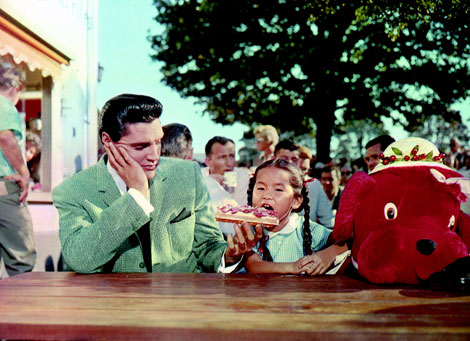
It Happened at the World's Fair (Norman Taurog, 1963) I'm something of a lunkhead about Elvis Presley, even though I grew up in the Elvisian Era.  Fact is, I was born into the Presley presence—he was a fact of life and nothing revolutionary to me, and by the time I was actually cognizant of him, aware, he had moved on from being a rock n' roll revolutionary to being something of a lounge lizard.  He'd evolved on to the Hollywood Elvis period, where there was less emphasis on picking good material and taking chances and more on banking on his success and name recognition, while also taking the edge off his persona to be more acceptable to "Mom and Dad America."  The films started out somewhat inspired, even special, then settled into a pattern of sticking the King into formula scenarios pulled from the screenwriters' template that had the feel (and factory precision) of romance novels.  They did the job, but had all the nutritional and aesthetic value of a TV-dinner, circa 1960.

Culturally, the U.S. had swiveled away from mambo (Castro's overthrow of Cuba being the main reason, as well as the inevitable momentum of faddishness) and gone Polynesian—the American Eagle had sunk its claws into Hawaii permanently, folding it into statehood, and Tiki had started to invade American dens and Trader Vic's was the big restaurant.  At the same time, Seattle was looking to the future, Sputnik having launched America's fledgling space program into a panicky orbit, and the plastic revolution bombarding American kitchens.  City fathers (one of whom was my father's employer) started a campaign to bring another World's Fair to the home of Boeing (its first being the Alaska-Yukon-Pacific Exhibition in 1910—on the site of what is now the University of Washington).  This one would be more forward thinking, embracing science and technology, and the 1962 Seattle World's fair was dubbed "Century 21."  It was surprisingly successful, managing to turn the city's "Warren Avenue slum" where the Armory was housed into a central hub of the downtown era...and—a rarity for World's Fairs—turn a profit.

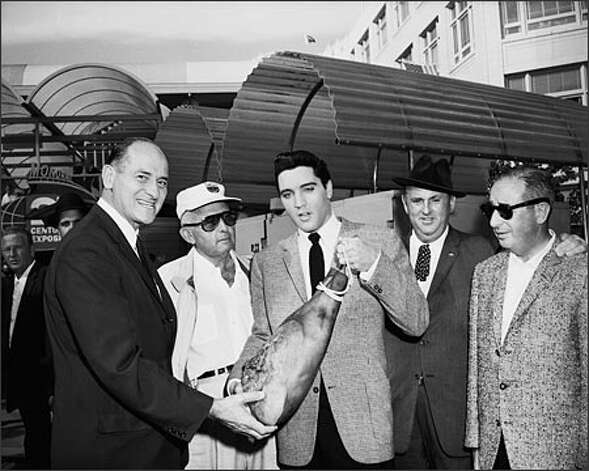
The organizers were particularly good at attracting celebrities and entertainers to the Fair, and only the Cuban Missile Crisis kept President Kennedy from officiating over the closing ceremonies.  They even managed to make a movie deal with M-G-M for Elvis to make a movie, no doubt paying the studio a handsome sum for the privilege, while also getting some of the corporate sponsors of the Fair to contribute towards the film (probably the reason why G-M's "car of the future" figures so prominently in the film—for no apparent reason).  If it was to promote tourism and the Fair, they might have worked out the timeline a little better—The film opened in April of 1963, six months after it had closed!

It Happened at the World's Fair (It's rather tough to determine what "it" is) is a fairly lousy Presley programmer, short of plot (Elvis is a pilot of a crop-duster, in partnership with Gary Lockwoodand gambling debts force them to try and raise money to buy their plane "Bessie" back) but it's the gristliest of connective tissue between songs that were barely charting and love scenes for the fans.  Director Norman Taurog was an efficient, if uninspired, director who moved from silent pictures through studio series—his peak years were directing the Martin and Lewis comedies before Lewis got the directing bug—who could be counted on to bring things in on-time and under-budget.  He was good at logistics, and managed to keep the studio accountants happy that his films were managed enough to be able to make a profit at the box-office.  And his experience with comedies made him a good candidate for making things light and airy and moving fast.

Which is what this one needed.  Seeing it as a kid, I thought it was the dullest thing in the world and needed more shots of The Space Needle and, frankly, The Fair.  Seeing it as an adult is a grim experience when noting that your tastes haven't changed much.  There are faint flashes of wit once in awhile, but it goes without for long stretches of obvious, perfunctory film-making.  But, face it, the thing was a commercial enterprise that had outlived its usefulness except to sell records for M-G-M, rather than break them.  It does have one oddity worth noting for trivialists: in the role of a kid who kicks Elvis in the shins (to fake an injury to see a pretty nurse) is Kurt Russell, who would play Presley in John Carpenter's biographical film (produced by the late Dick Clark, by the way).

The Seattle World's Fair opened 50 years ago, this past weekend.


Wednesday, May 27, 2009

Anytime Movies Reloaded: 2001: A Space Odyssey

It's Spring-Break for me. Times are busy. The Summer Movie Season is already begun (and I'll be writing about the new ones) and the Film Festivals are grinding away like creaky mills separating wheat from chaff. It's as good a time as any to re-boot a feature I started years ago, when it was suggested I do a "Top Ten" List.

I don't like those: they're rather arbitrary; they pit films against each other, and there's always one or two that should be on the list that aren't because something better shoved it down the trash-bin.

So, I came up with this: "Anytime" Movies.

Anytime Movies are the movies I can watch anytime, anywhere. If I see a second of it, I can identify it. If it shows up on television, my attention is focused on it until the conclusion. Sometimes it’s the direction, sometimes it’s the writing, sometimes it’s the acting, sometimes it’s just the idea behind it, but these are the movies I can watch again and again (and again!) and never tire of them. There are ten (kinda). They're not in any particular order, but the #1 movie IS the #1 movie.


Why is “2001” my favorite film?

1. It completely does away with the three-act play structure that hems in most films. It’s four acts—like a symphony.

2. It contains very little dialog, and insists on telling its story (about discovering extra-terrestrial life) and providing key dramatic information visually and aurally—something that too few films actually try to do--fully utilizing the strengths of the medium.

3. It dispenses with the traditional sense of screen-acting which depends on emoting high-points (which is not standard drama, but is, in fact, melodrama), that has long been the crutch of what is considered great screen acting.

4. It comes up with a rather nifty solution for the Evolution versus Creation argument, which is: “Why can’t it be a little bit of both?” Trust
Kubrick to answer a question with another question.

5. It is that very rare item in movie history—a true Science Fiction film. It is not a standard genre film (ie. a western or detective story) set in the future with gadgets, like “
Star Wars” or “Close Encounters” or “Blade Runner” or “Outland” or “Forbidden Planet.” There are no comfortable, reliable concepts in “2001.” It asks audiences to consider the inconsiderable and make leaps of knowledge and faith. And it doesn’t wait for that audience to catch up, despite protestations of a “glacial” pace.

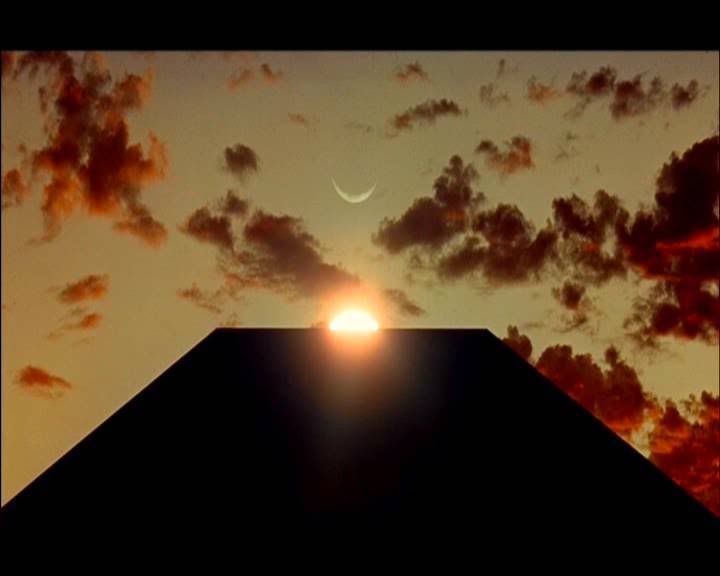
6. It obeys the rules of space and uses them dramatically. There is no sound in space. Trips in space take a long time. Isolation is a problem. Don’t get caught without your helmet. Ask your computer how its doing every so often. When you're dining over at a stranger's house, don't break the crystal. If a black monolith crosses your path, don't reach for it unless you're prepared for your life to change. Rules like that...

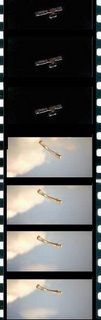
7. It takes advantage of the one unique element that separates film-making from any other art form, and presents the single greatest edit in movie history. To wit:

My Dad took me and my friend Jerry Fortune to see "2001: A Space Odyssey" on my thirteenth birthday. I was a space kid. I lived and breathed the Apollo program. I knew every Astronaut’s name and every mission. What went right and what went wrong. The names of landing sites and prominent craters nearby.

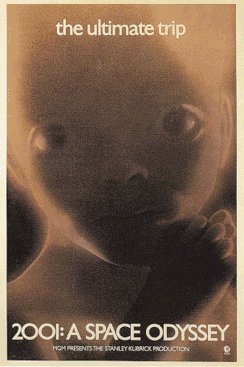
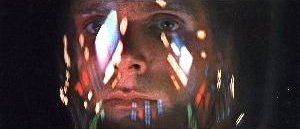
But I couldn’t make heads or tails out of this movie. Like my father, I “liked the middle parts,” but I couldn’t figure out what was up with the monkeys, what all that weird screaming was about, what was with those streamers when they get to Jupiter, who was the old guy and what was that baby at the end?

I mean, huh?

I was determined to figure it out. It was a space-movie for cryin’ out loud. And, at that time, they only came around once in a blue moon (the last being “
Planet of the Apes,” hardly a space-movie) and I wasn’t going to waste this one.

So it made me dig. I researched. I found out it had to do with the search for extra-terrestrial life (it did?), then I read Clarke’s book, and although Clarke and Kubrick deviated quite a bit, it let me in to what Kubrick was trying to communicate.

Then I got it. It made me realize why he did what he did, why he chose particular scenes to portray, why he framed shots the way he did, and what he could get away with without making his movie look stupid. For Kubrick, a suggestion was better than hitting you over the head by showing bug-eyed children in baggy suits and rubber masks ala Spielberg. There was no narrator to tell you what it all meant (Kubrick had cut out a prologue of talking heads discussing E.T. concepts). The film-maker trusted that his audience would figure it out. Some did.* Some just liked all the colors.

And it left a lot of people (including one thirteen year old and a good number of complacent critics) in the moon-dust.

It still boggles this mind that Kubrick was able to take Arthur Clarke’s slim concept in “The Sentinel” (alien beings leave a "burglar" alarm of sorts on the Moon), and take it to a logical beginning, wrap it in mythic proportions and take it to an inevitable, and, for me, heroic, end. It still is one of the few movies that purport to be science fiction with a deep sense of mystery and wonder, even a kind of visual poetry--something its sequel, the literal-minded “2010,” dispensed with to its drab, short-shelf-lived detriment.

Where did that inspiration come from? How did those concepts appear? For me, the movie fits the description of the Black Monolith in the film (and are its last spoken words) “It’s origin and purpose, still a total mystery.”

I may have seen "2001: A Space Odyssey" over a hundred times, and it never, ever bores me or fails to thrill me.

Such is the power of this movie over me.


*A site that "explains" "2001" and touches on some philosophical aspects

Here's the oldest running web-site about "2001". Lots of handy info.

The 2001 Internet Resource Archive. Lots of neat things here, too!

A pretty comprehensive Kubrick web-site

"Welcome to the Hal Corporation"

The Hal project


2001: A Space Odyssey
Citizen Kane
Once Upon a Time in the West
—Only Angels Have Wings
The Searchers
Mr. Smith Goes to Washington
Chinatown
American Graffiti
To Kill a Mockingbird
Goldfinger
Edge of Darkness

Large Association of Movie Blogs


Thursday, July 3, 2008

Olde Review: 2001: A Space Odyssey

This was part of a series of reviews of the ASUW Film series back in the '70's. Except for some punctuation, I haven't changed anything from the way it was presented, giving the kid I was back in the '70's a break. Any stray thoughts and updates I've included with the inevitable asterisked post-scripts.

SPOILER ALERT: I give away the entire plot of "2001" in this review, and with no apologies. There are some who might find this a good thing. Like Rock Hudson, who famously walked out of the premiere yelling "Will someone tell me what the hell this is about?" He was one of the 217 people who walked out of the premiere of "2001." That is an exact number. Kubrick was in the audience. He counted. Then he cut the film by some 20 minutes.

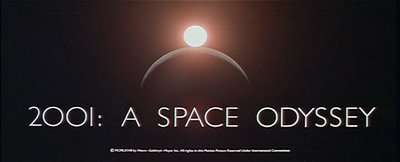
"2001: A Space Odyssey" (Stanley Kubrick, 1968) "2001"-now there's something to get excited about! I've seen it a dozen times and I have always been spell-bound and elated by it. It is, so far, Kubrick's masterpiece.* Certainly, it is the finest example of science fiction in film to date, undoubtedly one of the greatest films of the 60's and possibly of all time.** It is Stanley Kubrick's version of mankind's first contact with a life off of our planet, with the added twist that that extra-terrestrial life is out "God," which "created" us in such a way as to satisfy both Biblical and Darwinian theories of that momentous occasion (which in Kubrick's visualization, it certainly is) For anyone who hasn't figured it out yet, this is the very simple story-line:

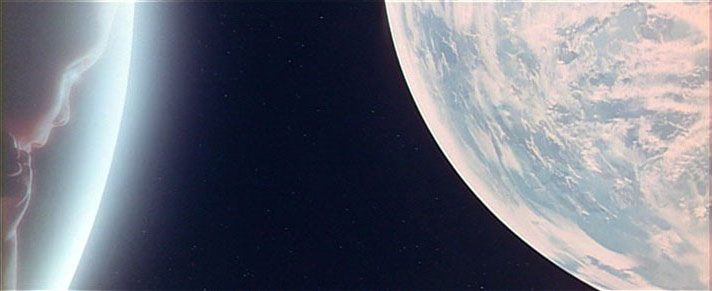
An extra-terrestrial life visits earth in its pre-historic past and finds a stagnating man-ape community and teaches it to use a tool, a bone, for killing, for food, and that lesson boosts man-ape several rungs up the evolutionary ladder. To continue their experiment the ET's bury a signalling device on the Moon, so that they may know when their creation has reached out into space. Of course, it is discovered and that signal*** is traced to Jupiter. A team of astronauts is sent to investigate. In Kubrick's version, the man of 2001 has stagnated much like the man-apes. He has reached the point where he has recreated himself mechanically, right down to his own neuroses. He has nowhere to go as such, and so, when Man, in the form of Astronaut David Bowman, arrives at Jupiter, he finds a transport to the ET's planet, where he is kept and studied the rest of his life. When he dies, he is "reborn" by his captors into a higher form of Man, much like the man-apes were, and the film ends with this "Star-Child," this "super-man" hovering over the Earth, watching, and considering his next move.

None of this is explained out-right, you have to figure it out through the film's images. Only a third of the film has dialog, most of it unimportant as far as plot development--and the plot development comes slowly, I wouldn't be surprised if some cretins actually got bored by it.**** You never see the ET's; it would be impossible to do it believably.***** But...even if you don't understand "2001," it still succeeds as being a visual and aural experience, something to be marvelled at. I think it can safely be said that no science fiction film can help but be compared with "2001" and compared unfavorably. I don't think I can do "2001" any justice in the time allotted, but I can personally say it is one of my ten favorite films, and it is the one that sparked my own interest in film several years ago.

Another thing--this might be your last chance to see "2001" before it is shown on TV and butchered by commercials and (the restrictions of) a square screen, so...go see it...as it should be.

Nothing to add that hasn't been said here. There are worse films to have as a Film-going Rosetta Stone. I've written about "2001" so much that I fear it to be obsessive, so I try to avoid it, actually. Such a thing can be limiting. But I do think it's one of the few "pure" science fiction films, willing to make an audience try to grasp an alien (in both meanings of the term) concept, and challenge them in intellectual, if not dramatic ways. Most science fiction is some other genre with jet-propulsion added.

Finally, this is one film that necessitates being PROJECTED. It really does need to be seen BIG and WIDE, not crimped by the confines of a small TV. Okay, that's it. I've written enough. On to the asterisks.

* And now, almost a decade after Kubrick's death, it's safe to say it still is, although "Dr. Strangelove" is still in the running, as well as "Barry Lyndon," his much-maligned brilliant film of the "me" decade of the 80's...1780's.

** Obviously, I like this film. Still do.

*** It's a solar-powered alarm. When it's dug up and the sun hits it for the first time, it sends its signal out into the Universe.

**** This is terribly unfair. I know a lot of intelligent people who are bored by it, and don't mind saying so. It is paced slowly. I'm in love with the film, so I just don't notice it--for me, it moves like a bat out of hell. But then, my eyes are constantly scanning the frame of "2001" picking out the details -- and that is tough to do on video (Not long ago, an acquaintance finally saw it in a theater and expressed shock: "My God, all those little windows are filled with people!" Yeah. They are. So, if you're wondering why it takes a minute for the moon-lander to descend through the landing bay, rather than worry about it, or the next thing, take a look around Kubrick's world. It's pretty damned full.

***** Something I still believe despite the parade of Spielberg's emaciated Pillsbury dough-boys, and the pantheon of alien life exhibited in the "Star Wars" and "Trek" universes. I still never really "buy into" a representation of alien life. I keep wondering who their agent was, and what their make-up clause was like.


Large Association of Movie Blogs

Monday, January 14, 2008

2001: A Space Odyssey


Why is “2001” my favorite film?

1. It completely does away with the three-act play structure that hems in most films. It’s four acts—like a symphony.

2. It contains very little dialog, and insists on telling its story (about discovering extraterrestial life) and providing key dramatic information visually and aurally—something that too few films actually try to do--fully utilizing the stregths of the medium.

3. It dispenses with the traditional sense of screen-acting which depends on emoting high-points (which is not standard drama, but is, in fact, melodrama), that has long been the crutch of what is considered great screen acting.

4. It comes up with a rather nifty solution for the Evolution versus Creation argument, which is: “Why can’t it be a little bit of both?” Trust
Kubrick to answer a question with another question.

5. It is that very rare item in movie history—a true Science Fiction film. It is not a standard genre film (ie. a western or detective story) set in the future with gadgets, like “
Star Wars” or “Close Encounters” or “Blade Runner” or “Outland” or “Forbidden Planet.” There are no comfortable, reliable concepts in “2001.” It asks audiences to consider the unconsiderable and make leaps of knowledge and faith. And it doesn’t wait for that audience to catch up, despite protestations of a “glacial” pace.

6. It obeys the rules of space and uses them dramatically. There is no sound in space. Trips in space take a long time. Isolation is a problem. Don’t get caught without your helmet. Ask your computer how its doing every so often. When you're dining over at a stranger's house, don't break the crystal. If a black monolith crosses your path, don't reach for it unless you're prepared for your life to change. Rules like that...

7. It takes advantage of the one unique element that separates film-making from any other artform, and presents the single greatest edit in movie history. To wit:


My Dad took me and my friend Jerry Fortune to see "2001: A Space Odyssey" on my thirteenth birthday. I was a space kid. I lived and breathed the Apollo program. I knew every Astronaut’s name and every mission. What went right and what went wrong. The names of landing sites and prominent craters nearby.

But I couldn’t make heads or tails out of this movie. Like my father, I “liked the middle parts,” but I couldn’t figure out what was up with the monkeys, what all that wierd screaming was about, what was with those streamers when they get to Jupiter, who was the old guy and what was that baby at the end?

I mean, huh?

I was determined to figure it out. It was a space-movie for cryin’ out loud. And, at that time, they only came around once in a blue moon (the last being “
Planet of the Apes,” hardly a space-movie) and I wasn’t going to waste this one.

So it made me dig. I researched. I found out it had to do with the search for extra-terrestrial life (it did?), then I read Clarke’s book, and although Clarke and Kubrick deviated quite a bit, it let me in to what Kubrick was trying to communicate.

Then I got it. It made me realize why he did what he did, why he chose particular scenes to portray, why he framed shots the way he did, and what he could get away with without making his movie look stupid. For Kubrick, a suggestion was better than hitting you over the head by showing bug-eyed children in baggy suits and rubber masks ala Spielberg. There was no narrator to tell you what it all meant (Kubrick had cut out a prologue of talking heads discussing E.T. concepts). The film-maker trusted that his audience would figure it out. Some did.* Some just liked all the colors.

And it left a lot of people (including one thirteen year old and a good number of complacent critics) in the moon-dust.

It still boggles this mind that Kubrick was able to take Arthur Clarke’s slim concept in “The Sentinel” (alien beings leave a "burglar" alarm of sorts on the Moon), and take it to a logical beginning, wrap it in mythic proportions and take it to an inevitable, and, for me, heroic, end. It still is one of the few movies that purport to be science fiction with a deep sense of mystery and wonder, even a kind of visual poetry--something its sequel, the literal-minded “2010,” dispensed with to its drab, short-shelf-lifed detriment.

Where did that inspiration come from? How did those concepts appear? For me, the movie fits the description of the Black Monolith in the film (and are its last spoken words) “It’s origin and purpose, still a total mystery.”

I may have seen "2001: A Space Odyssey" over a hundred times, and it never, ever bores me or fails to thrill me.

Such is the power of this movie over me.


* A site that "explains" "2001" and touches on some philosophical aspects


Anytime Movies are movies I can watch anytime, anywhere. If I see a second of it, I can identify it. If it shows up on television, my attention is focused on it until the conclusion. Sometimes it’s the direction, sometimes it’s the writing, some times it’s the acting, sometimes it’s just the idea behind it, but these are the movies I can watch again and again and never tire of them. There are ten (kinda). This is Number 1.


1. 2001: A Space Odyssey