Showing posts with label 1951. Show all posts

Wednesday, August 1, 2012

The Desert Fox

The Desert Fox: The Story of Rommel (Henry Hathaway, 1951) "In the somber wars of modern democracy, there is little place for chivalry." Words of Winston Churchill, during the Second World War and his censure debate before Parliament concerning Field Marshall Erwin Rommel, nicknamed "The Desert Fox," considered Germany's greatest strategist of WWII. 

Churchill may have been referring only to the consequences of his words, but that he made them is extraordinary.  No less extraordinary is that an American film studio would make a movie about a Nazi soldier six years after the termination of that war.  Even more extraordinary that the head of that studio, Darryl Zanuck, had spent a goodly amount of time as a chronicler of the North Africa campaign, and was as patriotic and conservative as they come.

But, he loved a good story.

And he found it in Desmond Young's post-war biography of Rommel; Young was also in that campaign, but in the trenches and had a brief encounter with him, inspiring him to research the man and write the book.  Young appears as himself in the film, but the narration sounds more like Michael Rennie.  The script, spare as it is, is by Nunnally Johnson (who wrote for Ford, Hawks, Wilder, Aldrich in a long career), who does very well at "writing to silence"—the practice of creating dialogue for conversations that no one surviving heard.  There's a lot of padding going on.  A pre-credits sequence of sorts that has a British commando raid on Rommel's HQ, some Allied talk about him—the letter telling soldiers not to attribute supernatural powers to the man is word for word true—and a lot of stock-war-footage sequences that bridge incidents that round out the story and provide the big picture (some of the scenes show Eisenhower and Patton).

But Rommel, played by James Mason, is the focus, specifically his years in the Second World War, his victories despite supply problems, and an increasingly erratic strategizing by the Fuehrer-in-Chief, which ultimately led the Field-Marshall to side with the conspirators who plotted to kill Hitler in a French bunker during a battle briefing (which was detailed in Valkyrie) and led, ultimately, to his death by Nazi-assisted suicide.

That turning of purpose, showing the conscience of a soldier fighting for his country, for its advancement and survival, whether by conquest or by treason, makes a very interesting story of principals.  And, along with the war footage, it is the through-line for the story, as Rommel comes to realize that in order to win the war and gain the peace, he must cut a little red tape, right at the jugular of the High Command.


Hathaway's approach is, as ever, artfully utilitarian.  He doesn't try to sentimentalize Rommel (too much), and spends a lot of time in desert locations trying to simulate the North African situations.  Stock-footage allows  Rommel to visit installations long since obliterated.  But mostly the filming is in California and Hathaway makes it work.  Johnson's script is first-rate, and nicely incremental in detailing Rommel's change of heart...and target.  Particularly nice is a prolonged dialogue with Field Marshall von Runstedt (Leo G. Carroll) full of irony and dripping sarcasm, but not so much that you'd mistake them for being other than loyal Germans...and chivalrous warriors of the Old School.  

Great cast, too, with Mason's cool intelligence drawing in all the veteran character actors like George Macready, Cedric Hardwicke, and Everett Sloane, and up-and-comers to the screen like Jessica Tandy (as Mrs. Field Marshall) and Richard Boone as his adjutant.  Luther Adler (brother of Stella) plays Adolf Hitler, and the Jewish actor had all the erratic moves and vocal cadences down.  Nice bit of irony there, in a film that was chivalrously kind to the enemy.

Mason would return to the role of Rommel two years later in the Robert Wise film of The Desert Rats, starring Richard Burton.


Saturday, October 29, 2011

Now I've Seen Every "Thing" Department

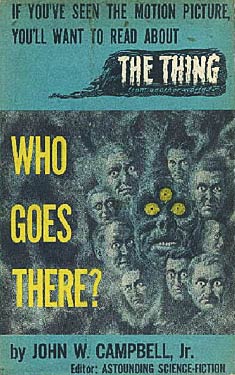
"Who Goes There?" by Don Stuart (a pseudonym for sci-fi pioneer John W. Campbell) is one of the acknowledged great stories in speculative fiction.  Part science-fiction, part horror and part psychological thriller, it tells of an isolated Antarctic research facility that discovers a flying saucer long buried in the ice.  Investigation leads to finding the saucer's sole inhabitant not too far away and taking the BEM-sicle back to the Ice Station for analysis.  Of course, it escapes and this particular ET has a special talent—it can "pretend" to be anyone it has killed and "absorbed."  Hiding in plain sight, the "Thing" starts picking off the scientists one by one, while the humans among them start to worry which of their (dwindling) number could be the wolf in sheep's clothing.  Paranoia strikes deep, but "The Thing" strikes deeper, able to replicate the men down to their blood-cells, which provides them with a nifty test to see who's genuine and who's a "Thing"-a-ma-job—take a blood-sample and dip a hot wire into it, and the alien-cells react and start to metamorphose, while the human hemoglobin merely sizzles.


Eventually, the alien is trapped by the scientists, while it is constructing an anti-grav ship to escape, forcing it outside into the cold, where it is torched by the scientists.  Humanity triumphs that the alien has been thwarted from fleeing or spreading itself to another outpost.  All's right with the world, especially considering that no other visit has occurred since the first ship crashed twenty million years before.  No other invasion is expected anytime soon.  The end.

From its origins in the August 1938 issue of "Astounding Stories," the tight, compact story was first adapted for the screen by Charles Lederer (with assists from Ben Hecht) and the film's producer, one of the great directors of American film, who put such a personal stamp on the film that, to this day, there is debate about just how much work on it the listed director of record actually did.  And that man's influence has taken over the DNA of his film's clones, so powerful is his influence and legacy.


The researchers take a measurement of the saucer.
Hawksian team-work in The Thing (from Another World)


The Thing (From Another World) (Christian Nyby, 1951).  Yes, it says "Christian Nyby" in the credits, but the film is such a prime example of Executive Producer Howard Hawks' style that folks just assume he had a hand in directing it, as well.  He almost certainly re-wrote the script, as it crackles with wit, banter, and includes the requisite "Hawks woman" who's tough enough to play with "the boys."  In fact, the dialogue and human interplay are better than the film deserves and is more entertaining than the "monster movie" that is at its frozen core. 

Hawks puts it in the arctic, then tossed out Campbell's psychological element—his military/scientific crew are Hawksian professionals and suspicions about each other would drive a wedge into that mix (it's enough that one scientist want to emphasize research over self-preservation to cause some heated exchanges*), fraying the team-spirit necessary for to get through the crisis and the simple goal of staying alive.  Nope.  It's simple.  The "Thing" is bad.  "It" wants to kill us.  We kill "it" before "it" kills us.  Research?  That's what autopsies are for!

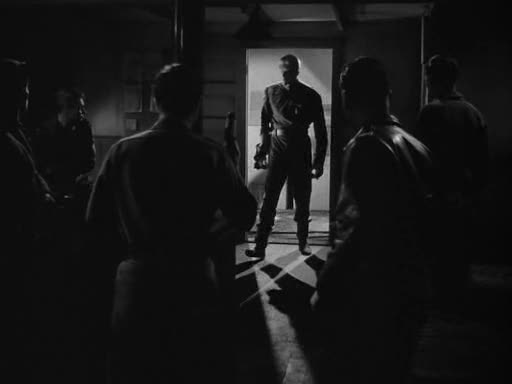
So, The Thing (From Another World) is much more of a monster movie than the study of paranoia the story is.  Teamwork towards a common goal is emphasized—you can say that a lot of Hawks' films are analogies to the disparate gypsy-camp of film-makers working together to create a single film—and it boils down to survival.  Besides the interplay of the characters, the film also boasts some iconic scenes: the Air Force officers and scientists spreading out on the ice to determine the size of the saucer; the sight of "the creature" (explained in simple unscientific jargon by one of the researchers as "an intellectual carrot") silhouetted in light as it kinetically bursts open the door of the room hiding the crew; the truly eerie scene of growing blood-sucking creature-clones like they were lethal daisies.

The Thing (From Another World) is a tough, no-nonsense monster movie with sides clearly drawn: us against them.  But the only hint of the original tale's paranoia comes from the film's final line: "Watch the skies!"


Braised carrots are on the menu at the arctic station tonight.
James Arness (in a role he hated) gets fried in The Thing (From Another World)


The Thing (John Carpenter, 1982) Carpenter has long been a disciple of Howard Hawks (his Assault on Precinct 13 is an urban remake of Rio Bravo, and Halloween is merely The Thing in costume), so it was only natural that he would take on the sole horror movie in Hawks' CV.  Bill Lancaster's script hews a little closer to Campbell's story, re-introducing the character conflicts and the assimilating alien (and eliminating Hawks' lone female character, making the station very much a "boys' club," comprised of Carpenter's "go-to" top-liner Kurt Russell—as chopper pilot McReady—and a "who's who" of veteran '80's character actors, Wilford Brimley, T.K. Carter, David Clennon, Richard Dysart, Charles Hallahan, Donald Moffat, Keith David, and Richard Masur).  In the Hawks version it was "us against them;" with Carpenter, it's back to "we have met the enemy, and he could be one of us."


Kurt Russell as MacReady in Carpenter's version


The tone is decidedly different, too.  Carpenter's film is dark and brooding and creepy, punctuated by sequences of crazily unnerving violence concocted by make-up wizard Rob Bottin's creative realizations of the creature's ability to turn any part of a human's anatomy into a potential source of weapon or defense.  It's icky and gooey and strangely goofy to see heads sprouting spider legs and skittering through the facility, or to see the detached head of one of the researchers pull itself along by whipping its tongue around a table leg and pulling itself out of harm's way.


Rob Bottin's creature creations for The Thing (1982) emphasize
a strange versatility when utilizing its human hosts.

Ultimately, though, for all the anarchic lunacy of the monster sequences, the movie boils down to a claustrophobic, paranoid fight between the men amongst themselves in their search for who is the monster among them, and Carpenter ends the film on a decidedly down note as the survivors of the carnage eye each other, each suspecting the other of being a creature, while they await certain death from the freezing elements, their previously secure station decimated by the events of the previous hours, providing no safety, no sanctuary or any warmth.  There are no winners in the decidedly small intergalactic battle zone.   And, though we're left with no ending and only a stalemate, we can be assured there will be no survivors, either.  Any victory is hollow, and one is left pondering if any "thing" human came out of it.


The Thing (Matthijs van Heijningen Jr., 2011) A direct prequel to Carpenter's film,** but basically the same plot.  Spaceship found.  Creature in the ice.  Thaws out.  Starts absorbing people.  What's interesting is that van Heijningen also pays tribute to Hawks, by turning the sex-tables on the story, making paleontologist Kate Lloyd (Mary Elizabeth Winstead from Scott Pilgrim, who looks unnervingly like Zooey Deschanel and can rock a flame-thrower) the "guy-in-charge" after the official authority structure breaks down.  Just as Hawks up-ended The Front Page by casting Rosalind Russell in one of the men's roles for His Girl Friday, van Heijningen provides an interesting dynamic by putting a woman in control of a station full of panicking men.

One doesn't have to have seen the Carpenter version to appreciate what is going on in the film, but if one has there are touchstones that one can appreciate (and check off if one is a "completist" or continuity-obsessive) along the way—especially at the end once the credits have started rolling—there's the merged double-creature that is briefly seen in the earlier film, the axe in the door, the suicide, the fleeing dog pursued by snipers.  But, the giddy, manic quality of the creature-creations has been muted for straight-out horror effects—van Heijningen even has a cheap-shot "Boo" effect early on that still makes one jump—but Carpenter's (and Campbell's) blood-test sequence is neatly sabotaged for a simpler, more organic, and slightly creepier, test that anticipates a potential attack every time someone opens their mouth.

It does its job well, but one is left feeling it really wasn't necessary to make this entry, as it its only function seems to be to ride the coat-tails of its predecessor and fill in some blanks of an already competent version that left some audience-members behind (in the same way that 2010 did for 2001).


Kate Lloyd (Mary Elizabeth Winstead) rocks a flame-thrower.

* And we all know how disastrous heated exchanges can be at an ice-station!

** The film literally ends where Carpenter's begins, with a Norwegian helicopter  and gunman chasing a dog over the Antarctic wastes.


Tuesday, August 24, 2010

The African Queen

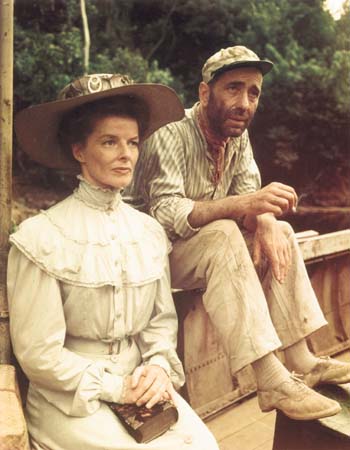
"The African Queen" (John Huston, 1951) An anomaly among John Huston's movies—an unambiguously happy ending (and with the same cameraderie and laughter of his less heroic finishes). Originally set up as a vehicle for Charles Laughton and Elsa Lanchester, then for Bette Davis and David Niven, by the time it crossed Huston's path it became an excuse for Huston to visit Africa (which had just made a cinematic splash in "King Solomon's Mines") and get in some hunting, in a Hemingwayesque quest to conquer new territory. *
Along for the ride were Huston's favorite actor, Humphrey Bogart (with his new bride Lauren Bacall), and the spunky, patrician Katherine Hepburn, who had never worked with Huston before, but was always up for an adventure. **

That always came working with the much-storied Huston.

But, "The African Queen" is a love story, one of those about the transforming nature of love, and the trip down the treacherous rapids on a craft not suited for the purpose is a metaphor for the new experience of love among the ruins—two mature people set in their ways, and for whom love has never been a part of the path.  Love is an adventure, exciting but dangerous, making one vulnerable—but whatever doesn't kill you makes you stronger, and at the end of the coasting, carousing, exploding journey, the couple are adrift but floating, no boat underneath them, but operating on their own power, swimming to an unseen shore, laughing, without a care.  What might have seemed peril before is just one more momentary inconvenience, for the most important thing is the life, the love, and reveling in it.  They start out, bound in dogma and disposition, but in the course of the movie the stick-up-their-butts bend like the high reeds that they must plow through to reach their destination.  Change and accomodating change is all.  At the end, the stodgy individuals are a very zen couple.

Rose Sayer (Katherine Hepburn) is an African missionary when World War I breaks out, and the mission maintained by her and her brother (Robert Morley) comes under attack by German troops.  The mission burned, her brother dead, Rose is taken transit by Candian riverboat captain Charlie Allnut (Humphrey Bogart), who soon finds himself at odds with his passenger.  She is disgusted by his boorish behavior and his drinking, and he is horrified at her stubborn suggestion of using his "African Queen" as a weapon in the war effort.  It's a small skirmish in the world-wide conflict, but the battle of wills softens once the gin is gone and the thrill of the journey kicks in.  The drama comes in the conflict and the crisis, the comedy comes in the duo's new-found dependency on each other and courtliness.  They're an "odd couple," (even the Germans think so!), and the movie veers on a course from drama to high adventure to comedy to horror and even despair, before veering back to its satisfying conclusion.  It's not "The Love Boat," but you'll feel like you've been through the rapids, as well.

I have never seen a version of this movie that wasn't scratched, patched, discolored or broken up.  I've sat through many screenings, horrified, that such a classic (containing Bogart's only Oscar-winning performance) would be allowed to fall into such a state of disrepair.  So, I am pleased to say that, finally, "The African Queen," newly digitized and cleaned up, is available on DVD and Blu-Ray.


* In her book about the filming of "The Red Badge of Courage," ("Picture") Lillian Ross talks about the distraction of "The African Queen" leading Huston to abandoning the Civil War film before it was finished editing, leading to M-G-M (and Louis B. Mayer) cutting the film down from two hours to 69 minutes.

** Two books on the subject of the movie's filming are out there: Hepburn's remembrance of the episode "The Making of 'The African Queen,' or How I Went to Africa with Bogie, Bacall and Huston and Almost Lost My Mind," and "White Hunter, Black Heart" by "Queen's" script doctor Peter Viertel, a roman à clef about the circumstances, much fictionalized—the names have been changed to protect the elephants.

Wednesday, January 20, 2010

Captain Horatio Hornblower (R.N.)

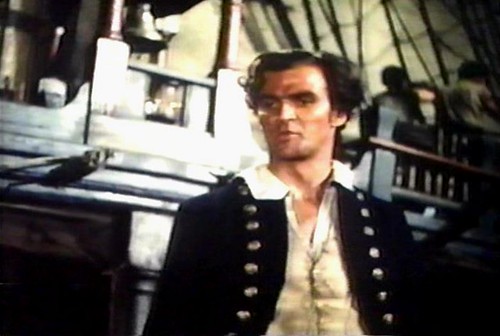
"Captain Horatio Hornblower (R.N.)"* (Raoul Walsh, 1951) Supposedly C.S. Forester himself adapted his first three Hornblower novels to make the screen-story for this swashbuckling distillation of the Royal Navy's fictional hero. It is 1805, and his majesty has sent the HMS Lydia on a secret mission. England is at war with Spain and France, and Hornblower must enlist the aid of a mad South American dictator in the war efforts a world away. But, upon arriving, Hornblower's distaste for the assignment and the "El Supremo" (Alec Mango) has him violating the Admiralty's standard orders, and when he captures the massive El Natividad (commanded by a very young Christopher Lee), he is forced to turn over the ship to the mad-man. Heading for home, he finds out that Spain is now England's ally (oops!) and he must re-take the massive ship on open seas, risking his crew and an unwanted passenger, Her Ladyship Barbara Wellesley (Virginia Mayo), sister to tthe Duke of Wellington and betrothed to Admiral Leighton (Denis O'Dea).

The crew is very British (
including a young Stanley Baker), but its Captain is played by the very American Gregory Peck,** ramrod-stiff and stoic, so even though the accent is wrong, the attitude is just so—Forrester's Hornblower is a stoic, constantly questioning himself and his failings, reflected in his constant lecturing and drilling of his crew. And Raoul Walsh is the perfect man to direct, as the action director has a keen eye toward the psychological and characters with complicated motivations. Peck has the attitude, but is a bit uneasy when called upon to display the comical aspects of the still-upper-lip Hornblower—his uneasy "harumphs" are constantly dubbed in to make more of them than Peck could convey on-set. But for the brooding and irritation (and the authoritarian air), Peck is fine.

The battles are well-choreographed for the times—one can practically see the wires yanking pieces of ship-railing past the players—and sometimes the falling masts and ropes get a little out of control, but the model-work and staging are excitingly done. A fine way to spend a rainy afternoon.


* The added "R.N." because the British version of the title included them, the American did not. As with the recent "Master and Commander," nothing is made of Hornblower maybe having to fight the American Navy, as he might have seven years in the future.

** The screen-rights were acquired for a vehicle for Errol Flynn, but after Flynn's previous movies had poor ticket sales (and the actor was proving difficult to manage), other actors (including Burt Lancaster) were considered. Peck got the part. Lancaster would star in "The Crimson Pirate" the next year.

Saturday, March 28, 2009

The Greatest Show On Earth

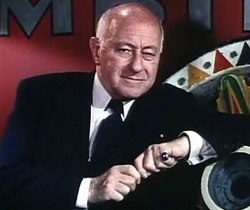
"The Greatest Show On Earth" (Cecil B. DeMille, 1952)

Insufferable.

In every way, insufferable.

Let's leave out winning the 1952 Best Picture Oscar (over "
High Noon" and "The Quiet Man"*), as obvious Hollywood Industry pandering during the McCarthy Era anti-communist witch-hunt to the Grand Wizard of that cause, Cecil B. DeMille.

Let's just take that out of the equation and take the film for what it is.

"
The Greatest Show On Earth" is an extended commercial/documentary/drama for The Ringling Brothers and Barnum and Bailey Circus. Filmed in eye-popping Technicolor (which is where the film, showing off the bright colors in many hues, truly is spectacular), that begins with the Director sepulchrally narrating a series of work-a-day location footage of the circus being prepped for its yearly run. The pompous tone that he sets is akin to a war film, the army metaphors stacked up thick and deep like a chain of marching elephants, with all the accompanying lack of grace and subtlety. Leave it to DeMille to take the fun out of a circus and turn it into something resembling boot-camp.

We transition (roughly, as DeMille's favorite transition is a quick right to left scene wipe, making it all seem like a moving slide-show) to the stars of the film acting roles that the folks who are told to stay out of their way actually do.
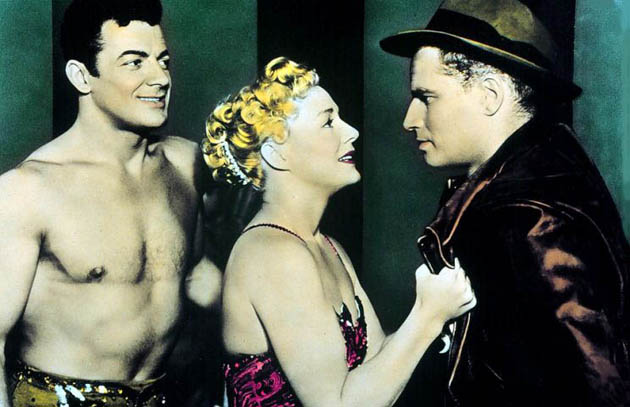
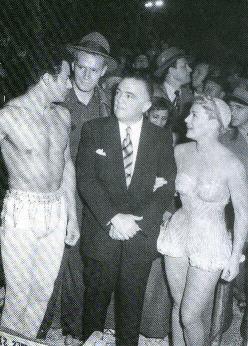
Charlton Heston is the circus "boss"--the show-runner, if you will--who, in order to guarantee a "full season" (the complete city tour) has brought a marquee name, "The Great Sebastian" (Cornel Wilde, cheerily smarmy) to take the center ring, displacing his aerialist sweetie, the plucky but vain Holly, played by Betty Hutton.

This top-billed character is particularly annoying. Hutton could play dumb well (with a vocal range from A to A-), but here's she's a schizo in need of a pair of padded tongs and a generator, with a change of motivation and character for every change of scene. Buffed up to do her own trapeze stunts (smattering of applause for that), her character is so insecure that she's a harpie spinning like a
Tasmanian Devil: "I HATE the Great Sebastian!" "I'm JEALOUS of the Great Sebastian!" "I LOVE the Great Sebastian," "No, now I HATE the Great Sebastian!" "I LOVE you, Sebastian!" "I feel GUILTY about Sebastian" "I'm going to forsake my Ca-REER for Sebastian!")

I pity Sebastian, myself. As well as Heston,
the guy you see rubbing his neck from whip-lash. See, she's in love with his character, although she's annoyed with the fact that he spends all his time trying to keep the Circus going, thus letting her keep the only job she's capable of, besides waving on floats. Hutton's Holly not only wears her heart on her sleeve, but also her ankle, around her pretty little neck as a broach, as a hat, anything but a symbol of commitment. She accuses Heston's Brad Braden** of having "sawdust in his veins"--at least he's got something in his. I wanted her capped in the head with her own trapeze twenty minutes in. Probably sawdust in that, too.

No such luck. Before one can turn their attention to what Holly would look like in the tiger-cage and quicker than one can shout "Sebastian! No! Don't do it without the net!!,"
tragedy does befall the circus leading to broken bones and souls, angst and recrimination and another case of Holly-pong in desperate need of a net...held by men in white coats.

The movie sets up a dull pattern: stentorian documentary section narrated by DeMille on "Circus as War Machine"/slide wipe to melodrama/slide-wipe to an extended sequence of abbreviated cir-cussedness that manages to make you feel slighted while still feeling interminable each time. Along the way, much of the subjects' opportunities are squandered, if not down-right sabotaged. For a scene of DeMille's heavies planning badness, DeMille stages the two Runyon-esque hoods*** (without the quaint patois) in front of a process shot simulating the outdoors. Halfway, DeMille cuts to a tighter shot of the two, but behind them the projection-screen image doesn't move, making it look like they've quantum-jumped closer to the camera. It's an amateurish give-away of a process shot.

And there's a cynical, rather crude attitude towards the circus audience—pandering to the audience while bashing them at the same time by endlessly showing giddy parents consuming ice-cream cones while their bored children look like they to want to erp up their cotton candy. But as the originator of this particular circus so famously said: "There's a sucker born every minute!" DeMille knew that lesson well.

Another lesson is the one of justice, where kindly Dr. Buttons (James Stewart in perpetual clown make-up...Richard Kimble never used that trick!), a surgeon on the lam for murder, unselfishly sacrifices himself by helping injured people on a train-wreck, exposing his true identity and is rewarded by getting cuffed and hauled off to the iron bar hotel. It was the '50's, after all—he could have been lynched. That would have to wait for prison, I guess. Thanks, doc! Take him away, boys.

Another little game of the movie is a sporadic "Spot the Stars." There's Hopalong Cassidy ! There's...somebody? Is that dewey debutante Jeanne Crain or a DeMille "ingenue?" And Bob Hope and Bing Crosby show up during Dorothy Lamour's number because its a Cyclical Universe on the Paramount Lot, with very tight gravitational rules; you could almost make a case for Creationism.

At some point during this megalith, you begin to realize with butt-numbing certainty, that if DeMille had cut out any of his "
Circuses aren't some pink clown-show, they're American Hard Work" lectures, or maybe cut a "Tribute" sequence or parade or two, or one of the forgettable songs (or allowed Holly one less seizure) that the movie wouldn't have had to clock in at 2 1/2 hours in length.

2 1/2 hours is a longish book, with...ya know...subtlties, not a circus movie. But DeMille must have seemed unable to strip whole sequences, however redundant, away. Like
Spielberg wanting to over-stuff "1941"**** with beloved-by-none-but him-gut-and-budget-busting sequences, DeMille super-saturates the screen until the Technicolor fairly bleeds. And he couldn't bear, or didn't know enough, to cut any of it.

The only thing never mentioned in the many of DeMille's "Bozo Marches On!" narrations, is the requisite shovelling of the tons of manure. Why bother? The evidence is all there on the screen.

* ...and the not-even-nominated "Singin' in the Rain."

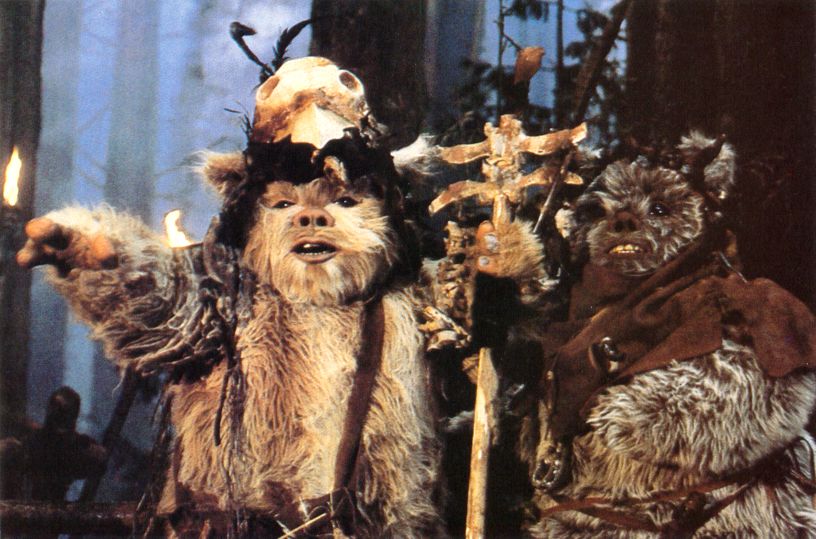
** ?...Brad Braden...of the "we-couldn't-come-up-with-a-better-last-name" Bradens? I think he became an "Ewok" trainer in later life.

*** One of them being Hollywood bad boy/guy Lawrence Tierney. He and Heston have a seething scene of clashing testosterone blasts.

**** It was this very movie that inspired the Spiel-boy-g to pursue a career directing films. Spielberg learned his lessons concerning movie elephantiasis in his 20's. DeMille was in his 60's.


Saturday, February 28, 2009

Ace in the Hole

"Ace in the Hole" (Billy Wilder, 1951) Probably more familiar under its name-change-in-desperation "The Big Carnival" (which sounds happier and more fun–which it isn't) "Ace in the Hole" is Billy Wilder's most acid-tongued movie to date (and considering it was coming off the heels of "Sunset Boulevard," that's saying something).
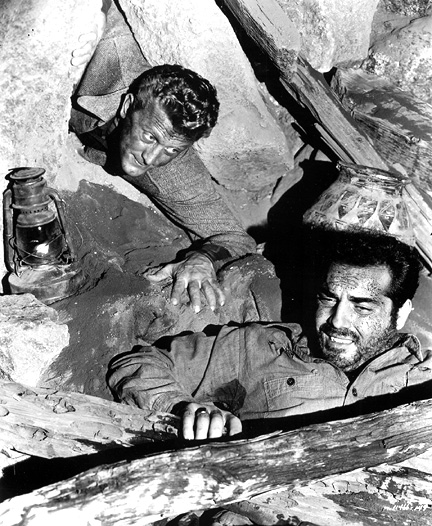
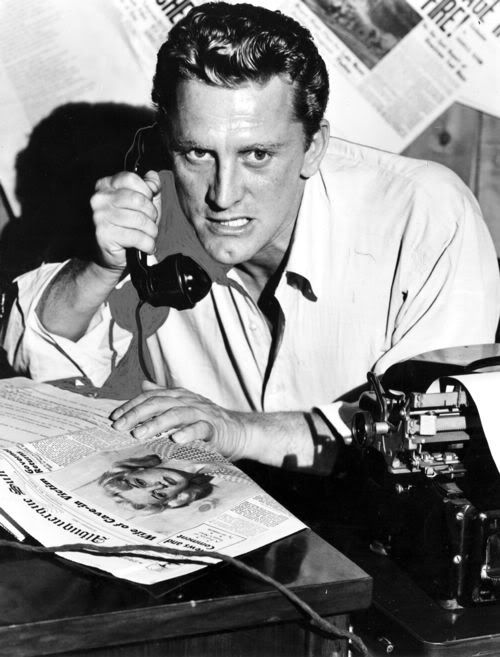
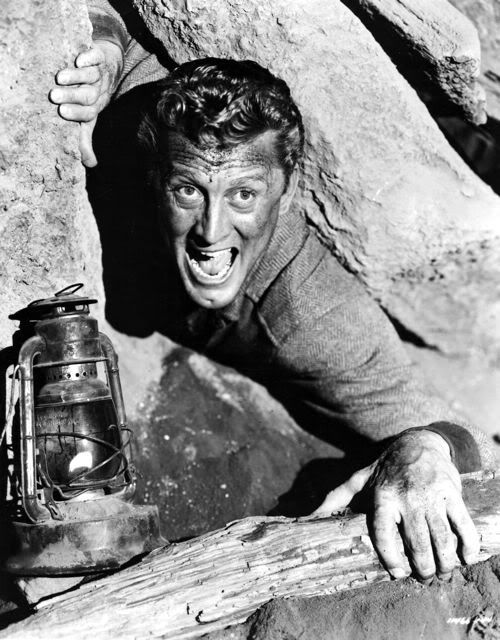
Charles Tatum (Kirk Douglas) rides into Albuquerque, New Mexico literally on the hook, and convinces the small-town newspaper to hire him. But after a year, Tatum feels trapped and is desperate for the Big Story that will get him back into The City Beat again. He stumbles onto a minor cave-in that has trapped Leo Minosa who was caught while looking for indian arrow-heads. Not a big deal to get him out, but it will take some work. But, as Tatum was on his way to cover a rattle-snake festival, the incident gives him a whiff of a potentially Big Story.

He should have stayed with the other rattle-snakes.


Working with the corrupt sheriff and
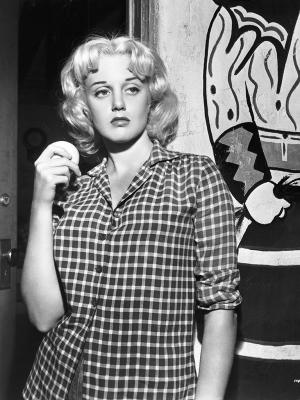
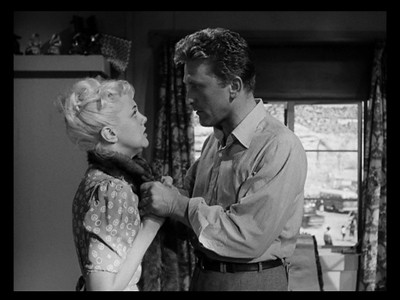
the bored-out-of-her-skull wife, Tatum prolongs the rescue, turning it into a major (and unnecessary) drilling operation that will keep the story alive for days. The reporter keeps his fingers on all aspects including access to other news-services, and pretty soon he's the Only Game in Town. No one associated with the rescue does anything without his say-so, lest they risk the promises Tatum's made.

Then the curious start showing up. Then the hopeful. Then the carnivorous. The Story becomes a vigil, and where there are crowds of people, comes the salesmen, and the site becomes "The Big Carnival" of Paramount's cheery alias.
Meanwhile, Leo is getting weaker and the pounding of the drills is slowly driving him crazy.

The screenplay, by Wilder,
Lesser Samuels and Walter Newman, has its ink mixed with venom (the most quoted line is from Minosa's wife (Jan Sterling): "I don't go to church. Kneeling bags my nylons."), but it's no worse than the cynical lines from Wilder's previous film, "Sunset Boulevard." The difference is Wilder's not looking at the easyily-satirized egotism of Hollywood, he's looking at us, and the American capacity to make a buck while wallowing in tragedy. "Ace in the Hole" is before its time, before the mawkishness and the trivial pursuit of the 24 hour news cycle made the trend easier to spot.

And there's one other thing: "Sunset Boulevard's" dispassionate cynic was
William Holden, "the golden boy," whose snide wise-cracks passed for intelligence. Here, he's Kirk Douglas, who is a more energetic performer, and so that constant cynicism is seen as more of a constant attack that just seems mean-spirited. And where Holden's self-loathing seemed somehow relaxed and noble, Douglas's is never less than actively self-destructive. It's a smarter, more satisfying performance that doesn't try to be likeable, or a wolf in sheep's clothing, but audiences found it repellant (as well they should!). They didn't want their movie-heroes (or anti-heroes) to be too unlikable. So, even though there is no redemption for this character, and no happy ending in sight, the crowds stayed home from "The Big Carnival."

That doesn't stop it from being the classic that it is, of Billy Wilder (who famously said "You're only as good as your best movie") in his prime.

Tuesday, December 23, 2008

The Daze After "The Day The Earth Stood Still"

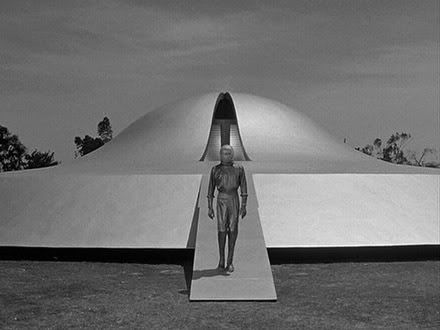
The Day The Earth Stood Still (Robert Wise, 1951) Iconic sci-fi pic that managed to be just strange enough to be spiritual without having to explain itself. Edmund H. North's script (adapted from the 1940 Harry Bates story "Farewell to the Master") just assumed that any advanced civilization's technology would seem like magic to us (ala Clarke's Third Law). It's anti-nuke theme was somewhat off-set by it's Christ allegory under-pinnings: a human-appearing being from above comes to Earth with a "message," is killed and resurrected to give mankind a lesson in humility. That the alien--Klaatu (Michael Rennie)--walks among us under the guise of a "Mr. Carpenter" just nails the significance home.

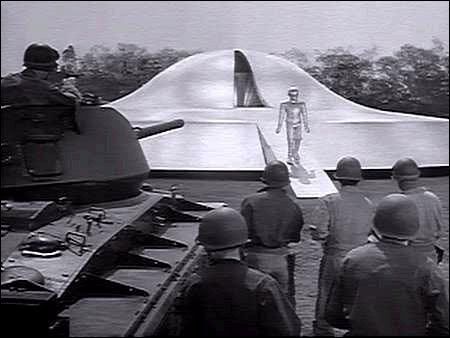
Right from the get-go, The Day The Earth Stood Still announces its intention with a "spooky" theremin-laced score (by the brilliant Bernard Herrmann), quite at odds with its message of peace. Wise shows a global humanity surrounded by its current technology (radio, television, radar) spreading the news of an invader from space, which lands in the Mall area of a tourist-clogged Washington D.C. in Spring. Phalanxed by a wall of tanks and military might (with a larger crowd of tourists behind it) the alien presence reveals itself and is shot by a panicky soldier for its trouble. Before you can say "Kent State," the alien is taken to Walter Reed to be treated, observed and questioned, and the formal Klaatu--patient, curious, but with a hint of passive condescension--does his own analysis, escaping from the hospital and blending with the populace as "Mr. Carpenter"--taking a room at a boarding house, becoming involved with a widowed secretary (Patricia Neal)--it IS the '50's, after all--and her son, seeing humanity first-hand.

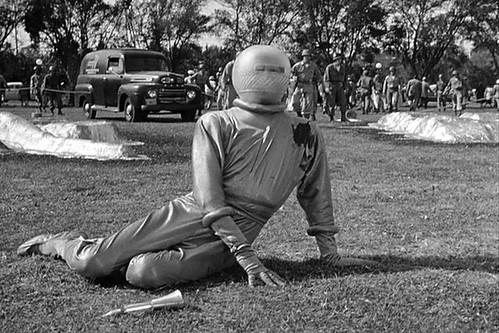
Meanwhile, his Enforcer, Gort, a lumbering, laser-cyclopsed, soft-metal robot stands guard over the saucer, turning his evil eye on any hint of aggression, without any regard to how much of the GNP was flushed to make those tanks. If Gort could laugh when he turned on his eye-light, he'd probably do it with glee.


There are so many small details that delight: Patricia Neal
's uncommonly common working Mom, with a wary eye towards Mr. Carpenter--there's not even the hint of romance there; Sam Jaffe's cameo as Einstein stand-in Dr. Barnhardt, looking at his business-suited stranger visitor from another planet with eyes of dazzled wonder; the whole design of the thing that has so permeated our culture with sleek silver surfaces that fold in and out of each other seamlessly; "Gort, Klaatu Barada Nikto!" which, indicative of the race's parsimoniousness, roughly translates to: "Robot, take Klaatu's body back to the space-ship and repair whatever damage has been done to it, bring him back to life, and oh! while you're at it, don't turn me into a smoking pile of ash, thank you very much*"--talk about "Three Little Words!"; Robert Wise's unerring sense of staging and for putting the camera in the exact, most effective place without making you aware that it's the most effective place. Wise is always given short-shrift as a director, implying a yeomanlike sensibility rather than an artistic one, but the Man Who Edited Citizen Kane also conceived beautiful, eerie, creepy shots like this:

Thanks to Glenn Kenny of "Some Came Running," who reminded me **


The Day the Earth Stood Still is a classic film—a time-capsule, of a kind—from a different time and place and space that reminds, yes, with great power comes great responsibilty--but there's always someone more powerful, who might take yours away, and make you stop and smell the fall-out.

—————————————————————————————————————————————————————


"Everything New (Testament) is Old Again"

So why remake it? Well, it's a question that Klaatu's United Planets couldn't negotiate--and Gort's Galactic Police Force would probably give you the eye. But the agent of Keanu Reeves saw a poster of the original and dollar signs swam into his head and here, we have it. And Scott Derrickson (who put a different head-spin on "The Exorcism of Emily Rose") thought he could turn it into a warning about global warming, and Reeves thought that, though the original Klaatu preached peace, he did so threatening force, which he found "fascist."

Sigh.
***

That sounds noble in thought (if a tad simplistic). On-screen, it's a different matter entirely.

Because it's a "re-imagining" (rather than "a remake"), there is no "
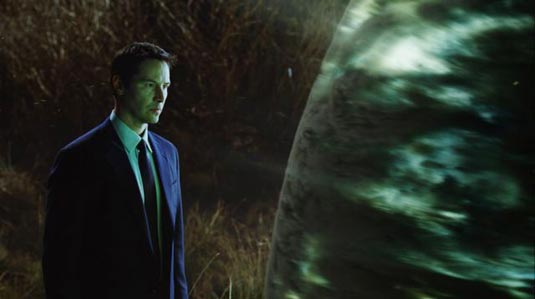
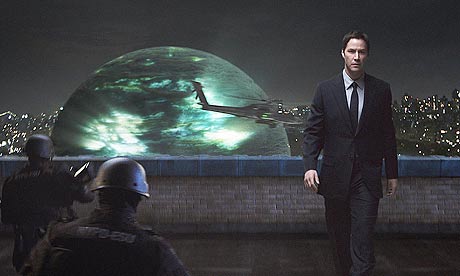
flying saucer," but a cloudy, spacy "orb" (all the better to remind you of the planet, but I kept wondering what kept it in place), and rather than the military, scientists are in the front line (with Princeton astro-biologist Helen Benson, played by Jennifer Connelly, as the point-person). The military is back-up.

The scenario starts the same: Land-Bang-End up in Hospital. And there things start to change. The original Klaatu had no special powers. Gort was the "muscle" (and here, the robot is 20 feet tall, gun-metal gray in color, and a completely CG construct--it's actually simplified from the original's design--and, as with the first Gort, its unreadability makes it a genuinely creepy sight). Keanu Reeves' Klaatu has a nasty way with bio-feedback that does damage. So much for pacifism. But, this Klaatu isn't Christ-in-a-business-suit. This one goes back a few chapters, back to the Old Testament. Particularly those parts dealing with Noah and Moses. The threat is environmental, rather than nuclear, and to sustain one of "the handful of planets that can support life," Keanu-Klaatu's United Planets are thinking of a little Silent Spring Cleaning of the life-form doing the most damage. Good thing he doesn't carry around a cook-book!

The following section is SPOILER material, so if you want to be surprised how it ends—if you care—don't highlight the next paragraph which, like the Earth, gets blacked out:


That scouring consists of billions of nanite-sized metal locusts (why they have to specifically look like insects, I have no idea, but I'd guess it has something to do with why Klaatu's named "Mr. Carpenter" in the first one). So, this "plague" starts doing its damage, devouring metal of all kinds, sports-arenas and such, and one can only hope that it can distinguish "green" technology, like solar panels and wind-generators, from the other kinds, but I suspect not--that might involve thinking! Keatu, or Klaanu, or whatever you want to call him, decides at the last minute that because humans have the capacity for change, they maybe, just maybe, could save their environment, so he sacrifices himself sabotaging the plague, leaving humans with no electricity, no technology, and presumably the resolve to stop the global warming crisis with, as a much wiser alien once inventoried, "stone knives and bear-skins." Thanks, Kleatu or Kono, or whatever your name is, thanks a lot. Who's gonna pick up these continents of dead nanites corrupting the soil, Mr. "Ecology?" And they thought the first one gave off mixed signals?


Keanu Reeves has the most limited range of any actor who hasn't suffered a stroke, but he does have two specialties at which he excels: endearingly stupid, or robotic. The latter serves him well, as in Speed, the portions of The Matrix when he was portrayed by pixels, and this film. His strange visitor from another planet is a nice piece of craft, slightly more human than Jeff Bridges' "Starman," and extremely efficient in his movements--when he turns his head to look you right in the eye, you'd better take him seriously. He's quite effective in the role. Jennifer Connelly delivers the techno-babble expertly (as she did in "Hulk"), but she really doesn't have much more to do than Patricia Neal did, as the role is basically reduced to "concerned mother." As the child she's concerned about, Jaden Smith at least doesn't fall into the "predictable child" category. He finds different ways of doing things than the "stock-child" role. Kathy Bates is too good for her role of Secretary of Defense, Jon Hamm, of "Mad Men," doesn't really separate himself from the pack, but Robert Knepper does a fine job as a Colonel in charge of trying to stop a tidal wave with a tea-cup. It's always great to see cameo's by James Hong, and John Cleese, who plays Prof. Barnhardt in this version.*****

But, ultimately, there wasn't much point in doing this, other than to give people jobs, and give some Hollywood-types more "green" cred. The production was carbon-neutral (wouldn't that have been ironic?), which means they presumably paid carbon credits used to destroy old-growth forests for eucalyptus plantations.

"The Universe wastes nothing," Keatu says at one point.

He's never been to Hollywood.

The Day The Earth Stood Still (2008) is a cable-watcher.


* I hope there's a "please" in there, somewhere!

** Kenny has a wonderful illustrated tribute to director Robert Mulligan, who died this week. It's far better than anything I could contribute.


*** My wife and I have a habit--a ritual, if you will--whenever we watch a movie with Keanu in it. After every
line of his dialogue, one of us will murmur a disappointed "Don't speak," in response to his poor inflaction choices--or lack of them.

**** There is one amusing bit--when Benson is shanghaied to participate in the landing investigation by the military, it's set-up and photographed exactly as it was done in "The Andromeda Strain"...directed by original TDTESS director Robert Wise. Coincidence? Nothing's a coincidence in a "re-imagining."

***** I hate playing the "If only..." game—it smacks of frustrated screenwriters—but, as they had an Albert Einstein-clone in the original, it would have been interesting to have a Stephen Hawking in this one—brilliant, but crippled, talking through a voice-box. If Klaatu wanted inspiration from the human race, who better? Then, imagine this scenario: the group leaves, but Klaatu hangs back, turning to look at the wheelchair-bound pysicist. "I could cure you..." Pause The voice-box rasps: "Save...the...world."

But, they didn't.