Showing posts with label James Stewart. Show all posts

Tuesday, December 18, 2012

The Man from Laramie

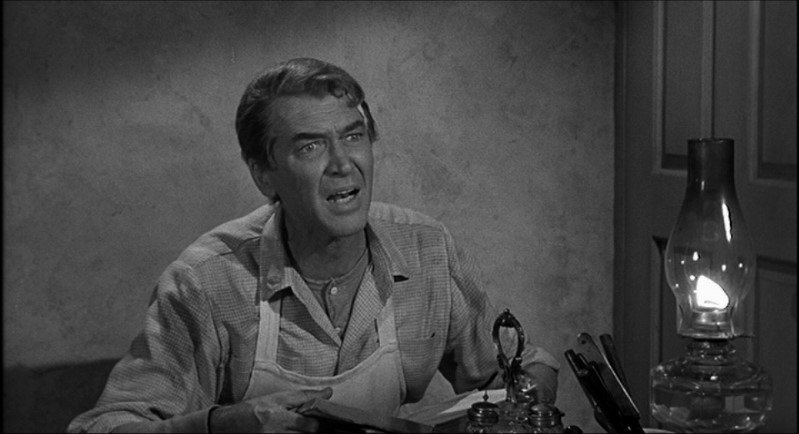
The Man From Laramie (Anthony Mann, 1955) "Hate's not becoming on a man like you." Hmm.  Then, they shouldn't have put this star and director again, as hate, obsession and (sometimes) disfigurement were the order of the screenplay. The last of the James Stewart-Anthony Mann pairings (the others being Winchester 73The Far CountryBend of the River, and The Naked Spur, all superior disturbing Westernsthat pushed Stewart's psychological boundaries in the Old West by pushing the traditional physical boundaries in the Old West.*

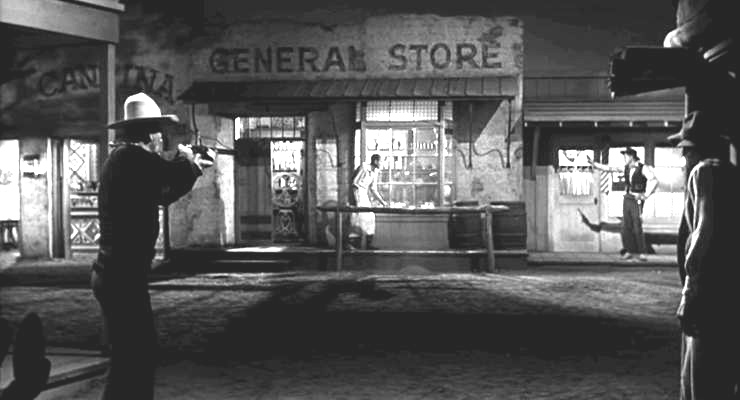
Stewart's Will Lockhart rolls into the town of Coronado with his small transport business delivering merchandise to the general store.  Along the way, he stops from his day job to indulge in his hobby—seeking revenge for his younger brother whose cavalry unit was ambushed by Apaches who were brandishing repeating rifles, too many to be acquired on raids.  The Apaches are another story.  He's after the man who sold them those rifles.

Coronado, though, is hardly welcoming.  He can't take a few steps into the street without being warned to leave the town the same way he went in—under his own power.  That advice, with intentions good or bad, stems from the town's controlling interest, a cattle baron by the name of Alec Waggoman (Donald Crisp), one of those autocratically protective father-figures who like things the way they are, are suspicious of any changes, and is a bit blind to how others see it.  He's particularly near-sighted when it comes to his entitled son Dave (Alex Nicol, in a thankless performance, rather dimly performed), a bully who's next in line to run the ranch—probably into the ground given his business acumen—and (as John Wayne used to put it) "if he lives."  To prevent those eventualities Waggoman has installed the only picket-wire he might approve of, his chief ranch-hand Vic Hansbro (Arthur Kennedy, who often provides the counterbalance in the Mann-Stewart westerns) as a nanny to keep Dave under control.


But Vic, with so much responsibility to the Old Man, always seems to be a day late and a dollar short, unable to keep Dave from single-handedly destroying Lockhart's business, burning his wagons and killing his mules, a rather contrary manner of getting him to leave town, by destroying the means.  And, of course, it just inspires Lockhart to get all-cussed and motivates him to stick his nose in everybody's business and his fists in Dave's mid-section.  Things don't get any better when Lockhart decides to take a job ranching for Waggoman's rival Kate Canady (Aline McMahon), a crusty woman-rancher who won't give an inch on territory or principle, or one hoof of cattle to the larger concern.


From any angle Lockhart is caught in the middle, guaranteeing a rise in tensions and an escalation of grievances.  And if the elder Waggoman wanted peace and quiet, he should have looked for the anarchy running wild in his own midst.   So, there's that familial element running through it.  And Mann and Stewart, through their collaborations, were exploring psychological depths that weren't mentioned between the gun-shots in the standard shoot-'em-up. All of their westerns involved Stewart's character going through a trial by fire—he's actually dragged through a campfire in this one—facing humiliation and crippling at the hands of the Waggoman's, the confrontations with the clan making up the best part of the film, with only Stewart's rather half-hearted interplay with Waggoman's neice (Cathy O'Donnell) seeming like time wasted, although it provides one more conflict for Lockhart to be distracted by.  Mann's use of location shooting is always imaginative and compositionally interesting, and he uses the Vistavision format to get as much horizon into the frame as possible.  Certainly worth a look-see, just don't go expecting Shakespeare.**

Maurice Thomas' Stewart portrait for some of the film's poster art.


  * The two also worked on the non-westerns Strategic Air Command and The Glenn Miller Story.

** Curiously, Shakespeare is on a lot of people's mind when they see this film, comparing it to "King Lear."  Um, okay, not the "King Lear" I'm familiar with, although there's a thematic string in there (actually there's a Shakespearean string in just about everything, isn't there?).  Actually, there's more "King Lear" in "Bonanza" than here (except that everybody gets along).   And, of course,  the movie Legends of the Fall has more than a bit of both in it.

Tuesday, November 6, 2012

Anytime Movies Perpetually Reloaded: Election Edition

It's Election day 2012. If you haven't already, go out and vote, dammit. And in that spirit, time for some truths to be self-evident.

Anytime Movies are the movies I can watch anytime, anywhere. If I see a second of it, I can identify it. If it shows up on television, my attention is focused on it until the conclusion. Sometimes it’s the direction, sometimes it’s the writing, sometimes it’s the acting, sometimes it’s just the idea behind it, but these are the movies I can watch again and again (and again!) and never tire of them.


I’m very suspicious of patriotism (I always recall the "last resort of a scoundrel" remark), yet nothing moves me so much like a movie extolling the virtues of America.

It wasn’t until I was voting on the
Emmy’s that I sat down and watched “The West Wing.” I figured it was going to be a vapid “America-Love It or Leave It” tract (starring Rob Lowe), even if it did have Martin Sheen playing the President, in which case, I could leave it. But TWW was a serious look at government work—its glories and disappointments, the combination of ego and sacrifice. It could criticize individuals and “ideology for ideology’s sake,” but one thing it never ever criticized was the idea of Public Service, no matter what side of the aisle it was on. At the same time the country is being run by crooks specializing in an institutionalized form of bribery and graft, there is an infrastructure of people for whom government service is a sacred trust (well, there’s gotta be ONE!) “The West Wing” paid tribute to that corps of people wherever they might be, week after week, and it made for refreshingly positive TV. It also made for a refreshing look at our nation as it stands.

And so, too, does “

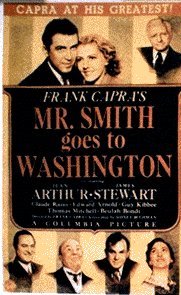
Mr. Smith Goes to Washington.” Made in 1939, it plays like it was written yesterday. When I saw it for the first time—right after “Watergate”—I found it amazingly prescient. But no, it was talking about its own times. The problems just keep re-occurring again and again. And again. Whoever doesn’t know history is doomed to repeat it, and with every fresh crop of people governing, they’ll keep making the same mistakes. Maybe they think they’re unique. Maybe they don’t know history. They say that if you keep making the same mistake over and over, it’s a sign of insanity. Well, psychology never factored in term limits.
“Mr. Smith…” is the story of a youth leader who is appointed to the Senate after the incumbent dies. This runs afoul of the state’s political machine that ran that senator as well as the senior Senator, Paine (
Claude Rains)—who just happens to be an idol of the new senator’s.

It wouldn’t work if director
Frank Capra didn’t have tall awkward Jimmy Stewart—not James, Jimmy—whose every stammered syllable bespoke humility. But get him talking about America or Liberty of The Capitol Dome and the stutter disappears in a fervent stage whisper that trails off in awe. Mr. Smith isn’t sure of himself, but he’s sure sure of the Country.

And
Washington, D.C. is just the place to shake him up with a few lashes of the Beltway. Stewart could be frustratingly folksy, but for Capra (and for Hitchcock and Anthony Mann) he could be unnervingly vulnerable and, at the other end of the bi-pole, dramatically unhinged. The last act of “Mr. Smith…”—the filibuster against false charges of graft—features Stewart in both phases. At one point, he's knee-deep in political hate-mail, clutching it in his hands and looking skyward like Jesus at Gethsemane. Then a few short paragraphs about “lost causes” later, he’s at his most defiant. “You think I’m licked! You ALL think I’m licked!!” That was his Oscar-winning performance, not the next year’s “The Philadelphia Story” where the “cynical reporter” bit just didn’t wash with someone who looked so homespun. The filibuster scene always brings a lump to my throat, and it’s not sympathy pains for Stewart’s frayed larynx.

Now, I’ve read the screenplay to “Mr. Smith Goes to Washington.” It ends with a big parade honoring the completely vindicated Smith, surrounded by his boy-rangers, supported by the woman-he-loves (Jean Arthur,
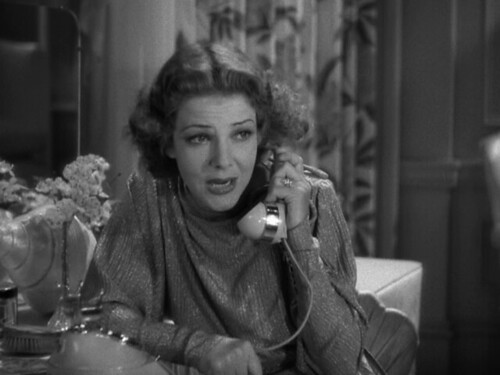
again, who manages to make her extraordinarily jaded Senate Aide adorable, even when she’s at her worst—and she has a great drunk scene with Thomas Mitchell. Hmmm, Thomas Mitchell, again). Why, even the disgraced Senator Paine is being lionized. Oh, it’s just so sweet, your eyes could roll back in their sockets and jam and stick that way. As Arthur’s Miss Saunders tipsily says in the film, “Nah, I can’t think of anything more shappy!” “Capra-corn” is what the very self-aware director called it.

So, he cut it.
Orson Welles has said: "If you want a happy ending that depends, of course, on where you stop your story." Capra leaves his story’s ending ambiguous. Oh, you could call the riotous goings-on at the end a Happy Ending—but all of Paine’s Senate pals are trying to calm him down, telling him it’s okay…everything’s all right, we're still on your side. The only solace Jefferson Smith is granted is in the sympathetic smile from the Vice-President (played by John Ford’s silent cowboy film-star Harry Carey) before he collapses in a heap of his enemy’s mass-generated letters. The movie "celebration" has all the weight of an Al Gore victory celebration on Election Day 2000--a case of premature exaltation. But nothing's been solved. No one's been cleared. Nothing has been decided. There is just misunderstanding and confusion. Carey leans back and has a chaw while the chaos of Democracy continues unabated. It may not be a "happy" ending, considering the sequence that was shelved. It may not even be a dramatically satisfying ending. But it is representative of the loud, messy process that turns the gears of Democracy. However slow-moving, however off-course, they still turn.

Jeferson Smith (Jimmy Stewart) looks for guidance.
Mr. Smith Goes to Washington
American Graffiti
To Kill a Mockingbird
Goldfinger
Bonus: Edge of Darkness

Sunday's Scene: For Dads and Grads
Tuesday: Fuggedaboutit...

Tuesday, July 10, 2012

Directed by John Ford

Directed by John Ford (Peter Bogdanovich, 1971, 2006) Bogdanovich's primer is a "viewer's digest" of some big things that that made John Ford such a powerful director not only in individual films, but also across a career of experience.  Generous clips from throughout his acreer illustrate points, punctuated by talking head clips from the '71 version including Ford himself (who is not very helpful, to say the least—by saying the least*—and is deliberately dismissive of the doing the whole critical analysis thing, much like a comedian hates to explain a joke, or a magician a trick), John Wayne, Henry Fonda, and James Stewart.  The 2006 update folds in Harry Carey, Jr., Maureen O'Hara, and analysis from Clint Eastwood, Martin Scorsese, Walter Hill, and Steven Spielberg, as well as Bogdanovich.  

The update has everything from the original re-jiggered to add more points, but there's more of a "legacy" feel to the thing, now, as the casts Ford depended on have dwindled—Ford was still alive during the first version—and so the next generation who grew up and learned their craft sitting in the theater watching Ford's images talk about "what John Ford means to me."  Also, as the man is gone now, there's a bit more psychological analysis and more delving into the man's irascible personality, already on full display in his interview.


But there is one troubling aspect to this "new" version, something that stuck in my craw when I saw it (and no doubt would result in Ford caning Bogdanovich if he got wind of it).  There is a brief (very brief) examination of Mary of Scotland, Ford's only film with Katherine Hepburn, and the subject of much speculation over what their relationship was.  A sound clip is played of Hepburn's visit to Ford days before his death.  The tape was allowed to run continuously, and their parting words to each other are played, words that they had no way of knowing were being recorded, and words that might not have been said if known they'd been overheard (Ford specifically asks her "Are they gone?").  It's nothing scandalous or huge.  Ford merely says "I love you," and Hepburn says "it's mutual."  But it feels like a violation of the departed by the parties that recorded it and who have re-presented it.  And far too much is made of it (Really?  It was the inspiration for the names of O'Hara's and Wayne's characters in The Quiet Man?) in a gossipy, speculative fashion. These were, after all, words from people who must have known they'd never see each other again, and it's nice and it's lovely. But it's beneath the film, beneath Bogdanovich, and undercuts whatever scholarly impact the film might otherwise enjoy to make anything more of than the sweet parting gesture it is.  The worst part is...there's no one to rebut, no one to protest, no one to defend...or even better yet, to correct the speculation. Even Ford's maxim of "When the legend becomes fact, print the legend" doesn't cover this.

That aside (and it's my quibble, really), it's an invaluable first toe-dip into the films of Ford, and enriches the experience and appreciation of every film of his seen afterwards.  One thing Bogdanovich did right (besides getting Turner Classic Movies to bank-roll it, so more people would see it, the various clips from many sources being very expensive) is he kept the original's essential narration by Orson Welles, Ford fan and student.   The voices and faces and memories out of the past have as much weight and bearing as the films do, reverberating throughout history and time, feeling immortal and universal.


*

Tuesday, February 28, 2012

After the Thin Man

After the Thin Man (W.S. Van Dyke, 1936) Follow-up to the popular The Thin Man, which took the Dashiell Hammett novel and characters and ramped up the entertainment value.  Although it has become the most popular of the series over the years (which might be due to the fact that the young and future star, but at the time MGM contract-player James Stewart is featured prominently in the cast), it suffers from a slight case of "sequelitis," with more arbitrary schtick—songs and production numbers that stick out like a milk-shake served in a speakeasy, much more attention and comic anthropomorphism attached to the dog, Asta—as well as making detective Nick Charles a perpetual lush (although there are flashes of the character's talents, as when after avoiding a low-life that has been tumbled down the stairs, he casually mentions "He has a gun under his left arm").  William Powell is an unsung, perhaps merely undersung, master of the throw-away and even though the performance is an amusing "drunk act," he manages to keep the character's thin veneer of dignity intact throughout the shenanigans, and the prim and unproper Myrna Loy lends enormous support in that regard by the obvious affection her character affords her husband.

But, still...we're talking Hammett here.  Sure, "The Thin Man," the author's last novel, was lighter than the mystery-master's "The Maltese Falcon," or "The Glass Key," but the screenplay's authors, Frances Goodrich and Albert Hackett* seem to have lost some of the original's dark roots, trading mystery for naughtiness, wit for "cute."  I quibble here—after all, the movie-James Bond isn't really Ian Fleming's character, either—for the movie's a solid romp—Nick and Nora investigate another disappearance,** this time the disappearance of Nora's cousin Selma's good-for-nothing husband, which not only involves low-life's, but the other end of the spectrum in Nora's unproperly prim side of the family.  Hijinks ensue, bullets fly (and complicate things while simplifying the cast), and it all ends with the "reveal" in a room full of suspects.  Van Dyke keeps the thing moving by staying out of the way—there are long, long takes where the actors do such involved business and are merely cramming as much fun into the scene as possible that they make the current cut-and-snip style of acting and film-making appear stodgy (compare this to The Tourist,*** for instance).  It's a fine time—save for some Asian racism that curdles the proceedings for a time—and another example of showing why "they don't make 'em like they used to" is a valid argument when it comes to movie-making quality.

* The pair also worked on the screenplays of Father of the Bride, Easter Parade, The Diary of Anne Frank, and It's a Wondeful Life—which, is extraordinarily impressive—all classics, all great, dense scripts.

** The first movie's disappearance was of "the thin man" of the novel's title, it didn't refer to the character of Nick Charles, at all.

*** Speaking of which, Johnny Depp and Rob Marshall are planning their own version of The Thin Man.  One hopes that Depp doesn't overdo the drunk bit (as he is wont to do), and the casting of Nora will be absolutely critical.

Saturday, February 26, 2011

My Favorite: Hitchcock

A recent Facebook Note request asked me to pick my fifteen favorite films.   The usual "Anytime movies" were there, and a few others that have crossed my path since starting LNTAM.  But as with any list, what was most fascinating to me was...the ones that were missing.  I've noticed this before when I did the "Anytime Movie" series; there were so many things not there—it's always the frustration I feel when making lists (and thus, why I refrain from doing them).  This led me to considering the film-artists who did not make the cut, and highlighting those films that have had such an impact on me—that I've fallen in love with, that have stayed with me, burrowing into my brain, and eliciting thoughts and emotions unique to those films.  The observations are purely personal (aren't they all?), and why I call this new series of neglected films "My Favorites."

Due to the nature of this particular movie, this article will contain SPOILERS that will actually destroy your enjoyment of the first-time viewing experience.  If you haven't seen Vertigo (and, really... what is keeping you?), you should not proceed further.  And to paraphrase Hitchcock's favorite tease: "No one will be seated after the article has begun." This is your last warning.


"What Is This Thing Called Love" asks the old song (a favorite of mine).  And I especially love the inclusion of the word "thing" to describe it.  What IS Love?  Why is it so powerful?  Why is it an obsession for film-makers, and their audiences, ...and for that matter, the scribes of centuries past...to the point where when we think about Love, it's the kind "like in the movies," (which should set off alarm bells to anyone doubting film's veracity—ever seen an accurate movie on a true story you love?).  And Love in the movies is all-good, an all-consuming passion, "the bestest thing in the world," that makes us better people (better-looking, too), sweetens our coffee, shines our shoes, puts a spring in our step, and makes us orgasm simultaneously, while the metaphorical ocean-waves crash over us.  Orchestral swell and fade to black (before the complications happen).

'Kay...  But it's become SUCH a movie-cliché (and aren't cliché's supposed to be such because they're true?) that movie-makers now "cut to the chase"...almost literally.  In the weaker efforts, people in movies fall in love willy-nilly, without doubt, without resistance, and without staring at the phone for hours at a time—wondering "why aren't they calling?"  It is effortless love, like falling off a love-log, with no pain, no pangs, no problems. 

As Randy Newman (or Joe Cocker) warbles "They don't know what love is."

I like movies that question love.  I like movies that question anything, but questioning love makes me sit up and take notice...which happens rarely.  I generally just slump in my movie-seat, ticking off the "meet-cute," the "song-montage," "the-rough-road," and the "happily-ever-after," so rare is the occurrence.

Alfred Hitchcock made movies in an era where cinematic love was that kind of easy, but he usually liked to sprinkle some salt in with the sugar.  There was no easy path for love in his films, in fact he liked to set up complications for the lovers to overcome—be they heterosexual or homosexual—and his least "typical" film, Mr. & Mrs. Smith, is all about a married couple divorcing and trying to find the path back together, as much as they don't want to.
So, here's Vertigo, which is as pure a love story as Hitchcock ever made despite its deceptively fantastical thriller plot, and it finds the director adapting a novel by the authors of Diabolique (which Hitchcock wanted to film), who might have been writing it precisely for this director, so emblematic of his work are their themes.  Hitchcock took a story of a man hampered with weakness (in this case, acrophobia, fear of heights and thus, fear of falling), and combined it with his own penchant for re-shaping actresses in his own singular fetishistic way to make one of the most personal films.  He'd hoped to lure his favorite actress, Grace Kelly back from Monaco to star in it, but she was dedicated to her fairy-tale marriage to a handsome prince, and declined.  Hitchcock never liked fairy-tales, but this is as close as his sensibilities would go.  But, it is more than that.  It is a mystery.  It is a thriller.  It is a psychological study.  It is a ghost story.  But, most of all, it is a love story...with a bottomless void at its heart.


The first shot of the story—a straight line bi-sects the screen...

A hand comes up in mid-frame and breaks that line—a man climbs a ladder.


Vertigo-proper—aside from the hallucinogenic Title sequence—begins with an undefined image; a murky sky bisected horizontally by a line.  In the first movement of the shot, a hand comes up and grabs it; it is the rung of a ladder, the hand belonging to a criminal making an escape from the police and the protagonist, police detective "Scottie" Ferguson (James Stewart).  A straight-lined pursuit across roof-tops is only temporarily interrupted by the chase-participants' leap across a void—over an open alley-way between buildings.  Everybody makes it with some difficulty, except Scottie.


He is caught suspended, on the brink of a bending gutter on a crumbling cornice, and we experience what he experiences—a change of perception.  It is "the vertigo shot"—an ingenious combination of optics and camera movement, that bends the image creating a telescoping tunnel-image.  Foreground and background separate and stretch, taking a rudimentary shot down, and making it collapse downward—a suspended fall that increases the distance between Scottie and his death.  The shot represents fear and the character's frailty, vertigo, in which heights cause a disorienting dizziness.  Scottie watches in horror as a police officer, who offers a helping hand, loses his footing and falls to his death. 

The sequence ends with Scottie, still hanging, the situation unresolved.  We never see how he gets out of it.

It is some time later, and Scottie's vertigo has forced his retirement from the San Francisco police force.  Out of friendship, curiosity, and a detectives love of a mystery, he takes on a freelance job for an old school chum he's lost track of, Gavin Elster (Tom Helmore). Elster thinks his wife Madeleine (Kim Novak) is going insane; she's become obsessed, maybe even possessed, by an ancestor, Carlotta Valdez, who committed suicide.  The job is simple: follow the wife, find out what he can and report back to Elster.  One look at Madeleine is all Scottie needs.  He follows her obsessive path seeking Carlotta, and follows her, and follows her...


...seemingly to the ends of the Earth, or, in this case, Golden Gate Park.  he is horrified to find Elster's worst fears confirmed: Madeleine jumps into the bay.


Scottie plunges in to save her, and like so much of his path in Vertigo, it's a straight line right to his heart, as his occupational obsession turns into identification and romantic obsession—the curse of so many movie detectives.  He falls in love with Madeleine.  Falls...in love.  And along the way, the straight lines and lateral paths that Scottie travels then become supplanted by something else throughout his investigation—a spiral.


We see that emblematic glyph within the very first moments of the movie (and Bernard Herrmann's cyclical music suggests it, as well), but it shows up throughout the movie in many forms.  Here are some of them:


Madeleine's hair ends in a spiral...
...inspired as it is by the dead Carlotta Valdez's portrait.
The embrace of Scottie and Madeleine suggests a spiral
And, of course, Hitchcock's "vertigo" shot in the steeple is a spiral.


What is a spiral?  A spinning form, its spinnakers flowing out from implied centrifugal force, but at its center...is nothing.  A void...a negative space usually placed by Hitchcock near the center of the screen, unavoidable to the eye.  And as the love between Scottie and Madeleine deepens, their embraces take on a spiral of their own, Hitchcock placing them in the center of the screen, linking the vertiginous "falling" and the lovers' dance.

(This is your last chance to leave before a major spoiler)

It all comes to naught, though.  Madeleine breaks their embrace and, compelled, runs up a Mission tower, which Scottie, in his acrophobia cannot climb.  He watches, horrified, as his love plunges to her death—a reflection of his own horror made real.  He could not stop it, and his life consists of a void.  He's walking down the avenues of grief and depression, at the corners of lust and need, and so much of his self-worth is wrapped up in it, the strong man he wants to be, the weakling he despairs over.  As Carlotta haunted Madeleine, her death haunts him. 

Scottie's nightmares after the death of Madeleine are of such voids...that he could fall into.


He is plunged into a crippling depression, institutionalized, broken.  We can "gussy" it up with hearts and flowers, but Love is chemistry, not the the man/woman variety (and its variations), but specifically, brain chemistry.  Anyone who's had depression or other mental schism, like impulse control or attention deficit disorder, knows that it boils down to chemicals—something's deficient in the attic, some missing ingredient that needs to be augmented.  Our brains are sparking stews of meat and chemicals, serotonin, hormones, pheremones, endorphins, testosterones and oxytocins.  Love lights them up, decreasing and increasing with attraction, pursuit and mating.

So, is Love a mental illness?  Like Scottie's fear?  His depression?  His vertigo?  Is his fear of falling tied to his fear of falling...in love?

Released from the sanitarium, Scottie sees a woman one day, Judy Barton (played, as with Madeleine, by Kim Novak).  He is compelled to pursue her, seeking his lost love.  But, what he does not know, what Judy never wants him to know, is that Judy was Madeleine, duped by Gavin Elster as an accomplice to murder his real wife.  Her love for Scottie is real, so, against her better judgement, she allows Scottie to re-make her—once again—in the image of Madeleine, the clothes, the hair, the make-up (as Hitchcock cast his actresses and made them coiffed blondes in tight grey suits).  Only when the transformation is complete, and Scottie and Judy embrace, does the camera begin to spin around them, creating its own spiral, this time the background changing between the hotel room and the site—a horse-barn—where the earlier love-scene happened.  For Scottie the illusion is complete.  He has found his lost love.

Or, has he?  The fascinating thing about Vertigo to me, aside from the association of Love to mental illness—is that Scottie's love is very real, but attached to, essentially, nothing.  Judy was Madeleine—a role she played for Gavin Elster.  Madeleine, vulnerable, suicidal, in need of rescuing, never existed.  Scottie is in love with an illusion, a figment, a zephyr.  He can re-capture—cruelly to Judy—the love.  But, Judy can never completely be Madeleine to him (despite that she actually is).  He is in love with an idea, a dream of perfection, that actually never existed—a ghost.

This is why I love Vertigo—it is a love story that questions the very nature of what love is, rather than just accepts it.  If you can love an illusion...what is this thing called love?

Whatever it is, Fate steps in.  Scottie is forced, and forces Judy, to relive the fateful steps up the Mission steeple, a move that cures him of his vertigo.  But does it cure his love, as well?  Scottie becomes truly unhinged in this scene, cruelly forcing Judy up the stairs and it is the apex of Stewart's acting career, challenging the beloved image of the "aw shucks" mid-westerner that marked so much of his interesting work in the 1950's.  At the end, we, and Scottie have come full-circle.  He is left on the edge, vertigo cured, but the situation, like his hanging from the gutter at the beginning of the film, is editorially unresolved.  He is left, his arms, like his image in the falling silhouette in his nightmare, slightly apart from his body, not reaching per se, but only slightly outstretched.

And empty.

What is this "thing" called love?  Is it part and parcel of the stew that makes up Scottie's mind, the confluent forces of worth and doubt, hope and despair, pleasure and pain, lust and heart-ache?  Is it part of the depression he feels, or the cause?  What is love, really?

We don't know.  We cannot know.  But the question is raised.  And, like the character of Scottie, we are left—every one of us—on the brink.

Again. And again.


Friday, January 8, 2010

Winchester '73

"Winchester '73" (Anthony Mann, 1950) One in a thousand. That's how many perfect Winchester rifles were produced. One in a thousand so perfect of bore and rifling that a man using it need not compensate for anything except that thrown at him by God. Men would fight for one. Men would kill for one. And the Winchester '73 that Lin McAdam (James Stewart) wins in a marksman's contest probably ends up a little less than perfect as it goes from hand to hand, and is even used as a shield and a club in the long circuitous route of the movie. But, as the repeating rifle has become the difference between life and death in the heady days after Little Big-Horn, the Winchester is the weapon of advantage in skirmishes on the plains.

The first of five westerns Stewart made with Anthony Mann in the 1950's that deepened and darkened the Stewart persona from the "aw, shucks" townie to a complex, psychologically challenged character who could be pushed to undisciplined anarchy, "Winchester '73" has more going on in it than most of the other Stewart-Mann films, which had more straight-forward story-telling through lines. This one is practically episodic, as McAdam and fellow-traveler "High-Spade" (the terrific Millard Mitchell*) start in Dodge City with run-ins with Wyatt Earp (Will Geer, before the blacklist got him), Bat Masterson and a stranger-in-town named Dutch Henry Brown (Stephen McNally) before winning the perfect Winchester in a shooting match.

He doesn't have it for long as the stranger beats McAdam up and steals it from him. From there, it falls into the hands of an unscrupulous Indian trader (John McIntire), a Sioux warrior (Rock Hudson--you read that right), briefly in the hands of horse-soldiers Jay C. Flippen and Anthony—soon to be Tony—Curtis), then to an untrustworthy homesteader (Charles Drake) and finally, the possession of desperado Dan Duryea. Quite the cast (where's Harry Morgan?), and add in Shelley Winters as the saloon-girl trying to make good, and even if you didn't have Mann's steady hand with action, you'd have a movie full of good character parts.

Duryea is at his hipster best, playing an outlaw determined to out-laugh all of his opponents, McIntire is nicely droll as the Indian giver/trader, and Shelley Winters gives off an "I'll deal" vibe that endears you to her immediately. In one of the little authentic touches Mann inserts to show how rough the West really was, Winters nearly bounces off a buck-board dangerously careening through the desert, and when McAdam hesitates when giving her a gun to defend herself during a Native attack, she gives him a toothy grin and says, "I understand what the last one's for..."

I want that girl on my side.

It is capped with a mountain shoot-out between old-antagonists-with-a-past McAdam and Brown that is a primer for any action director to clue an audience to the strategies and complications that a fight for advantage in the mountains can entail. Add to that Mann's experiments with light in landscape far outside and past the urban noir settings he had bathed in shadow and slivers of light in the post-war 40's.

But in the same year as Stewart and Delmer Daves dared make a western that showed the First Peoples' side of things ("Broken Arrow"), Mann and Stewart** (and Stewart and other directors) began a decade-long exploration of the cracks in Western civilization's veneer that showed the fragility of the individual—how, in a so-called "decent" society, there's only an angel's breath of morality distinguishing a maverick and a psychopath. Everyone can be pushed over the edge. And the only advantage is how many rounds you can fire off before the other guy feels the first one. The repeating fire-arm was the great leveler when it came to fighting. But it was also what prevented letting cooler heads prevail. Cooler heads don't have a chance against hot lead fired by a cold heart. It's how the West was taken...and still is. The chances of surviving it to build something decent?

Probably one in a thousand.

* Mitchell has a great stoved-in character face and a likable self-deprecating manner that are also on display in his other prominent movie role-in "Singin' in the Rain." He died in 1952.

** One of the joys of the current DVD version of "Winchester '73" is a rare commentary track by the elderly Stewart who goes into detail about the filming and his working relationship with Mann and the other actors. It's done without the "Stewart persona"--he's just watching the film and answering questions--but at the end, you can't help but smile when he blurts "Ya know, I'm just really impressed with this laser-thing."

Wednesday, September 16, 2009

The Man Who Shot Liberty Valance

"The Man Who Shot Liberty Valance" (John Ford, 1962) Even the mention of the title invokes a cynical irony for those who have seen it. This crowning glory in the long accomplished (dare one say legendary) career of director John Ford, 68 at the time of its filming, is a bitter pill of a film and a meditation on the inexorable march of time and the brutal boots of history.

It is about "becoming"—not just in the strictest sense of transitioning (although the town of Shinbone, in which it is set, is in the midst of leaving its old West roots behind to take its place as part of the Union of States), but also in the less used sense: of reflecting favorably on the subject to its advantage.

It is also about, as so many of
John Ford's films over the years, the taming of a wilderness, and the creation of a society. And the unbecoming truth that to create the veneer of civility, sacrifices must be made, just as sure as Sunday dinner.

Senator Rance Stoddard and his wife Hallie (
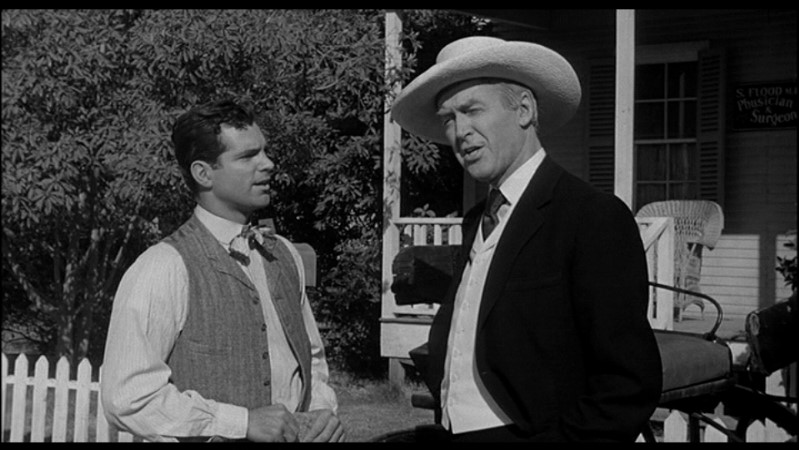
James Stewart, Vera Miles) return to the town of Shinbone to much hoopla. It is their home-town, of course, but as the Senator now spends all his time in Washington he doesn't get back there much. So the press start nosing around to get the wherefore's of why "The Man Who Shot Liberty Valance" (and rode that acclaim into politics), is there now. The occasion is a funeral for a man nobody knows (or has little regard for), but he's very important to the Stoddards—he is, after all, the man who brought them together. And as Hallie places a cactus on Stoddard's plain pine coffin, Stoddard relates the tale, one that blows away the Senator's folksy bluster with a scouring truth.

The Senator talks of his first coming to Shinbone as a greenhorn lawyer* and his run-in's with
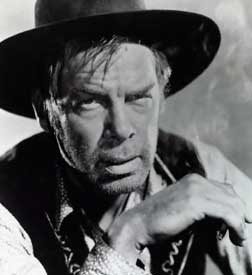
local bandit Liberty Valance (Lee Marvin, gloriously over-the-top), a malevolent thief and enforcer for the cattle industry who has the small town of Shinbone afraid to come out of their houses. Beaten and bleeding, Stoddard is brought to recover under the roof of the Ericson's (Jeanette Nolan, John Qualen, Miles) by Tom Doniphon (John Wayne), who's sweet on Hallie and is building a house for the two of them outside the city limits. Doniphon is contemptuous of Stoddard's belief in law and order (calling him "Pilgrim," only one of two films where Wayne used that oft-parodied term), believing that the only way to stand up to anarchists like Valance is a loaded pistol.

I say "anarchists" pointedly, because "
The Man Who Shot Liberty Valance" (Get it? "Liberty" Valance?) is as much about politics as it is a story about a love triangle in the Old West. You have the anarchistic, irresponsible Valance on one side and you have the "book-larned," law-and-order, taming-the-West-by-education-and-civics Stoddard on the other. In between, you have Doniphon, who's all for government (far as it goes) but in his time, you tame the West with bullets and hard work. But that time is passing. Doniphon is late to realize that that taming means the passing of the bad guys who will disrupt, but also good guys with a sense of entitlement. Ford chooses sides, and it's for civilization—because anything else is stagnation and waste. For all the talk of "Freedom" and "Rights," those are granted only under the auspices of control and Law. Because Valance represents not only unbridled freedom, but also the seeds of despotism. As a rancher, Doniphon knows those seeds will take over unless something stronger, hardier is planted in its stead.

Even if it means the death of his way of life.

Sacrifices must be made.

By the time the tale of Stoddard and his benefactor/mentor and rival
is told, a bloom has, impossibly, appeared on the cactus, because like Stewart's lack of youth in the flash-backs and the old-age make-up for the young actors in the present, Ford is also playing with time, even going to his own past, using a piece of music from 1939's "Young Mr. Lincoln" (that put a melody to Lincoln's loss of his first love Ann Rutledge) for the scene of Hallie regarding Doniphon's burnt-out homestead. And so, the telling of the tale of a lifetime is enough time to ensure new life in movie terms.

In "The Man Who Shot Liberty Valance," Ford goes so far as to state outright something he'd been alluding to throughout his career as a film-maker, story-teller and chronicler of the United States. Given a choice between printing the unvarnished truth or a myth for the common good, the newspaperman says," This is the West, sir. When the legend becomes truth, print the legend."

There was never a better-stated justification of film-making.

It's a definitive statement of Ford's career directing movies. But "Liberty Valance" is also a bridge from Ford's early Westerns to the "modern" "oaters" of the 60's as Valance's wormy toadies are portrayed by
Lee Van Cleef (of Sergio Leone's "Dollar" trilogy) and Strother Martin (part of Sam Peckinpah's stock company). Those film-makers were inspired by Ford, and in their own revisionist methods of "printing the truth," made their own legends.

And so the film is its own truth, summarizing one director's past as a pioneer and presaging the future of the Western film, on the edge of its demise, both "becoming" even in the depth of their cynicism.

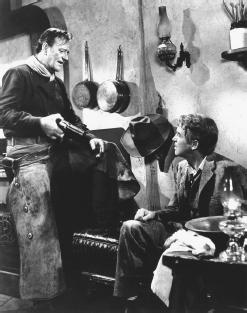
* One of the criticisms of the film is that both Stewart and Wayne are playing young men when the two were both in their 50's. Wayne can get away with it (as he always plays old...and other reasons), but Stewart doesn't come across as a man in his 20's. I have something to say about that towards the end of the review.