I Am, I Said/To No One There or Becoming Eastwood Amy Adams is amazing, really. Clint Eastwood has had many female co-stars, from Shirley MacLaine to Meryl Streep, and directed a bevy of others, some of whom have given great performances—Laura Linney, Marcia Gay Harden, Hilary Swank, Angelina Jolie, two of them to Oscars—all have studied at the Eastwood school. The results have been a combination of actress' gifts and Eastwood guile. But, none of them have taken to heart that state of naturalness, the implacable restraint and mandarin ironic humor that the actor has demonstrated in the past like Adams does inTrouble with the Curve,Eastwood's latest project (produced but not directed—that job going to Eastwood's assistant director Robert Lorenz) about the relationship between an aged baseball scout and his estranged-but-not-fallen-far-from-the-tree daughter. Linney has played Eastwood's screen-daughter in the past, and she was terrific, but Adams imbues so much of Eastwood's game that one actually believes in the symbiosis, and their scenes together crackle with a lived-in familiarity, a mutual passive-aggressiveness, and a sense of shared past and unspoken tensions. Eastwood is the top-liner but it's the daughter's story. Mickey Lobell (Adams) is on track to partner at a law firm (nice line up of of Bob Gunton, George Wyner and Jack Gilpin—in fact, the film is top-loaded with good character actors, not only in the firm, but also in the Braves organization—Robert Patrick—and among the veteran scouts—Ed Lauter, Raymond Anthony Thomas, and Chelcie Ross) when she gets wind from family friend, Atlanta Braves scouting coach Pete Klein (John Goodman) that her scout father (Eastwood) is about to be brushed back in the organization—he's old, his eyes are going, and there's a new scout (Mathew Lillard) who's more into stats and remote-controlling his decisions than doing the leg-work of seeing and hearing what the talent can do (this one would make a fine double-bill with Moneyball if double-bills still existed). Lobell is given one last chance—check out a kid with a killer swing (Joe Massingill) who looks to be a high draft pick. Lobell's job is on the line, and Klein recruits Mickey to follow the old man on-deck and pinch-hit for him if necessary as a seeing-eye daughter. Against her better instincts, she heads to North Carolina to dog her father by day and work on her client-presentation at night (the film sends mixed messages on the thesis of remote-working, as it seems to be fine for her), the father and daughter trading mutual scowls and muted growls, trying to "get closer" while they couldn't seem more like each other. That's a lot of scenario for a deceptively simple story about relationships and the importance of "being there" in them. It is also complicated by the mutual interaction between a fellow scout (Justin Timberlake) that the older Lobell has a past with, and the younger might have a future with—Timberlake does fine, relaxed...even charming...work here, not so strong on the dramatics, but hitting solidly on the humor (best line: "Poor Bruce..."), finding a nice line between Eastwood and Adams and making the most of a convenience role to show growth between the two characters. It works and works solidly if you, like Eastwood's character, don't look too well at it. And there's some late inning contrivances that come out of left field that tie everything up a little too conveniently and nicely, managing to retire the side and take care of every issue in only three pitches. I smelled a rigged game—we really didn't need a Grand Slam on the last pitch to put up a "W" for this one, and, to my mind, took away from the good things that had come before. Maybe I was feeling that way, anyway. Personally, I'd've been happy if Clint Eastwood had stuck to his lack of guns and retired from acting (as he said he was doing) with Gran Torino. The grace-note of that particular character's last act served as a "period" to the syntax of Eastwood's career, full of so many unrealistic face-offs with clusters of opponents throughout the years. It was the perfect bow and the perfect statement. But, he had to do a friend a favor—get his buddy a director card—and so he came back. I found it a little disappointing to find out that even Eastwood didn't know when the quitting was good. But, his work here is good, even if the eyes are squinting down to a lack of expressiveness (he does a wink here that is probably only visible in HD), and the voice has been reduced to a burned-out husk. The gravitas and irony are still there, though, enough for Adams to latch onto and take advantage of. And it makes for a pretty good show, while it lasts. Trouble with the Curve is a Rental.
Directed by John Ford(Peter Bogdanovich, 1971, 2006) Bogdanovich's primer is a "viewer's digest" of some big things that that made John Ford such a powerful director not only in individual films, but also across a career of experience. Generous clips from throughout his acreer illustrate points, punctuated by talking head clips from the '71 version including Ford himself (who is not very helpful, to say the least—by saying the least*—and is deliberately dismissive of the doing the whole critical analysis thing, much like a comedian hates to explain a joke, or a magician a trick), John Wayne, Henry Fonda, and James Stewart. The 2006 update folds in Harry Carey, Jr., Maureen O'Hara, and analysis from Clint Eastwood, Martin Scorsese, Walter Hill, and Steven Spielberg, as well as Bogdanovich.
The update has everything from the original re-jiggered to add more points, but there's more of a "legacy" feel to the thing, now, as the casts Ford depended on have dwindled—Ford was still alive during the first version—and so the next generation who grew up and learned their craft sitting in the theater watching Ford's images talk about "what John Ford means to me." Also, as the man is gone now, there's a bit more psychological analysis and more delving into the man's irascible personality, already on full display in his interview.
But there is one troubling aspect to this "new" version, something that stuck in my craw when I saw it (and no doubt would result in Ford caning Bogdanovich if he got wind of it). There is a brief (very brief) examination of Mary of Scotland, Ford's only film with Katherine Hepburn, and the subject of much speculation over what their relationship was. A sound clip is played of Hepburn's visit to Ford days before his death. The tape was allowed to run continuously, and their parting words to each other are played, words that they had no way of knowing were being recorded, and words that might not have been said if known they'd been overheard (Ford specifically asks her "Are they gone?"). It's nothing scandalous or huge. Ford merely says "I love you," and Hepburn says "it's mutual." But it feels like a violation of the departed by the parties that recorded it and who have re-presented it. And far too much is made of it (Really? It was the inspiration for the names of O'Hara's and Wayne's characters in The Quiet Man?) in a gossipy, speculative fashion. These were, after all, words from people who must have known they'd never see each other again, and it's nice and it's lovely. But it's beneath the film, beneath Bogdanovich, and undercuts whatever scholarly impact the film might otherwise enjoy to make anything more of than the sweet parting gesture it is. The worst part is...there's no one to rebut, no one to protest, no one to defend...or even better yet, to correct the speculation. Even Ford's maxim of "When the legend becomes fact, print the legend" doesn't cover this.
That aside (and it's my quibble, really), it's an invaluable first toe-dip into the films of Ford, and enriches the experience and appreciation of every film of his seen afterwards. One thing Bogdanovich did right (besides getting Turner Classic Movies to bank-roll it, so more people would see it, the various clips from many sources being very expensive) is he kept the original's essential narration by Orson Welles, Ford fan and student. The voices and faces and memories out of the past have as much weight and bearing as the films do, reverberating throughout history and time, feeling immortal and universal.
Lafayette Escadrille(William Wellman, 1958) Wellman's last film couldn't be more personal—the story of American flyers for the French Army during World War I. The director was in a similar squadron during the war, and he's even a character in the movie (played by son William Wellman, Jr., who would go on to make a documentary about his dad called Wild Bill: Hollywood Maverick). It's your basic service adventure/comedy—part daring-do, part rollicking hi-jinks, part romance, with the first two provided by the collection of cocky Yanks dealing with the conditions (abysmal), looking for thrills (the flying and combat), and making a mockery of the de riguer training of the French military—the marching, the discipline, the rules—while simultaneously staying above the fray, plotting ingenious, diffident ways to get their flying hours while getting their way breaking the rules. The Americans don't even learn the language making drilling a fait accompli with their harried D.I. (Marcel Dalio) It's the most entertaining aspect of the film.
It's a labor of amour, but it's bogged down with compromise. For the lead, Wellman wanted Paul Newman, but Newman wanted respect and did Cat on a Hot Tin Roof instead—and so was saddled with a Warners contract player, Tab Hunter, who is so wooden and inexpressive in the part that all the drama called for, the conflicts, the love scenes, simply do not "play." To be fair, Hunter could be fine in films and only got better with age, and his best scenes are the slightly comic interludes with the Maitre d' of his French girlfriend's walk-up. That poor actress, Etchika Choureau, has to deal with emotional scenes where her co-star is no help, and evokes sympathy just from the wasted opportunity their scenes can't achieve, not that she doesn't try hard.*
But ultimately, despite Hunter, it's a good film, one clearly after the director's heart, as he lived it. And he gets good work out of his son, as well as the sons of Andy Devine and Joel McCrea, and a couple of upstarts named David Janssen (who was starring in the TV Series "Richard Diamond" at the time) and Clint Eastwood—he's the tall scowling one in the back.
I'd never heard of this film until seeing the story of its making—which made up a good chunk of young Wellman's documentary of his father. The other great chance to learn more about the man is the episode on him from critic Richard Schickel's fine series "The Men Who Made the Movies." I'll always remember the section where Wellman talks about interference with his film Buffalo Bill, to make it more heroic and less true to life. After a scene where a young audience member says "God bless you, Buffalo Bill!", Schickel cut to a pained Wellman who succinctly states "That made me want to throw up!"
Lafayette Escadrille is by no means his best film, despite being his last, but it shows his gifts for pushing the envelope, tweaking the censors and, in general, being a professional pain in the ass.
"Wild Bill" Wellman at the time of his French service
* According to Tab Hunter's frank auto-biography "Tab Hunter Confidential: The Making of a Movie Star," he has remained close friends with Choureau ever since.
The F.B.I. (Love) Story or "What Determines a Man's Legacy is Sometimes That Which Isn't Seen"
J. Edgar Hoover ruled the Federal Bureau of Investigation for 45 years under the Department of Justice. Over the course of his tenure, he made the FBI his personal weapon in defending the nation from threats as he saw them, even as they changed form—from Bolshevik radicals to hayseed bootleggers and bank robbers to Communists to Civil Rights Activists to his very bosses. He did this unsubtly and unequivocally with press-trumpeted raids and whispered-about secret files that, if it didn't make him (as the phrase goes) "the most powerful man in the country," he was certainly the most feared. It was always assumed that Hoover had "the goods" on everyone, and guaranteed his long-held government post with weapons in manila files.
When he died (in office), Hoover's mug had the well-known face of a haggard bulldog—keeping secrets is something that can age you rapidly—and keeping secrets is something Hoover did best. Not only those of others, but his own. Rumors swirled about the nature of his relationship with FBI Associate Director Clyde Tolson—that they were secretly gay lovers rather than "gentleman cops," that Hoover was a cross-dresser, and that the reason Hoover didn't pursue the gangsters of La Cosa Nostra in the '40's and '50's was because of compromising photographs in the hands of Meyer Lansky. Nothing has ever been confirmed. It's all just rumor, the smirking kind that the powerful get (but there's never any proof).
Which is why news of a Hoover bio-pic, written by Dustin Lance Black and directed by Clint Eastwood seemed so intriguing. Eastwood isn't afraid to take chances, turning cliches on their ear and Black's clear-eyed script for Milk garnered an Oscar. Their filmJ. Edgarpromised "red meat," of the kind that could be delightfully and salaciously chewed.
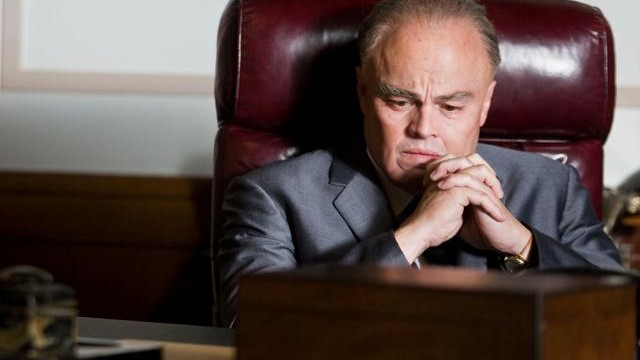
And the two men have taken chances...but not with the result you would think. Rather than being a rant or skreed, J. Edgar is actually a sympathetic look at the FBI director and his peccadilloes and shortcomings. There's nothing hysterical (save for one fist-fight that breaks out between Leonardo DiCaprio's Hoover and Armie Hammer's Tolson) in script or direction, but it offers a look at a severely closeted man who had to be in the times he lived and with the mantle he carried. Ambitious, yes. Paranoid, certainly. Vain and glory-hunting, without a doubt. Hoover craved the spotlight and his role in being "Head G-Man,"while at the same time operating in the shadows, single-mindedly hoarding the secrets of others, while keeping his own in the height of ironies. At the same time that he espoused the Bureau ethic for red-blooded American males as agents, one wonders if it is done for appearances' sake, a beard that would mask his own leanings while also serving as a "hiding-in-plain-sight" revelation of his own taste in men.
Black and Eastwood conduct the story-telling in flashback, as Hoover in his latter years, decides to set the record straight, dictating his memoirs to an amusingly rotating number of agent-stenographers who disappear as soon as a point is questioned, or a weakness revealed. The story is a white-wash, reflecting the man's "official" view of the Bureau's history in a mix of incident and myth. At many times, J.Edgar is a bit reminiscent of Citizen Kane, with its fracturing point-of-view, shifting perspective, and ironic commentary on some of the incidents.*
It also shares Kane's sense of the unattainable summation of a life. C.F. Kane's had little to do with "Rosebud," just as Hoover's gay leanings was a small part of his whole story. It began with a controlling mother (Judi Dench), determined to keep young John Edgar from becoming a drunk like his father. Groomed to become "the most powerful man in the country," Mother Hoover controls her son's life to make him the image of the perfect son, diction lessons to force past a stammer, impeccable grooming, and the enforcement of all of her prejudices. And the nullification of any behavior less than manly. He is made in the image of his Mother's "perfect son," even though that image may be completely counter to reality. It sets him on a lifelong course of fighting her battles, never really being his own man, as much as posing in the presentation he wanted to project. A performance. An act. Myth and lies.
It is a story soaked in ironies: the man who kept secrets on everybody, but the biggest being his own; the investigator who saw no harm in exposing other's private lives, while keeping an iron grip on his own; the policeman who targetted and made war on many enemies, the primary one being himself. Black and Eastwood present a case for sympathy, even empathy, for a man who shaped, and was shaped, by his times, who rose through the ranks of power in society, to not be shunned by it, and who searched for verifiable fact while living in denial, and closeted by the bureau of his own making.
J. Edgar is a Matinee.
Hoover and Tolson at their regular table at The Stork Club.
* Not to mention that DiCaprio's "old-man" make-up makes him look more like the aged Charles Foster Kane than the jowly Hoover (still, it's better than the never convincing make-up that Hammer sports as an aging Tolson), and the shots of Hoover witnessing the Inaugural parades of Franklin Roosevelt and Richard Nixon are shot from the same angle as the "newsreel" shot of Kane in a balcony appearance with Adolph Hitler.
Clint Eastwood's latest film J.Edgar opens today. Here is the second part of a career retrospective.
Second Acts
Bird, Clint Eastwood's heart-felt biographic film of jazz-legend Charley Parker begins with the erstwhile Scott Fitzgerald quote: "There are no second acts in American lives." The life and career of Clint Eastwood belies that dubious observation—everyone gets a second act if they live long enough, something even Fitzgerald might have acknowledged if he had. And though one may quibble that Eastwood has stayed as a constant in "the entertainment industry," his gradual emergence from actor to star to director represents a shift from interpreter to genuine artist. Once Eastwood became "an actor of a certain...maturity" (always said in interviews with a rueful smile), the stunt-work of his action-star years were no longer possible and he would turn his attention to what was going on behind the camera. At the same time, the star of so many gritty shoot-'em-up's displayed a depth of thinking about the films of his past and their underlying themes that belied his tough-talking portrayals over the years. The Second Act of Eastwood's career would be spent re-appraising the first.
"Vanessa in the Garden"("Amazing Stories", 1986) Episode of Spielberg's anthology series featuring performances by Harvey Keitel, Sondra Locke and Beau Bridges. The story (with a teleplay by Spielberg) features Keitel as a painter, deep in grief over the loss of his wife (Locke). Fearing that he'll lose her image forever in his mind, he paints an oil of her sitting in their garden...and discovers her sitting there, as a ghost, epehemeral and untouchable. He makes more and more paintings of Vanessa, everywhere in his house, making her appear everywhere he is. Soon, he has so many paintings that his agent (Bridges) suggests a gallery show, which the painter does not attend—he has painted a last painting of himself and Vanessa together, and has disappeared. Sweet, tender valentine of a piece (with a score by Georges Delerue) that moves at a somewhat glacial pace—as so many of the "Amazing Stories" episodes did—trying to stretch an idea fragment over an entire half-hour.
Heartbreak Ridge(1986) It's a bit hard to determine exactly what Eastwood was going for with this one. It might have been an attempt to make his version of a rollicking service comedy of the type perfected by John Ford. There are the slap-stick fist-fights, sure, but I doubt Ford would have envisioned Mario Van Peebles' hip-hop Marine (with...electric guitar?). It might be a somewhat straighter version of "Stripes," with its goof-ball Marines (this got the cooperation of the Marine Corps?*) and Eastwood is a "rebel" in the system. On the civilian front, Eastwood's Sgt. Tom Highway (get it?) is trying to win back his wife (Marsha Mason) by reading women's magazines to speak the lingo of the "sensitive male." It ends up with a fight during the invasion of Grenada, where Highway's methods save the day and the young recruits stand prepared to defend our country (God help us!) I hope the Corps got its recruiting numbers up during its release, but one wonders how many wash-outs it brought in. All around, a bad exercise that few should be proud of.
Bird(1988) Eastwood's love of jazz is evident in every frame and decibel of "Bird," his film about the short, turbulent career of Charley Parker. Eastwood and writer Joel Oliansky worked with Parker's common-law wife Chan fleshing out the screenplay and gaining access to a treasure trove of Parker recordings. Special attention was paid to the music: Parker's solos were isolated in recordings and new stereo arrangements were added to beef up the sound. Red Rodney (played by Michael Zelniker in the film) was still alive to play on the tracks and serves as the Parker student that Eastwood sees himself as. Forest Whitaker, who was only playing supporting roles at the time, infuses Parker with a roller-coaster energy that carries the film (garnering a Best Actor award at Cannes) and Diane Venora is brilliant as Parker's long-suffering wife. Jazz experts complain that not enough attention is paid to Parker's recording sessions—the only record of his playing, besides the live recordings—but that's a little "inside" and, frankly, recording sessions are boring. The drama is in Parker's life and, although revered for his music, didn't get any respect as a performer while he was alive, especially in club circles. That's the tragedy, beyond the story of prejudice that Parker endured. Eastwood won the Golden Globe for "Best Director" for "Bird."
White Hunter Black Heart(1990) "Bird" inspired Eastwood to set his sights higher, but it's poor box-office warned him that people wanted to see Eastwood the star and not the director. "White Hunter, Black Heart" allowed him to have it both ways—an interesting script by industry veterans and a part for him where he didn't have to be "Clint Eastwood." How much of the story is true is hard to say. But Peter Viertel's script, based on his roman à clef (and adapted with directors James Bridges and Burt Kennedy) of a director—not unlike John Huston—who goes to Africa to make a movie— not unlike "The African Queen"—who delays production and looking through his camera view-finder to accomplish his own personal goal of shooting and killing an elephant—the reason he wanted to make his picture in Africa in the first place. Huston was dead by this point, and his longevity might have been why the script hadn't been filmed yet. Eastwood made sure he had daughter Anjelica Huston's blessings before he took it on.
Eastwood himself plays "John Wilson" with a fair approximation of Huston's smokey, honey-magnolia voice, and the loping way Huston would walk and talk while looking back at you. Nice effort, but you never completely lose the impression that it's Eastwood doing a Huston imitation (seventeen years before Daniel Day-Lewis got an Oscar for doing the same schtick in "There Will Be Blood"). It's a pretty damning film as the pre-occupied Wilson goes through the motions of movie-prep, while his writer questions his motives. Eastwood makes good use of Jeff Fahey as the Viertel character and impersonations of Bogart, Bacall and Katherine Hepburn. It's not the most engaging film, but as a commentary on "man's man machismo," it's notable. And it's fun to watch the approximations to the film-world counter-parts.
Life Magazine picture of Huston on location in Africa.
The Rookie(1990)Easily Eastwood's worst movie, but even then, it's interesting. Eastwood's police films set the mark for action back in the day, and was now seeing his genre usurped by the bloody "Lethal Weapon" movies of Richard Donner. So, "The Rookie" takes that formula—old cop, new cop—and does a graduation ceremony on it. Eastwood, who'd done so many of his own stunts—including the strenuous climbing of "The Eiger Sanction"—was getting a bit long in the tooth for the elaborate foot-work called for. So Eastwood's cranky Lt. Nick Pulovski spends substantial time tied up and kidnapped by the Latino smuggling operation led by Raul Julia and Sonia Braga—she's the best thing in it—and fresh cop Charlie Sheen has to do the heavy lifting, fighting and bleeding. Sheen had been aping the Eastwood persona since his debut in "Ferris Bueller's Day Off " and has the same skill at dead-pan comedy. There's no clash of styles at all. Eastwood probably made it just for the last scene, where his character gets to put his feet up on his desk and relax while the "new kid" hits the streets. Eastwood, the actor, was looking at retirement.
"You Take it From Here, Kid" Eastwood hands off the stunt-work and takes the desk-job.
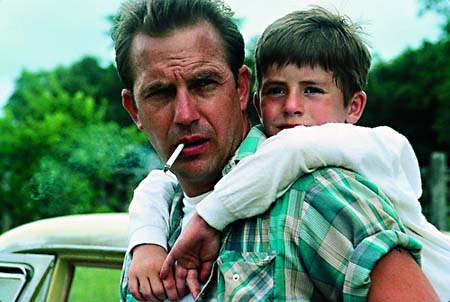
A Perfect World(1993) A minor film written by John Lee Hancock, but given a higher profile as it was Eastwood's first movie since "Unforgiven," and it featured box office star Kevin Costner. He plays one of two escaped felons pursued by Texas Rangers, represented by Eastwood and a criminologist played by Laura Dern. Early in the proceedings, Costner's "Butch" Haynes grabs an 8 year old boy (T.J. Lowther) as a hostage and the two form a bond as they're two kids robbed of childhoods: the boy, Phillip Perry is being raised by his strict Jehovah's Witness mother, and Haynes by his life in prison. For the boy, it's his first taste of a kind of freedom, which Haynes is only too happy to provide, but also begins to care for the child's welfare. There is some Costner grand-standing, but the scenes between him and the boy are sensitively allowed to grow into something approximating a family, as the boy learns to be a kid and the criminal to be responsible. Meanwhile, Eastwood's Ranger has to deal with gung-ho searchers and the press, making everybody look a little ineffectual.
The two lovers separate for the last time, through ever-increasing layers of transparent glass and rain. Eastwood displaying sentimentality and cruelty simultaneously, while Streep must endure her inner life in the context of her reponsibilities. Eastwood wrote the music for the scene as well. Amazing work, this.
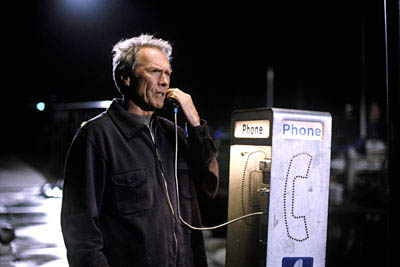
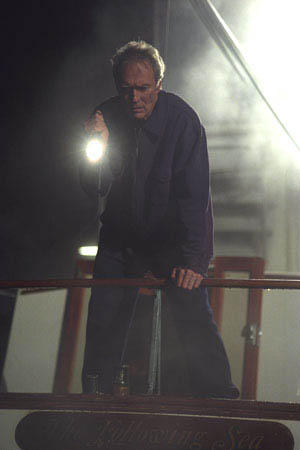
(1999) Eastwood tells two parallel stories along a single time-line: one, of the last day of a death-row inmate (Isaiah Washington) and the preparations he and the state must make in the 24 hours before his execution, and the other, of the crusty reporter-in-recovery (Eastwood) who follows his instincts that the guy is innocent. But he has until 12:01 am to prove it. Despite the manipulation of the set-up, it does turn into a nail-biter, as it becomes readily apparent that in the count-down to the inmate's zero-hour, the concerns of the state—even the protestors outside—have nothing to do with the man's innocence. Everyone is focused on the minutiae of ritual and protocol, in their own manacled lock-step with the Dead Man Walking. The film is loaded with great actors given "bits"—Eastwood gives James Woods a lot of latitude to stretch and their scenes together are a loopy highlight. But, also on hand areDiane Venora, Frances Fisher (and Eastwood's daughter by her), Denis Leary—perfecting his slow burn, Bernard Hill, Michael McKean, the great Michael Jeter and cameos byWilliam Windom and Lucy "Alexis" Liu.
"Piano Blues" (Episode of "Martin Scorsese Presents: The Blues," 2003) Eastwood gives himself the easiest job of the Scorsese-produced study of the Blues form. The director merely sets up shop at the Clint Eastwood scoring stage (at Warner Brothers Studios) and sits on the piano bench with some legendary blues keyboardists (like Ray Charles and Dave Brubeck) and just shakes his head and smiles. Once they stop playing, Eastwood asks some pretty pointed questions, both as a long-time devotee and a geeky fan, but mostly he just sits and watches and beams ...and stays out of the way of the music. For all the pyrotechnics of the other episodes of the series that took away from the Art it was examining, the fan from his earliest days as a teenager, might've had the right idea.
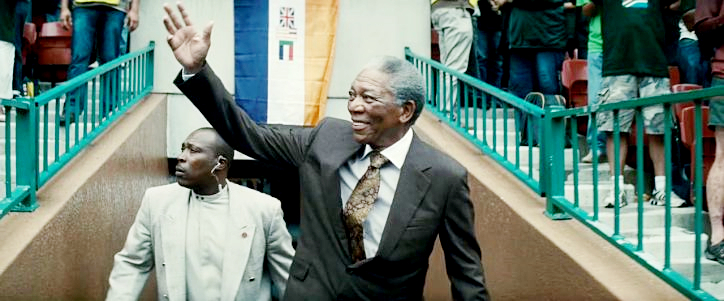
Flags of Our Fathers was roundly criticized by Spike Lee for not showing the black soldiers fighting on Iwo Jima, thereby proving 1) he hadn't seen the movie and 2) he was missing the point. Lee was oddly silent on the issue for Eastwood's next movie that came out only a few months later.
Hereafter(2010) Full review here. Okay, if you're going to take a broad overview of Eastwood's career, this might be the last movie you'd expect him to make. But the 80 year old director of such films as Breezy and The Bridges of Madison County seems like a natural fit for a story of faith, hope and charity despite the constant presence—and reminder—of Death. Peter Morgan's precise multi-lingual script is a triangular story of Fates waiting to mingle. That these people have been touched by the near-occassion of death, each subconsciously fulfilling mutual needs for a satisfying ending. Still, the movie's a bit of a tease, what with its frightfully effective opening sequence depicting a killer tsunami, Matt Damon's reluctant psychic who just hates talking to the dead, and enticing glimpses into The White Light. But, it is not death that Hereafter is most concerned with, it is Life, and living a good one, knowing it will end. It is a story of turning your back on "The Undiscovered Country" to appreciate what you know...and appreciate that there is just as much unknown here, as there. Deceptively simple, but very, very deep.
Up next:J. Edgar starring Leonardo DeCaprio, as the FBI director-for-life—and written by Milk's Dustin Lance Black, so it might be a bit different. It sounds like one of Oliver Stone's "lifetime-in-two-hours" schmeer movies.
* It did, initially. First, the Army refused co-operation, then the Marines stepped in. But upon seeing a first cut of the film, withdrew their support.
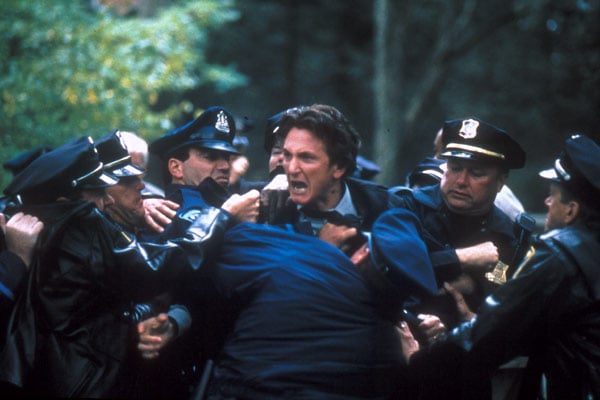
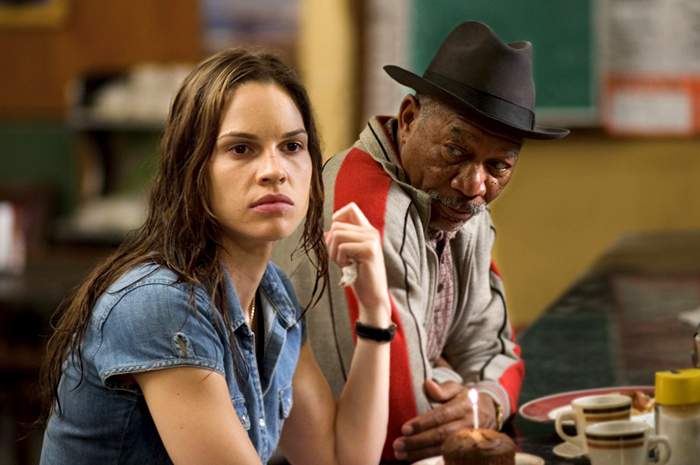
** ...as well as a well-deserved and long overdue second Oscar for Best Supporting Performance to Gene Hackman who, eying retirement from acting, initially rejected the part, thinking the movie too violent. He would start a long string of overlooked performers who would win awards in Eastwood movies, including Morgan Freeman, Sean Penn and Tim Robbins. But Hackman is terrific in this role. One line has always stood out for me. Staring up at the barrel of Munny's rifle pointed at his neck, Dagget blurts out: "I don't deserve this... to die like this. I was building a house." Which is why I chuckle every time I hear Hackman deliver the Lowe's Home Improvement tag-line—"Let's build something together."
*** The initial team of oldster astronauts was Eastwood, Jones, Sean Connery (in the Sutherland role) and Jack Nicholson (in the Garner part). That would have been...wild.
**** They aren't alone. Premiere Magazine (RIP) named "Mystic River" one of its "20 Most Overrated Movies of All Time."