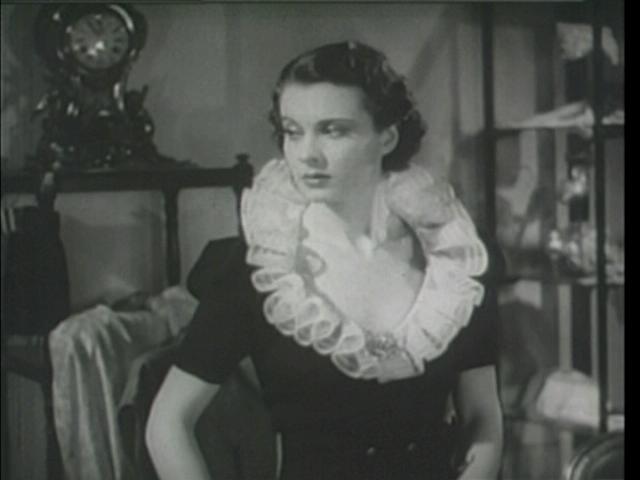
Dark Journey(Victor Saville, 1937) All's fair in love and World War I—but when love and war are running congruently, neck and neck, that's when things really get dicey. Especially when the warring lovers are spies, spying on each other. There's Madeleine Goddard (Vivien Leigh) is a designer and couture diva who regularly makes a shopping run between France and Switzerland, cloaking her activities as an agent for the British. She moves through the hoi-poloi (who never seem aware there's a war going on) attracting all the best customers, none of them suspecting that her decorative scarves and pattern swatches contain secret plans and schematics. Her assignment—find out who's the head of the German intelligence agency, Section 8. Enter the snakily charming Baron Karl von Marwitz (Conrad Veit), a German deserter who caddishly trolls the gargantuan supper-clubs with their high ceilings and higher society for the more low hanging fruit of females. It is through one of his companions that he becomes acquainted with Madeleine, becomes smitten and just a little stalkerish with her. For some reason, she finds this attractive and the two begin a wary relationship.
Yeah, well, hunt a tiger...and opposites attract, and all that. It isn't giving away any state secrets that the revelations that ultimately come about are a little less than surprising. Nor is it surprising that two intelligence agents so visibly hiding in plain sight might not actually be that effective (C'mon kids, it's called "undercover" for a reason). Imagine the dinner table conversation: "What did you do today?" "Nothing. And you?" "Same thing." Double crossing does not "go" with star-crossing. Anyway, you thought YOU had a complicated relationship. This was a few years before Leigh would toss away such behavior with a dismissive "Fiddle-dee-dee." And it's fun to watch the complications that ensue when the two spies are a little too loose with their lips. It's amazing that WWI was won at all. The costumes and sets are lavish (and very un-WWI era). Leigh and Veidt do very well conveying conflicting loyalties, but the plot is a bit spare in details as to be confusing. It's never really determined who has the upper hand—is Madeleine basically a "honey-trap" to seduce the German and get him where he can easily be captured, or is it all a misinformation campaign by either side. Whatever it is, the romance is the least charged of the themes in the film, even though Leigh and Veidt try their damnedest to be anything more than inscrutable. It's an interesting spy melodrama, it's just that there's not a lot to love.
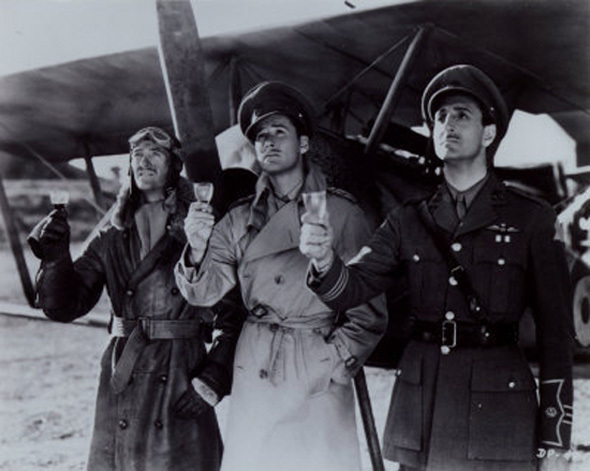
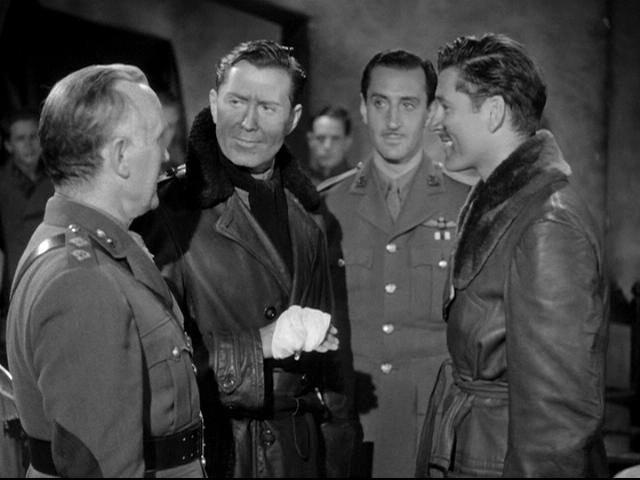
The Dawn Patrol(Edmund Goulding, 1938) Eight years after the silent Howard Hawks hit starring Richard Barthelmess and Douglas Fairbanks, Jr., the same studio released this remake, taking advantage of sound technology to enhance the story, not only in the roar of engines in combat (they even used the same planes from the Hawks version), but also the fellowship of song (a Hawks staple, by the way--I'm very curious to see how the first film got away without it, with no music and no use of the emblematic "Hurrah for the Next Man Who Dies.") This time, it's Errol Flynn as the pilot with the longest shelf-life, reporting to superiorBasil Rathbone (who sits and waits, listening for the sound of each plane returning) aided and abetted by Donald Crisp, who does the paper-work, writing the letters home to bereaved families.
A little odd for a war film,*but an example of Hawksian work ethics—do your job, be a professional, even in war-time. It's just a grudge-match between nations, anyway, and once everyone's on equal footing—in this case, terra firma—you don't hold a grudge against professionals. One has to prove oneself worthy, of course, but the general rule is to keep the war in the skies, keep your chin up and your upper lip stiff.
It's not a Hawks film, understand, just an interpretation of Hawks material. And Edmund Goulding is quite adept at making the material soar, both in the skies and on the ground. It's a British cast, so the bantering is quite formal with well-defined rules of engagement. Goulding doesn't match Hawks' trademark at-the-shoulders camera compositions, choosing, instead, a more versatile shooting scheme, which are, at times, artful. But, it is one odd war movie, removed from the geopolitics, insular and private. You get the impression that these guys might be doing this, anyway, if it wasn't for the damned turnaround. But, it is remarkably free of jingoism, glorification and other self-serving sentiments. War is a hell of job, even in the first light of mourning.
* Odd, yes, but not without precedent, especially given the odd episode of the Christmas truce during WWI (a variation of which Steven Spielberg used for an episode in his War Horse film). And, in these economic times, there are parallels: I have friends who work in a call center, who oft-times don't see the escorting off the premises of co-workers, while the "new recruits" keep revolving into the ranks to replace them. I've suggested more than once the idea of a tontine for the "last man standing" from the many cliques that form in such situations.
Lafayette Escadrille(William Wellman, 1958) Wellman's last film couldn't be more personal—the story of American flyers for the French Army during World War I. The director was in a similar squadron during the war, and he's even a character in the movie (played by son William Wellman, Jr., who would go on to make a documentary about his dad called Wild Bill: Hollywood Maverick). It's your basic service adventure/comedy—part daring-do, part rollicking hi-jinks, part romance, with the first two provided by the collection of cocky Yanks dealing with the conditions (abysmal), looking for thrills (the flying and combat), and making a mockery of the de riguer training of the French military—the marching, the discipline, the rules—while simultaneously staying above the fray, plotting ingenious, diffident ways to get their flying hours while getting their way breaking the rules. The Americans don't even learn the language making drilling a fait accompli with their harried D.I. (Marcel Dalio) It's the most entertaining aspect of the film.
It's a labor of amour, but it's bogged down with compromise. For the lead, Wellman wanted Paul Newman, but Newman wanted respect and did Cat on a Hot Tin Roof instead—and so was saddled with a Warners contract player, Tab Hunter, who is so wooden and inexpressive in the part that all the drama called for, the conflicts, the love scenes, simply do not "play." To be fair, Hunter could be fine in films and only got better with age, and his best scenes are the slightly comic interludes with the Maitre d' of his French girlfriend's walk-up. That poor actress, Etchika Choureau, has to deal with emotional scenes where her co-star is no help, and evokes sympathy just from the wasted opportunity their scenes can't achieve, not that she doesn't try hard.*
But ultimately, despite Hunter, it's a good film, one clearly after the director's heart, as he lived it. And he gets good work out of his son, as well as the sons of Andy Devine and Joel McCrea, and a couple of upstarts named David Janssen (who was starring in the TV Series "Richard Diamond" at the time) and Clint Eastwood—he's the tall scowling one in the back.
I'd never heard of this film until seeing the story of its making—which made up a good chunk of young Wellman's documentary of his father. The other great chance to learn more about the man is the episode on him from critic Richard Schickel's fine series "The Men Who Made the Movies." I'll always remember the section where Wellman talks about interference with his film Buffalo Bill, to make it more heroic and less true to life. After a scene where a young audience member says "God bless you, Buffalo Bill!", Schickel cut to a pained Wellman who succinctly states "That made me want to throw up!"
Lafayette Escadrille is by no means his best film, despite being his last, but it shows his gifts for pushing the envelope, tweaking the censors and, in general, being a professional pain in the ass.
"Wild Bill" Wellman at the time of his French service
* According to Tab Hunter's frank auto-biography "Tab Hunter Confidential: The Making of a Movie Star," he has remained close friends with Choureau ever since.
"The Lives That Pass Through a Horse" or "Come On, Joey! Come On!"
The one-two punch of two Spielberg movies opening within a week of each is almost an embarrassment of riches, and in going from Tintin to War Horse it's a journey from the ridiculous to the sublime. We've seen what happens when Spielberg tries to make a Kubrick film (A.I.: Artificial Intelligence), a David Lean film (Empire of the Sun) or cut up like Hitchcock (Jaws), but what happens when he makes a John Ford film?
The answer isWar Horse,based on the 1982 children's book by Michael Morpurgo, which was subsequently staged as a play adapted by Nick Stafford at London's National theater. Somewhere on this journey, Spielberg got wind of it, and the tale of World War I told from a horse's point of view became Spielberg's second Christmas release. Horse movies have all the sentimental elements of fables, which is why children love them, but the circumstances of this one have little to do with childhood concerns, but have more to do with kinship between man and beast in an unsentimental, often brutal world of adults.
But, where War Horse most resembles Ford's work is pictorially—Spielberg sticks to close shots for moments of drama, but when he opens up, it calls to mind advice that the old Commander gave the young director when he was still dreaming of making movies (see video below). He's definitely paying attention to the horizon in this one, and the film, especially in its final moments, seems to come from a different era, one more rich in design and purpose.
In its color, both in sentiment and photographically, War Horse hearkens back to another period of cinema, one that was simpler and more direct, but it never betrays anything less than sophistication of subject matter and maturity of purpose, while still maintaining a high level of entertainment value. At this point in his career, Spielberg is presenting a master class in film-making, evoking the past when it suits him, but maintaining a personal growth that seems to never flag.
War Horse is a Full-Price Ticket. Caution should be exercised if the kids want to go.