Showing posts with label Conrad Veidt. Show all posts

Tuesday, October 23, 2012

Mad Love (1935)/The Hands of Orlac (1928)

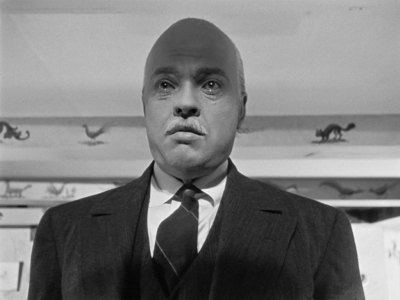
Mad Love (Karl Freund, 1935) It's been filmed many times since the silent era—most recently in 1958 starring Mel Ferrer and Christopher Lee, and another in 1962 as The Hands of a Stranger—but the most famous version of the 1920 French novel (by Maurice Renard) "The Hands of Orlac" is this 1935 version by German director Karl Freund.*  Well, "most famous" is a relative term—this one was pretty much forgotten until Pauline Kael exhumed it in her essay "Raising Kane" as an example of what she considered Orson Welles' derivative direction of Citizen Kane.  There are similarities, but vague ones—Peter Lorre's mad doctor bears a very slight resemblance to the elderly Charles Foster Kane, and his maid carries a pet cockatiel on her shoulder.**

Big deal, that.  Oh, and, of course, it's a deep-shadowed black-and-white film with deep-focus—a bit standard when dealing with low light levels in black-and-white (especially when the cinematographer is Gregg Toland, who worked on both films).  Beyond that, Mad Love is a completely different proposition than Citizen Kane and comparisons between the two are desperate and tortured, (as the writer could be at times).

But, that madness aside, Mad Love is a late version of German Expressionism from the silent era of film, and a direct descendant of:


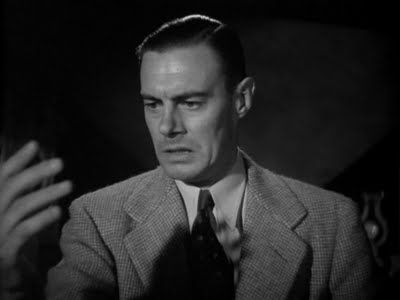
The Hands of Orlac (Robert Weine, 1928) the silent version, re-teaming the director and star of The Cabinet of Dr. Caligari, Weine and Conrad Veidt.  Both stories involve the maiming of a brilliant concert pianist in a train wreck.  His fiance, in a desperate attempt to save his career—emplores a surgeon to perform a radical double-hand transplant that has unforseen circumstances.  The difference between the two is motivational—in the latter version, the surgeon performs the surgery, not just for the sake of music, but also for his desperate love of the fiancee, an actress in a theater macabre that he devotedly attends every night, going so far as to buy the waxwork figure of her in the lobby as an object of adoration.

The operation is a success, but on the other hand, it isn't.  There's just one hitch, the same one that befell Dr. Frankenstein (coincidentally, the pianist in Freund's version is played by Colin Clive, the doctor in James Whale's version)—be careful where you shop for spare parts.  In this case, Orlac's hands are replaced by those of a murderer—a strangler in the silent version, a master knife-thrower in Freund's.  Before long, the composer is struggling to do his five finger exercises, and working on other handiwork, as well.  Before long, he is implicated in a murder, and beset by nightmares that his hands are out of his control (they are, after all, the devil's playground).


The two diverge at this point, with Mad Love concentrating on the insane machinations (literally in one instance) of Lorre's insane Dr. Gogol—in the silent version, the surgeon's role diminishes significantly at this point—and Orlac's new talents become even more literally "handy."

Both versions weigh heavily on the psychological, as Orlac and his new hands lose their grip on reality, but the first one is quite satisfied with takinbg the macabre elements so far.  The later version, post-Frankenstein and Dracula relishes the more twisted elements of the subject, going places that the original finds fanciful and, frankly, superstitious.  Mad Love embraces the possibility that the murderer's hands will, actually, assert their sense memory allowing Orlac to throw pointy things very, very accurately...and the difference between the two films is only a span of seven years.  Interesting how an audience's capacity for the weird and supernatural—and Hollywood's willingness to deliver it—could become so prevalent. 


* Freund was the German director/cinematographer whose most enduring influence came in the early days of television production when his 3-camera recording technique revolutionized filmed comedy shows (before a live audience)—a concept that started during his days with "I Love Lucy" but continues to be used today.

** Welles used a super-imposed shot of a cockatiel during what he considered a "rough transition" that didn't have enough dramatic impact, and later joked that he did it "just to wake people up."

Friday, September 7, 2012

Dark Journey

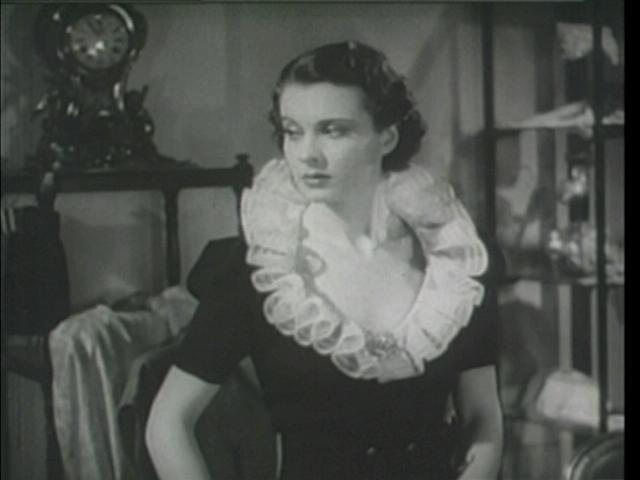
Dark Journey (Victor Saville, 1937) All's fair in love and World War I—but when love and war are running congruently, neck and neck, that's when things really get dicey.  Especially when the warring lovers are spies, spying on each other.  There's Madeleine Goddard (Vivien Leigh) is a designer and couture diva who regularly makes a shopping run between France and Switzerland, cloaking her activities as an agent for the British.  She moves through the hoi-poloi (who never seem aware there's a war going on) attracting all the best customers, none of them suspecting that her decorative scarves and pattern swatches contain secret plans and schematics.  Her assignment—find out who's the head of the German intelligence agency, Section 8.  Enter the snakily charming Baron Karl von Marwitz (Conrad Veit), a German deserter who caddishly trolls the gargantuan supper-clubs with their high ceilings and higher society for the more low hanging fruit of females.  It is through one of his companions that he becomes acquainted with Madeleine, becomes smitten and just a little stalkerish with her.  For some reason, she finds this attractive and the two begin a wary relationship.

Yeah, well, hunt a tiger...and opposites attract, and all that.  It isn't giving away any state secrets that the revelations that ultimately come about are a little less than surprising.  Nor is it surprising that two intelligence agents so visibly hiding in plain sight might not actually be that effective (C'mon kids, it's called "undercover" for a reason).  Imagine the dinner table conversation: "What did you do today?" "Nothing.  And you?"  "Same thing."  Double crossing does not "go" with star-crossing.

Anyway, you thought YOU had a complicated relationship.  This was a few years before Leigh would toss away such behavior with a dismissive "Fiddle-dee-dee."  And it's fun to watch the complications that ensue when the two spies are a little too loose with their lips.  It's amazing that WWI was won at all.

The costumes and sets are lavish (and very un-WWI era).  Leigh and Veidt do very well conveying conflicting loyalties, but the plot is a bit spare in details as to be confusing.  It's never really determined who has the upper hand—is Madeleine basically a "honey-trap" to seduce the German and get him where he can easily be captured, or is it all a misinformation campaign by either side.  Whatever it is, the romance is the least charged of the themes in the film, even though Leigh and Veidt try their damnedest to be anything more than inscrutable.  It's an interesting spy melodrama, it's just that there's not a lot to love.

Thursday, March 22, 2012

The Thief of Bagdad


The Thief of Bagdad (Michael Powell, Ludwig Berger, Tim Whelan, etc., 1940) Epic Alexander Korda production, with considerable work from his brothers Vincent and Zoltan, and the grand production designer William Cameron Menzies, that boasted three directors, filming on two continents (interrupted by the Blitz) and became a fantasy favorite.

It's still amazing, even if the two leads are a little leaden (and if we don't get too picky that all of the featured players are extraordinarily ethnically inaccurate—
Sabu was born in Mysore, then a part of British India, and Conrad Veidt...was German!), but if one takes it with a light-heartedness, and a mighty roaring laughter worthy of the Djinn (played by the larger-than-life—even without special effects—Rex Ingram), there are more than enough wonders that would enchant and entice a watcher (as it did with the young Francis Ford Coppola and Martin Scorsese, who both count it as their favorite childhood film).
Because it all comes together, all the disparate elements in eye-popping Technicolor, that somehow manages to make the real world look drab and shabby by comparison.  I've had that experience where movies change your outlook:  every new Orson Welles film made me see the world—and its possibilites—differently; a theater screening of the cinematography documentary Visions of Light was followed by an extended parking lot discussion in which the lights of the city (even in that drab corner of Seattle) never looked more beautiful to the eye; a screening of Don't Look Now (in the very same theater, coincidentally) had me walking back to the car, obsessively looking for the color red.

And The Thief of Bagdad has that same effect.  Between Menzies' sets (and his insistence on how they be filmed), the vibrant color sense and stylishness of the entire production, one yearns that movies might be more like this one, let alone the world (oh, by the way, give me a chance at those three wishes)...and isn't that illusion why we go to the movies, anyway?


The visually eye-popping The Thief of Bagdad

Thursday, October 2, 2008

All Through The Night

"All Through The Night" (Vincent Sherman, 1942) Just before solidifying his career with "Casablanca," Warner Brothers contract player Humphrey Bogart was still prone to being cast in Warners product like this, a bizarre B-movie comedy/adventure about Runyonesque hoods taking on Nazi "fifth columnists" skulking in the basements of Brooklyn. With gats in their pockets (and tongues firmly in cheeks), the mugs use their considerable street-skills to knock the Ratzis "back on their Axis."

It all starts when "Gloves" Donahue (Bogart) can't get his usual slice of cheesecake from Miller's Bakery with his morning coffee. Decrying the "
mucilage" set on his plate, "Gloves" investigates why Miller's delivery was held up. Then, his mama (Jane Darwell), the block noodge, gets in on the act, and soon, bodies start piling up, "Gloves" is framed for murder and stumbles upon a fine Frau frail and before you know it, he's running out of secret rooms, and heading for the East River...by choice.

It's hooey. But there is something amusing about a bunch of crooks fighting even harder against a totalitarian regime to save their livelihoods (them's being "lively hoods"). And the cast is impressive: as the heavies, usual suspects
Conrad Veidt, Peter Lorre (his character's named "Pepi," for some reason), and Judith Anderson. Besides Darwell, on the good side are Barton McLane ("The Maltese Falcon"), William Demarest ("My Three Sons"), Phil Silvers and one Jackie C. Gleason, pre-"Great One" persona.

It's truly whacked. Bogart is playing it as fast as he can. But comedy is not his strong suit. He looks a bit scruffy with his hair falling in his face at times.

"Casablanca" would propel him to the A-list, and he'd never have to settle for B-list material again.

Thursday, July 17, 2008

The Man Who Laughs

"The Man Who Laughs" (Paul Leni, 1928) Silent film from Universal of the Victor Hugo novel, that in this incarnation inspired two, maybe three kids working in comics (Bill Finger and Robert Kahn, and Jerry Robinson) to create Batman's Moriarty, The Joker.

Conrad Veidt plays Gwynplaine, the orphaned child of a dissident noble during King James II's rule, whose face is carved into a hideous smile, and makes a wretched existence as a clown in a travelling show. What makes him stay is the love of the blind girl he rescued in the snow, and his own disgust at his ravaged face. Billed in the carny as "The Man Who Laughs" Gwynplaine has the ability to make any local rabble laugh at his ghoulishly smiling face—except for an evil countess who he encounters in his old town. This leads to problems with his love, as he's torn between the woman who's never seen his face, or the one who's intrigued with him despite his affliction.
The fact that, unbeknownst to him, she's living on his lost estate complicates things even further.

It's high melodrama of the "melo-est" sort, and Leni crafts it with an artists' eye for lighting, and a trickster's way with camera movement. It's far more subtle than most films of the silent era, while glorying in the dramatic gestures of the era, and makes for a compelling fusion of the German and American film sensibilities.