Showing posts with label 1940. Show all posts

Friday, October 11, 2013

The Sea Hawk (1940)

The Sea Hawk (Michael Curtiz, 1940) Thought I'd better get this one in before Captain Phillips dashes all our fantasies about pirates.  Or, in this case, "privateers."  

Captain Geoffrey Thorpe (Errol Flynn) is the captain of The Albatross, part of the Sea Hawks, a private fleet of Queen Elizabeth I (Flora Robson), taking "reparations" from the Spanish fleet of King Phillip II (Montagu Love—my new favorite actor name), who has plans to (dare I say it?) rule the World.


Well, not if Thorpe (rather loosely based on Sir Francis Drake in the Howard Koch-Seton I. Miller screenplay that has nothing to do with the Rafael Sabatini novel) can fire across their bow.  On a diplomatic mission to see the Queen, the ship carrying Don José Alvarez de Cordoba (Claude Rains) and his daughter Doña Maria (Brenda Marshall) is intercepted, fired upon and boarded by Thorpe and his all-too-eager crew.  Once there, they see that the oarsmen for the Spanish are former English sailors, who are freed and taken back to home and family.  Don José is allowed to keep his meeting with the Queen, but all puffed up and protesting about it, and he and the Queen's adviser, Lord Wolfingham (Henry Darnell) demand that Thorpe be arrested and thrown in the dungeon, or the brig, or the tower, or whatever gray-bar hotel they had in 16th century England.  The Queen puts on a stern public face, but is only too happy to let Thorpe command his ship to the isthmus of Panama to commandeer supplies from South America to the Spanish Armada.


But, the Queen's court has divided loyalties and Wolfingham is working with Don José to intercept Thorpe's plans, and the crew, once on land, and in a tinctured yellow setting, is trapped by Spanish forces and imprisoned as oarsmen on an enemy ship on its way back to Europe.  Can Thorpe and his men escape their fate and warn the Queen about the oncoming attack by the Spanish Armada?


What do you think?


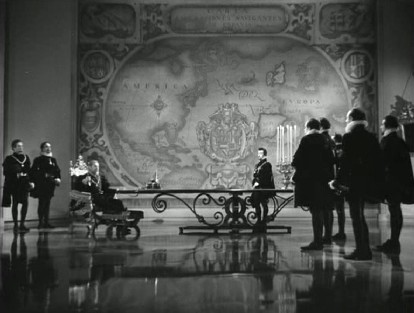
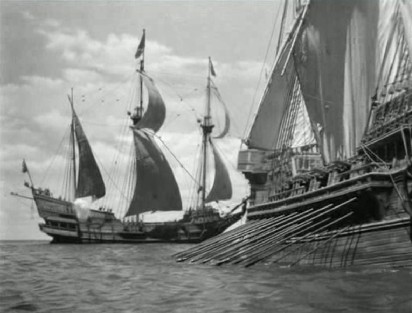
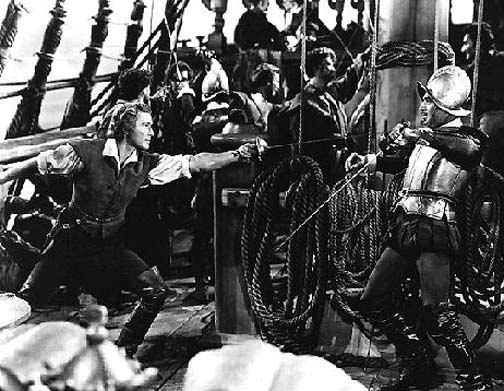
It's a grand epic, and director Curtiz, accustomed to filling the film-frame with detail has a lot of scenery to use.  The ships are big and impressive sets (especially when there are two next to each other), and the sea battles, some shots culled from Captain Blood (which is why this one is black and white and not Technicolor), are rousingly busy affairs starting with the chases, the cannon lobs, the swinging from ship to ship, then the sword-fights.  They're frenetic and fun, the stuff of our pre-Johnny Depp cultural memories, and blood-shed is kept to a minimum.  Curtiz and his designers also make the film feel a bit more gritty than one associates with a Hollywood studio film of the type (except of course in the Queen's court where everything is vast, spotless, and polished to the point of reflection).  But compare Curtiz's slave galley to the one Charlton Heston occupied in Ben-Hur, and although the effort displayed by the rowers in the latter seem more strenuous, the conditions in the former are far more depressing.  And Curtiz keeps it moving, no dawdling over the ironic dialogue or key sequences, as there's another just around the cut to get to.  The cherry on top is one of Erich Wolfgang Korngold's greatest film-scores, which in itself has an awful lot of swash-buckling just in the playing.  


Try to see the longer version, though.  For awhile, The Sea Hawk had its final scene plucked—The Queen's speech before the attack of the Spanish Armada, which may be the strangest speech a Queen has even been given: 


And now, my loyal subjects, a grave duty confronts us all: To prepare our nation for a war that none of us wants, least of all your queen. We have tried by all means in our power to avert this war. We have no quarrel with the people of Spain or of any other country; but when the ruthless ambition of a man threatens to engulf the world, it becomes the solemn obligation of all free men to affirm that the earth belongs not to any one man, but to all men, and that freedom is the deed and title to the soil on which we exist. Firm in this faith, we shall now make ready to meet the great armada that Philip sends against us. To this end, I pledge you ships - ships worthy of our seamen - a mighty fleet, hewn out of the forests of England; a navy foremost in the world - not only in our time, but for generations to come. 
"The earth belongs not to any one man, but to all men , and that freedom is the deed and title to the soil on which we exist."  What do mean "we," Queen E?  Fact is, Elizabeth didn't say this.*  But, as this film was released in 1940, it serves as its own little shot across the bow to another "one man" who wanted the map, not to be of Spain, but of the Third Reich—Herr Hitler.   The film, when first released, had that bit of rallying to it, in the days before The Blitz.  After the war, prints had that speech removed as unnecessary (and probably anachronistic, and not in a Queen's spirit.   


"...vast, spotless and polished to the point of reflection."


* She ACTUALLY said this: "My loving people, we have been persuaded by some that are careful of our safety, to take heed how we commit ourself to armed multitudes for fear of treachery; but I assure you, I do not desire to live to distrust my faithful and loving people ... I know I have the body but of a weak and feeble woman, but I have the heart and stomach of a king, and of a King of England too, and think foul scorn that Parma or Spain, or any Prince of Europe should dare to invade the borders of my realm."  "My" realm.  See that?  "My".

Thursday, March 22, 2012

The Thief of Bagdad


The Thief of Bagdad (Michael Powell, Ludwig Berger, Tim Whelan, etc., 1940) Epic Alexander Korda production, with considerable work from his brothers Vincent and Zoltan, and the grand production designer William Cameron Menzies, that boasted three directors, filming on two continents (interrupted by the Blitz) and became a fantasy favorite.

It's still amazing, even if the two leads are a little leaden (and if we don't get too picky that all of the featured players are extraordinarily ethnically inaccurate—
Sabu was born in Mysore, then a part of British India, and Conrad Veidt...was German!), but if one takes it with a light-heartedness, and a mighty roaring laughter worthy of the Djinn (played by the larger-than-life—even without special effects—Rex Ingram), there are more than enough wonders that would enchant and entice a watcher (as it did with the young Francis Ford Coppola and Martin Scorsese, who both count it as their favorite childhood film).
Because it all comes together, all the disparate elements in eye-popping Technicolor, that somehow manages to make the real world look drab and shabby by comparison.  I've had that experience where movies change your outlook:  every new Orson Welles film made me see the world—and its possibilites—differently; a theater screening of the cinematography documentary Visions of Light was followed by an extended parking lot discussion in which the lights of the city (even in that drab corner of Seattle) never looked more beautiful to the eye; a screening of Don't Look Now (in the very same theater, coincidentally) had me walking back to the car, obsessively looking for the color red.

And The Thief of Bagdad has that same effect.  Between Menzies' sets (and his insistence on how they be filmed), the vibrant color sense and stylishness of the entire production, one yearns that movies might be more like this one, let alone the world (oh, by the way, give me a chance at those three wishes)...and isn't that illusion why we go to the movies, anyway?


The visually eye-popping The Thief of Bagdad

Wednesday, December 23, 2009

Christmas in July

"Christmas in July" (Preston Sturges, 1941) James MacDonald (Dick Powell) lives a life of pretense and dreams. A bean counter for a coffee company, he's just won the $25,000 prize in the slogan contest for rival caffeine-pushers, Maxford House. The winning entry: "Can't sleep at night? It's not the coffee. It's the bunk."

Well, it is the bunk and the pretenses are false ones. MacDonald didn't win any contest. It's all an impractical joke played on him by co-workers, that manages to sneak under the radar due to a contest SNAFU.
But by the end of his perfect day, he's got a promotion, a new raise and an office, and bought presents for everybody on the block without spending a dime yet. You've got to have good luck to get good luck it seems, but it all comes crashing down when the check and everything with it bounces. Jimmy almost loses his new job because, let's face it, he only got it because he won the contest and, his boss, liking sure things and having made a ton of mistakes himself, needs to have something he can count on. Now that he can't count on MacDonald being a proven winner, well...

That twisted logic—the very basis of our banking credit system (You can only get money if you don't need it) forms the curvature of the spine of Sturges' short (68 minutes) winning second film. Another moral, Sturges-style is a familiar one, except in Hollywood: No good deed goes unpunished. MacDonald buys presents for everybody but himself and ends up humiliated in front of his neighbors. But at least he gets to keep his new job if he succeeds at it because "it's one thing to muff a chance once you've had it... it's another thing never to have had a chance."

Powell does measured work far subtler than his musical gigs and ingenue Ellen Drew is delightful. But the stand-out amond the Sturges stock company in this film is Raymond Walburn as the perpetually frustrated and passive aggressive Dr. Maxford, head of Maxford House Coffee. Usually these big business CEO's are played with comedy bluster, but Walburn fumes and fusses as if its as part of his everyday routine as a cup of coffee, roasted and aged. The entire movie has a fresh comic timing that's a bit off-kilter, and the results are hilarious. It's Frank Capra turned on his ear, but far more cynical and with less of a "reach" at the end.

Wednesday, November 25, 2009

The Great McGinty

"The Great McGinty" (Preston Sturges, 1940) Guy walks into a bar in a "banana republic" and tries to ventilate his own head. Turns out he's an embezzler on the lam who's made one mistake and wants to end it all. The bartender manages to stop him, but doesn't give him any sympathy. He thinks he has problems? He used to be Governor of the State.

The rest of the movie is
Sturges' tall tale told in flashback that turns around the bar's doubters and the rolling eyes. Dan McGinty (Brian Donlevy) is a bum. He finds out that if he votes for a candidate for Mayor at a polling place, the candidates' "political advisers" will pay him two bucks. Sounds good to McGinty. But if he votes for the guy at 37 different polling places. he'll get 74 bucks! The politico's can't believe it. They're petty criminals. They don't think "big" like McGinty. So, after a brief turner as a mob "collector," he goes to the next logical career step—politics!

Once Mayor,
McGinty starts shaking down city fathers and handing out favored construction contracts, his "tough guy" tactics backed up by mayoral power. And nobody can argue with him, save the mob boss (Akim Tamiroff) that McGinty regularly has knock-down-drag-outs with. Oh, and his "married-to-look-good-for-the-lady-voters" wife/former secretary (Muriel Angelus), she gives him a kick in the pants every so often. But, when McGinty becomes governor, she talks him into doing some good for a change, and...well, you know that "no good deed goes unpunished."

The characters are Dickensian, the fable is
Aesop turned on his toga. And drama turned on its head. A tragedy is a good man who does something wrong. And in Sturges' street-wise script, tragedy befalls a bad man who does the right thing. No moral codes are being broken—McGinty is taken down. But Sturges' view is a cock-eyed, if soberly cock-eyed, story of moral growth and the trouble it can cause, especially if you're working for the people. Told with brass and a smart alecky humor, it's a criss-crossed morality play told from the other side—an anti-Capra film, told with that director's straight-forwardness, but with more of a knockabout flavor.

This was the first film Sturges directed, and it has sophisticated ideas (which seem quite contemprary) told in a scruffy manner. If there's pretentiousness, it's all in the background and the sub-text, buried where no one can nod sagely at it. One gets the impression Sturges would look at a movie aiming for the handkerchiefs and blow it a raspberry. Before the year fades away, we're going to be looking at a lot more
Preston Sturges, a director who doesn't get near enough acknowledgement in the movie history books. There's not enough Sturges in my head, and we're going to rectify that.

Friday, December 5, 2008

They Drive By Night

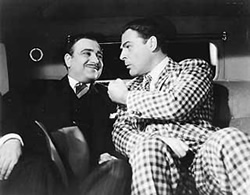
"They Drive By Night" (Raoul Walsh, 1940) Warner Brothers-style action-and-intrigue pot-boiler about...wild-cat truckers. The brothers Fabrini (George Raft and Humphrey Bogart) are partners in a truck who decide to stop working for other shipping companies and do the deals themselves. This pushes their murderous schedules to the edge and consequences determine a change of focus. An interesting little movie where two Warner's tough-guys—Raft and his understudy at the time, Bogart*—do "everyman" jobs and mine real drama out of it. Of course, it couldn't be a Warner's picture without action and the film boasts two nail-biters where truck-drivers fall asleep at the wheel, filmed with the snap that one can expect from Raoul Walsh.

Where the movie excels is the smart patter that spins drama in the economic realities of this corps of transport specialists. The movie manages to slip in lessons in Unionization and Modernization amid the wise-cracks and the trumped murder-plot that dominates the film's second half. You begin to feel like you're learning something without being preached to.

And there's enough good acting going on that raises it above "B" level. Raft is a bit looser in the starring role, but Bogart has the most dramatic...and fun part.
Ann Sheridan does well with her wise-acre dialog and Ida Lupino manages a mine-filed of femme fatale neuroses with dexterity and quick-silver reactions. But the stand-out is Alan Hale—"The Skipper''s" dad—who takes the part of a trucker-who-owns-a-company and can't believe his good fortune. Hale's "Ed Carlsen" never has a "down" moment, and is carried out with wolfish good spirits and the sense that he's making it up as he goes along. His performance is the diamond in the rough in this rough little film about trucking.

*At this time in his career, Bogie was still upset at the way his career was going, he was still doing the occasional western, and just the previous year he starred in the worst movie of his career--"The Return of Doctor X!" But in his next movie would be a part that Raft tosses aside--"Mad Dog" Roy Earle in "High Sierra." And the next part meant for Raft but inherited by Bogart would be detective Sam Spade in "The Maltese Falcon."