Showing posts with label Claude Rains. Show all posts

Friday, October 11, 2013

The Sea Hawk (1940)

The Sea Hawk (Michael Curtiz, 1940) Thought I'd better get this one in before Captain Phillips dashes all our fantasies about pirates.  Or, in this case, "privateers."  

Captain Geoffrey Thorpe (Errol Flynn) is the captain of The Albatross, part of the Sea Hawks, a private fleet of Queen Elizabeth I (Flora Robson), taking "reparations" from the Spanish fleet of King Phillip II (Montagu Love—my new favorite actor name), who has plans to (dare I say it?) rule the World.


Well, not if Thorpe (rather loosely based on Sir Francis Drake in the Howard Koch-Seton I. Miller screenplay that has nothing to do with the Rafael Sabatini novel) can fire across their bow.  On a diplomatic mission to see the Queen, the ship carrying Don José Alvarez de Cordoba (Claude Rains) and his daughter Doña Maria (Brenda Marshall) is intercepted, fired upon and boarded by Thorpe and his all-too-eager crew.  Once there, they see that the oarsmen for the Spanish are former English sailors, who are freed and taken back to home and family.  Don José is allowed to keep his meeting with the Queen, but all puffed up and protesting about it, and he and the Queen's adviser, Lord Wolfingham (Henry Darnell) demand that Thorpe be arrested and thrown in the dungeon, or the brig, or the tower, or whatever gray-bar hotel they had in 16th century England.  The Queen puts on a stern public face, but is only too happy to let Thorpe command his ship to the isthmus of Panama to commandeer supplies from South America to the Spanish Armada.


But, the Queen's court has divided loyalties and Wolfingham is working with Don José to intercept Thorpe's plans, and the crew, once on land, and in a tinctured yellow setting, is trapped by Spanish forces and imprisoned as oarsmen on an enemy ship on its way back to Europe.  Can Thorpe and his men escape their fate and warn the Queen about the oncoming attack by the Spanish Armada?


What do you think?


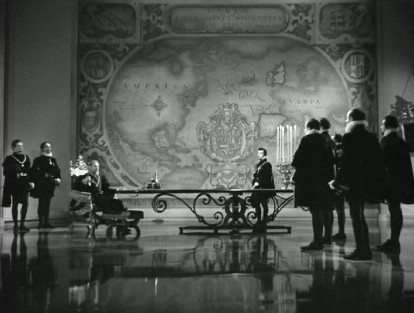
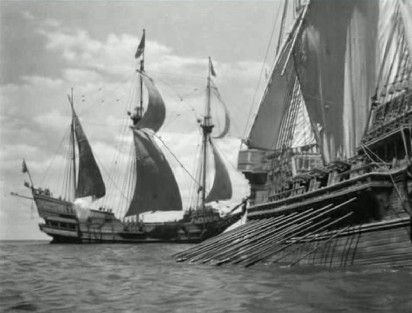
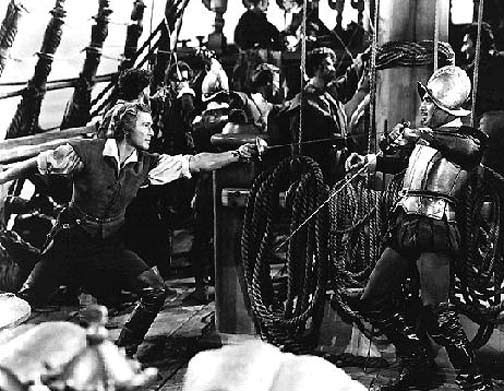
It's a grand epic, and director Curtiz, accustomed to filling the film-frame with detail has a lot of scenery to use.  The ships are big and impressive sets (especially when there are two next to each other), and the sea battles, some shots culled from Captain Blood (which is why this one is black and white and not Technicolor), are rousingly busy affairs starting with the chases, the cannon lobs, the swinging from ship to ship, then the sword-fights.  They're frenetic and fun, the stuff of our pre-Johnny Depp cultural memories, and blood-shed is kept to a minimum.  Curtiz and his designers also make the film feel a bit more gritty than one associates with a Hollywood studio film of the type (except of course in the Queen's court where everything is vast, spotless, and polished to the point of reflection).  But compare Curtiz's slave galley to the one Charlton Heston occupied in Ben-Hur, and although the effort displayed by the rowers in the latter seem more strenuous, the conditions in the former are far more depressing.  And Curtiz keeps it moving, no dawdling over the ironic dialogue or key sequences, as there's another just around the cut to get to.  The cherry on top is one of Erich Wolfgang Korngold's greatest film-scores, which in itself has an awful lot of swash-buckling just in the playing.  


Try to see the longer version, though.  For awhile, The Sea Hawk had its final scene plucked—The Queen's speech before the attack of the Spanish Armada, which may be the strangest speech a Queen has even been given: 


And now, my loyal subjects, a grave duty confronts us all: To prepare our nation for a war that none of us wants, least of all your queen. We have tried by all means in our power to avert this war. We have no quarrel with the people of Spain or of any other country; but when the ruthless ambition of a man threatens to engulf the world, it becomes the solemn obligation of all free men to affirm that the earth belongs not to any one man, but to all men, and that freedom is the deed and title to the soil on which we exist. Firm in this faith, we shall now make ready to meet the great armada that Philip sends against us. To this end, I pledge you ships - ships worthy of our seamen - a mighty fleet, hewn out of the forests of England; a navy foremost in the world - not only in our time, but for generations to come. 
"The earth belongs not to any one man, but to all men , and that freedom is the deed and title to the soil on which we exist."  What do mean "we," Queen E?  Fact is, Elizabeth didn't say this.*  But, as this film was released in 1940, it serves as its own little shot across the bow to another "one man" who wanted the map, not to be of Spain, but of the Third Reich—Herr Hitler.   The film, when first released, had that bit of rallying to it, in the days before The Blitz.  After the war, prints had that speech removed as unnecessary (and probably anachronistic, and not in a Queen's spirit.   


"...vast, spotless and polished to the point of reflection."


* She ACTUALLY said this: "My loving people, we have been persuaded by some that are careful of our safety, to take heed how we commit ourself to armed multitudes for fear of treachery; but I assure you, I do not desire to live to distrust my faithful and loving people ... I know I have the body but of a weak and feeble woman, but I have the heart and stomach of a king, and of a King of England too, and think foul scorn that Parma or Spain, or any Prince of Europe should dare to invade the borders of my realm."  "My" realm.  See that?  "My".

Tuesday, November 6, 2012

Anytime Movies Perpetually Reloaded: Election Edition

It's Election day 2012. If you haven't already, go out and vote, dammit. And in that spirit, time for some truths to be self-evident.

Anytime Movies are the movies I can watch anytime, anywhere. If I see a second of it, I can identify it. If it shows up on television, my attention is focused on it until the conclusion. Sometimes it’s the direction, sometimes it’s the writing, sometimes it’s the acting, sometimes it’s just the idea behind it, but these are the movies I can watch again and again (and again!) and never tire of them.


I’m very suspicious of patriotism (I always recall the "last resort of a scoundrel" remark), yet nothing moves me so much like a movie extolling the virtues of America.

It wasn’t until I was voting on the
Emmy’s that I sat down and watched “The West Wing.” I figured it was going to be a vapid “America-Love It or Leave It” tract (starring Rob Lowe), even if it did have Martin Sheen playing the President, in which case, I could leave it. But TWW was a serious look at government work—its glories and disappointments, the combination of ego and sacrifice. It could criticize individuals and “ideology for ideology’s sake,” but one thing it never ever criticized was the idea of Public Service, no matter what side of the aisle it was on. At the same time the country is being run by crooks specializing in an institutionalized form of bribery and graft, there is an infrastructure of people for whom government service is a sacred trust (well, there’s gotta be ONE!) “The West Wing” paid tribute to that corps of people wherever they might be, week after week, and it made for refreshingly positive TV. It also made for a refreshing look at our nation as it stands.

And so, too, does “

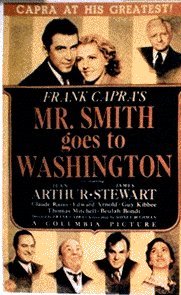
Mr. Smith Goes to Washington.” Made in 1939, it plays like it was written yesterday. When I saw it for the first time—right after “Watergate”—I found it amazingly prescient. But no, it was talking about its own times. The problems just keep re-occurring again and again. And again. Whoever doesn’t know history is doomed to repeat it, and with every fresh crop of people governing, they’ll keep making the same mistakes. Maybe they think they’re unique. Maybe they don’t know history. They say that if you keep making the same mistake over and over, it’s a sign of insanity. Well, psychology never factored in term limits.
“Mr. Smith…” is the story of a youth leader who is appointed to the Senate after the incumbent dies. This runs afoul of the state’s political machine that ran that senator as well as the senior Senator, Paine (
Claude Rains)—who just happens to be an idol of the new senator’s.

It wouldn’t work if director
Frank Capra didn’t have tall awkward Jimmy Stewart—not James, Jimmy—whose every stammered syllable bespoke humility. But get him talking about America or Liberty of The Capitol Dome and the stutter disappears in a fervent stage whisper that trails off in awe. Mr. Smith isn’t sure of himself, but he’s sure sure of the Country.

And
Washington, D.C. is just the place to shake him up with a few lashes of the Beltway. Stewart could be frustratingly folksy, but for Capra (and for Hitchcock and Anthony Mann) he could be unnervingly vulnerable and, at the other end of the bi-pole, dramatically unhinged. The last act of “Mr. Smith…”—the filibuster against false charges of graft—features Stewart in both phases. At one point, he's knee-deep in political hate-mail, clutching it in his hands and looking skyward like Jesus at Gethsemane. Then a few short paragraphs about “lost causes” later, he’s at his most defiant. “You think I’m licked! You ALL think I’m licked!!” That was his Oscar-winning performance, not the next year’s “The Philadelphia Story” where the “cynical reporter” bit just didn’t wash with someone who looked so homespun. The filibuster scene always brings a lump to my throat, and it’s not sympathy pains for Stewart’s frayed larynx.

Now, I’ve read the screenplay to “Mr. Smith Goes to Washington.” It ends with a big parade honoring the completely vindicated Smith, surrounded by his boy-rangers, supported by the woman-he-loves (Jean Arthur,
again, who manages to make her extraordinarily jaded Senate Aide adorable, even when she’s at her worst—and she has a great drunk scene with Thomas Mitchell. Hmmm, Thomas Mitchell, again). Why, even the disgraced Senator Paine is being lionized. Oh, it’s just so sweet, your eyes could roll back in their sockets and jam and stick that way. As Arthur’s Miss Saunders tipsily says in the film, “Nah, I can’t think of anything more shappy!” “Capra-corn” is what the very self-aware director called it.

So, he cut it.
Orson Welles has said: "If you want a happy ending that depends, of course, on where you stop your story." Capra leaves his story’s ending ambiguous. Oh, you could call the riotous goings-on at the end a Happy Ending—but all of Paine’s Senate pals are trying to calm him down, telling him it’s okay…everything’s all right, we're still on your side. The only solace Jefferson Smith is granted is in the sympathetic smile from the Vice-President (played by John Ford’s silent cowboy film-star Harry Carey) before he collapses in a heap of his enemy’s mass-generated letters. The movie "celebration" has all the weight of an Al Gore victory celebration on Election Day 2000--a case of premature exaltation. But nothing's been solved. No one's been cleared. Nothing has been decided. There is just misunderstanding and confusion. Carey leans back and has a chaw while the chaos of Democracy continues unabated. It may not be a "happy" ending, considering the sequence that was shelved. It may not even be a dramatically satisfying ending. But it is representative of the loud, messy process that turns the gears of Democracy. However slow-moving, however off-course, they still turn.

Jeferson Smith (Jimmy Stewart) looks for guidance.
Mr. Smith Goes to Washington
American Graffiti
To Kill a Mockingbird
Goldfinger
Bonus: Edge of Darkness

Sunday's Scene: For Dads and Grads
Tuesday: Fuggedaboutit...