Showing posts with label Flora Robson. Show all posts

Saturday, October 26, 2013

Eye of the Devil

Eye of the Devil (aka 13, J. Lee Thompson et al., 1966)
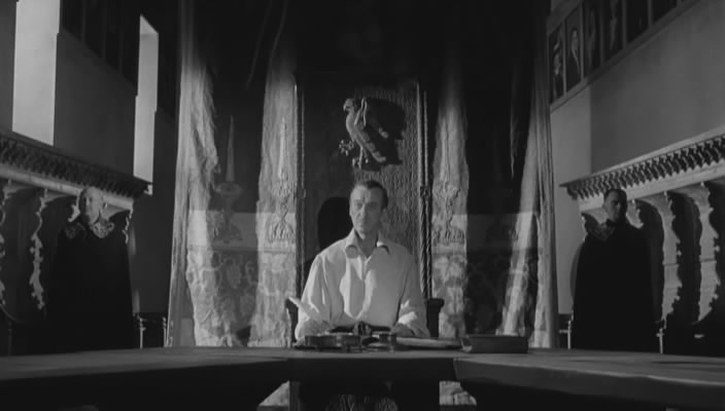
Going in cold to Eye of the Devil—its end-credits say that "13" is presented by M-G-M and that was the name of it when released in Europe—you wonder what were the filmmakers trying to achieve.  A great cast, with a middling occult story (although the dialogue is a bit "highfalutin'"), a rather amazing location in the Chateau de Hautefort, undercut by direction that one can only describe as "odd" and off-kilter, and editing that follows a particular beat for no apparent reason, then when it comes to shock moments, cuts away just too soon, so that one can't register what they're seeing.  Eye of the Devil is frustrating on very many levels

But probably more for the producer.  More on that later.  First, the film.


You start off watching the film by asking the question "why does Deborah Kerr have two children under the age of six?"  It was physically possible, of course (she was 45 at the time of filming), it's just that...well, in movie terms* it doesn't quite skew.  Then, the editing has an odd rhythm, allowing you to hear all the words people are saying, of course, but the natural beats are slightly "off." The camera glides along, cat-like, and BOOM there's an edit that feels uncomfortable or unnecessary given what's transpiring on-screen.


Things unravel as the mysteries deepen and people start to do "movie-logic" things.  For example, David Niven's marquis Phillipe de Montfaucon is called away at a dinner party; it seems the vineyards at his estate are dying and he must make one of his infrequent trips to the old stomping grounds of Bellenac. He explicitly tells his wife Catherine (Kerr) to keep the home fires burning while he goes to tend to things. Trusting him implicitly, she bundles up the kids and drives all the way out there, where she is greeted with all the welcome you'd give to a burning bag of poop at the front door.

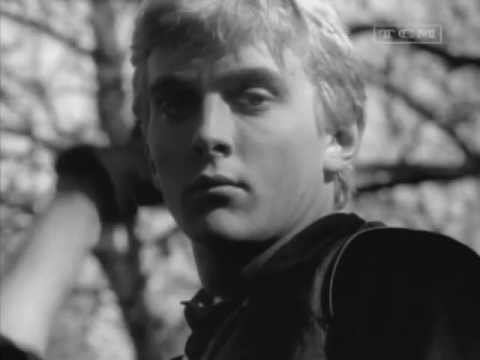
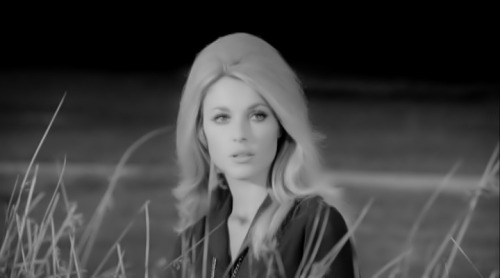
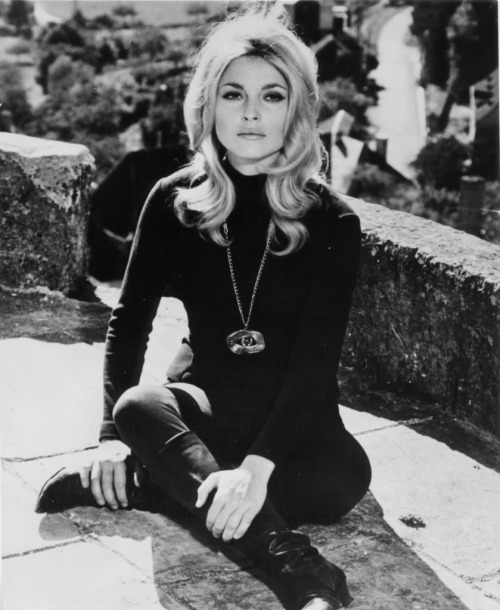
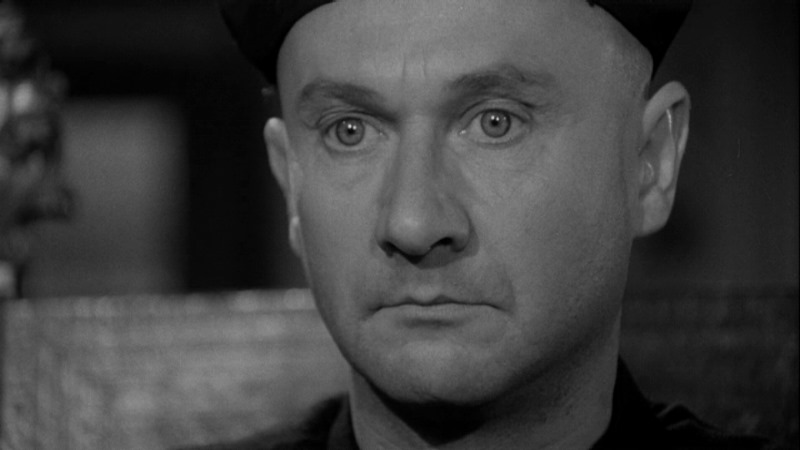
Phillipe's Aunt Estell (the wonderful Flora Robson) is outward-smiles, but suggests that things are fine (dear), why don't you go home?  Then, there are the strange kids hanging around, Christian and Odille de Caray (David Hemmings and "introducing" Sharon Tate, dubbed).  Christian thinks nothing of bow-skewing a dove in front of the wife and kids and Odile is all heavily-made-up blond-thing-in-a-black-catsuit (Were they able to watch "The Avengers" in Bellenac?).  Then, there's the unwelcome presence of Father Dominic (Donald Pleasence, whose name rhymes with "unwelcome presence," especially in the 1960's), who has the gaze of a psycho and looks like if he ran out of wine, he'd skip a step in the Mass and just serve blood to the parishioners, instead.  Plus, Mrs. de Montfaucon has creeping "Rebecca" disease, where the uneasy mistress of the house can't stop poking around all the dark corners and shuttered rooms of the castle.  One night, she finds a conclave of robed visitors surrounding her husband in a circle, and frightened, she runs into a mysterious man who tells her to go far, far from here.


Does she?  Nope.  Not even when the kids are encouraged to play near the edge of the castle's high parapets by Odile, not when she is nearly sent over the edge herself, and not when she decides to take an impromptu trip to the family mausoleum and finds herself surrounded by those 12 hooded...who-evers.  She doesn't get a clue when she finds the word "DEMON" chiseled into the mausoleum's wall.


It's a mess of a film, trying to emulate the Hammer style of occultish films—long entrance to the story, heavy atmospherics, and heaving starlets—and it probably would have been this messy even with the original players.  The first director attached was Michael Anderson, then Sidney J. Furie (probably where a lot of the confusion came in, even though it worked well with The Ipcress File), then, briefly Arthur Hiller, then J. Lee Thompson came in to pick up the pieces.  When filming started, the cast was in place, but Kim Novak was playing the role of Niven's suspicious wife, and left the production weeks into filming.**  Kerr was quickly hired and any frame involving Novak had to be re-shot.  There's only so much work-around you can do, and that's why Eye of the Devil looks so odd in presentation.  It's a patch-work affair with a good cast and good intentions, but a Frankenstein monster of a script and a completion cut. 

Maybe it belongs in the "Horror" category, after all.


No, really, honey, what was your first clue?


* And when I say "movie terms" I mean the ageist and sexist tropes that go along with film entertainment (and not just Hollywood, folks)—that an older woman can't have younger children, or that older men can't have wives that are older than, say, 20.  Or that older film stars can have mothers who are two years older (or younger) than they are

** "Creative differences."  Let's call it that.  It was explained away as a back injury from a horse riding scene (Novak is an excellent equestrian and lives with her vet-husband on a horse ranch these days) for insurance purposes.  These things are always "he said/she said." Kim Novak is an extremely talented actor, who manages to make the most of material, good, bad and indifferent.  She was particular in how she wanted to come across on-camera for the character and that could rankle the front office.  But, it is also tough to negotiate the "boy's club" of the picture making industry, and if you want to take control at all, you're considered "difficult."  I'm sure that leaving the production was a difficult decision.  I found this interesting web-site that tells the changing story.  

Friday, October 11, 2013

The Sea Hawk (1940)

The Sea Hawk (Michael Curtiz, 1940) Thought I'd better get this one in before Captain Phillips dashes all our fantasies about pirates.  Or, in this case, "privateers."  

Captain Geoffrey Thorpe (Errol Flynn) is the captain of The Albatross, part of the Sea Hawks, a private fleet of Queen Elizabeth I (Flora Robson), taking "reparations" from the Spanish fleet of King Phillip II (Montagu Love—my new favorite actor name), who has plans to (dare I say it?) rule the World.


Well, not if Thorpe (rather loosely based on Sir Francis Drake in the Howard Koch-Seton I. Miller screenplay that has nothing to do with the Rafael Sabatini novel) can fire across their bow.  On a diplomatic mission to see the Queen, the ship carrying Don José Alvarez de Cordoba (Claude Rains) and his daughter Doña Maria (Brenda Marshall) is intercepted, fired upon and boarded by Thorpe and his all-too-eager crew.  Once there, they see that the oarsmen for the Spanish are former English sailors, who are freed and taken back to home and family.  Don José is allowed to keep his meeting with the Queen, but all puffed up and protesting about it, and he and the Queen's adviser, Lord Wolfingham (Henry Darnell) demand that Thorpe be arrested and thrown in the dungeon, or the brig, or the tower, or whatever gray-bar hotel they had in 16th century England.  The Queen puts on a stern public face, but is only too happy to let Thorpe command his ship to the isthmus of Panama to commandeer supplies from South America to the Spanish Armada.


But, the Queen's court has divided loyalties and Wolfingham is working with Don José to intercept Thorpe's plans, and the crew, once on land, and in a tinctured yellow setting, is trapped by Spanish forces and imprisoned as oarsmen on an enemy ship on its way back to Europe.  Can Thorpe and his men escape their fate and warn the Queen about the oncoming attack by the Spanish Armada?


What do you think?


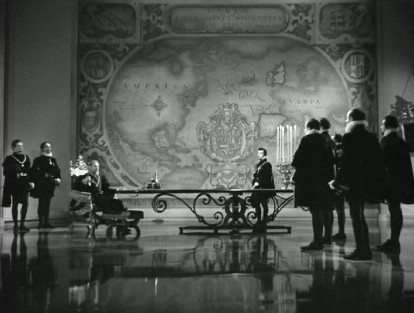
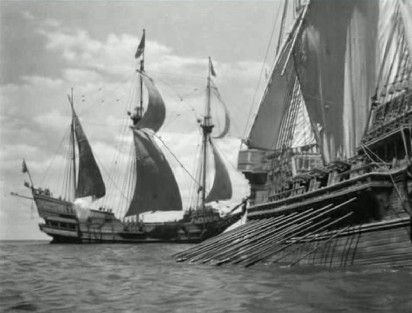
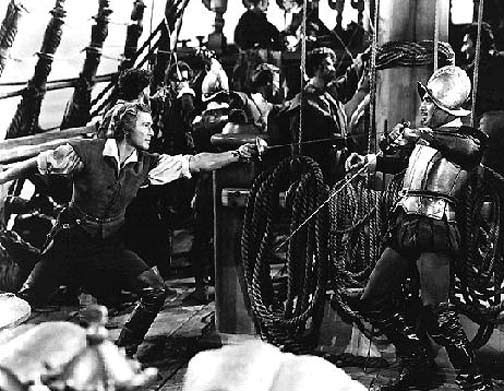
It's a grand epic, and director Curtiz, accustomed to filling the film-frame with detail has a lot of scenery to use.  The ships are big and impressive sets (especially when there are two next to each other), and the sea battles, some shots culled from Captain Blood (which is why this one is black and white and not Technicolor), are rousingly busy affairs starting with the chases, the cannon lobs, the swinging from ship to ship, then the sword-fights.  They're frenetic and fun, the stuff of our pre-Johnny Depp cultural memories, and blood-shed is kept to a minimum.  Curtiz and his designers also make the film feel a bit more gritty than one associates with a Hollywood studio film of the type (except of course in the Queen's court where everything is vast, spotless, and polished to the point of reflection).  But compare Curtiz's slave galley to the one Charlton Heston occupied in Ben-Hur, and although the effort displayed by the rowers in the latter seem more strenuous, the conditions in the former are far more depressing.  And Curtiz keeps it moving, no dawdling over the ironic dialogue or key sequences, as there's another just around the cut to get to.  The cherry on top is one of Erich Wolfgang Korngold's greatest film-scores, which in itself has an awful lot of swash-buckling just in the playing.  


Try to see the longer version, though.  For awhile, The Sea Hawk had its final scene plucked—The Queen's speech before the attack of the Spanish Armada, which may be the strangest speech a Queen has even been given: 


And now, my loyal subjects, a grave duty confronts us all: To prepare our nation for a war that none of us wants, least of all your queen. We have tried by all means in our power to avert this war. We have no quarrel with the people of Spain or of any other country; but when the ruthless ambition of a man threatens to engulf the world, it becomes the solemn obligation of all free men to affirm that the earth belongs not to any one man, but to all men, and that freedom is the deed and title to the soil on which we exist. Firm in this faith, we shall now make ready to meet the great armada that Philip sends against us. To this end, I pledge you ships - ships worthy of our seamen - a mighty fleet, hewn out of the forests of England; a navy foremost in the world - not only in our time, but for generations to come. 
"The earth belongs not to any one man, but to all men , and that freedom is the deed and title to the soil on which we exist."  What do mean "we," Queen E?  Fact is, Elizabeth didn't say this.*  But, as this film was released in 1940, it serves as its own little shot across the bow to another "one man" who wanted the map, not to be of Spain, but of the Third Reich—Herr Hitler.   The film, when first released, had that bit of rallying to it, in the days before The Blitz.  After the war, prints had that speech removed as unnecessary (and probably anachronistic, and not in a Queen's spirit.   


"...vast, spotless and polished to the point of reflection."


* She ACTUALLY said this: "My loving people, we have been persuaded by some that are careful of our safety, to take heed how we commit ourself to armed multitudes for fear of treachery; but I assure you, I do not desire to live to distrust my faithful and loving people ... I know I have the body but of a weak and feeble woman, but I have the heart and stomach of a king, and of a King of England too, and think foul scorn that Parma or Spain, or any Prince of Europe should dare to invade the borders of my realm."  "My" realm.  See that?  "My".