Showing posts with label David Niven. Show all posts

Saturday, October 26, 2013

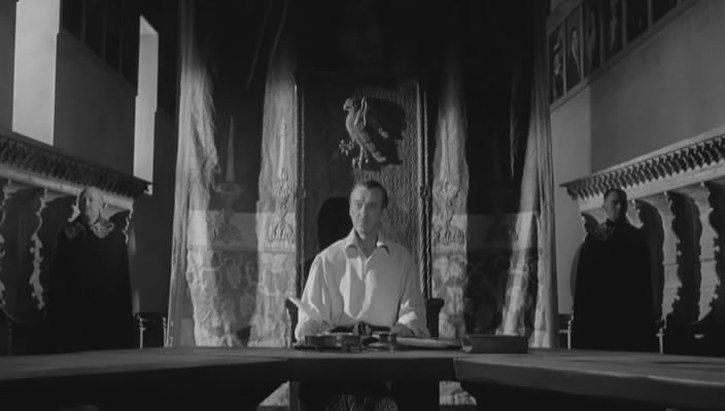
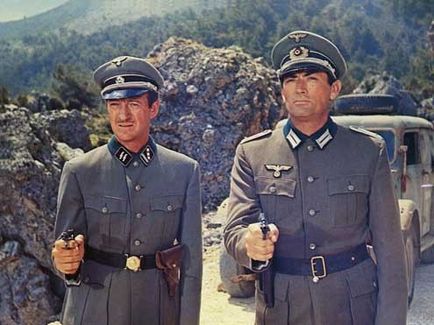
Eye of the Devil

Eye of the Devil (aka 13, J. Lee Thompson et al., 1966)
Going in cold to Eye of the Devil—its end-credits say that "13" is presented by M-G-M and that was the name of it when released in Europe—you wonder what were the filmmakers trying to achieve.  A great cast, with a middling occult story (although the dialogue is a bit "highfalutin'"), a rather amazing location in the Chateau de Hautefort, undercut by direction that one can only describe as "odd" and off-kilter, and editing that follows a particular beat for no apparent reason, then when it comes to shock moments, cuts away just too soon, so that one can't register what they're seeing.  Eye of the Devil is frustrating on very many levels

But probably more for the producer.  More on that later.  First, the film.


You start off watching the film by asking the question "why does Deborah Kerr have two children under the age of six?"  It was physically possible, of course (she was 45 at the time of filming), it's just that...well, in movie terms* it doesn't quite skew.  Then, the editing has an odd rhythm, allowing you to hear all the words people are saying, of course, but the natural beats are slightly "off." The camera glides along, cat-like, and BOOM there's an edit that feels uncomfortable or unnecessary given what's transpiring on-screen.


Things unravel as the mysteries deepen and people start to do "movie-logic" things.  For example, David Niven's marquis Phillipe de Montfaucon is called away at a dinner party; it seems the vineyards at his estate are dying and he must make one of his infrequent trips to the old stomping grounds of Bellenac. He explicitly tells his wife Catherine (Kerr) to keep the home fires burning while he goes to tend to things. Trusting him implicitly, she bundles up the kids and drives all the way out there, where she is greeted with all the welcome you'd give to a burning bag of poop at the front door.

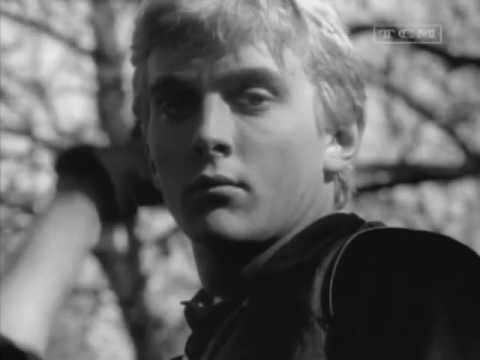
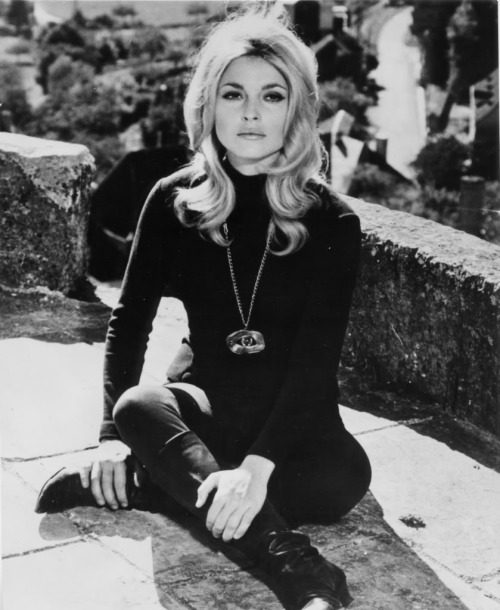
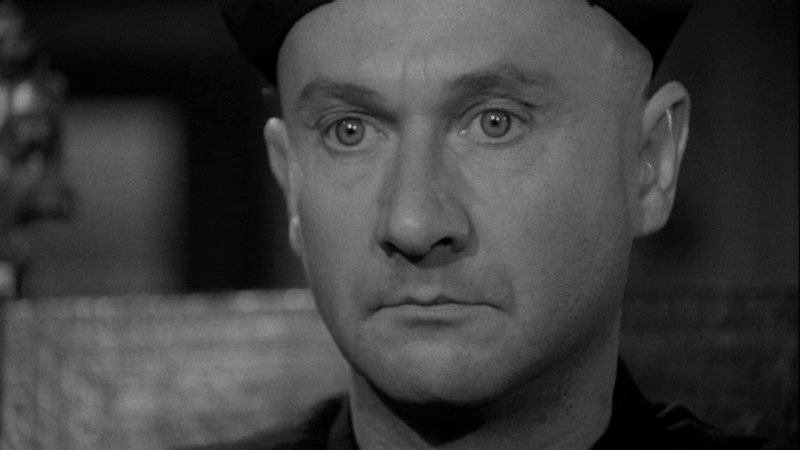
Phillipe's Aunt Estell (the wonderful Flora Robson) is outward-smiles, but suggests that things are fine (dear), why don't you go home?  Then, there are the strange kids hanging around, Christian and Odille de Caray (David Hemmings and "introducing" Sharon Tate, dubbed).  Christian thinks nothing of bow-skewing a dove in front of the wife and kids and Odile is all heavily-made-up blond-thing-in-a-black-catsuit (Were they able to watch "The Avengers" in Bellenac?).  Then, there's the unwelcome presence of Father Dominic (Donald Pleasence, whose name rhymes with "unwelcome presence," especially in the 1960's), who has the gaze of a psycho and looks like if he ran out of wine, he'd skip a step in the Mass and just serve blood to the parishioners, instead.  Plus, Mrs. de Montfaucon has creeping "Rebecca" disease, where the uneasy mistress of the house can't stop poking around all the dark corners and shuttered rooms of the castle.  One night, she finds a conclave of robed visitors surrounding her husband in a circle, and frightened, she runs into a mysterious man who tells her to go far, far from here.


Does she?  Nope.  Not even when the kids are encouraged to play near the edge of the castle's high parapets by Odile, not when she is nearly sent over the edge herself, and not when she decides to take an impromptu trip to the family mausoleum and finds herself surrounded by those 12 hooded...who-evers.  She doesn't get a clue when she finds the word "DEMON" chiseled into the mausoleum's wall.


It's a mess of a film, trying to emulate the Hammer style of occultish films—long entrance to the story, heavy atmospherics, and heaving starlets—and it probably would have been this messy even with the original players.  The first director attached was Michael Anderson, then Sidney J. Furie (probably where a lot of the confusion came in, even though it worked well with The Ipcress File), then, briefly Arthur Hiller, then J. Lee Thompson came in to pick up the pieces.  When filming started, the cast was in place, but Kim Novak was playing the role of Niven's suspicious wife, and left the production weeks into filming.**  Kerr was quickly hired and any frame involving Novak had to be re-shot.  There's only so much work-around you can do, and that's why Eye of the Devil looks so odd in presentation.  It's a patch-work affair with a good cast and good intentions, but a Frankenstein monster of a script and a completion cut. 

Maybe it belongs in the "Horror" category, after all.


No, really, honey, what was your first clue?


* And when I say "movie terms" I mean the ageist and sexist tropes that go along with film entertainment (and not just Hollywood, folks)—that an older woman can't have younger children, or that older men can't have wives that are older than, say, 20.  Or that older film stars can have mothers who are two years older (or younger) than they are

** "Creative differences."  Let's call it that.  It was explained away as a back injury from a horse riding scene (Novak is an excellent equestrian and lives with her vet-husband on a horse ranch these days) for insurance purposes.  These things are always "he said/she said." Kim Novak is an extremely talented actor, who manages to make the most of material, good, bad and indifferent.  She was particular in how she wanted to come across on-camera for the character and that could rankle the front office.  But, it is also tough to negotiate the "boy's club" of the picture making industry, and if you want to take control at all, you're considered "difficult."  I'm sure that leaving the production was a difficult decision.  I found this interesting web-site that tells the changing story.  

Wednesday, July 18, 2012

The Dawn Patrol (1938)

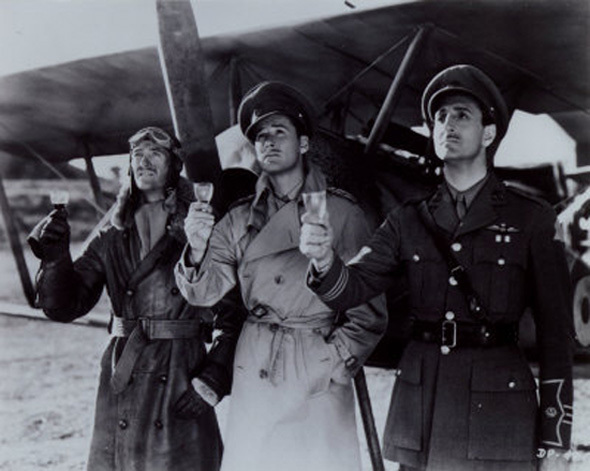
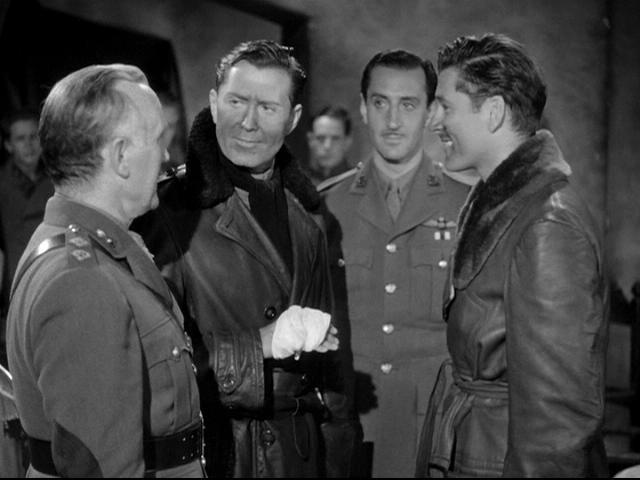
The Dawn Patrol (Edmund Goulding, 1938) Eight years after the silent Howard Hawks hit starring Richard Barthelmess and Douglas Fairbanks, Jr., the same studio released this remake, taking advantage of sound technology to enhance the story, not only in the roar of engines in combat (they even used the same planes from the Hawks version), but also the fellowship of song (a Hawks staple, by the way--I'm very curious to see how the first film got away without it, with no music and no use of the emblematic "Hurrah for the Next Man Who Dies.") This time, it's Errol Flynn as the pilot with the longest shelf-life, reporting to superior Basil Rathbone (who sits and waits, listening for the sound of each plane returning) aided and abetted by Donald Crisp, who does the paper-work, writing the letters home to bereaved families.

Headquarters is a slap-dash dormitory/strategy room with a 24 hour bar (tendered by Barry Fitzgerald)/rumpus room, done in late German atrophy and a blackboard containing the names of the squadron on duty and the chalk-dust that is left of the honored dead.  It's a rotating complement of young men dealing with the pressure cooker (with heavy seasoning) of combat and the existentialism of transitory bonhomie. Very quickly, rookies become veterans and the dreams of youth evaporate in the shots of whiskey and the oil grime that cakes their faces after every sortee.

They're all brothers in the air, dueling and jousting in the machines they pilot, and when they fall, there's enough honor to salute the plummeting.  These pilots are so joined that when a captured German pilot is brought to the barracks, he's welcomed to the party, even though he's just shot down one of their comrades (David Niven) and if someone holds a grudge, well, that's just bad manners, what?

A little odd for a war film,* but an example of Hawksian work ethics—do your job, be a professional, even in war-time.  It's just a grudge-match between nations, anyway, and once everyone's on equal footing—in this case, terra firma—you don't hold a grudge against professionals.  One has to prove oneself worthy, of course, but the general rule is to keep the war in the skies, keep your chin up and your upper lip stiff.

It's not a Hawks film, understand, just an interpretation of Hawks material.    And Edmund Goulding is quite adept at making the material soar, both in the skies and on the ground.  It's a British cast, so the bantering is quite formal with well-defined rules of engagement.  Goulding doesn't match Hawks' trademark at-the-shoulders camera compositions, choosing, instead, a more versatile shooting scheme, which are, at times, artful.  But, it is one odd war movie, removed from the geopolitics, insular and private.  You get the impression that these guys might be doing this, anyway, if it wasn't for the damned turnaround.  But, it is remarkably free of jingoism, glorification and other self-serving sentiments.  War is a hell of job, even in the first light of mourning.


* Odd, yes, but not without precedent, especially given the odd episode of the Christmas truce during WWI (a variation of which Steven Spielberg used for an episode in his War Horse film).  And, in these economic times, there are parallels: I have friends who work in a call center, who oft-times don't see the escorting off the premises of co-workers, while the "new recruits" keep revolving into the ranks to replace them.  I've suggested more than once the idea of a tontine for the "last man standing" from the many cliques that form in such situations.

Thursday, June 7, 2012

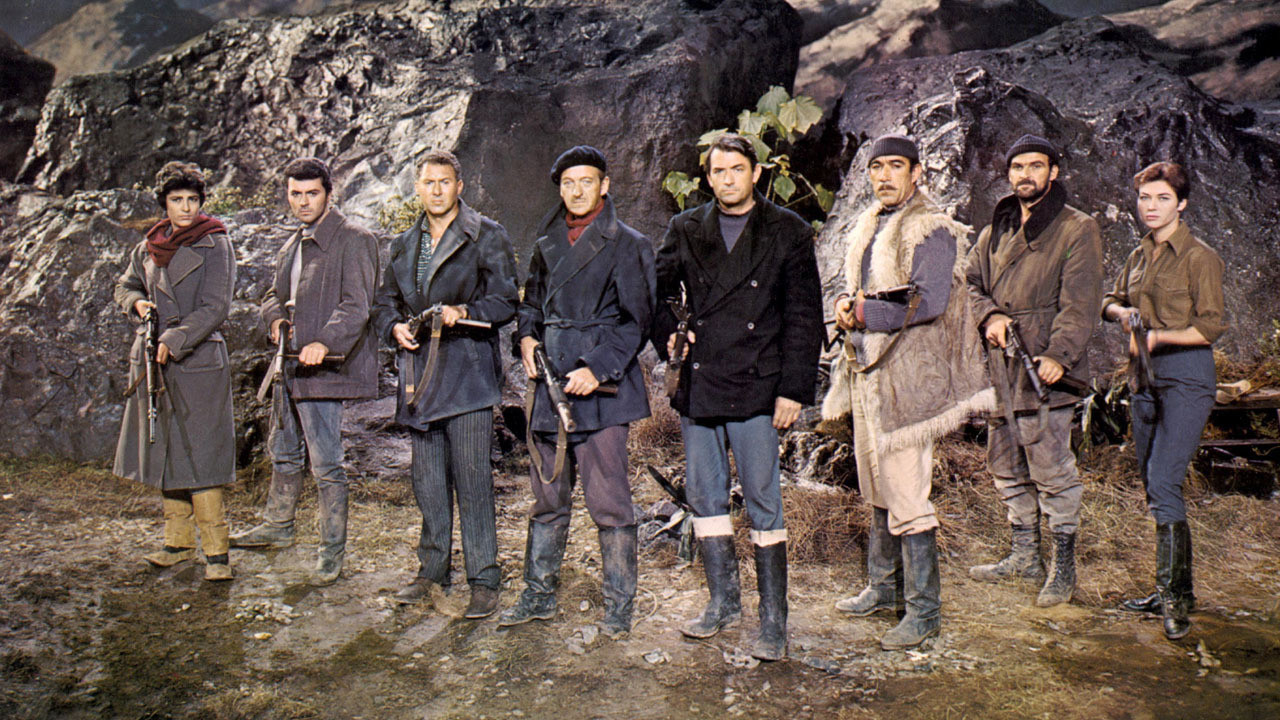
The Guns of Navarone

The Guns of Navarone (J. Lee Thompson, 1961) Maybe I should do a new LNTAM series—"The Ones That Got Away."  Somehow I managed to miss this one, an essential "action" film that "everybody" saw when it first came out, AND during umpteen playings on television. Not me.  I managed to sit down and watch it straight through only recently.  I do remember it from one particular Dick Van Dyke Show episode (Season 5, Episode 139-"You're Under Arrest") where Dick and Laura had a fight and Dick stomped out and went to a drive-in and fell asleep in the car and no one believed him because the movie playing was The Guns of Navarone. "YOU SLEPT THROUGH THE GUNS OF NAVARONE??!!" 

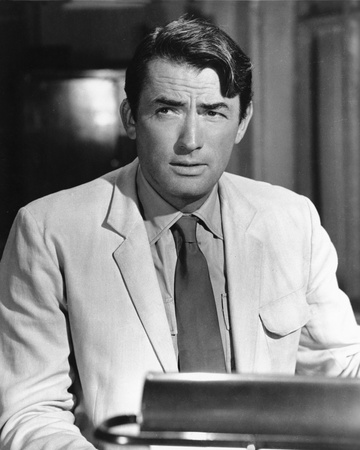
"With so many geniuses," says Team Captain Keith Mallory (Gregory Peck), "how can we fail?"

Ask a silly question...get a two and a half hour answer.  Particularly when the answer involves material supplied by Alistair McLean, from whose books nothing ever goes as planned and improvisation, no matter how well provisioned for, rules the day.

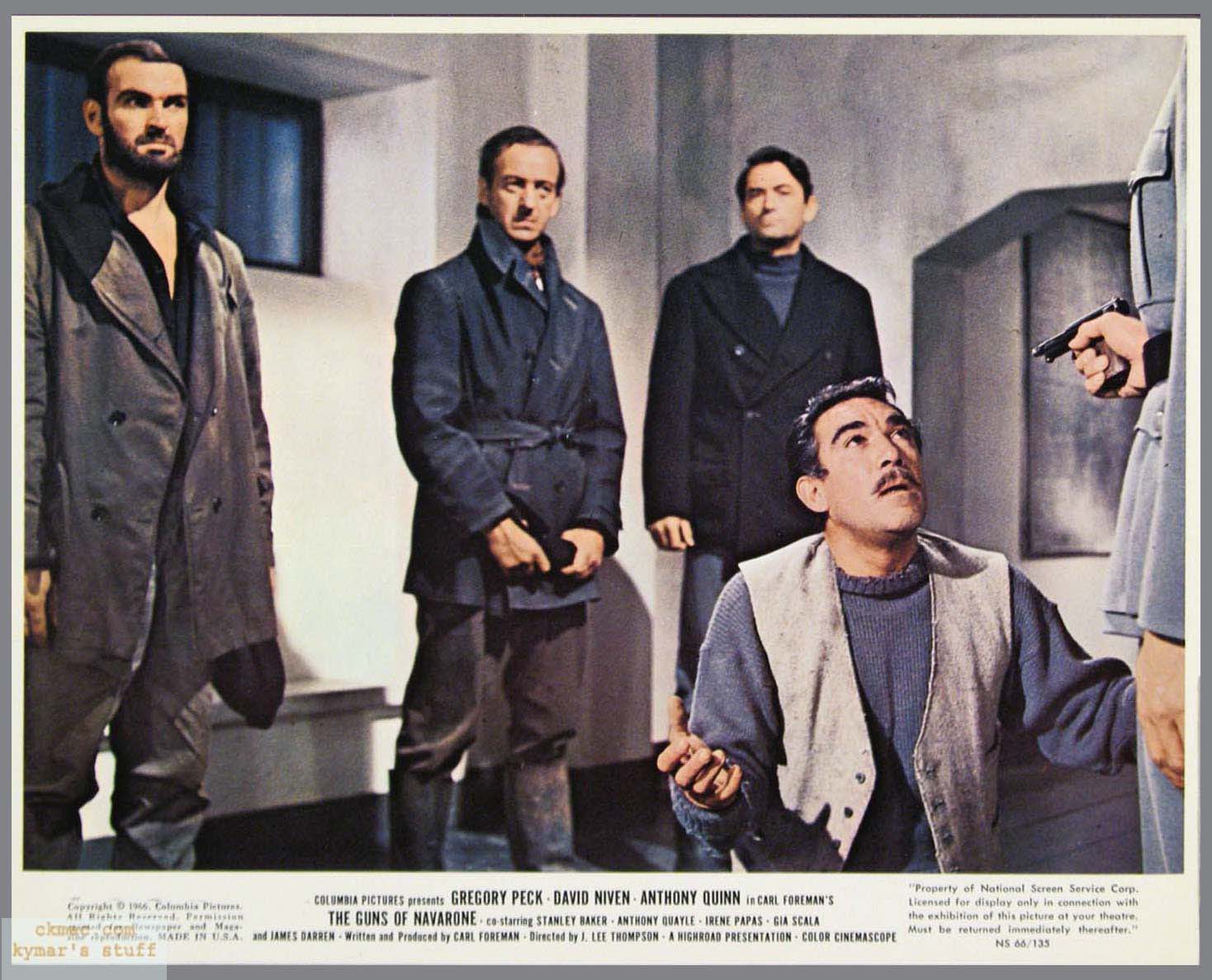
There are these cannons, see?*  They're caved into vertical cliff faces that have been daunting to regular forces.**  So, a team of specialists, cut-throats, and patriots form a surly group of cynics to make land-fall—extraordinarily uneasily—go up-country and meet up with resistance forces infiltrating a hummocky terrain populated by locals (who seem to be having a wedding every hour of the day) and an endless supply of Nazis, who seem to fall like ten-pins.

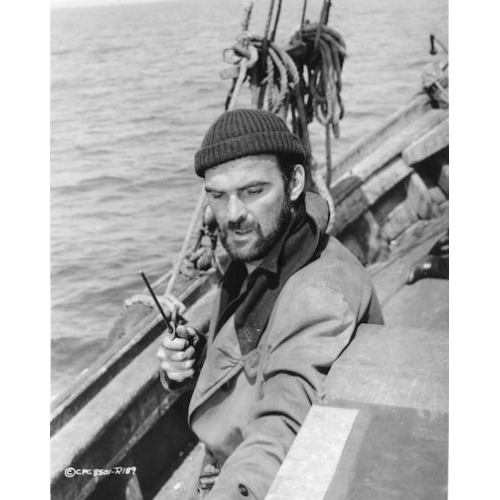
There's always a weak link in these groups.  In this case, it's Major Roy "Lucky" Franklin (Anthony Quayle), who has brittle bones and seems to have the ability to attract shrapnel.  The initial cliff-assault proves to be his undoing, although the rest of the team manage to make the climb without falling into the rear-projection.  And while not quite The Dirty Dozen, conflicts pop up pretty quickly—Corporal Miller (David Niven) is the griper, constantly needling Mallory and protective of Franklin.  Mallory has issues with Col. Andrea Stavros (Anthony Quinn) who holds a grudge for what happened to his family previously in the war.  Then there's Brown (Stanley Baker), "the Butcher of Barcelona," who seems to be having trouble negotiating wish-bones and his own conscience.***

Director J. Lee Thompson (a good yeoman-like director, who only gets "arty" on inanimate objects) keeps things moving fast and the frame centered—despite being a "widescreen" Cinemascope roadshow—managing to make everything capable of fitting into a square TV-frame.

The hero of the story, though, is Carl Foreman, black-listed writer-producer, who migrated to Europe to make films.  Despite the gung-heavery on display, his script still squeezes in enough anti-war sentiment and issues of conscience without slowing down the action any, even impressing crusty old John Wayne, one of the anti-communists who pressured him to leave the States.  His "Guns" fits into the same cynical fox-hole as the earlier Awards magnet The Bridge on the River Kwai, which he had once worked on. 

Curiously, even though I missed the original, I still managed to see its sequel Force 10 from Navarone (which recycled quite a lot of the first film's climax) a couple of times.  That one came out a full 16 years after the first, just in time to catch such up-and-coming stars as Harrison Ford, Barbara Bach and Richard Kiel, and replacing Peck and Niven with Robert Shaw and Edward Fox, two (count 'em, two) British actors who seemed to fit the characters a little bit better.  


* Them bloody "Navaronian" guns


*** Peck had an amusing homo-erotic spin on the story:  "David Niven really loves Anthony Quayle and Gregory Peck loves Anthony Quinn. Tony Quayle breaks a leg and is sent off to hospital. Tony Quinn falls in love with Irene Papas, and Niven and Peck catch each other on the rebound and live happily ever after." 


Wednesday, September 15, 2010

A Matter of Life and Death


"A Matter of Life and Death" (aka "Stairway to Heaven") (The Archers, 1946) A cryptic reference to "The Archers" (and their ability to seamlessly combine reality and fantasy) crept into my review of "Scott Pilgrim vs. The World," and necessitated the completion of a couple reviews I've had in draft stage the last few months, waiting for the creative spark that would ignite them into a full-blown post.


"A Matter of Life and Death," coming as it did with the stench of the Second World War still enveloping the planet, is a meditation on, and an impassioned plea for, the value of a single human life at a time when the world had seen so much slaughter.  Like it's American counterpart, Frank Capra's "It's a Wonderful Life," both films begin in the Heavens for a brief prelude contemplating cosmic predetermination.  One man is literally, and spiritually, put to trial for his life, on Earth (as it is in Heaven) when he doesn't die in circumstances that should have killed him.  The story proper begins with the protagonist's life in the air.  A lone RAF pilot, poet Peter Carter (David Niven) is the last man crouching on a doomed bomber hurtling to destruction.  The rest of the crew has bailed out, and Carter, without a parachute, has determined to go down with the plane, hoping to bail out at the last second to avoid death. 


He spends his last fleeting moments in tenuous radio communication with June (Kim Hunter), an American radio operator, who listens, horrified, as Carter banters through his stiff upper lip, and a  parallel falling occurs, as the two are linked in life, death and love for those precious few minutes.  Nothing can come of it, of course.  He's a dead man, for sure.


So, the two are both shocked (though delighted) that Carter survives the fall and is washed up on the beach.  It's some sort of miracle.


"Every time the factory whistle blows, an angel gets it's wings..."

Heavens Above...

The Earth Below

Actually, no.  It is more of a clerical error, as the being-counters in Heaven (we presume, and it's never stated outright) await Carter's arrival with the rest of his crew (none of them made it).  A representative (Marius Goring) is dispatched from Powell and Pressburger's amusing depiction of Kingdom Come (as a sort of empyrean General Motors, an Industrial Age Promised Land), to send Carter packing for Paradise...except...he doesn't want to go.  And won't, unless, he's forced to.  Of course, that he's seeing time-stopping visions of Heavenly Hosts indicates "chronic adhesive arachnoiditis" suffered from an earlier brain injury, and a battle for Carter's life is fought on two fronts, both dependent on the work of one man: Doctor Frank Reeves (Roger Livesey), who diagnoses the ailment and, before he can perform surgery, is killed, where he can conveniently argue Carter's case for life in a celestial court-room—the highest court of all.


The Highest Court of All


Carter's out-of-body experience on the operating table—a comic highlight

But, it is more than that—it always is with the films of Powell and Pressburger.  At the end of the European War, there was bitterness on both sides of "the pond:" Americans were grieving their losses and blaming England for "having to be bailed out;" Britons were bitter of the first American Invasion of the war—their own country, and of the havoc "the Yanks" caused creating their launch-point.*  The Case for Peter Carter becomes, in a deeper and richer sense, a debate centering on "Whither England," and whether the "special arrangement" between The Kingdom and The Colonies should be continued, unquestioned.  This odd and whimsical fantasy** becomes a propaganda piece for the very existence of Britain itself, God (or Whoever) Save the King.


The production values are top-notch and imaginative, including an ecumenical escalator that bridges the two worlds...and two photographic processes.  Reversing "The Wizard of Oz" schema, it is the worlds under the rainbow that glow with rich eye-dazzling Technicolor, while "the next world" is shown in black and pearly-white. 


And you thought "Led Zeppelin" made it up...

  It is rich in humor, rich in thought, and it stands right behind "Get Carter"(...?) in polls of the greatest British-made film.  This is one of those films you should see before you die...if only so you can get directions. And to make the journey until then...that much more enjoyable and precious.


* A fine film, too often overlooked, about this war on the home-front is John Schlesinger's unusually restrained (for him) "Yanks."

** This is one of those films that modern critics would sniff "is inconsistent in tone."  Hey, life is inconsistent, pal!