Showing posts with label Remake. Show all posts

Friday, October 25, 2013

Carrie (2013)

To Carrie Out the Lord's Vengeance
or 
"Mama, Don't Ruin it!"

I've been working on a review of Brian De Palma's latest film Passion the last couple of weeks (still working out how I feel about it—on a superficial enjoyment level it doesn't succeed very well, but if you appreciate craft and detail there is a lot to digest, and it makes you realize that a lot of older directors go through that shift where the details are more important than the Big Picture) and was watching an interview with De Palma* about the film (which I'll include again when I get around to finishing it) and at one point the subject of Kimberly Pierce making a new version of Carrie was broached.  

"We're friends", he said of Pierce, who made Boys Don't Cry and Stop-Loss. "I've seen some stuff and it looks good."  But the more telling comment from the talk is when someone brings up Piper Laurie (who played mother Margaret White in his version) and De Palma remarks: "Piper thought we were making a comedy."

As well she might have.  Stephen King's "Carrie" is a hoot to read (you can do so—textually—here), but it isn't if you take it too seriously.  Which is odd. King cackles and galumphs through his writing, something he also did when he took to acting and directing his films.  Which is why the best King adaptations have a surreal sense of giddy humor about them—they have to be a little over-the-edge, dangling their feet in the muddy waters of madness to be really, really good.  It's why George Romero made good King adaptations. And Kubrick (despite King's protestations).  And Carpenter.  And Reiner.  And De Palma.  But, if you get all solemn and reverential about them, they fall flat as pancakes.


Pierce gets precipitously close to that edge, but doesn't tumble over it.  She includes a couple of things that De Palma, and the screenwriter of both versions—and the musical version—Lawrence D. Cohen, left out of King's book, which are the opening scene of Carrie's birth (the harrowing circumstances alluded to in the first chapter) and a sub-plot involving Sue Snell.  Quite a few things are better—the kids...look like kids, not twenty-somethings from television sit-com's posing as teens.  The good of that is that the performances are more awkward and more vulnerable.  The downside is that they are all dewy lumps that don't have a lot of distinctiveness to them, so one is caught for a second wondering "which one is this, again?"  I mock the ages of the older Carrie cast-members, but they had the experience and chops (from those sit-coms, presumably) to make their characters known as soon as they entered a shot.  The 2013 kids are...awkward...looking like they're ready for a direction-cue in the middle of a take.  For example, as pretty and competent as Gabriella Wilde is (she plays this version's Sue Snell, the "remorseful" girl played first by Amy Irving), most of the time she's blandly waiting for her next line with a concerned furrow and not much else behind it.


One essential thing (given the times, making this Carrie somewhat relevant) is the inclusion of the evil genie of new media into the mix.  Every kid here has a cell-phone.  Every kid is documenting their lives like would-be film-makers (and Pierce throws in random samples of such stuff for bridging sequences, showing "normal" high school activity). But, the most innovative use of it comes when Carrie has a "period" in school that isn't scheduled and the girls in her high school gym class viciously taunt her, there's the added inevitability that some goonish lout will whip out their I-phone (usually banned from bathrooms for this very reason) to record the event.  At that point, the truly bad-bad girl of Kris Hargenson (a brunetted Portia Doubleday here, future Mrs. de Palma Nancy Allen then) decides to go one step further, post it on YouTube, and it's then that punishment is meted out to the class. For Kris, this is unfair—she doesn't want to be an out-cast as she sees Carrie is and lashes out, digging herself deeper and deeper into detention, punishment and malicious revenge—and that video is used to twist the knife during the horrific prom sequence.  It raises the stink of public media being thrown into the mix of private bullying and how it has escalated the trauma of humiliation by bringing mob mentality into the pecking order, empowering the mean-spirited far beyond their reach, and narrowing the victim of options for safe zones that might bring light (and perspective) to their situation.  At that point, humiliation becomes torture and isolation becomes impenetrable.


As I said, if you take this stuff too seriously, it becomes no fun at all.  And while Pierce's heart is in the right place, standing up for the repressed outcast and removing the puerile nudity of De Palma's version, she also goes a bit too far, making things less horror-ific, and more disturbingly real.  For example, taking the loony ecstasy that Laurie brought to her fundamentalist (no fun; all mental) mother—Julianne Moore's version is seriously deranged, scratching herself to bleeding at the slightest provocation—and making Moretz's Carrie a very active revenge-seeker (where Spacek's interpretation was all evil-eye and mannequin-stiff, Moretz directs the carnage like a magician), the changes make her much less sympathetic as a character.  Even though both movies show Carrie "learning her craft" by checking out resources in the library (I thought schools were banning books right and left—heck, they even ban "Carrie!"), the new Carrie seems to have more control than Spacek's, whose bursts of revenge felt like an id monster that would combust things with a look.  This one concocts tortures and lingers over them like a cat playing with a mouse.  Hey, control is great, but at what point does the tortured become the torturer?  At what point do we lose sympathy for her and see her as just another maniac terrorizing a school?  At what point does that earnestness work against the intent?


So.  Good attempt.  Maybe even worth the effort.  But, at some point, this new Carrie manages to undermine the reason it was generated in the first place—to give us a really good scare.  Perhaps real life events have just caught up and overwhelmed the perspective of seeing entertainment in this, or, to make debating points, the filmmakers just eked out some of that entertainment value.  But, I remember leaving the first Carrie feeling sympathy for the devil, seeing it as a tragedy.  This time, it seemed everything was a natural consequence of tinkering with forces beyond one's control, especially if self-control is in short supply.  There was no catharsis, and at that point, Carrie just stands for nothing, a nihilistic bloody mess. 

Carrie is a Rental.


*


Wednesday, October 17, 2012

Frankenweenie (2012)

Recycled Material From the Grave
or
"I Can Fix This..."

Really, it's a little soon for Tim Burton to be re-making one of his own films—albeit his first live-action short for Disney.  One worries that maybe he's run out of ideas, or that he's simply doing what he's always done—take a property and combine it with that goofy blend of the kinky and ghoulish that he has made his own...it's just that this time the property is his...and he's already made it his own once.  Maybe, he looked at this product of his younger self with limited resources and thought "I can do better. I can do more."  Or along the lines of young Victor Frankenstein, he looked at it his earlier creation and vowed "I can fix this."

At the time of the live-action short, Disney looked at the product of their young animator...and promptly dumped it...only acknowledging it when Burton became an A-list director (with some studio hesitancy) with the first "Batman" film.* Now, Disney is crowing about its brand new Burton movie, and one can only imagine the wry smile that must produce for the director.  It was natural for Disney to want an expansion—they owned the property—and although this new version of Frankenweenie has a lot of (dare I say) re-animation of material, it did give Burton a chance to give it a little more depth and play around without the inhibitions of live action.

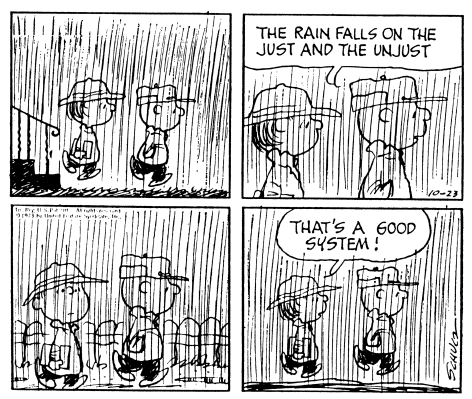
I say inhibitions rather than limitations because the differences are exhibited in a weird and rather contrary way, given that the film is done with puppet figures: emotion.  The character of Sparky exhibits a far greater depth of moods than a trained pit-bull terrier could exhibit in live action, not only in its darker moments, but especially in moments of joy—the animation of the dog running elicits fond feelings immediately, as the puppet is rarely touching the ground in motion, not unlike Charles Schulz's "Peanuts" kids who hover over the ground in transit.  And although the human figures are Burton cyphers (resembling the human character designs of his first film Vincent) they are still soulful, their eyes expressing more emotions than their faces will betray. Given that the subject matter is about a mad scientist of a little boy who runs the parallel path of his literary namesake to re-animate his beloved dog, killed in a traffic mishap, there's a lot of room for high emotion there, and far more than in the motivations of the original story.

But, Burton takes it further and makes it more than about young Victor.  Taking pages from The Nightmare Before Christmas and Batman Returns, he stages the denouement at a city festival that brings all parties together in one spot, the communal experience gone awry.  Seems that Victor's work has attracted a lot of attention among his classmates, and as there's a science fair going on, all the kid's are doing the same thing—literally, the same thing, bringing to life their dead pets with very mixed results, and providing Burton a chance to explore other species of monster movies (and recreating scenes from them) than just the one, paying tribute to each, just as he does by including a scene from friend Christopher Lee's turn as "Dracula."  Like Victor's experiment, this is a labor of love as Burton—just as with the earlier short—resurrects the movies he loved as a kid, long-buried memories that never really leave, and have influenced Burton throughout his career.  It's a fun, resonant electrification of his earlier work, with just enough fresh in it to make it worth the effort and bring it back to new life in leeched black-and-white (which Burton always manages to make look sumptuous).  Now, if only we could see something wholly new and original from him, that would be some experiment.


The original Frankenweenie


Brad Bird's "Family Dog" (based on animation designs by Tim Burton)

* It did find it's way to Paul Reubens who'd been trying to find a suitable director to collaborate on his long-in-the planning Pee-Wee Herman movie he'd been dreaming about.  Frankenweenie convinced him to contact Burton.


Thursday, August 9, 2012

Total Recall (2012)

You Don't Know Dick (Philip K.)
or
I Can Misremember It For Your Wholesale

The reviews that I've seen for the new version of Total Recall have not been kind.  Rotten Tomatoes, that fine aggregator/cuisinart of opinion, put it on "puree" when it said "While it boasts some impressive action sequences, Total Recall lacks the intricate plotting, wry humor, and fleshed out characters that made the original a sci-fi classic."

Huh?  What the wha...?

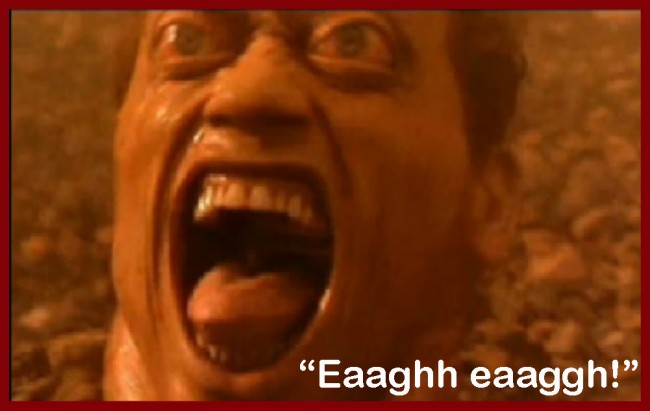
Maybe I'm in Rekall right now and this is all some elaborate alternate reality, but my vivid memories of the Schwarzenegger Total Recall (made 22 years ago by that "master" of intricate plotting, wry humor and sub-tle human interactions*, Paul Verhoeven) was of an R-rated Sci-Fi gore-fest, light on "Gee-Whiz" and heavy with Cheese-Whiz, that seemed to mark the limit to how much Arnold could contort his face.**  The one thing I remember being amusing was Sharon Stone as Doug Quaid's wife, in an arch performance that basically made her a star.***


This "re-imagining" (if you will) has Colin Farrell as Quaid,**** working on an assembly line for synthetic security forces—robo-cops (although they more resemble—and collapse just like—the battle-droids in the Star Wars prequels).    The elaborate set-up has the world decimated by chemical weapons making the world inhabitable on only two islands, Britain and Australia.  The most precious commodity, thus, is living space, and the commute from one to the other is a tough one, a high-speed transport through the Earth's core—the shortest distance between two points being a straight line (would really have hated to be a construction worker on that project!).  

Anyway, Quaid is beset by dreams of running, chasing, shooting and loss, waking up in a cold sweat to find himself sleeping next to Lori (Kate Beckinsale, a fine actress—remember her in Branagh's Much Ado About Nothing—who is going to be stuck in kick-ass roles as long as Keira Knightley, Michelle Williams, and Carey Mulligan are alive), who works for security for the United Federation of Britain, and its leader Cohaagen (Bryan Cranston), which begs the question: Where's the Queen?  And begs the question: she's married to a factory worker?

But if we start picking nits we'll be here until the time the movie's set in. Leave it that there are plot-holes larger and deeper than the one running through the planet, and it all begins when Quaid decides to go to the Rekall facility in his local city (which I believe is Great Britain, but owes a lot to Ridley Scott's Los Angeles in Blade Runner...and Spielberg's D.C. in his own version of Dick's Minority Report), a divey section of town with a yen for Chinese decor.  Basically, he wants a spy fantasy, where there are double identities, secret plots and no one can be trusted.  He gets it, but whether it's reality or a drug-induced fantasy he has no way of knowing.  Something goes horribly (horribly) wrong, and by the end of his session, all the Rekall technicians are dead, as well as a dozen security forces, who burst in (pretty quickly, too) and whom Quaid overcomes in a single-shot, digitally-tracked shot that resembles a first-person shooter game.

Which is what this movies is, essentially—game scenarios, one after the other, trying to get to the next level.  It's not that this Total Recall is anything less than competent.  It truly is, and the cast is fine and all.  But, it's never anything more than that, there's nothing very inspired...except from other sources, movies and video-games, mostly,***** and tangential stuff at that.  But, although attempts have been made to make it sleeker and faster-paced, there is no attempt to make it better or develop themes that the first film dropped for kinetic thrills.  When you're dealing with alternate realities, why leave it at one?  Why not keep the audience on edge on what's true?  Why not make the stakes a little bit higher, so there are more consequences (like what this movie hints at in an early scene) for Rekall users, so there's more at risk than physical pain?  This is Inception-material, but on only one level, and it's a sub-level at that.  The potential was there to do more, but, instead, it's more of the same.

And Len Wiseman, the director of this, and the "Underworld" films (and "Die Hard 4")?  It's a few films in now, and one can say that he's not aspiring to much, other than keeping both the budget and the pace high.  It's not so much directed, as art-directed, full of detail to distract from the lack of depth—highly finished, but with a sub-standard foundation.  There was so much that anyone could do with this material to make it rise above the first one, rather than just make it worse.

Total Recall (2012) is a Total Cable-Watcher.


"But, I don't WANT to be in a bad Schwarzenegger movie!"
"Which one: Jingle All the Way or Last Action Hero?"


* ...usually involving fists, but in this case involving anything that could penetrate a human torso or face.  This one was a particularly nasty exercise in excess, and I remember Schwarzenegger shilling it on Entertainment Tonight: "Yah, It's a GREAT FAMILY moo-vie, Bring the KIDS!"  I was horrified to see that some idiot-parents actually did, and those kids have probably been in therapy for a couple years now.

** ...without  special effects, anyway.

*** It put her on the path, anyway, as Verhoeven was so impressed with her that he cast her in Basic Instinct, then she was a star in a flash.

**** A better match, I think, than Schwarzenegger.  Farrell is more relatable, and you could see him as a factory worker, which makes the concept—which is telegraphed and anticipated to the Nth degree in both films—work a bit better.  Schwarzenegger can't be believed as a factory worker—he's too much of a "800-pound gorilla in the room" to be hiding in such plain sight.  The original concept...and casting...had someone like Richard Dreyfuss in the role.  Now, THAT would have been fun, and surprising.

***** A lot from the first film, of course, but it's weird stuff—the plaid pattern that Quaid wears at some point, the woman in the transport station—there to fake out only the audience that had seen the first film—and the triple-breasted prostitute (probably because it's what the geeks remember...and want).  All of which will bring me to an up-coming point...

Wednesday, July 18, 2012

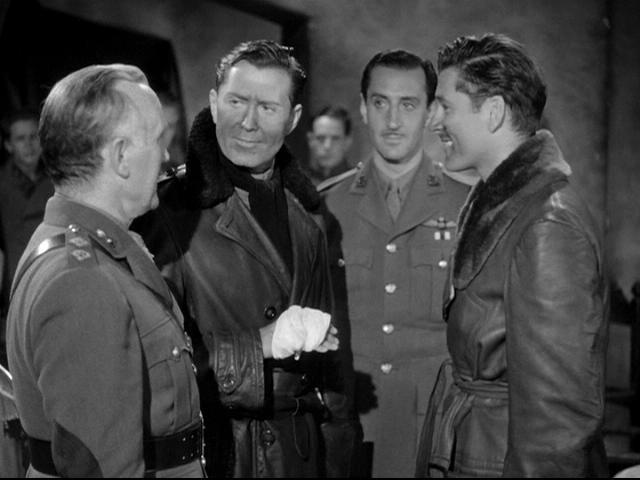
The Dawn Patrol (1938)

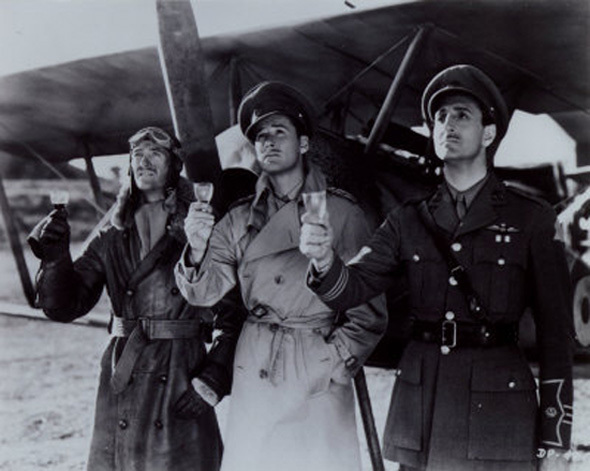
The Dawn Patrol (Edmund Goulding, 1938) Eight years after the silent Howard Hawks hit starring Richard Barthelmess and Douglas Fairbanks, Jr., the same studio released this remake, taking advantage of sound technology to enhance the story, not only in the roar of engines in combat (they even used the same planes from the Hawks version), but also the fellowship of song (a Hawks staple, by the way--I'm very curious to see how the first film got away without it, with no music and no use of the emblematic "Hurrah for the Next Man Who Dies.") This time, it's Errol Flynn as the pilot with the longest shelf-life, reporting to superior Basil Rathbone (who sits and waits, listening for the sound of each plane returning) aided and abetted by Donald Crisp, who does the paper-work, writing the letters home to bereaved families.

Headquarters is a slap-dash dormitory/strategy room with a 24 hour bar (tendered by Barry Fitzgerald)/rumpus room, done in late German atrophy and a blackboard containing the names of the squadron on duty and the chalk-dust that is left of the honored dead.  It's a rotating complement of young men dealing with the pressure cooker (with heavy seasoning) of combat and the existentialism of transitory bonhomie. Very quickly, rookies become veterans and the dreams of youth evaporate in the shots of whiskey and the oil grime that cakes their faces after every sortee.

They're all brothers in the air, dueling and jousting in the machines they pilot, and when they fall, there's enough honor to salute the plummeting.  These pilots are so joined that when a captured German pilot is brought to the barracks, he's welcomed to the party, even though he's just shot down one of their comrades (David Niven) and if someone holds a grudge, well, that's just bad manners, what?

A little odd for a war film,* but an example of Hawksian work ethics—do your job, be a professional, even in war-time.  It's just a grudge-match between nations, anyway, and once everyone's on equal footing—in this case, terra firma—you don't hold a grudge against professionals.  One has to prove oneself worthy, of course, but the general rule is to keep the war in the skies, keep your chin up and your upper lip stiff.

It's not a Hawks film, understand, just an interpretation of Hawks material.    And Edmund Goulding is quite adept at making the material soar, both in the skies and on the ground.  It's a British cast, so the bantering is quite formal with well-defined rules of engagement.  Goulding doesn't match Hawks' trademark at-the-shoulders camera compositions, choosing, instead, a more versatile shooting scheme, which are, at times, artful.  But, it is one odd war movie, removed from the geopolitics, insular and private.  You get the impression that these guys might be doing this, anyway, if it wasn't for the damned turnaround.  But, it is remarkably free of jingoism, glorification and other self-serving sentiments.  War is a hell of job, even in the first light of mourning.


* Odd, yes, but not without precedent, especially given the odd episode of the Christmas truce during WWI (a variation of which Steven Spielberg used for an episode in his War Horse film).  And, in these economic times, there are parallels: I have friends who work in a call center, who oft-times don't see the escorting off the premises of co-workers, while the "new recruits" keep revolving into the ranks to replace them.  I've suggested more than once the idea of a tontine for the "last man standing" from the many cliques that form in such situations.

Tuesday, May 1, 2012

The Debt

The Debt (John Madden, 2011) Remake of the Assaf Bernstein 2007 original out of Israel.

A team of three Israeli agents are tasked with bringing a concentration camp doctor, Dieter Vogel (Jesper Christensen) to justice.  The team, two men and a woman (Marton Csokas, Sam Worthington—his best film performance, one should say—, and Jessica Chastain) must find the man, who's now an OB/GYN in Berlin, kidnap him, and hold him him until they can transport him out of the country.

Things do not go well. 

They manage to grab the butcher, but end up hold up in their apartment with the man, while delays keep the four antagonists in close proximity.  The cops are stepping up the investigation looking for him, rather than having things cool down.  Everyone is trapped like rats, all the better for everyone to get to know each other better.  Then the fun begins.

It's thirty years later and the three (played by Tom Wilkinson, Ciaràn Hinds and Helen Mirren, respectively) are being feted at an event celebrating the publication of a book in which the incident figures, written by the female agent's daughter.  The three are praised, glad-handed and lionized, despite the fact that one of the three is missing.

And the story isn't really true.

John Madden is not the best fit for the film, despite his previous television work.  But he gets the milieu down, and the layered performances of the principles benefit from his attention to detail (although one doesn't feel that the performances between older and younger selves merge too successfully).  Ultimately, the film feels unsatisfying, and not just in the sense of the downbeat subject matter.  

One is left feeling next to nothing, except in the uselessness of the exercise—where the mission is to fulfill commitments rather than doing any real good—to exact revenge, rather than justice.

Some lip-service is paid to duty, to country, but one gets the impression that's merely a card to be played in a battle of wills.  In the end, its a case of diminishing returns:  if justice can't be achieved, revenge will do; if that doesn't happen, the best to do is keep up appearances for morale and PR. If one can accept that such a conspiracy of silence can be maintained for 30 years without corroborating evidence—a not-small consideration (especially given these agents)—the movie still feels empty and unsatisfying.


Tuesday, December 27, 2011

The Girl With the Dragon Tattoo


"The Girl With the Dragon, Take Two"
or
"Once More...with Feeling"

"We come from the land of the ice and snow
from the midnight sun where the hot springs FLOW

How soft your fields so green,
can whisper tales of gore,
Of how we calmed the tides of war.

We are your overlords.
On we sweep with threshing oar,

Our only goal will be the western shore."

"Immigrant Song"  Led Zeppelin


The American production of The Girl with the Dragon Tattoo advertised itself (amusingly) with the tag-line "The Feel Bad Movie for Christmas."  Compared to the Swedish-TV version (with Michael Nyqvist and Noomi Rapace), it's actually, if one can believe it given the subject matter, a "kinder, gentler" version.

So, what's different?  For those familiar with the first version, many of the locations reveal themselves to be the same.  Resolutions are slightly different. The casting certainly is (and more on that later).  Editors Kirk Baxter and Angus Wall keep things moving very fast, sometimes abruptly, and scripter Steven Zaillian delivers punchy dialogue dripping with icyclic irony, while keeping the circumstances equally savage and shocking (what else can you expect from from a murder mystery involving in-bred families crusty with krona, corruption, Nazi affiliations, serial killers, sexual violence and "men who hate women"—the original title of the book when published in Sweden?).  It's how director David Fincher (Se7en, Zodiac, The Social Network) approaches the tone that's slightly different, and though still mordantly frigid, this version is a bit more clever in presentation, adding a darkly humorous slant.  Sure, the violence is still sickening, but blunted, even handled at times more discretely, making the impact contrarily even more squeamy, while, at the same time, counter-pointing with sly musical choices.*

But, it's the casting where the main differences occur.  Daniel Craig, no less intense, but muted and reduced to human scale with a world-weary familiarity, plays Mikael Blomqvist, co-publisher and chief reporter for an investigative magazine, MillenniumDisgraced by a libel suit gone against him and to shake off the publicity and the hit to his reputation and bank account, he takes on a murder investigation for the patriarch of the industrialist Wanger family (Christopher Plummer)—a literal cold case of the forty year old disappearance of the elder Wanger's granddaughter, although distinctive clues point to her either being alive, or the killer is cleverly taunting the old man.

It's soon clear that Blomqvist may be over his head and he calls on an "assistent"the same background investigator who cleared him for the job for the Wangers.  She's the titular "girl with the dragon tattoo"—Elisabeth Salander and "she's different."  "In what way?" asks Wanger's lawyer, Frode (Steven Berkoff).

"In every way," says her employer.

Too true, not only in terms of Society, but also from the actress who previously took the role (Noomi Rapace, currently starring in Sherlock Holmes: A Game of Shadows).  She's still the same Salander, the goth-punk, vegan, pierced, bi-sexual hacker-savant who becomes the focus of the series, zipping around the bleak Swedish countryside on her black-on-black motorcycle, but this movies version, in the form of Rooney Mara, is slight (she had to be starring opposite the 5'10" Craig), tiny and even more startling in appearance than Rapace.  There's still the same shock of hair, but with her elfin face, shaved eyebrows and eyes sunk deep into her face, she has the appearance of the walking dead, her head looking often like a skull, and speaking in a dull, listless monotone.  Rapace looked like she could kick serious ass (and did in the Swedish productions), but Mara is deceptively tiny, even looking sickly frail, so when she goes on the attack, it's doubly alarming. 

We learn more about the little spit-fire in the second and third books of the series (hopefully they'll have their own versions with this cast—as with the Swedish films—because this cast is too good to waste, but the film's poor box-office showing—"The Feel-Bad Movie of Christmas," remember?—may make that unlikely), but Mara's dead-inside interpretation, that only slightly blossoms through the film, is an interesting take, doubly tragic, keenly felt and puts both her character and Blomqvist's into an interesting perspective.

I actually like this version better than the first.

The Girl with the Dragon Tattoo is a Full-Price Ticket.


Not the actual main title, but the video of the Trent Reznor/Karen O version of the Led Zep song.
It's somewhat in the same visual style, and might consist of "outtakes.".


* The best being what was used in the initial trailers—Led Zeppelin's "Immigrant Song," subtly adapted by producer-composer Trent Reznor (the perfect guy to score this film) for female vocal, while keeping the brutal orchestrations of the original intact.  The Main Title sequence accompanying it, is visually arresting, suggestive and creepy, almost a mission statement in tone—black and white, reflecting the film's dark muted color scheme—while suggesting minds, trapped, tortured and squirming like toads. 

Friday, August 5, 2011

Psycho (1998)

Psycho (Gus Van Sant — after Alfred Hitchcock, 1998) What is good about Gus Van Sant's color version of the original can be laid at the feet of that film's creator, Alfred Hitchcock: the relentless pace, the choreography of the camera (matched by Van Sant and his cinematographer—the great Christopher Doyle), the various set-pieces that alternately tease and deepen the mystery manipulating the audience's needs and tensions "like an orchestra," and that the film maker breaks the director-audience "trust" by the film's mid-point.  Danny Elfman, Bernard Herrmann's No. 1 fan, lovingly recreates his score in stereo. And modern film techniques allow Van Sant to make that opening pan across Phoenix, Arizona (2:48 pm), seamlessly locate the apartment where Marion Crane (Anne Heche) and Sam Loomis (Viggo Mortensen) play out their melancholy nooner and then crawl (with no cuts) through the window.


*


Van Sant's semi-scrupulous recreation (right) of Hitchcock's original shot-plan (left).

Everything that's wrong with Psycho '98 can be blamed on Van Sant: the kitschy color schemes, the bizarre inserts (see below) and the casting. Vince Vaughn had his hands full having to follow in Anthony Perkins' sashaying foot-steps as Norman Bates, so kudos to him for even showing up on-set, although he's lousy. What's surprising is how poorly Anne Heche and Julianne Moore step in for Janet Leigh and Vera Miles, even though both seem to be working harder. And it's that way down the line, including—startlingly, Viggo Mortenson's poor standing next to John Gavin (??!) and Robert Forster's shrink monologue next to...Simon Oakland? Where there is parity (or is it parody, it's hard to say how much Van Sant is taking this seriously...did Hitchcock?) is William H. Macy's Detective Arbogast compared to Martin Balsam's original, and Philip Baker Hall for John McIntire.


So, why even do it? Van Sant, in his commentary, cites several reasons: today's generation of movie-goers don't know from Psycho...or Hitchcock, making this a sort of a remedial version—Hitchcock for Dummies; some movie-goers don't like black and white films, hence the move to color; changes in movie technology allow the sorts of things that Hitchcock wanted to achieve technically with Psycho but could not (and the ratings system allows for a post-censor version—lines cut by Hitchcock are re-inserted, and there is a bit more blood-and-gore); and, the most compelling reason for Van Sant—nobody'd ever done it before—at least as scrupulously.  He basically follows Hitchcock's story-boards (and carried a portable DVD player with the film for reference while shooting on-set), so it is mostly a matter of interpretation, which is not that radical a concept.  After all, how many different interpretations of "Hamlet" have there been?  And as Hollywood seems to be running out of ideas (or continues its policy of playing it safe) we've seen remakes, re-boots and re-imaginings of Planet of the Apes, True Grit, Solaris, The Taking of Pelham 1-2-3, any book by Jane Austen or the Brontë sisters, and we've seen movie versions of teleplays, such as Traffic, State of Play, Edge of Darkness, and we'll see one of The Girl With the Dragon Tattoo and Tinker, Tailor, Soldier Spy in December.  Is this necessarily a bad thing?  NoThe Maltese Falcon had been filmed twice before when John Huston made his classic version in 1941.  It is interesting that Van Sant not only remade Psycho, but also made it in Hitchcock's style using his shooting plan, acknowledging that the movie and the man who made it are inseparable.

What's different?  Van Sant follows Hitchcock's ideas pretty well...but does a sort of skewed version of them in terms of color, angle and performance. Some scenes have a more modern spin on then—for example, Lila and Sam wait for word from Arbogast (Martin Balsam in Hitchcock's version, William Macy in Van Sant's) at Sam's business, a hardware store in the 1960 version, but a flea-market in 1998, notice Sam reading the liner notes on a Judy Garland record.


In 1960, while investigating the Bates house, Lila finds children's books in Norman's room, but in 1998, it's porn.


And Mrs. Bates is found sitting in the dull basement, but in 1998, she's seen sitting in front of a diorama with live birds.


The biggest difference has a more feminist slant: rather than sitting back and watching the final fight, 1998's Lila takes part kicking her assailant.


But, Van Sant's entirely new additions are, frankly, unnecessary.  Sure, the first shot of the fly might have suggestions of bringing things full-circle, but the other shots—quick cut-aways (no pun intended—??) during the murders are merely distractions taking us out of "the moment" of the victims' deaths, and seem pretty frivolous.  Hitchcock does establish a "mind's eye" kind of cinema with his "voices in my head" sound overlays, and his "see that I look"/"see what I look at"/"see my reaction to it" style of silent story-telling might allow it, but it seems superfluous, and more than that, confusing, especially when we're having a shocking thing happening on-screen.


During the opening scene in the hotel room, an image of a fly on a half-eaten sandwich is inserted, paralleling the lucky fly who won't be killed in the prison cell at the end of the film.
During the first murder, a shot of a dilating pupil (presumably in the victim's eye) and a quickly moving storm-scape which presumably was witnessed previously.  
The second murder victim's flash-frames are (given that person's profession) a sleazy vice scene...
...As well as a stray cow in the middle of a road (A memory?  A potential victim?)

As well as a quick, obfuscating shot of the murderer approaching.

So...the Van Sant version of Psycho is an interesting experiment, Hitchock through the sensibilities of Van Sant, respectful but different.  Does it do harm to the original? 

Well, no.  Interesting story: the pulp novelist James M. Cain was told once by a person "too bad what Hollywood has done to your books," and Cain took them into his library and pointed to his own novels. "Hollywood hasn't done anything to my books. They're right there on the shelf." 


The original—Alfred Hitchcock's Psycho—will always be there.


Cameo's: Hitchcock on the left (1960) and a portly Hitchcock stand-in points at Gus Van Sant (1998).

The final card of Van Sant's Psycho—taking us beyond Hitchcock's raising of a car from the bog for a bit of perspective: all that horror has gone on just off the highway.  The distant traffic sails by, indifferent and unsuspecting of what lies out of their attention.  There's an element of that in all of Van Sant's movies—horror and secret lives occur just out of sight of normalcy.


*  In-joke (there are lots) here: The sign on The Bates Motel says "newly renovated" (a cutting remark)