Showing posts with label Bill Nighy. Show all posts

Thursday, August 9, 2012

Total Recall (2012)

You Don't Know Dick (Philip K.)
or
I Can Misremember It For Your Wholesale

The reviews that I've seen for the new version of Total Recall have not been kind.  Rotten Tomatoes, that fine aggregator/cuisinart of opinion, put it on "puree" when it said "While it boasts some impressive action sequences, Total Recall lacks the intricate plotting, wry humor, and fleshed out characters that made the original a sci-fi classic."

Huh?  What the wha...?

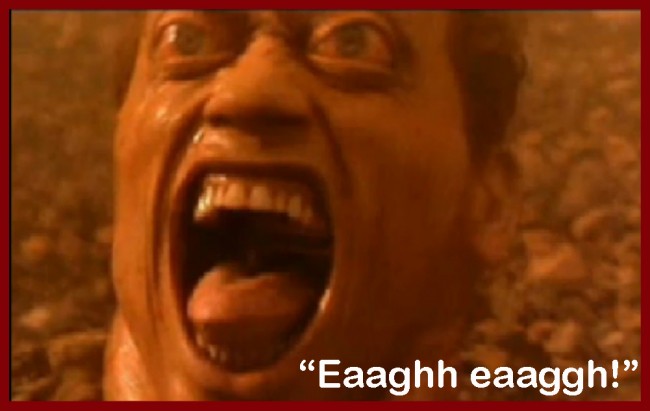
Maybe I'm in Rekall right now and this is all some elaborate alternate reality, but my vivid memories of the Schwarzenegger Total Recall (made 22 years ago by that "master" of intricate plotting, wry humor and sub-tle human interactions*, Paul Verhoeven) was of an R-rated Sci-Fi gore-fest, light on "Gee-Whiz" and heavy with Cheese-Whiz, that seemed to mark the limit to how much Arnold could contort his face.**  The one thing I remember being amusing was Sharon Stone as Doug Quaid's wife, in an arch performance that basically made her a star.***


This "re-imagining" (if you will) has Colin Farrell as Quaid,**** working on an assembly line for synthetic security forces—robo-cops (although they more resemble—and collapse just like—the battle-droids in the Star Wars prequels).    The elaborate set-up has the world decimated by chemical weapons making the world inhabitable on only two islands, Britain and Australia.  The most precious commodity, thus, is living space, and the commute from one to the other is a tough one, a high-speed transport through the Earth's core—the shortest distance between two points being a straight line (would really have hated to be a construction worker on that project!).  

Anyway, Quaid is beset by dreams of running, chasing, shooting and loss, waking up in a cold sweat to find himself sleeping next to Lori (Kate Beckinsale, a fine actress—remember her in Branagh's Much Ado About Nothing—who is going to be stuck in kick-ass roles as long as Keira Knightley, Michelle Williams, and Carey Mulligan are alive), who works for security for the United Federation of Britain, and its leader Cohaagen (Bryan Cranston), which begs the question: Where's the Queen?  And begs the question: she's married to a factory worker?

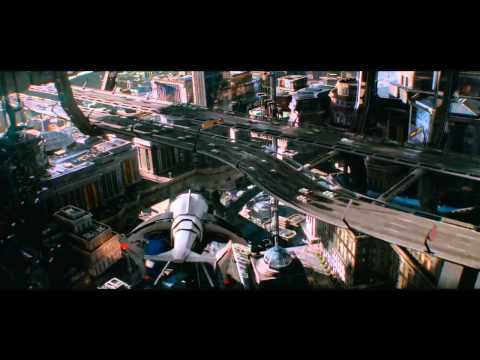
But if we start picking nits we'll be here until the time the movie's set in. Leave it that there are plot-holes larger and deeper than the one running through the planet, and it all begins when Quaid decides to go to the Rekall facility in his local city (which I believe is Great Britain, but owes a lot to Ridley Scott's Los Angeles in Blade Runner...and Spielberg's D.C. in his own version of Dick's Minority Report), a divey section of town with a yen for Chinese decor.  Basically, he wants a spy fantasy, where there are double identities, secret plots and no one can be trusted.  He gets it, but whether it's reality or a drug-induced fantasy he has no way of knowing.  Something goes horribly (horribly) wrong, and by the end of his session, all the Rekall technicians are dead, as well as a dozen security forces, who burst in (pretty quickly, too) and whom Quaid overcomes in a single-shot, digitally-tracked shot that resembles a first-person shooter game.

Which is what this movies is, essentially—game scenarios, one after the other, trying to get to the next level.  It's not that this Total Recall is anything less than competent.  It truly is, and the cast is fine and all.  But, it's never anything more than that, there's nothing very inspired...except from other sources, movies and video-games, mostly,***** and tangential stuff at that.  But, although attempts have been made to make it sleeker and faster-paced, there is no attempt to make it better or develop themes that the first film dropped for kinetic thrills.  When you're dealing with alternate realities, why leave it at one?  Why not keep the audience on edge on what's true?  Why not make the stakes a little bit higher, so there are more consequences (like what this movie hints at in an early scene) for Rekall users, so there's more at risk than physical pain?  This is Inception-material, but on only one level, and it's a sub-level at that.  The potential was there to do more, but, instead, it's more of the same.

And Len Wiseman, the director of this, and the "Underworld" films (and "Die Hard 4")?  It's a few films in now, and one can say that he's not aspiring to much, other than keeping both the budget and the pace high.  It's not so much directed, as art-directed, full of detail to distract from the lack of depth—highly finished, but with a sub-standard foundation.  There was so much that anyone could do with this material to make it rise above the first one, rather than just make it worse.

Total Recall (2012) is a Total Cable-Watcher.


"But, I don't WANT to be in a bad Schwarzenegger movie!"
"Which one: Jingle All the Way or Last Action Hero?"


* ...usually involving fists, but in this case involving anything that could penetrate a human torso or face.  This one was a particularly nasty exercise in excess, and I remember Schwarzenegger shilling it on Entertainment Tonight: "Yah, It's a GREAT FAMILY moo-vie, Bring the KIDS!"  I was horrified to see that some idiot-parents actually did, and those kids have probably been in therapy for a couple years now.

** ...without  special effects, anyway.

*** It put her on the path, anyway, as Verhoeven was so impressed with her that he cast her in Basic Instinct, then she was a star in a flash.

**** A better match, I think, than Schwarzenegger.  Farrell is more relatable, and you could see him as a factory worker, which makes the concept—which is telegraphed and anticipated to the Nth degree in both films—work a bit better.  Schwarzenegger can't be believed as a factory worker—he's too much of a "800-pound gorilla in the room" to be hiding in such plain sight.  The original concept...and casting...had someone like Richard Dreyfuss in the role.  Now, THAT would have been fun, and surprising.

***** A lot from the first film, of course, but it's weird stuff—the plaid pattern that Quaid wears at some point, the woman in the transport station—there to fake out only the audience that had seen the first film—and the triple-breasted prostitute (probably because it's what the geeks remember...and want).  All of which will bring me to an up-coming point...

Tuesday, March 8, 2011

Rango

"A Fistful of Pixels"
or
"Draw!...The Gun, Not the Computer!!"

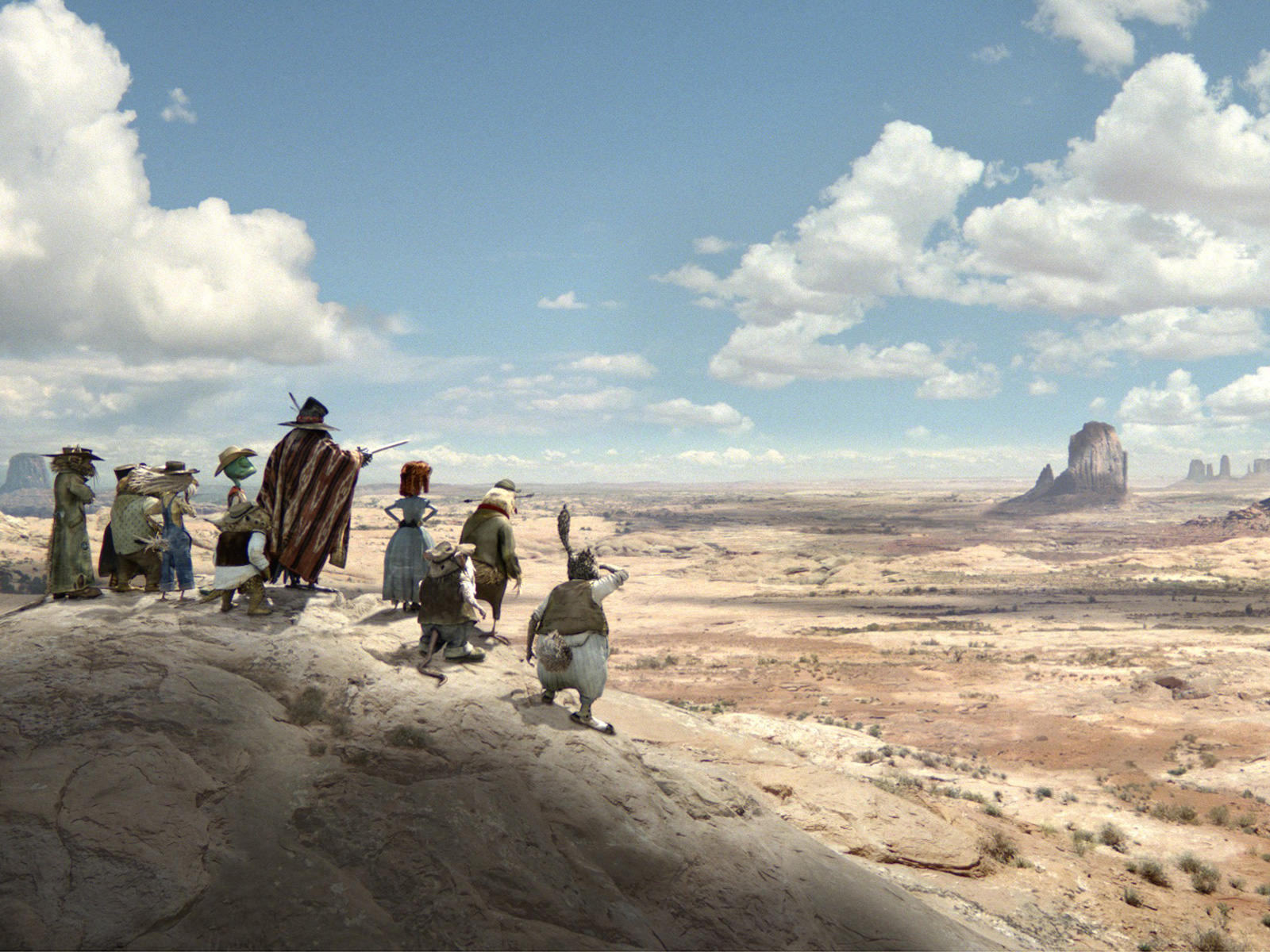
Rango is an amusing hybrid of animated feature and a rather encyclopedic mish-mash of stylized western themes, set in an animal kingdom that could only be imagined in a Ralph Steadman fever-dream.  Directed by Gore Verbinski (who manages to make interesting movies from least likely sources, like The Pirates of the  Caribbean*), it boasts a unique look, visually consulted by ace cinematographer Roger Deakins, while being the premiere animated feature to come out of George Lucas' FX house Industrial Light and Magic.
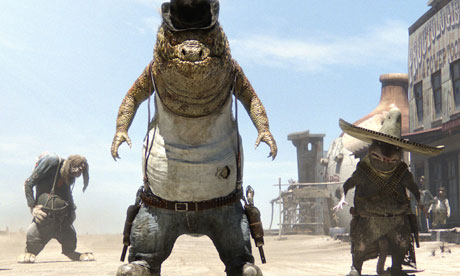
With such a background, the film should be technically interesting, and it is that, rich in detail and texture with a visual look unlike anything previously seen in computer animation.  Everything looks real and like it should exist in a real world, even though the physics of things could never, ever work.  It's a pixelated bizarro-world of funny animals just over the dunes from a mad civilization, a nightmare-world from inches off the ground.

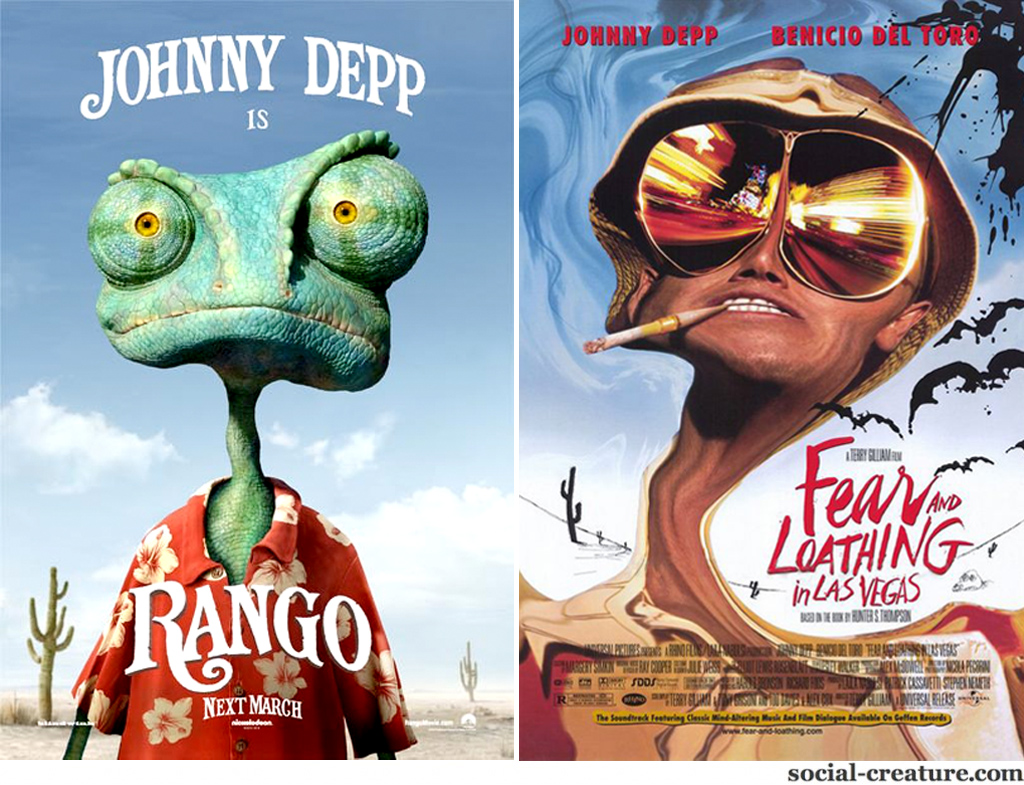
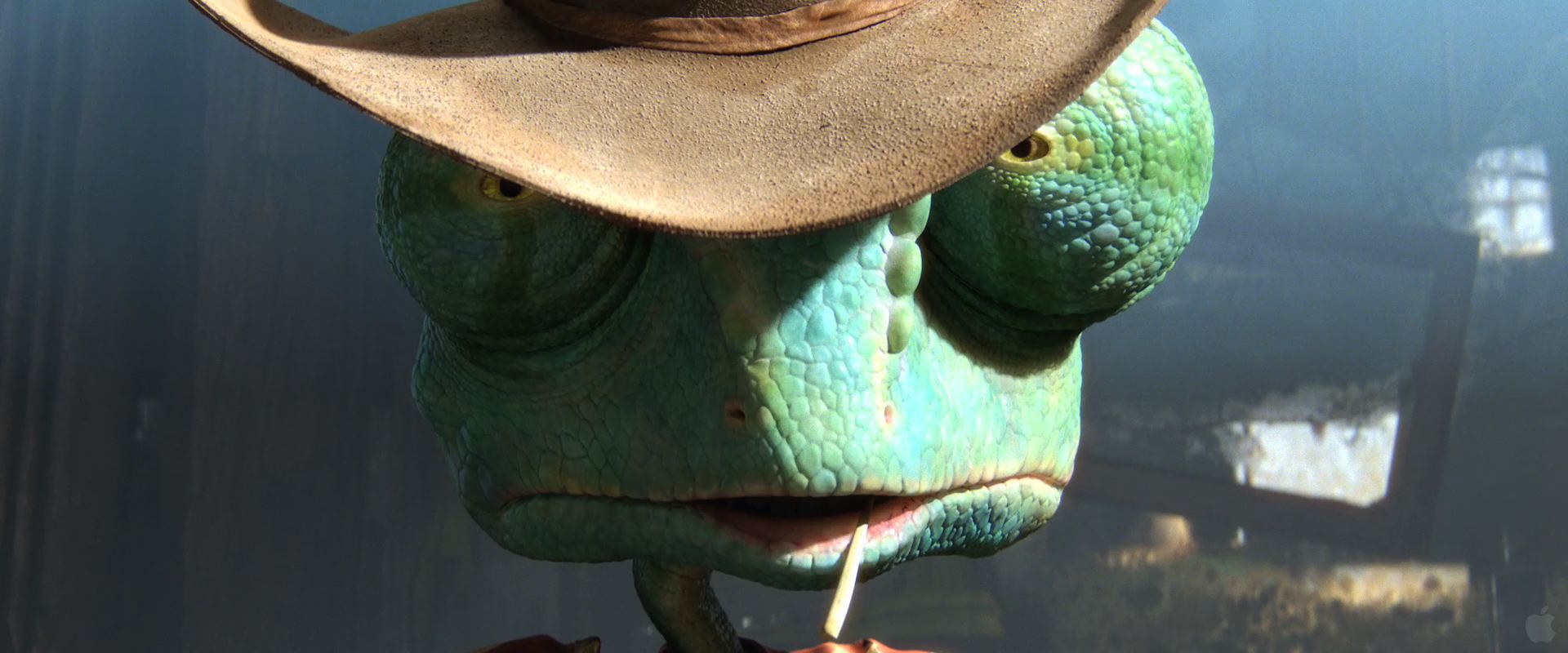
While on a cross-country trip, a small highway accident causes a major disaster for a family's pet chameleon (with neatly quick-silver voice work by Johnny Depp)—an apt choice as he must change his persona often at times in the story—who finds himself stranded in the crushing heat of the desert, where his life of comfort leaves him ill-prepared for survival.  Fortunately, he is befriended by a crusty armadillo (voiced by Alfred Molina), who seconds after meeting the lizard is run over by a truck and he's left lying prone on the asphalt with the impression of a Michelin bisecting his stomach...and he enjoins Lars (er, Rango...whatever) to go on a vision quest to face his destiny.  Immediately, you know that this one is going to be a little different...not only for the kiddies, but also for producing partner Nickelodeon, which usually plays it a little safer and a little younger for its audiences.

It's something different, but also extremely familiar.  I've had to gut-check this review because Rango is so stuffed to the shaded-texture sweat-band with movie references that I had to make sure geek-love didn't color my perceptions.  Culled (one hesitates to say "written") by John Logan,** the story does so much reference-rustling that it feels like a pop-culture scavenger hunt—The Shakiest Gun in the West (and thus, Bob Hope's "Paleface" movies), High Noon, Shane, the Sergio Leone "spaghetti westerns," "Looney Tunes" cartoons, and a large back-wash of Chinatown.  More like a tsunami, that last one, as the Mayor of the desert town of "Dirt" (clever) is a an ancient tortoise that looks, dresses, and speaks (sometimes verbatim, in the voice of Ned Beatty) like John Huston's Noah Cross from the latter.

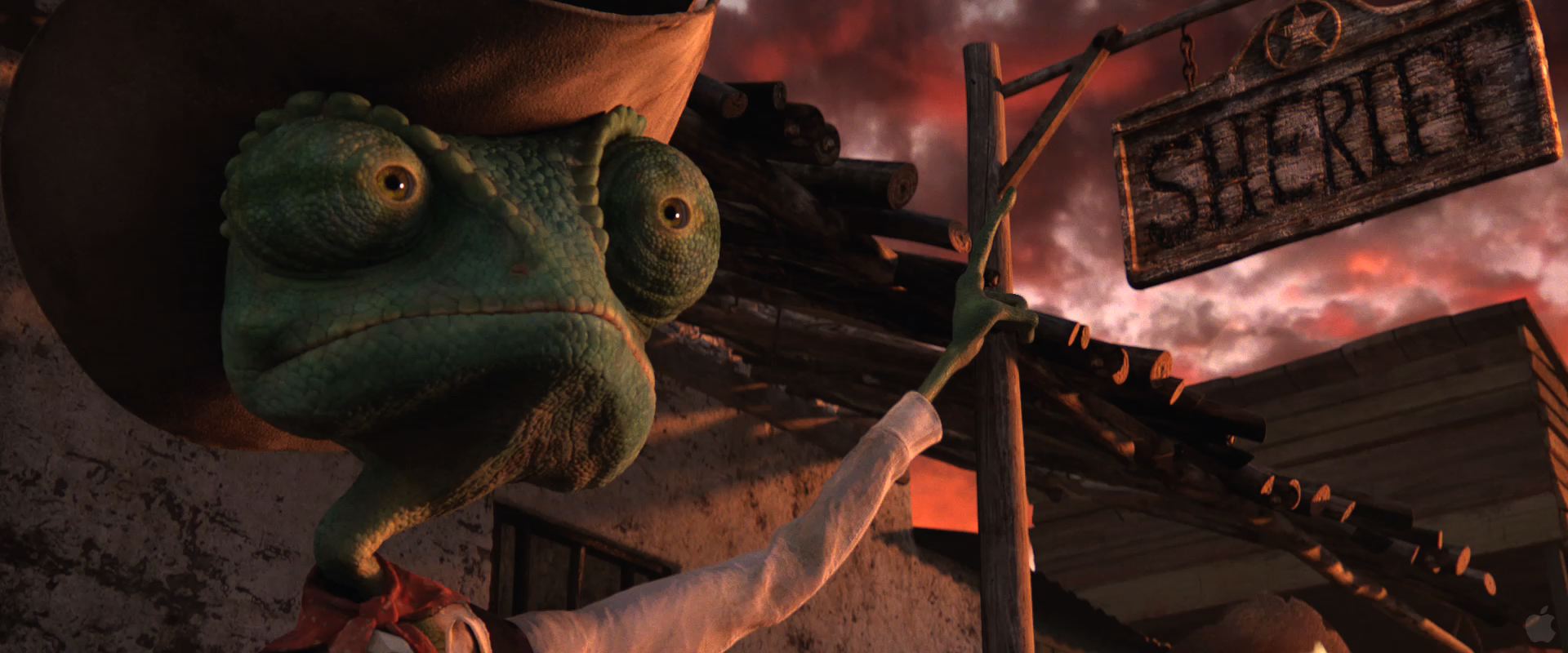
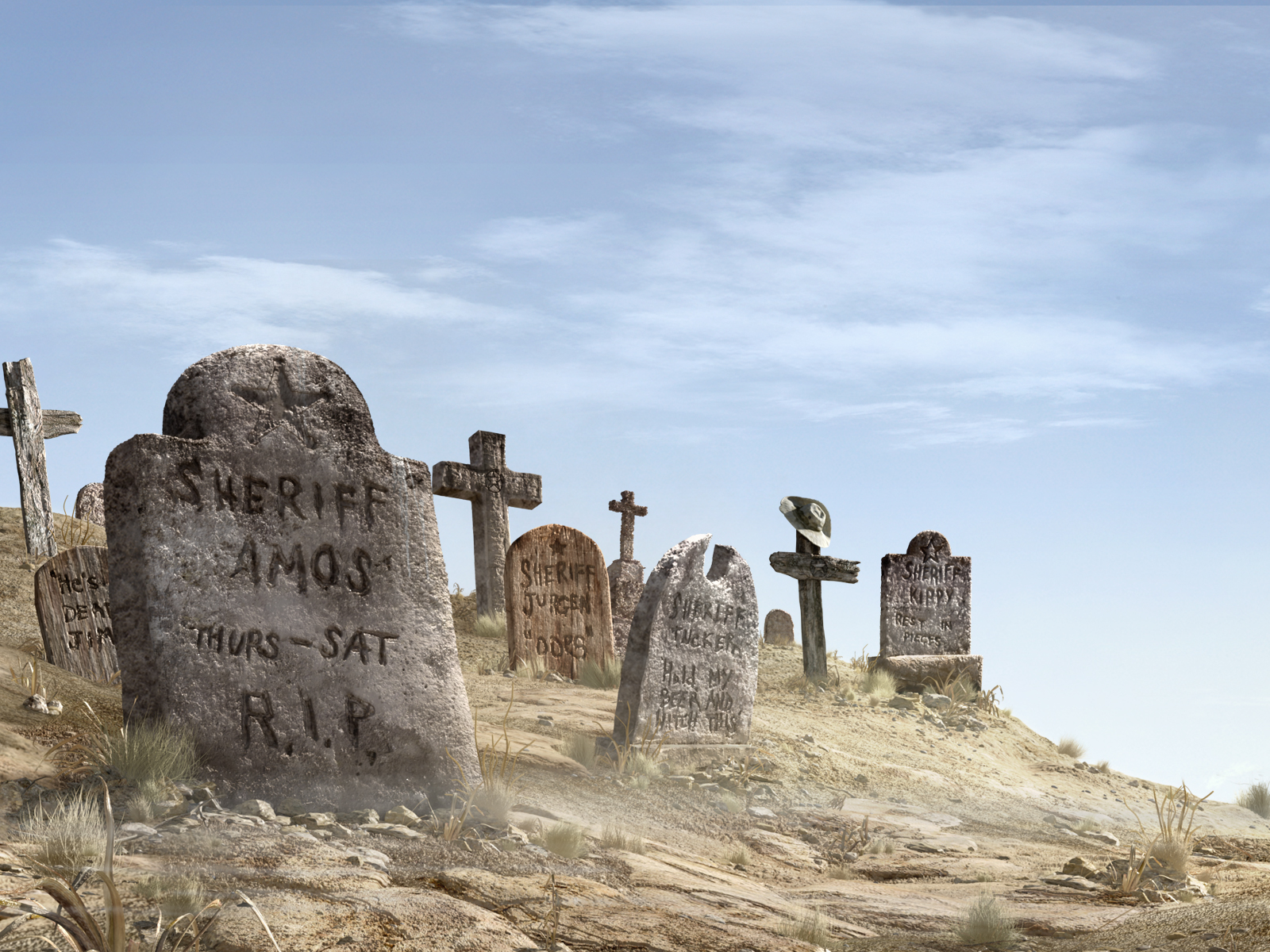
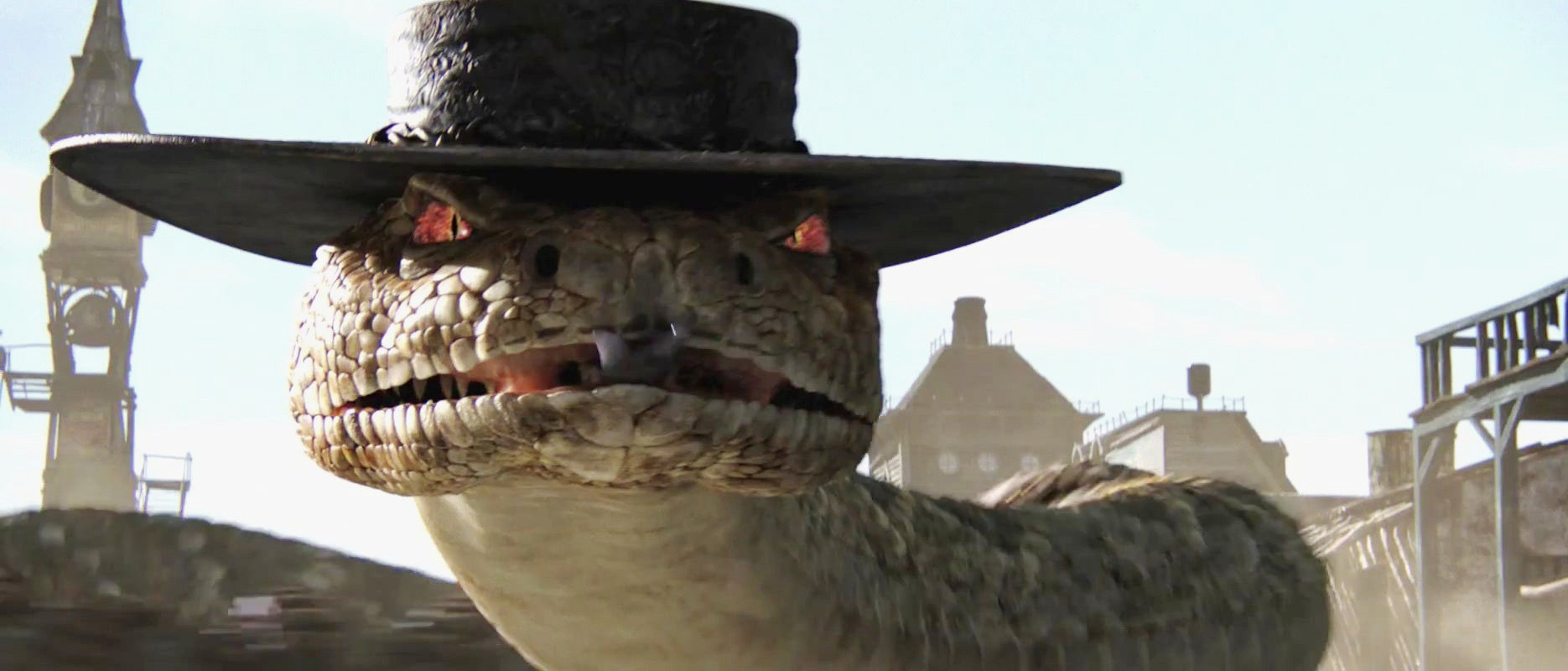
When the chameleon drags into town, the Mayor sees an opportunity to put a patsy into the vacant Sheriff's job (there is evidently a quick turn-around in the job), which also makes the movie resemble Mr. Smith Goes to Washington, thus keeping his claws in charge of the town's water supply, or lack of it.  Whatever his effectiveness in the job, one way or another "Rango" is going to be "over his head" in Dirt unless he stops concentrating on "blending in" and changes in ways more than appearance.  Along the way, he is threatened by bad-guys and helped by unlikely allies in a free-wheeling roller-coaster with enough hi-jinks for the kids and enough "inside jokiness" for adults, *** done at a speed that Verbinski can't achieve in live-action films (but aspires to).  This might give parents in the theater a little too much work to do, explaining things (like water-rights) while trying to deaden the "sugar-rush" the pace will give their kids.  And some of the images can be a little scary for the little ones, like big snakes (modeled after Jack Palance and Lee Van Cleef) voiced by Bill Nighy (shudder).

But, it is smart, clever and different, with good performances and that extra attention to detail that shows off the best of the art-form.

Rango is a Full-Price Ticket.


* My God, I'd forgotten that he directed Mousehunt, a film I got slapstick-happy chuckles over, but that I know annoys a LOT of people.  There are times when I see a bit of Mousehunt in Rango. 

** Maybe I'm being a little harsh there.  I liked this script by Logan and is the first of his that doesn't feel half-baked, and gives me hope that the guy might be able to bring substantial to the next Bond film, despite having replaced the more promising Peter Morgan.

*** For instance, as "Rango" is bounced around, caroming off the windshields of desert-highway traffic, he alights on one particularly relevant vehicle, and his meeting with an unnamed "Spirit of the West" (voiced so well by Timothy Olyphant  that I thought the real guy had come out of his announced retirement to do it—but he's keeping true to his word with his myth-busting coda performance.  Disciplined.)

Friday, November 19, 2010

Harry Potter and the Deathly Hallows, Part 1

"Harry Potter and the Delay of the Inevitable, Part II"
0r
"Oh!  Like We've Never Done THAT Before..."

It is very disturbing to me that the all-time box-office-generating series of all time is the "Harry Potter" series.  I've only read one of the novels—the first—and found it charming, nicely irreverent, and "tuned in" perceptively on the subject of kid-angst, albeit "special needs" students.  J.K. Rowling deserves all the acclaim and revenues for her wizard knock-off, and a special thanks (and maybe a medal or something...flowers?) for getting kids to read again.


The movies started out with a wonderful charm under the directions of Chris Columbus and Alfonso Cuarón.  But starting with the fourth film, everything started to be treated just a Death-Eater shade too darkly, the scripts being too respectful to their sources (while simultaneously neglecting the arcana that delighted in the Rowlings), and the neat visual touches that were thrown in and taken for granted as part of the magical landscape, really WERE taken for granted, and never advanced in sophistication, or inspiration.  The emphasis has been on economics—meeting deadlines and cranking them out under the lackluster director of the series' final four films, David Yates.


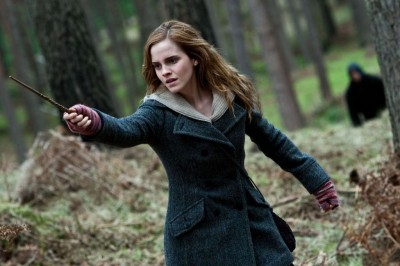
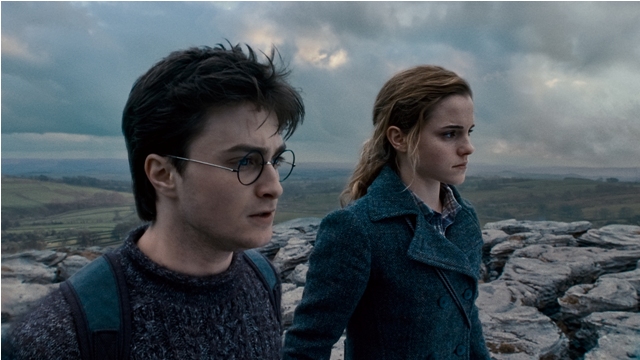
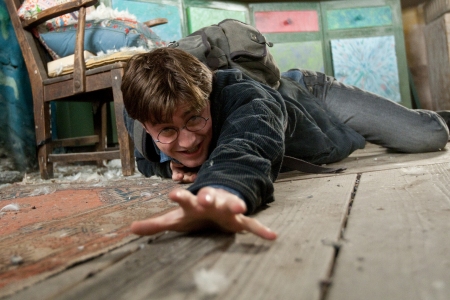
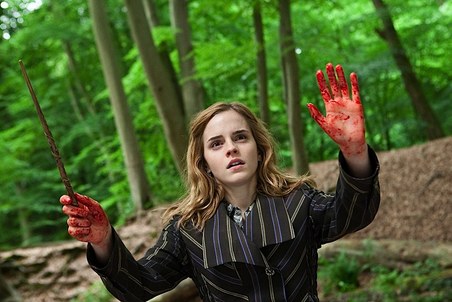
The same holds true for the new one, Harry Potter and the Deathly Hallows, Part 1.  Yates is back as the director (and Steve Kloves, thankfully, is back as scripter, providing bursts of dialogue freshness), and his shot-planning is just as uninspired as it has been his last two outings, taking his cues from the gloomy vista look of "The Lord of the Rings" series.  This time out, It is a Dark Time for the World, Muggle or No: the Big Nasty of the series, Voldemort (Ralph Fiennes, relishing the role) and his minions control the Ministry of Magic and Hogwarts School.  Time to eliminate the one person he hasn't been able to kill—Harold James Potter (Daniel Radcliffe).  Harry's inner circle of loyalists spirit him away to hide him from The Dark Lord (which ends up killing a couple of them—and like every death in the series, they are disquietly unmoving).  Ultimately, the Trio to Whom Everything Happens (Radcliffe, Emma Watson, Rupert Grint) separate from the group in a self-sacrificing quest to find the horcruxes—the movie seems confused about whether there are seven or merely three—that contain the souls of Voldemort's victims that are keeping him together.  Destroy the horcruxes and destroy Voldemort.  Sounds simple enough.  But, we go through an extended camping trip with the three where they are fugitives from dark Snatchers and Death-Eaters and petty disagreements.  It's not spoiling anything to say that they find precisely zero horcruxes, and, instead, discover the secret of the Deathly Hallows (told in a quite nice animated story), which would appear to negate all previous plot-points and quests...hence, they wouldn't be in the title if they weren't so damned important, as this isn't "Harry Potter and the Completely Superfluous Thingamabobs."  One walks out feeling as if one had just spent a dragon-choking wad of cash and two and a half hours of precious life-time having merely seen the pre-game show, the same result as from the last two films.

There are joys and differences: the kids have learned to be very subtle actors, and, as always, the cast of British thesps is head-spinning in scope and styles, and they all seem aware that they must make the most of their limited screen-time, and they do—Fiennes and Helena Bonham Carter and Jason Isaacs go out of their way to make their every moment count.  Bill Nighy makes his first appearance in a "Potter" and he has that sepulchral style that makes him a natural for it.  Some of the lines are clever, There are a couple of seat-jumps (remnants of when the film was to be released in 3-D),and there's even a touch of sex in this one—the kids are 17, now—with a chaste moment of Potter paramour Ginny Weasley (Bonnie Wright) asking Harry to zip up her wedding frock, and a vision of a naked Harry and Hermione making out is produced at one point to infuriate Ron Weasley ("That was...disturbing," said the girls sitting behind me...mm-hmm).

But, it's much ado about nothing.  We're left at the cusp of the action to come (and there are no hints or previews of Part 2 after the credits, so don't stick around unless you want to hear Alexandre Desplat's serviceable—and momentarily inspired—stand-in score for John Williams'), a theatrical moment that is merely some villainous chest-thumping.  Not the best or most impressive way to end it.  At this point, I'm beginning to think that the Potter film series is like a box of Bertie Bott's jelly beans—one or two might be good, but there are a bunch of ugly unsatisfying ones in the mix. 

The one thing missing that I hope—but doubt—will re-appear for the finale,* is the one thing that should be emblematic for such a series: some inspired magic.

Harry Potter and the Deathly Hallows, Part 1 is a Rental.


* Is there some sort of spell we can conjure to ensure there are no more sequels, prequels or "inspired by's?" 

Tuesday, November 17, 2009

Pirate Radio

"Rockin' the Boat"

The legend of "Radio Caroline" (and similar ships of the line) is one of the great stories of broadcast rebellion...and opportunism; during "The British Invasion" of Rock n' Roll the government-run radio stations (the BBC) limited the amount of "pop" to a minimum of hours. Seeing a demand among the populace for more, a small band of entrepreneurial renegades hired a ship, built a powerful transmitter on it and began defiantly broadcasting over the Island with rock n' roll—advertising-supported rock n' roll. Other ships did the same. At one point, another pirate operation, Radio City, commandeered one of Britain's off-shore defense forts from World War II and began rocking out.

"Pirate Radio" (released April in Britain as "The Boat That Rocked") is the latest in a string of 2009 releases that take the premise of a true story and make an easily digested, formula film out of it. The movie and its producers would have you believe the British ministry felt a moral imperative to stamp out pop music, the very thing that was filling the government coffers with tax dollars, and the radio-pirates were acting in a fit of rebellion and righteous indignation at their musical muses being silenced. They were on a Mission to bring the Music to the People.

Nah.

They wanted to make money. It was a bunch of guys who saw an opportunity to make it in a market that wasn't having its needs met. So, they created illegal, unlicensed operations that played 24 hour rock in international waters. Nothing succeeds like excess. And "The Beeb," run by the country's Post Office, didn't like the pirates because they were competitors, siphoning funds that they believed to be rightfully theirs. The word "pirate" isn't used lightly. But money is not sexy enough subject matter when dealing with rock music, despite that you can't have one without the other, positively or negatively.* And movies about turf wars work best where there's actual turf.

I'll beg forgiveness on this for the writer-director is Richard Curtis, who has managed to fill his movies with sharp utterances that we find ourselves wishing we were smart enough to make as comebacks. He says things better than we mortals do, and luckily he chooses to caper in the comic realm, having started as a writer on ""The Black Adder"," and ""Mr. Bean"," and graduated with such rom-com's as "Four Weddings and a Funeral," "Notting Hill," and "Love Actually"—his directing debut.**

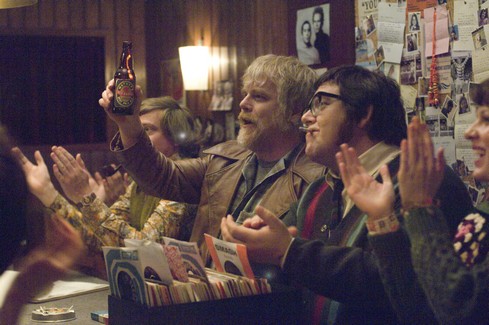
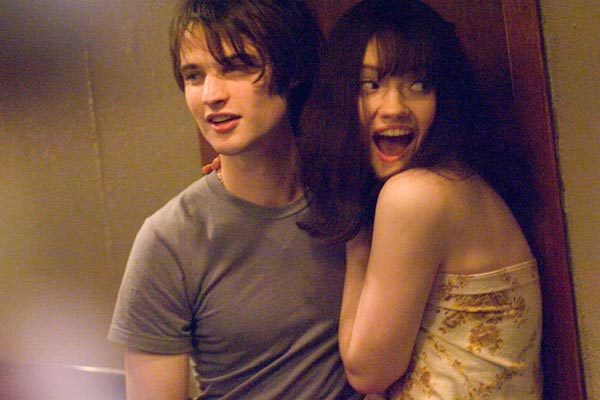
Stylistically, the thing is a mess. A fast multi-screened 60's-styled opening that operates like some flipping PowerPoint nightmare explains the back story fast and loose, and from there pin-points a fictional ship, "Radio Rock," operated by Oliver (Bill Nighy, who does a fine balancing act of appearing totally stoned while being exceedingly "British"), and a crew of good-for-nothing-but-jamming disk jockeys, led by a token American "The Count" (Philip Seymour Hoffman) and his nemesis, the beloved rake Gavin (Rhys Ifans), other jocks divided between "characters" and burn-outs and a just-arrived newbie named Carl (Tom Sturridge) who serves as the audience's surrogate for reams of exposition. This ship of fools maintains a fixed position in the North Atlantic, frustrating the efforts of one particular minister, Dormandy (Kenneth Branagh, just as twittish as he can be) and his assistant...er...Twatt (Jack Davenport) to bring them down by any means necessary. It sets up a neat heroes and villains scenario that completely messes up the history, but tries to gin up some advocacy towards the wackos broadcasting without a license to shrill.

The main story is the government versus pirates scenario where the government is a tidy, repressed bunch of stick-uppers and
the disc jockeys are slobby loose cannons on deck. Carl's story of being sent to the ship, for reasons unknown, by his Mum (Emma Thompson***) after he's been expelled, and his subsequent attempts to de-virginize himself is second in priority (Gemma Arterton and Talulah Riley are the "bits of crumpet"—if I can use the period vernacular—employed in the attempt), and its filled out with petty bickering on-board ship and various personal crises among the disc jockeys. Hi-jinks on the high seas.

That all sounds perfectly dreadful in summation, but Curtis is deft in the details, providing a lot of genuinely earned laughs, and pulling off some nice little moments—one example being a post-heart-crushing of Carl, where he sits dejected in the ship's meeting room, where he's soon joined by fellow crew who try to boost his spirits with chocolate and crisps. When he has none of it, they begin to eat the cookies and drink the drink until he finally pulls his head out and nibbles with them. The unspoken lesson: you have to shoot while the geese are flying, chappie. That it's done without words and with "Bean-ish" comic timing makes it good writing and good film.

But, if Curtis and crew deigned not to complicate the story particulars, it's assured that they wouldn't take the film into uncharted dramatic waters, so they turn it into a "crisis"
where "the people" triumph, conflicts are washed away, everybody gets paired up and Rock n' Roll will never die.

And artists get a penny per disc sold, if they're lucky.

The film did poorly in its Anglicized form, where it was shown at a length of 140 minutes, which is excessive for any comedy. For the titularly changed "States" version, twenty minutes were cut, but it doesn't solve a basic problem. Today's audiences may not have the same flavor of love of rock music as director Curtis does. The market is super-saturated with it on all levels, and a people's version of piracy, through peer to peer networks, has exposed what was thought of as devotion as merely acquisitiveness. How much love can you have for an artist's work if you're perfectly happy to rip him off?
**** This is the market-place the film is preaching to and trying to reach.

So enough talk of saving rock music to sell the movie. It's a sham. What is there is genuine laugh out-loud moments, a persistent air of tart larkiness several cuts above your standard "Carry On" movie and a killer soundtrack of innocent-sounding 60's standards. It's fun.

"Pirate Radio" is a very cheap bargain-price Matinee.

* Unless you download your favorite artists' music illegally, of course. Then they get screwed. Ain't devotion grand?

** He also co-wrote the two "Bridget Jones' Diary" movies and for "The Vicar of Dibney"


*** Thompson does a lovingly vapid 60's hipster, with cigarette holder, moonish sun-glasses, and Mary Quant checkered coat, reminding one of Vanessa Redgrave in her "spacey" days. And I guess you can't do a 60's movie without putting January Jones in it, so she's there, too. Here's a thought: Most of the women in the film, save the on-board lesbian who takes care of "the boys," are duplicitous. What's up with that?

**** And, not to belabor the point (BUT!) radio stations have a blanket agreement with music publishers (BMI and ASCAP, say) to pay the artists for the music played. The Pirate stations were under no obligation to do so, and probably didn't. So much for promoting rock.

Wednesday, April 15, 2009

Hot Fuzz

"Hot Fuzz" (Edgar Wright, 2007) Clever, but not really laugh-out-loud funny comedy from the makers of "Shaun of the Dead." Simon Pegg plays Nicholas Angel, a metro cop so good that he is busted to the idyllic small town of Sandford in Gloucestershire.

That's
a funny concept right there: what if you took the highly testosteroned and heavily armed cops of American movies and put them in a sleepy little town? Two things would happen: he'd begin to bust the petty crimes in such an over-the-top fashion that'd he'd cause a ruckus, or there really would be something rotten deep to the core of the town that only Angel's uber-dedication could ferret out.

Well, "Hot Fuzz"
runs two hours so it's both. But that two hours is also part of the gag (singular). The film-makers stage the relatively minor showdowns with the same orgiastic verve as American action films—several cameras rolling at once and an editing style that extends the scene from every angle to an impossible length, complete with slo-mo fire-balls and not-anticipated consequences to the masonry around town. A little of that goes a long way, but a lot of it...tends to get monotonous. There's only so many times you can laugh at the shooting in slo-mo mid-leap before you start to ask "So, uh...can you do anything else?"