Showing posts with label Fantasy. Show all posts

Wednesday, December 18, 2013

The Hobbit: The Desolation of Smaug

Maintaining Good Working Hobbits
or
A Dense Overlay of Smaug

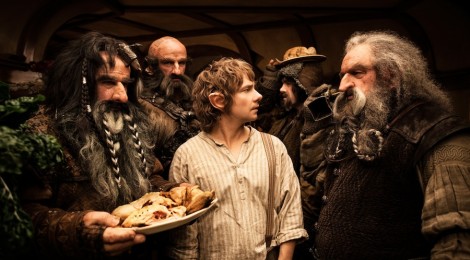
The second of Peter Jackson's three "Hobbit" films, The Hobbit: The Desolation of Smaug is, predictably, more of the same.  It's a three hour ramble, a complication and a darkening of the tone of the first film—as usually happens with the second of a trilogy, so that we, the audience, can climb out of our emotional valley in time for the resolution of conflicts in the third.  Standard Operating Procedure.  We are given a quick recap of the first film—going back in time to when Gandalf the Gray (Ian McKellan) first put the idea into the head of Thorin Oakenshield (Richard Armitage) and getting the dwarf crusade rolling.  Once the summary is done (in brief: Gold, Mountain, Dragon, Dead King, Arkenstone, New King, No Elves Allowed), they skip over An Unexpected Journey and head back to the Gandalf, Bilbo and the dwarves on the path to Lonely Mountain (Sindarin Erebor), orcs still snapping at their behinds and making their way to the entrance of Mirkwood.

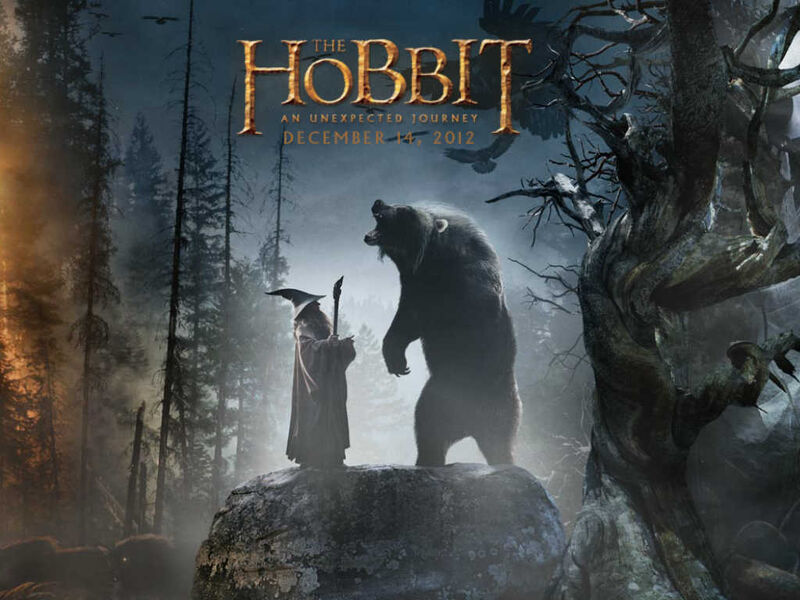
A quick visit to the skin-changer Beorn (Mikael Persbrandt), who usually appears in the form of a bear—not much is made of him, even though he got his own poster with Gandalf last time—and they get to Mirkwood (by pony), at which point Gandalf goes "walkabout"—he does this every movie and they probably split the story to accommodate a "Gandalf disappearance"—so the wee folk must enter the spooky forest alone, with a promise from the wizard that he'll meet them at "the Lookout."
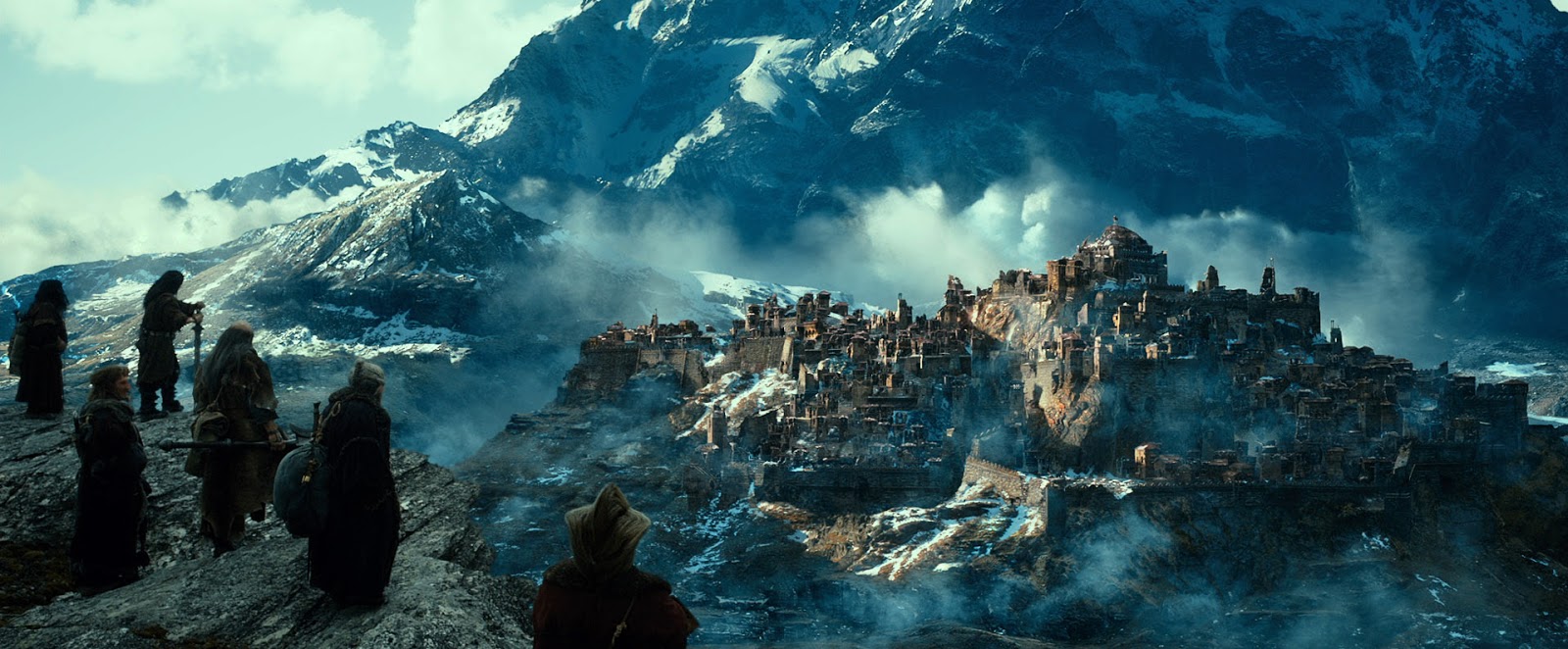

"The Lookout"—he said he'd meet us; he should be easy to find...

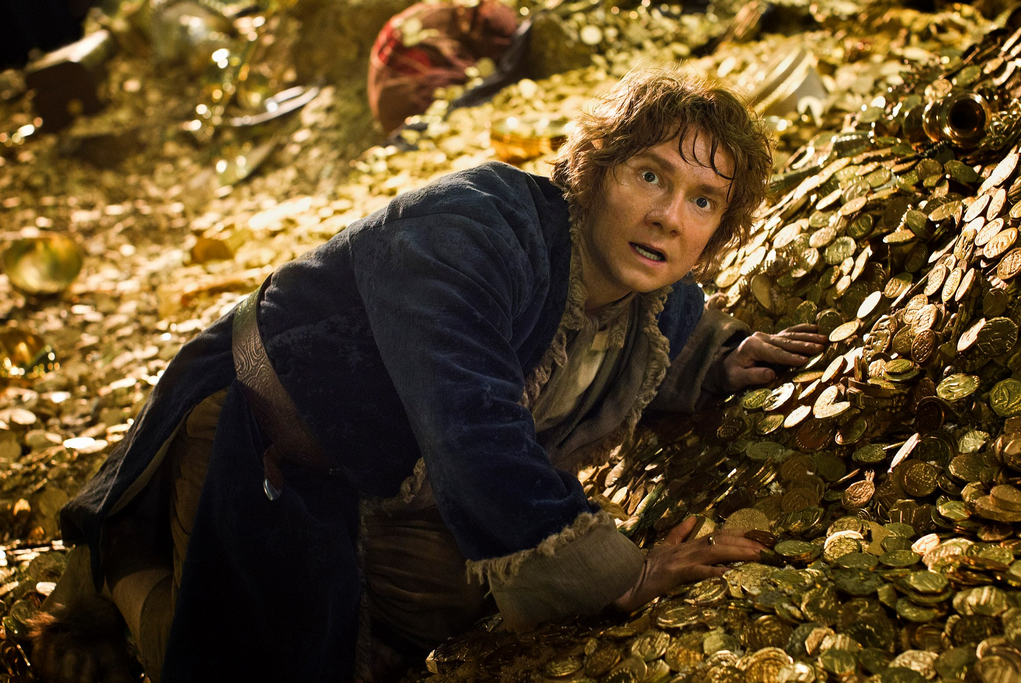
Anyone familiar with the book knows that you don't find out where G.theG. goes until the last chapter, and that was after Tolkien had written "The Lord of the Rings" and got continuity-conscious.  But, here, we do get to see where (hint: he went there LAST movie), and Jackson's The Lord of the Rings gets set up all good and proper (except Benedict Cumberbatch is voicing the character now—wonder if Jackson will Lucasize everything to make it all match up).   The dwarves and hobbit are concerned with icky things and splendors that one would associate with a place called Mirkwood, and the ring that Bilbo snatched from Gollum is starting to exert its unholy influence turning the peaceful little guy into a berserker bad-ass.  Travel packages with unruly companions and nasty accommodations with large pests and diffident natives will do that to anyone.  But, Bilbo proves his worth on more than one occasion and eventually they do make it to the Halls of Lonely Mountain, a few shy of a full dwarve-deck and make their way to a meeting with the titular character that's been hoarding all the gold and keeping it for himself—the ultimate one percenter of Middle Earth.

Bilbo above the canopy of Mirkwood
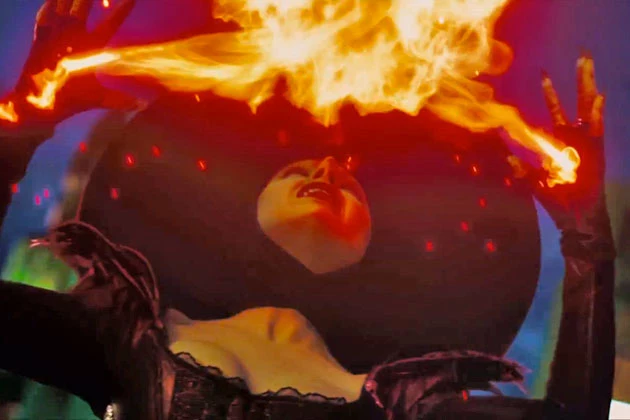
Smaug is the dragon, living in the massive storage caves of the Mountain, and he spends his time, far from desolate, sleeping among the gold and treasures of the dwarves like a big scaled, fire-breathing Scrooge McDuck. When Bilbo's attempts to find the Arkenstone awaken him, there is quite an extensive cat-and-mouse game as the small hobbit scurries around the cumbersome dragon.  Or I should say Cumberbatch, as the ubiquitous actor provides a nicely arch resonant voice to Smaug, which is accompanied by a lip-curling animation to enhance it.  This is where the film shines, as the territory is new, the imagineering of the dragon is fresh, and the surprises are many.  After the previous two hours, that's a bit refreshing.

For if there's a problem with Peter Jackson's version of The Hobbit, it's that, by now, we are so familiar with the way he does things that nothing much really resonates anymore.  The heavily belabored ripostes by the actors seem a bit too predictable—when Bilbo changes his story to gandalf that he found his courage in the goblin caves last movie (rather than The Ring), there's a close-up of Gandalf as he says what half the audience is expecting: "You'll need it." Really, that one and "You should be" are certain candidates for Screenwriting 101 "easy irony" along with "You just don't get it, do you?" and "They're standing behind me, aren't they?"  

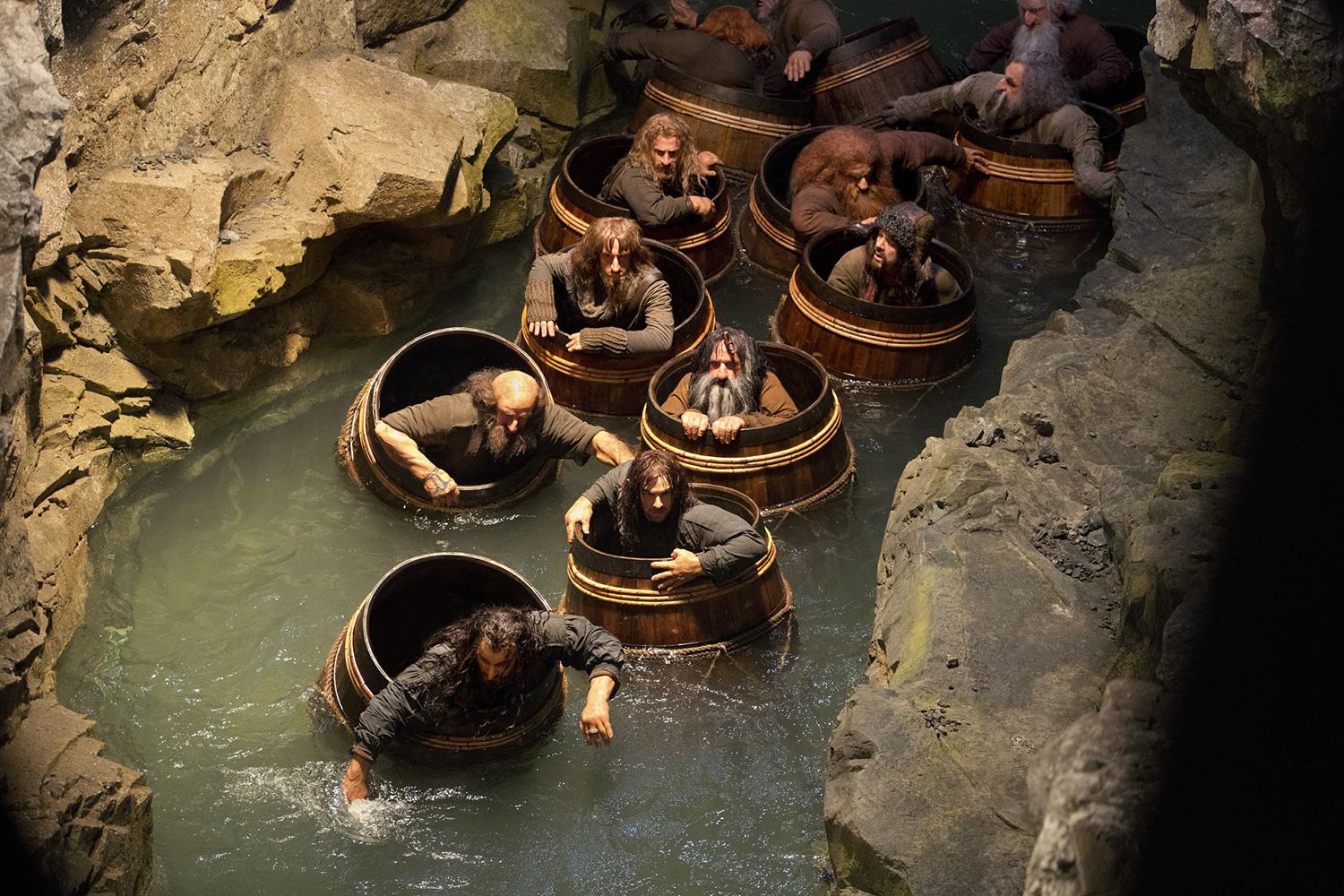
And the action sequences, this time assistant-directed by actor Andy Serkis. go on and on, in ever-increasing silliness.  If last movie set a more rollicking, silly tone than The Lord of the Rings (in part by the influence of Guillermo del Toro), now the joke's wearing a little thin.  Extended fights between orcs and elves are no longer thrilling, they're a demonstration of every possible way you can kill something with an arrow.  An extended rush down a rapids in barrels is accompanied by additional orc-elf fighting, where the barrels are used for any other purpose besides transport, as every tree-limb and branch over-hanging is used as a foot-hold.  Some of this criticism isn't fair, because if this had been the first film in a trilogy of Tolkien adaptations, the marvels of the film would send people off a CGI cliff in amazement.  It might take at least forty-five minutes to tumble down it, though.


One should, however, point out that the "we've been down this glade before" problem didn't occur with Jackson's earlier Tolkien trilogy, where there was enough material to keep things seeming fresh each film, and Jackson and his screenwriters did enough juggling of the narrative to keep things seeming new from film to film.  Their attempts here amount to trying to add a romantic element between the elf warrior Tauriel (Evangeline Lily) and the dwarf Kili (Aidan Turner), much to the consternation of Legolas (Orlando Bloom, back in action).  And while it provides a reprieve from tumbling and shooting and other too-frantic sequences, it does take away from the basic focus on the titular Bilbo Baggins (Martin Freeman) whose story this is.  Freeman's performance is, again, terrific, bringing all sorts of fretting elements to play, and making the transformation of his hobbit into a killer more than a little disturbing.

The vistas are staggeringly rendered, but some short-changing has been done with the characters in action sequences—Orlando Bloom seems to be the chief character robbed of some pixels, here and there, and the attempt to de-age him to a younger self doesn't really work (I've never seen it done convincingly, so far).  the only real surprises come in snatches of casting with Lee Pace, disappearing into the role of the elf Thronduil, Lily's elven warrior, and Stephen Fry's Master of Laketown.   Be on the lookout for some Laketown spies and you might even find Stephen Colbert for a brief second.  Oh, and Jackson gets his own "Hitchcock moment" out of the way very quickly.

Oh.  And SPOILER ALERT there's another movie coming, so this one ends at a rather inopportune time.  You only have to wait another year.

The Hobbit: the Desolation of Smaug is a Matinee.

"Conversations with Smaug" drawn by J.R.R. Tolkien
"Conversations with Smaug" drawn by WETA

Saturday, October 19, 2013

They Might Be Giants (1971)

They Might Be Giants (Anthony Harvey, 1971) It's the same writer/director/composer team as The Lion in Winter, but a decidedly off-kilter product is this out-of-circulation curiosity from the era immediately following George C. Scott's Oscar win for Patton.  Set in the "modern" age, which might be quite a few years too late for it, They Might Be Giants—yes, it did inspire the band's name—tells the story of Justin Playfair (Scott), a retired judge, and in whose grief after the death of his wife, now thinks he's Sherlock Holmes.
That might be useful, actually, but Playfair is now convinced that everything wrong with the world (and there's a lot in New York around 1970) is the work of the infamous Professor Moriarty.  That includes the blackmail being played against Playfair's brother Blevin, who wants to pay up and be done with it, but the Judge, forbids it—and he's the one with all the money—so the brother decides to have him committed.  He picks the worst person in the world to examine the Judge in order to declare him insane, a psychiatrist named Watson (Joanne Woodward).

In the course of her examination, Playfair leads her on the wildest of goose-chases, trying to track down Moriarty, finding random clues in the detritus of the city, and introducing her to his own version of The Irregulars, the niche-dwellers all but abandoned by the hustle-bustling population and see nothing wrong in Playfair's behavior.  In fact, they marvel at it, admire it, and wish to emulate it.  Meanwhile, Holmes and Watson run the gamut of scenes of crimes displaying apathy, greed, gracelessness, and rampant consumerism in Society while Playfair rails against Moriarty's presence behind it.  Watson serves as the Doubting Thomas (Scully to Scott's Mulder?), but eventually succumbs to Playfair's way of thinking.

The writer is James Goldman, brother of William (The Princess Bride, Butch Cassidy and the Sundance Kid, The Marathon Man), writer of the afore-mentioned The Lion in Winter, as well as Robin and Marian, Nicholas and Alexandra, and...White Nights.  And the problems with the movie is in James' screenplay, full of wonderful detail and dialog, but precious (to the point of cloying) in scene concepts relating to the larger point.  The mystery's good, but the clues suck.  Fortunately, he's got actors like Scott, Woodward, Jack Gilford, Rue McClanahan, F. Murray Abraham, Al Lewis, Gene Roche, Paul Benedict, and Emmet Walsh, all of whom can spin gold from cotton candy, but can only go so far to improve the material.

The film is as twee as twee can be, more in keeping with—Vincent Canby had a good idea in his negative review—the time of You Can't Take it With You and Arsenic and Old Lace and the sunny-side-up attitude (despite eyes being open to the negative) of Frank Capra.  But it's not Capra, it's Anthony Harvey, terrific editor and Hepburn-favorite director.  Harvey's really good at designing a film, its ambience and lighting, but he's not the best at forming image to idea, which the best directors can do merely by having empathy with the material.  Harvey doesn't judge in his projects, but he also rarely comments at all, good at staging, but not at direction...that is, direction of you, the audience to a feeling the material should provoke.  For a former editor, his weakness as a director is editorial. Odd.

The analyst in me cringes at the movie in its romantic notion of insanity—I've long wanted to do an "out there" version of "Harvey" where Elwood P. Dowd self-medicates in all sorts of ways besides booze—but, the wide eyed moon-calf who first saw this film (probably to hear the score, as I am a Barry fan and will see anything with Scott in it), still has an affection for it, guarded though it has become, and probably for its ending, which drives audience members looking for answers crazy and let down, but for me, is a perfect little nugget of an ending whose power (the acting,** the lighting effects, the music?) one can't explain away.  I'd put a spoiler alert here, but, really, this ending spoils nothing—it only enhances.


Sadly, John Barry's score for this film (conducted by Ken Thorne) has never been released.


* Here's two examples, both out of the mouth of Playfair:
"Because, you see, we live in Eden. Genesis has got it all wrong — we never left the Garden. Look about you. This is paradise. It's hard to find, I'll grant you, but it is here. Under our feet, beneath the surface, all around us is everything we want. The earth is shining under the soot. We are all fools."
and
 "Well [Don Quixote] had a point. Of course, he carried it a bit too far. He thought that every windmill was a giant. That's insane. But, thinking that they might be... well… all the best minds used to think the world was flat. — But, what if it isn't? — It might be round — and bread mold might be medicine. If we never looked at things and thought of what they might be, why, we'd all still be out there in the tall grass with the apes."
** Scott's feral growl and playing of "Now!  Do you see him now?" always gives me chills.

Thursday, July 18, 2013

The 5,000 Fingers of Dr. T

The 5,000 Fingers of Dr. T (Roy Rowland, 1953) Marvelously odd-ball, bizarre fantasy film for kids that's as much fun for adults, and has the added benefit of a crazed performance by Hans Conreid and a script, songs and design (after a fashion) the eccentric Theodore Geisel, whose nom de plume was Dr. Seuss.  Seuss was a definite, defiant genius,* in that he maintained throughout his complicated adulthood, the simplistic child-view, with all its neurotic simplicity, the well-ordered conservative traditionalism, swirled with a wildly anarchistic streak.

Dr. T is a bit like The Wizard of Oz in that it's a vividly imagined fever-dream that reflects the real world pureed in eye-popping colors and shapes through a child's trauma filter.  For Dorothy Gale, it's brought on by familial stress instigated by head-trauma.  For Bartholomew Collins (Tommy Rettig), it's familial stress instigated by exhaustion created by piano drills imposed by the unholy alliance of his mother (Mary Healy) and his music teacher, the snooty Dr. Terwilliker (Conreid).  The kid's got no allies, save for his dog, the audience—whom he regularly addresses—and the local plumber, Mr. Zabladowski (Peter Lind Hayes), whom he respects for his control over his life abd his ability to fix stuff—fixing stuff is important when you're a kid seeing the world broken.  Bart sums up his predicament for us, then falls into a horrific exhausted slumber, where he pictures himself the lone victim in the machinations of Dr. T, secluded in his impossibly architectured institute, the first specimen in a regimented experiment to lead a slave-team of 500 kids to realize his ultimate composition.  


Bart hides in plain sight in T's complex—making him look bug-like and squashable
For Bart, the job is simple: get out of the castle, rescue his mother (who is in thrall to the Professor as his assistant) and barring any escape, sabotage the Doctor's magnum opus. 

It may be the weirdest, most enjoyable leftist agenda movie that producer Stanley Kramer ever produced (even over It's a Mad, Mad, Mad, Mad World), If.... without machine guns, creating a passive-aggressive (through a "very atomic" silence producer) explosion of revolt to decimate the forces of regimentation and create a nuclear family out of the resulting chaos.  Even if Bart can't escape his lot, he can at least do some damage in it, and make it work to his advantage.  Sounds like any skill-set a kid would, should, and could have use of.  


Bart climbs to the top of an impossible ladder, only to be found out by a searchlight.
Regimentation and the individual's right to be one's self—by any means necessary—is the story's theme, one that runs throughout Geisel's work through various guises and creatures.  And even though Dr. T's denizens are fairly standard bi-ped's, the universe of Bart's Dr. T nightmares is one of wrong angles with no standard rules of design—a free-flowing construction, in danger of collapsing in on itself, even without a kid's help.  The songs are fine, the language is wonderful, and the acting whimsical and uneven, but, who cares?  It's the LOOK of the thing that creates the magic of the film, and makes it recognizable, along with some peripheral like the freakish "happy-hands"-beanies the kids are forced to wear, as Geisel...or, rather, Seussian.

Geisel thought little of the film, either because he thought the product compromised, or because the response to it was lackluster to the extreme. And kid-star Tommy Rettig went on to become the first "Timmy" on the Lassie TV show, an unpromising career with drugs, but ended strong by becoming a pre-eminent software programmer, specializing in DBaseIII.  All of which seems rather Seussian, as well.


Dr. Terwilliker's castle is full of oddities and Gehrey-esque angles


* For example, he labeled the film a "debaculous fiasco."

Tuesday, June 11, 2013

Oz the Great and Powerful

What a World, What a World;
or
There is no Baum in Gilead

Any movie attempting to resuscitate L. Frank Baum's "Oz" books has to deal with the series' own Wicked Witch of the West—that being M-G-M's musical version The Wizard of Oz, which had Judy Garland in it, and set the bar very high as far as expectations go (for quality that is, whereas for the box-office TWoO was not a box-office success at the time of its release and only became a classic after a couple decades worth of Thanksgiving showings on network TV).  Walter Murch's attempt to take an OZ story back to its roots, 1986's Disney's Return to Oz, was an abysmal failure, although artistically it was a terrific show--but probably butted heads with too many memories for its own goodness as, for instance, the Lion, Tin Man, and Scarecrow were not vaudevillians in theater-suits, as was the 1939 version, but looked more in line with the book's illustrations.

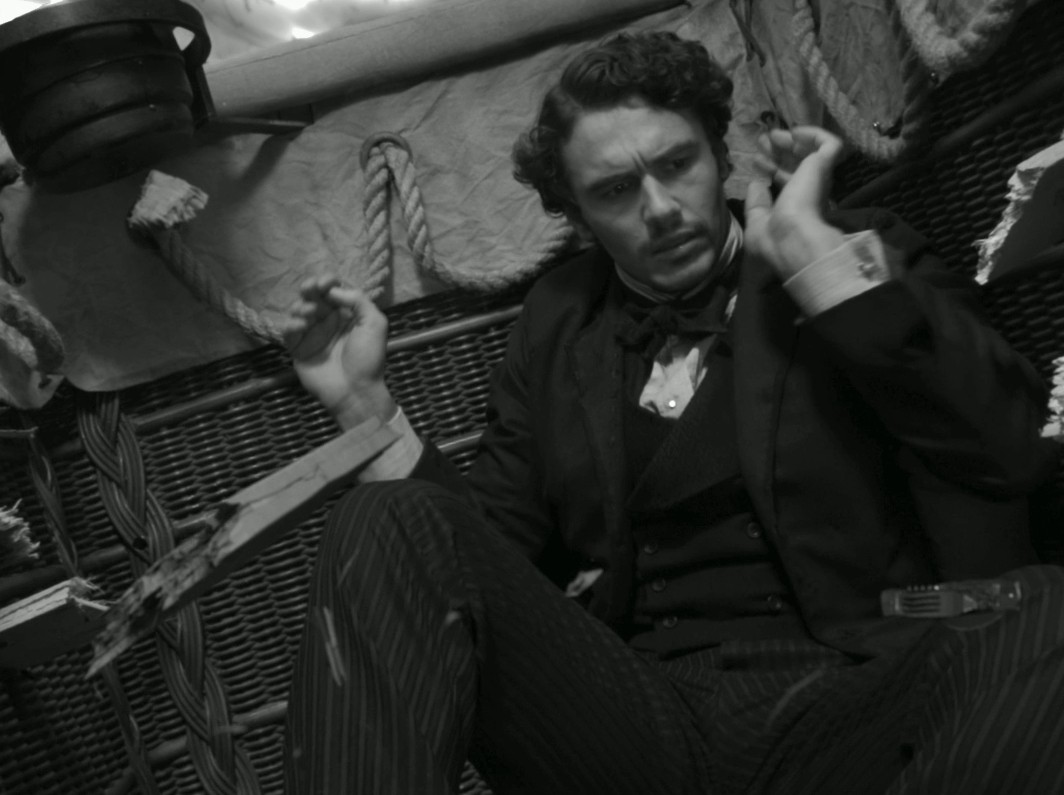
Sam Raimi, he of larkey horror films and the Tobey Maguire Spidermen, is probably a very good choice for doing an OZ film, as he has equal qualities of sweetness and sour, where Tim Burton (the next usual suspect*) would have made the film travel heavier to the morose.  Raimi's Disney's Oz the Great and Powerful (as convoluted and punctuationally challenged a title if ever, oh ever, there was one) manages to be its own thing while bowing and occasionally scraping to the previous' yellow brick road (which is revealed, as an aside, to have potholes, which nicely sums up the movie's respect, and lack thereof).  A prequel, kinda sorta to The Wizard of Oz, it starts out in a black and white box-square format (with a special effect detail amusingly violating it here and there) on a sound-staged Kansas that creepily recalls the musical version.  There scam-magician Oscar Diggs (James Franco) is conning rubes and comely assistants alike, and taking advantage of his stage-assistant, Frank (Zach Braff).  He's a jerk, only revealed to better purposes when a lost love (Michelle Williams) comes to visit to tell him she's going to marry farmer John Gale (father of Dorothy, making her mother of), and he takes the higher road, telling her she chose the better man.

But his past catches up with him...or tries to...and his road goes even higher, escaping a vengeful cuckolded circus strong-man in a helium balloon.  Kansas being Kansas, he is caught up in a tornado—one that presumably opens up a rip in the space-time continuum through some sort of meteorological consequence, and winds up in the storied land of Oz, where, true to movie-form, everything turns to color and the screen expands to wide-screen proportions.


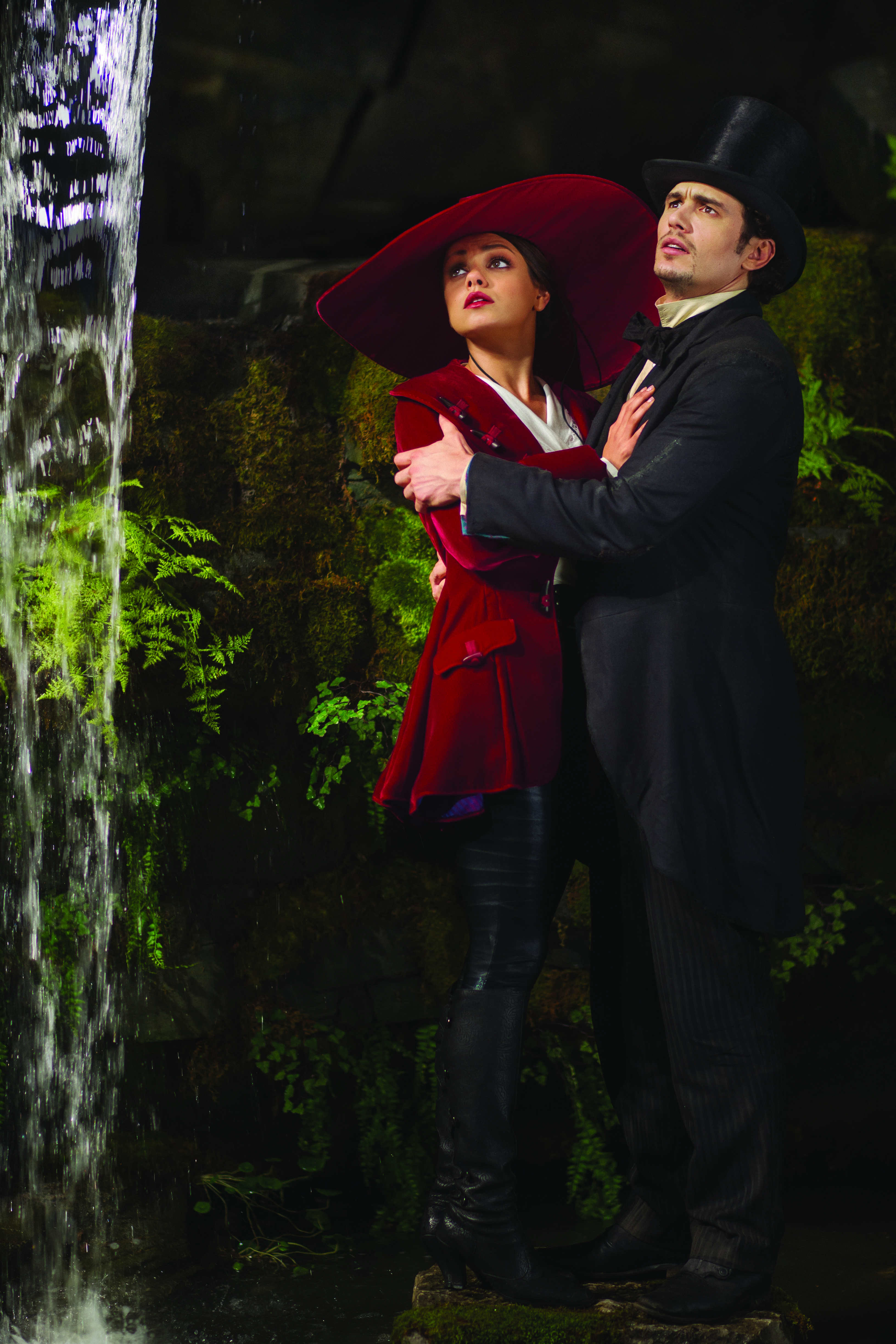
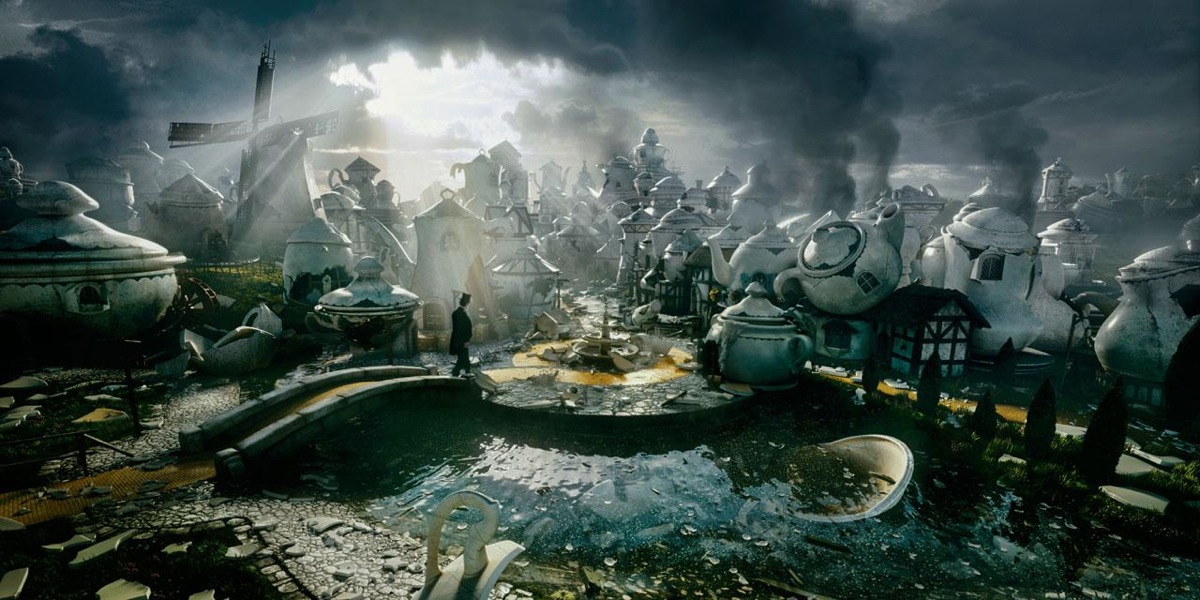
The pattern is set—Diggs is an outsider, a stranger in a strange land, but enough of a roué that any sense of wonder he initially feels is soon replaced by annoyance (Franco is great at that).  Oh, it's nice to have a minor seduction with the first female he stumbles on, Theodora (Mila Kunis), but the flying monkeys (in the form of Finley, voiced by Braff), and the girl who comes from hummle beginnings, the fragile porcelain girl (who comes from the neighboring land of Chinatown and voiced by Joey King), but before long he's embroiled in Oz's matriarchal politics between witches Theodora and her evil sister Evanora (Rachel Weisz), who are lording it over the Emerald Cityand the witch Glinda (Williams again), who is protecting the provinces from the influence of the Big Bad City.  This troika of females all think that Oscar will bring some sort of balance to Oz, and despite himself, he's got enough answers to help Finely and China, who become devotees.  Evanora is the first to see Oscar and think "there goes the neighborhood," and the plot and the make-up thickens in a battle royale between the various forces of magic, Evanora and Theodora in the Emerald City, and Glinda and Oscar and her army of tinkers, winkies and munchkins.  Tinkers and winkies and munchkins.  Oh my.


As Donald Rumsfeld said, you fight with the army you got.


And just to show this isn't Gramma's OZ (or Louis B. Mayer's) when we get welcomed to Munchkinland this time, and the town's welcome wagoneers start into a bouncey little song with high, tight voices (provided by composer Danny Elfman), Diggs just calls the whole thing off: "Stop!  Stop it!"  Musical numbers are not tolerated in this more cynical fantasyland.  Nor is anything approaching the good-heartedness of Baum or Fleming.  Even Glinda the Good Witch turns out to be something of a bad-ass here, far badder than in the '39 version.  And that's just a little backwards because the original has an empowered little girl who saves the day, while in this one it's a man, a messiah, who must sort things out in the messy rule of a matriarchy.  


This is progress?


The movie ends with some fantasy-nastiness.  Glinda is captured, tortured, and made to grovel before the sisters, Oscar comes to the rescue with his own Earth-bound pyrotechnics, similar to what he's use in the future.  But the movie feels very much like a movie of today—things end not with a splash of water, but a lot of impressive fireworks.  You want something a little meatier, though, something that might last and impress longer, but given the Oz that will come post-prequel, there's really nothing much to do about it.  The great and powerful Oz is merely a humbug, the man behind the curtain.  The evil sisters will remain evil, although Evanora's fashion sense (especially regards hosiery) will take a serious hit.  And Oscar will become a patriarch based on big promises with nothing much to back it up.  Sounds like any politician, really.  This Oz is not so magical, not so great and not so powerful.  What it needs is more brains, more heart and more courage.


Disney's Oz the Great and Powerful is a Rental.


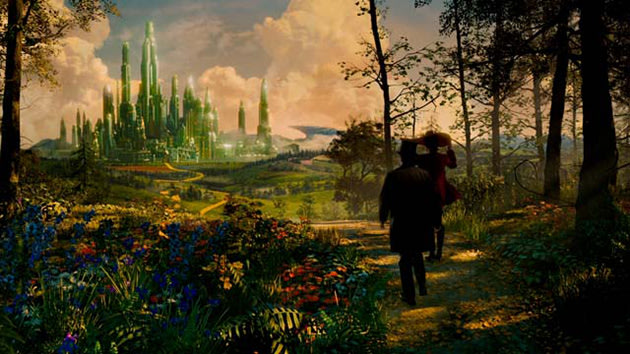
Yellow Brick Road?  Check.  Emerald City? Check.  Dark Forest?  Check.
Now we just needs brains, a heart and courage.


Oz, the Great and Powerful is available on DVD starting today.


And the original is forever.
 
* Frequently recalled as this film is scored by Burton co-conspirator Danny Elfman.

Wednesday, May 8, 2013

Holy Motors

Rich Man, Poor Man, Beggar-man, Geek...
or
The War of the Grease-paint...

All the world's a stage, And all the men and women merely players; They have their exits and their entrances, And one man in his time plays many parts...
William Shakespeare

You may be an ambassador to England or France
You may like to gamble, you might like to dance
You may be the heavyweight champion of the world
You may be a socialite with a long string of pearls
But you’re gonna have to serve somebody, yes indeed
You’re gonna have to serve somebody
Well, it may be the devil or it may be the Lord
But you’re gonna have to serve somebody
Bob Dylan 


The latest film by Leos Carax, Holy Motors, is a fascinating polyglot of life imitating art or vice-versa, and by the time it's over, you're not sure which.  It's a film brimming over with tantalizing ideas ranging from the rational to the surreal that it puts the brain into over-drive while constantly changing the landscape, shifting gears episodically while maintaining a singular day-in-the-life storyline for its central character Oscar (Denis Lavant), a trouper if ever there was one.  Oscar is an actor of extraordinary gifts.  In a gigantic white-stretch limo, driven by his scheduler Celine (Edith Scob of Eyes Without a Face, which Carax nods to briefly), he applies make-up, dons costumes, prepares for the next gig on the schedule in a rolling tour of Paris, all precincts, all life-styles, and most importantly to Carax, all genres.

In one scene, he's a motion-capture artist in a completely empty studio performing fight moves, running gun-battles, and a bizarre alien love-scene without a clue as to what the finished product will look like.  In another, he's a gangster sent to assassinate his doppelganger. 
On to the next gig—Oscar in Holy Motors
His assignments are given to him in a notebook with all the specs and requirements.  He opens up his kit of make-up prosthetics, ruffles through his rack of costumes, Celine lets him out and he's on-stage.  As the jobs go from one to the other, the questions bubble up: who is he working for—not only for the booking agency, but also, who are the clients?  Reality blurs.  A call from a teenage daughter could be his real daughter, but one suspects not—he's wearing a wig, and she's never seen again.  The gangster segment could be for anybody.  But, how about the segment where he's a disfigured geek who interrupts a photo-shoot with Eva Mendes--is it to throw off the photographer or to transform the model from a fantasy figure into a person of emotional worth, phantom of the opera-style.  And who is the death-bed tableau for, as the woman he plays it with is also an actress (one suspects that it might be for the loyal dog sleeping on the bed).  An encounter with another actress (Kylie Minogue) turns into a musical number, and a wacko marching band-with accordions-could be for anybody.

But, those are the details.  Ultimately, it's a fantasia about the roles we play in our everyday lives.  We adjust, we tinker, take on different suits and attitudes with every situation that crosses our path in the give-and-take of daily life.  We make an entrance, role-play, act-out, ad-lib, pose, and exit stage-right.  All the world's a stage and we all gotta serve somebody, the devil, the Lord, or ourselves.

Holy Motors keeps you guessing and keeps you challenged, and is one of those rare films that elicit bigger thoughts than the whole, leaving questions that anyone can answer, given their respective roles.


Holy Motors is a Full-Price Ticket.
 

Wednesday, December 19, 2012

The Hobbit: An Unexpected Journey

Getting to Be a Hobbit With Me
or
There and Back Again...and Again...And A-GAIN.

Peter Jackson returns to Tolkien's Middle-Earth, the scene of his greatest triumphs as a film-maker.  And it hasn't been easy for him.  "The Lord of the Rings" trilogy took the film industry by storm, changing all sorts of accepted things, like "sittable" film length, production timetables (filming three films simultaneously), elaboration of production design, and whether a "fantasy" film can ever be taken seriously by the Oscar Academy for anything other than technical awards.  In fact, when The Lord of the Rings: The Return of the King won Best Picture a few years back, more than one gossip-monger (or as they're known, "industry press") suggested it was for the entire series of films, rather than for the merits of the final one.  I believe that.  So, pressure immediately started to bring Tolkien's "The Hobbit" to the screen in as much the same way as possible, with Jackson producing and Guillermo del Toro directing, a good choice, actually (and the film benefits from his bizarre creature designs).  

But, "The Hobbit"'s past caught up with it, and the several (animated) versions of it came into play over who owned the film rights, and so The Hobbit: An Unexpected Journey has a complicated production titles sequence with Warner Brothers the (North American) distributor and New Line Cinema and M-G-M as the production facilities.  M-G-M's financial troubles (now long forgotten in the wake of Skyfall's nearly billion dollar take) caused del Toro to drop out, leaving Jackson and his orc-army of New Zealanders to once again handle the short-duties for the assembled hobbitage.


And how is it?  Much as you'd expect.  It's as if they'd never stopped production on the first series, and so sure of the continuity are they, that the moments immediately preceding the start of The Fellowship of the Ring are presented, as if it was the easiest thing in the world to do.  The film's been getting lukewarm reviews, and I can't can't quite fathom why. Nothing's really different.  The supporting cast is uniformly the same (there's no Viggo, but Frodo is briefly there, and Martin Freeman takes over the role of the younger Bilbo Baggins in a way that seems to suggest a more spry Ian Holm with much faster and more comedic reaction-sense), but the main criticism seems to be a more leisurely pace.  This, I don't mind.  Jackson has always regretted not showing more of Hobbiton, which might have given "The Lord of the Rings" more of a sense of "home," and as something worth fighting for—a theme played in spades in TH:AUJ.*

Seeing as so much of it is set in the Hobbit's land, and that the cast is dominated by a baker's dozen of knock-about dwarves (see below for a guide) that have a propensity for one-liners and malapropisms, the tone is considerably lighter and larkier (and dare I say "precious") than the Doom-laden "Rings" trilogy, and it is only once the band of adventurers get going that things change to the previous series' denatured color schemes, brooding skies, ugly thuggery and general bad-assery ensues.**  The pace may be slower, but the film is considerably richer for all of that, and with so many characters in this arc, it's rather a luxury to get to know them before they are threatened in all sorts of ghastly ways.

The other issue with this Tolkien adaptation is technological.  Films, since the frame-rate has been standardized, have traditionally been projected at twenty four frames per second, the estimated time that an image is retained by the eye.  Now that film is mostly passé, the video standard is 30 frames per second, but it's largely an arbitrary rate to match the traditional film experience.  During the late 70's, special effects wizard Douglas Trumbull offered up something he called "Showscan" which was 70mm film projected at 60 frames per second, which produced a larger, sharper image with less "streaking" of movement, due to the higher frame rate.  I saw one of these "Showscans" at the Vancouver World's Fair and the effect was like watching a richer, more beautiful version of videotape.  It was still film, with its photo-chemical reaction to light, but far more relatable to a "life-image" than film.

TH:AUJ is photographed digitally, but at a frame rate of 48 frames per second (what is being called HFR, or "Higher Frame Rate"), twice that of standard film, and in 3-D (to make what Jackson calls a more "immersive" film experience).  The effect, once one has adjusted to it, is quite magical.  Jackson doesn't try to do the 3-D tricks that Ang Lee does in Life of Pi, but the faster frame rate does improve the effect of things moving close by in 3-D; there is no longer the "stutter" effect, if something is moving by in the "near-field" at any rate of speed, which is something of a relief.  And given that Jackson employs even more helicopter shots over New Zealand terrain here than in the "Rings" trilogy (as well as parallel swooping "crane" shots during the many sequences underground), that's a big help.  Where it has its drawbacks are in some scenes that make the CGI characters look like toys figures, some of the impressive building constructs look like play-sets, and a slight mismatch of CGI (particularly during flying scenes) melded with terrain.

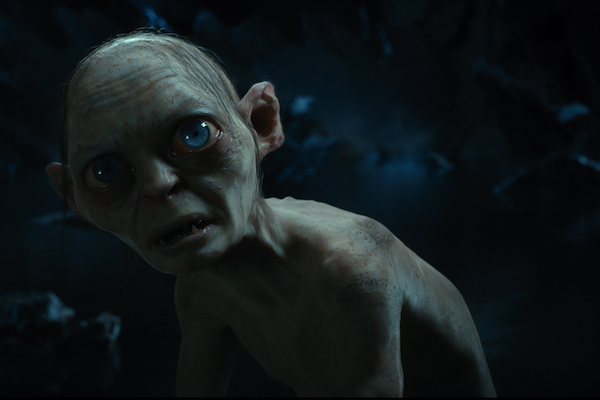
Still, it is hard to quibble when the image is so sharp, Jackson's color sense is eye-popping, and he still manages to keep a shimmering image through murky 3-D glasses.  It doesn't look like videotape (as so many reviewers seem to think), as the lighting is more graded and subtle, but the movement recalls a better videotape image, and even something moving fast still has a better chance of being registered by the naked, or glasses-hampered, eye.  It also allows the telling detail in even the CGI-est of images, like the moistness in Gollum's eyes, or the deep crags under Gandalf's.  It is oddly transporting, and given the care that everyone has put into it, it's a very rewarding experience.


The Hobbit: An Unexpected Journey is a Full-Price Ticket (worth it in 3-D and HFR).


Wilhelm Scream Alert: at 02:05 and 02:35


Ya can't tell a dwarf from a halfling without a program.


* Thauj...sounds like a character name.

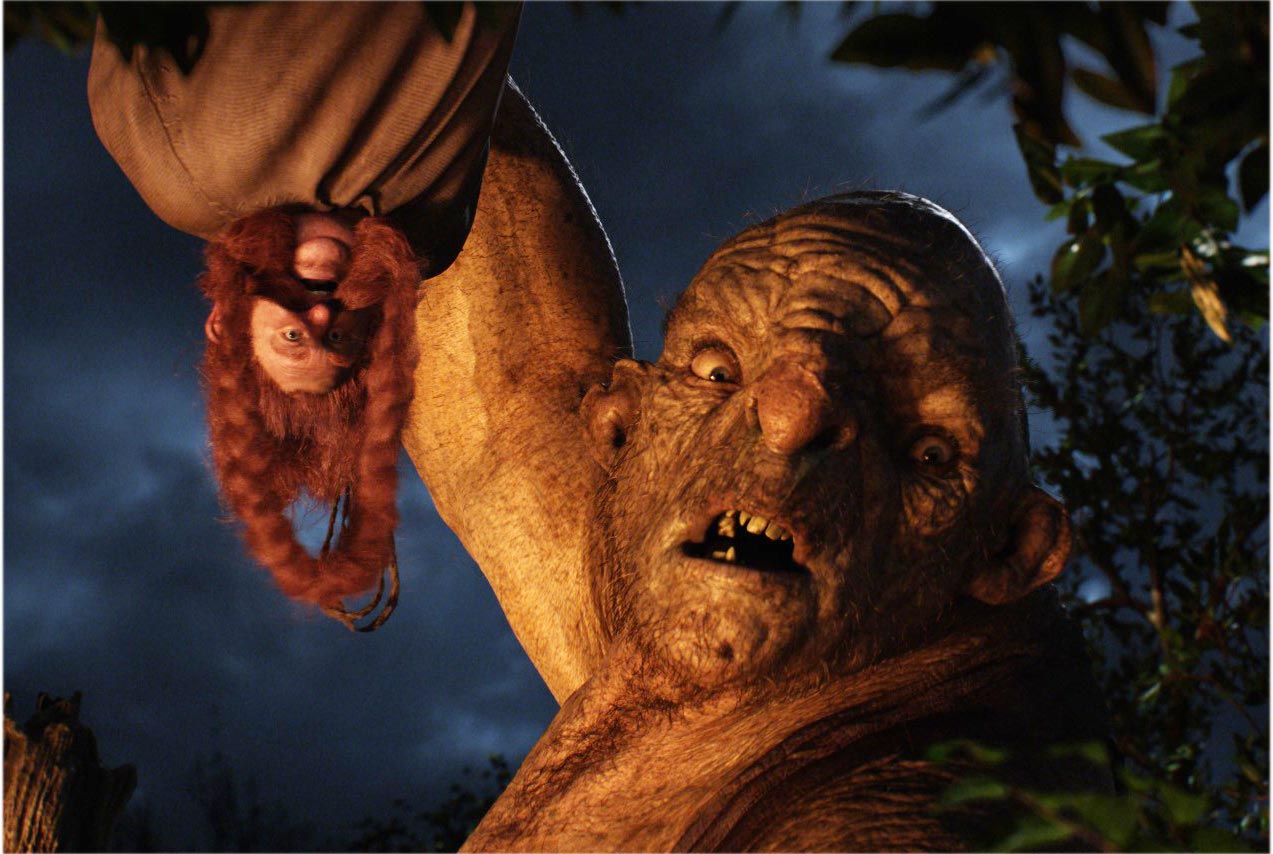
** Speaking of which, things have now approached and gone past the "Indiana Jones" threshold for physical believability here.  There's one particularly Rube Goldbergian sequence fighting trolls in an underground mine that strains credulity—but then, we're talking about a movie with dwarves, trolls, elves, ancient wizards, fire-breathing dragons, giant spiders, animated cliff-sides, and orcs riding big dogs.  That's enough to throw any griping fan-boys off their dyspepsia.  "Dude, this movie troll-kinged the bridge..."

Thursday, August 30, 2012

Ruby Sparks

Hearts and Minds
or
"The Situation is Crazy.  I Am Not."

Stephen King will see this one and slap his forehead for an opportunity missed for a seven hundred page novel.  I've known enough authors of fiction that have mentioned a scary thing: they'll start writing, fleshing out the skeleton of an idea, the characters take shape, become three-dimensional, and then suddenly, they live. In fact (and fiction), they become so alive they'll start doing things and going in directions that the author never intended or had even planned for. The figments of the author's imagination take on a life of their own, rebel and...rather than the author changing them, they change the author, or at least his intentions for them.

Eerie.  And the basis for Ruby Sparks, the latest film from Jonathan Dayton and Valerie Faris, the folks who directed Little Miss Sunshine.  That film I wasn't too crazy about, as it seemed to scream "Indie Sensibilities" from every tortured writerly "quirk" that was tossed in.  Ruby Sparks, however, is different—a nicely buttoned-up movie that reverberates with all sorts of echoes that ripple through the film and cross over in a concentric series of folded back references, self- and otherwise. 

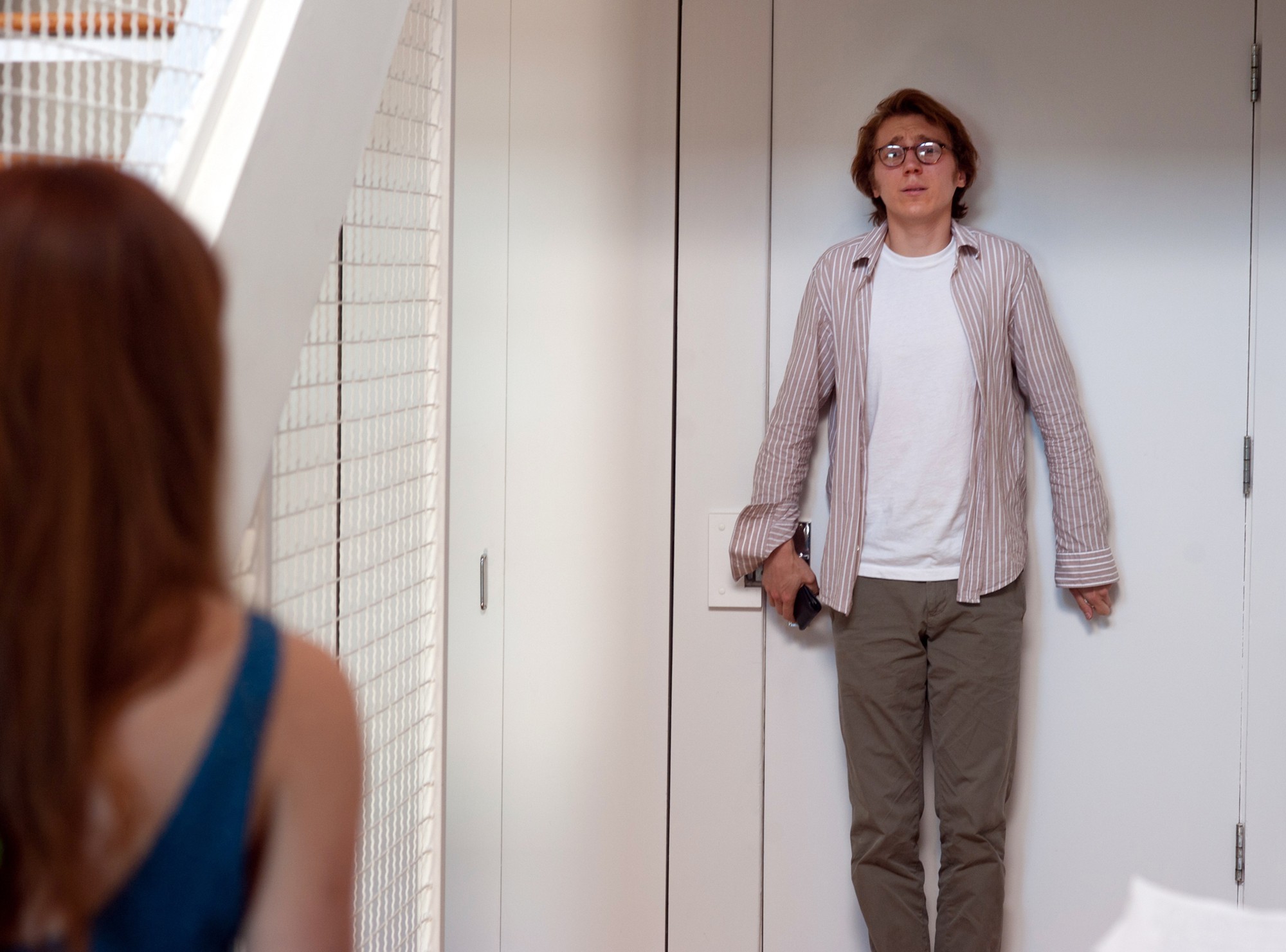
Author Calvin Weir-Fields (Paul Dano) is struggling with a follow-up novel after an initial success—struggling for 10 years, in fact.  His shrink (Elliott Gould) gives him an assignment to take the pressure off, and Calvin is inspired, writing about an idealized, neurotic woman named Ruby Sparks.  But, he's not just inspired, he's energized, so much so he can't wait to get back to his typewriter (it's this old piece of technology before a PC, or what was known in the Pleistocene era as a "word processor") to continue the work, spend more time with her, creating her.  So much so that he starts to fear that he's falling in love with her.  His brother reads the pages and his criticism is harsh: "You haven't written a person.  You've written a girl.  Geeky, messy girls are not what people want."  He remains undeterred, writing all night and into the morning.  Imagine his horror when he wakes up from his QWERTY keyboard, runs downstairs and finds Ruby (Zoe Kazan) in one of his shirts, eating cereal.

He freaks, naturally, much to her consternation, and then is shocked to discover that everybody can see her, too.  She's just not a figment of his imagination; his imagination walks amongst us.

This is the stuff of male fantasy rom-com's.  But, Ruby Sparks takes it into some dark places, ala Hitchcock, in the realms of identity, manipulation, male wish-fulfillments, and the odd idealization and expectations that love creates and blinds us to.  We all create an object of affection (on both sides, sending and receiving), but whether that object has anything to do with reality depends on both parties and how much they want to compromise to achieve that...whatever it is..."more perfect union," let's say.

The script (by Kazan herself) explores some uncomfortable territory in that regard and Kazan has a knack for writing dialogue that is spot-on, but containing deep echoes that weight them further.  It's one of the better rom-com/fantasy scripts to come along in awhile—at least it has a thought in its head—and the performers, while still showing an abundance of the too-eager "cutes," its not enough to keep you wondering how it all could end.  Yes, the film has its moments of coy cloyness—for example, when Ruby goes to a family dinner with Calvin's hippy-dippy step-parents (Annette Benning and Antonio Banderas), that amounts to a side-bar, and just lets us know what we already know, that Calvin is a bit of stick-in-the-mud and a buzz-kill, and (surprise, surprise) less capable of change than his own creation, which, if he wanted to, he could correct with a new sentence, or some Liquid Paper.

It doesn't go there (and only for revelation purposes, any more and it might be a good vehicle for Adam Sandler), nor does it end "Happily Ever After" as rom-com's do (but only because they choose to).  Ruby Sparks chooses another way, fully committed to not committing and finding the fine balance of compromise.

Ruby Sparks is a Matinee


Saturday, April 28, 2012

A Guy Named Joe

A Guy Named Joe (Victor Fleming, 1943) Wartime fantasy film that was such a favorite of Steven Spielberg's that he remade it as Always in 1989.  One can see why, despite the torturous transition from changing the milieu from World War II bombers to forest fire-fighting.  It has a lot of diverse plot elements and crosses many genres: love story, war story, fantasy, action.  Yet it's also a personal story with a character arc close to Spielberg's heart: a man-child has to learn to grow up.  But, instead of committing to something, here the key to maturity is letting go...making the sacrifice.  Of course, that story is only one dangerous mission away from being told in any war film.  In a story about fire-fighting, not so much.

But, back to Spielbergian motivations—the best reason to remake this movie? The love story doesn't work. Whatever passes between Spencer Tracy and Irene Dunne in this movie feels more like mere tolerance than a quickening flame.  One hesitates to bring Hollywood gossip into discussing the results on film; what is on-screen should be taken at face value, and the situations  and logistics on-set should, if all goes well, be invisible to the casual movie-goer (and Fleming, a yeoman director who skirted the complexities of Gone with the Wind and The Wizard of Oz is better than most at surmounting them).  But, the chemistry between Tracy and Dunne, that is so important to making the rest of the film work is not there.  The two did not get along during filming, and Tracy's entire performance comes off as aloof and "above-it-all," not heartfelt as it should be.  In his update, Spielberg overcompensated, going the other way, Richard Dreyfuss' work being a little too smiley and treacly and trying too hard to be "winning," making his character seem petty and destructively selfish during Always' dark passages.

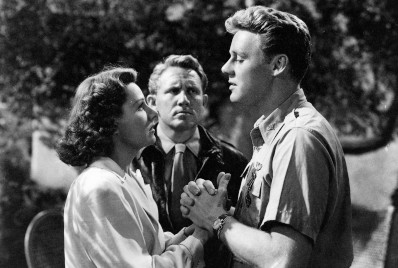
But, the story's a compelling one: Pete Sandidge (Tracy) is a chances-taking bomber pilot in the European theater of WWII.  He's best buddies with Al Yackey (Ward Bond) and sweet on Durinda (Dunne), a pilot in her own right.  During one mission, Pete is killed, and finding himself in the after-life, is tasked by "The General" (Lionel Barrymore) with helping to train a young pilot, Ted Randall (Van Johnson in his first major screen role) in the Japanese theater.  Durinda comes back into the picture, still shattered by Pete's death, but at the urging of Yackey, she ends up nearby, and, though reluctant, finds herself falling for Ted.

For Pete, this is agony, watching their budding romance, and leaves him conflicted about his "mission" and his feelings, and only an extremely melodramatic act of sacrifice forces him to "see the light," as it were.  

The screenplay is by Dalton Trumbo, and he works hard—maybe a might too hard—to balance the conflicting emotions in Pete, and as good as Tracy is, he can't seem to find the right balance to give Pete the depth of character integration to keep the different aspects of his personality together.  The motivations are there in the script, but Tracy, fine in individual scenes, can't seem to make Pete a whole human being, giving a slightly disinterested air to the character.  Some scenes were re-shot later in the studio to find a better balance (which, ironically, might have led to the problem), but the results on-screen don't pay off.  Maybe it's the integration of fantasy elements with a war film that causes the conflict, and although the film comes to a resolution satisfyingly, it leaves one feeling a little melancholy, as if something more could be done.  Partially, that's the film and how its elements might have more fully gelled.  But, it's also the resolution of the film, too.  Realistically (and bear in mind we're talking about a fantasy film here) the proper resolution is to face facts and accept and let go, for spirits on both sides of the astral plane...to accept grief and move on, parting.  A bitter pill, even if for a greater good (which is always suspect).  In the end, it comes down to making the best out of loss, and given the time of strife in which the film was made, that's a heartening statement to make, if superfluous, given the very real individual losses the world was producing during that war.

Interesting film, if not completely successful.  However, three years later, Michael Powell and Emeric Pressburger would take similar themes and turn it into the far superior, and more fantastical, A Matter of Life and Death