Showing posts with label Michelle Williams. Show all posts

Tuesday, June 11, 2013

Oz the Great and Powerful

What a World, What a World;
or
There is no Baum in Gilead

Any movie attempting to resuscitate L. Frank Baum's "Oz" books has to deal with the series' own Wicked Witch of the West—that being M-G-M's musical version The Wizard of Oz, which had Judy Garland in it, and set the bar very high as far as expectations go (for quality that is, whereas for the box-office TWoO was not a box-office success at the time of its release and only became a classic after a couple decades worth of Thanksgiving showings on network TV).  Walter Murch's attempt to take an OZ story back to its roots, 1986's Disney's Return to Oz, was an abysmal failure, although artistically it was a terrific show--but probably butted heads with too many memories for its own goodness as, for instance, the Lion, Tin Man, and Scarecrow were not vaudevillians in theater-suits, as was the 1939 version, but looked more in line with the book's illustrations.

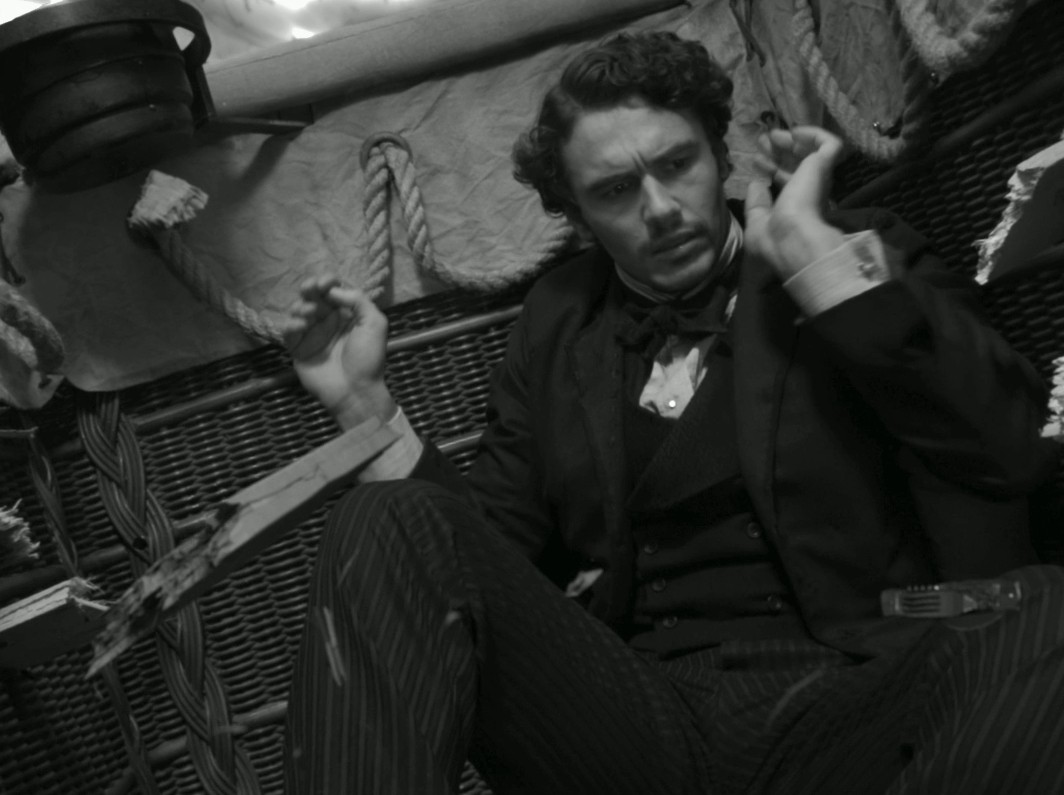
Sam Raimi, he of larkey horror films and the Tobey Maguire Spidermen, is probably a very good choice for doing an OZ film, as he has equal qualities of sweetness and sour, where Tim Burton (the next usual suspect*) would have made the film travel heavier to the morose.  Raimi's Disney's Oz the Great and Powerful (as convoluted and punctuationally challenged a title if ever, oh ever, there was one) manages to be its own thing while bowing and occasionally scraping to the previous' yellow brick road (which is revealed, as an aside, to have potholes, which nicely sums up the movie's respect, and lack thereof).  A prequel, kinda sorta to The Wizard of Oz, it starts out in a black and white box-square format (with a special effect detail amusingly violating it here and there) on a sound-staged Kansas that creepily recalls the musical version.  There scam-magician Oscar Diggs (James Franco) is conning rubes and comely assistants alike, and taking advantage of his stage-assistant, Frank (Zach Braff).  He's a jerk, only revealed to better purposes when a lost love (Michelle Williams) comes to visit to tell him she's going to marry farmer John Gale (father of Dorothy, making her mother of), and he takes the higher road, telling her she chose the better man.

But his past catches up with him...or tries to...and his road goes even higher, escaping a vengeful cuckolded circus strong-man in a helium balloon.  Kansas being Kansas, he is caught up in a tornado—one that presumably opens up a rip in the space-time continuum through some sort of meteorological consequence, and winds up in the storied land of Oz, where, true to movie-form, everything turns to color and the screen expands to wide-screen proportions.


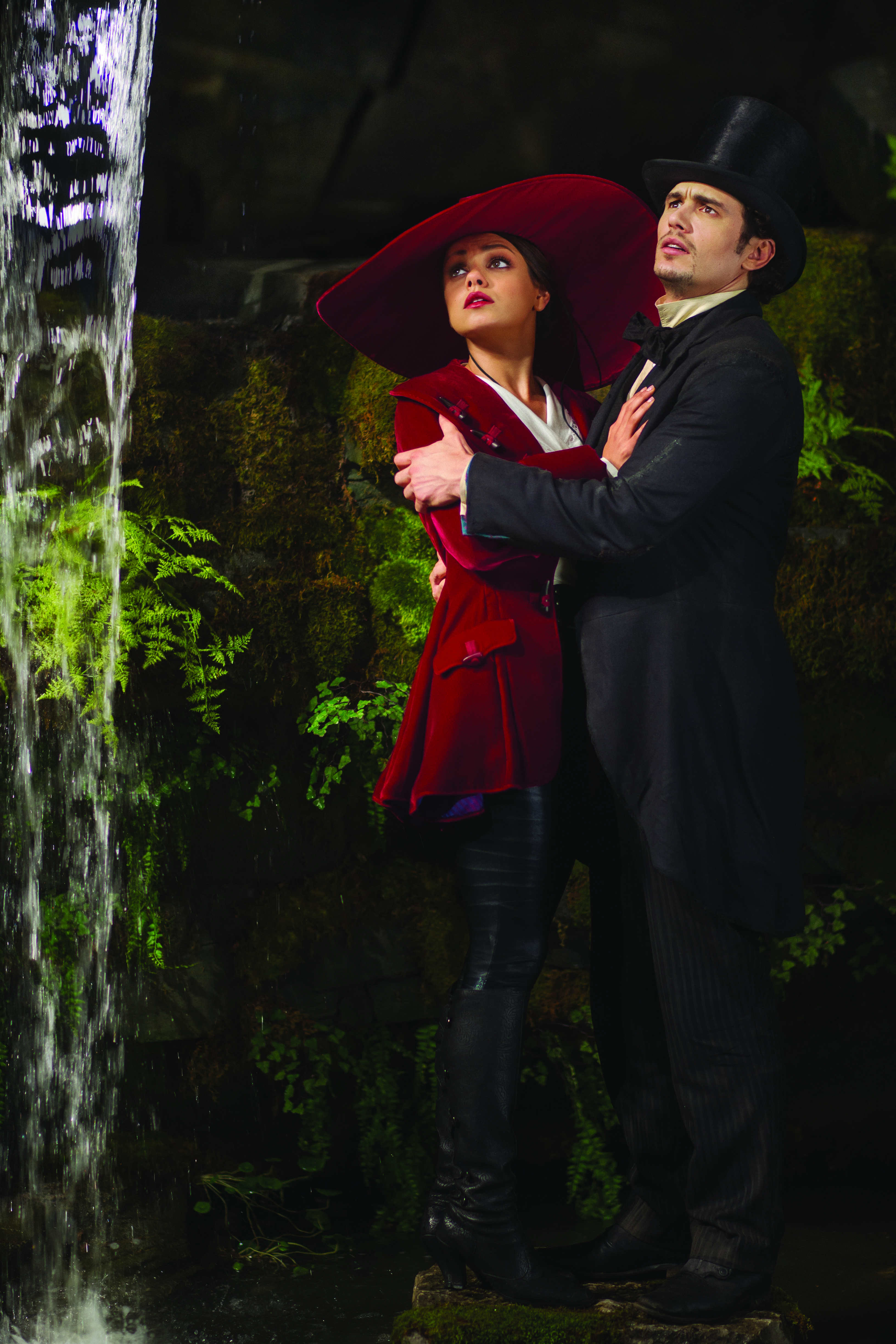
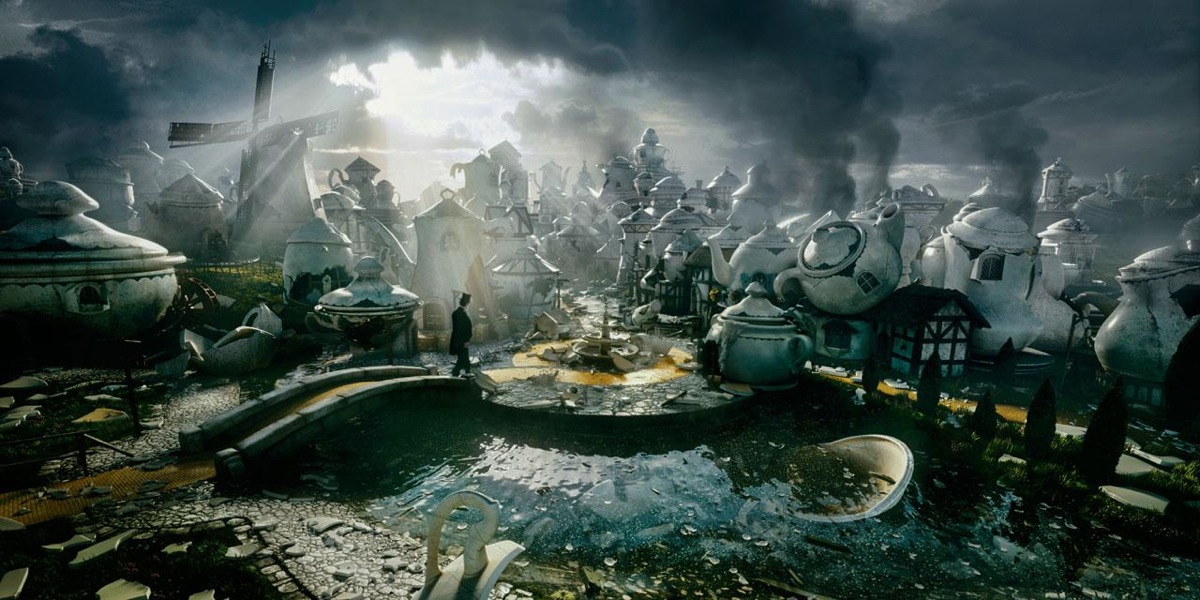
The pattern is set—Diggs is an outsider, a stranger in a strange land, but enough of a roué that any sense of wonder he initially feels is soon replaced by annoyance (Franco is great at that).  Oh, it's nice to have a minor seduction with the first female he stumbles on, Theodora (Mila Kunis), but the flying monkeys (in the form of Finley, voiced by Braff), and the girl who comes from hummle beginnings, the fragile porcelain girl (who comes from the neighboring land of Chinatown and voiced by Joey King), but before long he's embroiled in Oz's matriarchal politics between witches Theodora and her evil sister Evanora (Rachel Weisz), who are lording it over the Emerald Cityand the witch Glinda (Williams again), who is protecting the provinces from the influence of the Big Bad City.  This troika of females all think that Oscar will bring some sort of balance to Oz, and despite himself, he's got enough answers to help Finely and China, who become devotees.  Evanora is the first to see Oscar and think "there goes the neighborhood," and the plot and the make-up thickens in a battle royale between the various forces of magic, Evanora and Theodora in the Emerald City, and Glinda and Oscar and her army of tinkers, winkies and munchkins.  Tinkers and winkies and munchkins.  Oh my.


As Donald Rumsfeld said, you fight with the army you got.


And just to show this isn't Gramma's OZ (or Louis B. Mayer's) when we get welcomed to Munchkinland this time, and the town's welcome wagoneers start into a bouncey little song with high, tight voices (provided by composer Danny Elfman), Diggs just calls the whole thing off: "Stop!  Stop it!"  Musical numbers are not tolerated in this more cynical fantasyland.  Nor is anything approaching the good-heartedness of Baum or Fleming.  Even Glinda the Good Witch turns out to be something of a bad-ass here, far badder than in the '39 version.  And that's just a little backwards because the original has an empowered little girl who saves the day, while in this one it's a man, a messiah, who must sort things out in the messy rule of a matriarchy.  


This is progress?


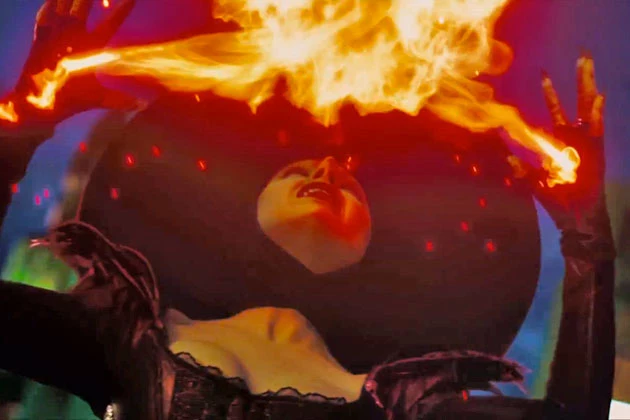
The movie ends with some fantasy-nastiness.  Glinda is captured, tortured, and made to grovel before the sisters, Oscar comes to the rescue with his own Earth-bound pyrotechnics, similar to what he's use in the future.  But the movie feels very much like a movie of today—things end not with a splash of water, but a lot of impressive fireworks.  You want something a little meatier, though, something that might last and impress longer, but given the Oz that will come post-prequel, there's really nothing much to do about it.  The great and powerful Oz is merely a humbug, the man behind the curtain.  The evil sisters will remain evil, although Evanora's fashion sense (especially regards hosiery) will take a serious hit.  And Oscar will become a patriarch based on big promises with nothing much to back it up.  Sounds like any politician, really.  This Oz is not so magical, not so great and not so powerful.  What it needs is more brains, more heart and more courage.


Disney's Oz the Great and Powerful is a Rental.


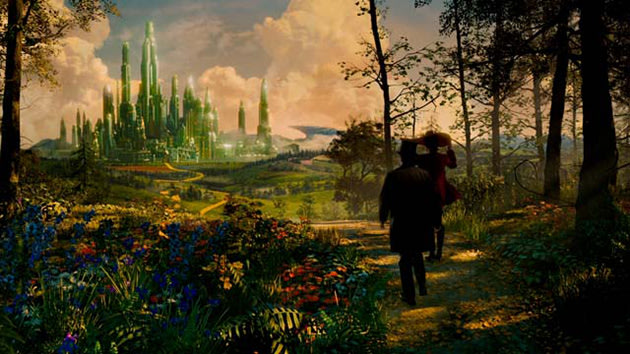
Yellow Brick Road?  Check.  Emerald City? Check.  Dark Forest?  Check.
Now we just needs brains, a heart and courage.


Oz, the Great and Powerful is available on DVD starting today.


And the original is forever.
 
* Frequently recalled as this film is scored by Burton co-conspirator Danny Elfman.

Friday, January 6, 2012

My Week with Marilyn

The Battle of Mrs. Miller ("Whose Side Are You On?")
or
"What Becomes a Legend Most?"

"We are such stuff as dreams are made on" says Prospero in "The Tempest."  Prospero and Shakespeare run through My Week with Marilyn (the latest confection of young love and fictionalized reality—with appearance by Judi Dench—from the Weinstein Company) like Caliban, a spirit of confused form and intent in Shakespeare's play.  All the revelers in Simon Curtis' film (written—especially well by Adrian Hodges) are real, based on real individuals and events, but how true they are to the source is questionable, given as they are to interpretation and expectations, and to the dreams of the particpants, for whom the movies and fame is a business, an art, as well as personal obsessions.

None more so than Norma Jeane Baker, who inhabited our world and our dreams as Marilyn Monroe, a free spirit trapped in prison bars formed of klieg lights, a vessel that men poured their love and lust onto and women their princess dreams of being the most popular girl in the world.  Heavy, heavy burden, that, and she bore it from the lowliest, sleeziest agent in Hollywood to Kings of the Sports World and Men of Letters.  She also bore it from other film stars, who looked at her fame and wanted a piece of it (and maybe her, as well), including Sir Laurence Olivier, who insisted on casting Marilyn in his production of The Prince and the Showgirl, a trifling movie if ever there was one, despite being written by Terence Rattigan

What Marilyn saw in doing the movie was obvious; she was working with the world's greatest Shakespearean actor and director on a film written by an acknowledged writer.  Why Olivier wanted to do this is less so: financial success for his unbarded film; name recognition to draw the crowds for a film out of his metier; maybe he just wanted Marilyn, as so many men did, and the new bride of American playwright Arthur Miller (not the best looking guy in the world) might have provided a world to conquer for the actor who played so much ambitious Shakespearean royalty.  Whatever the reason, Olivier was constantly frustrated with the fragile, neurotic actress, who had other concerns besides working with the exacting director—it was the only film she made outside of her protective home studio, 20th Century Fox, the only film she made outside of the United States, and the first film of her fledgling production company—all unique concerns that might have distracted the actress, on top of her new marriage to Miller and a hushed-up pregnancy during filming that resulted in a miscarriage.

The film that Hodges and Curtis have crafted from the events and a tell-all written about it by filmmaker Colin Clark (played by Eddie Redmayne), is one of the better ones to be made of this type.  Casting has a lot to do with it.  Michelle Williams is not the first person I would picture as Norma Jean, but the versatile actress manages to capture the presence of the human being at the core of the star and suggest the winsomeness that charmed so many in her orbit.   Kenneth Branagh has been linked with Olivier for most of his career, paralleling the legendary thesp by making his own film directing debut with a gritty, strapping version of Olivier's own first directorial effort of Henry V.  His portrayal of Olivier might seem too easy, but there was nothing about the man that was 'easy," and Branagh has a fine time, mixing Olivier voices, accents, and mercurial swings throughout the film—his Olivier is never consistent in mood, manner or method, just as you'd expect a Master Thespian to be (he maximizes the precision of great lines like "Teaching Miss Monroe to ACT is like trying to teach URDU to a BADGER!").  Rounding out the cast are such fine performers as Toby Jones (hilariously indecent as Marilyn's publicist and future Planet of the Apes producer Arthur P. Jacobs), Dench—playing a woman she once acted with, Dame Sybil Thorndike, Dougray Scott as Arthur Miller, and Weinstein go-to girl Julia Ormond as Olivier wife-partner, Vivien Leigh, as well as turns by Zoë Wanamaker, Derek Jacobi, Emma Watson, and one of my favorites, Michael Kitchen.  Redmayne is fine and callow, as he's supposed to be, eyes always a little bit wide at a new turn of events in the film business, and a tentative, crooked half-smile his constant fall-back.

The script is full of great zingers about fame, fortune, the madness of the movie business, and how hard people work to make things look effortless (and on-time), as well as loads of gossipy references for "the blue-hairs."  It also has a nice undercurrent that touches on fantasy and reality—hence the Prospero—and the process by which reality and the illusion of reality can really mess us up...if we believe our own "press."  Sometimes the illusion of reality is nothing more than fantasy—the very stuff that dreams are made on.  And the makers of fantasy are just as susceptible as the rest of us—maybe even more.  My Week with Marilyn brings to the imagination such thoughts, beyond just being a tale of the Myth of Marilyn. 

She did exist in reality.  And her reality had little to do with her fantasy.  The camera loved her.  And that's what killed her. 

My Week with Marilyn is a Full-Price Ticket.


Marilyn...in the wind.
 

Saturday, June 11, 2011

Meek's Cutoff

"Trudging to the End of Knowledge"
or
"This Was All Written Long Ago"

One must now ask the chicken-or-the-egg question: where does Michelle Williams consistently find these great awards-worthy roles to play in indie films?  Or do they find her?  Whichever came first, Williams has again found a great role that, if there is any justice come awards season, will garner her attention for her acting in Meek's Cutoff.*

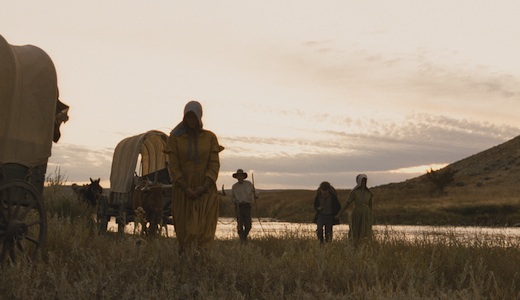
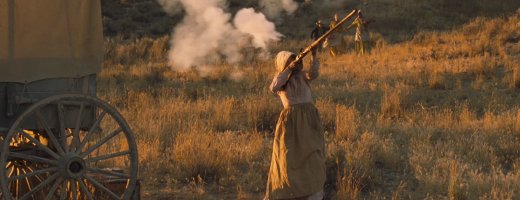
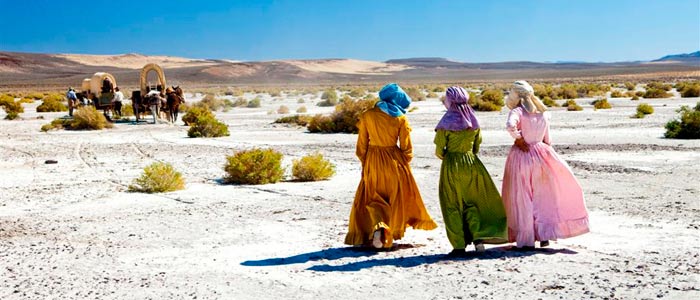
It's a western, directed by Williams' collaborator on Wendy and Lucy, Kelly Reichardt, and is as spare as the genre can get, in a field that has many a furrow in it from the trails blazed by John Ford and Howard Hawks—the wagon train.  The Tetherow-Gately-White Party, however, has slightly derailed. 

When we first encounter the group, three families, three wagons pulled by oxen, a clutch of horses and guide Steven Meek (an unrecognizable but nicely gruff Bruce Greenwood), they are fording a river—Meek and his horse first, then the three women (Williams, Zoe Kazan, Shirley Henderson) carrying precious cargo in what looks like slow-motion—they're actually fighting the current—while the men (Will Patton, Paul Dano, Neal Huff and Tommy Nelson) hang back with the wagons.

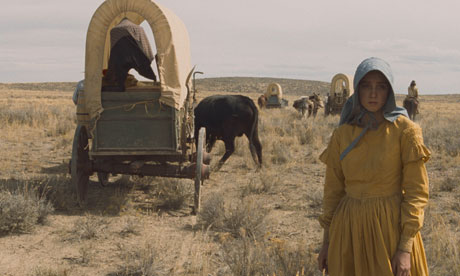
Immediately, you're struck with differences: this first sequence is silent, except for the effects track—indeed, you don't hear any dialog until a night-time reading of Genesis, just the white-noise of the river, the thunder of the wagons through the dirt, punctuated by the squeaks of the wheels; the wagons are not tarped as tight as a bonnet as with most trail-films, the coverings hang loose and look like there's been some shifting going on, and the wagons are painted with washed-out colors, not for decoration, but as a vain attempt at preservation.

It's not your TV-"Wagon Train," with a cook and several scouts and organized dancing.  This is work.  The women get up in the hours before dawn, gathering sticks for fires and grinding coffee.  The men get up with the sun and hook up the animals and talk amongst themselves about what they should do next, voting the direction.  The women hang back and tend and mend, listening to the muted conversation, their opinions not wanted or appreciated.

It's tempting to call it a "feminist" Western, even though the roles of the women are in marked contrast to the spunky women of past cinema wagon-trains, who would up-braid their cow-like men and take charge during hysterical child-births. It is only "feminist" by omission—the women are strong (as they'd have to be on such a trek), but they are clearly the low men on the societal totem pole, offering opinions, but not expecting them to be taken seriously, and often completely dismissed.  More's the pity as the party appears to be lost in the desert, with no water in sight and mutterings that Meek might not know what he's doing and may be deliberately leading them astray...although why is never thought through.

Austere and simple, with moments of truly inspired beauty, Meek's Cutoff is a study in bare-bones story-telling, where, like travelling a desert with no end in sight, the details are important...even critical.  The sameness of the journey is only broken by fleeting incidents, often at the edge of sight, and sometimes on the far side of reason.  At some point, the possibilities of a future life recede into memory and are replaced by hopes to survive the day, and plans are discarded, like the furniture routinely tossed out of the back of the wagon, because they might be an unnecessary burden—a useless extravagance.  

Slowly, but surely, you realize that this is the message of Meek's Cutoff right up to the point where the film ends—in a way that is sure to aggravate some viewers (there was quite a bit of grumbling at the showing I attended).  But, there is no other way to end it.  The destination of the movie has been made—the point has been reached.  And even if the pilgrims are not where they aim to be, geographically, they are, spiritually, at the point where civilization can begin, on the far side of knowledge.

Meek's Cutoff is a fine Matinee, I reckon.

* It's fairly historically accurate if you're familiar with the high desert areas of the Williamette section of Eastern Oregon, leading to the Deschutes River to approximately where Bend, Oregon is today.  There was a Steven Meek, he did lead wagon trains, he had a bad reputation for getting lost, but the historic trail still bears his name.

Wednesday, February 9, 2011

Blue Valentine

"For Better or For Worse (and this is me at my worse)"
or
"...With a Hasty Word You Can't Recall."

When Derek Cianfrance's Blue Valentine comes out on DVD in the Spring, I wouldn't be surprised if a few June weddings got cancelled.  Not because it's such a depressing movie about marriage (it is!), but because it is so annoyingly accurate in depicting its scenes from a broken marriage.  Not broken, really, and not sinking...but definitely floundering—one of Woody Allen's "dead sharks."

It depicts 24 hours in a marriage, complete with flash-backs of the puppyish love of the participants (Ryan Gosling and Michelle Williams, both brave performances and both equally deserving of Oscar recognition—like love and marriage, you couldn't have one without the other*) and devoted actions that led to it.  Because that is what is so painful about watching Blue Valentine—you see both the sour and sweet of the marriage without the glacial wearing down of feelings into numb reaction that occurred in between.  The contrast between the two periods is stark, and the film jumps between them with the speed of a single edit.

He's a house painter with Peter Pan syndrome, she's a nurse who can't cure itThey have a child who adores them both, and doesn't notice the tension in the words between the two adults.  They're not bad people and married with the best of intentions.  But, at some point, the growing between them stopped, and the euphemism for marriage—"settling down"—has a chilling ring of complacency to it.

Love is hard work, and marriage is even harder (that is, if you do it right—says Mr. Divorcee).  One cannot take the initial spark that prompted it and forget it, like a pilot light (a metaphor that Blue Valentine exploits at its ending).  It must be tended and cared for and nurtured and not taken for granted.  And that is one thing the romantic comedies of today's cinema rarely get right—they stop right at the beginning, making them a bit of a cheat and giving them all the validity of a Hallmark card.  You look at a film like Blue Valentine, so brave in its depiction of the tough love a relationship or marriage requires, and the final shot of a typical rom-com like James L. Brooks' How Do You Know—the held framing of a now abandoned bus stop indicating that the couple are now together—looks a little hollow, like a null set (as opposed to Brooks' Spanglish, which is a bit more mature in its depcition of dedication in the face of desirable and easier choices. 

One of the aspects of the film, which has hung with me for days and haunts me, is its use of delayed pay-offs.  Most films these days hammer image and soundtrack together in an obvious manner to reinforce a point in case the audience doesn't get it.  A bit insulting, actually.  Cianfrance and his writers and actors have far more faith and build a skein of rock-solid "call-backs" that, given the perspective of the whole film—The Big Picture—creates a rich tapestry of a film.  Blue Valentine, in its appropriately fractured structure, leaves things hanging, that in retrospect—a major theme of the film—connect to other incidents that shore up the situation: the song "Smoke Gets in Your Eyes" snaps to the end-shot; Cindy's casual mentioning of a chance encounter in a liquor store that inexplicably sets Dean off is revealed to be an insensitive and cruel topic; and—my favorite—an odd protracted shot of Dean looking directly at the camera in a hospice corridor.

So, yes, it might discourage a couple of Darwin Award-winning marriages, but Blue Valentine is a raw, rewarding, intelligent film about maybe-not-so-intelligent choices, however right they may feel.  It might be the pomegrannette in the box of chocolates, but during this Valentine month, full of hearts and flowers and fluff on the cinema screens, it's a brave thing to say that the course of true love never runs smooth, but the path to Hell...even the one down a church-aisle...is paved with good intentions.

Blue Valentine is a Full-Price Ticket.

* Gosling was shut out of the Oscar race, which is a shame.  His performance is so seeringly on the money, taking full advantage of Gosling's callow strengths as an actor, that it makes his myopic man-child of a young husband painful to watch, while not making him entirely unsympathetic.  Tough trick to pull off, but Gosling makes it look easy.  Sometimes, Ryan Gosling is not so good.  Here, he's brilliant.

Tuesday, February 10, 2009

Wendy and Lucy and Marley & Me

"Dog is My Co-Pilot"


"A dog has no use for fancy cars or big homes or designer clothes. Status symbols mean nothing to him. A dog judges others not by their colour or creed or class but by who they are inside. A dog doesn't care if you are rich or poor, educated or illiterate, clever or dull. Give him your heart and he will give you his. It was really quite simple, and yet we humans, so much wiser and more sophisticated, have always had trouble figuring out what really counts and what does not."


John Grogan, "Marley & Me"


That's just the sort of tripe that made me avoid reading "Marley & Me" by John Grogan (although I did give it to K., and she cried all the way through it, as, no doubt, would I, seeing how it's a "true story" by Hemingway's terms). See, Grogan can get all gooey about his dog (and I'm one to talk, anyone who knows me and my relationship with my dog knows I'm a big softie with him) but even I know that as much as I want to anthropomorphize my dog into seeming more like "my son the attorney," he's a dog—a pack animal, who craves being part of the pack. A dog doesn't know "privacy." A dog doesn't worry about "having space" (unless he's been shoved off the bed). A dog is hard-wired to be part of a group, his genetic-strings bunched to "family," which he interprets as anything that he can be a part of, and provides for him.

As much as I'd like to think my dog loves me, I think he merely respects the chain of command or the pack order, and knows where his next meal is coming from. I'm not going to call it "love."

Because the truth is he loves bacon. He may even consider it with religious fervor, like seeing
the Madonna in a piece of toast--which he'd also eat, just as a warning. You mention the word "bacon" and my dog's head will tilt, his eyes brighten. If he smells bacon cooking, his eyes soften and get teary, and he'd lay patiently, rooted in that spot with bacon-potential until such a time as he can wolf it down, concentrating with all his doggy-will to "just eat the bacon, not the Master's fingers." When I read Grogan burble that a dog judges you by who you are inside, I think, "Yeah, meat...and gristle and sinew and marrow..." all things my dog "loves." My wife and I are never sure that if we would both spontaneously collapse in a heap, our dog wouldn't "love" us so much that we'd be missing limbs after being found five days later.

But what do I know?
Grogan's a multi-millionaire now because of his shaggy dog story. I'm just content if I can bring home the bacon.

Safer that way.

So I avoid "dog movies" like I avoid rabies because I know they can't end well, be they "
Lassie" or "Lad: a dog," or "Old Yeller" or "Cujo."

Because I always cry at them. Buckets. I get very sentimental towards dogs in dog movies, because they're portrayed as such noble creatures that if anything ever happens to them, I bawl at the injustice of the world. And because the doggy's so cute. Hell, I even cried when the dog had to be put down before it was turned into a "Red Bull Mutant" in "
I Am Legend."

Here are two quite different "dog movies" but they share one lesson: a dog is a relationship. A dog changes your life. A dog teaches responsibility. A dog is a commitment. A dog canot be turned on and off, like the ones at
Radio Shack. Dog ownership is not to be entered into lightly. The two movies come at this basic truth from different angles.

"Wendy and Lucy" is about a girl making her way from Illinois to Alaska in her beat-up '88 Honda Accord (with a bad serpentine belt), with dog as her co-pilot. Her funds are few, and so when she shop-lifts some cans of dog-food in small-town Oregon, she gets nabbed and sent to jail, leaving her dog tied up in front of the scene-of-the-crime. The movie does a good job of turning evey kid's question during a sci-fi movie ("What happened to the monkey?") into a feature-length film. Writer-director Kelly Reichardt shows just how well you can make a film about just about nothing, and still pack it with drama—but drama to which we're well-accustomed: the balancing-the-budget, the making-ends-meet, the shock-of-the-car-repair-bill. Familiar ground. But for Wendy Carroll (Michelle Williams), runaway, this is an accumulation of a very-bad day, one which affects her path and alters her course, shattering dreams and teaching reponsibility.

The film looks good. It was filmed in Portland, Oregon. The sound needs a bit of work, and the secondary characters seem to resonate better than the title bi-ped. Kudos to Michelle Williams for carrying the movie like a knap-sack on her back, but there's a few too many times when she seems aware that the camera is on her—when she seems to be thinking "this is a close-up," rather than "there's a guy looking at me suspiciously." Still, it's not a showy performance, and Williams keeps it internalized throughout most of the movie.

Where "Wendy and Lucy" is quiet and introverted, "Marley & Me" is all labrador retriever, extroverted and just a little dumb. Half-way through the movie, you begin to realize that it's not a movie about a dog, it's about John Grogan's marriage—the dog is the bait-and-switch, a co-star and a trial-run in responsibilty for the two career-journalists before babies start rearing their ugly heads. The dog is the fool, the comic relief who inspires wisdom in the lead's. That's fine. Two hours of doggy-hijinks can sour any movie-going relationship.

Fortunately, the movie has
Owen Wilson and Jennifer Aniston: Wilson is especially strong in the lead, doing nothing special but being extremely charming in a just-folks-Jimmy-Stewart kind of way, and Aniston—the only "Friend" who seems to understand what acting is all about, does wonders with her role, finding just the right touch to enliven a scene. Both she and Wilson play conflicted adults who see dreams fall by the way-side while life takes precedence: it's the version of "Revolutionary Road" that you might want to see. Plus, it's got Alan Arkin in it. I'll see any piece of crap featuring him, and he doesn't disappoint here. "Nah, this stuff cracks me up," he says without a hint of humor, reading one of Grogan's columns. "Really, this makes me laugh."*

Yes, "
Marley & Me" is controversial: it was sold as a dog-comedy which the kids will lo-ove and presents the entire life-cycle of a dog—the entire life-cycle. Which the kiddies won't. It is, after all, a "true" story, and, as Hemingway pointed out, every true story ends in death. Life's a bitch, and then you die. But "Marley & Me" is a better movie for adding the bitter with the sweet, the yelling and tears with the joys. It's more honest that way, and you know how much people hate honesty. And frankly, it's a cheaper way to teach your kids an easy lesson in death than buying them a goldfish or a hamster.

But still, it's a tough thing to sit through. No, I didn't cry...in either of these films. But, watching "Marley & Me," it's just solidified in my mind that when the inevitable day comes, and I have to take my animal in for his final vet visit, he's not going to go out with mere platitudes and murmured words ringing in his ears. They aren't enough to convey my gratitude and depth of feeling for his life and companionship. He's going to know love when he goes. He'll have the taste of bacon in his mouth.

There. Dropped a tear. Happens every damn time.

Both "Wendy and Lucy" and "Marley & Me" are Rentals. No biscuit.


Post Post Script (02/20/2009) "Wendy and Lucy" has stayed with me a bit longer, partly because it's a simpler film with issues closer to my heart (and it's pathos, after all), but also because I read all these other criticisms that lavish praise on it for telling the simplest of stories in the simplest of ways. This is so much "Dark Knight" back-lash, and lighting critical candles in a dark world of hyper-edited blockbusters. Reichert is to be commended for maximizing her meager budget to make her film (I'll bet she didn't have to steal dog-food to do it)

All well and good. But let's not go rabid here. Ever occur to you scribes that the film ultimately endorses the words of the most objectionable character (who just so happens to be doing the right thing for his employer, by the way?) And the "can't get a job without an address and you can't get an address without a job" Catch-22 is familiar to anyone who's tried to buy something large without credit. Can't do it. You have to prove you've had debt to prove you won't go South on a loan. Makes sense only to a banker. Can we extend the metaphor to "You can't be irresponsible if you're responsible?" That's a dictum that would well suit the title character...and bankers.

For me, the most intriguing question is: What has she learned? Does she go back in "Wendy 2" or not?

My answer is probably different than a lot of people's. But then, I take care of a dog.

Also, both of these dog titles are mis-leading. "Wendy and Lucy" are joined, but separated in the film, with two story-arcs. "Marley & Me" has the billing wrong.


* The script is co-written by, of all people, Scott Frank, one of the better writers of mature films, having written "Out of Sight," "Get Shorty," "Minority Report," and directed "The Lookout." There's a veneer of truth to this film, as with a lot of his films. With the exception of the satiric "Get Shorty," none of his characters seem like they've ever visited Hollywood.

Thursday, December 4, 2008

Synecdoche New York

"And the Truth Is..."

All the world's a stage,
And all the men and women merely players:
They have their exits and their entrances;
And one man in his time plays many parts,
His acts being seven ages. At first the infant,
Mewling and puking in the nurse's arms.
And then the whining school-boy, with his satchel
And shining morning face, creeping like snail
Unwillingly to school. And then the lover,
Sighing like furnace, with a woeful ballad
Made to his mistress' eyebrow. Then a soldier,
Full of strange oaths and bearded like the pard,
Jealous in honour, sudden and quick in quarrel,
Seeking the bubble reputation
Even in the cannon's mouth. And then the justice,
In fair round belly with good capon lined,
With eyes severe and beard of formal cut,
Full of wise saws and modern instances;
And so he plays his part. The sixth age shifts
Into the lean and slipper'd pantaloon,
With spectacles on nose and pouch on side,
His youthful hose, well saved, a world too wide
For his shrunk shank; and his big manly voice,
Turning again toward childish treble, pipes
And whistles in his sound. Last scene of all,
That ends this strange eventful history,
Is second childishness and mere oblivion,
Sans teeth, sans eyes, sans taste, sans everything.

William Shakespeare "As You Like It" 2/7


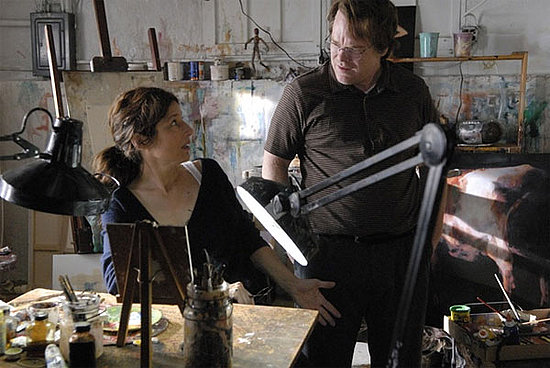
Director Caden Cotard (Philip Seymour Hoffman) wakes up every morning with a fresh pain to fuss about in the morning and a malady that he saves for the afternoon. He's a mess. So's his life, and the only time he feels comfortable is telling actors how to play their parts. But he frets about everything else. "I have 650 lighting changes! Why does it have to be so complicated?" "Because you make it complicated," says his wife Adele Lack (Catherine Keener), whose own art is to make paintings so small you need magnifying specs to look at them in the gallery. She's reductive. He likes to blow things out of proportion, which sometimes manifests itself, physically, as sycosis. "It's spelled differently," he tells his daughter Olive. "P-s-y 'psychosis' is when you're crazy, like Mommy is sometimes."

Welcome back to the World of
Charlie Kaufman (and yes, after all the success you can still call him "Charlie"). Kaufman's screenplays are expanded "Twilight Zone" episodes where reality is warped and woofed through the gray matter of Kaufman's mind and some basic axiom of the human condition comes shining through like sunlight through cheese-cloth. "Synecdoche New York" is the same sort of Möbius-loop swirl like Kaufman's scripts for "Being John Malkovich," "Eternal Sunshine of the Spotless Mind," "Confessions of a Dangerous Mind," and "Adaptation.."* And as with those scripts, you not only get the story as it stands, but also a look into the soul of Kaufman, as well. "Malkovich" was the story of an street-artist who dreamed of being more than a puppeteer and ended up becoming a director of another man's life--a grander-scale puppet-master. "Eternal Sunshine" explored relationships and the hopeless act of putting one behind you. "Adaptation." was a look at obsession, disguised as Kaufman's own frustrations at trying to write a screenplay for an un-adaptable book. "Synecdoche New York" is another step altogether: Kaufman makes his directorial debut in this film about a director who can direct anything but his own life.

"And the Truth Is..."

"...well, like most directors, I suppose, what I really want to do is act."

Mel Gibson's Oscar speech, 1996


As life sometimes happens, when one part of your life is going great, another slides. Adele has taken Olive to Berlin for a showing of her work, and the weeks stretch into months, and Cadon can't hold his fragile state enough to have an affair with Hazel (Samantha Morton) the ticket-agent at his theater. The he gets a MacArthur grant. How's he going to spend his "genius" money? He rents a warehouse--like a monolithic Quonset hut in the middle of Schenectady, and begins a series of work-in-progress workshops, where the play will begin to take shape. But pretty soon, the play cannot be contained, and Cotard begins to wander through an increasing maze of scenarios intertwined with a phalanx of actors seeking direction and a cityscape forming inside the warehouse. He begins to lose track of his life and the play's purpose until he hires Sammy (the terrific Tom Noonan) to play himself. Sammy claims to have followed Cotard for years and says he knows the director better than he knows himself. At the time, that didn't seem like quite a stretch. For awhile the two are inseparable.

And then things start to get a little bit weird.


syn•ec•do•che (sĭ-něk'də-kē) Pronunciation Key n. A figure of speech in which a part is used for the whole (as hand for sailor), the whole for a part (as the law for police officer), the specific for the general (as cutthroat for assassin), the general for the specific (as thief for pickpocket), or the material for the thing made from it (as steel for sword).

To explain any more of the plot is to do two things: 1) Give away what's going on, and 2) explain what's going on; I can do the first, but not the second, which 1) is anathema to film criticism and 2) required of film criticism. The stew of "Synechdoche New York" is so rich that one can only pick a flavor or two, a passing impression, the overall emphasis, but I can't tell you what it tastes like, other than to say "I enjoyed it immensely, and I'd order this item on the menu again." I can understand why it would completely overwhelm a casual tasting or appear too rich to stomach, and I can certainly see the polarizing effect it has on those whose tastes don't run to such things.

But taste is an individual thing, and the structure of "Synecdoche New York," which, in itself, is its own false-front, is a deliberate shout-out that "Nothing is real," so if you're looking for explanations of some basic matters, it's just not going to happen, because the connective tissue that would provide the answers not only isn't there, it's considered irrelevant to the task at hand, and manipulated to actually confront, confuse, and consternate. And make a joke of it.

Which I find hilarious.

For instance, I love that Kaufman cast two actresses—Samantha Morton
and Emily Watson—who I find, frankly, a bit indistinguishable, and cast them as an important woman in Cadon's life and the woman who's playing her in the play. That the two actually do become indistinguishable is a wonderful joke that I, alone, might get, but I still enjoy it. That the background score for a poignant telephone conversation seems to travel over the telephone line, as well (with the same tinny sound), is a great joke, but might frustrate someone else looking for logic or reason. That Adele coughs in a voice-over might make someone throw up their hands and question why someone would consider doing that only makes me giggle. That Hazel, when taking a tour with a real estate agent, makes a comment that she's really nervous about buying a house, but really wants to take the plunge, so much so that she'll ignore that the house is on fire, and, oh by the way, the agent's son is living in the basement, only reminds me of the compromises I've made and the flaws I've overlooked in similar decision-making processes. It also says something about the character...yes (*sigh*) in a lunatic way...but I found it funny.


"And the Truth Is..."


"I thought I was President of the United States. Then when my daughter was born, I realized I was just the Secret Service."

Seattle actor Ken Boynton, explaining Fatherhood


What's interesting to me is that I have my own ceiling of "guff" in movies: I'll "take" Kaufman because the spirit in which he creates is playful, the ideas he expresses I find, if not profound, worthy of consideration (such as the over-uttered point of "SNY") and the work, and the path taken to get there, entertain me; I appreciate the journey, even if the destination disappoints.

Yet, as a recent post on David Lynch's "Inland Empire" made abundantly unclear (my fault: I'm sorry, I was being illustrative of my frustration with the piece and its artist) there's only so much obfuscation I can take. There is a difference between an artist being deliberately "difficult" to understand, and an artist with a point to make. If you want to confound, go into the puzzle-making business. If you want to communicate—and that means taking the chance that your message may be received and judged—make sure that you're communicating. "Inland Empire" had no "Rosetta Stone," not even the orientation of humor, to guide the viewer, so whatever "TRUTH" Lynch was aiming for got lost in the scene-shuffle.** One can argue about the cruel economics of the film business, but every so often an indulgent artist has to give his Muse a bracing cuppa joe, black, (and amusingly, Lynch, of all artists, should know this!) and show it where the audience is sitting.***


Which brings up the philosophical question: If a theater-troupe makes a play in an empty theater, does it make a sound

And the answer is: "Who cares?"


"And the Truth Is..."

I know now that there is no one thing that is true - it is all true.

Ernest Hemingway, "For Whom the Bell Tolls"


"Synecdoche New York" is a full-price ticket.


* Although nobody ever brings up his writing for "Ned and Stacey" and "The Dana Carvey Show"

** I don't make a habit of beating up on Lynch. I love 80% of his out-put, especially "The Elephant Man," "Blue Velvet," "Mulholland Falls," and "The Straight Story." "Wild At Heart" and "Twin Peaks: Fire Walk With Me," pffft!

*** At the Guild 45th late show, a late-comer sat across the aisle from me, and throughout the movie we separately giggled and hooted throughout the film, laughing at the same parts. Only when the credits came up did we glance at each other and, in a perfectly synched move, raised our drink-cups in salute to the screen.