"Adaptation." (Spike Jonze, 2002) I love Charlie Kaufman's writing. It reminds me of the old "Twilight Zone" series...but with depth*—but he's more of the Charles Beaumont style of TZ story-telling than Serling's or Richard Matheson's or Earl Hamner Jr.'s. Leaps are made every few minutes beyond the central conceit, and comes to a truly disconcerting kernel of truth at the end, which makes whatever frustrations made during the course of the film worth it. "Being John Malkovich" is a charming deconstruction of personality and wish-fulfillment, and "Eternal Sunshine of the Spotless Mind " is a jaded cynic's validation of love, and its intrinsic ability to be more than merely a process of instincts, chemistry and firing synapses. What's not to love?
 But "Adaptation." is another animal. It's "Charlie Kaufman in crisis," and a bit of a cheat, while also being an ingenious way to solve a problem--that is, writing a screenplay for a book that is, basically, unfilmable. Given the opportunity (and contract) to write a treatment based on Susan Orlean's best-selling book "The Orchid Thief,"** Kaufman readily accepted the job, being attracted to the odd obsessive themes of the book, and found himself unable to translate it into a film-story.
So he wrote about his difficulties translating it into a film-story! The book's subject, John Laroche, the poacher who was seeking the "Ghost Orchid" in the Florida Everglades was a real person who was determined to find the rare flower to clone it and sell it. The screenplay's subject is about Charles Kaufman, screenwriter, who's trying to adapt Susan Orlean's book, "The Orchid Thief," and wrestling with its themes and his own inability to create the screenplay. Impeding his process is his twin, simpler brother Donald (both played by Nicolas Cage), who's
 decided he's also going to write screenplays--none of which Charlie likes. Susan Orlean figures in it (played by Meryl Streep), as does Laroche—he's the bespectacled fellow pictured to the right, not Chris Cooper's snaggle-toothed, though Oscar-winning, portrayal— but they're fictionalized versions of the real people, adapted to fit a more commercial film. Laroche is using the orchids to make a drug and sell it, hooks Orlean, and she begins a needy affair with him and, fueled by her addiction, becomes as obsessed with the Orchid Thief as much as he's obsessed with the orchids. Is any of that true? No. Are the people real? Yes. The website, Chasing the Frog.com had done a fairly succinct job of separating the fact from fiction here. Yes, these people do exist, as does screen-lecturer Robert McKee,*** but they're fictionalized versions of the real people. Can Kaufman get away with doing that? Yes, he obviously did, but they had to get permission from the real-life counterparts to do so (just as Jonez had to get permission from John Malkovich for Kaufman's "Being John Malkovich" or that would have been a moot project).
Look up the word "Adaptation" in the dictionary. "Any change in the structure or functioning of an organism that makes it better suited to its environment." There couldn't be a better explanation of the screen treatment of "Adaptation." Kaufman couldn't, as they say in the trades, "crack it," so he changed the structure of the scenario...transplanted it, if you will...to make it work as a movie—especially a movie in the current environment of movie-making. And he made the debate between what he wanted to do and what he had to do part of the story in the form of the arguing screenwriting twins, Charles and Donald Kaufman.
Any writer of success must at some point deal with "the Other." The other writer, whose ideas are dismissed and shelved for work accomplished. Steven King did an experiment once to see if his writing would be as successful in other genres as opposed to the "scary fiction" writer, Steven King. So he created a psuedonym, Richard Bachman, much to the consternation of his publisher. Bachman sold well, but King had to deal with the success of his dopplescrivener after several books were published. Ultimately, it inspired the concept of his novel "The Dark Half."
Noms de plume are as old as Bashō (and I'd bet cave paintings had false signatures, as well), and "Adaptation." is credited to both Charlie and Donald Kaufman. Donald Kaufman is the first completely fictional person to be nominated for an Academy Award. Donald also serves as a way for Charles to have conflict while doing something solitary—writing. For all the preciousness of the conceit, it still manages to work in a weirdly clear way, and it provides the means of this exchange, which re-defines the whole picture and sums it up: Donald and Charlie are talking about a time in school when Donald approached a girl he had a crush on, and when his back was turned, she and her gaggle of "Heathers" made fun of him.
Donald Kaufman: I knew. I heard them.
Charlie Kaufman: How come you looked so happy?
Donald Kaufman: I loved Sarah, Charles. It was mine, that love. I owned it. Even Sarah didn't have the right to take it away. I can love whoever I want.
Charlie Kaufman: But she thought you were pathetic.
Donald Kaufman: That was her business, not mine. You are what you love, not what loves you. That's what I decided a long time ago.
You are what you love. Not what loves you. For that little gem of a thought—multi-faceted, flawless and fundamental—I have enormous respect for "Adaptation." for all its problems.
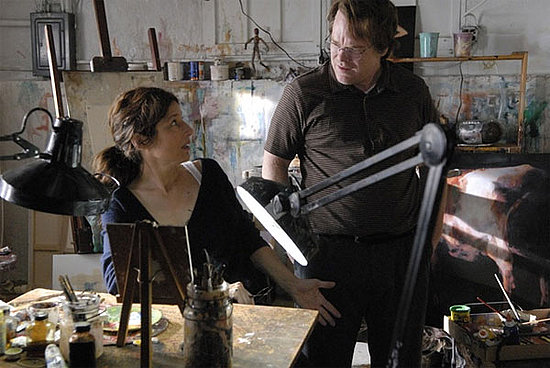
 The fictional Charles Kaufman—or is it Donald? (Nicolas Cage)
—on-set with the non-fictional Susan Orlean.
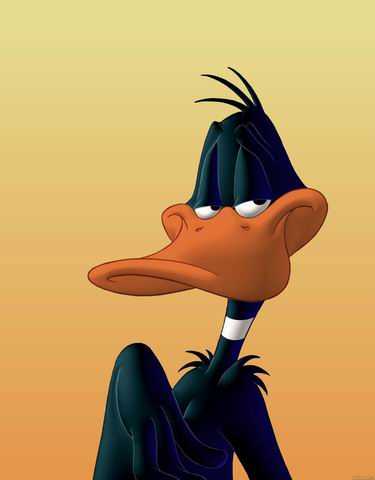
Oh, one more thing: My first impression of "Adaptation." was to recall a punch-line from an ancient Warner Brothers cartoon (actually a couple of them, one of them being "Show Biz Bugs," another "Curtain Razor")--but because of what transpires (and the fear that kids would duplicate it) it's not much in circulation anymore. In it, the indefatigably fame-seeking Daffy Duck is auditioning for stage-time for his act. Each one fails miserably and he's rejected. "Next!" Finally, he shows up in a devil's costume. He eats gunpowder. He drinks gasoline and nitro-glycerine. Then...dramatically, he swallows a lit match. BOOM! There's a huge explosion. "That's incredible!" cries the ecstatic agent. "I can book you immediately!" "Yeah yeah," says the ghost of Daffy, drifting heavenward. "But I can only do it once!"
For Ned, who asked...on July 9th, 2008
* There are others who take that switcheroo-based style of writing, including M. Night Shamyalan, and Alejandro Amenábar.
**You can read the original Laroche article here, at Orlean's web-site.
***McKee suggested Brian Cox (the original Hannibal Lecter) to play him in the movie. Good suggestion, actually.