Jim Morris' baseball card "The Rookie" (John Lee Hancock, 2002) With all the fuss being made over "The Blind Side," attention must be paid to the director's previous sports-film that proved popular, like "The Blind Side," also based on a actual story that's just this side of incredible and told with a clear-eyed lack of pretension.
John Lee Hancock's first film in the Majors* is a double-header of a sports film that manages to tell its male-weepie "dreams do come true" stories, both of them essentially true, with a minimum of sentimentality—the principals are actually quite bitter throughout the film, weighed down by the burden of "what might've been," and to a certain extent paralyzed by it. Coach Jim Morris, a former Big League prospect makes a deal with the High School team he coaches he'll "re-up" if they win their division. It then moves on to top itself to tell the consequence of that first story to the coach who must fulfill a promise to his team...and himself...to try out—again—for the Majors at the age of 39, a time when most pitchers are eyeing retirement, not opposing pitchers.
And because it's situated in Texas (for the most part), there's not an awful lot of talking about it, but, instead, there is a lot of scowling and stewing and time spent in solitude beating themselves up by transference in the form of hurling a baseball in frustration as fast as can be at some woe-be-gone target.
It might have been that baseball abuse added a few feet per second to Jim Morris' pitch, or it might be an arm strengthened by scar-tissue that can top his fast-ball at two ticks shy of a hundred mph. Whatever the reason, the science teacher/baseball coach in the arid football town of Big Lake, Texas must put-up or shut-up to his high-school team after his exhortation to pursue their dreams (and some batting practice with his blazing fast-ball) sharpens them up to become division champions.
That's story one. Story two is Morris' old-man hoofing it through try-outs and the farm system at the off-chance of being called to "The Show." It is an unlikely scenario, but Morris manages to do it, the film ending on the fairy-tale night that he must pitch in his first Major League game in his home state in front of his team and friends and family.
The movie could have been a sob-fest, but instead Hancock hinges it on dark nights of the soul and doubts about responsibility. This isn't some up-beat "Rudy" story where "wishing makes it so," (despite being produced by Disney). Morris (Dennis Quaid) must make a personal journey of dealing with a lifetime of disappointment and what might-have-been to accept the result of his efforts. After a life of compromise and making-do (and blaming others), he has to learn the grace to accept the gifts he has been given and the opportunities he's been afforded. Whatever pain goes behind each pitch, he must also put behind him.
Grace? Sacrifice? Forgiveness? Where do you go to learn such traits? Such inspiration usually is found at the Cathedral, the Temple, or the Mosque, but in the sports-world the big stadium is the source of humility. Hancock stages Morris' first walk into the Texas Rangers stadium as if he was walking into the Vatican, the high-arched entryway with the sun streaming through that stretches to a vanishing point that evokes a long journey, but also the long history of a game that, more than any other sport, is a competition with the ghosts of the past as well as the Boys of that particular Summer. The arches reach to the sky to define the goal but also press down with the weight of tradition, dwarfing the new recruit, challenging him to fill the space. In the distance, his fellow rookie, half his age, looks on in amusement at the old duffer hanging back in awe, anxious to start his journey and not thinking he may be looking at a flash-forward to a future of regret. It is a poignant moment of film, that says volumes in a single image and no words.
It's a good story told well. The characters are not larger than life, merely as large as they need to be. And no decision is made with a self-serving speech and heraldic trumpets—decisions and their consequences are agonized and fretted over. It's a story of people who not only have a lot to lose—they know it—but take the chance anyway for whatever amount of time it may last. "The Rookie" manages to make it look not quixotic, but essential.
* After writing two quirky off-beat films for Clint Eastwood: "A Perfect World" (1993) and "Midnight in the Garden of Good and Evil" (1997).
Showing posts with label 2002. Show all posts
Showing posts with label 2002. Show all posts
Thursday, January 14, 2010
The Rookie (2002)


Tuesday, January 20, 2009
By Request: Adaptation.
 "Adaptation." (Spike Jonze, 2002) I love Charlie Kaufman's writing. It reminds me of the old "Twilight Zone" series...but with depth*—but he's more of the Charles Beaumont style of TZ story-telling than Serling's or Richard Matheson's or Earl Hamner Jr.'s. Leaps are made every few minutes beyond the central conceit, and comes to a truly disconcerting kernel of truth at the end, which makes whatever frustrations made during the course of the film worth it. "Being John Malkovich" is a charming deconstruction of personality and wish-fulfillment, and "Eternal Sunshine of the Spotless Mind " is a jaded cynic's validation of love, and its intrinsic ability to be more than merely a process of instincts, chemistry and firing synapses. What's not to love?
 But "Adaptation." is another animal. It's "Charlie Kaufman in crisis," and a bit of a cheat, while also being an ingenious way to solve a problem--that is, writing a screenplay for a book that is, basically, unfilmable. Given the opportunity (and contract) to write a treatment based on Susan Orlean's best-selling book "The Orchid Thief,"** Kaufman readily accepted the job, being attracted to the odd obsessive themes of the book, and found himself unable to translate it into a film-story.
So he wrote about his difficulties translating it into a film-story! The book's subject, John Laroche, the poacher who was seeking the "Ghost Orchid" in the Florida Everglades was a real person who was determined to find the rare flower to clone it and sell it. The screenplay's subject is about Charles Kaufman, screenwriter, who's trying to adapt Susan Orlean's book, "The Orchid Thief," and wrestling with its themes and his own inability to create the screenplay. Impeding his process is his twin, simpler brother Donald (both played by Nicolas Cage), who's
 decided he's also going to write screenplays--none of which Charlie likes. Susan Orlean figures in it (played by Meryl Streep), as does Laroche—he's the bespectacled fellow pictured to the right, not Chris Cooper's snaggle-toothed, though Oscar-winning, portrayal— but they're fictionalized versions of the real people, adapted to fit a more commercial film. Laroche is using the orchids to make a drug and sell it, hooks Orlean, and she begins a needy affair with him and, fueled by her addiction, becomes as obsessed with the Orchid Thief as much as he's obsessed with the orchids. Is any of that true? No. Are the people real? Yes. The website, Chasing the Frog.com had done a fairly succinct job of separating the fact from fiction here. Yes, these people do exist, as does screen-lecturer Robert McKee,*** but they're fictionalized versions of the real people. Can Kaufman get away with doing that? Yes, he obviously did, but they had to get permission from the real-life counterparts to do so (just as Jonez had to get permission from John Malkovich for Kaufman's "Being John Malkovich" or that would have been a moot project).
Look up the word "Adaptation" in the dictionary. "Any change in the structure or functioning of an organism that makes it better suited to its environment." There couldn't be a better explanation of the screen treatment of "Adaptation." Kaufman couldn't, as they say in the trades, "crack it," so he changed the structure of the scenario...transplanted it, if you will...to make it work as a movie—especially a movie in the current environment of movie-making. And he made the debate between what he wanted to do and what he had to do part of the story in the form of the arguing screenwriting twins, Charles and Donald Kaufman.
Any writer of success must at some point deal with "the Other." The other writer, whose ideas are dismissed and shelved for work accomplished. Steven King did an experiment once to see if his writing would be as successful in other genres as opposed to the "scary fiction" writer, Steven King. So he created a psuedonym, Richard Bachman, much to the consternation of his publisher. Bachman sold well, but King had to deal with the success of his dopplescrivener after several books were published. Ultimately, it inspired the concept of his novel "The Dark Half."
Noms de plume are as old as Bashō (and I'd bet cave paintings had false signatures, as well), and "Adaptation." is credited to both Charlie and Donald Kaufman. Donald Kaufman is the first completely fictional person to be nominated for an Academy Award. Donald also serves as a way for Charles to have conflict while doing something solitary—writing. For all the preciousness of the conceit, it still manages to work in a weirdly clear way, and it provides the means of this exchange, which re-defines the whole picture and sums it up: Donald and Charlie are talking about a time in school when Donald approached a girl he had a crush on, and when his back was turned, she and her gaggle of "Heathers" made fun of him.
Donald Kaufman: I knew. I heard them.
Charlie Kaufman: How come you looked so happy?
Donald Kaufman: I loved Sarah, Charles. It was mine, that love. I owned it. Even Sarah didn't have the right to take it away. I can love whoever I want.
Charlie Kaufman: But she thought you were pathetic.
Donald Kaufman: That was her business, not mine. You are what you love, not what loves you. That's what I decided a long time ago.
You are what you love. Not what loves you. For that little gem of a thought—multi-faceted, flawless and fundamental—I have enormous respect for "Adaptation." for all its problems.
 The fictional Charles Kaufman—or is it Donald? (Nicolas Cage)
—on-set with the non-fictional Susan Orlean.
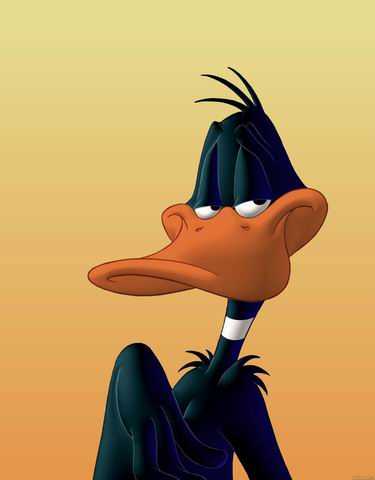
Oh, one more thing: My first impression of "Adaptation." was to recall a punch-line from an ancient Warner Brothers cartoon (actually a couple of them, one of them being "Show Biz Bugs," another "Curtain Razor")--but because of what transpires (and the fear that kids would duplicate it) it's not much in circulation anymore. In it, the indefatigably fame-seeking Daffy Duck is auditioning for stage-time for his act. Each one fails miserably and he's rejected. "Next!" Finally, he shows up in a devil's costume. He eats gunpowder. He drinks gasoline and nitro-glycerine. Then...dramatically, he swallows a lit match. BOOM! There's a huge explosion. "That's incredible!" cries the ecstatic agent. "I can book you immediately!" "Yeah yeah," says the ghost of Daffy, drifting heavenward. "But I can only do it once!"


For Ned, who asked...on July 9th, 2008
* There are others who take that switcheroo-based style of writing, including M. Night Shamyalan, and Alejandro Amenábar.
**You can read the original Laroche article here, at Orlean's web-site.
***McKee suggested Brian Cox (the original Hannibal Lecter) to play him in the movie. Good suggestion, actually.
Tuesday, March 18, 2008
Personal Velocity: Three Portraits

In Personal Velocity: Three Portraits, Rebecca Miller has adapted and directed three of her own short stories for the screen - how faithfully I don't know. Each story features a central female character who defies the path they expect to follow or are expected to follow. Progressing from one story to another, we get increasingly shorter slices of the character's lives so whereas the first section featuring Delia's story (Kyra Sedgwick) follows her from high school to married life with teenage children, by the time we get to the last part, Paula (Fairuza Balk), we are only covering a couple of days. In between these is the story of Greta (Parker Posey), that appears to take place over a number of years. Though the stories vary in the length of time they accelerate to their end, they all culminate in a life-altering change that each character feels finally compelled to make. Miller uses what seems to be an unnecessarily cute device to link the three stories together by making them overlap in time: the accident that occurs at the heart of the third story is mentioned in passing in the first two though it is unclear what we are meant to draw from this. Some have also found the director's decision to use a man as the voice-over narrator a problematic one: as a way to add depth to the brevity of the form it works whether or not you feel it strange to hear a man's voice inside a woman's head.
Tuesday, January 22, 2008
The Pianist
"The Pianist" (Roman Polanski, 2002): I've been avoiding this like the plague, because when you get home the last thing you want to see is a "holocaust" movie. But since our current Net-flicks choices are "The Pianist" or "The Constant Gardener," its a bit easier to choose which of the two depressions  you want to take on. We went with "Pianist," and I regret putting it off. Yes, it's about the Warsaw Ghetto. But it's also a terrific adventure/survival movie about a man used to the rarefied world of the arts being forced to make life and death choices in order to survive. That its a true story (about pianist Władysław Szpilman) makes it even more remarkable and a testament to one's will to live. But its also one of Roman Polanski's best films--a straight ahead artful telling of the tale without blandishments or Polanski's usual tendency to throw in some frivolous garbage that devalues the piece. Adrien Brody is simply amazing in it (but "Man Alone" movies tend to bring out the best in actors--anyone remember Dr. Hang S. Noor in "The Killing Fields?"), slowly losing the detached look in his eyes as his situation worsens and worsens. One can't help but flash on current events and how a populace can be fooled into thinking "But they wouldn't dare...." Give someone enough power, and they'll dare anything. With enough power, who's going to stop them? Well worth seeing so don't be scared by it.
 you want to take on. We went with "Pianist," and I regret putting it off. Yes, it's about the Warsaw Ghetto. But it's also a terrific adventure/survival movie about a man used to the rarefied world of the arts being forced to make life and death choices in order to survive. That its a true story (about pianist Władysław Szpilman) makes it even more remarkable and a testament to one's will to live. But its also one of Roman Polanski's best films--a straight ahead artful telling of the tale without blandishments or Polanski's usual tendency to throw in some frivolous garbage that devalues the piece. Adrien Brody is simply amazing in it (but "Man Alone" movies tend to bring out the best in actors--anyone remember Dr. Hang S. Noor in "The Killing Fields?"), slowly losing the detached look in his eyes as his situation worsens and worsens. One can't help but flash on current events and how a populace can be fooled into thinking "But they wouldn't dare...." Give someone enough power, and they'll dare anything. With enough power, who's going to stop them? Well worth seeing so don't be scared by it.
Subscribe to:
Posts (Atom)