Showing posts with label digital. Show all posts

Thursday, June 28, 2012

Brave

We All Have Our Bear to Cross
or
"A Princess Strives for Perfection"

They used to have a lot of trouble with hair in the early days of digital crafting.  For instance, you remember the monkeys from Jumanji—the hair was short and matted and plasticene looking ("Not good enough, Sonny Jim").

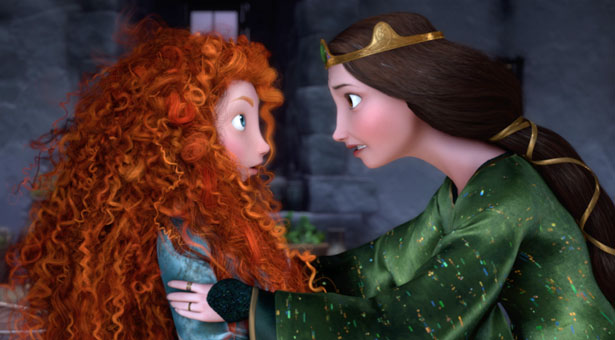
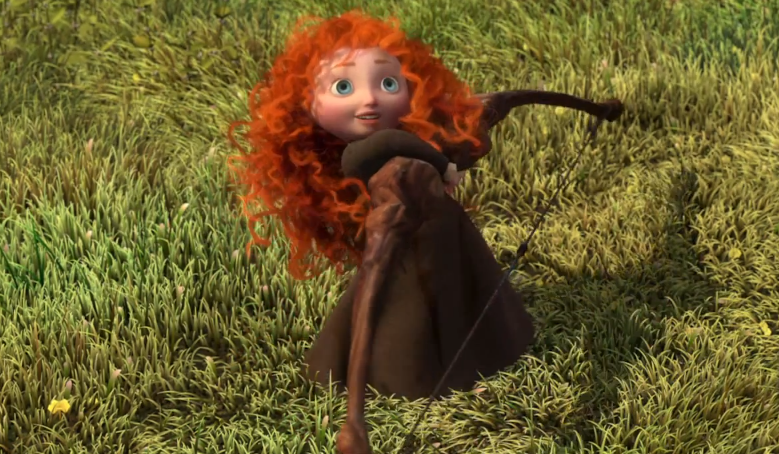
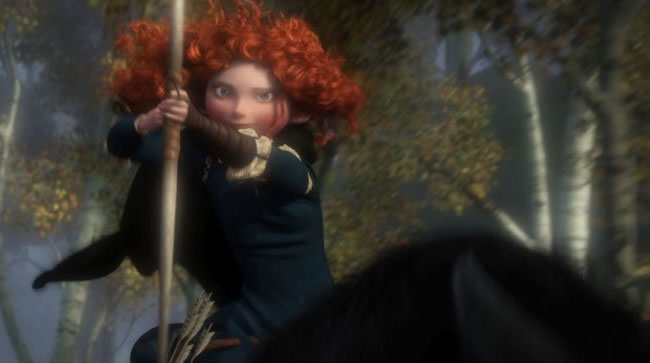
Things have come a long way; Princess Merida (voiced by Kelly Macdonald) in Brave has an unruly hedge of red hair, of all different textures and tensile strength, thatched together, the odd curlicue strands floating, like the representatives of an unruly spirit.  The one girl in the royal Scottish family of Lord Fergus (Billy Connelly) and Lady Elinor (Emma Thompson), she is being groomed, quite radically by Elinor, to be the perfect little princess, a prim and proper consort to one of the sons of the other clans (led by voice actors Robbie Coltrane, Craig Ferguson, and Kevin McKidd)—losers all.  Trouble is, Merida is very much a product of her parents.  The first born, she takes off a lot from her Lord-father, who when we first encounter the family, gives his daughter a bow for her birthday.  A wild shot sends an arrow deep into the forest where Merida has her first encounter with will'o-the-wisps, which her Mother tells her can lead her to her Fate.  As if Merida wants to be led anywhere.  As she grows, she'd much rather take off with her steed Angus, firing arrows at a full gallop on an archery course of her own devising, going on adventures that her potential suitors might blanch at.

But, when forced to play the role imposed on her, Merida becomes defiant, setting in motion a series of events that will prove disasterous to her clam, politically and personally.

To reveal any more would be spoiling the surprises along the way, which are heart-felt, potentially extremely tragic, and ironic all at the same time.  It's a grim fairy tale, conceived by original director Brenda Chapman (Pixar's first female director, although she was let go in the middle of production over "creative differences.")

There are a lot of "first's" here: it's Pixar's first "period" film; their first with a female protagonist, believe it or not (and this has a strong one to start off with, with feminist leanings, and mother-daughter issues); their first "princess" film and their first "fairy tale" of sorts, although it's not based on any story I'm aware of, treading new ground, although the touchstones along the way have all the familiarity of ages-old myth.

And Pixar has re-written their software codes to make a truly complex-looking film.  It's not just the hair, but also the verdant forests, rough-hewn roads, castles, and water effects all have a photo-realism quality, while the cartoon-proportioned people have a fastidiously eclectic design and a malleability of expression far beyond what Pixar's animators have been able to accomplish before.  There are no short-cuts here, but only the pushing of the artistic envelope (and that includes the 3-D effects which looks seamless and flawless with no speed-artifacting) that has been the standard for every production out of this studio.

At the showing I attended there was a technical glitch with the projectors that delayed the film somewhat (pfft...so I missed a couple of previews), and one of the patrons remarked out-loud how much the theater might compensate for the delay.  It left me wondering what sort of compensation is needed besides a great film, flawlessly done. 

Brave is preceded by a magical short, La Luna.  And stay 'til the end as there's a nice little coda.

Brave is a Full-Price Ticket.


Thursday, November 12, 2009

A Christmal Carol (2009)

"God Bless Us, Every Mega-Pixel"

Everyone has a favorite "Christmas Carol" (or I should say, "version" of "A Christmas Carol").* A novella, it is the perfect length for adaptation to movie (with some padding) or television special (with some commercials). And being as it's in the Public Domain, anybody can adapt it without paying any money to Mr. Dickens (who probably haunts the producers, every one!). Hence the title: "Disney's 'A Christmas Carol.'"tm **

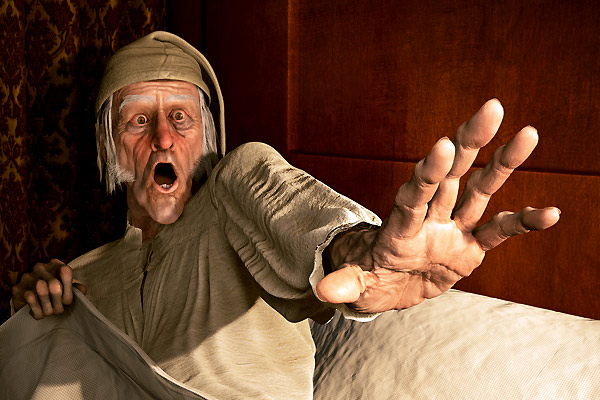
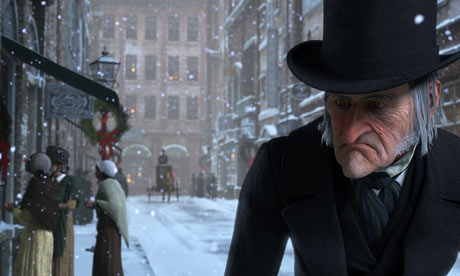
Disney may own it, but it's Robert Zemeckis and Jim Carrey's "A Christmas Carol," and it stands up against even beloved ghosts of "Christmas Carols" past. Face it. There are so many, that presentation is the main criterion to base a judgement, like "Hamlet." And format has a lot to do with what drives Zemeckis' version. Skip the 3-D aspect for a moment. This motion capture-CG "take" does some very interesting things with the story (adapted within a farthing of Dickens' original by Zemeckis himself) that are only possible with animation—the ghosts being integral to the story.

"A Christmas Carol" is a ghost story. The ghosts and their tours of Scrooge's life past, present and future must be enough to slap Scrooge giddy,
make him "scared straight," turn his perspective from "profit" to "a common good."

In other words, it must turn him from
a "cool, conservative man" to a "bleeding heart liberal."***

You have to have really scary ghosts to do that. Really scary ghosts. Any half-steps and Scrooge would be a "champagne liberal," and what good are they?

In this version,
Carrey not only plays "Scrooge" (through Zemeckis' ever-improving "motion-capture" technique) but also the three Ghosts: a cooing Irish flame for the past, a roaring Scottish present, and a funereally silent Future. Each has their own presentation of their visions, Past whisking Scrooge to his old haunts, Present turning Scrooge's sitting room into a camera obscura to spy the current Christmas, flinging Scrooge to a stage street to present Want and Ignorance, two feral spirits—the one growing up violent behind prison bars, the other morphing into a hooker and into a straight-jacketed mad-woman. And Future, in a neat touch, forms itself from Scrooge's own shadow.

There emerges during the sequence a chase as Scrooge is pursued by his own nightmarish funeral cortege pulled by two red-eyed horses, a bit that old Walt would have been proud of. It soon deteriorates into a demonstration of 3-D (which Zemeckis and Pixar are already masters of—the previews of
James Cameron's "Avatar" shows a few problems) as bedlam as a mouse-sized Scrooge must scramble through the sewers to escape a terrible fate. One could live without it, as well as the "snuffing" episode of Christmas Past were the sequence not a vivid demonstration of just how well Zemeckis uses the technology to bring a life-like edge to the movie. And that's where this "Christmas Carol" truly makes its mark.

Where this version of "A Christmas Carol" is unique is that this marks the occasion when "motion capture" CG "got the faces right." Zemeckis' previous experiment in this realm, "
Beowulf," had an odd, plasticene feel to it, mouths didn't crinkle correctly in speech, faces wobbled in perspective. Not here. Carrey is a broad actor, to be sure. But he's also an actor of simultaneous quicksilver subtleties, and this film captures it all. It's one thing to flit the camera perspective through snow-storms and sail through the chains of a scale, falling chestnuts, and the "eye" of a wreath (all done in the film's credits), but it's quite another artistic thing to capture the look of pleased instant love on young Ebeneezer's face when he first meets his beloved Belle (Robin Wright Penn), or to show the pleading terror and remorse when a ghostly Scrooge comes "face-to-face" with a mourning Bob Cratchit (a perfect Gary Oldman). Keep your dizzying flights of fancy 3-D. It's in those moments of intricate expression when "Disney's 'A Christmas Carol'" truly soars.

"Disney's 'A Christmas Carol'" is a Full-Price Ticket.****

* Well, since you asked, I have my own favorites—usually the ones that are a bit scarier in their psychic psychological warfare on Scrooge. I like the "Alastair Sim" version often sighted as a favorite, and love the "George C. Scott" version for television from 1984 (he's scarier at the end than at the beginning!), but my favorite—and this is probably a case of "Mom's Apple Pie Syndrome"—is "Mr. Magoo's Christmas Carol," which, even though it is a musical, even though it is a cartoon and even though Scrooge is Jim Backus, still manages to pack an emotional wallop, more than any "live" version I've seen, including this version.

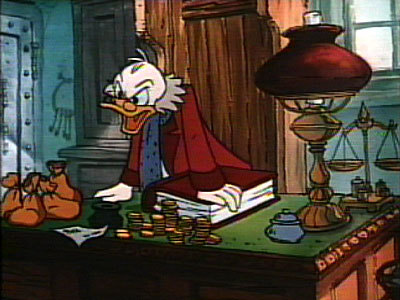
** They've already done a version with Mickey Mouse: "Mickey's Christmas Carol" (1983). Scrooge McDuck played Scrooge. Natch.

*** I have to bring this up: a couple years ago one of the Zucker bros. directed a conservative version of "A Christmas Carol," but it took the Christmas out of it—I guess it's "An X-mas Carol," then,...talk about your "Wars on the Holidays"(sic)—called "An American Carol" in which a Michael Moore type (played by Chris Farley's brother—more popularly known as "Chris Farley's brother") is shown the Ghosts of America Past, Present, and Future in order to "scare" him into being more conservative—frankly the Bush II Administration had the opposite effect on me. Not to paint with too large a brush, but conservative political humor tends to be so ham-fisted and structurally unsound that it can't even see its own hypocritical ironies.

**** And a spendy one at that. Ticket prices are higher for 3-D presentations. I have some trepidations about saying it—this site being all about "value" and all—but I thought it was worth it. My opinion, merely.

Tuesday, March 18, 2008

Personal Velocity: Three Portraits


In Personal Velocity: Three Portraits, Rebecca Miller has adapted and directed three of her own short stories for the screen - how faithfully I don't know. Each story features a central female character who defies the path they expect to follow or are expected to follow. Progressing from one story to another, we get increasingly shorter slices of the character's lives so whereas the first section featuring Delia's story (Kyra Sedgwick) follows her from high school to married life with teenage children, by the time we get to the last part, Paula (Fairuza Balk), we are only covering a couple of days. In between these is the story of Greta (Parker Posey), that appears to take place over a number of years. Though the stories vary in the length of time they accelerate to their end, they all culminate in a life-altering change that each character feels finally compelled to make. Miller uses what seems to be an unnecessarily cute device to link the three stories together by making them overlap in time: the accident that occurs at the heart of the third story is mentioned in passing in the first two though it is unclear what we are meant to draw from this. Some have also found the director's decision to use a man as the voice-over narrator a problematic one: as a way to add depth to the brevity of the form it works whether or not you feel it strange to hear a man's voice inside a woman's head.