Vantage Point (Pete Travis, 2008) An American news crew sits in their van in Salamanca, Spain, technically coordinating coverage of a Presidential visit. No sooner does POTUS (William Hurt) take the podium when two shots ring out, sending him flying, to the horror of the news-people, the Secret Service, the crowded throng and the millions who are (probably not) watching at home. For a split-second, there is reaction all around, and then the confusion starts: where did the shots come from, who's that running guy, get the president to the hospital, foot-chase. At the end of it, a lot of people are dead, and the ramifications are huge, while the news channels try to play catch up...and one suspects never will.
This one's just plain crazy. The same 15 minutes, played out, rewound, clock started again, and POV switched. Technically, it's a daunting challenge, with all the shots of things that have gone before shifted into the background, and having to match what went before in the same time-frame that it did before, although one later incident seems to be fudged a little longer to allow some exposition in one segment (all the better to build suspense). The director, Pete Travis, mostly known for his British television work) does one thing that always drives me nuts in pot-boiler novels—he takes you to one pop-eye inducing moment...and then...stops and goes back. Next chapter. We'll get back to that...
That would make it "a relentless page-turner" if it had a spine, but you're stuck watching the movie, wondering, "Yeah, but what about..." Annoying. But, not enough to make you hit the "Eject" button.
Source Code did this a little better this year, and had the decency to make all the populace in it more than innocent by-standers. Most of the characters are there to serve a function in the plot, rather then being motivated, save for Dennis Quaid's Secret Service agent, who has just come back to active duty after taking a bullet for this President six months earlier. The speculation is that he might be a little gun-shy (if so, he wouldn't be put on active duty, now would he?)
This is the problem with the film. Good concept (even if it is Akira Kurosawa's), but the deeper we go into the movie and the more we find out about this 15 minutes, the situation becomes less and less likely, and more and more contrived. It has the kinetic feel of an episode of "24" compressed and spread out over a ninety minute running time. And, it isn't even "The Rashomon Effect," where (when it's done well) the differing perspectives are colored by the person telling the story. Here, facts are facts—it just happens from different angles, how the person feels about it doesn't enter into things. In that regard, Vantage Point is just a standard detective thriller, more about information dissemination in an electronic 24 hour news cycle, rather than saying anything about the human condition—besides the obvious jumping to conclusions. The film begins and ends in that van and the broadcast of events, making the point that there's a photon-filter between truth and knowledge. At the end, the news audience does not know, and may never know exactly what went down. But, given what we already know about the efficacy of reporting "while it happens," the endless speculation and rumor-airing and other apocrypha and opinion that's offered as journalism, it is a bit of a hollow exercise, a "gimmick" movie without that much to offer.
Is it a good movie? I don't know.
Wednesday, July 20, 2011
Vantage Point


Thursday, January 14, 2010
The Rookie (2002)
Jim Morris' baseball card "The Rookie" (John Lee Hancock, 2002) With all the fuss being made over "The Blind Side," attention must be paid to the director's previous sports-film that proved popular, like "The Blind Side," also based on a actual story that's just this side of incredible and told with a clear-eyed lack of pretension.
John Lee Hancock's first film in the Majors* is a double-header of a sports film that manages to tell its male-weepie "dreams do come true" stories, both of them essentially true, with a minimum of sentimentality—the principals are actually quite bitter throughout the film, weighed down by the burden of "what might've been," and to a certain extent paralyzed by it. Coach Jim Morris, a former Big League prospect makes a deal with the High School team he coaches he'll "re-up" if they win their division. It then moves on to top itself to tell the consequence of that first story to the coach who must fulfill a promise to his team...and himself...to try out—again—for the Majors at the age of 39, a time when most pitchers are eyeing retirement, not opposing pitchers.
And because it's situated in Texas (for the most part), there's not an awful lot of talking about it, but, instead, there is a lot of scowling and stewing and time spent in solitude beating themselves up by transference in the form of hurling a baseball in frustration as fast as can be at some woe-be-gone target.
It might have been that baseball abuse added a few feet per second to Jim Morris' pitch, or it might be an arm strengthened by scar-tissue that can top his fast-ball at two ticks shy of a hundred mph. Whatever the reason, the science teacher/baseball coach in the arid football town of Big Lake, Texas must put-up or shut-up to his high-school team after his exhortation to pursue their dreams (and some batting practice with his blazing fast-ball) sharpens them up to become division champions.
That's story one. Story two is Morris' old-man hoofing it through try-outs and the farm system at the off-chance of being called to "The Show." It is an unlikely scenario, but Morris manages to do it, the film ending on the fairy-tale night that he must pitch in his first Major League game in his home state in front of his team and friends and family.
The movie could have been a sob-fest, but instead Hancock hinges it on dark nights of the soul and doubts about responsibility. This isn't some up-beat "Rudy" story where "wishing makes it so," (despite being produced by Disney). Morris (Dennis Quaid) must make a personal journey of dealing with a lifetime of disappointment and what might-have-been to accept the result of his efforts. After a life of compromise and making-do (and blaming others), he has to learn the grace to accept the gifts he has been given and the opportunities he's been afforded. Whatever pain goes behind each pitch, he must also put behind him.
Grace? Sacrifice? Forgiveness? Where do you go to learn such traits? Such inspiration usually is found at the Cathedral, the Temple, or the Mosque, but in the sports-world the big stadium is the source of humility. Hancock stages Morris' first walk into the Texas Rangers stadium as if he was walking into the Vatican, the high-arched entryway with the sun streaming through that stretches to a vanishing point that evokes a long journey, but also the long history of a game that, more than any other sport, is a competition with the ghosts of the past as well as the Boys of that particular Summer. The arches reach to the sky to define the goal but also press down with the weight of tradition, dwarfing the new recruit, challenging him to fill the space. In the distance, his fellow rookie, half his age, looks on in amusement at the old duffer hanging back in awe, anxious to start his journey and not thinking he may be looking at a flash-forward to a future of regret. It is a poignant moment of film, that says volumes in a single image and no words.
It's a good story told well. The characters are not larger than life, merely as large as they need to be. And no decision is made with a self-serving speech and heraldic trumpets—decisions and their consequences are agonized and fretted over. It's a story of people who not only have a lot to lose—they know it—but take the chance anyway for whatever amount of time it may last. "The Rookie" manages to make it look not quixotic, but essential.
* After writing two quirky off-beat films for Clint Eastwood: "A Perfect World" (1993) and "Midnight in the Garden of Good and Evil" (1997).


Friday, January 23, 2009
The Right Stuff
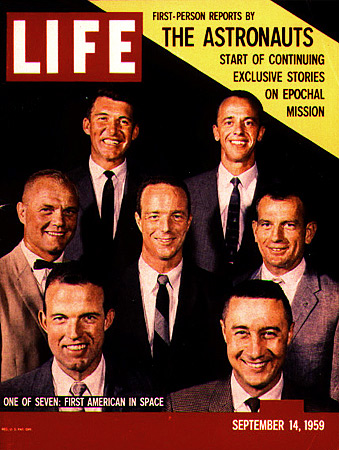
 "The Right Stuff" (Philip Kaufman, 1979) Something of a miracle. Not just getting into Space. Making a movie of Tom Wolfe's distillation of the effort from the days of breaking the sound barrier post-WWII to the age of astronauts. Wolfe stripped away the Iron Curtain of PR flakkery to tell the story of the men who put their hides on the line to go farther, faster and higher than the earth-bound. And do so on "live" TV. Or in secret during a race for Space with the Russians. Wolfe opened the guarded doors of the test-pilot fraternity and told tales and punctured myths, while simultaneously creating myths anew—of the laconic "other" quality of pilots that pulled them out of scrapes, channeled their fear and kept them climbing the pyramid: the indefinable, ephemeral "right" stuff.
The book was optioned for the movies, but was considered too unwieldy and too expensive to turn into a film. But Philip Kaufman, one of the up-and-coming USC film-school grads took a bare-bones, low-tech approach to the effects, combined it with stock footage of the well-documented space program, and combined it with an irreverent sophomoric humor that combined Wolfe's myth-busting with SNL spoofery. But just as Wolfe found a new glory glowing inside the heart of the flummery he was burning away, Kaufman found interesting cinematic ways to illustrate those truths and celebrate the gung-ho heroism of a team of competing fly-boys. Chuck Yeager is a horse-riding cowboy of Western tradition riding in to town to take on a challenge. John Glenn's description of "fire-flies" while in orbit, is tied to the bonfires of Australian natives praying for his safe return. And in this stunning sequence, two disparate incidents from Wolfe's book unite the newly-beknighted Astronauts with their spiritual mentor and comrade-in-wings.
It starts with the arrival of a new test-jet—The Lockheed NF-104 Starfighter, which Yeager believes can break a record for altitude. With his wing-man, Ridley, he does an inspection of the jet working his way back to the exhaust port, which Kaufman pulls in on. Kaufman takes us into the dark-hole of the jet-engine, and inside we hear echoing voices and whistles and the sound of drums, and before we can register the change, we're not in the negative space of the engine anymore, we've transitioned to another channelled tube of energy—we're traveling through a tunnel riding atop a limousine from an astronaut's perspective...
 ...as President Lyndon Johnson stands on a flag-draped stage and welcomes the seven Mercury astronauts to an out-sized barbecue in Houston--the new home for the Manned Space Center, as well as the astronauts and their families. Their homes, their furnishings are all paid for by the Houston developers who are benefitting from Johnson's earmarks. The Mercury 7 are living the good life, while the Man who Broke the Sound Barrier makes a run for space.
 Both these incidents happened and are mentioned in Wolfe's book, but they took place months apart, while Kaufman has them happening simultaneously. To what purpose will become clear later, but in the meantime, we follow Yeager (Sam Shepard) as he vaults into the sky, his pilot's gear now more closely resembling the astronaut's flight-suits.
 And in one spectacular shot, we see space bend and warp as we approach the feathery layer of a cloud-ceiling, then go through it...
 ...and the picture fades to an incident from that barbecue--an odd detail that Wolfe found funny and sad and a bit pathetic, but Kaufman turns into visual poetry. For some reason, the Houston event organizers chose as one of the entertainers stripper Sally Rand, now in her 60's, doing her famous "fan-dance" that had wowed 'em at the 1933 Chicago's World Fair. But that was thirty years previous. And the elderly Rand tottered around the stage. To what end, no one can say.
 But Kaufman takes that incident and marries it with a running theme throughout the film. The Moon has been a beckoning image throughout "The Right Stuff," and now, as the clouds that Yeagher is punching through become the delicate feathers of Sally Rand's fans, she dances to an orchestral version of the melancholy "Clair deLune," by Debussey.
And it's lovely.
 Kaufman stays on his images of empty space and feathers and lights, then to shots of the astronauts and their wives reacting to the irrelevence and embarrassment of it all. And then, something strange happens....
 John Glenn (Ed Harris) looks over at fellow astronaut Alan Shepard (Scott Glenn), with whom he's had a contentious relationship...
 ...and Shepard's not even watching the stage-show. He's lost in thought...
 ...as is Deke Slayton (Scott Paulin).
 Glenn turns to look at Gus Grissom (Fred Ward)...
 ...who is already looking at him.
 Grissom turns and looks at his buddy, Gordon Cooper (Dennis Quaid)
 ...who is his usual grinning self, but he's subdued. We transition back to Sally Rand...
 ... and a blaze of klieg-lights to Yeager trying to "punch a hole in the sky."
 Yeager reaches top altitude, then his engines give out and he's given one tantalizing glimpse of the stars in space...

 ...before his fighter-jet begins to rapidly tumble back to Earth.
 Unable to bring it under control, Yeager makes a fiery ejection...
 ...and Kaufman holds on him--trailing smoke, because as we'll see his helmet is on fire--and we watch his long, long fall through space as he tumbles through the silence--a modern Icarus...


 ...who disappears into the clouds.
 The clouds fade back to the feathers of Sally Rand.
 ...and to the astronauts, who are somewhere else.
 Scott Carpenter (Charles Frank) begins to look pensive.
 Walter Schirra (Lance Henriksen) acts like he hears something...
 Glenn, on edge, looks to Grissom and Cooper...
 Grissom is wary...
 Cooper, head bowed, tentatively looks up...
 as does Slayton...
 And Shepard cranes his gaze to the ceiling...
 We transition to Sally Rand, and on the soundtrack we hear a distant boom.
 With a hard cut, we're back in the California desert.
 Reverse angle to an ambulance approaching in the shimmering desert heat.
 The driver points ahead "Sir? Is that a man?"
 Amid the smoke and heat-waves, a silvery shape emerges.
 "Yeah," says Ridley (Levon Helm), "you bet it is."
 As the music swells, Yeager carrying his parachute, his face burned, but still chewing gum, approaches the ambulance.

Yeah. You bet it is. It's great film-making, too. And a brilliant sequence by Kaufman that shuffles real time a little, but makes a point about the competitiveness of air-men, giving way to a brotherhood. All of the men in the sequence have competed with each other as well as Yeager to be "at the top of the ol' pyramid," going faster and higher than any person before. The astronauts were test-pilots competing with Yeager, then signed on to become astronauts, "spam in a can" in the test-pilots' jargon, achieving a fame Yeager never would...until Wolfe's book...and this movie
Now at this Houston fete, the astronauts "tune in" to Yeager's struggle, as if linked. Backed by an echoing ochestral version of "Claire DeLune," it is haunting and haunted, communicating viscerally, if not literally, of the bond between the men—Indefinable.
"The Right Stuff."