Showing posts with label V. Show all posts

Friday, November 1, 2013

Post Hallowe'en Special: Get Off the Lawn, You "Damned" Kids!

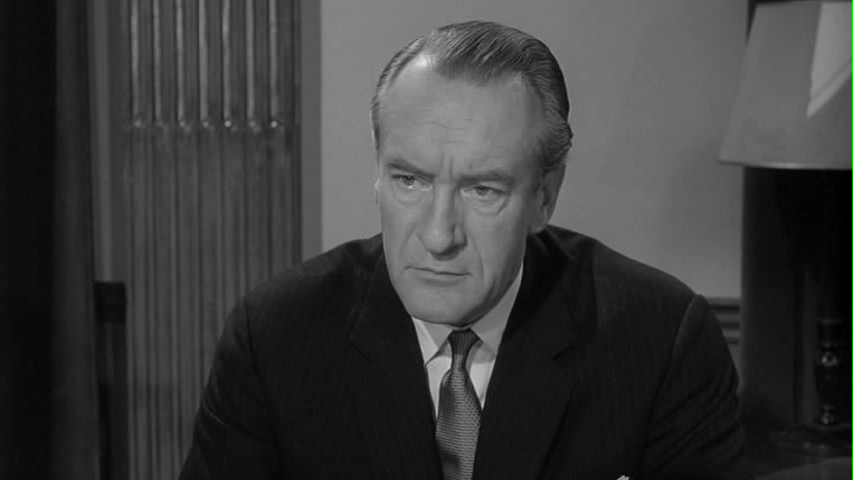
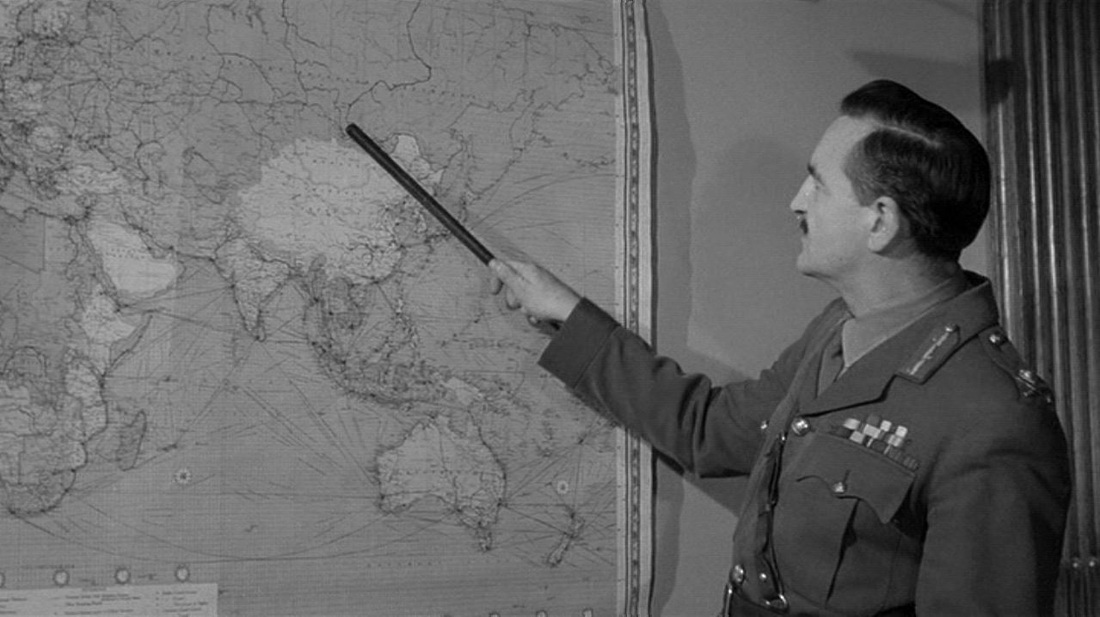
Village of the Damned (Wolfe Rilla, 1960)  Based on the John Wyndham sci-fi novel "The Midwich Cukoos," adapted by Stirling Silliphant and director Rilla, Village of the Damned* is a curious mixture of sci-fi and horror—a combination of pulp sensibilities, but with a strange sub-text that could be taken as religious, mystical, or invasive, and then has the audacity to not answer any of the questions and leave you hanging as the suppositions swirl through your head.  Both it and its sequel are fascinating things to watch, but each in their different way.

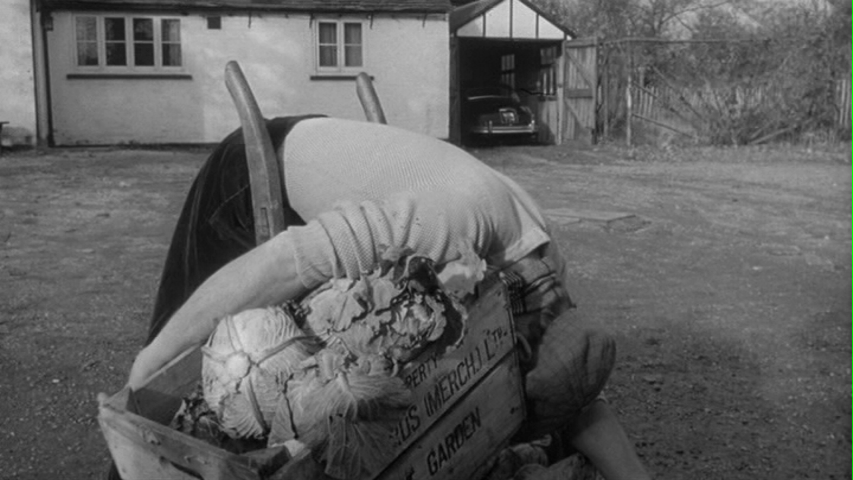
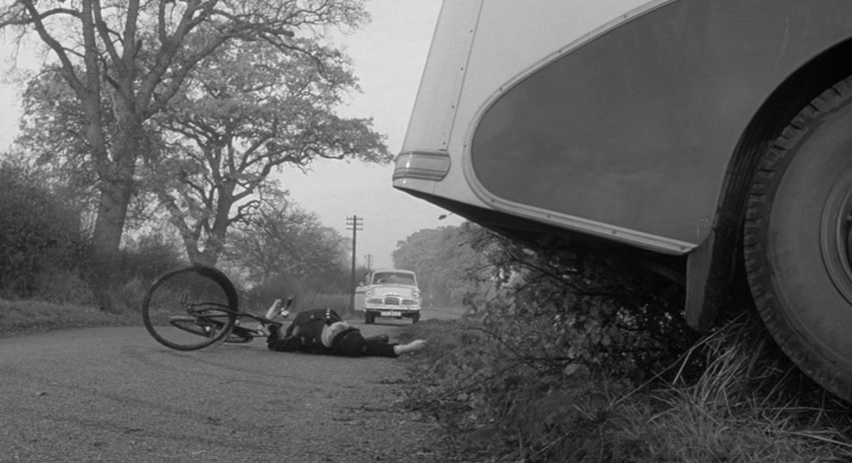
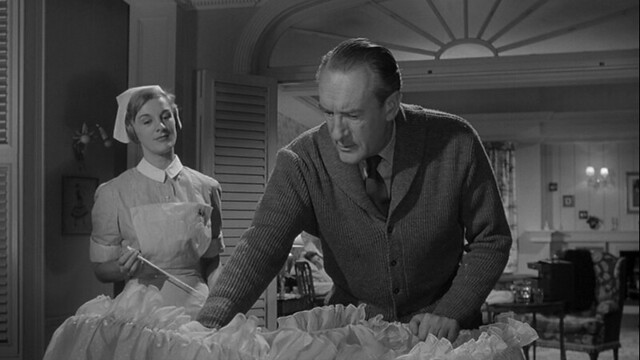
In the town of Midwich, professor Gordon Zellaby (George Sanders) is making a call to his brother-in-law Alan Bernard (Michael Gwynn) when all of a sudden, he falls unconscious.  So does the family dog.  Bernard is alarmed at this and can't raise anyone in town, so he investigates and being in the military he doesn't do it subtly.  What he finds is that everyone within a few mile radius of city center is unconscious...or will become unconscious (even taking preventative measures like gas-masks) if they enter within that "zone"—aeroplanes flying overhead will have their pilots drop off, the planes crashing.  


It's a mystery.  Why this town?  Why this effect?  But, two hours later, everyone awakens, mystified.  They felt a cold sensation before they dropped, but that was it.  The disturbance is forgotten.


Until two months later, when it's determined that every woman "of child-bearing years" in Midwich is pregnant.  For Zellaby and his wife (Barbara Shelley), it's a miracle though it's a little late in life for him.  But, for the unmarried women in town, and for the women with husbands away, it's not only embarrassing, it has to be some bizarre mistake...and when it's confirmed it makes things uncomfortable, socially.  For awhile they're stigmatized, but before long (and with the doctor's confirmation) it's determined that all the women are pregnant...and they don't how.


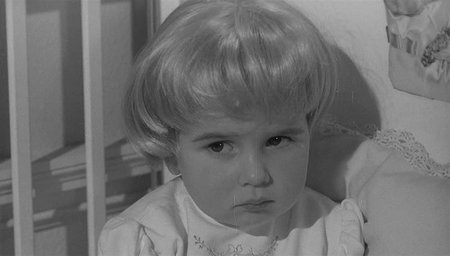
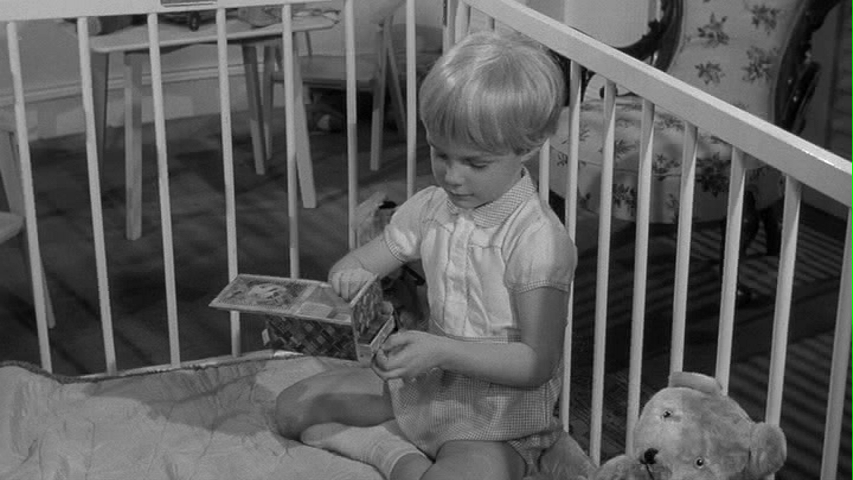
Out of this mass-immaculate conception, the village is seriously creeped out, but the children appear to be normal, if gestating at an accelerated rate.  And all are born on the same night, all premature by normal standards, but all around ten pounds, all with white shocks of hair and something "weird" about their eyes, totally black.  The kids grow quickly and they learn quickly, being able to figure out chinese puzzle boxes while still toddlers.  Give it to one, and then another, sight unseen, will be able to figure it out, as if by telepathy or shared mental faculties.

And...if things don't go their way, they can influence the thoughts and actions of others, an act apparent when their eyes begin to glow white.  The children, as they grow older and become more sophisticated, become even odder—walking as a group by themselves, dressing themselves, speaking in a tone, sophisticated and cold.
**

What to do about them...and who "is" them, anyway?  No one has any answers, but reports around the world suggest Midwich isn't the only village on Earth to experience this.  Some of the places have murdered the children. One isolated village in Russia is trying to instruct the children to the best they can.  What is the answer: to eradicate, or to exploit? 

The military doesn't want to do anything subtle, but Zellaby, with doubts as to their origin, staves off their eradication by seeing if he can teach them in their own segregated school (naturally).  The trouble is, the children don't want to do anything subtle, either, and these kids are of a mind to stop the problem of bullying by any means necessary.


This is a great film, which doesn't shirk societal issues at the same time it doesn't pin down exactly what the hell is going on here.  The fact is the kids are here and dealing must begin.  But how, never mind why.  Plus, it's a genuine horror-fest, making one web-site's list of "10 movies pregnant women should never watch." Apt.  And one curious anomaly about the film is that the strange glowing eyes that signal some heavy brain-work on the part of the children (and figures in the denouement) is only seen in American prints of the film.  Interesting, as they seem to appear in the British posters for the film.

But, those curiosities aside, it's well-worth seeing, and pondering...

One further note, young Martin Stephens who gives such a calmly mature performance as little David Zellaby in this (and The Innocents) left acting while still a child and became an architect.  Yes, he has a web-site.


°° °° °° °° °° °° °° °° °° °° °° °° °° °° °° °° °° °° °° °° °° °° °° °° °° 


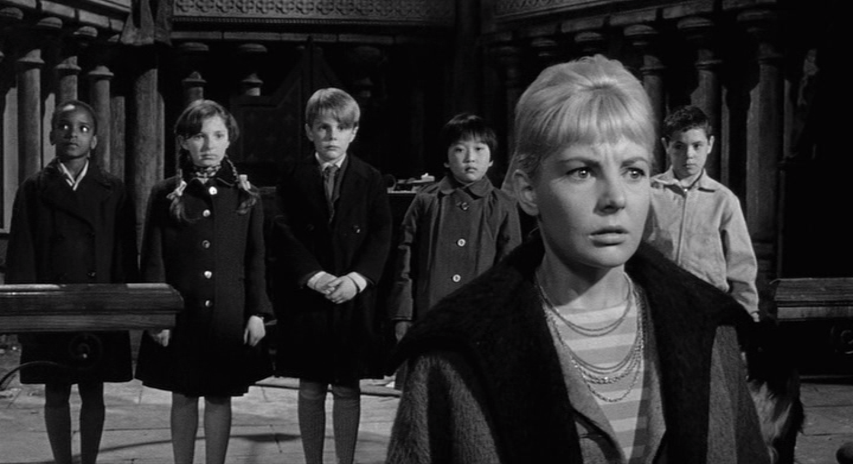
Children of the Damned (Anton M. Leader, 1964) If Village of the Damned leaves things unexplained, Children of the Damned just complicates the issue, rather than coming up with any concrete answers. The six titular children have the same powers and intellect, but not the same attributes.  None of them has the tell-tale white hair or the slightly high browline as the first crop of kids.  And there's only one child from Britain; the others, flown in by the UN, come from Russia, China, India, America, and Nigeria and their abilities are only discovered by a UNESCO survey on child development.  The lead investigators in England, psychiatrist Tom Llewelynn (Ian Hendry) and geneticist Dr. David Neville (Alan Badel, laconically ironic) are looking into the why's and wherefore's of young Paul Looren (Clive Powell), a child of extraordinary learning skills that are frankly off their charts.  A visit to his single mother only ends with her tossing them out and their disbelief in her claiming she was never "touched by a man."

Llewelynn and Neville make an odd duck duo,*** the shrink earnest and straightforward and the geneticist cracking wise with every line.  Their investigations come up with no reason why these kids have these abilities, they just do, and when Britain's Secret Service tries to take control of young Paul, he sets up a distraction and scampers, seeking out the other five children and taking up residence in an abandoned church, with Paul's aunt (Barbara Ferris) as hostage/mouthpiece.  The various embassies want each of their children back to exploit them, weaponizing them, in effect.  Llewlynn is thunderstruck by the idiocy of that: "As soon as one of them knows your plan, then the others will know it."  So much for Cold War secrets.


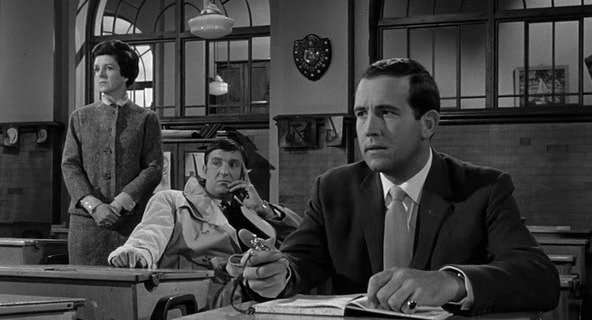
Neville and Llewelynn, U.N. observers...observing

Still the various countries want their kids back, and the kids want nothing of it, attacking from their stronghold in the church, devizing a broadcasting "thingie" using the church's pipe-organ to incapacitate anyone attempting to remove them, leaving their attackers dead or "wishing they were."


Children of the Damned is slightly diminished from its original, but on its own is one of those great science fiction films of limited scope and budget that still manages to evoke the sense of a much larger concept, despite narrowing down what the children "are," while giving the film a sense of cautionary tragedy that the first film doesn't have.  Less a horror film than a story of sociological and political paranoia, Children of the Damned features good performances and an efficiently crackling script (by John Briley—he would go on to write Cry Freedom and Gandhi) and manages to stand on its own terms, apart from the first film, as an entertaining, if very unsettling film.


...and what they're observing.


°° °° °° °° °° °° °° °° °° °° °° °° °° °° °° °° °° °° °° °° °° °° °° °° °° 


Village of the Damned (John Carpenter, 1995) This updated version of the original follows the same plot structure of the first, with less emphasis on the mysterious circumstances that cause the "immaculate" pregnancies in the town of "Midwich, California," less stigma—it is the '90's, after all, there's even the subject, given the circumstances, of aborting the children—and more emphasis on the children and the violence they mete out on the town.  In color, and sporting a good cast of stars (with Christopher Reeve—his last role before his crippling accident—Linda Kozlowski—she of the "Crocodile Dundee" series—Michael Paré, Mark Hamill and Kristie Alley), these kids are more pointedly accusatory, speak in archly threatening whispers,**** and action-oriented, and unusually vicious in the way they have their victims destroy themselves—impaled on a broom, blinding an eye-doctor, having one of the parents driving into a propane tank (rather than a brick wall), another perform an autopsy on herself, and the botched military intervention in another country alluded to in the first film is dutifully played out with all the blood-bags the budget can allow—and Carpenter doesn't cut away as the original did.  There's no implication here, which (as it usually is) isn't as powerful as leaving your audience's squirming imagination to do the dirty work.  


Christopher Reeve's doctor hates talking to kids.

On the plus side, it's less of a man's world this time out on both sides: the chief investigator of the phenomenon is a woman (Alley, whose a bit cavalier in her dealing with the kids) and the leader of the children is one of the little girls, Mara (Lindsey Haun) daughter of Reeve's local physician and his wife (Karen Kahn).  This time out, the children pair off, boy-girl, with one of the children (Tom Dekker) left partnerless because one of the children is stillborn, and, as a result, being the only one to develop any empathy at all.  The other kids are little monsters who, when forced to go up against an adult with any will at all, will have the pinwheels in their glowing eyes go from green to red to white, then, just to stack the deck against them further, their faces glow red into a demon's visage.

In other words, what was subtle and thought-provoking in the first film doesn't have the same effect in this one.  And the reason is you're being beaten over the head with it, and rather pointlessly.  There's no ambiguity here.  There's no mystery.  It's just a simple formula: strange is bad=kill it. Carpenter can be a good film-maker and stylist—he wrote the playbook on the post-Hitchcock slasher film (which may not be much of a recommendation—until you compare it with his imitators).  Maybe this was just a case of studio expectations for meeting a carnage quotient.  But whatever it is, the 1995 remake of the Village of the Damned takes all the fun...and the seriousness out of the story.

And that's a "Damned" shame.


* There is another film done by the Hammer group, and directed by American director Joseph Losey, starring McDonald Carey and Oliver Reed called (depending on which version you see) These are the Damned or The Damned, and are unrelated to this film series, although it does involve children, with special qualities.

** It was odd watching it this time around, as the children, particularly Martin Stephens, reminded me of no one so much as Sheldon Cooper, Jim Parson's character on "The Big Bang Theory."  Sorry, DR. Sheldon Cooper.

*** And no, I don't think they're gay, even if they do share a flat in London (separate rooms, mind you).  Both are on assignment from Unesco in London.

**** Unfortunately, the kids' performances are melodramatically threatening, a bit like Patty McCormick in The Bad Seed.

Wednesday, July 20, 2011

Vantage Point


Vantage Point (Pete Travis, 2008) An American news crew sits in their van in Salamanca, Spain, technically coordinating coverage of a Presidential visit.  No sooner does POTUS (William Hurt) take the podium when two shots ring out, sending him flying, to the horror of the news-people, the Secret Service, the crowded throng and the millions who are (probably not) watching at home.  For a split-second, there is reaction all around, and then the confusion starts: where did the shots come from, who's that running guy, get the president to the hospital, foot-chase.  At the end of it, a lot of people are dead, and the ramifications are huge, while the news channels try to play catch up...and one suspects never will.

This one's just plain crazy.  The same 15 minutes, played out, rewound, clock started again, and POV switched.  Technically, it's a daunting challenge, with all the shots of things that have gone before shifted into the background, and having to match what went before in the same time-frame that it did before, although one later incident seems to be fudged a little longer to allow some exposition in one segment (all the better to build suspense).  The director, Pete Travis, mostly known for his British television work) does one thing that always drives me nuts in pot-boiler novels—he takes you to one pop-eye inducing moment...and then...stops and goes back.  Next chapter.  We'll get back to that...
That would make it "a relentless page-turner" if it had a spine, but you're stuck watching the movie, wondering, "Yeah, but what about..."  Annoying.  But, not enough to make you hit the "Eject" button.

Source Code did this a little better this year, and had the decency to make all the populace in it more than innocent by-standers.  Most of the characters are there to serve a function in the plot, rather then being motivated, save for Dennis Quaid's Secret Service agent, who has just come back to active duty after taking a bullet for this President six months earlier.  The speculation is that he might be a little gun-shy (if so, he wouldn't be put on active duty, now would he?)

This is the problem with the film.  Good concept (even if it is Akira Kurosawa's), but the deeper we go into the movie and the more we find out about this 15 minutes, the situation becomes less and less likely, and more and more contrived.  It has the kinetic feel of an episode of "24" compressed and spread out over a ninety minute running time.  And, it isn't even "The Rashomon Effect," where (when it's done well) the differing perspectives are colored by the person telling the story.  Here, facts are facts—it just happens from different angles, how the person feels about it doesn't enter into things.  In that regard, Vantage Point is just a standard detective thriller, more about information dissemination in an electronic 24 hour news cycle, rather than saying anything about the human condition—besides the obvious jumping to conclusions.  The film begins and ends in that van and the broadcast of events, making the point that there's a photon-filter between truth and knowledge.  At the end, the news audience does not know, and may never know exactly what went down.  But, given what we already know about the efficacy of reporting "while it happens," the endless speculation and rumor-airing and other apocrypha and opinion that's offered as journalism, it is a bit of a hollow exercise, a "gimmick" movie without that much to offer.
Is it a good movie? I don't know.


Thursday, July 7, 2011

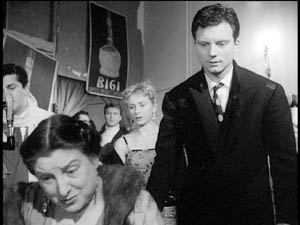
I vitelloni

I Vitelloni (aka The Large Calves) (Federico Fellini, 1953) So many films have come down the strada since this one (American Graffiti, Diner) that bear a resemblance to this nicely melancholy collection of stories about the wasted lives of young men that fans of those later Americanized versions will find themselves in cozily familiar (if uncomfortable) terrain.  It has become a staple of film makers who have become nostalgic, but just smart enough to see their pasts with the lenses of irony and affectionate smugness.

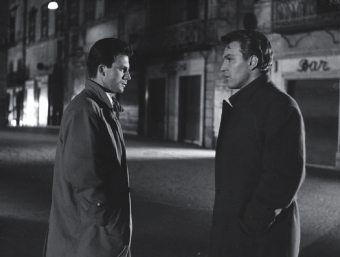
In a provincial town, there are five men who, post-education and living with their parents, are poised on the edge of putting away childish things and becoming men—and they're doing it as slowly as possible: Alberto (Alberto Sordi) a flamboyant life-of-the-partier, which is fine for him but he's bothered by sister's dalliances with a married man; Riccardo (Riccardo Fellini, the director's brother) is a fine baritone with never-realized dreams of being an entertainer;  Leopoldo (Leopoldo Trieste), the intellectual, has the required "script-in-the-drawer," never published, never performed; the unofficial leader, Fausto (Franco Fabrizi), whom all the others look up to, is an unrepentant womanizer, good at seducing but bad at staying 'til morning; then, there's Moraldo (Franco Interlenghi), the youngest, who observes all the behavior, following in the others' footsteps if not down their paths.

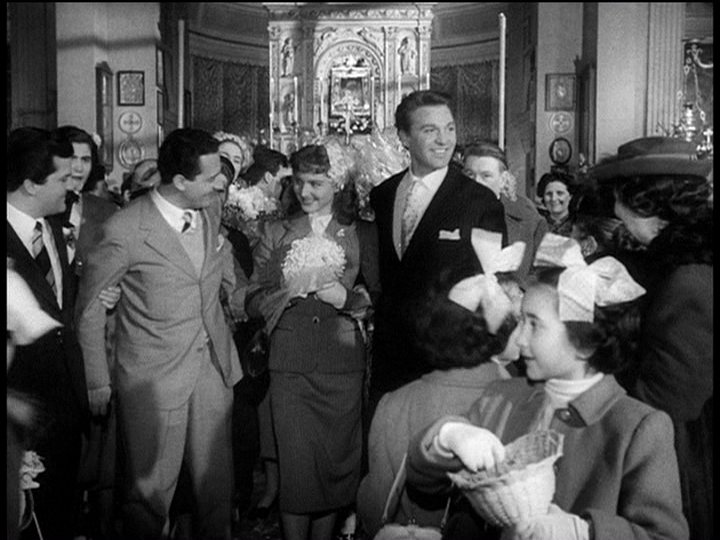
See, there's a problem: Moraldo's sister (Leonora Ruffo), who's just been named "Miss Siren of 1953" at the end-of-Summer bash, is pregnant with Fausto's baby.  When she faints after being crowned, the whole town becomes aware of the scandal and Fausto is forced to marry her, then take on a job as a clerk, which he despises.  Already, Moraldo's loyalties are divided, between loyalty to family and friends, between fun and responsibility, and right and wrong, and it creates a new perspective from which he observes his friends as they listlessly make their way from Summer to Summer (their season to shine) free, but not care-free...and not entirely rootless.  Time goes by, getting by, and all are shown lessons they don't want to learn—about compromise, about self-reliance and duty.  But there's always another party to go to, another prank to pull, another alley to duck into when the going gets uncomfortable.  There's no time to lose, as time can't be wasted, only spent.

It's all set to the sad swagger of Nino Rota's perfectly-in-tune score, and it is one of those rare Fellini films that ends with a resolution, rather than a wry shrug.  There is hope, and an indelible last image that hangs in the memory (and not because it's freeze-framed) that shows how brilliant Fellini could be when he kept things simple (and he had to on this film, shot over six months, with different cinematographers).  The last line is also curious, as it is dubbed, not by the actor, but by Fellini himself.  He would insert himself more and more into his films, until they merged, the two indistinguishable for a time, the man and his work, his dreams made real.


Sittin' on the dock of the bay...wastin' time

.

Saturday, February 26, 2011

My Favorite: Hitchcock

A recent Facebook Note request asked me to pick my fifteen favorite films.   The usual "Anytime movies" were there, and a few others that have crossed my path since starting LNTAM.  But as with any list, what was most fascinating to me was...the ones that were missing.  I've noticed this before when I did the "Anytime Movie" series; there were so many things not there—it's always the frustration I feel when making lists (and thus, why I refrain from doing them).  This led me to considering the film-artists who did not make the cut, and highlighting those films that have had such an impact on me—that I've fallen in love with, that have stayed with me, burrowing into my brain, and eliciting thoughts and emotions unique to those films.  The observations are purely personal (aren't they all?), and why I call this new series of neglected films "My Favorites."

Due to the nature of this particular movie, this article will contain SPOILERS that will actually destroy your enjoyment of the first-time viewing experience.  If you haven't seen Vertigo (and, really... what is keeping you?), you should not proceed further.  And to paraphrase Hitchcock's favorite tease: "No one will be seated after the article has begun." This is your last warning.


"What Is This Thing Called Love" asks the old song (a favorite of mine).  And I especially love the inclusion of the word "thing" to describe it.  What IS Love?  Why is it so powerful?  Why is it an obsession for film-makers, and their audiences, ...and for that matter, the scribes of centuries past...to the point where when we think about Love, it's the kind "like in the movies," (which should set off alarm bells to anyone doubting film's veracity—ever seen an accurate movie on a true story you love?).  And Love in the movies is all-good, an all-consuming passion, "the bestest thing in the world," that makes us better people (better-looking, too), sweetens our coffee, shines our shoes, puts a spring in our step, and makes us orgasm simultaneously, while the metaphorical ocean-waves crash over us.  Orchestral swell and fade to black (before the complications happen).

'Kay...  But it's become SUCH a movie-cliché (and aren't cliché's supposed to be such because they're true?) that movie-makers now "cut to the chase"...almost literally.  In the weaker efforts, people in movies fall in love willy-nilly, without doubt, without resistance, and without staring at the phone for hours at a time—wondering "why aren't they calling?"  It is effortless love, like falling off a love-log, with no pain, no pangs, no problems. 

As Randy Newman (or Joe Cocker) warbles "They don't know what love is."

I like movies that question love.  I like movies that question anything, but questioning love makes me sit up and take notice...which happens rarely.  I generally just slump in my movie-seat, ticking off the "meet-cute," the "song-montage," "the-rough-road," and the "happily-ever-after," so rare is the occurrence.

Alfred Hitchcock made movies in an era where cinematic love was that kind of easy, but he usually liked to sprinkle some salt in with the sugar.  There was no easy path for love in his films, in fact he liked to set up complications for the lovers to overcome—be they heterosexual or homosexual—and his least "typical" film, Mr. & Mrs. Smith, is all about a married couple divorcing and trying to find the path back together, as much as they don't want to.
So, here's Vertigo, which is as pure a love story as Hitchcock ever made despite its deceptively fantastical thriller plot, and it finds the director adapting a novel by the authors of Diabolique (which Hitchcock wanted to film), who might have been writing it precisely for this director, so emblematic of his work are their themes.  Hitchcock took a story of a man hampered with weakness (in this case, acrophobia, fear of heights and thus, fear of falling), and combined it with his own penchant for re-shaping actresses in his own singular fetishistic way to make one of the most personal films.  He'd hoped to lure his favorite actress, Grace Kelly back from Monaco to star in it, but she was dedicated to her fairy-tale marriage to a handsome prince, and declined.  Hitchcock never liked fairy-tales, but this is as close as his sensibilities would go.  But, it is more than that.  It is a mystery.  It is a thriller.  It is a psychological study.  It is a ghost story.  But, most of all, it is a love story...with a bottomless void at its heart.


The first shot of the story—a straight line bi-sects the screen...

A hand comes up in mid-frame and breaks that line—a man climbs a ladder.


Vertigo-proper—aside from the hallucinogenic Title sequence—begins with an undefined image; a murky sky bisected horizontally by a line.  In the first movement of the shot, a hand comes up and grabs it; it is the rung of a ladder, the hand belonging to a criminal making an escape from the police and the protagonist, police detective "Scottie" Ferguson (James Stewart).  A straight-lined pursuit across roof-tops is only temporarily interrupted by the chase-participants' leap across a void—over an open alley-way between buildings.  Everybody makes it with some difficulty, except Scottie.


He is caught suspended, on the brink of a bending gutter on a crumbling cornice, and we experience what he experiences—a change of perception.  It is "the vertigo shot"—an ingenious combination of optics and camera movement, that bends the image creating a telescoping tunnel-image.  Foreground and background separate and stretch, taking a rudimentary shot down, and making it collapse downward—a suspended fall that increases the distance between Scottie and his death.  The shot represents fear and the character's frailty, vertigo, in which heights cause a disorienting dizziness.  Scottie watches in horror as a police officer, who offers a helping hand, loses his footing and falls to his death. 

The sequence ends with Scottie, still hanging, the situation unresolved.  We never see how he gets out of it.

It is some time later, and Scottie's vertigo has forced his retirement from the San Francisco police force.  Out of friendship, curiosity, and a detectives love of a mystery, he takes on a freelance job for an old school chum he's lost track of, Gavin Elster (Tom Helmore). Elster thinks his wife Madeleine (Kim Novak) is going insane; she's become obsessed, maybe even possessed, by an ancestor, Carlotta Valdez, who committed suicide.  The job is simple: follow the wife, find out what he can and report back to Elster.  One look at Madeleine is all Scottie needs.  He follows her obsessive path seeking Carlotta, and follows her, and follows her...


...seemingly to the ends of the Earth, or, in this case, Golden Gate Park.  he is horrified to find Elster's worst fears confirmed: Madeleine jumps into the bay.


Scottie plunges in to save her, and like so much of his path in Vertigo, it's a straight line right to his heart, as his occupational obsession turns into identification and romantic obsession—the curse of so many movie detectives.  He falls in love with Madeleine.  Falls...in love.  And along the way, the straight lines and lateral paths that Scottie travels then become supplanted by something else throughout his investigation—a spiral.


We see that emblematic glyph within the very first moments of the movie (and Bernard Herrmann's cyclical music suggests it, as well), but it shows up throughout the movie in many forms.  Here are some of them:


Madeleine's hair ends in a spiral...
...inspired as it is by the dead Carlotta Valdez's portrait.
The embrace of Scottie and Madeleine suggests a spiral
And, of course, Hitchcock's "vertigo" shot in the steeple is a spiral.


What is a spiral?  A spinning form, its spinnakers flowing out from implied centrifugal force, but at its center...is nothing.  A void...a negative space usually placed by Hitchcock near the center of the screen, unavoidable to the eye.  And as the love between Scottie and Madeleine deepens, their embraces take on a spiral of their own, Hitchcock placing them in the center of the screen, linking the vertiginous "falling" and the lovers' dance.

(This is your last chance to leave before a major spoiler)

It all comes to naught, though.  Madeleine breaks their embrace and, compelled, runs up a Mission tower, which Scottie, in his acrophobia cannot climb.  He watches, horrified, as his love plunges to her death—a reflection of his own horror made real.  He could not stop it, and his life consists of a void.  He's walking down the avenues of grief and depression, at the corners of lust and need, and so much of his self-worth is wrapped up in it, the strong man he wants to be, the weakling he despairs over.  As Carlotta haunted Madeleine, her death haunts him. 

Scottie's nightmares after the death of Madeleine are of such voids...that he could fall into.


He is plunged into a crippling depression, institutionalized, broken.  We can "gussy" it up with hearts and flowers, but Love is chemistry, not the the man/woman variety (and its variations), but specifically, brain chemistry.  Anyone who's had depression or other mental schism, like impulse control or attention deficit disorder, knows that it boils down to chemicals—something's deficient in the attic, some missing ingredient that needs to be augmented.  Our brains are sparking stews of meat and chemicals, serotonin, hormones, pheremones, endorphins, testosterones and oxytocins.  Love lights them up, decreasing and increasing with attraction, pursuit and mating.

So, is Love a mental illness?  Like Scottie's fear?  His depression?  His vertigo?  Is his fear of falling tied to his fear of falling...in love?

Released from the sanitarium, Scottie sees a woman one day, Judy Barton (played, as with Madeleine, by Kim Novak).  He is compelled to pursue her, seeking his lost love.  But, what he does not know, what Judy never wants him to know, is that Judy was Madeleine, duped by Gavin Elster as an accomplice to murder his real wife.  Her love for Scottie is real, so, against her better judgement, she allows Scottie to re-make her—once again—in the image of Madeleine, the clothes, the hair, the make-up (as Hitchcock cast his actresses and made them coiffed blondes in tight grey suits).  Only when the transformation is complete, and Scottie and Judy embrace, does the camera begin to spin around them, creating its own spiral, this time the background changing between the hotel room and the site—a horse-barn—where the earlier love-scene happened.  For Scottie the illusion is complete.  He has found his lost love.

Or, has he?  The fascinating thing about Vertigo to me, aside from the association of Love to mental illness—is that Scottie's love is very real, but attached to, essentially, nothing.  Judy was Madeleine—a role she played for Gavin Elster.  Madeleine, vulnerable, suicidal, in need of rescuing, never existed.  Scottie is in love with an illusion, a figment, a zephyr.  He can re-capture—cruelly to Judy—the love.  But, Judy can never completely be Madeleine to him (despite that she actually is).  He is in love with an idea, a dream of perfection, that actually never existed—a ghost.

This is why I love Vertigo—it is a love story that questions the very nature of what love is, rather than just accepts it.  If you can love an illusion...what is this thing called love?

Whatever it is, Fate steps in.  Scottie is forced, and forces Judy, to relive the fateful steps up the Mission steeple, a move that cures him of his vertigo.  But does it cure his love, as well?  Scottie becomes truly unhinged in this scene, cruelly forcing Judy up the stairs and it is the apex of Stewart's acting career, challenging the beloved image of the "aw shucks" mid-westerner that marked so much of his interesting work in the 1950's.  At the end, we, and Scottie have come full-circle.  He is left on the edge, vertigo cured, but the situation, like his hanging from the gutter at the beginning of the film, is editorially unresolved.  He is left, his arms, like his image in the falling silhouette in his nightmare, slightly apart from his body, not reaching per se, but only slightly outstretched.

And empty.

What is this "thing" called love?  Is it part and parcel of the stew that makes up Scottie's mind, the confluent forces of worth and doubt, hope and despair, pleasure and pain, lust and heart-ache?  Is it part of the depression he feels, or the cause?  What is love, really?

We don't know.  We cannot know.  But the question is raised.  And, like the character of Scottie, we are left—every one of us—on the brink.

Again. And again.


Thursday, February 18, 2010

Valentine's Day

"Love, American Style: The Movie"

A movie top-heavy with stars given a limited time-frame in a limited locale (Los Angeles) where lives intersect and the sub-strata of conflicts are put to the test through the separation of instincts and rational thought.

No, that was "
Crash." But the set-up is the same with less fighting and more clinches. Call it "Squish."

Or better yet, "Smoosh."

This is
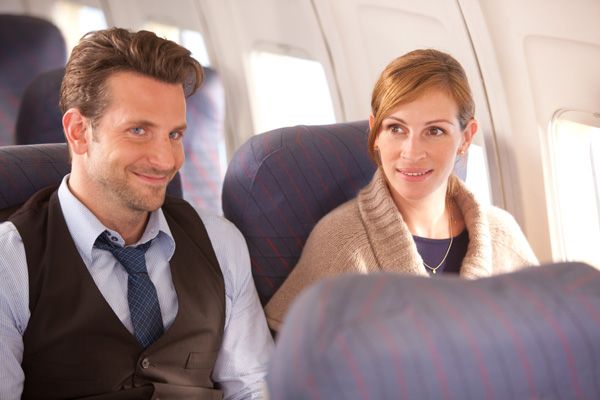
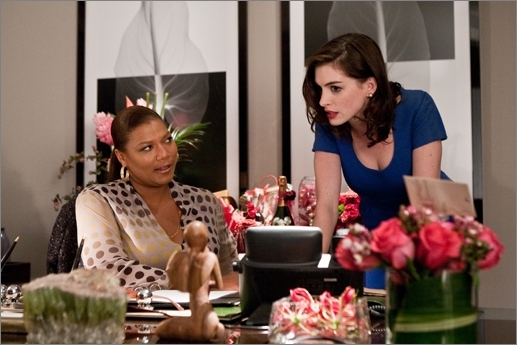
"Valentine's Day" directed by Garry Marshall, whose television career took him from "Love, American Style" through the "Happy Days" Dynasty (or as it's referred, "ABC-TV during the '80's") and into motion pictures, which were usually light comedies. This is a light comedy, too, but with several intersecting stories cross-populated by the stars guesting in other people's stories other than their own, with interstitial vignettes of a comical nature inserted at various places, especially if the ad-libbing gets a little dicey for the editor's sake.

By God, it is "Love, American Style."

The cast is...amazing, frankly. So much so that a superb actor like
Joe Mantegna has a mere cameo of a few seconds (as does the director). Probably just as well, this isn't Mamet material. But there's Alba and Garner and Hathaway and Biel and Roberts and Latifah for the guys. For the girls, there's Dempsey and Dane and Cooper and Foxx and Grace and Kutcher (if L,AS had lasted four more seasons all of these kids would have been on it!). For the oldsters there's George Lopez and Hector Elizondo (he's a requirement of all Garry Marshall movies) and Shirley MacLaine—the one moment I couldn't resist was MacLaine playing a love scene in front of her own projected image (The movie is 1958's "Hot Spell"). For the kids, there's Taylors Swift and Lautner, who are both charming and she has a fine comedienne's willingness to make herself look foolish.

It's frothy as a watered down meringue, but with the occasional sour lemon bite that keeps it from getting too sticky and could lead to puckering...the good kind. Suffice it to say that everything ties up nicely, with a couple of mild surprises along the way. It is supposed to be cute, and all the actors have the presence to dance around the material with their own peculiar rhythms to make it seem fresher than it is, if not better than it is.

"Valentine's Day" is a Cable-Watcher.

Wednesday, January 7, 2009

Valkyrie

"Tom Cruise Takes on Adolph Hitler, Single-Handed"

Man, they've been rough on this movie and particularly Tom Cruise. It's been "Nacht der Langen Messer" for a lot of gossip columnists who fancy themselves critics (but had second-hand facts from their "sources").

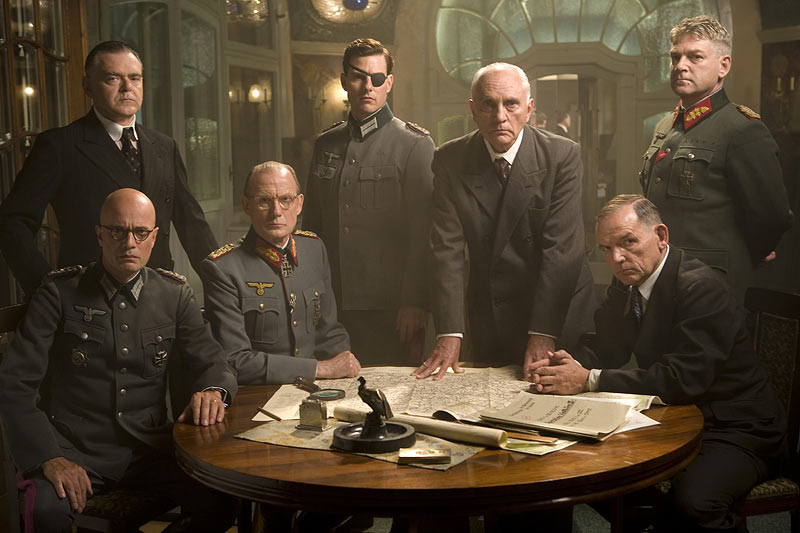
Among the rumors that were cackled about was Cruise's lack of a German accent (there aren't any in the film and Singer makes a big show of having Cruise narrate the beginning of the film in German--a rather stilted, halting German--before transitioning to English), that he rather grossly takes out a glass eye in the film (he does--with his back turned to the camera), that he does a weird Nazi salute (his character—
the very real Count Von Stauffenberg—gets away with forgoing the usual "nicety" throughout the film until, in one the film's best scenes, the War Minister (Tom Wilkinson) calls him on it—"I would hear you say it, Colonel"—and Stauffenberg, irritated that 1) he can't get away with it and 2) he's being forced to give allegiance to a man he's conspiring to kill, pointedly turns and yells the "Heil" while giving the standard right-handed salute—only he doesn't have a right hand, having lost it in the war, the stump of his arm protruding from his jacket, making a point. Good scene, that.)

Look, I don't like
Tom Cruise, either. His performances have dragged down many a movie, especially the vain-glorious ones. The man seems incapable of portraying more than one emotion at a time, and whenever his character must choose options Cruise falls back on an open-mouthed blank look.* Listening to him in interviews I get the impression that his acting process runs something like: "I have to do this, then I have to do this, then I have to do this, and then I have to do this."

But, though he's the King of Hollywood and the "
Jesus Christ of Scientology," one could cut him some slack; none--none--of those rumors are true in the final analysis, and no one making those rumors is held accountable for them, shoddy and unprofessional as they are. But that's "Entertainment Reporting" for ya.**

Enough about the 800 pound top-gorilla. How's the movie? Good, actually. It is a true story and screenwriter
Christopher McQuarrie and Director Bryan Singer (the team behind, and still trying to top, "The Usual Suspects") lay everything out in a clear time-line, do their best to cast faces that have a 1940's German feel and maintain the illusion that it's that time and place. They keep the tension taut and make the most of the story's quirks and coincidences--the kind that make you say "if it weren't true, you couldn't write this." The fascination of the story is that the German bureaucracy that was running the war (badly in the minds of the conspirators) was just as responsible for the conspiracy coming apart, and Stauffenberg was the only one with the Hoden who would push if there was any chance of success, to his credit and the conspiracy's detriment. It's a real-life version of the "Mission: Impossible" scenario, something that Cruise is all-too familiar with.

What's nice is that the film-makers turn the process of pushing through policy-changes into tense set-pieces that have just as much verve as a pistol shoot-out. In fact, there is a small fire-fight later in the film and getting Hitler to sign a policy-change (
the "Valkyrie" operation of the title) is far more exciting. And the central gambit—there's a satchel with a bomb in it that's set to go off in a room full of men—is the classic Hitchcock example of tension versus surprise.

The film is top-heavy with fine British actors: Wilkinson, Terence Stamp (another fine portrait of an ineffectual pol), Bill Nighy, Eddie Izzard (!!), Ian McNeice and Kenneth Branagh. That's a lot of impressive talent for a movie not written by Richard Curtis. And they're all spot-on. Branagh is particularly good as an initial conspirator who is whisked away to the front before the bombing of the Führerhauptquartier Wolfsschanze.

If there's a problem with the movie, it is
Singer's sometimes too-elaborate direction—the most egregious example being a circular camera move that catches up to a record (and it's a 78!) so that it can stabilize on the label to read the word "Walkure" while the rest of the world keeps on spinning—an awful lot of effect for not much return. As such it parallels the story of the movie.*** The film of that story—of conscience over the brutal status quo—is much more successful.

"Valkrie" is a Nachmittagsvorstellung.

* As opposed to Brad Pitt, another Hollywood pretty-boy, but who's managed to pick interesting roles (on occasion) and has grown as an actor of depth and subtlety. Something Cruise used to do. Cruise once was attached to "The Curious Case of Benjamin Button."

** My favorite bit of bone-head journalism from Hollywood came from the "reporter" who asserted that Russel Crowe had gone off the deep-end because he said something about "Bob being his uncle." Shhyeah! Been out of Hollywood much?

*** There is such a rich vein of fascinating stories that came out of the ashes of World War II that would make compelling films. A similar story—of the elaborate civilian aassassination of Hitler's "Golden Boy" (and probable successor) Reinhard Heydrich in 1942 I've always thought would make a compelling story of uprising. But one couldn't tell it without mentioning Hitler's utter crushing of the town of Lidice in reprisal for the attack.