Showing posts with label Romance. Show all posts

Wednesday, November 14, 2012

The Perks of Being a Wallflower

Something from Nothing
or
No Man is an Island of Misfit Toys 

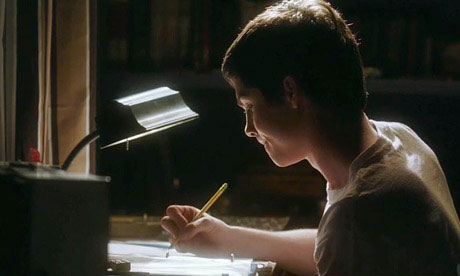
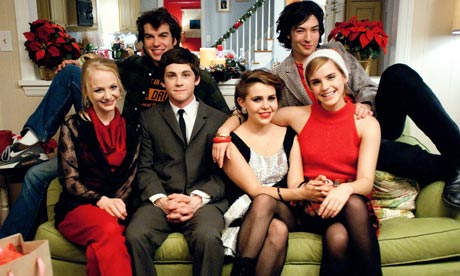
Charlie (Logan Lerman) is starting his first year in High School as a freshman and he has a lot to learn.  He's shy, introverted, and fragile the result of some trauma we know not what going in.  He walks the corridors friendless, a punching bag for the cool kids and their posses.  His parents (Dylan McDermott and Kate Walsh) are lightly caring, and his English teacher (Paul Rudd) reassures—"If you make one friend on your first day, you'll do good."  "If my English professor is the only friend I make today, that'll be sorta depressing."

But Charlie does have one friend, writing to him about his experiences, pouring out his frustrations and observations in letter after letter about his "trying not to be a loser."  The friend is anonymous, may not even exist, or once existed, but those letters keep Charlie going and serve as his avenue of expression, rather than having his day pulled out of him at the family dinner table.   It's an uphill battle from some valley that isn't discussed, but Charlie is self-aware enough to know some perspective.  "My life is officially an after-school special," he grouses.


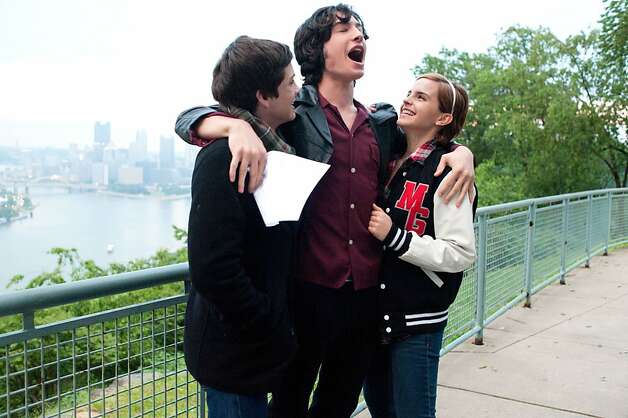
At a football game, he meets Patrick (Ezra Miller), a senior and the subject of some casual bullying, but Patrick has a wicked sense of humor that he throws out with no hesitancy as a shield.  Charlie gravitates to him, and meets Patrick's step-sister Sam (Emma Watson), also a Senior, but who is coming back from "having a reputation."  After the football game, the three hang out at a diner and compare notes of commonality, which involve a distinct lack of fitting in with the high school social structure, and Charlie is introduced to more of the group, who hold fast, hang out, and provide safety in numbers and a fresh perspective on the puerile benefits of normalcy.


The Perks of Being a Wallflower (written and directed by Steven Chbosky  from his own novel) is a fine quirky example of a "Coming of Age" movie, that sub-set of the teen flick where lessons are learned (his life really is an after-school special) and is not so much a film about growing up, as growing out.  Growing out of the insular self-inspection, narcissism and selfishness that is comfortable and has no risk, it's dark and warm and safe in that little "black cave of the psyche."  But is it?  That cave only echoes one's own thoughts back to us, providing no perspective and no horizon to reach to or for.

Yeah, it's pretty safe in there...if there aren't any demons or other creatures of the nightmare lying in wait to strike when you're most vulnerable.  And we all have those.  And even if we don't, the echoes of our own thoughts are only phantoms and zephyrs, not sustaining, and if that's all we cling to, they become echoes of echoes, distorting, becoming less clear, and often impenetrably undecipherable—a feedback loop. 


And feedback loops, uninterrupted, can become weapons.

Charlie is scared.  And ashamed.  And that limits his choices, when he does make a choice.  Most of the time, things are just foisted on him and he has to make a decision: like this, or don't?  Comfortable or not?  Aware, or comatose?  And by the time, he makes a decision, it's usually too late, putting him a tail-spin, and another trap.   His fellow wallflowers are in traps, too (isn't that what High School is all about?), but one thing he learns is that they're not the only ones and the traps, self-made or imposed are universal.

It's a good film, with good imagery, but a neophyte director's tendency to hit things a little too square—the shot from the communion wafer to the LSD tab, please—but the performances feel real, Emma Watson is a helluva dancer, and it's a good trip down memory lane, now that it's gone and out of our lives.  "See ya, wouldn't wanna be ya"

For the truth of the matter is, we all grow out.  We couldn't survive if we didn't.  Yes, "we are infinite" as the movie's tag line wants to be sure we know.  

But not individually.

And not by ourselves.

The Perks of Being a Wallflower is an After-school Special Matinee.


Out of the black cave and into the light


Friday, September 7, 2012

Dark Journey

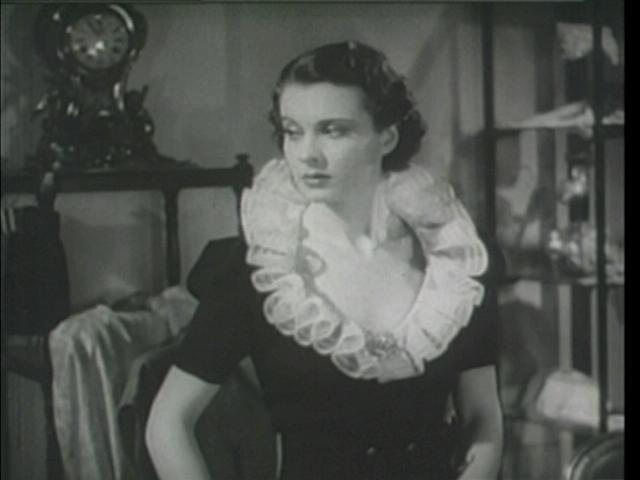
Dark Journey (Victor Saville, 1937) All's fair in love and World War I—but when love and war are running congruently, neck and neck, that's when things really get dicey.  Especially when the warring lovers are spies, spying on each other.  There's Madeleine Goddard (Vivien Leigh) is a designer and couture diva who regularly makes a shopping run between France and Switzerland, cloaking her activities as an agent for the British.  She moves through the hoi-poloi (who never seem aware there's a war going on) attracting all the best customers, none of them suspecting that her decorative scarves and pattern swatches contain secret plans and schematics.  Her assignment—find out who's the head of the German intelligence agency, Section 8.  Enter the snakily charming Baron Karl von Marwitz (Conrad Veit), a German deserter who caddishly trolls the gargantuan supper-clubs with their high ceilings and higher society for the more low hanging fruit of females.  It is through one of his companions that he becomes acquainted with Madeleine, becomes smitten and just a little stalkerish with her.  For some reason, she finds this attractive and the two begin a wary relationship.

Yeah, well, hunt a tiger...and opposites attract, and all that.  It isn't giving away any state secrets that the revelations that ultimately come about are a little less than surprising.  Nor is it surprising that two intelligence agents so visibly hiding in plain sight might not actually be that effective (C'mon kids, it's called "undercover" for a reason).  Imagine the dinner table conversation: "What did you do today?" "Nothing.  And you?"  "Same thing."  Double crossing does not "go" with star-crossing.

Anyway, you thought YOU had a complicated relationship.  This was a few years before Leigh would toss away such behavior with a dismissive "Fiddle-dee-dee."  And it's fun to watch the complications that ensue when the two spies are a little too loose with their lips.  It's amazing that WWI was won at all.

The costumes and sets are lavish (and very un-WWI era).  Leigh and Veidt do very well conveying conflicting loyalties, but the plot is a bit spare in details as to be confusing.  It's never really determined who has the upper hand—is Madeleine basically a "honey-trap" to seduce the German and get him where he can easily be captured, or is it all a misinformation campaign by either side.  Whatever it is, the romance is the least charged of the themes in the film, even though Leigh and Veidt try their damnedest to be anything more than inscrutable.  It's an interesting spy melodrama, it's just that there's not a lot to love.

Thursday, September 6, 2012

Mogambo (1953)

Mogambo  (John Ford, 1953) It's good to be The King.  When you're Clark Gable, King of Hollywood, you can forgive a lot of shortcomings on the acting front.  Mogambo, situated in Africa, and for a large part photographed there, makes Gable the King of the Jungle and no less predatory than some of the denizens.  If the film has a shortcoming, and it has a few, it's that it depends so much on Gable's charisma to carry what is essentially an under-written "man's man" of a role—one who will take a woman in his arms and plant one with a mere change in the barometer, his, hers or Nature's.  Gable's Vic Marswell is so fragile in his moods, he's practically bi-polar, swinging from cranky to rapacious to "I don't care," running hot and cold and more than a little unreadable either way.  And for the women in the film, Eloise "Honey Bear" Kelly (a plucky Ava Gardner), a recklessly adventurous widow, and Lina Nordley (Grace Kelly, still in her neurotic, fragile period), wife of Marswell's current client, it creates a weird triangle that I.Sosceles himself couldn't figure out.  Maybe it's the heat of Africa, or maybe it's the wild life of the wildlife, but both of these women, with lots going for them, still neurotically slam themselves like meteors into Winslow's orbit.  And while the heat and flash are nice, things burn out mighty quick.  And the only explanation is "it's Gable," in a writer's shorthand that defies logic, common sense, or understandable motivation (other than box-office).  It's just assumed that any woman's going to throw themselves at the King, no matter how much of a tiger trap he might be.

That shaky "given" aside, it's a nice adventure entertainment, directed by John Ford with a painterly eye trained on a new canvas.  The Technicolor cinematography—by Freddie Young and Robert Surtees—is absolutely gorgeous, whether in the blinding sunlight of a native village, or the shadowy slats of a "civilized" encampment.  Ford is a long way from the locations he favored in his Westerns, but adjusts, employing his fascination with native culture in the same diversions of including the faces of the tribes, distinguishing them from each other and, in a single set up, putting the flavor of the place on obvious display.  He's truly recharged and energized by Africa, his camera roaming all over, finding the picturesque and telling details.*

And it's interesting to note (to me, anyway) that Ford is essentially making a Howard Hawks movie:  a group of professionals and semi-professionals trying to eke out a living (and a kind of focused community) despite their differences.  Hawks and Ford would knowingly tip their hats to each other in their projects—if it didn't interfere with their own process—and there are a lot of the Hawks hallmarks here—the group sing-along, the loaning and sharing of a cigarette as relationship sub-text, the strong females (one of whom is "just one of the boys"), and the alpha male who has a code, few words, and manages to mangle them around the opposite sex.**

Even if the emotions run a little too high and there's way too much drama to get any real work done, there's a lot in Mogambo to like, that is pleasing to the eye.  The story's not much, but it sure is interesting to see how Ford tells it.

  
Gardner and Kelly-revealed in their environments


* One of my favorite shots is a simple one of Gable and company walking the high grass on a trapping trip, shot at ground level, looking up through the wisps at the party.  How much less interesting would that shot have been from any other angle?  How much less would it have said about the conditions there, while making the most of the surroundings?  Ah, I'm probably getting all "academic" here.  Ford probably shot it that way to avoid seeing a garbage heap in the distance.  

** Hawks made his own version of the "African trapper" story—Hatari—ten years later with John Wayne (although internet sources say Gable was to co-star "but who believes the Internet?") with a more cohesive group (the kids have the relationship problems, not the leader) turning the story into a metaphor for a filmmaking crew).  The differences are night and day—in style and atmosphere—despite the similarities in subject matter.  In Hawks, the relationships are background, while the job is scenter-stage.  In Ford, it's the other way around.  They'd make an interesting double-bill.

Thursday, March 10, 2011

The Adjustment Bureau


"I Guess The Lord Must Be in New York City"
or
"Dicking Around with People's Lives..."

The stories of Philip K. Dick have provided all sorts of story-fodder for the movies for both good or illBlade Runner, Total Recall, Minority Report, Paycheck, A Scanner Darkly, Next, and Impostor.
They feature the sort of high-concept story-spine that easily translates into genre-bending sci-fi/fantasy films that are the easiest thing to translate to the screen short of a superhero property.  Just put a slight spin on a story concept—a police force that stops crimes before they happen, spies and detectives who are mentally undercover, a guy who can see into the future, but just eight minutes out—all odd concepts that illuminate the character dilemma in a way that a straight story might not highlight.  You don't have to be a genius to "get" what the movie says.  And the inevitable SFX look great on trailers.

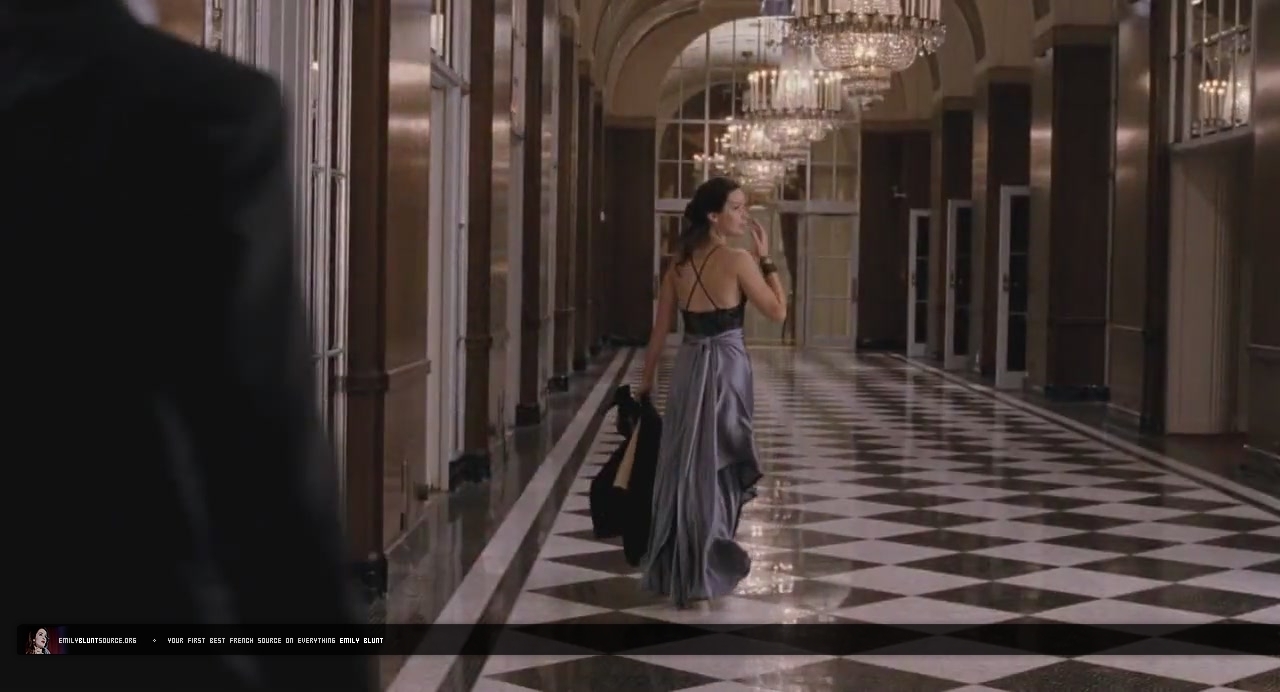
So, here's The Adjustment Bureau, a paranoid conspiracist's validation of all things manipulated.  Young senatorial candidate David Norris (Matt Damon) is about to lose an election big, due to some ill-considered party-decisions earlier in his life.  In the men's room of the Waldorf, he practices his contrite, yet defiant acceptance speech, only to find that he is being overheard by Elise Sellas (Emily Blunt), who is evading hotel security after crashing a wedding upstairsIt's a "meet-cute" as the two banter about Norris' loser-status and Elise becomes intrigued enough to plant a lip-lock on himHis campaign manager (the always welcome Michael Kelly) walks in just in time to catch this and bust it up to get Norris to the ballroom to admit defeat.  I'd've fired him on the spot.

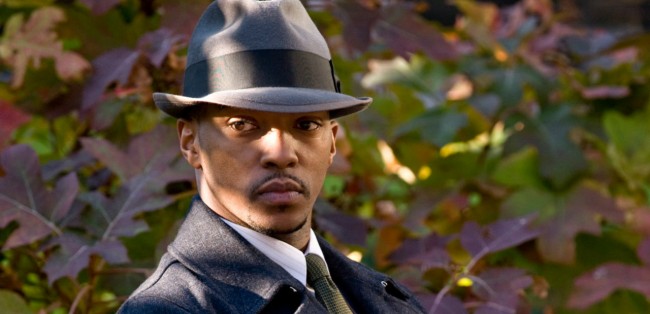
It's some time later and Norris is working for an investment capital firm with his manager.  He's running a little late, so he doesn't notice a team of angular men in business suits and fedoras are shadowing him.  One in particular—Harry (Anthony Mackie)—has an assignment: Norris must spill coffee on his shirt by 9:05 am, not any later. It's his job, says Agent Richardson (John Slattery), so don't screw it up. 

But, if he didn't, there wouldn't be a movie.

There's no use crying over unspilled coffee, but as a result, the rest of the movie is the Team attempting to solve the mess the non-mess creates: Norris is able to catch his bus on-time, where he once again encounters Elise, and gets to work just in time to see the Pre-Destinators (my term) sweeping the office, the personnel frozen, and key players receiving a "mind-wipe."  Norris catches on quickly, and tries to evade the invaders, only to find them around every office corner, calmly telling him to that, really, he should take it easy and cooperate and "this" will all go a lot easier.

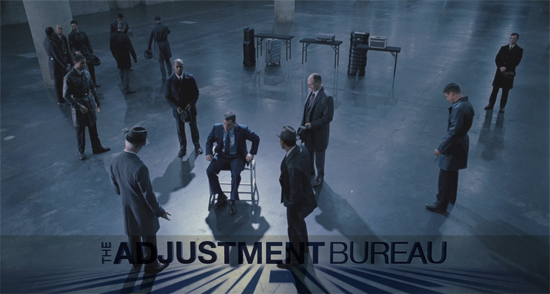
He wakes up in an empty warehouse, with his pursuers deigning to tell him the truth about things: "You've just seen behind the curtain you never knew existed."  They're a team of agents who manipulate events among humankind—a kind of Uber-illuminati ('"sometimes it's chance, sometimes it's us")—at the behest of "The Chairman."  They lay down the law: He can't have a relationship with Elise, which David objects to ("Your entire world just changed and you're thinking about a woman?") as it's not in "the plan," and if he tells anybody about what he's seen, they'll make everyone think he's crazy, and "reset" him, leaving him basically lobotomized.* 

Norris is too much a free-thinker to obey the "button-down men of Fate" and the rest of the movie entails him "changing the curtains," as it were.  It's very clever and director George Nolfi, (who wrote the screenplay for the similarly time-trippy Timeline, had fun adapting his screenplay "Honor Among Thieves" into what would become Ocean's Twelve, and was one of the team who wrote—and re-wrote—The Bourne Ultimatum) ingeniously keeps things moving at a good clip, while also staying one jump ahead of the story-complications inherent in the plot...while also doing enough cinematic sleight-of-hand to keep the Doubting Thomases in the audience from falling into plot-holes.  He gets good performances out of everyone—allowing enough ad-libbing in the scenario to make it seem real and fresh, sort of a real-life version of the film's conceit of re-writing History in pencil before the Cosmic Ink dries.  It's fast, fun, and fresh and avoids pretentiousness or taking itself too damn seriously.  It is only after a little Time has passed that it feels a bit slight, but who could have anticipated that?

One thing is for sure: I gotta get me one of them hats!

The Adjustment Bureau is a Matinee.


* At that point I flashed on former CBS news-anchor Dan Rather walking down a New York Street and being attacked by men and all they said was "What's the frequency, Kenneth?"  Everybody acted like Rather had had "a spell," but I wonder if his attackers were wearing hats.

Wednesday, March 9, 2011

Ryan's Daughter


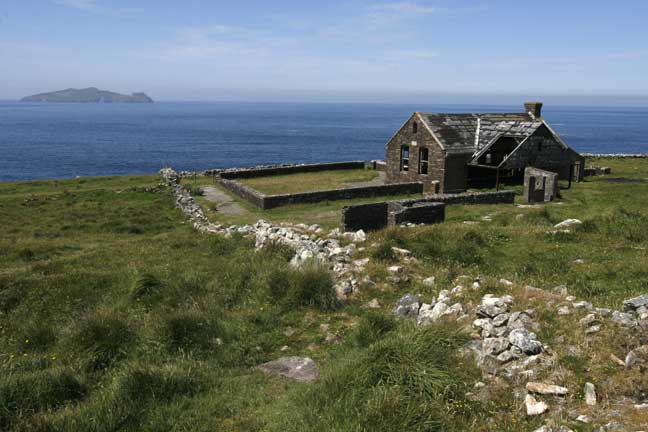
Ryan's Daughter (David Lean, 1970) This is director David Lean's supposed "big flop," although, now, given a few decades of perspective (40 years?), Time can be seen to be quite kind to it, revealing it to be solid as a film, and as film-making, unburdened by the need to survive in the capricious tastes of film-critics during the "youth-culture" cusp of the 1970's.  While so many of the films that were sending the filmophiliacs into paroxysms of tortured metaphor have crumbled into the dust of pretentiousness, this one still stands up as a story well told...even if the story might be a little frayed and dog-eared.

One can quibble.  Yes, it's elephantine in a way that a small-scale story shouldn't be (it's more than 3 hours, time enough for an epic, or at least a couple more infidelity stories thrown in!) and the huge landscapes that Lean favors tend to dwarf the participants of the tiny Irish town of Kirarry (not to mention there's a LOT of people in the crowd scenes...where do they all LIVE!).  But, the only serious charge is that Lean is merely being Lean (as in being himself, as opposed to the inelegantly penny-pinching film-making of its era—he spent a year making it "just-so," due to the ever-changing coastal climate of the location, and another year editing and fine-tuning it).  Lean may not have been a versatile director, altering his technique for every film (nor does a leopard change its spots...because it's a gall-durned leopard and doesn't have to) but he certainly achieves the maximum in every shot...and one is never confused or questioning what is going on.  For all the big vistas, there's a lot of small nuance going on, that merely represents good story-telling.


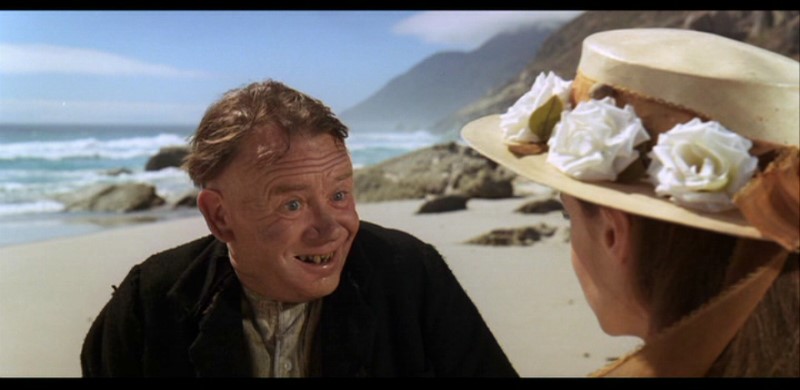
Sure, there are things that grate: Maurice Jarre's egregiously "mickey-mousing" score, or maybe a couple of scenes are pushed a little hard—the post-traumatic stress incident that erupts from John Mills' "village idiot" swinging his leg against the wall, the venality of the town's citizenry—but, one can see why Lean did what he did, and the drama benefited, ultimately, from such touches.


It started out as an adaptation of Flaubert's "Madame Bovary" by screenwriter Robert Bolt.  By this time, Bolt and Lean had a working relationship as tight as Powell and Pressburger ("The Archers") did.  Lean told the writer he was not interested, even if it was written for his wife, Sarah Miles.  Lean had higher ambitions for his films now.  Like Lawrence of Arabia and Doctor Zhivago, he wanted the problems of his figures in a landscape to have political overtones, rather than just the caprices of their natures.  And with present day tensions in Belfast between British Army forces and the IRA in the headlines, locales were switched, accommodations made, and, one feminist nice concession, the female adulterer didn't have to pay the ultimate price for her crimes of indiscretion.  Oh.  She pays...(things hadn't advanced that far!), but it's the male (a cute, but out-of-his-depth, Christopher Jones) who sacrifices himself...in the guise of destroying evidence.


Bolt wrote his "Irish Bovary," but called it "Michael's Day," after John Mills' poor unfortunate—unfortunate, maybe, but he's the only character who doesn't judge, the lowest of the social strata, but the highest in moral character, followed by the priest Father Hugh (Trevor Howard), who is judgemental, but doesn't allow that to not seek the judged's salvation.  In Kirarry, the first one now will later be last, and those who are triumphant by film's end will suffer a life of misery due to it...just by being themselves.

Lean's Irish crowds can be seen in the cackling crones of John Ford's Irish films, or the scandalously rich elite in George Cukor's films—these film-makers are only too happy to take down the gossips and gadabouts in the eyes of the audience, showing their true colors despite the trappings of civility.  In truth, they are more like barnyard animals taking full advantage of pack mentality and pecking order.  It's not the only instance of Lean using Nature to tell the story, not with so much scenery and weather filling his frames perfectly.  But, their shallow triumphs have no permanence, because their attitudes leave a lasting impression, long after they've left the screen.


The actors, save for the callow Jones, are great: Miles is not afraid to show her Rosy Ryan as a selfish brat, Mills creates a character as pathetic (and sometimes as mawkish) as Chaplin's Little Tramp (and he won an Academy Award for it), Leo McKern, bold and blustery as Rosy's too-eager-to-please Conformist-father, but the best are Robert Mitchum, cast against type as Rosy's cuckolded older husbanda bull in a china shop just aware of breaking his first dish—and Trevor Howard, who even whispers in a roar as the Kirarry parish priest—a great, bold, stamping performance of ingenuity and froth.

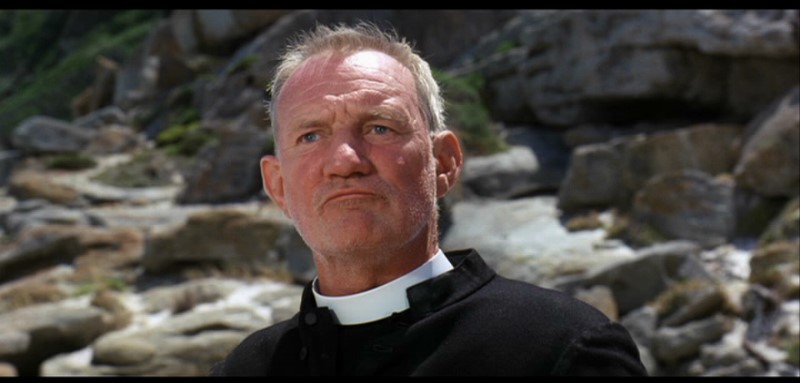
But, in the end, it is Lean's film, as personal as he could make it with those wide Earth-framing lenses.  The figures may be fighting the crags and spray of the Irish coast, but when Lean chooses to bring them front and center, it is always with the best design sense and a painter's eye.  Look at the two frames below: as Rosy runs from her husband's bed to join her wounded soldier of a lover, smoke inexplicably—chimney fire, maybe?—roiling over the hill, darkening the moment; and the next shot, as Mitchum's school-master Charles Shaughnessy, sees with his own eyes and not his suspicions, his betrayal out in the open, trapped behind glass and bars, he retreats, his eyes falling into shadow, displaying the loss he is reluctant to express. 


It doesn't get much better than that.  And there's over three hours of this meticulousness and beauty.  It might be a bit rich.  But it's quite the banquet.

Saturday, February 26, 2011

My Favorite: Hitchcock

A recent Facebook Note request asked me to pick my fifteen favorite films.   The usual "Anytime movies" were there, and a few others that have crossed my path since starting LNTAM.  But as with any list, what was most fascinating to me was...the ones that were missing.  I've noticed this before when I did the "Anytime Movie" series; there were so many things not there—it's always the frustration I feel when making lists (and thus, why I refrain from doing them).  This led me to considering the film-artists who did not make the cut, and highlighting those films that have had such an impact on me—that I've fallen in love with, that have stayed with me, burrowing into my brain, and eliciting thoughts and emotions unique to those films.  The observations are purely personal (aren't they all?), and why I call this new series of neglected films "My Favorites."

Due to the nature of this particular movie, this article will contain SPOILERS that will actually destroy your enjoyment of the first-time viewing experience.  If you haven't seen Vertigo (and, really... what is keeping you?), you should not proceed further.  And to paraphrase Hitchcock's favorite tease: "No one will be seated after the article has begun." This is your last warning.


"What Is This Thing Called Love" asks the old song (a favorite of mine).  And I especially love the inclusion of the word "thing" to describe it.  What IS Love?  Why is it so powerful?  Why is it an obsession for film-makers, and their audiences, ...and for that matter, the scribes of centuries past...to the point where when we think about Love, it's the kind "like in the movies," (which should set off alarm bells to anyone doubting film's veracity—ever seen an accurate movie on a true story you love?).  And Love in the movies is all-good, an all-consuming passion, "the bestest thing in the world," that makes us better people (better-looking, too), sweetens our coffee, shines our shoes, puts a spring in our step, and makes us orgasm simultaneously, while the metaphorical ocean-waves crash over us.  Orchestral swell and fade to black (before the complications happen).

'Kay...  But it's become SUCH a movie-cliché (and aren't cliché's supposed to be such because they're true?) that movie-makers now "cut to the chase"...almost literally.  In the weaker efforts, people in movies fall in love willy-nilly, without doubt, without resistance, and without staring at the phone for hours at a time—wondering "why aren't they calling?"  It is effortless love, like falling off a love-log, with no pain, no pangs, no problems. 

As Randy Newman (or Joe Cocker) warbles "They don't know what love is."

I like movies that question love.  I like movies that question anything, but questioning love makes me sit up and take notice...which happens rarely.  I generally just slump in my movie-seat, ticking off the "meet-cute," the "song-montage," "the-rough-road," and the "happily-ever-after," so rare is the occurrence.

Alfred Hitchcock made movies in an era where cinematic love was that kind of easy, but he usually liked to sprinkle some salt in with the sugar.  There was no easy path for love in his films, in fact he liked to set up complications for the lovers to overcome—be they heterosexual or homosexual—and his least "typical" film, Mr. & Mrs. Smith, is all about a married couple divorcing and trying to find the path back together, as much as they don't want to.
So, here's Vertigo, which is as pure a love story as Hitchcock ever made despite its deceptively fantastical thriller plot, and it finds the director adapting a novel by the authors of Diabolique (which Hitchcock wanted to film), who might have been writing it precisely for this director, so emblematic of his work are their themes.  Hitchcock took a story of a man hampered with weakness (in this case, acrophobia, fear of heights and thus, fear of falling), and combined it with his own penchant for re-shaping actresses in his own singular fetishistic way to make one of the most personal films.  He'd hoped to lure his favorite actress, Grace Kelly back from Monaco to star in it, but she was dedicated to her fairy-tale marriage to a handsome prince, and declined.  Hitchcock never liked fairy-tales, but this is as close as his sensibilities would go.  But, it is more than that.  It is a mystery.  It is a thriller.  It is a psychological study.  It is a ghost story.  But, most of all, it is a love story...with a bottomless void at its heart.


The first shot of the story—a straight line bi-sects the screen...

A hand comes up in mid-frame and breaks that line—a man climbs a ladder.


Vertigo-proper—aside from the hallucinogenic Title sequence—begins with an undefined image; a murky sky bisected horizontally by a line.  In the first movement of the shot, a hand comes up and grabs it; it is the rung of a ladder, the hand belonging to a criminal making an escape from the police and the protagonist, police detective "Scottie" Ferguson (James Stewart).  A straight-lined pursuit across roof-tops is only temporarily interrupted by the chase-participants' leap across a void—over an open alley-way between buildings.  Everybody makes it with some difficulty, except Scottie.


He is caught suspended, on the brink of a bending gutter on a crumbling cornice, and we experience what he experiences—a change of perception.  It is "the vertigo shot"—an ingenious combination of optics and camera movement, that bends the image creating a telescoping tunnel-image.  Foreground and background separate and stretch, taking a rudimentary shot down, and making it collapse downward—a suspended fall that increases the distance between Scottie and his death.  The shot represents fear and the character's frailty, vertigo, in which heights cause a disorienting dizziness.  Scottie watches in horror as a police officer, who offers a helping hand, loses his footing and falls to his death. 

The sequence ends with Scottie, still hanging, the situation unresolved.  We never see how he gets out of it.

It is some time later, and Scottie's vertigo has forced his retirement from the San Francisco police force.  Out of friendship, curiosity, and a detectives love of a mystery, he takes on a freelance job for an old school chum he's lost track of, Gavin Elster (Tom Helmore). Elster thinks his wife Madeleine (Kim Novak) is going insane; she's become obsessed, maybe even possessed, by an ancestor, Carlotta Valdez, who committed suicide.  The job is simple: follow the wife, find out what he can and report back to Elster.  One look at Madeleine is all Scottie needs.  He follows her obsessive path seeking Carlotta, and follows her, and follows her...


...seemingly to the ends of the Earth, or, in this case, Golden Gate Park.  he is horrified to find Elster's worst fears confirmed: Madeleine jumps into the bay.


Scottie plunges in to save her, and like so much of his path in Vertigo, it's a straight line right to his heart, as his occupational obsession turns into identification and romantic obsession—the curse of so many movie detectives.  He falls in love with Madeleine.  Falls...in love.  And along the way, the straight lines and lateral paths that Scottie travels then become supplanted by something else throughout his investigation—a spiral.


We see that emblematic glyph within the very first moments of the movie (and Bernard Herrmann's cyclical music suggests it, as well), but it shows up throughout the movie in many forms.  Here are some of them:


Madeleine's hair ends in a spiral...
...inspired as it is by the dead Carlotta Valdez's portrait.
The embrace of Scottie and Madeleine suggests a spiral
And, of course, Hitchcock's "vertigo" shot in the steeple is a spiral.


What is a spiral?  A spinning form, its spinnakers flowing out from implied centrifugal force, but at its center...is nothing.  A void...a negative space usually placed by Hitchcock near the center of the screen, unavoidable to the eye.  And as the love between Scottie and Madeleine deepens, their embraces take on a spiral of their own, Hitchcock placing them in the center of the screen, linking the vertiginous "falling" and the lovers' dance.

(This is your last chance to leave before a major spoiler)

It all comes to naught, though.  Madeleine breaks their embrace and, compelled, runs up a Mission tower, which Scottie, in his acrophobia cannot climb.  He watches, horrified, as his love plunges to her death—a reflection of his own horror made real.  He could not stop it, and his life consists of a void.  He's walking down the avenues of grief and depression, at the corners of lust and need, and so much of his self-worth is wrapped up in it, the strong man he wants to be, the weakling he despairs over.  As Carlotta haunted Madeleine, her death haunts him. 

Scottie's nightmares after the death of Madeleine are of such voids...that he could fall into.


He is plunged into a crippling depression, institutionalized, broken.  We can "gussy" it up with hearts and flowers, but Love is chemistry, not the the man/woman variety (and its variations), but specifically, brain chemistry.  Anyone who's had depression or other mental schism, like impulse control or attention deficit disorder, knows that it boils down to chemicals—something's deficient in the attic, some missing ingredient that needs to be augmented.  Our brains are sparking stews of meat and chemicals, serotonin, hormones, pheremones, endorphins, testosterones and oxytocins.  Love lights them up, decreasing and increasing with attraction, pursuit and mating.

So, is Love a mental illness?  Like Scottie's fear?  His depression?  His vertigo?  Is his fear of falling tied to his fear of falling...in love?

Released from the sanitarium, Scottie sees a woman one day, Judy Barton (played, as with Madeleine, by Kim Novak).  He is compelled to pursue her, seeking his lost love.  But, what he does not know, what Judy never wants him to know, is that Judy was Madeleine, duped by Gavin Elster as an accomplice to murder his real wife.  Her love for Scottie is real, so, against her better judgement, she allows Scottie to re-make her—once again—in the image of Madeleine, the clothes, the hair, the make-up (as Hitchcock cast his actresses and made them coiffed blondes in tight grey suits).  Only when the transformation is complete, and Scottie and Judy embrace, does the camera begin to spin around them, creating its own spiral, this time the background changing between the hotel room and the site—a horse-barn—where the earlier love-scene happened.  For Scottie the illusion is complete.  He has found his lost love.

Or, has he?  The fascinating thing about Vertigo to me, aside from the association of Love to mental illness—is that Scottie's love is very real, but attached to, essentially, nothing.  Judy was Madeleine—a role she played for Gavin Elster.  Madeleine, vulnerable, suicidal, in need of rescuing, never existed.  Scottie is in love with an illusion, a figment, a zephyr.  He can re-capture—cruelly to Judy—the love.  But, Judy can never completely be Madeleine to him (despite that she actually is).  He is in love with an idea, a dream of perfection, that actually never existed—a ghost.

This is why I love Vertigo—it is a love story that questions the very nature of what love is, rather than just accepts it.  If you can love an illusion...what is this thing called love?

Whatever it is, Fate steps in.  Scottie is forced, and forces Judy, to relive the fateful steps up the Mission steeple, a move that cures him of his vertigo.  But does it cure his love, as well?  Scottie becomes truly unhinged in this scene, cruelly forcing Judy up the stairs and it is the apex of Stewart's acting career, challenging the beloved image of the "aw shucks" mid-westerner that marked so much of his interesting work in the 1950's.  At the end, we, and Scottie have come full-circle.  He is left on the edge, vertigo cured, but the situation, like his hanging from the gutter at the beginning of the film, is editorially unresolved.  He is left, his arms, like his image in the falling silhouette in his nightmare, slightly apart from his body, not reaching per se, but only slightly outstretched.

And empty.

What is this "thing" called love?  Is it part and parcel of the stew that makes up Scottie's mind, the confluent forces of worth and doubt, hope and despair, pleasure and pain, lust and heart-ache?  Is it part of the depression he feels, or the cause?  What is love, really?

We don't know.  We cannot know.  But the question is raised.  And, like the character of Scottie, we are left—every one of us—on the brink.

Again. And again.


Wednesday, February 23, 2011

Love Story (1970)


Love Story (Arthur Hiller, 1970) What can you say about a 40 year old movie that manages to stay alive, despite being so much of its time?  That it's maudlin, and saccarine, completely apolitical in a time of radicals, shamelessly tear-jerkey, and ridiculously dishonest in its treatment of disease?  That its success was completely manufactured by a marketing strategy so machiavellian that it belied any of the inspiration that might go along with a phenomenon?  That, what looked like a delicate butterfly to those enthralled with it, actually more resembled one of Disney's hippoes in a tutu

Yeah, yeah.  But, damn it, it works. (sob!)
At least, it did on me when it was first released.

Truth is, Love Story started as a screenplay that Erich Segal sold to Paramount.  Producer Robert Evans (to whom the credit for its success must assuredly go, as it was, literally, "a labor of love" for his then girl-friend Ali MacGraw).  It was a low-budget film with no "buzz" and Segal was encouraged to write a "tie-in" novel to help boost its caché.  Released on Valentine's Day, and bolstered by studio-engineered "block-buying," it made the New York Times Bestseller List, and, being slight and written in a punchy, simple style, mushroomed to become a "thing."  The success of the movie was almost a sure-thing.

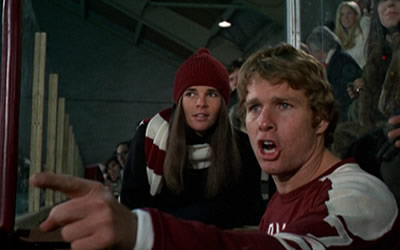
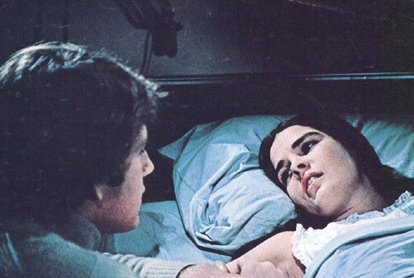
With the passage of time, the "phenom" aspect of it has disappeared and one can look at it without much prejudiceArthur Hiller's direction is largely inelegant, combining a "caught-on-the-fly" feeling that was popular in the wake of Easy Rider (but without the pretentious editing tricks) with television style blocking.  The film hinges on a score by Francis Lai (A Man and a Woman) that is used for a few "frolic-in-love" scenes.  The acting varies in quality from professional turns by veterans Ray Milland and John Marley to the "do as little as possible and just be sincere" performance by Ryan O'Neal, and a functional one by Ali MacGraw, that started to show the cracks in her abilities that weren't apparent in Goodbye, Columbus.*  Still, it jerks tears...if one has lost or (and probably more importantly) if one has not.  Imagined grief can sometimes be more powerful than the actual if one lives in a fantasy-world.  Anyone who has lost someone to a lingering disease will be a bit perplexed by this aspect of Love Story and could righteously yell "bullshit."  Roger Ebert went so far as to call what heroine Jenny succumbs to as "Ali MacGraw Disease" ("Movie illness in which the only symptom is that the sufferer grows more beautiful as death approaches").  Movie Magic in Hollywood.  "She's going.  I need pancake make-up STAT"

But, the part the most galling aspect of Love Story—The Book! The Movie!  The Phenomenon!—to me, personally, is its bracketing tag-line—"Love means never having to say you're sorry"—which would make a great Hallmark card if it wasn't such crap.**  It would be easy if love meant never having to say you're sorry (certainly, it would be nice if it meant never having to say you're sorry that you've loved!)  But the fact of the matter is that, if you're doing it right...or wrong...love really means saying you're sorry.  It's common courtesy.  And hopefully, you learn from having to say it, to change the behavior that demands an apology.  Love cares.  Love accomodates.  Love humbles.  And ('cause the Bible tells us so) love never dies.

Not in the real world.

Sorry.


* MacGraw and O'Neal were nominated for Oscars for Best Lead Performances that season, which seems less to do with merit than with studio electioneering.  The film was nominated for 7 Academy Awards, but only won one...for Lai's score.  It was Patton's year that year (and I'd argue that Jerry Goldsmith's lean score for that film has had more importance, both to its film and the legacy of film music, than Lai's).  But, in a year of Patton, Five Easy Pieces and M*A*S*H, Woodstock, Let It Be, The Great White Hope, Women in Love, and Ryan's Daughter, it's a little difficult to see how Love Story could compete on any level. 


** Just found an article where even MacGraw says "it makes no sense."