"I Guess The Lord Must Be in New York City"
or
"Dicking Around with People's Lives..."
The stories of Philip K. Dick have provided all sorts of story-fodder for the movies for both good or ill: Blade Runner, Total Recall, Minority Report, Paycheck, A Scanner Darkly, Next, and Impostor.
They feature the sort of high-concept story-spine that easily translates into genre-bending sci-fi/fantasy films that are the easiest thing to translate to the screen short of a superhero property. Just put a slight spin on a story concept—a police force that stops crimes before they happen, spies and detectives who are mentally undercover, a guy who can see into the future, but just eight minutes out—all odd concepts that illuminate the character dilemma in a way that a straight story might not highlight. You don't have to be a genius to "get" what the movie says. And the inevitable SFX look great on trailers.
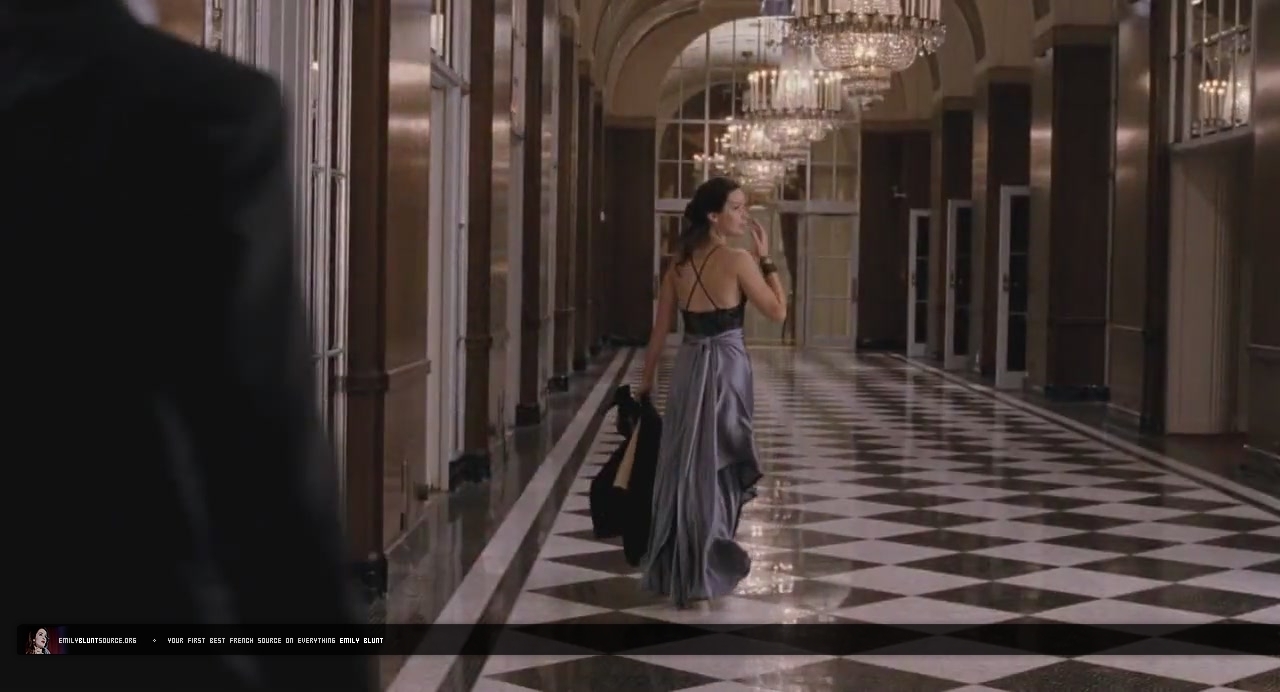
So, here's The Adjustment Bureau, a paranoid conspiracist's validation of all things manipulated. Young senatorial candidate David Norris (Matt Damon) is about to lose an election big, due to some ill-considered party-decisions earlier in his life. In the men's room of the Waldorf, he practices his contrite, yet defiant acceptance speech, only to find that he is being overheard by Elise Sellas (Emily Blunt), who is evading hotel security after crashing a wedding upstairs. It's a "meet-cute" as the two banter about Norris' loser-status and Elise becomes intrigued enough to plant a lip-lock on him. His campaign manager (the always welcome Michael Kelly) walks in just in time to catch this and bust it up to get Norris to the ballroom to admit defeat. I'd've fired him on the spot.
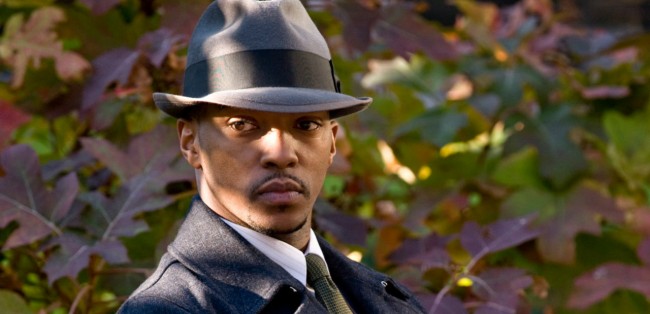
It's some time later and Norris is working for an investment capital firm with his manager. He's running a little late, so he doesn't notice a team of angular men in business suits and fedoras are shadowing him. One in particular—Harry (Anthony Mackie)—has an assignment: Norris must spill coffee on his shirt by 9:05 am, not any later. It's his job, says Agent Richardson (John Slattery), so don't screw it up.
But, if he didn't, there wouldn't be a movie.
There's no use crying over unspilled coffee, but as a result, the rest of the movie is the Team attempting to solve the mess the non-mess creates: Norris is able to catch his bus on-time, where he once again encounters Elise, and gets to work just in time to see the Pre-Destinators (my term) sweeping the office, the personnel frozen, and key players receiving a "mind-wipe." Norris catches on quickly, and tries to evade the invaders, only to find them around every office corner, calmly telling him to that, really, he should take it easy and cooperate and "this" will all go a lot easier.
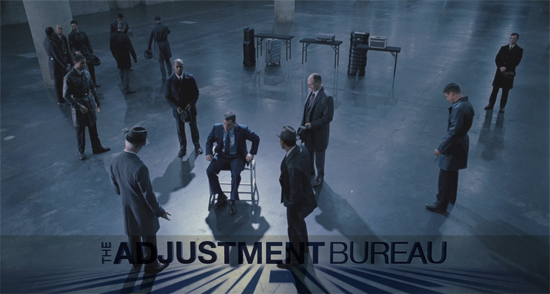
He wakes up in an empty warehouse, with his pursuers deigning to tell him the truth about things: "You've just seen behind the curtain you never knew existed." They're a team of agents who manipulate events among humankind—a kind of Uber-illuminati ('"sometimes it's chance, sometimes it's us")—at the behest of "The Chairman." They lay down the law: He can't have a relationship with Elise, which David objects to ("Your entire world just changed and you're thinking about a woman?") as it's not in "the plan," and if he tells anybody about what he's seen, they'll make everyone think he's crazy, and "reset" him, leaving him basically lobotomized.*
Norris is too much a free-thinker to obey the "button-down men of Fate" and the rest of the movie entails him "changing the curtains," as it were. It's very clever and director George Nolfi, (who wrote the screenplay for the similarly time-trippy Timeline, had fun adapting his screenplay "Honor Among Thieves" into what would become Ocean's Twelve, and was one of the team who wrote—and re-wrote—The Bourne Ultimatum) ingeniously keeps things moving at a good clip, while also staying one jump ahead of the story-complications inherent in the plot...while also doing enough cinematic sleight-of-hand to keep the Doubting Thomases in the audience from falling into plot-holes. He gets good performances out of everyone—allowing enough ad-libbing in the scenario to make it seem real and fresh, sort of a real-life version of the film's conceit of re-writing History in pencil before the Cosmic Ink dries. It's fast, fun, and fresh and avoids pretentiousness or taking itself too damn seriously. It is only after a little Time has passed that it feels a bit slight, but who could have anticipated that?
One thing is for sure: I gotta get me one of them hats!
The Adjustment Bureau is a Matinee.
* At that point I flashed on former CBS news-anchor Dan Rather walking down a New York Street and being attacked by men and all they said was "What's the frequency, Kenneth?" Everybody acted like Rather had had "a spell," but I wonder if his attackers were wearing hats.
Thursday, March 10, 2011
The Adjustment Bureau


(030310113912)emily_blunt_the_adjustment_bureau_3.jpg)








Wednesday, September 8, 2010
The American

"It's Endangered"
or
"Good-Bye, Mr. Butterfly"
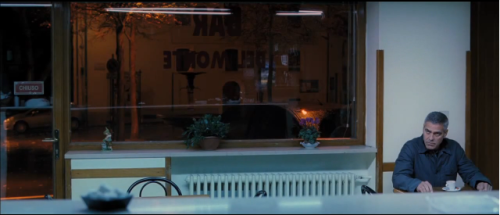
After a Main Title trip through an appropriately myopic tunnel, the "mechanic" ("I'm no good with machines," he says to several people, quite rightly) emerges into a wide, scenic Italian landscape bi-sected by a winding motorway, then stops at a phone-booth on a narrow cobble-stone street in a rustic Italian town. He's boxed in, surrounded by two-story piazzas with open windows, with only two directions he can go—forward or backward.
But the bullets can come from anywhere. Because that is what he would do.
He stands half-way out of the open door of his rental car, standing at the transom. He sees an man fixing a tractor, an woman sweeping her stoop, watching him, and a caffe habitue peering at him over his newspaper. The bullet can come from anywhere. He has only an Entrance and an Exit.
Stay or Go? Commit or Run?
"The American" harkens back to a kind of film they don't make anymore: the art-house action film, where the locales and the characters are more important that the edit-to-shot ratio.* Where today's action films feature the locales as a blur, the soundtrack overwhelms, and characterization is defined by the quality of quip after a kill, this one, with its long lens shots, its whole blocks of time without any dialogue (or explication of any kind) and unknowable character-cyphers is a challenge to the ADD'd afflicted audience, who expect all suspense films to defy that description and merely be FPS's.**
"The American" of the title is a "Man with No Name" like the many anti-heroes of the Sergio Leone films.*** He is also a man of many names: to his phone-contact, Pavel (Johan Leysen), he is "Jack;" his "client" calls him "Mr. Butterfly"—he's into lepidoptery, and he bears a stylized pappilon tattoo between his shoulder blades; he signs into his hotel as "Mr. Clarke;" his voluptuous Italian hooker-lover (Violante Placido) knows him as "Edward."****
But, nobody knows him. And he doesn't reveal much. George Clooney plays him much the way Cary Grant played his government op in "Notorious," bland, cool, serious, not reacting and never risking a smile. Not even the requisite
smirk.***** Clooney's gunsmith-for-hire is thin, wiry, sports the same chopped salt-and-pepper hair-cut that, when worn by Harrison Ford, signalled that his character was "repressed," and is addicted to routine—the better to spot something out of the ordinary that might come hurtling at his neck. There may be nothing but doubt there behind the hooded, suspicious eyes, that are always searching, searching, searching for the muzzle flash (which he might survive), or the echoing discharge (which he probably won't). All he knows is that he can't let down his guard. It's the rule of most men on the run: Suspect everyone.
Because there's a lot of space, visual and aural, in the film, unaccompanied by exposition, director Anton Corbjin ("Control," which I've never finished watching) has enough respect for his audience to let the pictures do the talking. The film may reference Leone, but it's the style of Michelangelo Antonioni that Corbjin is emulating, and there's enough symbolic cinematography that one has a hard time distinguishing dream and reality, just as Clooney's gun-smith has difficulty distinguishing suspicion and reality. So much of the movie depends on "the unseen possibility," that pretty soon you're sucked into the mind-set, watching the corners of frames, searching out the change of expressions (among the circle of assassins it happens rarely) that might signal an ambush. That also jams it into the magazine-clip of "paranoid thriller" films popular in the 70's, post-Watergate.
But, like many of the art-house suspense films it reminds one of, the pace allows a great weakness: heavy-handed symbolism. In fact, the final scene (which, if one thinks about it, strains credulity) is so over-layed with symbolism, that it actually undercuts the seriousness of the scene, evoking chuckles from the audience I saw it with.
Be that as it may, for most of its length, "The American" is compelling film-making, even though, in its dour staging, it tends to take itself too seriously, a trap that film-makers have been trying to avoid since film-making began. It's hard to determine whether it's a step forward or a step back.
"The American" is a Matinee.
* This caused a lot of consternation to the Tacoma audience I saw it with: the three-some in front of me grumbled at the end, and the hip-hop wannabe's next to me loudly cursed their contempt. "I slept through half that m*****-f*****!" "That was SHIT!" said the other (he'd missed the best part to take a phone-call in the lobby, after dropping his cell under his seat—which I helped him find). "It was good!" I defended, "just a little heavy on the symbolism is all." "Man, you are stu-pid," said the guy I'd helped. "F*****' stu-pid," said the other. I was going to mention that they'd both paid full-price for it, while I'd gotten a discount, to base my idea that stupidity might have economic consequences, but I demurred.
** And I know that I only have to explain this to the older half of my audience—an FPS is a type of video-game, described as a "First Person Shooter."
*** (Leone is paid prominent and unsubtle tribute in this film, as a classic scene from "Once Upon a Time in the West" appears on a tv-screen, and the soundtrack in moments of high stalking suspense pays tribute to Ennio Morriconne's (and Jerry Goldsmith's) esoteric "thumping" suspense cues).
**** Heh.
***** Grant's agent in "Notorious" was "Devlin," (or as Grant pronounced it "De-ve-lin"), as if to point out that, if he DID have a soul under that icey manner, it probably belonged to darker forces.