Showing posts with label Robert Mitchum. Show all posts

Wednesday, March 9, 2011

Ryan's Daughter


Ryan's Daughter (David Lean, 1970) This is director David Lean's supposed "big flop," although, now, given a few decades of perspective (40 years?), Time can be seen to be quite kind to it, revealing it to be solid as a film, and as film-making, unburdened by the need to survive in the capricious tastes of film-critics during the "youth-culture" cusp of the 1970's.  While so many of the films that were sending the filmophiliacs into paroxysms of tortured metaphor have crumbled into the dust of pretentiousness, this one still stands up as a story well told...even if the story might be a little frayed and dog-eared.

One can quibble.  Yes, it's elephantine in a way that a small-scale story shouldn't be (it's more than 3 hours, time enough for an epic, or at least a couple more infidelity stories thrown in!) and the huge landscapes that Lean favors tend to dwarf the participants of the tiny Irish town of Kirarry (not to mention there's a LOT of people in the crowd scenes...where do they all LIVE!).  But, the only serious charge is that Lean is merely being Lean (as in being himself, as opposed to the inelegantly penny-pinching film-making of its era—he spent a year making it "just-so," due to the ever-changing coastal climate of the location, and another year editing and fine-tuning it).  Lean may not have been a versatile director, altering his technique for every film (nor does a leopard change its spots...because it's a gall-durned leopard and doesn't have to) but he certainly achieves the maximum in every shot...and one is never confused or questioning what is going on.  For all the big vistas, there's a lot of small nuance going on, that merely represents good story-telling.


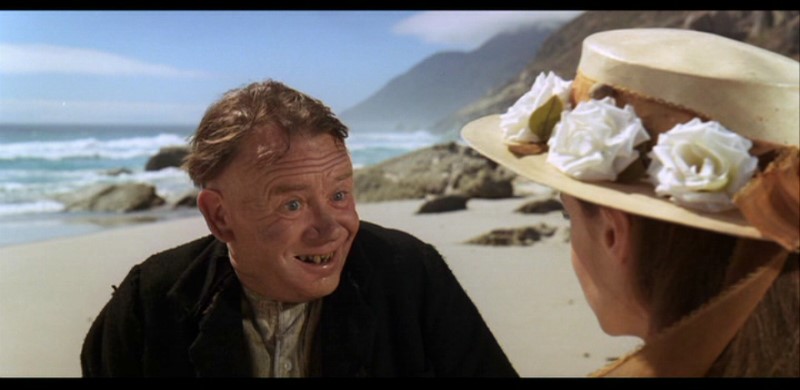
Sure, there are things that grate: Maurice Jarre's egregiously "mickey-mousing" score, or maybe a couple of scenes are pushed a little hard—the post-traumatic stress incident that erupts from John Mills' "village idiot" swinging his leg against the wall, the venality of the town's citizenry—but, one can see why Lean did what he did, and the drama benefited, ultimately, from such touches.


It started out as an adaptation of Flaubert's "Madame Bovary" by screenwriter Robert Bolt.  By this time, Bolt and Lean had a working relationship as tight as Powell and Pressburger ("The Archers") did.  Lean told the writer he was not interested, even if it was written for his wife, Sarah Miles.  Lean had higher ambitions for his films now.  Like Lawrence of Arabia and Doctor Zhivago, he wanted the problems of his figures in a landscape to have political overtones, rather than just the caprices of their natures.  And with present day tensions in Belfast between British Army forces and the IRA in the headlines, locales were switched, accommodations made, and, one feminist nice concession, the female adulterer didn't have to pay the ultimate price for her crimes of indiscretion.  Oh.  She pays...(things hadn't advanced that far!), but it's the male (a cute, but out-of-his-depth, Christopher Jones) who sacrifices himself...in the guise of destroying evidence.


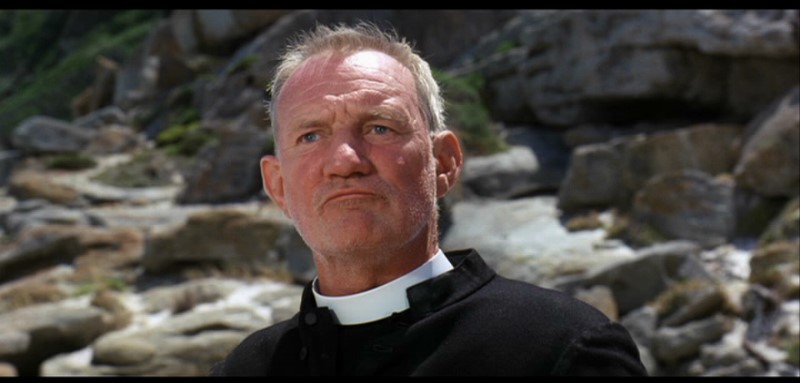
Bolt wrote his "Irish Bovary," but called it "Michael's Day," after John Mills' poor unfortunate—unfortunate, maybe, but he's the only character who doesn't judge, the lowest of the social strata, but the highest in moral character, followed by the priest Father Hugh (Trevor Howard), who is judgemental, but doesn't allow that to not seek the judged's salvation.  In Kirarry, the first one now will later be last, and those who are triumphant by film's end will suffer a life of misery due to it...just by being themselves.

Lean's Irish crowds can be seen in the cackling crones of John Ford's Irish films, or the scandalously rich elite in George Cukor's films—these film-makers are only too happy to take down the gossips and gadabouts in the eyes of the audience, showing their true colors despite the trappings of civility.  In truth, they are more like barnyard animals taking full advantage of pack mentality and pecking order.  It's not the only instance of Lean using Nature to tell the story, not with so much scenery and weather filling his frames perfectly.  But, their shallow triumphs have no permanence, because their attitudes leave a lasting impression, long after they've left the screen.


The actors, save for the callow Jones, are great: Miles is not afraid to show her Rosy Ryan as a selfish brat, Mills creates a character as pathetic (and sometimes as mawkish) as Chaplin's Little Tramp (and he won an Academy Award for it), Leo McKern, bold and blustery as Rosy's too-eager-to-please Conformist-father, but the best are Robert Mitchum, cast against type as Rosy's cuckolded older husbanda bull in a china shop just aware of breaking his first dish—and Trevor Howard, who even whispers in a roar as the Kirarry parish priest—a great, bold, stamping performance of ingenuity and froth.

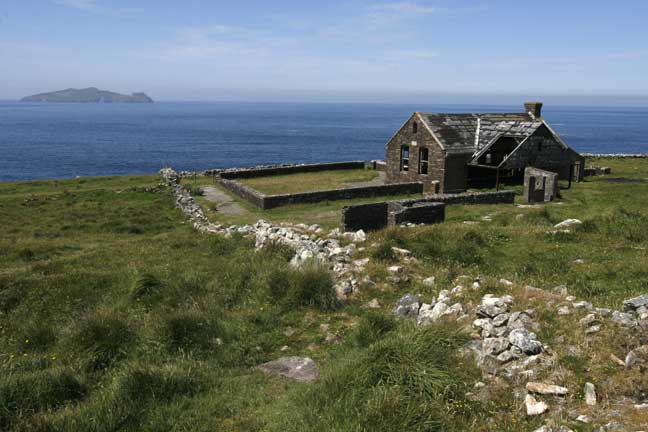
But, in the end, it is Lean's film, as personal as he could make it with those wide Earth-framing lenses.  The figures may be fighting the crags and spray of the Irish coast, but when Lean chooses to bring them front and center, it is always with the best design sense and a painter's eye.  Look at the two frames below: as Rosy runs from her husband's bed to join her wounded soldier of a lover, smoke inexplicably—chimney fire, maybe?—roiling over the hill, darkening the moment; and the next shot, as Mitchum's school-master Charles Shaughnessy, sees with his own eyes and not his suspicions, his betrayal out in the open, trapped behind glass and bars, he retreats, his eyes falling into shadow, displaying the loss he is reluctant to express. 


It doesn't get much better than that.  And there's over three hours of this meticulousness and beauty.  It might be a bit rich.  But it's quite the banquet.

Tuesday, February 23, 2010

Ernie Pyle's Story of G.I. Joe

"Ernie Pyle's 'Story of G.I.Joe'" (William A. Wellman, 1944) One of 2009's films designated to be preserved by the Library of Congress—and boy, does it need it, the current DVD displaying scratches, bad splices, and scenes truncated in the middle of dialogue—"The Story of G.I. Joe" was an uncommon war movie, especially for one produced in the middle of the conflict it portrayed, showing a less-varnished portrait of war and the soldiers fighting it. Done with the co-operation of the military and advice from an office-load of war correspondents, the film is an unglamorous, non-propagandistic look at the life of the common infantryman. In it, the grunt's are grimey, muddy, ass-scratching, spitting dog-faces, who get exhausted, make mistakes, leave behind fallen comrades, but keep slogging.

But then, it had to be.
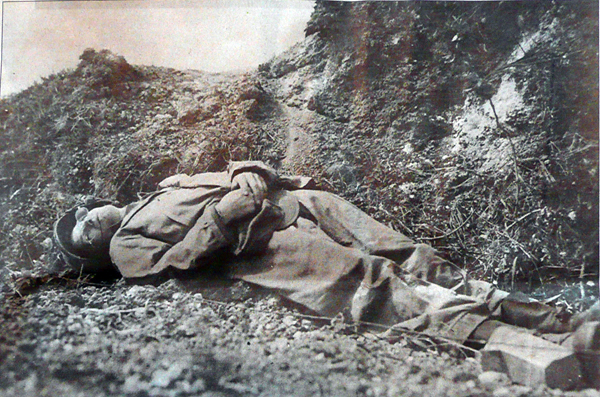
Ernie Pyle, a Scripps-Howard correspondent covering the European theater took the tough route with his reportage, staying out of the clean briefing rooms and jumping into the fox-holes with the entrenched common soldiers. Through the course of his work, he became a beloved go-between for the soldiers and the folks back home aching for something other than the Big Picture and the Campaign—there were plenty of other Corona jockeys to do that—but on the soldiers following orders, following dirt roads, punching through entrenched enemy forces—their kids. Pyle's writing was clear-eyed, unsentimental and just discreet enough for the censors, written usually with the help of a bottle. He won the Pulitzer for his correspondent work in 1944, and had a hand in shaping the film.

And he was the one to get
William "Wild Bill" Wellman to direct the film.

Wellman was an inspired choice, as he was the one who insisted on the weather-beaten look of the film. But the director was a fighter pilot in World War I, and was subject to the same inter-corps squabbling of most servicemen, and had a low opinion of the infantry, only stregthened by his run-ins with a recalcitrant Army adviser on his film "Wings." And the film has several instances of "mea culpa's" from the director,* extolling the scrappy courage of the guys with boots on the ground, as opposed to the guys with their heads in the clouds.

Burgess Meredith got a deferment to play the part of Ernie Pyle—he was picked over other actors because he wasn't well known and had an odd home-spun quality and a crusty voice that could make the tough joshing resonate with warmth. Every war film has a cuddly troop mascot, but not every film has someone ask (in humor) "Haven't you eaten this dog yet?" As the Captain in charge of the men, Robert Mitchum plays his role in the manner he used to the end of his days, looking authentic and undramatic, like he shipped in with the other ringers—only a lot taller—and hadn't slept in days, born with the weight of the world on his shoulders, but still balanced on his aching feet. Or maybe it was the mud that was holding him up.

It was the only time he was nominated for an Oscar for his acting.

Pyle never saw the movie. Two weeks before the premiere,
he was killed by a sniper on Ie Island off Okinawa in the Pacific. He was still with the troops, reporting their struggles.

* Besides a couple of on-the-nose comparisons between Army and Air Force—that seem to come out of nowhere—one of the various character arcs is for an infantryman dubbed "Wingless" (played by John R. Reilly), who starts the film depressed that he was drummed out of the Air Corps but soon comes around to a respect for the common foot-soldier.

Saturday, February 13, 2010

Thunder Road

"Thunder Road" (Arthur Ripley, 1958) A B-movie curiosity that has gained cult status, especially in the southeast corner of the U.S., usually neglected by Hollywood. Although beloved by its corps of loyalists (there are "Thunder Road" fests every year), most folks only know it from writer-producer-composer-star Robert Mitchum's driving recording of the film's theme song. He co-wrote that song, as well as it's love ballad "The Whipoorwill," sung in the film by Keely Smith, the exotic—if dead-pan—wife-chanteuse of the Louis Prima Band.

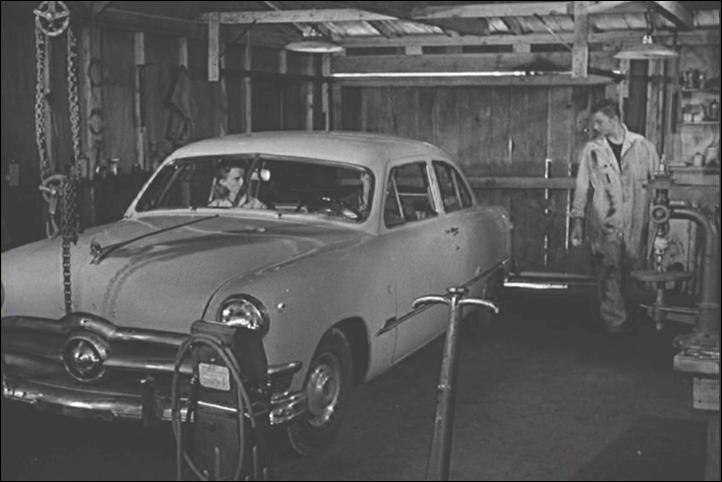
The film, based on Mitchum's story-idea,
concerns an ex-con Luke Doolin (Mitchum), who drives a souped-up Ford delivering moonshine hootch throughout Kentucky and Tennessee. The story has Luke as the hub of several tugs-of-war: there's the struggle between the still-men and the Treasury boys (represented by Gene Barry); a territorial tussle between the loose association of mountain-folk and the smuggling kingpin (Jacques Aubuchon) who wants control of their routes, by any way possible; then, he's caught between two girls after his affections—singer Francie Wymore (Smith), who wants him to settle and stop rum-running, and the girl who looks up to him (Sandra Knight), whether he's running or not. She's probably more suited to Luke's younger brother Robin (played by Mitchum's son, Jim—when Col. Tom Parker wanted too much money for Elvis Presley to play the part), who wants to be a part of the family business.
The film's directed by Arthur Ripley a B-movie veteran who'd started doing television work, but whose lasting legacy is as one of the industry stalwarts who established the UCLA film school. The film looks much older than it is, as it employs filming techniques that emphasized economy over spectacle, or even consistency, as in one scene where Gene Barry's monologue starts on location and ends up in a studio.

But dang! Some of the racing scenes are amazing, especially in some of the daylight scenes where it's readily apparent no camera tricks were used to speed things up—those hulking roadsters are really go that fast.

Mitchum is great in it—he rarely stepped out of his personal cruise control when acting, employing the same effective techniques as he had since "
The Story of G.I. Joe," but he stands out like a professional thumb in this film. Keely Smith has a startling look, but her acting ill-becomes her, as she's at her best at stillness—the more lines you give her, the worse she is. Barry is terrific in his "Just the Facts, Ma'am" mode, and Peter Breck and Mitchell Ryan are around to off-set some of the halting, amateurish acting of some of the cast.

"
Thunder Road" is beloved as a cult film, but it's one of those films where love is blind and looks past the faults. One of those "not a great movie, but it's 'our' movie" movies.

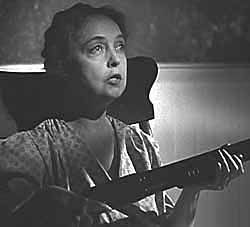
Is the song in it? Yup. But it's sung as a ballad with just an acoustic guitar accompaniment, like it was being trilled on the porch, a part of memory and maybe of legend.


Saturday, August 16, 2008

Olde Review: Farewell, My Lovely

Written Nov. 25, 1975

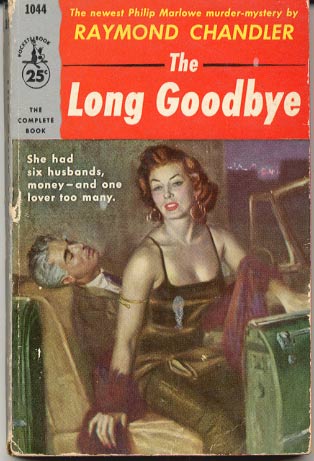
"Farewell, My Lovely" (Dick Richards, 1975) This summer I became acquainted with my first Raymond Chandler novel (I'm a late bloomer). It was an old copy, tattered and falling apart with an honest-to-god-"Genuine Pocket Book" pulp cover on it (barely), of "The Long Goodbye." A lovely thing to read--entertainingly, slickly written. The magic of the gutter just kind of spills out of it.

Now,Howard Hawks made a great Marlowe picture, with Humphrey Bogart, but Bogart naturally talks like Chandler writes(people don't talk like Bogart--his emphases come in the oddest places).* Robert Mitchum talks like ol' Bob Mitchum, and though he'll put in some "Bogartian" inflections of his gravelly voice, there's still a lot of wrong with him.

Dick Richards is not one of my favorite directors. His "Rafferty and the Gold-Dust Twins," though occasionally gratifying was highly episodic, strung together and rather poorly paced (maybe I just don't like "road pictures," but then why did I like "Harry and Tonto" and "Alice Doesn't Live here Anymore?"). His adaptation of "Farewell, My Lovely" doesn't fare to well, either. It's sleazy where it wants to be gritty, and slightly hysterical when it wants to be tough. It's warmed-over Chandler with nothing that can revitalize the plot plagiarized and bastardized by so many rotten tv detective shows.** "Chinatown" had an evil "plot" idea that I've seen before on these same detective shows, yet "Chinatown" burned with Polanski's perversity, so that you didn't care. "Farewell, My Lovely" is beautifully photographed (that title sequence with Los Angeles burned up in yellows and reds blurring on the street is just beautiful--can't tell a book, etc.) But it's just another movie that tried to cash in on another film's appeal and wasted its own potential. "No way has been invented yet to say good-bye to them."

"Farewell, My Lovely" was the second time Chandler's novel had been adapted as an official Philip Marlowe movie. The first was 1944's "Murder, My Sweet" starring singing, dancing Dick Powell (who also played Marlowe in a television adaptation of "The Long Goodbye") Other Marlowe's, besides the best-remembered Bogart, are the Montgomery's, Robert and George, James Garner and Elliott Gould. Philip Carey, Danny Glover and the very fine Powers Boothe played him on tv. Mitchum, 30, even 20 years earlier, would have been a great Marlowe, but in 1975, he was just a bit too old and paunchy to be playing Chandler's L.A. shamus. It's a great cast though, with Charlotte Rampling, Sylvia Miles, John Ireland, Harry Dean Stanton, Anthony Zerbe--even a pre-"Rocky" Sylverster Stallone. And they got the ambience right, with Marlowe's attention being diverted from the case by DiMaggio's hitting streak in 1941--the book was released in 1940, but why quibble? It was still pre-war. They did far better than Michael Winner's version of "The Big Sleep"--set in London in 1978.

And David Shire's trumpet-dominated score could notch comfortably behind any detective story.

* And one can say that people don't talk like Chandler writes!


** And had been used starting as early as 1942, evidently, in a George Sanders B-movie called "The Falcon Takes Over." Chandler's "The High Window" was adapted as "Time To Kill" for the Lloyd Nolan "Michael Shayne, Private Detective" movie series (and again in 1947 as "The Brasher Doubloon").

Monday, February 4, 2008

The Night of the Hunter

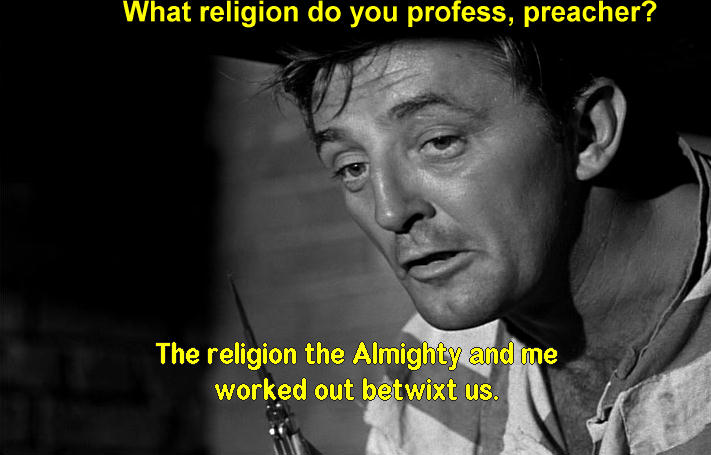
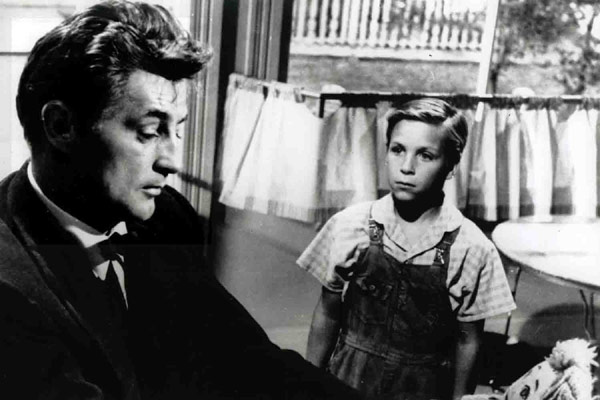
"The Night Of the Hunter" (Charles Laughton, 1955) One of the most stylized, creepiest movies ever made--the only one ever directed by actor Charles Laughton--"The Night of the Hunter" tells the story of an almost-elementally corrupt minister who comes to town seeking fortune by seducing and murdering the wife and terrifying the children of his old cell-mate, and tells it in the manner of a magical fairy tale. As two of the targets of the Rev.'s obsessions are the impressionable children of Willa Harper (Shelley Winters), the film becomes a battle between Good and Evil as seen through their eyes. The Good is represented by the Grandmother, played forthrightly by silent film star Lillian Gish. The Evil is the right Rev. Harry Powell, who strides into town with the conflicts in his soul tatooed on his fists. It's a bravura performance by Robert Mitchum, who wasn't known for bravura performances, usually satisfied maintaining a laconic air to get by. Here he brays and exhorts like a bull and it's an amazing thing to see so theatrical a performance out of him--in fact, it's the role he's best remembered for. The film itself is a creepy blend of reality and fantasy, of realism and theatricality and the clashes of those sensibilities jar one's attention, while burrowing into the soft places of one's skull. Despite poor box-office and crtical pans when it opened in 1955, "The Night of the Hunter" abides. It abides and it endures.