Showing posts with label 1955. Show all posts

Tuesday, December 18, 2012

The Man from Laramie

The Man From Laramie (Anthony Mann, 1955) "Hate's not becoming on a man like you." Hmm.  Then, they shouldn't have put this star and director again, as hate, obsession and (sometimes) disfigurement were the order of the screenplay. The last of the James Stewart-Anthony Mann pairings (the others being Winchester 73The Far CountryBend of the River, and The Naked Spur, all superior disturbing Westernsthat pushed Stewart's psychological boundaries in the Old West by pushing the traditional physical boundaries in the Old West.*

Stewart's Will Lockhart rolls into the town of Coronado with his small transport business delivering merchandise to the general store.  Along the way, he stops from his day job to indulge in his hobby—seeking revenge for his younger brother whose cavalry unit was ambushed by Apaches who were brandishing repeating rifles, too many to be acquired on raids.  The Apaches are another story.  He's after the man who sold them those rifles.

Coronado, though, is hardly welcoming.  He can't take a few steps into the street without being warned to leave the town the same way he went in—under his own power.  That advice, with intentions good or bad, stems from the town's controlling interest, a cattle baron by the name of Alec Waggoman (Donald Crisp), one of those autocratically protective father-figures who like things the way they are, are suspicious of any changes, and is a bit blind to how others see it.  He's particularly near-sighted when it comes to his entitled son Dave (Alex Nicol, in a thankless performance, rather dimly performed), a bully who's next in line to run the ranch—probably into the ground given his business acumen—and (as John Wayne used to put it) "if he lives."  To prevent those eventualities Waggoman has installed the only picket-wire he might approve of, his chief ranch-hand Vic Hansbro (Arthur Kennedy, who often provides the counterbalance in the Mann-Stewart westerns) as a nanny to keep Dave under control.


But Vic, with so much responsibility to the Old Man, always seems to be a day late and a dollar short, unable to keep Dave from single-handedly destroying Lockhart's business, burning his wagons and killing his mules, a rather contrary manner of getting him to leave town, by destroying the means.  And, of course, it just inspires Lockhart to get all-cussed and motivates him to stick his nose in everybody's business and his fists in Dave's mid-section.  Things don't get any better when Lockhart decides to take a job ranching for Waggoman's rival Kate Canady (Aline McMahon), a crusty woman-rancher who won't give an inch on territory or principle, or one hoof of cattle to the larger concern.


From any angle Lockhart is caught in the middle, guaranteeing a rise in tensions and an escalation of grievances.  And if the elder Waggoman wanted peace and quiet, he should have looked for the anarchy running wild in his own midst.   So, there's that familial element running through it.  And Mann and Stewart, through their collaborations, were exploring psychological depths that weren't mentioned between the gun-shots in the standard shoot-'em-up. All of their westerns involved Stewart's character going through a trial by fire—he's actually dragged through a campfire in this one—facing humiliation and crippling at the hands of the Waggoman's, the confrontations with the clan making up the best part of the film, with only Stewart's rather half-hearted interplay with Waggoman's neice (Cathy O'Donnell) seeming like time wasted, although it provides one more conflict for Lockhart to be distracted by.  Mann's use of location shooting is always imaginative and compositionally interesting, and he uses the Vistavision format to get as much horizon into the frame as possible.  Certainly worth a look-see, just don't go expecting Shakespeare.**

Maurice Thomas' Stewart portrait for some of the film's poster art.


  * The two also worked on the non-westerns Strategic Air Command and The Glenn Miller Story.

** Curiously, Shakespeare is on a lot of people's mind when they see this film, comparing it to "King Lear."  Um, okay, not the "King Lear" I'm familiar with, although there's a thematic string in there (actually there's a Shakespearean string in just about everything, isn't there?).  Actually, there's more "King Lear" in "Bonanza" than here (except that everybody gets along).   And, of course,  the movie Legends of the Fall has more than a bit of both in it.

Wednesday, August 29, 2012

Rififi

Rififi (aka "Du Rififi Chez Les Hommes") (Jules Dassin, 1955)


It's not a word that people use/
Among the "swells" and "Who's Who"/
Rififi
It's the lingo of the streetwise/
The battle cry of real tough guys/
So don't try your brain and grumble/
All it means is "rough and tumble"
Rififi

A vital missing piece (in my viewing, anyway) in the career of Jules Dassin (of Middleton Connecticut, Harlem and the Bronx—it's pronounced "Dass'-in,") is this second European film of his exile from America and the Hollywood Black List.  "Rififi" is not well regarded as literature (Francois Truffaut said at the time of its release "Out of the worst crime novels I ever read, Jules Dassin has made the best crime film I've ever seen."), and Dassin was not the first choice as director (that was Jean-Pierre Melville-I'll have to look at Le Samouraï one of these days), but he needed a job, and managed to turn the book (which he also didn't like) into a cracklingly dark caper movie about a motley crew of thieves knocking over a jewelry store.  The leader, Tony le Stéphanois (Jean Servais in a nicely played, tubercular performance that recalls Humphrey Bogart) isn't interested, having just served a stretch in prison for a previous crime, but relents after finding his girl having taken up with a local gangster.  Rather than the fast snatch-and-grab proposed to him, though, he ups the ante, going all in only if, rather than just grabbing some jewels, the group steals the entire contents of the store's safe, the latest in security.

The scheme is elaborate, involving casing the joint for police walk-by's, then doing a home-invasion of the apartment above it, and drilling through the floor/ceiling to gain access in order to disarm the high-tech, high-sensitivity alarm system.  This sequence, which works out to nearly half an hour of screen-time is unscored, reliant on natural sound...and as the heist occurs in the middle of the night, every screeching, tearing, hammering sound could betray the enire operation.  It's a nail-biter, one of the better crimes in film history, and the model for every highly planned knock-over since.

The robbery is the big set-piece, but it's merely the middle of the film.  It's buttressed by the set-up and subsequent fall-out resulting in a rival gang's extortion, a kidnapping, and the gradual dissolution of the gang, a section that, after the tension of the robbery, becomes more and more free-wheeling, taking off, playing on the relationships established in the film's first third, the audience's complicity in the robbery, by itself, becoming a tour de force.  At the same time, it makes an interesting change-up from the rest of the film as "le Stéphanois" becomes a one-man wrecking crew, balefully upholding his criminal code while also trying to "do the right thing," culminating in a desperate drive through Paris that has a thrilling manic intensity with nary a car crash nor explosion (why, they don't even crash through a fruit-stand).

Rififi is a showcase for Dassin's talents as an adapter and director, taking the noir film back to the place where the phrase was first coined, by one of "da guys" who created and perfected the dark mysteries of the form, no matter which city streets are drenched with rain.  


Friday, July 13, 2012

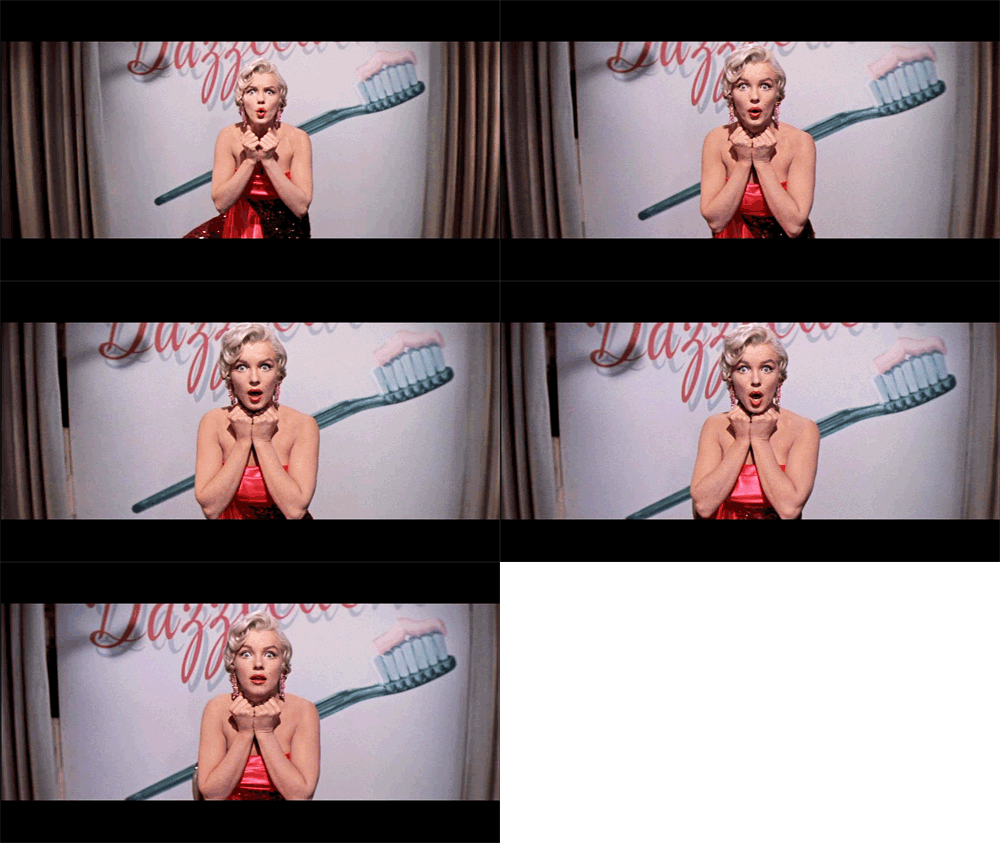
The Seven Year Itch

The Seven Year Itch (Billy Wilder, 1955) Another one of those ones that "got away."  Never seen it.  Don't know why.  And yet it's a film of such an iconic nature that inevitably makes it into "movie-clip" shows, maybe I thought there wasn't a need. 

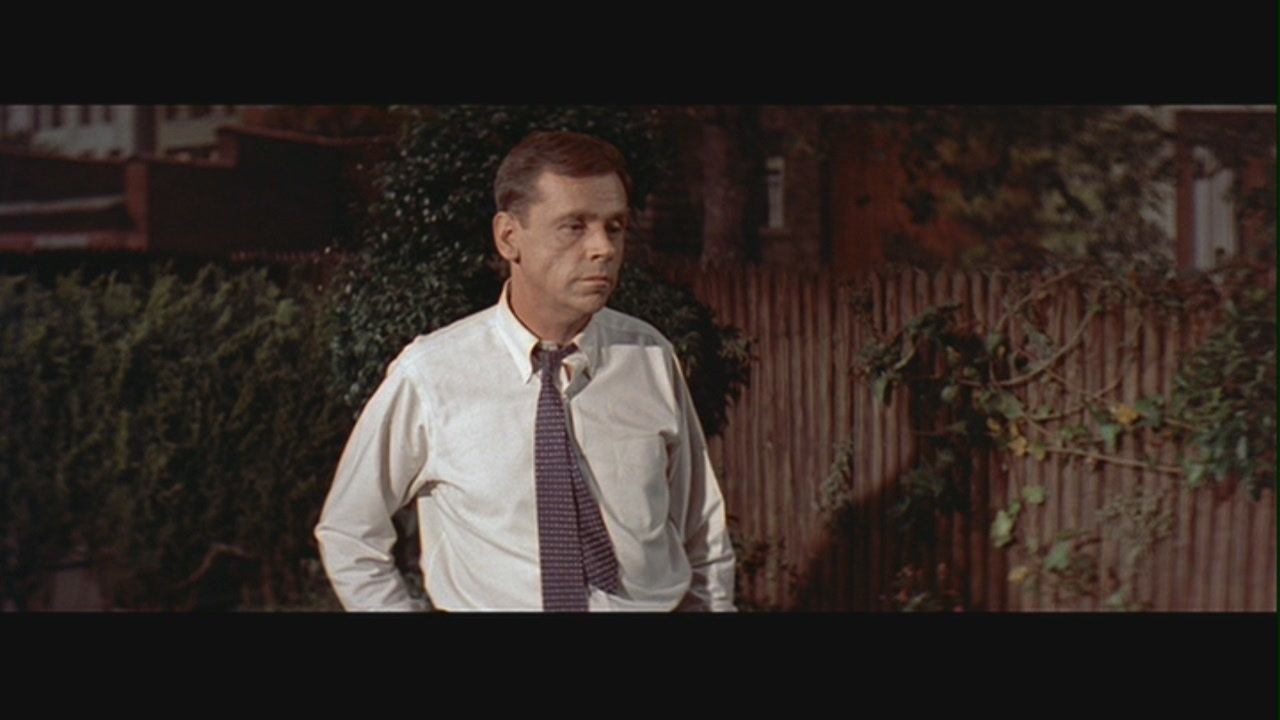
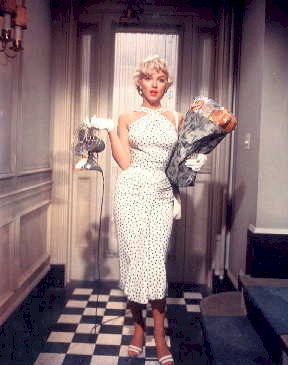
Too bad, because the film has so much more to offer than the shot of Marilyn Monroe's skirt blowing up over a subway grill...much more.  It's just tough to get past that image...all five seconds of it. In fact, the film might be my favorite Billy Wilder film...if it weren't for Sunset Blvd., Ace in the Hole, The Apartment, Double Indemnity, Lost WeekendSome Like It Hot, The Private Life of Sherlock Holmes (and on and on).  As it is, it's unique among Wilder films (which seem all to be unique) in that it is basically a one-man show, a monologue (which makes Monroe's dominance of it so mysterious...but only proves her power) by Tom Ewell, the bassett-hounded everyman-actor, who played the role on Broadway (900 times over three years).  Ewell wasn't a comedian, he was a serious actor, and his playing of this sexed-up version of Thurber's "The Secret Life of Walter Mitty," never betrays a need to evoke laughs.  No, he plays it straight, even tragically, and garners belly-laughs.  Even his vast experience with the role contributes to the world-weary quality of his fantasy sequences and the beleaguered "I'm too sexy for this life..." attitude that permeates the performance.

Richard Sherman (Ewell) works for a paperback company that specializes in marketing dull titles with salacious covers.  At the start of a long, hot summer, he sends his wife (Evelyn Keyes) and son (Butch Bernard) to her family in Maine to get them out of the sweltering city of New York.  The vacation offers pastoral pleasures like kayaking, but Sherman is left to sin upstream with the paddle.  He is the perfect domesticated husband, but his "overactive imagination," making him so good at marketing, is a constant battlefield.  However good he might be, giving up smoking ("all those lovely, injurious tars and resins," he sighs), not drinking, eating at health-food restaurants, he still has "urges" to misbehave.

Emphasis on the "Miss," an unnamed upstairs neighbor (Marilyn), model, and frequent guest of her upstairs neighbors, "the interior decorators or something."  "Being good" does not come easy when Sherman has to figure out how to "sell" his company's latest manuscript—a psychological text on the sexual urges of repressed middle-aged males (which to Sherman reads like an auto-erotic-biography).  An office visit from the doctor only confirms what everybody, real or fantasy, has already told him—he's got an overactive imagination (code for libido, and it "breaks out" in nervous tics, itching, scratching and neurosis) and no perspective about his appeal (or lack of it) as a man, seeing every woman in his orbit as an attractive force, and he—brave soul—is a stalwart unmovable object, despite "the girl" hanging over his head from her balcony.

Ewell is amazing, but everybody's good and all the actors are clicking along on all cylinders, with crack comic timing.  Monroe is great, too.  This isn't one of her later "one-note" performances.  Her "girl" is a comic innocent, and Monroe's versatile enough to personify all of Sherman's fantasy versions of her. 

The play is different.  It's not so chaste, and, reportedly, Wilder and Axelrod were frustrated with the restrictions imposed by the Hayes Office.  But what is there is great, with very little slack in pacing, and Ewell's amazing work throughout.  He deserves so much of the credit for making the film as consistently entertaining as it is.  But, as in the film, he's helpless to conquer Monroe's image.

Sadly, neither was she.

Friday, September 9, 2011

Il Bidone


Il Bidone (aka "The Swindle") (Federico Fellini, 1955) The Italian maestro in his hey-dey.  This 1955 film follows a trio of grifters—Augusto (Broderick Crawford), Picasso (Richard Basehart), and Roberto (Franco Fabrizi)—who are low-level con-artists in search of the Big Score—even a Ponzi scheme would do.  They drive into a small village, all pomp and circumstance, with as much respectability as a disguise or a decent suit can buy, and with guile and a healthy disrespect for people's own need for "easy riches" or a "too-good-to-be-true" deal, bilk the citizenry out of as much cash as they can find lying around.  As priests (using the respectability of the Church), they convince simple farm-folk of "buried treasure."  On a grander scale, they're developers collecting down-payments on rooms to a vapor—hotel that will never materialize ("The economy's bad and we've suffered some set-backs"). 

For Picasso, there are dreams of becoming a famous painter (but in the mean-time he can forge a few masterpieces to get by, much to the chagrin of his long-suffering wife, played by the wonderful Giulietta Masina).  Roberto, their chauffeur/get-away driver, is young to the game and is always looking for new angles so he can set off on his own crime-spree, free of "the losers" he thinks might be holding him back.  

But, the leader of the group, Augusto, is feeling the advance of age and getting a little desperate; he hasn't achieved any real fortune, just what can be piffled away on a falsley high lifestyle and an evening of prospecting at the clubs (he's not a high-roller, but he has to play one and that can get "spendy").  He is torn.  He wants the respectability that a really big perpetual con (like the kind found in government circles and among the constabulary can provide) can bring.  In essence, what he wants to do is be for real what he only play-acts as his work.  A man of respect, a high roller...an adult, or his version—his imagining—of what that is, this overlarge, over-age boy in big pants.  For Augusto, he hits "the brick-wall of Reality," in the presence of his very real daughter, for whom he wants most to be seen as a man of respect, a man of accomplishment, instead of the fraud he pretends to be.

I started out this review saying "the Italian maestro in his hey-dey" and have come to this point wondering if that is true.  I've often dismissed his latter films as inferior if more complicated and less grounded in reality to his 1950's films, which are more asprirational in nature.  They're about wishing and hoping for success which eludes their protagonists—the street-performers of La Strada, the drifting men of I Vitelloni...Cabiria.   When Federico Fellini became "Fellini," international artist, he seemed to lose that touch of "becoming," to make observations of his new life of "having made it," and finding it difficult to maintain and empty, finding it wanting, and in a sense, was compiling an autobiography of his journey to success and beyond.  Even his wife (Messina) complained that his Juliet of the Spirits wasn't about a woman's issues, but about his own.  His movies about the glitzerati felt hollow and self-absorbed (appropriately). 

But, the director still aspired, although he struggled for subject matter (see ) or funding, especially in his later years, despite his reputation.  He retreated to fantasies and circuses, reality being not enough—and maybe not sure anymore about what reality was, surrounded as he was by reputation, the expectations of fame, and the glare of the spotlight.  Simple virtues and humble origins cannot be found on the soundstages of Cinecitta, or the boardrooms of Titanus

But, the aspirations continued.  As if documenting Shakespeare's seven stages of life, Fellini's vision, aimed ever inward, began looking back, became nostalgic for those early times of "wanting" dreams, trying to reclaim them, make them real again.  Not so much aprirational anymore, but seeking the times and memories of aspiration, when the world was full of possibilities, when wonder was more than klieg-lights and grease-piant, a fraud wanting to be real.

I've had a review of Amarcord in the drafting stage for almost a year. I think I can write that now.


Thursday, August 18, 2011

The Brightest Noir or the Anti-Life Equation

Kiss Me Deadly (Robert Aldrich, 1955) Kiss Me Deadly might be the greatest film noir film of all time.  You know the genre—"When the streets are dark with something more than night"—implying that the lack of light goes far beyond foot-candles and is radiated by a void in the soul...or the permeating Evil in the World.  Oh, there'd always been detective movies—but, they were usually played in a cocktail party environment, gussied up and prettified for the ladies...and there always had to be a pet.  But, in the late 30's, with Hitler bringing real evil to our headlines and minds, that world changed, became darker, the booze cheaper, and the dames less dependable.  After the war, we'd lost our innocence enough that the tarnished golden age of noir happened, its authors became legit, movie deals followed, and the resulting rougher, because we could take it.  Combined with what Hollywood saw coming out of the European neo-realist movement, things got grittier, less polished and the gangsters came out of the dark cracks of the wood-work to walk amongst us and make the lives of decent folk miserable, while in the mind's eye loomed the existence of mushroom clouds that could turn all of us, any of us, into ash and dust.  By the time the 50's sneaked up on us, promising a better life (if we followed the rules), paranoia walked the streets, the board-rooms and halls of government, setting the stage for Robert Aldrich's über-noir. 

Mickey Spillane, author of "Kiss Me Deadly" in all its popular crudeness, didn't like the film version.  It slapped his book around for its tough-guy attitude that puffed up its chest in the face of truly nihilistic forces that could wipe the sneer off its mug and dared to question the sexist-macho attitude of its protagonist.  The script is by one of the better novelist-scriptwriter vagabonds, A.I. Bezzerides (whose novels were turned into the films They Drive By Night and Thieves' Highway).  "I was having fun!" Bezzerides said of his adaptation of Kiss Me Deadly, and, indeed, it is a lot of fun in a savage, even cruel way, that has no truck with the merits of its source-book, and boils it down into a Maltese Falcon-ish quest of thugs for a "great whats-it," that, as is ultimately revealed is not riches, but power—at the time the most dangerous form of power extant.

Our savior—the point-man walking down these mean streets—is a private dick in all senses of the term, the not-subtly named Mike Hammer (Ralph Meeker), the bluntest of instruments, and where that other tool of the trade, Sam Spade, beat up bad-guys and gunsels, Hammer makes no character distinctions, he's as indiscriminate as a force of Nature, turning people, places and prized possessions into disaster areas so he can sort through the rubble.


The caper doesn't start very subtley—it doesn't come to him, knocking politely on the door of his offices—he nearly runs it over on the highway.  A damsel in distress (Cloris Leachman—yes, her—in her film debut) is running down the street in a panic and only a trench-coat.  She might have escaped from a mental institution, but Hammer, at her request, tries to take her to the nearest bus stop.  

"Get me to that bus stop and forget you ever saw me. If we don't make that bus stop…"  "We will," says Hammer dismissively, confidently.  "If we don’t," she pointedly says, "Remember me."

They never make it. 

Details aside, Hammer wakes up in a hospital bed, remembering—the girl is dead, tortured, and he has two motivations: revenge and to find the people who tried to kill him and succeeded with her.  Hammer strikes out, becoming the bull with Los Angeles as his personal china shop, getting closer to the responsible parties but not many answersA detective without a clue, things usually have to be spelled out for him with a constant litany of "you just don't get it, do you's."  His informants and victims dance around the answers, talking circumspectly, while Hammer just scowls, wondering if there's a way to beat the answers out of them.

It's the way things have to be, because almost everyone is corrupt, no matter what their position of the intelligence scale, and that includes the guy behind the whole operation, Dr. G.E. Soberin (Albert Dekker), the type of character Sydney Greenstreet might play in earlier mysteries: brilliant, erudite, but not smart enough to be brought down by baser instincts than his own.  And, once he's gone, any hope of containing the evil about to be unleashed goes with him.


The opening of "The Great 'Whats-it:" a "Pandora's Box" that would "inspire"
filmmakers Alex Cox, Steven Spielberg and Quentin Tarantino.

There are two endings to the film: in the first, Hammer and his sexy secretary Velda (Maxine Cooper) manage to escape from the traditionally burning building (burning quite nontraditionally) and seek refuge in the surf.  But, somewhere along the way, the film was streamlined, so their fate is undecided and, indeed, the film screams "The End" in the middle of a growing apocalyptic nuclear conflagration.  Does it ever end, or does Los Angeles go up with it, the match being struck the sociopath who sold her soul for power.

It's the ending I first saw when I encountered the film and it's the ending I prefer: Kiss Me Deadly presents a world so far done the jungle path that even a thug like Mike Hammer can be considered a hero.  Man has de-evolved so far but still managed to harness the power of God, that the inevitable happens.  The film asks nihilistically, given how bad the world is, why not let the whole rotten system crash (sound familiar?).  The quest for power has gone nuclear.  Let 'em get what they deserve. 

Given the view of the film Kiss Me Deadly, if the world is so corrupt, maybe the justice should be dealt in an uncontained fusion, where the shadows are permanently burned into the landscape.  And so the world ends—not with a bang, but a high keening shriek, echoing the many screams that have occurred throughout the film.

Even in the glare of nuclear light, you can't get more dark than that.

Saturday, July 9, 2011

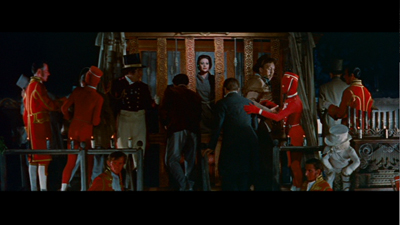
Lola Montès

Lola Montès (Max Ophüls, 1955) "The things we do to women"—one of the mantras of fictional President Jed Bartlett in "The West Wing," said several times over the course of the series in the presence of a male audience (but never as much as "What's next?"). 

The last film of master craftsman Max Ophüls (two years before his death) is a reverie, a cautionary tale of the course of the life of dancer/courtesan Lola Montez, who climbed socially through the world of prominent men until a dalliance with the King of Bavaria (who appointed her The Countess of Landsfeld) created such an uproar, it caused a revolution in 1848.  The real Lola lived quite well, though doing it so fast ultimately cost her.  She died from pnuemonia after suffering a stroke at age 40 in the United States.


Ophüls' "reel" Lola (played by Martine Carol) lives out her foreshadowed final days as a featured performer of a circus (ring-led by Peter Ustinov), a public spectacle where she is forced to re-live and metaphorically re-enact her scandalous rise and precipitous fall before an audience of French rubes, who, like the rabble they are, shout questions from the dark (and Ustinov's Circus Master smarmily answers, egging them on). 


She is the star performer, but trappedby the schedule, by the spotlight, and finally caged, as a seemingly endless line of paying customers queue up to kiss her hand, paying homage and risking little.  She is a prisoner of her fame, her reputation and her life, that once represented a kind of freedom, where she felt she could challenge the limitations of polite society.


For Lola, it must seem a little like Hell, and for director Ophüls, it might have, too.  A long, complicated shoot, his first in color and wide-screen (at the producers' insistence), with a star he didn't want (at the producers' insistence), his film's complicated flashback structure, shifting back and forth from the circus' smarmy presentation of incidents to Lola's memories of the events—was re-edited into an uneasy chronological order to get to "the good parts" faster (at...well, you already know), after its premiere.  And that version of Lola—with one or two bits of lost footage tacked on over the years—was what the world knew of Ophüls' last film...until 2008.  Restored to the structure Ophüls intended, the film wheels between Lola's life in charge and manipulating events, to her being manipulated reliving the events, like a sideshow attraction.  And the presentation has an accusatory, sensationalist tone—a show-trial, literally.


It's a cunning look at fame (or infamy), of how one's actions can be sold as just about anything (the director's son in a supplemental interview says "Lola Montès is anti-advertising.")—and ironically the producers took the deception one step further, missing, or ignoring, or even sabotaging, the point.


Meanwhile, Ophüls managed to make the most of his star's lack of range, making her a stoic throughout the self-abasement.  Politically, it's an odd film: ostensibly, a "Comeuppance" film where an upstart (in this case, Lola) gets her "just desserts" (if one is thinking uncharitably), suffering humiliation and entrapment at the hands of men—once powerful and influential, she's now powerless.  But, that's a simplistic, even a foolish, reading.  Lola still holds fascination, draws a crowd, and those lines of men at the end are paying money to kiss her hand and pay their respects.  Even the Circus Master betrays his personal devotion to her.  Caged she may be, but she's still "got" it.

And Ophüls might have just told the flashback story, but the tragic scenes at the circus provoke empathy for Lola, reliving her lost past, generating understanding, or as Ophüls' son says, "in a spirit of penitence and mortification, benevolence." An audience might not be so sympathetic if Lola wenched her way around the world. getting her way and getting away with it, but the circus summaries exploit and promote her past victories, while placing her in marked contrast with her accomplishments. Like the circumstances of Barry Lyndon (Ophüls was a huge influence on Kubrick), the comedown goes a long way to evoking sympathy for the unfortunate forever caught in the frame.


Critic Andrew Sarris once called Lola Montès "the greatest film ever made."  One can see why.


Saturday, June 20, 2009

The Big Knife

"The Big Knife" (Robert Aldrich, 1958)

"Odets, where is thy sting?" George S. Kaufman

How much you like this movie depends on how much you like Clifford Odets and his writing.

Me, not so much.

Odets has always grated on me, his writing seeming like a creative writing parody of Tennesee Williams. He's of the "cookie made out of arsenic" school, where every metaphor is tortured and every character is an overwrought drama-queen, pontificating in the most flowery way possible their transparently obvious thoughts, often at the top of their lungs. Their world comes down to good and bad, the bad being moustache twirling scene-stealers and the good down-trodden martyrs. It's a theater-world as realistic as a proscenium arch and as subtle as projecting to the back of the house.

"
The Big Knife" is no better. An "exposé" of Hollywood corruption written in the '40's, but filmed in 1955—a decade saturated with industry self-loathing—the film suffers from its over the top theatricality. Robert Aldrich has never been the most tasteful of directors, but his stylishness with dreck has never been questioned. He can make chopped liver look like foie gras (even though it still tastes like chopped liver). Directing "The Big Knife"* (the year after directing the brutal, but terrific "Kiss Me Deadly")" he barely leaves the ornate living room of screen idol Charlie Castle, nee Charlie Cass (Jack Palance), well-payed but agonizing over signing a seven-year contract with a studio that might not be artistically fulfilling. At the time of the signing, he's artistically throwing himself into a boxing picture, so already his motivations are suspect. Mrs. Castle (Ida Lupino), recently separated from Castle, doesn't want him to sign (they're separated for Castle's philandering—what does she care?).

The reason Charlie's even considering signing is the hit-and-run accident that the studio has covered up to keep Castle's reputation with the public spot-less. And studio chief Stanley Shriner Hoff (Rod Steiger) is only too willing to spill the beans if Castle doesn't co-operate and limits his work to his studio. As a signing bonus the studio just might eliminate the only witness to the case (Shelley Winters).

Odets prided himself on being of the "Kitchen Sink" school, but here he expects you to feel sorry for the plight of the privileged boo-hooing through their silk handkerchiefs rather than tissue paper. By the time of writing "The Big Knife," Odets was making good money, so maybe it was more artistically fulfilling to write about his contemporaries "in the biz," than take on the troubles of Ma and Pa Average. He also has no problems with Charlie being a perpetual lech and philanderer, but "a sell-out?" Horrors! One might ask
Frances Farmer her opinion of his choices.

John Garfield, who was Odets' stage mouth-piece, played Castle on Broadway in 1949. But the role is beyond Jack Palance—he didn't yet have the polish to play (or be) a Hollywood leading-man, so he mostly just seethes and heaves himself around the room. Ida Lupino, one of the best actresses around, is reduced to soap opera sop work here. The only actors who seem able to cope with Odets' purple prose are Winters with a force of cluelessness and Steiger, who just powers his way through like a bull—no hesitations, no apologies, which works well for the character—a studio mogul of the Louis B. Mayer/Harry Cohn ferocity.

The final act of the film is a mess of theatrical hysteria and misdirection that compresses a lot of story and reactions off-screen, while a running narrative informs us (or rather misinforms) about what all that hub-bub is upstairs. Perhaps Aldrich rushed through it to cut through the giggle factor, but the material is lumpen at any speed. You need a bigger knife than this movie's got to make it play.


* I keep seeing "The Big Knife" being referred to as a film noir. Nah. Sure, it's got a gritty title, and it's filmed in black and white, and the souls are sordid and Aldrich directed noirs--but, this is as much a film noir as "The Oscar" is!

Saturday, December 20, 2008

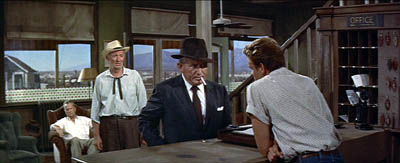
Bad Day at Black Rock

"Bad Day at Black Rock" (John Sturges, 1955) WWII vet John J. Macreedy (Spencer Tracy) steps off the train at Black Rock--the first time the train has stopped in four years. He's looking for a man named Komoko, and he is treated with an inexplicable hostility that he can't fathom and no one will explain. Macreedy, stoically--though increasingly crankily, sets out to find the man he's looking for, and has his life threatened several times by the town toughs (Ernest Borgnine, Lee Marvin and the town "boss" Robert Ryan). And though Macreedy may only have one hand, he's quite capable of using it to defend himself, and discover the town's secret that would force the tiny town's residents to kill.

It's hard to believe that "Bad Day at Black Rock" was considered "subversive" by its studio M-G-M when it was being made but, ten years after the end of World War II, it was considered a hot potato, especially while its production was going on in the waning days of the McCarthy hearings. One couldn't mistake the metaphor of a town cowed by a single man who bends rules to his favor, and harasses outsiders who ask questions.

Right off the bat, one is struck by an over-earnestness that feels false. The wide-screen titles* of a train careening through the Southwest desert is backed by a semi-hysterical Andre Previn score--full of sound and fury and signifying...a train, feels overdone and pointlessly busy.

Previn will keep popping up, goosing the action like a teen-ager playing his radio too loud at a funeral, ** and everything is done with such brutish heavy-handedness and self-importance that one could mistake this for a Stanley Kramer production.

Tracy is reliably lived in as the maimed vet who comes to town, but he's a shade long-in-the-tooth for the role.
Robert Ryan starts subtle and ends up chewing the cactus in much the same way that Lee Marvin and Ernest Borgnine do their dirty work.*** Walter Brennan, Dean Jagger and Anne Francis (the only female in town) round out the cast as sycophants and victims, weak in one way or another.

Ultimately it all comes down to a secret and the conspiracy to keep it that way beyond all reason; obviously, all these guys must have been part of the Bad Rock City Council. There are bursts of action including Tracy taking on Borgnine (I'm part mule, part alligator") with one mutilated hand in his pocket, and the other accomplishing some fancy karate and judo moves, something not often seen in '50's films. But one acknowledges that though the film's heart is in the right place, too much of it has spilled out onto its sleeve.

* Can someone explain to me, for the love of Mike, why this small-scale film about a veritable ghost-town of few actors was filmed in the widest of Cinema-scopes?

** In five years that "goosing" of slow material would pay off like gang-busters with Elmer Bernstein's energetic score for "The Magnificent Seven.

***Ironically, Tracy would be nominated for a Best Actor Oscar that year and lose to...Ernest Borgnine, playing the title role of "Marty."


Tuesday, July 1, 2008

Les Diaboliques

"Les Diaboliques" (Henri-Georg Clouzot, 1955) Oft-imitated classic thriller from the writers of "Vertigo" (Hitchcock tried to acquire the film-rights to this book, but lost out to Clouzot), and brought to low-key life by France's master film-maker. It's become the template for stories about duplicitous menage a trois' and twist endings, as well as a model of how to wring suspense out of an audience. And it's been remade a few times* (the last time with Sharon Stone and Isabelle Adjani and de-articled as simply "Diabolique."

Clouzot starts out slowly, bringing into detail the specifics of the unhappy/unholy union of cruel school-master Michel Delassalle (
Paul Meurisse) and his weak (and weak-hearted wife) Christina Delassalle, (Véra Clouzot)and his mistress Nicole Horner, another school-teacher (played by Simone Signoret). The arrangement has been out in the open among the parties for awhile, and everyone is vaguely dissatisfied with it, so the only way to make everybody happy (well, almost everyone) is a simple little murder-plot. Three's a crowd. And as the school-master's a beast, he's the one to go.

Clouzot follows their plot with intricacy and humor, but with a disturbing eye for the horrific. His manipulation of dark-spaces (and subsequently, the audience) shows a master of technique, as well as creating amazing challenges for cinematographer Armand Thirard (whose work is simply amazing).

As with any film that sets a template, one might be able to know what will happen around the corner (it's the inevitability of the film's success and experience), but Clouzot's execution of the film is still a marvel to watch, and whether one suspects the outcome or not, it still provides considerable jolts to the system, and real moments of unease.

* I remember a TV movie with and Sam Waterston, Ira Levin's "Death-Trap" with Michael Caine and Christopher Reeve, and "Mortal Thoughts" starring Glenn Headley, Bruce Willis and Demi Moore. Hitchcock borrowed more than once from this film, just as one can say that Clouzot no doubt had the British director in mind, as well.

Monday, February 4, 2008

The Night of the Hunter

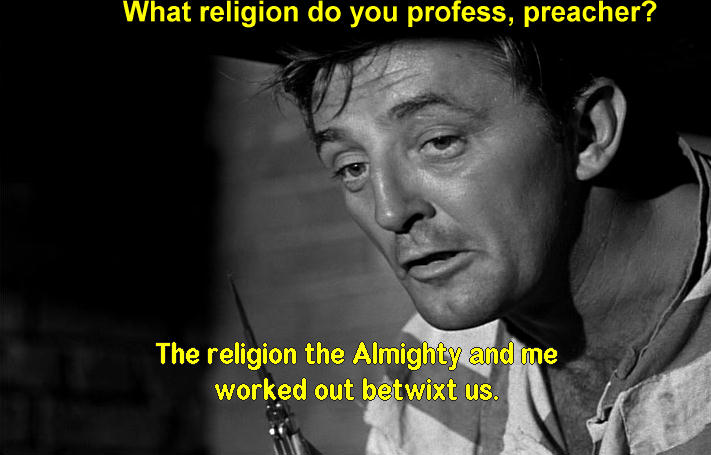
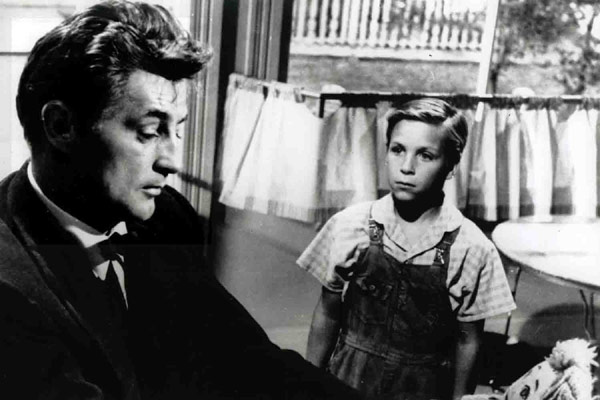
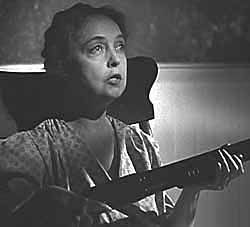
"The Night Of the Hunter" (Charles Laughton, 1955) One of the most stylized, creepiest movies ever made--the only one ever directed by actor Charles Laughton--"The Night of the Hunter" tells the story of an almost-elementally corrupt minister who comes to town seeking fortune by seducing and murdering the wife and terrifying the children of his old cell-mate, and tells it in the manner of a magical fairy tale. As two of the targets of the Rev.'s obsessions are the impressionable children of Willa Harper (Shelley Winters), the film becomes a battle between Good and Evil as seen through their eyes. The Good is represented by the Grandmother, played forthrightly by silent film star Lillian Gish. The Evil is the right Rev. Harry Powell, who strides into town with the conflicts in his soul tatooed on his fists. It's a bravura performance by Robert Mitchum, who wasn't known for bravura performances, usually satisfied maintaining a laconic air to get by. Here he brays and exhorts like a bull and it's an amazing thing to see so theatrical a performance out of him--in fact, it's the role he's best remembered for. The film itself is a creepy blend of reality and fantasy, of realism and theatricality and the clashes of those sensibilities jar one's attention, while burrowing into the soft places of one's skull. Despite poor box-office and crtical pans when it opened in 1955, "The Night of the Hunter" abides. It abides and it endures.

Monday, January 14, 2008

The Searchers

It’s a film that chills me right down to my bones and makes me cry every single time. It throws itself into the deepest pits of despair and within moments, prat-falls into low comedy. It’s a western…about race relations, and in the house of mirrors of a “genre” piece deflects the self-righteous tone of a sermon. It stares into the soul of people at their worst, and exults in their best.

It is arguably
John Ford’s best film (and he made many great ones). It is inarguably John Wayne's finest performance on-screen, while completely working against the image that Marion Morrison built as “John Wayne.”

Oh no. We’re talking about “
The Searchers”—a “western” made during the somnambulant 50’s …and with John Wayne, ferchrissakes! How corny can you get?

Back up, pilgrim.

“The Searchers” has just been re-released (to mark its 50th anniversary) in a
gloriously re-mastered DVD, and has come under critical review for being too corny, too obvious, and more than a little dated. Worse still, it has been branded a “film-school darling” that has skated too long on an undeserved reputation as a masterpiece.

Bullshit.

Like
Pauline Kael’s faulty detective work dissecting “Citizen Kane” and Elvis Mitchell’s naïve un-analysis of “2001,” the work in Slate smacks of a critic either looking for something to write about or make a name for themselves bucking “conventional wisdom.” Having to spend a summer reviewing the third X-Men movie, the fifth “Superman” opus AND an entirely superfluous “Pirates of the Caribbean” sequel is bound to make anyone crabby.

But it shouldn’t lower one’s standards, and there’s enough slip-shod work in the article to indicate that’s the case. At the very least, it’s a terrible gloss-over.

“The Searchers” is a masterpiece—the culmination of decades of film-making experience that John Ford had accumulated since the silent era—while crystallizing Ford’s growing disenchantment with the Myth of the West. In a time when westerns were still basically built around the simplistic formula of “Cowboys vs. Indians,” Ford was starting to speak out more explicitly for the latter sixteen years before such accepted “consciousness-raising” films as “Little Big Man” or “Soldier Blue.” Like any masterpiece, it displays the sum of a body of work and breaks new ground, paving the way for the future.

“The Searchers” tells the story of an obsessive 10 year hunt for a lone family member taken in a violent Comanche raid. It’s led by the worst person possible: the child’s uncle--a hate-obsessed confederate soldier, self-exiled from his family, who still carries his saber on his hip, bitterness in his soul and his heart on his sleeve. Mix in a venomous race-hatred for all non-whites and you have the most flawed anti-hero to appear in movies. Ethan Edwards starts his search to bring his niece back alive, but as the years pass and she matures, he gives her up as one of the Enemy, and sets out to kill her. At the center of the film’s black heart is that most archaic and useless word: miscegenation.

It’s rough stuff. Rougher still are the attitudes of the settlers towards the Indians that border on hysteria. There’s a haunting scene late in the film where Edwards and his fellow traveler (played by future Captain Pike and “Teenage Jesus,”
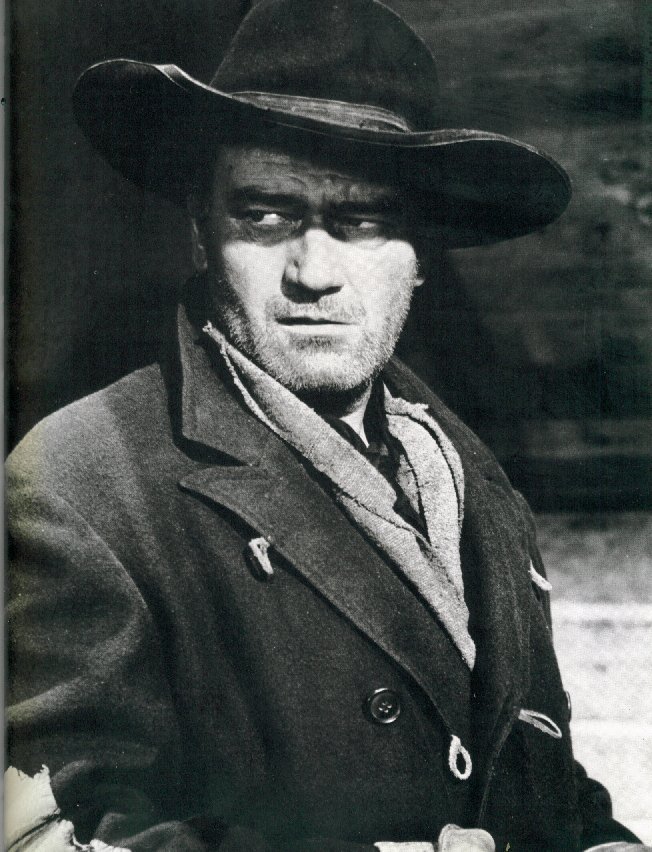
Jeffrey Hunter) ride into a fort on the Trail of Tears to inspect some white women who have been captured by the Cavalry. “It’s hard to believe they’re white” a sergeant says. “They ain’t white,” spits Edwards, and at the sound of a shriek from one of the women, he turns to look at her. Ford trucks in the camera fast onto Wayne’s face (mirroring the shot he used to introduce Wayne in their first film together, “Stagecoach”) and it’s amazing. Wayne was always blessed with a mug that the camera loved*—it could read every emotion that played across it--and in a performance minus the “hero façade” and that turns on the full after-burners that usually blew his co-stars off the screen, this one quiet moment radiates a combination of hate, disgust…and abject fear. No words need to be said to make the point.

And yet, for all its depths of despair amid bloodshed and the race-hysteria swirling around that most antiquated and completely useless term “miscegenation”—Ford tries to balance it with entertainment. That’s quite the tight-rope walk. But then, it’s not a sermon. It’s a Western. Ford was never so pretentious to be caught lecturing. He’d say if you want to send a message, use the Pony Express. Better to sneak the lessons into the fabric of the story, and distract with shenanigans about wayward lovers, goony old men, and green cavalrymen with pointy swords. One of the incidents involves the unintended marriage of Hunter’s character to a portly Indian maid. It’s the source of raunch comedy in the vein of Ford’s “The Quiet Man”—all roughhouse and bad taste. But when Ford’s good guys “The Cavalry” dessimate a Native village and the luckless character along with it, Hunter is left to ask “What’d they have to killer her for? She never hurt anybody!” The question hangs in the air with indictments all around.

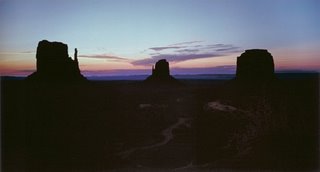
“The Searchers” begins and ends with a black screen. In the beginning, the blackness gives way to the vast magical vista of Monument Valley (which figures in two of my anytime movies. If God lives anywhere on Earth, I think it’s on that vast acreage of land overseen by the Navajo) that to Garry Wills suggests an irising lens, but to these eyes seems more of a proscenium arch. At the end it shuts out Ethan Edwards who is left out of the warmth of a family embrace to wander the desert (Of course, Wayne’s character is going to come in eventually and eat…but Ford chooses to leave Edwards outside). His prejudice does not belong with home and hearth...and society…and Civilization. Yet it is also Ford’s choice to leave the character alive, the wolf always at the door.

It’s as if having made his plea for tolerance, Ford cautions us that it will always exist, somewhere.

Will we ever lose the hate?

“That’ll be the day.”


* Screenwriter Robert Towne has a better term for it, the "camera-love" phrase implying a happy accident that doesn't give enough credit to the actors, their craft and experience. He says that actors like Wayne, Henry Fonda, and Gary Cooper are "ruthlessly efficient" in that they can communicate differing emotions with an economy of expression. The words are particularly apt for Wayne's performance in "The Searchers."


Anytime Movies are movies I can watch anytime, anywhere. If I see a second of it, I can identify it. If it shows up on television, my attention is focused on it until the conclusion. Sometimes it’s the direction, sometimes it’s the writing, sometimes it’s the acting, sometimes it’s just the idea behind it, but these are the movies I can watch again and again and never tire of them. There are ten. This is Number 5.

V: The Searchers