Showing posts with label Rod Steiger. Show all posts

Saturday, July 20, 2013

The Loved One

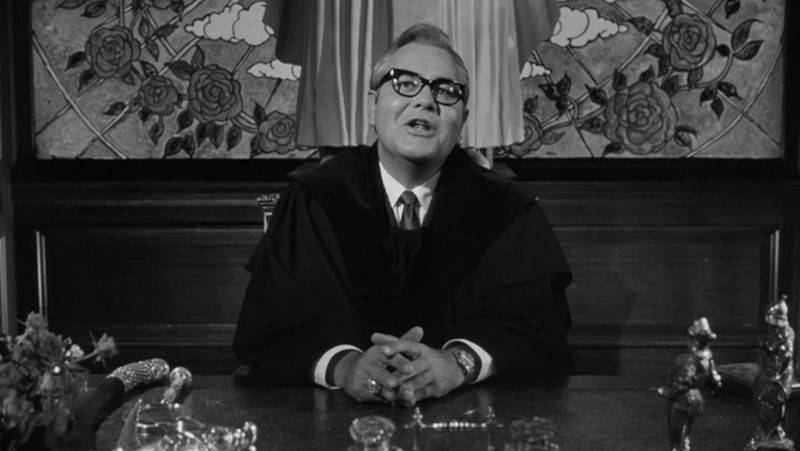
The Loved One (Tony Richardson, 1965)  Director Tony Richardson "does" Hollywood, and it ain't pretty.  There are lots of Tinsel Town screeds out there, mostly about personal mania (Sunset Boulevard, What Makes Sammy Run?), but few—like Day of the Locust—where the craziness seems endemic to the region and its excesses.  The Loved One has an air of pretense with sanctimonious chortling while it shoots its fish in a barrel, casting the film with "types"—Liberace as a coffin salesman, Milton Berle as a crass businessman—that might be a little too leaden in its intent.

Flush from his success with the multi-Oscar-winning Tom Jones, after toiling away over the British "kitchen-sink" industry, Richardson returned to black and white cinematography (by Haskell Wexler) in an adaptation of Evelyn Waugh's novel adapted by Terry Southern and Christopher Isherwood.  Waugh's book was inspired by a disappointing trip to Hollywood on the pretense of making a film of "Brideshead Revisited," and his twining of the film industry with the funeral business has a natural feel to it, as both have a lot to do with presentation, and the construction of artifice, all in the name of comfort (while robbing them blind).  


But that was in the 40's.  The film was made in the early 60's on the cusp of "mod" and in the nuclear shadow of Dr. Strangelove.  Both films have that Southern exposure in common, but where Kubrick made his film with a gargoylishly straight face, Richardson can't help gilding the mourning lily.


Poet Dennis Barlow (Robert Morse, post-dubbed with a wavering British accent) wins a literary competition, the first prize being a trip to Hollywood, where he stays with his uncle, Sir Francis Hinsley (John Gielgud) who works at a film studio.  Hinsley is soon fired by the studio's boss DJ, jr. (Roddy McDowell) and commits suicide.  The British community (led by Robert Morley) insists that Hinsley's funeral be as grand as possible, bankrupting the old man's estate, and forcing Barlow to stay in Hollywood and taking a job at a pet cemetery run by Henry Glenworthy (Jonathan Winters), whose brother, the Reverend Wilbur Glenworthy (also Jonathan Winters) runs the Whispering Glades cemetery and mortuary, the establishment handling Hinsley's solemnities.  There, Barlow meets Aimee Thanatogenous (Anjanette Comer), a corpse beautician and Mr. Joyboy (Rod Steiger), the Whispering Glades embalmer, who competes with Barlow for her affections.  


There is a lot of brilliant stuff here: a sequence at another chapel has a wedding (ministered by Ed—the original "You're in good hands with Allstate" Reimers) that is run like a television production, so that everyone can be ushered out, and a funeral ushered in; the "keeping up appearances" haranguing of the British enclave in Hollywood; Jonathan Winters, not really given free rein to his inner demons in the roles, but showing how he might have been our Peter sellers; and (okay) Liberace as a coffin salesman, there's something utterly apropos about that; a visit to Ms. Thanatagenous' under-construction cliff-house that is constantly rumbling with the threat of sliding to the highway below (a nice visual representation of her fragile doe-eyed innocence); Lionel Stander as newspaper advice columnist Guru Brahmin—a study in contrasts; the creepily loving reverence of the Whispering Glades workers for "the loved ones," as opposed to how the stiff pets at the pet cemetery are tossed into a freezer.


It's all very ghoulish and naughty (even flirting with pornography towards the end, discretely edited by Hal Ashby) but something of a misfire in its presentation.  Morse is energetic and fun (and he has the teeth to play British), but in the same way The Wrong Box has the timing wrong to evoke humor, The Loved One never quite convinces you that you're supposed to be laughing, even guiltily.  Instead, it has the air of stuffy indignation even as it's trying to regale.  And one can sympathize with the sentiments, but one wishes it was done better, less fire and more mockery.  What's the quote? "There's nothing I like less than bad arguments for a view I hold dear."


Saturday, June 20, 2009

The Big Knife

"The Big Knife" (Robert Aldrich, 1958)

"Odets, where is thy sting?" George S. Kaufman

How much you like this movie depends on how much you like Clifford Odets and his writing.

Me, not so much.

Odets has always grated on me, his writing seeming like a creative writing parody of Tennesee Williams. He's of the "cookie made out of arsenic" school, where every metaphor is tortured and every character is an overwrought drama-queen, pontificating in the most flowery way possible their transparently obvious thoughts, often at the top of their lungs. Their world comes down to good and bad, the bad being moustache twirling scene-stealers and the good down-trodden martyrs. It's a theater-world as realistic as a proscenium arch and as subtle as projecting to the back of the house.

"
The Big Knife" is no better. An "exposé" of Hollywood corruption written in the '40's, but filmed in 1955—a decade saturated with industry self-loathing—the film suffers from its over the top theatricality. Robert Aldrich has never been the most tasteful of directors, but his stylishness with dreck has never been questioned. He can make chopped liver look like foie gras (even though it still tastes like chopped liver). Directing "The Big Knife"* (the year after directing the brutal, but terrific "Kiss Me Deadly")" he barely leaves the ornate living room of screen idol Charlie Castle, nee Charlie Cass (Jack Palance), well-payed but agonizing over signing a seven-year contract with a studio that might not be artistically fulfilling. At the time of the signing, he's artistically throwing himself into a boxing picture, so already his motivations are suspect. Mrs. Castle (Ida Lupino), recently separated from Castle, doesn't want him to sign (they're separated for Castle's philandering—what does she care?).

The reason Charlie's even considering signing is the hit-and-run accident that the studio has covered up to keep Castle's reputation with the public spot-less. And studio chief Stanley Shriner Hoff (Rod Steiger) is only too willing to spill the beans if Castle doesn't co-operate and limits his work to his studio. As a signing bonus the studio just might eliminate the only witness to the case (Shelley Winters).

Odets prided himself on being of the "Kitchen Sink" school, but here he expects you to feel sorry for the plight of the privileged boo-hooing through their silk handkerchiefs rather than tissue paper. By the time of writing "The Big Knife," Odets was making good money, so maybe it was more artistically fulfilling to write about his contemporaries "in the biz," than take on the troubles of Ma and Pa Average. He also has no problems with Charlie being a perpetual lech and philanderer, but "a sell-out?" Horrors! One might ask
Frances Farmer her opinion of his choices.

John Garfield, who was Odets' stage mouth-piece, played Castle on Broadway in 1949. But the role is beyond Jack Palance—he didn't yet have the polish to play (or be) a Hollywood leading-man, so he mostly just seethes and heaves himself around the room. Ida Lupino, one of the best actresses around, is reduced to soap opera sop work here. The only actors who seem able to cope with Odets' purple prose are Winters with a force of cluelessness and Steiger, who just powers his way through like a bull—no hesitations, no apologies, which works well for the character—a studio mogul of the Louis B. Mayer/Harry Cohn ferocity.

The final act of the film is a mess of theatrical hysteria and misdirection that compresses a lot of story and reactions off-screen, while a running narrative informs us (or rather misinforms) about what all that hub-bub is upstairs. Perhaps Aldrich rushed through it to cut through the giggle factor, but the material is lumpen at any speed. You need a bigger knife than this movie's got to make it play.


* I keep seeing "The Big Knife" being referred to as a film noir. Nah. Sure, it's got a gritty title, and it's filmed in black and white, and the souls are sordid and Aldrich directed noirs--but, this is as much a film noir as "The Oscar" is!