Showing posts with label Satire. Show all posts

Saturday, July 20, 2013

The Loved One

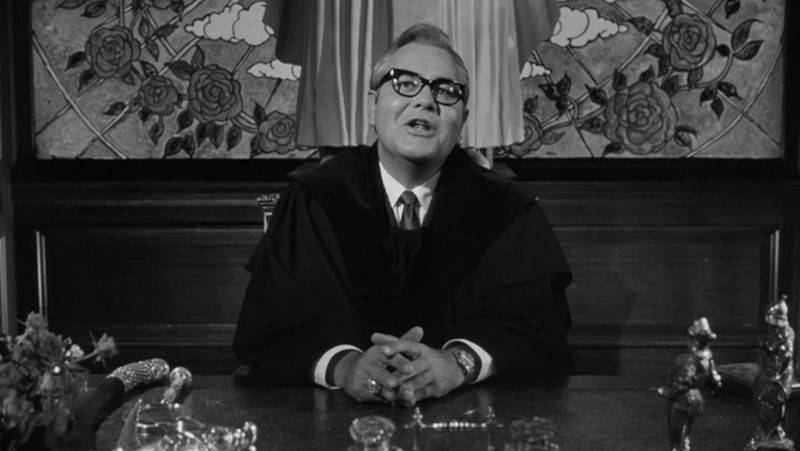
The Loved One (Tony Richardson, 1965)  Director Tony Richardson "does" Hollywood, and it ain't pretty.  There are lots of Tinsel Town screeds out there, mostly about personal mania (Sunset Boulevard, What Makes Sammy Run?), but few—like Day of the Locust—where the craziness seems endemic to the region and its excesses.  The Loved One has an air of pretense with sanctimonious chortling while it shoots its fish in a barrel, casting the film with "types"—Liberace as a coffin salesman, Milton Berle as a crass businessman—that might be a little too leaden in its intent.

Flush from his success with the multi-Oscar-winning Tom Jones, after toiling away over the British "kitchen-sink" industry, Richardson returned to black and white cinematography (by Haskell Wexler) in an adaptation of Evelyn Waugh's novel adapted by Terry Southern and Christopher Isherwood.  Waugh's book was inspired by a disappointing trip to Hollywood on the pretense of making a film of "Brideshead Revisited," and his twining of the film industry with the funeral business has a natural feel to it, as both have a lot to do with presentation, and the construction of artifice, all in the name of comfort (while robbing them blind).  


But that was in the 40's.  The film was made in the early 60's on the cusp of "mod" and in the nuclear shadow of Dr. Strangelove.  Both films have that Southern exposure in common, but where Kubrick made his film with a gargoylishly straight face, Richardson can't help gilding the mourning lily.


Poet Dennis Barlow (Robert Morse, post-dubbed with a wavering British accent) wins a literary competition, the first prize being a trip to Hollywood, where he stays with his uncle, Sir Francis Hinsley (John Gielgud) who works at a film studio.  Hinsley is soon fired by the studio's boss DJ, jr. (Roddy McDowell) and commits suicide.  The British community (led by Robert Morley) insists that Hinsley's funeral be as grand as possible, bankrupting the old man's estate, and forcing Barlow to stay in Hollywood and taking a job at a pet cemetery run by Henry Glenworthy (Jonathan Winters), whose brother, the Reverend Wilbur Glenworthy (also Jonathan Winters) runs the Whispering Glades cemetery and mortuary, the establishment handling Hinsley's solemnities.  There, Barlow meets Aimee Thanatogenous (Anjanette Comer), a corpse beautician and Mr. Joyboy (Rod Steiger), the Whispering Glades embalmer, who competes with Barlow for her affections.  


There is a lot of brilliant stuff here: a sequence at another chapel has a wedding (ministered by Ed—the original "You're in good hands with Allstate" Reimers) that is run like a television production, so that everyone can be ushered out, and a funeral ushered in; the "keeping up appearances" haranguing of the British enclave in Hollywood; Jonathan Winters, not really given free rein to his inner demons in the roles, but showing how he might have been our Peter sellers; and (okay) Liberace as a coffin salesman, there's something utterly apropos about that; a visit to Ms. Thanatagenous' under-construction cliff-house that is constantly rumbling with the threat of sliding to the highway below (a nice visual representation of her fragile doe-eyed innocence); Lionel Stander as newspaper advice columnist Guru Brahmin—a study in contrasts; the creepily loving reverence of the Whispering Glades workers for "the loved ones," as opposed to how the stiff pets at the pet cemetery are tossed into a freezer.


It's all very ghoulish and naughty (even flirting with pornography towards the end, discretely edited by Hal Ashby) but something of a misfire in its presentation.  Morse is energetic and fun (and he has the teeth to play British), but in the same way The Wrong Box has the timing wrong to evoke humor, The Loved One never quite convinces you that you're supposed to be laughing, even guiltily.  Instead, it has the air of stuffy indignation even as it's trying to regale.  And one can sympathize with the sentiments, but one wishes it was done better, less fire and more mockery.  What's the quote? "There's nothing I like less than bad arguments for a view I hold dear."


Tuesday, March 30, 2010

To Die For

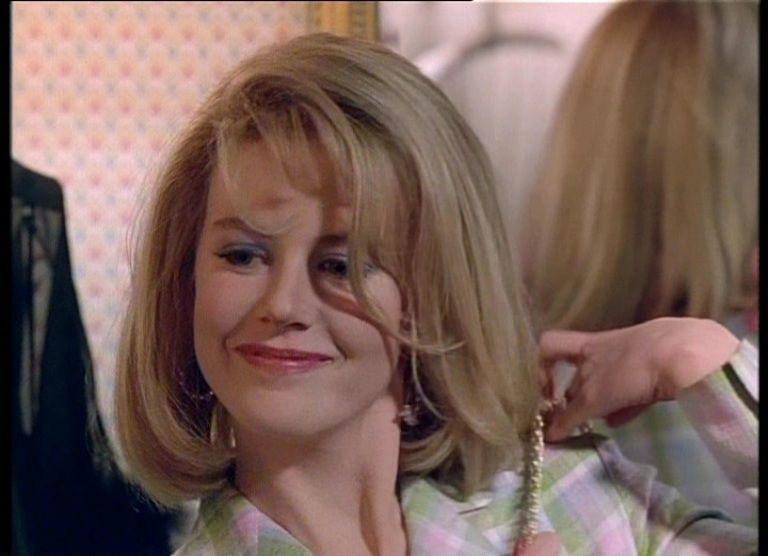
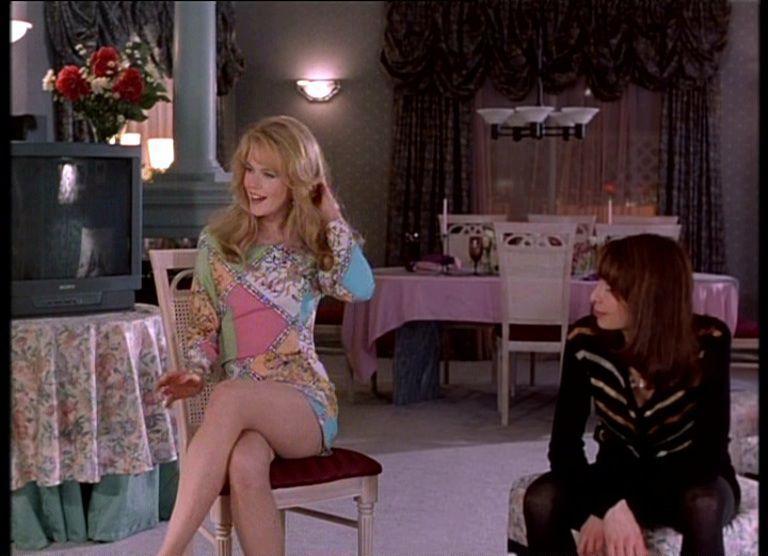
"To Die For" (Gus Van Sant, 1995) Nicole Kidman plays Suzanne Stone, a local tv weather-girl with a particularly aggressive addiction to celebrity. Her new-found fame conflicts with her ordinary home-life and her marriage to a mechanic. So she plots to murder her husband (Matt Dillon), as his lack of status might hold her back her fortunes. She recruits three teenage misfits (Joaquin Phoenix, Casey Affleck, Alison Folland) to carry out the homicide and when her in-law's attempt to pin the murder on her, she turns on the kids with blackmail.

A black comedy
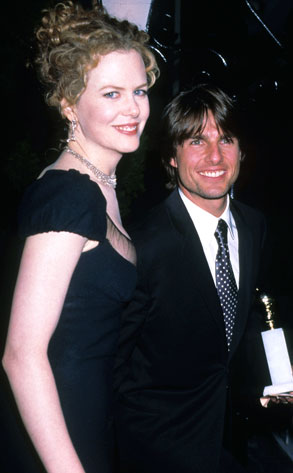
mixed with film-noir (that pairing almost never works as it tends to pile on the ironies) on the sociopathy of celebrity, it was written by Buck Henry (based on a novel by Joyce Maynard, which in turn was inspired by the Pamela Smart case) and directed by Gus Van Sant. Those who had seen her in "BMX Bandits" and "Dead Calm" knew that Kidman was more than "Mrs. Tom Cruise," but it wasn't until "To Die For," that she emerged from her superstar husband's shadow and began creating a separate career. An arch performance just shy of camp, it was the first of many of the actress' forays into aberrant personalities that have subsequently dominated her career, and proved troubling to her audience base.

But as time has moved on and
the bar for celebrity has gone as low as a snake's belly, the film looks positively prescient. And Kidman etches an indelible portrait of a femme fatale, hot-blooded in her manipulation and cold-blooded in her abandonment. Making an audition tape, Kidman's Stone looks right into the camera with knowing seductiveness and invites the watcher in on her little dark secrets and fervent desires for tv work. The wileyness of the actress playing the character is matched by the character's own wickedness and the two seem to fuse. Reason enough to watch the film, but Kidman is nearly matched in ferocity by the fine Illeana Douglas, as the Dillon character's sister, who is equally capable of killing for love. It's a movie that will keep you unnerved until the final black comic cold-hearted image.

Tuesday, September 8, 2009

JCVD

"JCVD" (Mabrouk El Mechri, 2008) Odd, but likable film all about Jean-Claude Van Damme. It is an action movie, a meditation on the quirks of fame and it's "Alice Through the Looking Glass" world.

And it's also a slyly subversive film that bends the rules of story-telling—always welcome.

Jean-Claude Van Damme has just flown back to Belgium, after attending a not-going-well custody trial for his daughter. He's jet-lagged, without sleep for 48 hours, his bank-cards aren't working, just lost a part to Steven Seagal ("he's cut off his pony-tail for the first time!") and he's Jean-Claude Van Damme, which means that every human being on Earth is judging him against his screen-image.* So, he goes to the post-office to wire funds for his lawyer for a bounced check, and finds that he's stumbled onto a robbery. He's immediately taken hostage.

And that's when things get interesting.

It is then that this little movie, so urgent and slightly snarky, turns into a treatise on fame. The robbers think it's cool that they have Van Damme as a hostage, and use him as their "voice" with the police negotiators. When the police find out Jean-Claude Van Damme is robbing the post office, they begin to freak out ("What do you do when Jean-Claude Van Damme goes rogue?") When the press and public find out Van Damme is robbing the post office, it turns into a circus.

The robbers alternately despise the star's presence, while still exploiting it, suspecting that he might try and foil the robbery, which the actor, the only one not fooled or dazzled by his screen-image, has no intention of doing.** It turns into utter madness, "Die Hard" on a small scale,
where one man is caught between both the enemy and cavalry and taking shots from both sides, but in a perverse twist, that man is an action star—with no script to follow.

And then at the 1 hour 8 minute mark, the ambient sound of chanting street noise and bickering criminals goes away, and the strangest part of the film begins,
as the actor begins to rise into the lights of the set, looks into the camera and tells a story—his story—of how he began his career in films. The monologue, mostly ad-libbed, is a bi-polar roller-coaster of emotions that Van Damme delivers in a raw, bitter style. But what is it? The truth? An audition piece? A confession? Something for the demo? An actor show-boating, or having a narcissistic pity party? That these questions are brought up is part of the razor's edge that the film is walking in that nether-world of life and movie-world.

But, it's something not seen before: actor Jean-Claude Van Damme is very good at stretching his muscles in his movies, but not his emotions...and this performance, embedded in one of his most naturalistic performances overall, does two things: it breaks the wall of movie-artifice and allows the inner thoughts of the character to burble forth. Whether it reflects truth is, actually...finally... unimportant. That it explains the actions to come of that character...is. And it casts the deep-seated motivations of the martial artist in an interesting light, rarely explored in movies.*** It is a strange, bizarre action film that questions the form, and ultimately, is just a little bit dangerous.

* One of my favorite running gags in the film is how a lot of ordinary people ask him how he feels about director John Woo, who cast him in an early film and didn't use him once he was established in Hollywood. "Still," one of them opines in the capper, "'Windtalkers' must have felt like some kind of justice."

** At one point, one of the star-struck robbers entreats Van Damme to kick a cigarette out of a hostage's mouth, which the star does. Then the robber attempts it: "I haven't done this in years," says the robber. "I don't know if I still can!" Van Damme looks at him with growing frustration: "Then, don't DO it!" The robber does anyway, kicking the hostage in the jaw. It's just one of the wonderful ways El Mechri shows fame as the crazy phenomenon it is, asking whether the crazy people are looking out of the fish-bowl or in?

*** Interestingly, another film HAS explored this theme: "Redbelt;" the two films would make a fascinating double-bill.

Thursday, August 20, 2009

In the Loop

"You Might Have Heard Him Say it, But He Didn't Say it, and That's a Fact!"

They say you don't want to see government at work just as much as you don't want to see sausage being made. The implication is that both involve grinders and a certain amount of evisceration. And the dropping of blood, metaphorically, and in some cases, literally.

"In the Loop," the smart, funny movie version of the British comedy "In the Thick of It" manages to bludgeon home that point, but also draw parallels with the most drop-dead dysfunctional of office settings. "In the Loop" employs the same "caught on the fly" filming and editing techniques of "The Office" and they're played out by a cracker-jack group of actors who give the impression that they're ad-libbing the whole thing (led by a startlingly brilliant performance by Scotts actor Peter Capaldi*). Only it's "The Office" with a vindictive murderous glee and what, if it had gone through the Ratings Board,** would be described as "pervasive language."

It is also an episode of "
Yes, Minister" on meth-amphetamines set in an abatoir, where the civil servants—the guys who never get voted out of office—run the show, and the show is the pantomime of a representative government working on the people's behalf. The lobbying people. The people in power. Those people. You know. There's enough invective in this movie to launch a thousand Uni-bombers, and most of it is hilarious—the kind of hilarity you feel guilty about laughing at. Especially if you didn't vote (not that it would do you much good).

In this expansion of the series,
the British Secretary of State for International Development Simon Foster (Tom Hollander) burbles through an inoccuous press interview that an anticipated war conducted jointly by the U.S. and Britain is "unforseeable" and the Prime Minister's Director of Communications Malcolm Tucker (Capaldi) begins running interference ("I'm sweating spinal fluid here!") for Foster, the PM, and American functionaries creating damage control by causing as much destruction as possible (not too unlikely a scenario). That he does it by some of the most creative uses of the Anglo-Saxon tongue makes it hilarious, cruising through the labyrinths of power filled with ass-covering lackeys like a shark through a school of puffer-guppiesbattering through so many non-functionaries "on defense" by being as offensive as possible.

This is not your father's "
Mr. Smith Goes to Washington," or even "The West Wing"—both those political dramas assume that civil servants are servants, rather than being self-serving, doing their jobs for the public good, not seeing it as a public nuisance. Those films assume the core of public service as "Love Thy Neighbor," rather than the reality of all-knowing governments—but only in the biblical sense.

"In the Loop" is a Full-Price Ticket. See it soon before it goes away.

* Capaldi may not be familiar to American audiences, but you've seen him before—deny it all you want, but you have—maybe in "Local Hero" or even "Doctor Who." In fact, he won an Oscar for writing and directing "Franz Kafka's It's a Wonderful Life." Also in the cast are James Gandolfini—as good as you'd expect him to be—Mimi Kennedy, the always entertaining David Rasche, and...anybody remember Anna Chlumsky..."My Girl?"

** It didn't, and so it arrives at theaters with the "NR" rating, the "nolo contendre" of the MPAA system.