Showing posts with label Gus Van Sant. Show all posts

Friday, August 5, 2011

Psycho (1998)

Psycho (Gus Van Sant — after Alfred Hitchcock, 1998) What is good about Gus Van Sant's color version of the original can be laid at the feet of that film's creator, Alfred Hitchcock: the relentless pace, the choreography of the camera (matched by Van Sant and his cinematographer—the great Christopher Doyle), the various set-pieces that alternately tease and deepen the mystery manipulating the audience's needs and tensions "like an orchestra," and that the film maker breaks the director-audience "trust" by the film's mid-point.  Danny Elfman, Bernard Herrmann's No. 1 fan, lovingly recreates his score in stereo. And modern film techniques allow Van Sant to make that opening pan across Phoenix, Arizona (2:48 pm), seamlessly locate the apartment where Marion Crane (Anne Heche) and Sam Loomis (Viggo Mortensen) play out their melancholy nooner and then crawl (with no cuts) through the window.


*


Van Sant's semi-scrupulous recreation (right) of Hitchcock's original shot-plan (left).

Everything that's wrong with Psycho '98 can be blamed on Van Sant: the kitschy color schemes, the bizarre inserts (see below) and the casting. Vince Vaughn had his hands full having to follow in Anthony Perkins' sashaying foot-steps as Norman Bates, so kudos to him for even showing up on-set, although he's lousy. What's surprising is how poorly Anne Heche and Julianne Moore step in for Janet Leigh and Vera Miles, even though both seem to be working harder. And it's that way down the line, including—startlingly, Viggo Mortenson's poor standing next to John Gavin (??!) and Robert Forster's shrink monologue next to...Simon Oakland? Where there is parity (or is it parody, it's hard to say how much Van Sant is taking this seriously...did Hitchcock?) is William H. Macy's Detective Arbogast compared to Martin Balsam's original, and Philip Baker Hall for John McIntire.


So, why even do it? Van Sant, in his commentary, cites several reasons: today's generation of movie-goers don't know from Psycho...or Hitchcock, making this a sort of a remedial version—Hitchcock for Dummies; some movie-goers don't like black and white films, hence the move to color; changes in movie technology allow the sorts of things that Hitchcock wanted to achieve technically with Psycho but could not (and the ratings system allows for a post-censor version—lines cut by Hitchcock are re-inserted, and there is a bit more blood-and-gore); and, the most compelling reason for Van Sant—nobody'd ever done it before—at least as scrupulously.  He basically follows Hitchcock's story-boards (and carried a portable DVD player with the film for reference while shooting on-set), so it is mostly a matter of interpretation, which is not that radical a concept.  After all, how many different interpretations of "Hamlet" have there been?  And as Hollywood seems to be running out of ideas (or continues its policy of playing it safe) we've seen remakes, re-boots and re-imaginings of Planet of the Apes, True Grit, Solaris, The Taking of Pelham 1-2-3, any book by Jane Austen or the Brontë sisters, and we've seen movie versions of teleplays, such as Traffic, State of Play, Edge of Darkness, and we'll see one of The Girl With the Dragon Tattoo and Tinker, Tailor, Soldier Spy in December.  Is this necessarily a bad thing?  NoThe Maltese Falcon had been filmed twice before when John Huston made his classic version in 1941.  It is interesting that Van Sant not only remade Psycho, but also made it in Hitchcock's style using his shooting plan, acknowledging that the movie and the man who made it are inseparable.

What's different?  Van Sant follows Hitchcock's ideas pretty well...but does a sort of skewed version of them in terms of color, angle and performance. Some scenes have a more modern spin on then—for example, Lila and Sam wait for word from Arbogast (Martin Balsam in Hitchcock's version, William Macy in Van Sant's) at Sam's business, a hardware store in the 1960 version, but a flea-market in 1998, notice Sam reading the liner notes on a Judy Garland record.


In 1960, while investigating the Bates house, Lila finds children's books in Norman's room, but in 1998, it's porn.


And Mrs. Bates is found sitting in the dull basement, but in 1998, she's seen sitting in front of a diorama with live birds.


The biggest difference has a more feminist slant: rather than sitting back and watching the final fight, 1998's Lila takes part kicking her assailant.


But, Van Sant's entirely new additions are, frankly, unnecessary.  Sure, the first shot of the fly might have suggestions of bringing things full-circle, but the other shots—quick cut-aways (no pun intended—??) during the murders are merely distractions taking us out of "the moment" of the victims' deaths, and seem pretty frivolous.  Hitchcock does establish a "mind's eye" kind of cinema with his "voices in my head" sound overlays, and his "see that I look"/"see what I look at"/"see my reaction to it" style of silent story-telling might allow it, but it seems superfluous, and more than that, confusing, especially when we're having a shocking thing happening on-screen.


During the opening scene in the hotel room, an image of a fly on a half-eaten sandwich is inserted, paralleling the lucky fly who won't be killed in the prison cell at the end of the film.
During the first murder, a shot of a dilating pupil (presumably in the victim's eye) and a quickly moving storm-scape which presumably was witnessed previously.  
The second murder victim's flash-frames are (given that person's profession) a sleazy vice scene...
...As well as a stray cow in the middle of a road (A memory?  A potential victim?)

As well as a quick, obfuscating shot of the murderer approaching.

So...the Van Sant version of Psycho is an interesting experiment, Hitchock through the sensibilities of Van Sant, respectful but different.  Does it do harm to the original? 

Well, no.  Interesting story: the pulp novelist James M. Cain was told once by a person "too bad what Hollywood has done to your books," and Cain took them into his library and pointed to his own novels. "Hollywood hasn't done anything to my books. They're right there on the shelf." 


The original—Alfred Hitchcock's Psycho—will always be there.


Cameo's: Hitchcock on the left (1960) and a portly Hitchcock stand-in points at Gus Van Sant (1998).

The final card of Van Sant's Psycho—taking us beyond Hitchcock's raising of a car from the bog for a bit of perspective: all that horror has gone on just off the highway.  The distant traffic sails by, indifferent and unsuspecting of what lies out of their attention.  There's an element of that in all of Van Sant's movies—horror and secret lives occur just out of sight of normalcy.


*  In-joke (there are lots) here: The sign on The Bates Motel says "newly renovated" (a cutting remark)

Tuesday, March 30, 2010

To Die For

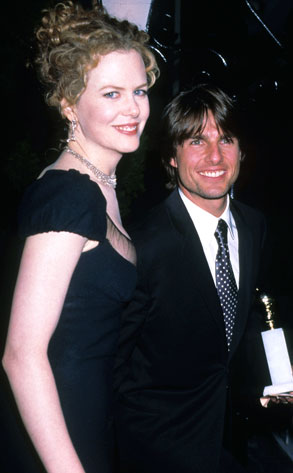
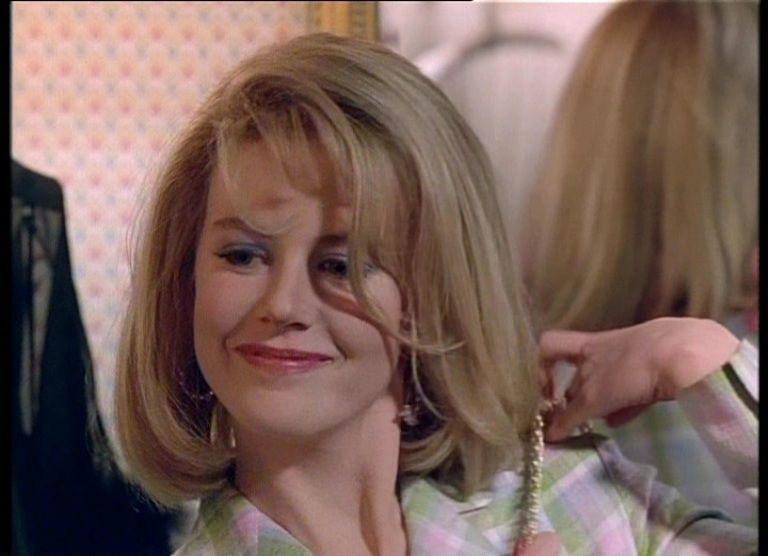
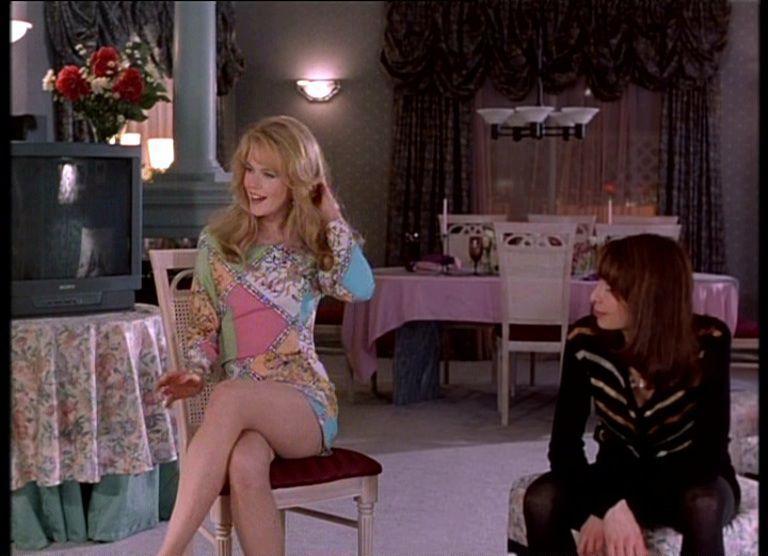
"To Die For" (Gus Van Sant, 1995) Nicole Kidman plays Suzanne Stone, a local tv weather-girl with a particularly aggressive addiction to celebrity. Her new-found fame conflicts with her ordinary home-life and her marriage to a mechanic. So she plots to murder her husband (Matt Dillon), as his lack of status might hold her back her fortunes. She recruits three teenage misfits (Joaquin Phoenix, Casey Affleck, Alison Folland) to carry out the homicide and when her in-law's attempt to pin the murder on her, she turns on the kids with blackmail.

A black comedy
mixed with film-noir (that pairing almost never works as it tends to pile on the ironies) on the sociopathy of celebrity, it was written by Buck Henry (based on a novel by Joyce Maynard, which in turn was inspired by the Pamela Smart case) and directed by Gus Van Sant. Those who had seen her in "BMX Bandits" and "Dead Calm" knew that Kidman was more than "Mrs. Tom Cruise," but it wasn't until "To Die For," that she emerged from her superstar husband's shadow and began creating a separate career. An arch performance just shy of camp, it was the first of many of the actress' forays into aberrant personalities that have subsequently dominated her career, and proved troubling to her audience base.

But as time has moved on and
the bar for celebrity has gone as low as a snake's belly, the film looks positively prescient. And Kidman etches an indelible portrait of a femme fatale, hot-blooded in her manipulation and cold-blooded in her abandonment. Making an audition tape, Kidman's Stone looks right into the camera with knowing seductiveness and invites the watcher in on her little dark secrets and fervent desires for tv work. The wileyness of the actress playing the character is matched by the character's own wickedness and the two seem to fuse. Reason enough to watch the film, but Kidman is nearly matched in ferocity by the fine Illeana Douglas, as the Dillon character's sister, who is equally capable of killing for love. It's a movie that will keep you unnerved until the final black comic cold-hearted image.

Thursday, April 9, 2009

Elephant

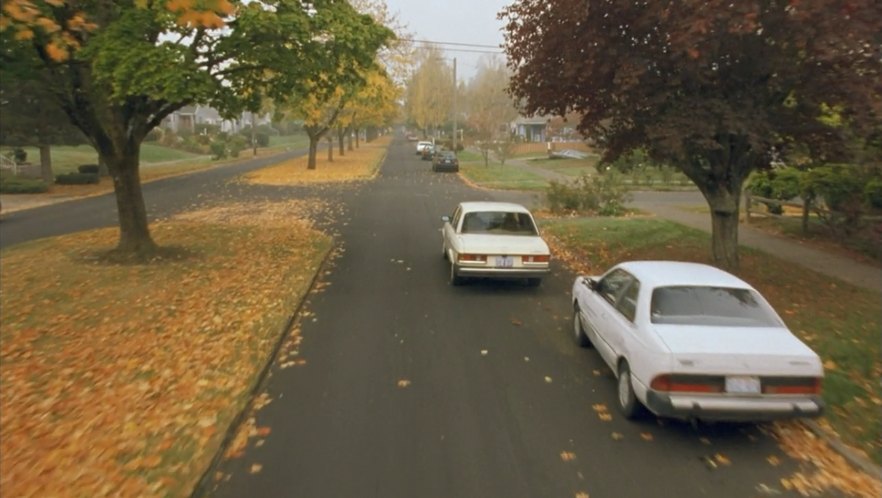
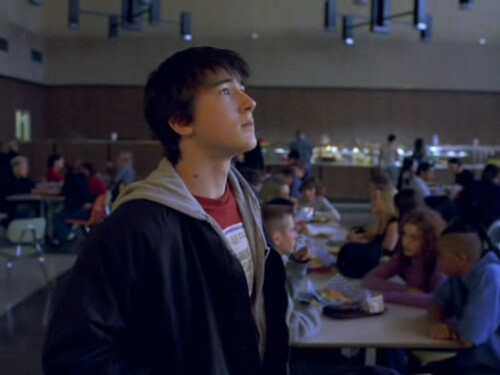
"Elephant" (Gus Van Sant, 2003) "Columbine from the Trenches." The film starts with a car out of slow-motion control smashing into garbage cans along the street. John McFarland (John Robinson) has to take the keys away from his father (Timothy Bottoms), who is driving his son—drunk—to school. Already we're given a sense of life out of control as we spend a weirdly typical day at a High School in suburban Portland, following the criss-crossing paths of several strata of students in long floating camera tracks down the long corridors of lockers and linoleum. The shots follow the gaze of the walkers extending to vanishing-points down the halls, leading inexorably...to what? Usually, another hall-way. After many minutes of this you begin to feel trapped in a maze, and Van Sant's doing enough obscure things with his mumbling non-actors (most of the film was improvised) to keep an audience-member on-edge. It's "The Shining," all "Greased" up and nowhere to go. Around each corner, there may be the photo class guy who wants to take your picture, or it might be the last thing you ever see.

The film is an homage of sorts to
Danny Boyle and Alan Clarke's experimental film about an IRA shooter, using long tracking shots and a chilly minimalist approach. But Van Sant (and his producer Diane Keaton) have changed the "elephant in the room" to school violence and the 1999 Columbine Massacre, which the carnage from "Elephant" somewhat resembles. The film plays out dispassionately without any answers and no questions asked. The Act simply is. Kids get pissed. Kids arm up. Kids get revenge. The shooters aren't glorified. They have little on the ball, get abused by the jocks, play first-person shooter video games, experiment with gay sex, and build bombs that don't work. Their assault is shooting fish in a barrel, with no rules and no thought. What could explain it? And nothing could justify it. In the end, you're left drained and hopeless and questioning why you wanted to see it in the first place.

But Van Sant excels in draining feeling out of his movies. Oh, emotions are there, but there's a chilly null-void surrounding the actors as they float through the landscapes. The kids in the school are chirpily distracted, turning drama from the trivia. They're not even thinking, so much as using brain-energy and you can feel the complacency in their hall-walkabouts—("This is where I'm supposed to be, and okay, I get to do things I like to do, so no problem") They're innocent cows in a field, ill-prepared for armed assault, and death unfathomable given their age. They're the slowest of targets.

The shooters have that same null-void cocoon around them and through them. They shoot, sometimes watch the results, but mostly just randomly pick off kids they encounter by chance. All the earlier intersections we've seen (and re-seen from other perspectives) come to an abrupt ending, the wanderings stopped with a bloody, crumping jolt. This is death by violence, but it's not a crime of passion. These kids feel nothing, not even satisfaction, wandering through their little cloud of atrocity, while the other kids wander in theirs of complacency. The gun-shots are the lightning that form when they meet.

It's a disturbing film for its utter lack of feeling, remorse or empathy. As such, it provides a bit more insight to a senseless killing than any speculation of its cause might serve.

What could explain such an act?

Nothing.

Wednesday, January 14, 2009

Milk

"The Plural of 'Us's' is 'I'"

I had all these cute little headlines to put at the top of this review, reflecting my disappointment with Gus Van Sant's bio-pic of slain San Francisco supervisor Harvey Milk—"Condensed Milk," "2% Milk"—but ultimately it comes down to this: you owe it to yourself to see "The Times of Harvey Milk" the Oscar-winning documentary on Milk and his efforts to fight discrimination. No hidden links: You can watch it on Hulu here: http://www.hulu.com/watch/49577/the-times-of-harvey-milk It'll cost you nothing but 90 minutes of your time with minimal interruptions. "Milk" acknowledges its debt to this film in its final credits. Indeed, you'll see a lot of archive footage shared by both films. And "Milk," a features recreations of footage from this film. The film ends with Sean Penn, as Milk, saying the words that you'll find in the video at the bottom of this review into his tape recorder for the prescient "In the Event of My Death by Assassination" tape he made. But that sentiment was not a private one. And the film does a disservice to Milk making it so.

It also inadvertently plays into stereotypes by suggesting that Milk's assassin Dan White was a closeted gay man instead of the mentally ill person he was. White's angry (and public) resignation during a meeting of the Board of Supervisors is also made private in the film. White's sneaking into the city hall with a loaded weapon to avoid metal detectors is alluded to, but not that White re-loaded his pistol after shooting Mayor Moscone and heading to the Supervisor offices to kill three other board members (Milk was the only one present). That the crimes were deliberate seems incontrovertible. But White was only convicted of manslaughter and released after serving five years in prison.

And one can quibble about Penn's performance as well, making Milk more fey in his mannerisms (Milk had hidden his sexuality in New York for years), and giving him a thick Bronx accent more Harvey Fierstein than Harvey Milk (ironically, Fierstein narrates the "Times" documentary).

Still, ya gotta do what ya gotta do. The original documentary is 25 years old and is probably past its shelf-life. A dramatic re-telling of the tale was probably due (a twin project "The Mayor of Castro Street" has been in the works, first by Oliver Stone and more recently by writer Christopher McQuarrie and Bryan Singer for years, and has for the time being been abandoned) if only to keep reminding people of the toll closeted life inflicted on the gay population. The battle continues to put a familiar face on homosexuality. And if a melodramatic re-telling of a pivotal story is required, so be it.

Van Sant does a fine job of mixed media cutting between vintage footage, newscasts, and recreations. And he gets great work out of his cast, particularly Penn, who's never seemed so relaxed in a role, James Franco (who gets better with each movie) as his first partner in San Francisco, and Emile Hirsch from Penn's "Into the Wild" as one of his youngest recruits.

"Milk" is a Matinee.