 Physician, Heal Thyself
or
"It's Hard, You Will Find, to be Narrow of Mind When You're Jung at Heart"
There's a lovely scene in Francis Coppola's Tucker: The Man and His Dream, in which Tucker's accountant (played by Martin Landau) talks about how his mother "in the old country" warned him not to get too close to people or he'd catch their "dreams." "Years later," he says "I realized I misunderstood her. 'Germs', she said, not dreams, you'll catch their germs."
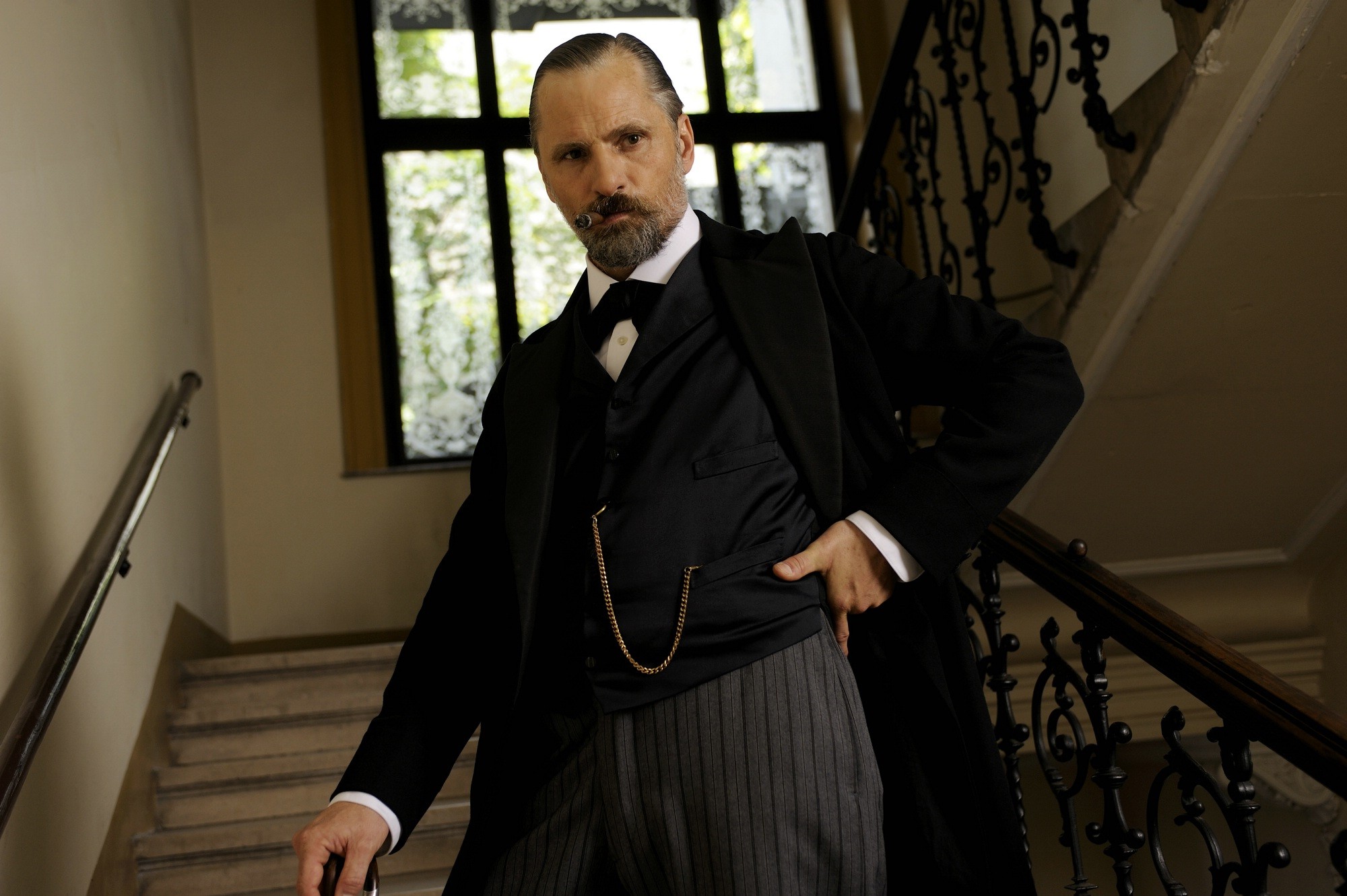
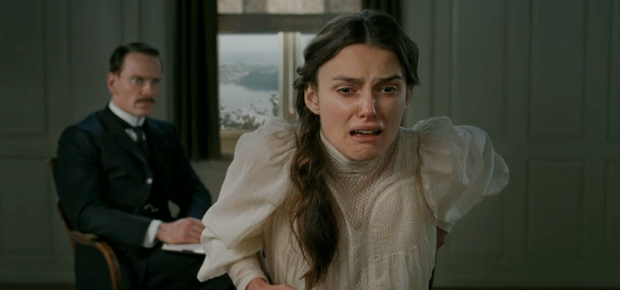
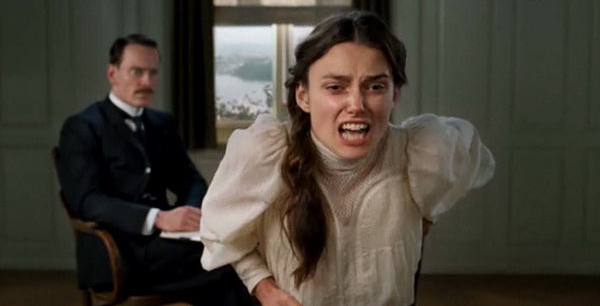
David Cronenberg's film of A Dangerous Method (adapted by Christopher Hampton from his play), a fictionalization of the relationship between psychiatric pioneers Signmund Freud, Carl Jung and Sabina Spielrein, might well have "don't get too close to people or you'll catch their dreams" as its tagline. Starting out, Jung and Freud are two eminent theoretical psychiatrists, the former in Switzerland and the latter in Vienna. Spielrein is admitted to Jung's care, suffering from what appears to be schizophrenia, but he is convinced that Freud's "talking cure" (the name of Hampton's play) might lead to a break-through from her confusion and agitation.
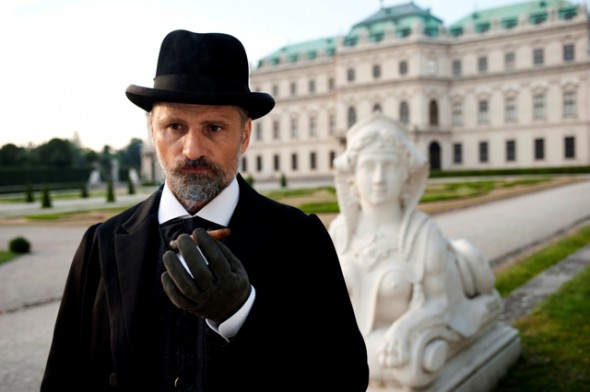
Jung (Michael Fassbender) has it all going for him—in marked contrast to his troubled patients and his contemporaries in his field—married to a rich heiress, he works because he wants to, not because he has to. Humorless, cool and entirely self-absorbed and -satisfied, the treatment of Spielrein gives him a very real sense of accomplishment, as the woman's obvious intelligence allows her to improve from the agitated state she arrives in.* His comradeship with Freud (Viggo Mortensen, his third film in a row with director Cronenberg) starts intellectually, evolves into an affectionate father-son mentorship, Freud sees him as an "heir" in the field of psychotherapy, and encourages his younger contemporary and his processes...up to a point—Freud cooly informs Jung, while he's is visiting the home of the elder, that, sure, he can espouse his sexual theories at the Freud family dinner table—after all, "they've heard worse." But the air of chastisement is never far from Freud's sphere, like the smoke that hangs around his cigar.
Jung is a confident, if clueless, intellectual and emotionally remote (although he would use the word "dispassionate"). Things start to go downhill when Freud sends him "a problem" professor, Otto Gross (a nearly unrecognizable Vincent Cassel), a libertine without conscience or consequences, who starts to influence Jung to his way of thinking. The pressures of Gross' philosophy (such as it is) and Spielrein's needy attempts at seduction, compels him to begin, eventually, a twisted affair with his patient, the result of which leads to whispers of impropriety in psychiatric circles and creates a rift between him and Freud. Jung reacts, not by questioning his own actions, but escalating his objections to Freud's obsession with sex as the root of human dysfunction,** and as good as he is at examining others, is incapable of realizing the deadening of his own emotions and darkening of his tone. His own self-analysis becomes paralyzed in the conflicts of his own mind, and he's left confused, disillusioned and impotent to know how to bring himself out of it. The patient improves and becomes a more rounded human being, but the doctor...he succumbs.
It recalls words the simple answer my brother used when I was contemplating psychotherapy: "But...psychiatrists are crazy!"
And why wouldn't they be? In tending to our needs, they are just as likely to catch our dream and ensnare our nightmares...and be ensnared by them. Everything is communicable.
And the stories of Spielrein, Jung and Freud, running parallel but opposite paths of mental health, exemplify the rising and falling fortunes, not of career and accomplishment, but of personal integrity. A Dangerous Method is a furthering of the film argument (which is found throughout the work of Kubrick and Welles, for instance) that intellect does not matter so much in a person's measure as character.
A Dangerous Method is a Matinee.
* A passing comment on Keira Knightley's performance, which is, initially, truly alarming, one of the great "crazy" acts since Helena Bonham Carter's Ophelia in Zefferelli's version of Hamlet, but then Knightley has never been afraid of a performance that will risk her beauty. Here, she is vigorously spastic, mercurial, contorting her face into ape-like grimaces and flashes of madness, the eyes pin-wheeling around the room in search of...anything that might pull her out of her own head. Yes, it's over-the-top, but compare it to the woman she becomes by the end—for the triad of performances and personalities in the film, her story is the focus, the linch-pin around which the film revolves—very properly, as those early years of the "talk treatment" are dominated, probably unfairly, but historically accurately, by the reputations of the father-figures in the field. Girls Not Allowed.
** This is certainly true in the portrayal of Freud here; if you ask Morgenson's Freud how many psychiatrists it would take to change a light-bulb (Answer: Just one, but it has to really want to change), he'd cooly appraise you, contemplate his cigar and ask aloud why you chose to not use the word "screw." Avoidance, maybe? Um...
Friday, February 3, 2012
A Dangerous Method






Friday, August 5, 2011
Psycho (1998)
 Psycho (Gus Van Sant — after Alfred Hitchcock, 1998) What is good about Gus Van Sant's color version of the original can be laid at the feet of that film's creator, Alfred Hitchcock: the relentless pace, the choreography of the camera (matched by Van Sant and his cinematographer—the great Christopher Doyle), the various set-pieces that alternately tease and deepen the mystery manipulating the audience's needs and tensions "like an orchestra," and that the film maker breaks the director-audience "trust" by the film's mid-point. Danny Elfman, Bernard Herrmann's No. 1 fan, lovingly recreates his score in stereo. And modern film techniques allow Van Sant to make that opening pan across Phoenix, Arizona (2:48 pm), seamlessly locate the apartment where Marion Crane (Anne Heche) and Sam Loomis (Viggo Mortensen) play out their melancholy nooner and then crawl (with no cuts) through the window.


Everything that's wrong with Psycho '98 can be blamed on Van Sant: the kitschy color schemes, the bizarre inserts (see below) and the casting. Vince Vaughn had his hands full having to follow in Anthony Perkins' sashaying foot-steps as Norman Bates, so kudos to him for even showing up on-set, although he's lousy. What's surprising is how poorly Anne Heche and Julianne Moore step in for Janet Leigh and Vera Miles, even though both seem to be working harder. And it's that way down the line, including—startlingly, Viggo Mortenson's poor standing next to John Gavin (??!) and Robert Forster's shrink monologue next to...Simon Oakland? Where there is parity (or is it parody, it's hard to say how much Van Sant is taking this seriously...did Hitchcock?) is William H. Macy's Detective Arbogast compared to Martin Balsam's original, and Philip Baker Hall for John McIntire.


So, why even do it? Van Sant, in his commentary, cites several reasons: today's generation of movie-goers don't know from Psycho...or Hitchcock, making this a sort of a remedial version—Hitchcock for Dummies; some movie-goers don't like black and white films, hence the move to color; changes in movie technology allow the sorts of things that Hitchcock wanted to achieve technically with Psycho but could not (and the ratings system allows for a post-censor version—lines cut by Hitchcock are re-inserted, and there is a bit more blood-and-gore); and, the most compelling reason for Van Sant—nobody'd ever done it before—at least as scrupulously. He basically follows Hitchcock's story-boards (and carried a portable DVD player with the film for reference while shooting on-set), so it is mostly a matter of interpretation, which is not that radical a concept. After all, how many different interpretations of "Hamlet" have there been? And as Hollywood seems to be running out of ideas (or continues its policy of playing it safe) we've seen remakes, re-boots and re-imaginings of Planet of the Apes, True Grit, Solaris, The Taking of Pelham 1-2-3, any book by Jane Austen or the Brontë sisters, and we've seen movie versions of teleplays, such as Traffic, State of Play, Edge of Darkness, and we'll see one of The Girl With the Dragon Tattoo and Tinker, Tailor, Soldier Spy in December. Is this necessarily a bad thing? No. The Maltese Falcon had been filmed twice before when John Huston made his classic version in 1941. It is interesting that Van Sant not only remade Psycho, but also made it in Hitchcock's style using his shooting plan, acknowledging that the movie and the man who made it are inseparable.
What's different? Van Sant follows Hitchcock's ideas pretty well...but does a sort of skewed version of them in terms of color, angle and performance. Some scenes have a more modern spin on then—for example, Lila and Sam wait for word from Arbogast (Martin Balsam in Hitchcock's version, William Macy in Van Sant's) at Sam's business, a hardware store in the 1960 version, but a flea-market in 1998, notice Sam reading the liner notes on a Judy Garland record.


In 1960, while investigating the Bates house, Lila finds children's books in Norman's room, but in 1998, it's porn.


And Mrs. Bates is found sitting in the dull basement, but in 1998, she's seen sitting in front of a diorama with live birds.


The biggest difference has a more feminist slant: rather than sitting back and watching the final fight, 1998's Lila takes part kicking her assailant.


But, Van Sant's entirely new additions are, frankly, unnecessary. Sure, the first shot of the fly might have suggestions of bringing things full-circle, but the other shots—quick cut-aways (no pun intended—??) during the murders are merely distractions taking us out of "the moment" of the victims' deaths, and seem pretty frivolous. Hitchcock does establish a "mind's eye" kind of cinema with his "voices in my head" sound overlays, and his "see that I look"/"see what I look at"/"see my reaction to it" style of silent story-telling might allow it, but it seems superfluous, and more than that, confusing, especially when we're having a shocking thing happening on-screen.
 |
| During the opening scene in the hotel room, an image of a fly on a half-eaten sandwich is inserted, paralleling the lucky fly who won't be killed in the prison cell at the end of the film. |

 |
| During the first murder, a shot of a dilating pupil (presumably in the victim's eye) and a quickly moving storm-scape which presumably was witnessed previously. |
 |
| The second murder victim's flash-frames are (given that person's profession) a sleazy vice scene... |
 |
| ...As well as a stray cow in the middle of a road (A memory? A potential victim?) |
 |
| As well as a quick, obfuscating shot of the murderer approaching. |
So...the Van Sant version of Psycho is an interesting experiment, Hitchock through the sensibilities of Van Sant, respectful but different. Does it do harm to the original?
Well, no. Interesting story: the pulp novelist James M. Cain was told once by a person "too bad what Hollywood has done to your books," and Cain took them into his library and pointed to his own novels. "Hollywood hasn't done anything to my books. They're right there on the shelf."
The original—Alfred Hitchcock's Psycho—will always be there.


 |
| The final card of Van Sant's Psycho—taking us beyond Hitchcock's raising of a car from the bog for a bit of perspective: all that horror has gone on just off the highway. The distant traffic sails by, indifferent and unsuspecting of what lies out of their attention. There's an element of that in all of Van Sant's movies—horror and secret lives occur just out of sight of normalcy. |
* In-joke (there are lots) here: The sign on The Bates Motel says "newly renovated" (a cutting remark)
Thursday, November 26, 2009
The Road
Oh, where have you been, my blue-eyed son?
Oh, where have you been, my darling young one?
I've stumbled on the side of twelve misty mountains,
I've walked and I've crawled on six crooked highways,
I've stepped in the middle of seven sad forests,
I've been out in front of a dozen dead oceans,
I've been ten thousand miles in the mouth of a graveyard,
And it's a hard, and it's a hard, it's a hard, and it's a hard,
And it's a hard rain's a-gonna fall.
 "Lost in a Haunted Wood"
A boy and his father are walking through the valley of the shadow of death. A cataclysm has happened, whether by the hand of Man or God it is uncertain and does not matter. The sky shows no sunlight, only the gray of dust clouds and smoke. The animals are dead. The forests are dying, crisping into fire or crumbling from dead roots. There is no food. No gas. No electricity. Buildings are crumbling or have been turned into abbatoirs for cannibalism. The boy and the father fear for there is evil anywhere for in the fight to survive, there is no moral contingent in the death-struggle to survive.
For the father (Viggo Mortensen), the worries are "food, the cold and our shoes." The fears are the roving packs of humans who'll survive by any means necessary, theft, killing, consumption. Some have taken to hacking off their own limbs to stave off starvation. His wife (Charlize Theron) is long dead, having walked out into the night, which is tantamount to committing suicide. Now the father and boy (Kodi Smit-McPhee, who looks eerily like Theron) are heading South to the ocean because to stay in one place means eventual attack. They have miraculously survived so far, and they must repeat the miracle day after day until the miracles give out. Among the effects the father carries are a gun with two bullets, one for each of them. And one of the life lessons taught is how to shoot oneself in the most efficient manner. "The child is my warrant," says the father in narration. "If he is not the Word of God, then God never spoke."
Cormac McCarthy's "The Road" was a best-seller and eventually won the 2007 Pulitzer Prize for Literature. John Hillcoat's film of it doesn't shirk from the doomsday scenario or amoral atrocities and has managed to find bleak blast areas of Pennsylvania, Louisiana, Oregon and Washington* to depict the nightmare world, post-disaster. It's somewhat ironic to see this film of people trying to pick up the pieces when booming next door at the multi-plex is "2012" showing a scenario that might have created the situation as a fun-ride. "The Road" is anything but rollicking, but is a great work of film that cuts right to the bone of what it means to be a human being, a father, and responsible. We've seen such scenarios before in movies, but they've all been kinetic desert chases or the threats are vampires, mutants and zombies—"others"—and not beings who've only been tipped by circumstance to preying on their own kind. This is no "pop"-nihilism for the sake of entertainment, with its "safe" zones, and goals of legended peace. It's a dog-eat-dog world and all the dogs are gone. Instead of pyrotechnics and thrill rides, we're left with survival—plodding, exhausting, fearful...on the edge of life and humanity.
It's tough stuff—"fight or flight" stuff with an edge of "Deliverance" maliciousness, but treated with an unsentimental "It is what it is" approach. So, be warned that its an ordeal (not as much of one as I was prepared for, but know that it is unpleasant), but is bursting with excellent work on all fronts. Viggo Mortenson's film-length performance is epic—a good man tossed into impossible situations, weakening bit by bit in the struggle, the panic in his eyes rarely allowed to escape to the rest of his face. Smit-McPhee gives one of the most clear-eyed kid performances put to screen, and their work is punctuated by tough, unsentimental cameos by Theron (one steel-edged performance, this), Guy Pearce, and Robert Duvall (in a short but masterful, almost lyrical performance).
It is not too much to say that "The Road" does its extraordinary source proud, while making its own path to greatness.
"The Road" is a Full-Price Ticket.


Oh, what'll you do now, my blue-eyed son?
Oh, what'll you do now, my darling young one?
I'm a-goin' back out 'fore the rain starts a-fallin',
I'll walk to the depths of the deepest black forest,
Where the people are many and their hands are all empty,
Where the pellets of poison are flooding their waters,
Where the home in the valley meets the damp dirty prison,
Where the executioner's face is always well hidden,
Where hunger is ugly, where souls are forgotten,
Where black is the color, where none is the number,
And I'll tell it and think it and speak it and breathe it,
And reflect it from the mountain so all souls can see it,
Then I'll stand on the ocean until I start sinkin',
But I'll know my song well before I start singin',
And it's a hard, it's a hard, it's a hard, it's a hard,
It's a hard rain's a-gonna fall.
Bob Dylan
* Early on, I recognized paths that I'd walked on in Gifford Pinchot National Forest in the shadow of Mount St. Helens, and as soon as the hairs on the back of my neck relaxed, a shot of the timber-clogged Spirit Lake appeared. From what I've read, the FX crew used shots of the NW skies at the time of the Mt. St. Helens eruption to loom over the horizons—the whole movie has the looming density of a lousy NW winter day.
Thursday, October 23, 2008
Appaloosa
 "The Unforeseeable"
Virgil Cole and Everett Hicks (Ed Harris, Viggo Mortensen) law enforcers for hire, have been "pards'" for a long time now. They're two peas in a pod, and when they ride into the town of Appaloosa (in the New Mexico Territory, circa 1882) they already know what they're gonna say to the town-fathers about their marshaling problem. They've done it before.

The two form a unit in everything: conversationally, they finish each other's sentences, and where Cole is a pistol man with a fast draw, Hicks has an 8-gauge shotgun that can distribute a wide enough pattern to make a mob think twice....before it cuts them in two. Cole's contract with the town is simple: if he's going to enforce the law, he has to make the laws. As Hicks explains, "Whatever Mr. Cole states, it's law."


Ed Harris' sophomore directorial effort (after the particularly well-done bio-pic "Pollack") is a minor western, limited in population and scope. Based on Robert B. Parker's* novel of the same name, it still manages to do what it does very well, and provides a collection of very good actors (including Harris, Mortenson, Renée Zellweger, Jeremy Irons, Timothy Spall and Lance Henriksen) with complex roles that they clearly enjoy taking on. These people are infused with quirk, and character drives the story-line. Where Harris is brittle and short with words, Mortenson is laconic and lanky. Zellweger's Allie French happily screws up her face in a pinched manner that I haven't seen before--either mighty pleased with herself, or trying to keep the prairie dust off her face, I'm not sure which. Irons carries on the long tradition of English gentlemen-actors lovingly chewing western scenery.

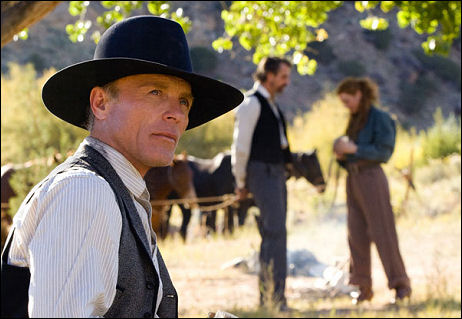
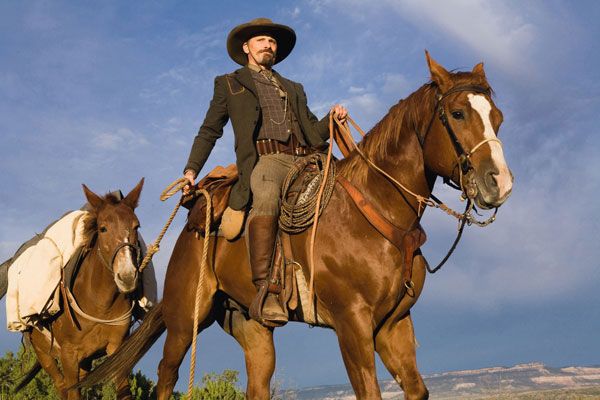

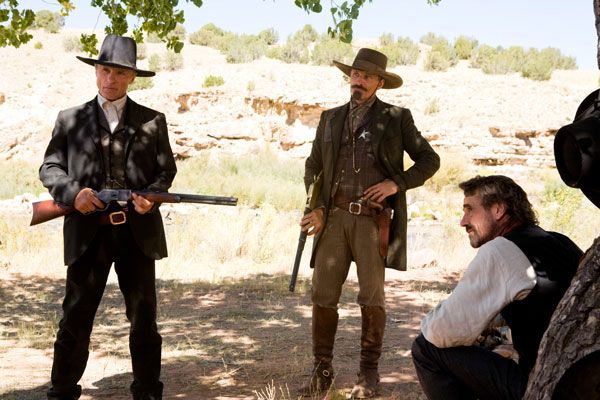
After making a none-too-subtle point about a town that wants security giving away its freedoms, the film settles into the...what's that word?...resolution of the conflict between Irons' predatory land-baron, Bragg, and the homespun issues that occur with the arrival of Zellwegger's Allie French. Will a triangle develop? Who gets the girl? What happens to men of principle when the compromise of love enters the picture? A held prisoner in the jail reminds one of the Alamo consequences of "Rio Bravo," but it's not dwelled on for very long, and the story keeps advancing, despite the well-travelled terrain into unknown territory.

And I've always had a fondness for Western colloquialisms that arise from each new author tackling Westerns, and Parker and Harris and co-scenarist Robert Knott do not disappoint.
Little details stand out: Harris makes a point of showing the high forehead tan-line that's a permanent part of every hat-wearing citizen of Appaloosa (of course, that would be true, but it's too rarely seen in "perfect make-up" movie Westerns), and his gun-fights are brief, brutal affairs that are over in a flash of wills and smoke. "That happened quick!" muses Hicks after a long-odds gun battle is finished. "Everybody could shoot!" is Cole's tight-jawed reply.

And situations are repeatedly presented showing how much will is required "out there." Hesitancy could mean death. And the rules of the jungle claim jurisdiction even in a desert covered in clap-board. It's refreshing to see a Western that doesn't cloak itself as an epic. The aims of "Appaloosa" are small, but ring true.


"Appaloosa" is a Matinee.
* After John D. MacDonald, Parker is a favorite author when one is looking for pleasingly composed, enjoyably readable genre story-telling. His "Spenser" novels are his CTF, but his westerns, and his post-Chandler Phillip Marlowe stories are great fun to relax with.
Wednesday, November 14, 2007
Eastern Promises
 Every picture tells a story, don't it?
 "Eastern Promises" is the latest film by David Cronenberg, Master of the Uncomfortable, Enemy to the Squeamish. As with "A History of Violence" his star of choice is Viggo Mortenson, who after years of "body in a suit" roles where he barely registered, became a star with the "Lord of the Rings" trilogy. His post-"Ring" choices have been interesting, including two films by Cronenberg where he could use his inscrutable demeanor to maximum advantage. His Nikolai--ostensibly "The Driver," but to others, "The Undertaker"--is a lieutenant in the Russian mob in contemporary London. His boss is Kirill (Vincent Cassell), the unreliable son of Semyon (Armin Mueller-Stahl), owner of the Trans-Siberian supper club, and "King" of the mob. There are many facades in "Eastern Promises," whether they're legitimate businesses that front prostitution, or the quaint grandfatherly demeanor that Semyon presents. *
Into this world of death comes mid-wife Anna (Anna Ivanovna as Semyon, from the old country, calls her) who oversees the birth of a baby girl to a heroin addict who dies in childbirth. Trying to return the child to relatives, Anna takes the girl's diary to try and gleen any information from it. As it's written in Russian, she turns to the Russian community for help. Her timing couldn't be worse as warring factions are busy slitting the throats of their enemies and it's a world where innocence can be completely subsumed in everyone's search for "a better life."
Cronenberg doesn't make "feel-good" movies, and all of his films take you places you don't want to go. Fans of Viggo Mortenson will see this film and be nicely rewarded with a finely layered, laid-back performance using an accent that approaches parody. But be warned: It's a violent flick with two graphic throat-cuttings, a scene where a dead man's fingers are snipped off to prevent identification, and in the major set-piece of the film, Mortenson's Nikolai is attacked in a bathhouse by two toughs with box-cutters. Yes, ladies (and gentlemen), you get to see his package, but the price you pay is sitting through one of the crunchiest, gristleiest, gooiest fights in a long, long time.
But that's the price you pay.
"Eastern Promises" is a full price ticket
*The only truths are those tatooes into the bodies of the mobsters, from their days in the Russian work-camps--their lives, their stories are burned into their skin for all to see.