Showing posts with label Charlize Theron. Show all posts

Thursday, November 21, 2013

Hancock

Hancock (Peter Berg, 2008) The premise (for a super-hero movie) is interesting, the stars are all competent, and in some cases exceptional (Charlize Theron puts in quite a surprising turn in her role), and the writing sometimes refreshing.  

What kills Hancock is the direction.  Berg's snatch-and-grab semi-documentary style worked gangbusters for Friday Night Lights, but for the super-heroics of Hancock, you just get the impression that they're trying to hide some flaw in the effects from you, especially in the inevitable fisticuffs that these things seem to depend on (although the cleverer ones find ways around it).


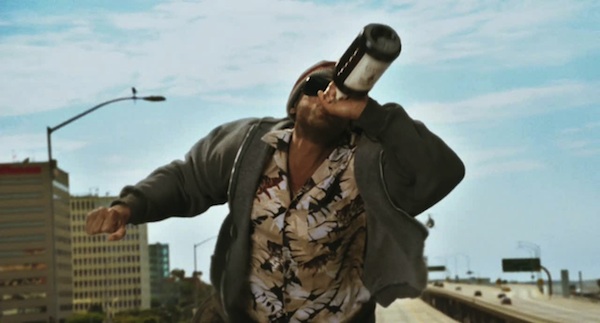
Will Smith plays John Hancock, who can bend steel in his bare hands, but would rather bend his elbow.  He's alcoholic, down and out and super-depressed. Most super-heroes are high and flying, but Hancock takes it the wrong way, so rather than looking up in the sky for him, chances are the best place to find him is the gutter.  He has powers and abilities far beyond mortal men, but no idea who he is, how he got that way, and there's no messianic father-figure to tell him the back-story.  And yeah, he'll do all that super-heroic stuff, but he's too stoned out of his mind to do anything carefully—he's like a bull in a china shop, and every time he does some good, he does a lot more harm in property damage.


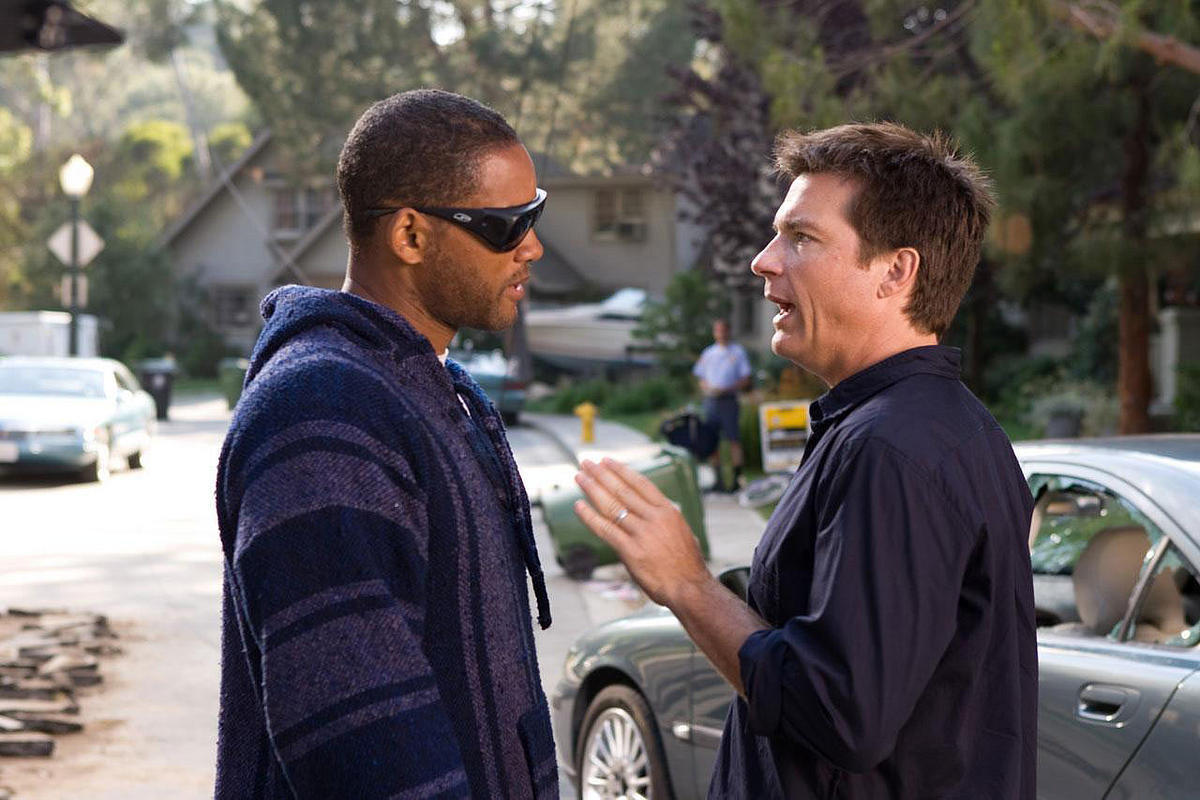
After saving the life of marketing maven Ray Embrey (Jason Bateman), Hancock is taken under wing, sobered up, read the "with great power comes great responsibility speech," and given a better public image (rather than a secret identity), a leather "sooper-suit," and is supervised in his derring-do so that he first does no harm.


Hancock isn't very good, but it has an interesting take on things "Superman-ish," and when you see Man of Steel, the latest "official" Superman movie, you'll see some of the ideas brought back to the source—the colliding bodies, the city-wide collateral damage, and the hard edge of sci-fi aspect to things that most super-hero movies tend to miss for the musculature and myth-making.  Also, the script has a literal vulnerability for the super-dude that's far more ingenious than sticks and kryptonite-stones.  You wanna reduce Superman's effectiveness?  Attack him through his loved ones.  Hancock takes that one step further by making his loved ones his true weakness, making him vulnerable, and shortening his life, taking the "apart-ness" of the super-hero, bringing it from the sub-text to the foreground, and lending the whole thing a nice melancholy touch that's missing from the genre as a whole.  It also brings Will Smith nicely down to earth, as well.


Wednesday, June 13, 2012

Prometheus

Going to Meet Your Maker 
or 
"Eloi, Eloi, lema sabachthani?"*

Every time I see a poor copy of a good idea become the latest pop darling out there, I get the inevitable useless reply from someone who takes it personally: "There aren't any original ideas anymore!  Just because it's been done before doesn't make it bad!"  (And it certainly doesn't make it "good!")  It's missing my point.  I don't care that it's been done before (and I'll identify where if anybody wants to look it up), what I care about is that it isn't done as well.  Jean-Luc Godard said "It doesn't matter where you take things from, it matters where you take things to."  

Succinct and right on.

So, now, Prometheus—Ridley Scott's return to SCI-FI, and the world he created in Alien.  If one goes in seeking another "Alien" movie, one might come out a little disappointed.  Oh, there are chases with disoriented POV's, conflicted crews and amoral androids, "hair-in-the-drain" icky effects, H.R. Giger designs, shocks and revelations, but this isn't Alien.

It's better, richer, and more thought-provoking...while still being a rather nifty action-horror-science-fiction hybrid.  It must be a hybrid, as Scott (and screenwriters Jon Spaihts of The Darkest Hour and "Lost"'s Damon Lindelhof) have stolen just about every science-fiction idea in the Universe.  

But, again, where they take it is original in its implications.  SCI-FI always asks "What if...?"  This one goes one question further in the interrogation and asks "But why?"  Yes, it's a monster movie, but like so many of those, God plays a role. 

There's a significant amount of religion in this film, and speculation about God and our origins, but it still manages to find room for Faith in settings that remind one of Hell.

Dr. Elizabeth Shaw (Noomi Rapace, the first "Girl with the Dragon Tattoo") is an archaeologist who stumbles on the latest of a series of cave paintings that have the same image even though originating from different parts of the globe.  This new one is in the Isle of Skye in Scotland.  The paintings show a group of primitives praying to a huge humanoid figure who is gesturing towards a configuration of six planets.

It's enough to fund Shaw and her lover-colleague Dr. Holloway (Logan Marshall-Green, in a performance that's trying too hard to find significance) on a trillion dollar excursion to find the only place in the Universe where the planets have that configuration at that point in the sky (??) aboard the good ship USCSS Prometheus, captained by Janek (Idris Elba, even more impressive than he was in Thor, in fact, I'd enjoy a movie centered around this character), overseen by Meredith Vickers (Charlize Theron, in brittle ice-queen mode) of The Weyland Corporation, caretakered by David (Michael Fassbender, in a terrific heavily-influenced performance), an android who serves as ships' H.A.L. in all manners, including a slightly unctuous air, but in movie choices fancies David Lean over Kubrick.**  Once they get planet-side, a holographic image of the CEO of the Weyland Group (Guy Pearce, in extreme old-age make-up) introduces Shaw and Holloway to the dubious crew—the mission: to find that planet in the cave paintings and see if we can find the humanoids pointing us there.  In simple terms, we want to find that ancient "god."  They find a landing strip of sorts and settle there because "God does not build in straight lines."

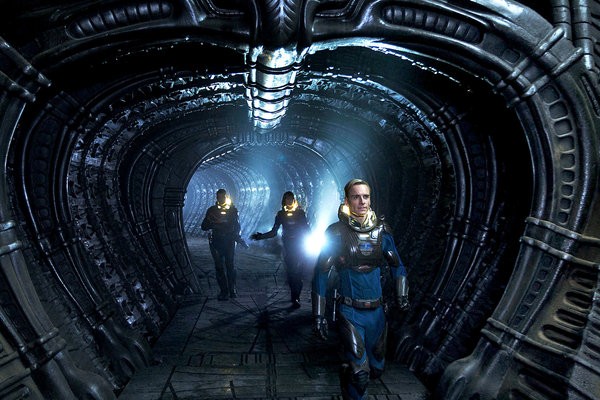
Upon landing they find a semi-hostile environment with two ancient dome-like structures.  They enter and begin digital cartographing with laser mapping drones.  As they go deeper into the structures, things seem somewhat familiar to the sequel-oriented movie-goer, but not really.  It's a clean environment, protected against savage wind-storms, snaking corridors and the occasional dead body of an alien species.  What happened here?

If you think you know where it's going, you're wrong.  This one's going somewhere else than running down a neon-lit corridor being chased by a monster (well, there's some of that, in fact quite a bit of it). But, it's a much bigger Universe than the Xenomorph of the first one (I've started calling them "glitches" after this movie), and if there is a sequel to Prometheus, it's going to be along a different track than Alien, and has bigger fish to light up with a flame-thrower.

It's technically stunning, and fun to see how they took all the unused stuff left on the drawing room floor in Alien and incorporated it here.  And lest you think that this is a high-philosophy movie, no, it's scary, designed to make you jump and gross you out.  It is a horror film, after all, but for all the shock stuff, it might also make you think, as it toys with big sci-fi ideas—"A Shaggy God Story" as acerbic critic John Simon called 2001: A Space Odyssey.  But, it's Scott's best film in years, retracing old steps, sure, but finding a new path to go somewhere else, some place a lot more interesting.

Prometheus is a Full-Price Ticket.


"The answer, Dear Brutus, is not in our stars, but ourselves"


* No, it's not Klingon. It's Aramaic.

** In fact, he watches a scene that we featured in a "Don't Make a Scene" article.

Wednesday, January 11, 2012

Young Adult

Writer's Cell-Block
or
"He Talked to Me Like I'm Not Pretty!"

The writing-directing team of Diablo Cody and Jason Reitman reunite to present what could be the dark sequel to their sunny, funny Juno.  But, instead of examining the student body sub-strata of geeks, we're looking at the sosh's side down there at the very shallow end of the gene pool and the eventual disintegration of High School Dreams.

Trouble is knowing when to wake up.  That's the thing about the privileged and the entitled, they never know when the party's done and it's time to go home (and don't even bother asking them to help clean up—that's maid-service).  It's the problem of Mavis Gerry (Charlize Theron): her party's over but she's still rocking in the corner, hugging her Maker's Mark bottle, and she picks the perfectly wrong time to go home to Mercury, Minnesota.  A writer of moony, self-absorbed children's books (No, no...that's "Y-A's," the contradictory term "Young Adult" novels) about High School life in a series called "Waverly 128", she draws mostly from real life—her own—but with additional snatches of overheard conversations cribbed from teen conversations in fast-food joints and malls.

She need not bother with the latter.  Mavis' emotional development is so arrested it should be serving 10 to 20 in "juvie."  Her thought processes are still confined to Middling School concerns, even if her behaviors have become more adult in nature, with one marriage behind her and several casual affairs left high and dry, to sleep it off in her bed, and the height of a social life being getting hammered in a bar, anticipating it like a kegger, and her one constant companion an "accessory pet," an animated white hair-ball named Dolce that is left, more or less abandoned, but still capable of the one love Mavis can accept or understand—reverse unconditional.  Oh, in our self-absorbed and -absorbed youth culture, she can pass for a grown-up, she's pretty, put-together, and trendy, but on the inside she hasn't graduated, pushing off her writing assignments like she was having to write a term-paper.

In the midst of burbling out her latest teen tome, she gets a message from an old flame (Patrick Wilson) that he and his wife (Elizabeth Reaser) have had their first child...and something in Mavis snaps.  She packs up laptop and lap-dog and cruises back to Mercury to recapture her past and maybe new father Buddy Slade and "rescue" him from responsible domesticity, two things she can't fathom or stomach.  I mean, have you seen that baby?  Ga-ross!

Thing is, she's clueless.  Mavis is so stuck in the past rattling around inside her head, you begin to wonder if she might be a little insane, besides insular.  Fortunately, she runs into somebody she perpetually ignored in High School—the guy who had the hall-locker next to her that she never noticed existed, Matt Freehauf (Patton Oswalt, best thing he's ever done), who had his own development beaten out of him ("Oh, yeah, you're the "hate-crime" guy!" blurts Mavis, tactfully and sensitively) by High School toughs who, in a clear case of High School temperance, tolerance and judiciousness, mistakenly assumed he was gay.  Matt, with his twisted body, develops a fascination with Mavis and her twisted logic, only half-heartedly trying to suggest that...you know...she might be a little out of sync with the normal, a notion that she scoffs at, before taking another slug and checking herself out in her mirror.

"You...are a piece of work," says Matt, admiringly.  "And you are a piece of shit," comebacks writerly Mavis.

This can not go well, and one wonders where the movie could possibly go and if it can ever be resolved without something being destroyed.  The damage being done, though, is to the expectations of the casual movie-goer.  Mavis is not your charming debutante "sweet thing" that you'd find in your standard rom-com.  She is, as one of her class-hates says, a "psychotic prom-queen bitch," and, though smart and clever, thoroughly unlikable, even when sometimes bordering on the sympathetic.  Theron is never afraid of tackling this type of character (she did, after all, win an Oscar for her terrifying Aileen Wournos in Monster) or challenging expectations of the audience, and Cody (with Reitman) has a fine time skewering the traditional "woman-pursues-her-soul-mate" brand of romantic fiction.  For that, Young Adult, as cringe-inducing and unsettling as it is, deserves an acknowledgement for being a brave film, risking a lot, while also giving a bitch-slap to the Hollywood romance.  It left me in an odd place.  I didn't thoroughly enjoy Young Adult, but, at the same time, I recognized that the makers were making a thoroughly professional statement...or at least an obscene gesture...to the too-easy way that love is presented in the movies, something I've railed against myself.  This isn't love.  It's selfish obsession.  And Mavis, like so many of the protagonists in Reitman's films, is an outlier of Society, playing by her own rules, but, as opposed to the others, she reaches no self-awareness, and is absolutely clueless as to where the goal-post is (knowing Mavis, she probably would pick a random spot, easy to reach, and declare it 'good").  One is hesitant to praise or applaud such accomplishments, when the impulse is to show it the door and kick it in the ass on the way out. 

Young Adult is a Rental.

Friday, September 16, 2011

In the Valley of Elah

This week, we're re-publishing some reviews of the films from the post 9-11 environment.


The Quagmire at Home

This is Paul Haggis' first directorial effort since Crash. In the meantime he wrote three films for Clint Eastwood, The Last Kiss and Casino Royale. He wrote this one for Eastwood, too, but to star in, not direct, which Clintus declined, saying that he's retired from acting. Too bad. This one might have gotten him that Best Actor Oscar. As it is, Tommy Lee Jones has the role, probably does a better job of it, and is certainly deserving of an Oscar. His Hank Deerfield, ex-Army investigator, is a portrait of a guy so meticulous, so disciplined that you wait for him to crack the whole film. It's one of the joys of the film, along with another of Charlize Theron's fine "de-glammed" performances, and Susan Sarandon bringing maximum effort to a small but vital role, all doing great work in a film that tries to be too many things, though it does succeed in many of them.

Part mystery, part war-story, part psychological drama, "Elah," punctuates its story with fragments of media recovered from a cell-phone that, like "Blow-Up" and "The Conversation," give tantalizingly legible glimpses into Deerfield's son's tour in Iraq, and frustratingly opaque clues into his post-Iraq behavior. He's gone AWOL, and Dad Deerfield goes to New Mexico to get to the bottom of it, because that's what he does. Once there, he and a detective try to piece together the evidence, and fight the bureaucratic red tape that hinders their work. Just as Crash owes so much to La Ronde," Elah calls to mind Courage Under Fire, about the death of a Persian Gulf War veteran, where conflicting stories and the subject of post-traumatic stress disorder are dealt with tangentially. Here, it's more overt, but there is an underlying message of the power of doing nothing, or of passing the buck, even ignoring the buck, taking the easy way out, or as the phrase went in Chinatown, the futility of good intentions, when not backed with action. The characters of In the Valley of Elah do "as little as possible" until provoked, challenged and threatened, and its reach is all-pervasive. In the end there is no one perpetrator, but a constant thread of sins of omission, and therein lies the tragedy.

As he did so much in Crash, Haggis telegraphs too many things, with some pretty obvious set-ups that are none too subtle.** The man just doesn't believe in red herrings, and everything gets used. Maybe that's his buttoned-up-in-25-minutes television writing showing. He's become better at cloaking some, though, hiding them in plain sight until they're trotted out for weighty significance. Some will see his final statement as un-American (which they're looking for, I expect), but a careful reading of what's gone before* reveals exactly what he's saying, and its entirely appropriate and, frankly, completely non-controversial. But Haggis seems to invite mis-interpretation. It's what makes him interesting. On top of that, you'll never see better work out of Tommy Lee Jones and Susan Sarandon and their scenes together have a lived-in familiarity and friction that speaks volumes of history and experience. There's some awfully good work in this.

In the Valley of Elah is a solid Matinee.

* Easy for me to say, I take notes!

** According to the Addictionary, this is called "five-shadowing"


Saturday, January 30, 2010

Battle in Seattle

"Battle in Seattle" (Stuart Townsend, 2007) I admit I have a bit of a chip on my shoulder regarding this movie. Written and directed by actor Stuart Townsend, the film was yet another Seattle movie that was photographed, for the most part, in Canada, specifically "Seattle" North, Vancouver British Columbia. It was post-produced in Montreal, Canada, and for authenticity, they cast a few American actors, shot a day or two in Seattle (actually!) and spent the rest of the time writing and shooting around the story. Give it credit, there is a lot of Seattle in it, but mostly from the archive footage of many news sources and folks present on the scene. In Townsend's version, Seattle looks a lot more "Caucasian" than it is, and feels entirely phony. But then, this isn't even trying to be a true telling of events, other than its advocacy. It's a disaster movie, with all the tarted up (they use that phrase in Vancouver) melodrama of an Irwin Allen picture. There's even that standard of the D-movie: "Pregnant Woman in Peril," played by the director's squeeze, Charlize Theron.

In his commentary, Townsend acknowledges he didn't know much about what went down in
1999 at the Seattle-housed WTO conference, but, like everyone else, he was grabbed by the headlines and that phrase "Battle in Seattle." Research into the WTO and the complications from its basic philosophy of "you can't have a war with someone you're economically tied with (but you can sure as hell exploit them)" led to him finding a reason to make the movie in the second place. But, ultimately, although the message is there in the graphics-laden sections, the story still boils down to police versus demonstrators and bricks versus windows. The message, like with the riots, can't be seen for all the tear-gas.

And Townsend tries to represent all sides—the demonstrators', the delegates', the mayor's, the governor's, the reporters', the merchants,'
as well as that of the police—to the point where the only folks to blame are those darned anarchists (much like the surface spin of the event) for not towing the line of having an orderly demonstration, albeit one with as many different agendas as there were countries in attendance. Lip-service is given to the fact that things didn't get dicey until Madeleine Albright called to gripe to her boss, President Clinton, that she couldn't get out of her hotel room, thus throwing the fellow local Democratic administrations to get their own brown-shirts in a twist and over-react.

Townsend even shoots himself in the foot by showing delegates of the WTO with legitimate concerns having them over-shadowed and ignored by...those darned uppity protesters. By showing all sides, ultimately
Townsend doesn't take sides and the movie becomes merely about the relationships of the demonstrators and the hurdles the National Guard presence threw up for all concerned. A political riot should be about more than delaying True Love, which, according to "Battle in Seattle," it does, until the movie ends in an extended group-hug.

A making-of documentary has a clutch of representatives from a few of the protest groups pay lip-service to the film, and they're all cheery about it, despite the fact that everybody got their own black eyes from the occurrence. But, then, if you want to get your message out there, there isn't such a thing as "bad" publicity; it's what happens when idealists become egotists and politics becomes show business (or is it the other way around?).

The performances are fine, although
Ray Liotta is far too young to be playing someone elected mayor of Seattle—and the guy they've got playing Gary Locke sounds like the first one they found from Central Casting who fit the description "Chinese." Among the protesters, Jennifer Carpenter is merely okay as a lawyer representative for the protesters—she rocks on "Dexter"—there is a token African-American (André Benjamin from Outkast), a token Latina (Michelle Rodriguez), and a token New Zealander (Martin Henderson) and that's about it. Attempts at cast diversity is merely skin-deep. Although two of the delegates are played by Rade Serbedzija and Isaach De Bankolé, their roles are small and, like Woody Harrelson, they spend most of their time looking frustrated.

If so, I'm walking in solidarity, brothers.

Thursday, November 26, 2009

The Road

Oh, where have you been, my blue-eyed son?
Oh, where have you been, my darling young one?
I've stumbled on the side of twelve misty mountains,
I've walked and I've crawled on six crooked highways,
I've stepped in the middle of seven sad forests,
I've been out in front of a dozen dead oceans,
I've been ten thousand miles in the mouth of a graveyard,
And it's a hard, and it's a hard, it's a hard, and it's a hard,
And it's a hard rain's a-gonna fall.


"Lost in a Haunted Wood"

A boy and his father are walking through the valley of the shadow of death. A cataclysm has happened, whether by the hand of Man or God it is uncertain and does not matter. The sky shows no sunlight, only the gray of dust clouds and smoke. The animals are dead. The forests are dying, crisping into fire or crumbling from dead roots. There is no food. No gas. No electricity. Buildings are crumbling or have been turned into abbatoirs for cannibalism. The boy and the father fear for there is evil anywhere for in the fight to survive, there is no moral contingent in the death-struggle to survive.

For the father (Viggo Mortensen), the worries are "food, the cold and our shoes." The fears are the roving packs of humans who'll survive by any means necessary, theft, killing, consumption. Some have taken to hacking off their own limbs to stave off starvation. His wife (Charlize Theron) is long dead, having walked out into the night, which is tantamount to committing suicide. Now the father and boy (Kodi Smit-McPhee, who looks eerily like Theron) are heading South to the ocean because to stay in one place means eventual attack. They have miraculously survived so far, and they must repeat the miracle day after day until the miracles give out. Among the effects the father carries are a gun with two bullets, one for each of them. And one of the life lessons taught is how to shoot oneself in the most efficient manner. "The child is my warrant," says the father in narration. "If he is not the Word of God, then God never spoke."

Cormac McCarthy's "The Road" was a best-seller and eventually won the 2007 Pulitzer Prize for Literature. John Hillcoat's film of it doesn't shirk from the doomsday scenario or amoral atrocities and has managed to find bleak blast areas of Pennsylvania, Louisiana, Oregon and Washington* to depict the nightmare world, post-disaster. It's somewhat ironic to see this film of people trying to pick up the pieces when booming next door at the multi-plex is "2012" showing a scenario that might have created the situation as a fun-ride. "The Road" is anything but rollicking, but is a great work of film that cuts right to the bone of what it means to be a human being, a father, and responsible. We've seen such scenarios before in movies, but they've all been kinetic desert chases or the threats are vampires, mutants and zombies—"others"—and not beings who've only been tipped by circumstance to preying on their own kind. This is no "pop"-nihilism for the sake of entertainment, with its "safe" zones, and goals of legended peace. It's a dog-eat-dog world and all the dogs are gone. Instead of pyrotechnics and thrill rides, we're left with survival—plodding, exhausting, fearful...on the edge of life and humanity.

It's tough stuff—"fight or flight" stuff with an edge of "
Deliverance" maliciousness, but treated with an unsentimental "It is what it is" approach. So, be warned that its an ordeal (not as much of one as I was prepared for, but know that it is unpleasant), but is bursting with excellent work on all fronts. Viggo Mortenson's film-length performance is epic—a good man tossed into impossible situations, weakening bit by bit in the struggle, the panic in his eyes rarely allowed to escape to the rest of his face. Smit-McPhee gives one of the most clear-eyed kid performances put to screen, and their work is punctuated by tough, unsentimental cameos by Theron (one steel-edged performance, this), Guy Pearce, and Robert Duvall (in a short but masterful, almost lyrical performance).

It is not too much to say that "The Road" does its extraordinary source proud, while making its own path to greatness.

"The Road" is a Full-Price Ticket.


Oh, what'll you do now, my blue-eyed son?
Oh, what'll you do now, my darling young one?
I'm a-goin' back out 'fore the rain starts a-fallin',
I'll walk to the depths of the deepest black forest,
Where the people are many and their hands are all empty,
Where the pellets of poison are flooding their waters,
Where the home in the valley meets the damp dirty prison,
Where the executioner's face is always well hidden,
Where hunger is ugly, where souls are forgotten,
Where black is the color, where none is the number,
And I'll tell it and think it and speak it and breathe it,
And reflect it from the mountain so all souls can see it,
Then I'll stand on the ocean until I start sinkin',
But I'll know my song well before I start singin',
And it's a hard, it's a hard, it's a hard, it's a hard,
It's a hard rain's a-gonna fall.
Bob Dylan


* Early on, I recognized paths that I'd walked on in Gifford Pinchot National Forest in the shadow of Mount St. Helens, and as soon as the hairs on the back of my neck relaxed, a shot of the timber-clogged Spirit Lake appeared. From what I've read, the FX crew used shots of the NW skies at the time of the Mt. St. Helens eruption to loom over the horizons—the whole movie has the looming density of a lousy NW winter day.

Monday, April 21, 2008

In the Valley of Elah

There is a good movie here wishing it could be born out of this mess. Tommy Lee Jones is giving it all he's got, portraying a meticulous and persevering war vet trying to uncover the mystery of his son's death. Some nice details build his character... like the way he creases his pants even when he's living out of a motel room; or the way he pumps young soldiers for information by inviting them to share a cigarette or a shot of Jim Beam. The center of the film is a half-hearted attempt at a detective story, with Tommy Lee and Charlize Theron sniffing out a cover up. I say "half-hearted" because the film never fully commits to engaging you in the detective story... instead, it gets distracted. There's an aborted try at a family drama (where TL Jones becomes surrogate daddy for Charlize's kid, which is not only unbelievable, but only lasts for about 2 minutes and is never mentioned again); some limp attempts to address racial prejudice (in which TL Jones again breaks character and beats a man while delivering an ethnic slur); and wasted appearances by fine actors Barry Corbin and Josh Brolin. Their screen time is well-written and compellingly delivered, but fails to contribute to any central thrust of the film. (BTW, I think this must have been filmed around the same time as No Country for Old Men, which might explain how at least three cast members appeared in both films.)

The film hints at fertile territory, but it's all undone by a heavy-handed insistence at creating a "message" film. As such, it reeks of embarrassingly obvious symbolism and propaganda. It's the same sort of failure that plagued Fast Food Nation. Lots of good actors contribute to both films (no doubt they support the respective causes) but nothing cohesive or satisfying comes of it.

I would only recommend In the Valley of Elah for Tommy Lee Jones completists. Otherwise, like me, you'll probably want your two hours back.

Wednesday, November 14, 2007

In the Valley of Elah

The Quagmire at Home
This is Paul Haggis' first directorial effort since Crash. In the meantime he wrote three films for Clint Eastwood, The Last Kiss and Casino Royale. He wrote this one for Eastwood, too, but to star in, not direct, which Clintus declined, saying that he's retired from acting. Too bad. This one might have gotten him that Best Actor Oscar. As it is, Tommy Lee Jones has the role, probably does a better job of it, and is certainly deserving of an Oscar. His Hank Deerfield, ex-Army investigator, is a portrait of a guy so meticulous, so disciplined that you wait for him to crack the whole film. It's one of the joys of the film, along with another of Charlize Theron's fine "de-glammed" performances, and Susan Sarandon bringing maximum effort to a small but vital role, all doing great work in a film that tries to be too many things, though it does succeed in many of them.
Part mystery, part war-story, part psychological drama, "Elah," punctuates its story with fragments of media recovered from a cell-phone that, like "Blow-Up" and "The Conversation," give tantalizingly legible glimpses into Deerfield's son's tour in Iraq, and frustratingly opaque clues into his post-Iraq behavior. He's gone AWOL, and Dad Deerfield goes to New Mexico to get to the bottom of it, because that's what he does. Once there, he and a detective try to piece together the evidence, and fight the bureaucratic red tape that hinders their work. Just as Crash owes so much to La Ronde," Elah calls to mind Courage Under Fire, about the death of a Persian Gulf War veteran, where conflicting stories and the subject of post-traumatic stress disorder are dealt with tangentially. Here, it's more overt, but there is an underlying message of the power of doing nothing, or of passing the buck, even ignoring the buck, taking the easy way out, or as the phrase went in Chinatown, the futility of good intentions, when not backed with action. The characters of In the Valley of Elah do "as little as possible" until provoked, challenged and threatened, and its reach is all-pervasive. In the end there is no one perpetrator, but a constant thread of sins of omission, and therein lies the tragedy.
As he did so much in Crash, Haggis telegraphs too many things, with some pretty obvious set-ups that are none too subtle.** The man just doesn't believe in red herrings, and everything gets used. Maybe that's his buttoned-up-in-25-minutes television writing showing. He's become better at cloaking some, though, hiding them in plain sight until they're trotted out for weighty significance. Some will see his final statement as un-American (which they're looking for, I expect), but a careful reading of what's gone before* reveals exactly what he's saying, and its entirely appropriate and, frankly, completely non-controversial. But Haggis seems to invite mis-interpretation. It's what makes him interesting. On top of that, you'll never see better work out of Tommy Lee Jones and Susan Sarandon and their scenes together have a lived-in familiarity and friction that speaks volumes of history and experience. There's some awfully good work in this.
In the Valley of Elah is a solid Matinee.
* Easy for me to say, I take notes!
** According to the Addictionary, this is called "five-shadowing"