Showing posts with label Peter Berg. Show all posts

Thursday, November 21, 2013

Hancock

Hancock (Peter Berg, 2008) The premise (for a super-hero movie) is interesting, the stars are all competent, and in some cases exceptional (Charlize Theron puts in quite a surprising turn in her role), and the writing sometimes refreshing.  

What kills Hancock is the direction.  Berg's snatch-and-grab semi-documentary style worked gangbusters for Friday Night Lights, but for the super-heroics of Hancock, you just get the impression that they're trying to hide some flaw in the effects from you, especially in the inevitable fisticuffs that these things seem to depend on (although the cleverer ones find ways around it).


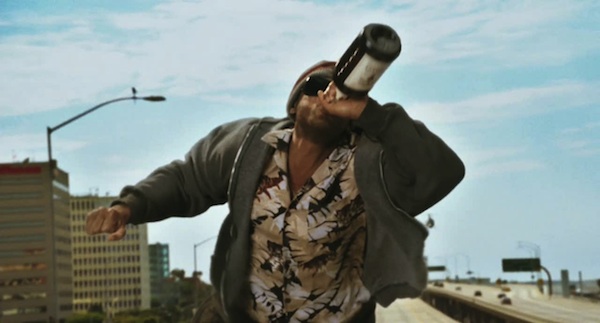
Will Smith plays John Hancock, who can bend steel in his bare hands, but would rather bend his elbow.  He's alcoholic, down and out and super-depressed. Most super-heroes are high and flying, but Hancock takes it the wrong way, so rather than looking up in the sky for him, chances are the best place to find him is the gutter.  He has powers and abilities far beyond mortal men, but no idea who he is, how he got that way, and there's no messianic father-figure to tell him the back-story.  And yeah, he'll do all that super-heroic stuff, but he's too stoned out of his mind to do anything carefully—he's like a bull in a china shop, and every time he does some good, he does a lot more harm in property damage.


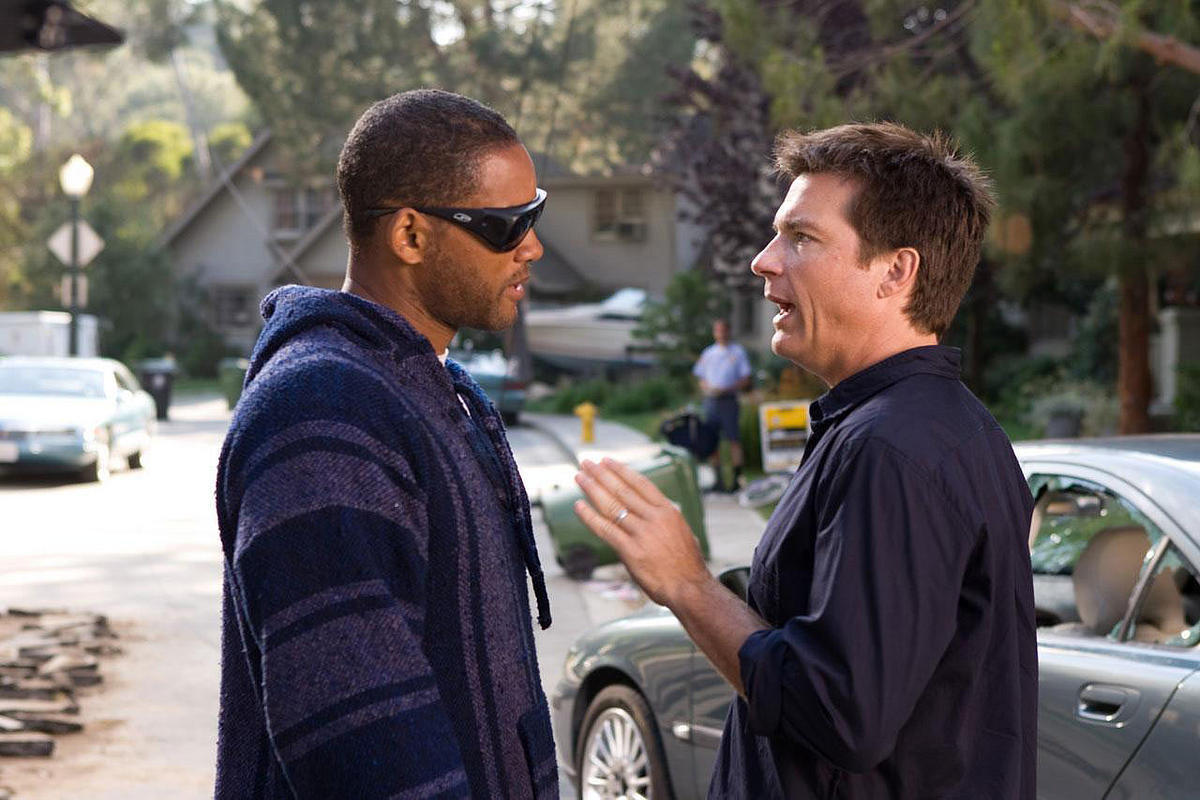
After saving the life of marketing maven Ray Embrey (Jason Bateman), Hancock is taken under wing, sobered up, read the "with great power comes great responsibility speech," and given a better public image (rather than a secret identity), a leather "sooper-suit," and is supervised in his derring-do so that he first does no harm.


Hancock isn't very good, but it has an interesting take on things "Superman-ish," and when you see Man of Steel, the latest "official" Superman movie, you'll see some of the ideas brought back to the source—the colliding bodies, the city-wide collateral damage, and the hard edge of sci-fi aspect to things that most super-hero movies tend to miss for the musculature and myth-making.  Also, the script has a literal vulnerability for the super-dude that's far more ingenious than sticks and kryptonite-stones.  You wanna reduce Superman's effectiveness?  Attack him through his loved ones.  Hancock takes that one step further by making his loved ones his true weakness, making him vulnerable, and shortening his life, taking the "apart-ness" of the super-hero, bringing it from the sub-text to the foreground, and lending the whole thing a nice melancholy touch that's missing from the genre as a whole.  It also brings Will Smith nicely down to earth, as well.


Wednesday, September 14, 2011

The Kingdom

This week, we're re-publishing some reviews of the films from the post 9-11 environment.

Cries and Whispers

On the American military compound in Rhiyadh, two terrorists command a security vehicle and open up machine gun fire on a family softball game leaving carnage before they are killed. But like the WTC attacks, it's a two-pronged assault, the first wave of terror providing the means for a devastating explosion during the rescue efforts. For four FBI investigators it becomes a personal duty to investigate the scene and find out what happened and who was responsible. They only have five days. They're under constant surveillance by the local police. Their movements are restricted, their presence resented and the attack zone compromised in the clean-up efforts. The only thing they do have is an Exit Strategy, which has been formulated before their arrival, and things have a way of changing. But it's personal, and they have to find a way, doing an impossible task, in an unfamiliar and hostile area, without leaving a trace because it's not exactly sanctioned by the U.S. government. Yeah, good luck with that.

The Kingdom is directed by Peter Berg, whose previous film was Friday Night Lights, a film I greatly admire. Berg shepherded that film over to a fascinating series on NBC, and unlike his previous series "Wonderland," has made it all the way to a second season. He started out as an actor-- was the slightly lump-headed first seduction of Linda Fiorentino in The Last Seduction, and he starred for several seasons on "Chicago Hope," where he first started directing. Berg is a genuine find--an intelligent director who communicates everything-- gives you all you need to know, keeps things logistically decipherable, and lenses with an oblique eye that takes everything in but doesn't beat you over the head with it. An action-director who gives his audience credit for intelligence and propels the film along, trusting that the audience will keep up.

Berg has a flashy cast for "CSI: Rhiyadh" (scripter Matthew Carnehan describes it as "Imagine a murder investigation on Mars") in Jamie Foxx, Chris Cooper, Jennifer Garner and Jason Bateman (as well as Danny Huston, Frances Fisher, and Jeremy Piven--who basically plays his "Entourage" character working for the State department). Everyone's performance is tamped down, but the fact is they're all stars--well, Bateman is there for comedy relief--and unlike the cast of "Friday Night Lights," they stand out like sore thumbs, which actually serves the film well. But the stand-out performance is by Ashraf Barhom, whose Col. Faris Al Ghazi takes his job of providing protection for the team so seriously that he hampers their efforts at every turn. And given that his job is to stand in for the entire Arab world (almost every other local is a bit of a cypher), he carries off the role with a subtlety that doesn't betray the heavy lifting.

Berg has stated that he didn't want to make a "message" film, saying that the ratio for a film to make a point and make an audience is "98% action, and 2% message." That may be overstating the case, as there's a lot more message in the film hidden between the frames. But...though the film does put a face to the Arab world, though it does reflect the heavy-handed presence of America there, though it may bring into sharp focus the folly of having a formalized military presence in a guerilla situation and the dangers that that presence can provide in escalating the conflict--though it may say all these things that point to the folly of invading Iraq, that 98% action still has the effect of having the audience jingo-cheer on the Americans (even with Arab back-up) in a fire-fight in a hotel building. You have to have your message and the action that belies it. That's troubling. But while one contemplates that, the film moves on and delivers a spoken coda that says that, really, we're all not so different after all.

Boo-yah.

"The Kingdom" is a cheap Matinee


Saturday, March 26, 2011

Fire in the Sky


Fire in the Sky (Robert Lieberman, 1993) I once remarked to a family in distress that they'd gone through "everything except alien abduction." Not the most comforting of consolements.

But, if you believe Fire in the Sky (and that's not easy...), alien abduction can be pretty dull.

"Based on the (proverbial) True Story"—but trumped up by screenwriter Tracy Tormé from Travis Walton's account, evidently because studio executives found the story boring—Fire in the Sky tells the story of Walton's disappearance in 1975 around the area of Snowflake, Arizona.  What's different about the Walton story is that it was witnessed by several of his co-workers who were clearing brush for the Forest Service.*  They didn't actually see Walton lifted by the bright blue-green light into the bright disk that attracted them to the area.  He was lifted a couple feet into the air, then knocked to the ground, prompting his friends to gun their truck and get the hell out of there...like the friends they were.  They came back for him...but the disc and Walton were gone.

Cue the theremin.

The initial phone call to the police merely said that Walton was "missing." The abduction story didn't come up until they actually met with the local constabulary to report that he was gone.  An extensive search ensued, lasting five days, until Walton called from a phone booth to ask to be picked up at a gas station—he was fully clothed, wearing the same clothes as the last time he'd been seen, and not naked as the movie depicts.

So...what happened?  The "story" had attracted attention, not only from police, but also "ufologists" from around the country, who flew to Arizona as if it was Mecca.  The story became bigger than the described spacecraft (8 feet high, 20 feet across) could contain.

And that's what Fire in the Sky is about—the turmoil on the ground between the friends and Walton's relatives and the police and the "experts."  It's a tale of suspicion, speculation, confused facts, guilt, and accusation....with elements of torture by black-eyed beings that looked like fetuses.  Of course, the latter is the most interesting part, so they save it for near the end—with Travis kept in a huge honey-combed hive until he escapes and starts making the aliens' lives difficult.  It bears little resemblance to his story, which involves actually moving the controls of the ship, and visits by smiling human-resembling "ambassadors."  The movie's sequence involves horror elements and probes and sticky shrouds.  The rest resembles a Lifetime movie with aliens instead of oxycontin.

Whether it's true or not seems irrelevent.  The story and the movie made from it is dull.  It only leads to wondering why advanced aliens choose to scope out the limited life-forms on Earth in rural areas at night, why they avoid cities or cultural centers (maybe they saw how well it went in The Day the Earth Stood Still?) or even people with a phD or a Master's degree...in anything.  There's only one thing sure, and that is, while the upper 1% of this country have 38% of the wealth, the lowest seem to get all the alien abductions.


* One of the things that brings up red glowing pulsating flags is that the job they were doing was running behind in schedule, and the crew had been working quite long hours to make up time.  There was some speculation that the whole thing was cooked up because the job couldn't be finished, and the disappearance was a convenient distraction.  But, that the contractor never invoked the "act of God" clause to get out of it, flies in the bug-eyed face of that theory.

Monday, February 4, 2008

Friday Night Lights

"Friday Night Lights" (Peter Berg, 2005) I missed this movie in its first go-'round, but seeing the pilot for the eventual NBC series put "the hooks" in me. I wanted to see what had inspired the series, which had impressed me, and see if the movie was as good.

Short answer. Yes. And a bit better. It's another High School football movie, replete with all the drama that situation lends to it. The pressure on the kids to win. The pressure on the coach to make them winners. The crush of expectations, and the town's sense of worth wrapped up in the team. It's all there, but shot in the "caught off-guard" style of a documentary that gives it more power, more immediacy. You don't feel sympathy for Tom Cruise in "All the Right Moves" because, hey, he's Tom Cruise. But a bunch of nobodies, with the melodrama tamped down, takes it out of Hollywood contrivance, and makes you look away from the glare of stars and see into the drama. You begin to think that anything can happen. You begin to care. The film is dedicated to Alan J. Pakula, producer-director, who in the 70's made dispassionate, stylistically intimate films that had that same lived-in quality--"Klute," "All the President's Men"--even if it was Jane Fonda and Robert Redford on the screen. Here the biggest star in Billy Bob Thornton, who excells at low-key, lived-in, but even he feels like a bit of a distraction from the rest of the movie's verisimilitude, so completely does Berg maintain the illusion. It's a damned good film.

Saturday, November 17, 2007

The Kingdom

Cries and Whispers

On the American military compound in Rhiyadh, two terrorists command a security vehicle and open up machine gun fire on a family softball game leaving carnage before they are killed. But like the WTC attacks, it's a two-pronged assault, the first wave of terror providing the means for a devastating explosion during the rescue efforts. For four FBI investigators it becomes a personal duty to investigate the scene and find out what happened and who was responsible. They only have five days. They're under constant surveillance by the local police. Their movements are restricted, their presence resented and the attack zone compromised in the clean-up efforts. The only thing they do have is an Exit Strategy, which has been formulated before their arrival, and things have a way of changing. But it's personal, and they have to find a way, doing an impossible task, in an unfamiliar and hostile area, without leaving a trace because it's not exactly sanctioned by the U.S. government. Yeah, good luck with that.

"The Kingdom" is directed by Peter Berg, whose previous film was "Friday Night Lights," a film I greatly admire. Berg shepherded that film over to a fascinating series on NBC, and unlike his previous series "Wonderland," has made it all the way to a second season. He started out as an actor-- was the slightly lump-headed first seduction of Linda Fiorentino in "The Last Seduction," and he starred for several seasons on "Chicago Hope," where he first started directing. Berg is a genuine find--an intelligent director who communicates everything-- gives you all you need to know, keeps things logistically decipherable, and lenses with an oblique eye that takes everything in but doesn't beat you over the head with it. An action-director who gives his audience credit for intelligence and propels the film along, trusting that the audience will keep up.

Berg has a flashy cast for "CSI: Rhiyadh" (scripter Matthew Carnehan describes it as "Imagine a murder investigation on Mars") in Jamie Foxx, Chris Cooper, Jennifer Garner and Jason Bateman (as well as Danny Huston, Frances Fisher, and Jeremy Piven--who basically plays his "Entourage" character working for the State department). Everyone's performance is tamped down, but the fact is they're all stars--well, Bateman is there for comedy relief--and unlike the cast of "Friday Night Lights," they stand out like sore thumbs, which actually serves the film well. But the stand-out performance is by Ashraf Barhom, whose Col. Faris Al Ghazi takes his job of providing protection for the team so seriously that he hampers their efforts at every turn. And given that his job is to stand in for the entire Arab world (almost every other local is a bit of a cypher), he carries off the role with a subtlety that doesn't betray the heavy lifting.

Berg has stated that he didn't want to make a "message" film, saying that the ratio for a film to make a point and make an audience is "98% action, and 2% message." That may be overstating the case, as there's a lot more message in the film hidden between the frames. But...though the film does put a face to the Arab world, though it does reflect the heavy-handed presence of America there, though it may bring into sharp focus the folly of having a formalized military presence in a guerilla situation and the dangers that that presence can provide in escalating the conflict--though it may say all these things that point to the folly of invading Iraq, that 98% action still has the effect of having the audience jingo-cheer on the Americans (even with Arab back-up) in a fire-fight in a hotel building. You have to have your message and the action that belies it. That's troubling. But while one contemplates that, the film moves on and delivers a spoken coda that says that, really, we're all not so different after all.

Boo-yah.

"The Kingdom" is a cheap matinee