Showing posts with label Jamie Foxx. Show all posts

Saturday, January 5, 2013

Django Unchained

What's Black and White and Red All Over?
or
Wasted Away Again in Tarantinoville

One walks into any Quentin Tarantino film warily.  It's going to be a "cheese-fest," for sure, it's just a matter of the quality of presentation—because it is always going to be about cheese.

And it's always going to be about movies, rather than the subject or genre it revolves around.


But, that's all you can count on; one never knows what to expect (which is a good thing).  One also knows that there will be moments, and even whole sequences of clownishness where he can't help going off the rails of a disciplined narrative to succumb to some cackling goonishness.  Tarantino is a bad little kid.  He's also a major league slugger...who likes to aim for the dug-out and, contrarily, hits home runs.  When he pulls off a whole movie, as he has in the past (particularly Inglourious Basterds), it can be a thrilling wallow—challenging and cathartic; he's got such good ideas that nobody has thought before, even while he plunders others' right and left.  It's just that he can't separate good ideas from bad ones, maybe because the originating Tarant-ego can't discriminate which, because they come from the same source.


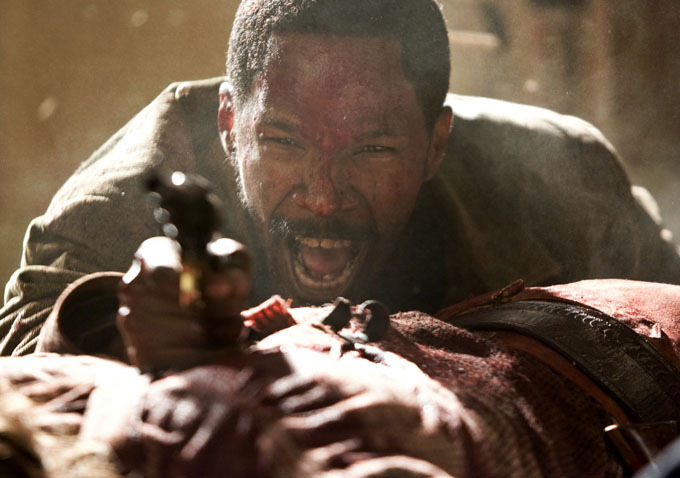
Django Unchained is his latest polyglot of a film, the influences coming from everywhere, the soundtrack a dog's breakfast of styles and eras,* a mixture of high camp, dark humor, and revenge fantasy/wish-fulfillment set once upon a time in the era of slavery, that, even though it rigorously evokes the time and place in design (The South, "1858, two years before the Civil War"), must bow to Tarantino's superficial wishes to what's "cool" in his own head.  There are a couple of scenes that immediately made me think "this is great" (a long, protracted discussion in a bar and a street between Django (Jamie Foxx) and his mentor/patron Dr. King Schultz** (Christoph Waltz) on the similarities between slavers and bounty hunters ("Like slavery, it's a cash for flesh business....Still, I feel guilty about it"), a presentation by Schultz of the Siegfried myth (before a cliff-side proscenium arch that only contains Django as audience), and a bizarre proto-Klan gathering played for Pythonesque laughs.  The set up in the first half of the movie is fine, even intriguing (while the inspirations wheel through your head—not so much Sergio Leone, as The Skin Game, Blazing Saddles, Rosewood), then everything falls apart when, in an effort to rescue Django's wife Broomhilda von Shaft*** (Kerry Washington) we get to Candieland, the plantation owned by the eccentric Calvin Candie (Leonardo DiCaprio), where things seem to go on and on and on and on, the humor dries up, and things turn nasty.  The proclivity towards going overboard while not really advancing the story takes over and becomes paramount, with extended shoot-outs, emphasizing the thinnest of blood exploding out of wounds as if every blood vessel were an artery.  Django Unchained becomes repetitive and, frankly, dull, then a little prematurely self-congratulatory.  

A lot of the problem is that Tarantino has written such a good set-up, that he can't top himself with a finish, and falls back on the action that is neither inspired or clever.  And that is a low-down, dirty shame, especially when it comes to the characters he's spent a great deal of time creating and setting up.  They're inconsistent—ironic, as one of Schultz's major pieces of advice to Django is "during the act, you can never break character."  And yet Schultz ultimately does as does most everyone in the service of getting to the popping blood-bags.  Drama comes from character and most of the individuals in the film break character in ill-considered ways as a quick means to get out of a writerly jam.  The ultimate goal of the piece is foiled by blunt actions  from characters who had previously survived by guile.  That Django must use the same tactics—along with a fistful of dynamite (which, by the way, hadn't been invented yet)  shows an inconsistency in the most important player of the thing, and the star of the show, Quentin Tarantino.  Indulgence is one thing.  Lazy indulgence that trashes the previous good work is quite another.  

Look.  One should never take Tarantino too seriously.  If you do, you're missing a lot of the manic joy of his films for films' sake.  And reverence for such irreverence on his part is more than a little counter-intuitive and weirdly contrary.  But, it is disappointing that the director reached a certain point with this one, and just said "Aw, why work so hard?  Let's blow some shit up" leaving a path of destruction that includes dozens of bodies, and one pretty good idea for a movie, once upon a time.

Django Unchained is a Rental.  
Wilhelm alert @ 00:50:00

Jamie Foxx's Django wears a sun-screening cowboy hat AND shades.
Remember that line from Once Upon a Time in the West
about a man who wears both a belt and suspenders?


* This one is all over the map: start off with Luis Bacalov's song for the Sergio Corbucci western ("with the kind participation of Franco Nero") done in a cross-bred Elvisian/Frankie Laine style, a lot of Ennio Morricone (including a piece that Tarantino thinks is "original" but actually comes from Two Mules for Sister Sara), a piece of Jerry Goldsmith from Under Fire, Verdi's Requiem, and songs like Richie Havens' Freedom, and...most bizarrely, Jim Croce's cheery "I've Got a Name" which he guillotine-edits right before the phrase "And I'm gonna go there free."  Hmm.

** Just realized: "Dr. King."  Heh.

*** See what I mean about Blazing Saddles?  Remember Lili von Schtupp?

Wednesday, September 14, 2011

The Kingdom

This week, we're re-publishing some reviews of the films from the post 9-11 environment.

Cries and Whispers

On the American military compound in Rhiyadh, two terrorists command a security vehicle and open up machine gun fire on a family softball game leaving carnage before they are killed. But like the WTC attacks, it's a two-pronged assault, the first wave of terror providing the means for a devastating explosion during the rescue efforts. For four FBI investigators it becomes a personal duty to investigate the scene and find out what happened and who was responsible. They only have five days. They're under constant surveillance by the local police. Their movements are restricted, their presence resented and the attack zone compromised in the clean-up efforts. The only thing they do have is an Exit Strategy, which has been formulated before their arrival, and things have a way of changing. But it's personal, and they have to find a way, doing an impossible task, in an unfamiliar and hostile area, without leaving a trace because it's not exactly sanctioned by the U.S. government. Yeah, good luck with that.

The Kingdom is directed by Peter Berg, whose previous film was Friday Night Lights, a film I greatly admire. Berg shepherded that film over to a fascinating series on NBC, and unlike his previous series "Wonderland," has made it all the way to a second season. He started out as an actor-- was the slightly lump-headed first seduction of Linda Fiorentino in The Last Seduction, and he starred for several seasons on "Chicago Hope," where he first started directing. Berg is a genuine find--an intelligent director who communicates everything-- gives you all you need to know, keeps things logistically decipherable, and lenses with an oblique eye that takes everything in but doesn't beat you over the head with it. An action-director who gives his audience credit for intelligence and propels the film along, trusting that the audience will keep up.

Berg has a flashy cast for "CSI: Rhiyadh" (scripter Matthew Carnehan describes it as "Imagine a murder investigation on Mars") in Jamie Foxx, Chris Cooper, Jennifer Garner and Jason Bateman (as well as Danny Huston, Frances Fisher, and Jeremy Piven--who basically plays his "Entourage" character working for the State department). Everyone's performance is tamped down, but the fact is they're all stars--well, Bateman is there for comedy relief--and unlike the cast of "Friday Night Lights," they stand out like sore thumbs, which actually serves the film well. But the stand-out performance is by Ashraf Barhom, whose Col. Faris Al Ghazi takes his job of providing protection for the team so seriously that he hampers their efforts at every turn. And given that his job is to stand in for the entire Arab world (almost every other local is a bit of a cypher), he carries off the role with a subtlety that doesn't betray the heavy lifting.

Berg has stated that he didn't want to make a "message" film, saying that the ratio for a film to make a point and make an audience is "98% action, and 2% message." That may be overstating the case, as there's a lot more message in the film hidden between the frames. But...though the film does put a face to the Arab world, though it does reflect the heavy-handed presence of America there, though it may bring into sharp focus the folly of having a formalized military presence in a guerilla situation and the dangers that that presence can provide in escalating the conflict--though it may say all these things that point to the folly of invading Iraq, that 98% action still has the effect of having the audience jingo-cheer on the Americans (even with Arab back-up) in a fire-fight in a hotel building. You have to have your message and the action that belies it. That's troubling. But while one contemplates that, the film moves on and delivers a spoken coda that says that, really, we're all not so different after all.

Boo-yah.

"The Kingdom" is a cheap Matinee


Saturday, August 6, 2011

Horrible Bosses

"That 'Strangers on a Train' Shit"
or
"It's Like a Douchebag Museum...!"

Office politics can get mean.  Office politics can make you crazy.  Office politics can get very, very messy (now, we have a movie that has all three!)However, I don't know many offices (outside the Post Office) where the politics can make you homicidal.  Not even Congress.But that's the situation in Horrible Bosses, which given the tough economic times, the high unemployment rates, and the relative lack of power suffered by your disappearing middle class, almost seems plausible.  Documentarian/director Seth Gordon (The King of Kong: A Fistful of Quarters) has made a film that follows three rather hapless worker-buddies (who seem competent at their jobs, the events of the movie notwithstanding), as their job situations drive them to considering murdering their higher-ups.  All three are unmarried (although Charlie Day's dental technician is engaged), so we're talking some arrested development here, especially considering Jason Bateman is one of the three and SNL's Jason Sudeikis is the third).  Bateman's Nick is up for a promotion, so he's been tolerating some abusive grooming tactics by his boss Dave Harken (Kevin Spacey, recycling his role in Swimming with Sharks), but doesn't get it when Harken takes the position himself; Sudeikis' Kurt is also expecting advancement as an account manager at the chemical factory run by Donald Sutherland, when Sutherland's character dies, and the company is taken over by his "Dipshit Cokehead Son", played by Colin Farrell (in a nicely over-the-top skeezeball performance, which seems to have been cut a bit—he's not in it much; And Day's Dale is a tech for an extremely aggressive cougar of a dentist (Jennifer Aniston, bless her) who is determined to seduce him (for some reason), and is incapable of anything more complicated than single entendres.

They decide that, rather than "Best Practices," going to "H.R.," or finding another situation, they'll merely cut through the red tape and go straight to the yellow—they're going to kill their bosses.  So much for negotiating skills and being a "people person."  This is what commiserating in a bar can lead to.  The next bar leads them to Dean Jones (Jamie Foxx—playing it straight and dead-pan), an ex-con who goes by a common vulgarism, because "Dean Jones" reminds too many people of The Love BugNo wonder they want this guy to plan the executions.  Jones' suggestion is that each of the guys does the murder of someone else's boss (and dutifully, Alfred Hitchcock's Strangers on a Train is mentioned, as is Throw Momma From the Train, which is the red-headed step-child of the Hitchcock film...which reminds me that today is recycling day).

This cannot go well, and despite some laugh-out-loud moments, it does not, succumbing to "easy answers," and a "Deus ex machina."  God's gotta be watching these guys, because they're so incompetent, they can't do anything right*...which leads us back to the recycling bin.  Rummaging through, it is not too hard to see that this is The Hangover which itself is a new version of a Three Stooges movie, especially in the psychology of the three leads.  Bateman plays Moe the strong one, Day is Larry the weak whiner, and Sudeikis is so meat-headed he can only be Curly.  And while no eye-poking or face-slapping occurs, you just know that the insults and slow burns between the three are the passive-aggressive equivalent.  And a lot less fun.

There are good moments—Aniston and Farrell are clearly having fun playing broad—and one of my favorite actor-characters shows up at the end (a little too briefly), but all in all, the face I wanted to slap was my own.

Though not completely horrible, Horrible Bosses is a Cable Watcher.

* This shoots down the premise of the movie: if these guys are so ham-fisted doing...everything...maybe they don't deserve the promotions they think they've been cheated out of. 

Wednesday, January 12, 2011

The Soloist

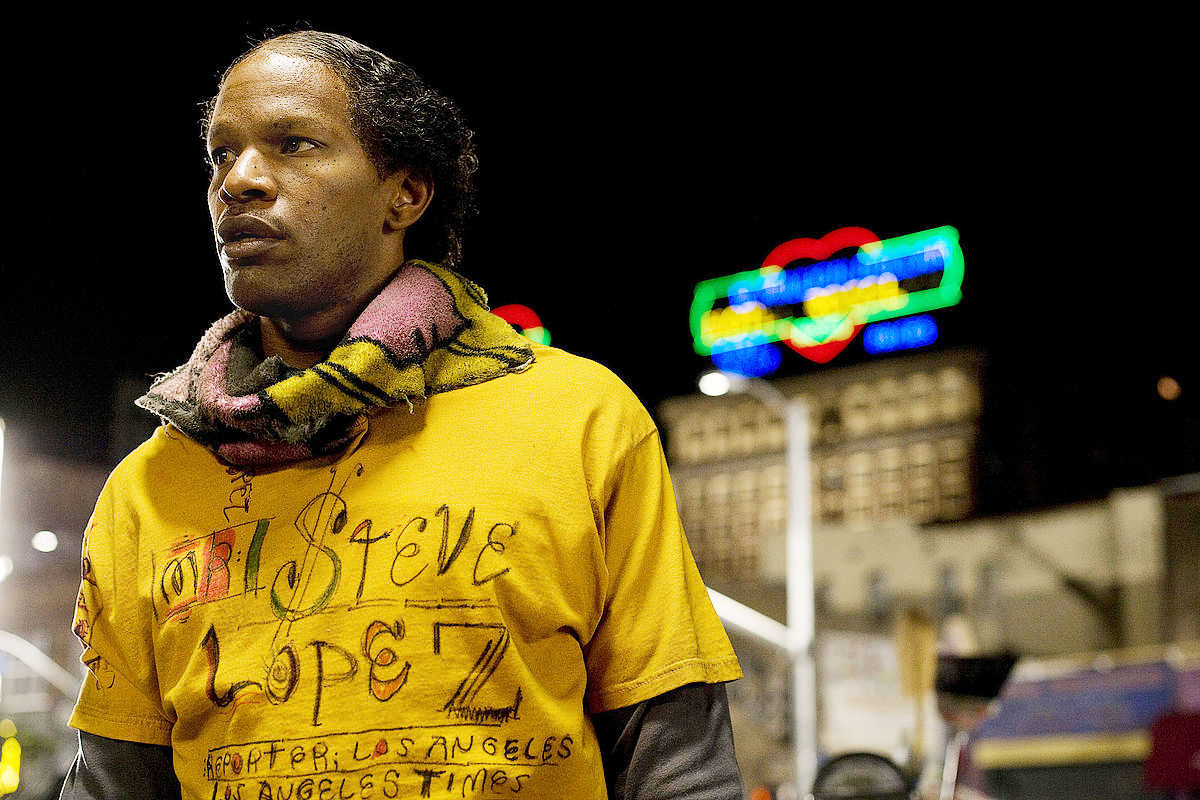
The Soloist (Joe Wright, 2009) The Los Angeles of Joe Wright's The Soloist is an alien landscape of clover-leaved asphalt, caves of concrete, and dwellings like jail-cells, overlain with a constant muffled roar, punctuated with neon- and police-bar-lit nights through which the homeless meander in surrealist tableaux that would give Federico Fellini pause.

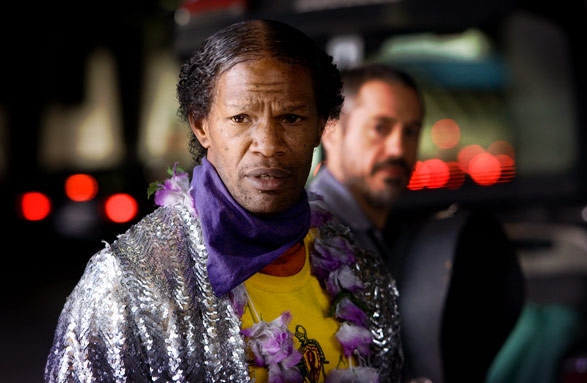
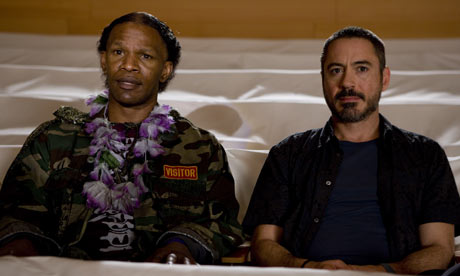
In this environment, while recovering from a nasty bicycle accident Los Angeles Times feature reporter Steve Lopez (Robert Downey Jr.) is contemplating another failed idea for a column, when he hears, echoing, a high sonority piercing the white noise.  It emanates from Nathaniel Anthony Ayers (Jamie Foxx)—homeless, schizophrenic, sawing out pure tones from a violin with only two strings, the sounds of the others only imagined in Ayers' head.  It's the stuff human interest columns are made of: a Julliard drop-out, cast adrift amidst the flotsam and jetsam on economic beachrocks, whose music cuts through the din.  Soon, Lopez's column puts a face on the L.A. homeless community (numbering 90,000) and the public responds, including the donation of a no-longer-used bass-cello, Ayers' original instrument, and Ayers' simple existence gets complicated.

Joe Wright has made two rarefied films set in the English gentry (Pride & Prejudice, Atonement), but this urban tale of harmony amidst grinding chaos, propels his gifts into a new arena.  No longer able to settle on the classical symmetry of English estates, this film is jagged, off-kilter, and sonically and visually complex, both in exterior spaces and in the echoing interiors of Ayers' mind.  Music soon supplants the chattering roar of the film, softening and simplifying it, finally allowing it to soar, sometimes literally, evoking the peace that soothes Ayers' mind.  But those moments are all-too brief, as the two men are both impacted by each other's demons.  

That jagged, off-kilter quality is also necessitated by the editing rhythms Wright is forced into by his principal stars, two of the better "riffers" of the current crop of young actors.  Downey, Jr. and Foxx intersect each other, the latter, in a constant stream of focused non-sequiturs, while the former interjects whenever he can, like Ayers' music trying to find structure in the jumble of words and thoughts.  The editing of their scenes together is tight and, frankly, a little daunting to consider how difficult it must have been.  Like the rest of the film, it succeeds if, in not bringing order to chaos, it offers a respite from disorder


Mr. Ayers

Tuesday, January 22, 2008

Dreamgirls

Dreamgirls (Bill Condon, 2006) Think "The Color Purple" in sequined gowns and moved north to Motown and you've got it in a nutsell. Or the story of "The Supremes" but without the good music. I've always liked the material provided Motown's premiere girl-group (the singer, not the song/the singer, not the song) even though they were vamping cross-gendered "Pip's," but I've always had a feeling like chewing aluminum foil when it comes to uber-diva Diana Ross. In fact the only concert I'd kept a record of was the one in Central Park that was interrupted by a freak thunderstorm of such magnitude that New Yorkers started leaving in throngs (cabs and coaches being presumably unavailable), while the rain-pelted, wind-whipped Ross was exhorting "Please! Stay! Just sing with me! It'll blow over! " (It didn't. Sometimes reality can overwhelm ego) That one always gave me a chuckle. Poor drenched Diana. Nobody loved her enough to risk electrocution. Musta been hard.

So to see a fictionalized version of their story, even one not to Ms. Ross' liking, might have had some sort of crass-enjoyment to it. But the songs have none of the agressive bop of Motown pop, the conceit of songs in concert/songs as commentary doesn't work and most of the performances try to trudge through the treacle unsuccessfully. Who'd have thought that Beyonce, child of Mariah, born of Whitney, out of Diana would prove to be such a non-entity on-screen, even when the movie is made to order for her. And the very talented Jamie Foxx can't play a bad guy when all his life he has sung like a good guy. It is his sorry fate to be cast as "Mister" splitting up the women, then banished to inconsequence when we end with The Big Reunion.

But...the things that make the movie watchable and of any interest at all are Jennifer Hudson and Eddie Murphy. Hudson won the Oscar for the over-wrought "And I'm Telling You I'm Not Going," but her bad-attitude acting and her quieter singing are what really make you miss her when she's off-screen. And Murphy proves that, despite the schlock that he's attached his name to, he's a man of unqualified gifts. His fictionalized riff on James Brown shows the athleticism, the brio, the stage-power and the inherent puffery of "A Hardest Working Man in Show Business." Not a false or contrived-cute note in that performance. And he sings good, too. He shoulda won that Oscar.

Saturday, November 17, 2007

The Kingdom

Cries and Whispers

On the American military compound in Rhiyadh, two terrorists command a security vehicle and open up machine gun fire on a family softball game leaving carnage before they are killed. But like the WTC attacks, it's a two-pronged assault, the first wave of terror providing the means for a devastating explosion during the rescue efforts. For four FBI investigators it becomes a personal duty to investigate the scene and find out what happened and who was responsible. They only have five days. They're under constant surveillance by the local police. Their movements are restricted, their presence resented and the attack zone compromised in the clean-up efforts. The only thing they do have is an Exit Strategy, which has been formulated before their arrival, and things have a way of changing. But it's personal, and they have to find a way, doing an impossible task, in an unfamiliar and hostile area, without leaving a trace because it's not exactly sanctioned by the U.S. government. Yeah, good luck with that.

"The Kingdom" is directed by Peter Berg, whose previous film was "Friday Night Lights," a film I greatly admire. Berg shepherded that film over to a fascinating series on NBC, and unlike his previous series "Wonderland," has made it all the way to a second season. He started out as an actor-- was the slightly lump-headed first seduction of Linda Fiorentino in "The Last Seduction," and he starred for several seasons on "Chicago Hope," where he first started directing. Berg is a genuine find--an intelligent director who communicates everything-- gives you all you need to know, keeps things logistically decipherable, and lenses with an oblique eye that takes everything in but doesn't beat you over the head with it. An action-director who gives his audience credit for intelligence and propels the film along, trusting that the audience will keep up.

Berg has a flashy cast for "CSI: Rhiyadh" (scripter Matthew Carnehan describes it as "Imagine a murder investigation on Mars") in Jamie Foxx, Chris Cooper, Jennifer Garner and Jason Bateman (as well as Danny Huston, Frances Fisher, and Jeremy Piven--who basically plays his "Entourage" character working for the State department). Everyone's performance is tamped down, but the fact is they're all stars--well, Bateman is there for comedy relief--and unlike the cast of "Friday Night Lights," they stand out like sore thumbs, which actually serves the film well. But the stand-out performance is by Ashraf Barhom, whose Col. Faris Al Ghazi takes his job of providing protection for the team so seriously that he hampers their efforts at every turn. And given that his job is to stand in for the entire Arab world (almost every other local is a bit of a cypher), he carries off the role with a subtlety that doesn't betray the heavy lifting.

Berg has stated that he didn't want to make a "message" film, saying that the ratio for a film to make a point and make an audience is "98% action, and 2% message." That may be overstating the case, as there's a lot more message in the film hidden between the frames. But...though the film does put a face to the Arab world, though it does reflect the heavy-handed presence of America there, though it may bring into sharp focus the folly of having a formalized military presence in a guerilla situation and the dangers that that presence can provide in escalating the conflict--though it may say all these things that point to the folly of invading Iraq, that 98% action still has the effect of having the audience jingo-cheer on the Americans (even with Arab back-up) in a fire-fight in a hotel building. You have to have your message and the action that belies it. That's troubling. But while one contemplates that, the film moves on and delivers a spoken coda that says that, really, we're all not so different after all.

Boo-yah.

"The Kingdom" is a cheap matinee