 "Moving, with Shrekless Abandon"
I saw the first two "Shrek's" in the theater, and made the, in retrospect, wise decision to skip "3" and saw it on TV. The first two were cheeky fun, playing with the conventions of fairy-tales and the mass market merchandizing of same (Hallo, Uncle Walt), while playing with the idea that "Happily Ever After" is a bit relative, after all. "Shrek 3" recycled heroes and villains from the first two, and betrayed a certain Disney-envy by only adding a "Charlie's Angels" bevy of bickering Princessi to the proceedings. Although there were some good gags, it seemed like the ideas had run their course.
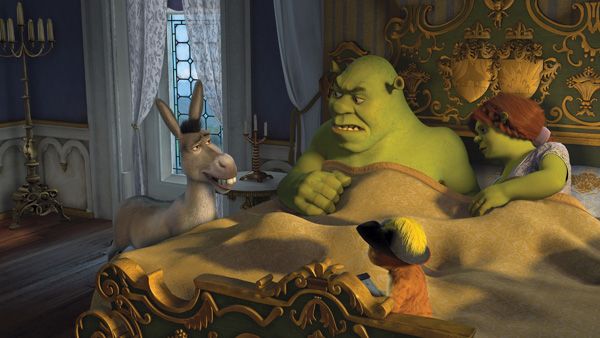
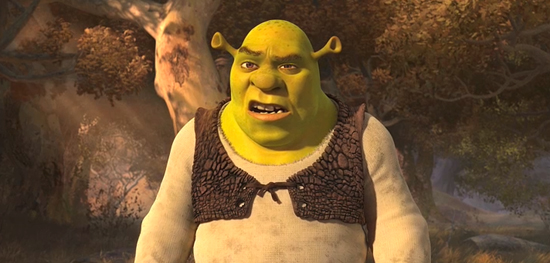
"Shrek 4" (whatever it's title is this week) in the required 3-D, at least goes back to the fairy tale world for inspiration, and with some careful noodling with movie idioms comes up with a good idea. Employing the trickster gambit, of those troll-like creatures, who would sell ya a hill of beans or a bill of goods which would promise one outcome and yurn into a life-complicating problem (In our modern times, we call them mortgage brokers and real estate salesmen). In this case, it's "Rumplestiltskin," he of the first-born fetish, who sees all of his troubles stemming from the fact that his little deal to become King of Far Far Away was dashed when Shrek rescued and won Princess Fiona away back in the first picture.
As Fate would have it, the opportunity arises for him to correct his sorry state of affairs: Shrek, now a father of muling puking ogres—no, they're not just infants, they're really ogres—is not feeling the domestic bliss. He misses the old days, when he would grind men's bones to make his bread, and frighten trespassers who came within a league of his hovel, and he didn't have to change diapers and do the chores, and arrange play-dates with donkey's kids. Worst yet, he has to drive a Subaru.*
So, Rumplestiltskin makes a deal where Shrek can have his old life back (the re-establishment of which is done to the tune of The Carpenter's "Top of the World") in exchange for one day—that day being his birthday. He wakes up in a world where he doesn't exist, where Rumplestiltskin is King (as Shrek never rescued Fiona), and in 24 hours he will cease to be.
Unless....(there's always an "Unless"—those old scribes never let themselves be written into a corner) and it entails True Love's Kiss. Naturally.
So, "It's a Wonderful Life" where Shrek must contend with no one knowing who he is, and negotiating his way through a country where he is just one of many ogres in a race war between the greens and the whites. That's all fine for us, but it's mind-warping for the kids in the audience. The infestation of kiddies near me were terror-struck that things were different than what they were used to seeing on the Pacifier at home. Shrek and Fiona aren't married? Donkey and Puss aren't his bff's—best furry friends? What if it doesn't work out and all the DVD's at home are changed...(it's possible, we're talking time-space paradox/parallel worlds here)? That's a lot for wee ones to wrap their tap-dancing sugar-plum minds around.
They'll live. It's odd to see how much more detailed the rendering of the characters is than it used to be. Everything is more crisp and nuanced, while also taking a big step backwards—the lip-sync seems to be a little soft, just fudged a bit to make it "work," and the characters tend to turn away while talking rather than expose it, like hiding bad teeth. Perhaps it always has and I never spotted it before, but I doubt it—it's one of those things I notice in movies. I watched in 2-D, but no one goes out of their way to throw something at the screen, but I'll bet the reality-transition scenes will be spectacular.
New voices this time around include Jon Hamm as a burly ogre-leader and the justifiably ubiquitous Jane Lynch. But the stand-out is Walt Dohrn as Rumplestiltskin; a writer-director of "Spongebob Squarepants," and "Shrek" gag-writer, his mealy-mouthed little schemer is easily the best performance in the film, which, given the usual talent, is really saying something.
"Shrek Forever After" is a Rental.
* Yeah, I made that up.
Tuesday, June 1, 2010
Shrek Forever After (The Final Chapter)






Saturday, November 28, 2009
Best Defense
 "Best Defense" (Willard Huyck, 1984) Time to pull the pin of this grenade, light the fuse on this bomb, pull the switch, and send it down the ol' chute. Actually it doesn't need my help at all. "Best Defense," a comedy about incompetence in military contractors, * does its own job for it by self-destructing. Spear-headed by the husband-wife team of Willard Huyck and Gloria Katz (they wrote "American Graffiti," but are also responsible for the nasty screenplays for "Indiana Jones and the Temple of Doom" and "Lucky Lady" and, disastrously, writing-directing "Howard the Duck."), this clunking, clanking film tells the story of Wylie Cooper (Dudley Moore), an engineer for a defense contractor going out of business. By complications of circumstance, he acquires the plans for a missile system, which his company then proceeds to nickle and dime into inoperability—yes, this is a movie supporting inflating defense contracts and profits to the expense of the soldiers who use the armaments. Hilarious. So funny, it kills. Sadly, it doesn't stray too far from the truth. The best comedic aspect to the sorry show is that Paramount Pictures evidently operates under the same philosophy.
Not sure what the storyline is, but, according to legend, audience previews for this cluster-bomb were so bad that Paramount—which must be blamed for shelling out the 18 mil' it cost to produce this—brought in then-as-hot-as-could-be Eddie Murphy as "Strategic Guest Star" to film comedic sequences (that was the intent, anyway) of him coping with the system in a conflict in Kuwait,** in an effort to salvage their investment.
Didn't work. It cost 18 million to produce, and got back 19 million in revenue, not counting publicity and promotion costs. One wishes one could say it was funny, but I didn't laugh once during the amount of time I watched it.
Confession time: This is the only time I have ever walked out of a movie (It was a free preview, so I had nothing to lose but time) before it was over. I couldn't endure one more second of it, and losing any more of my life...or my love of movies...to it.***
"Best Defense" was the worst offence.
* Potentially, a good source for black comedy, but might have been funnier if just done as a documentary about "The Bradley."
** The only interesting thing about this film is that it shows sequences taking place during a fictional invasion of Kuwait by Iraq, seven years before the Gulf War took place. Defenders of this film—both of them—insist that this makes the movie special in that it "predicted" The Gulf War. In reality, it didn't predict anything. It just made a safe guess where a conflict could occur. It might not occur to those defenders that it is conceivable that Saddam Hussein might have gotten the idea from watching this movie; "Patton" inspired Nixon to invade Cambodia. Hell, Saddam Hussein might have LIKED this movie.
*** There was one other movie I walked out on, truth be told—"Hollywoodland," starring Adrien Brody, supposedly about the death of George Reeves, but was so full of falsehoods that I didn't stay for the very end of the film, which would have depicted Reeves' suicide after several sequences that suggested it was murder.


Tuesday, January 22, 2008
Dreamgirls
 Dreamgirls (Bill Condon, 2006) Think "The Color Purple" in sequined gowns and moved north to Motown and you've got it in a nutsell. Or the story of "The Supremes" but without the good music. I've always liked the material provided Motown's premiere girl-group (the singer, not the song/the singer, not the song) even though they were vamping cross-gendered "Pip's," but I've always had a feeling like chewing aluminum foil when it comes to uber-diva Diana Ross. In fact the only concert I'd kept a record of was the one in Central Park that was interrupted by a freak thunderstorm of such magnitude that New Yorkers started leaving in throngs (cabs and coaches being presumably unavailable), while the rain-pelted, wind-whipped Ross was exhorting "Please! Stay! Just sing with me! It'll blow over! " (It didn't. Sometimes reality can overwhelm ego) That one always gave me a chuckle. Poor drenched Diana. Nobody loved her enough to risk electrocution. Musta been hard.
So to see a fictionalized version of their story, even one not to Ms. Ross' liking, might have had some sort of crass-enjoyment to it. But the songs have none of the agressive bop of Motown pop, the conceit of songs in concert/songs as commentary doesn't work and most of the performances try to trudge through the treacle unsuccessfully. Who'd have thought that Beyonce, child of Mariah, born of Whitney, out of Diana would prove to be such a non-entity on-screen, even when the movie is made to order for her. And the very talented Jamie Foxx can't play a bad guy when all his life he has sung like a good guy. It is his sorry fate to be cast as "Mister" splitting up the women, then banished to inconsequence when we end with The Big Reunion.
But...the things that make the movie watchable and of any interest at all are Jennifer Hudson and Eddie Murphy. Hudson won the Oscar for the over-wrought "And I'm Telling You I'm Not Going," but her bad-attitude acting and her quieter singing are what really make you miss her when she's off-screen. And Murphy proves that, despite the schlock that he's attached his name to, he's a man of unqualified gifts. His fictionalized riff on James Brown shows the athleticism, the brio, the stage-power and the inherent puffery of "A Hardest Working Man in Show Business." Not a false or contrived-cute note in that performance. And he sings good, too. He shoulda won that Oscar.