Showing posts with label 1984. Show all posts

Saturday, November 28, 2009

Best Defense

"Best Defense" (Willard Huyck, 1984) Time to pull the pin of this grenade, light the fuse on this bomb, pull the switch, and send it down the ol' chute. Actually it doesn't need my help at all. "Best Defense," a comedy about incompetence in military contractors, * does its own job for it by self-destructing. Spear-headed by the husband-wife team of Willard Huyck and Gloria Katz (they wrote "American Graffiti," but are also responsible for the nasty screenplays for "Indiana Jones and the Temple of Doom" and "Lucky Lady" and, disastrously, writing-directing "Howard the Duck."), this clunking, clanking film tells the story of Wylie Cooper (Dudley Moore), an engineer for a defense contractor going out of business. By complications of circumstance, he acquires the plans for a missile system, which his company then proceeds to nickle and dime into inoperability—yes, this is a movie supporting inflating defense contracts and profits to the expense of the soldiers who use the armaments. Hilarious. So funny, it kills. Sadly, it doesn't stray too far from the truth. The best comedic aspect to the sorry show is that Paramount Pictures evidently operates under the same philosophy.

Not sure what the storyline is, but, according to legend, audience previews for this cluster-bomb were so bad that Paramount—which must be blamed for shelling out the 18 mil' it cost to produce this—brought in then-as-hot-as-could-be
Eddie Murphy as "Strategic Guest Star" to film comedic sequences (that was the intent, anyway) of him coping with the system in a conflict in Kuwait,** in an effort to salvage their investment.

Didn't work. It cost 18 million to produce, and got back 19 million in revenue, not counting publicity and promotion costs. One wishes one could say it was funny, but I didn't laugh once during the amount of time I watched it.

Confession time: This is the only time I have ever walked out of a movie (It was a free preview, so I had nothing to lose but time) before it was over. I couldn't endure one more second of it, and losing any more of my life...or my love of movies...to it.
***

"Best Defense" was the worst offence.

* Potentially, a good source for black comedy, but might have been funnier if just done as a documentary about "The Bradley."

** The only interesting thing about this film is that it shows sequences taking place during a fictional invasion of Kuwait by Iraq, seven years before the Gulf War took place. Defenders of this film—both of them—insist that this makes the movie special in that it "predicted" The Gulf War. In reality, it didn't predict anything. It just made a safe guess where a conflict could occur. It might not occur to those defenders that it is conceivable that Saddam Hussein might have gotten the idea from watching this movie; "Patton" inspired Nixon to invade Cambodia. Hell, Saddam Hussein might have LIKED this movie.

*** There was one other movie I walked out on, truth be told—"Hollywoodland," starring Adrien Brody, supposedly about the death of George Reeves
, but was so full of falsehoods that I didn't stay for the very end of the film, which would have depicted Reeves' suicide after several sequences that suggested it was murder.


Monday, October 26, 2009

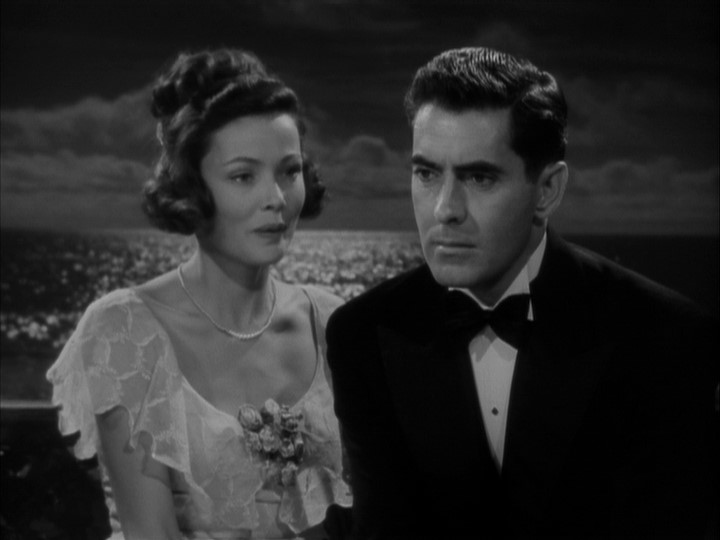
The Natural

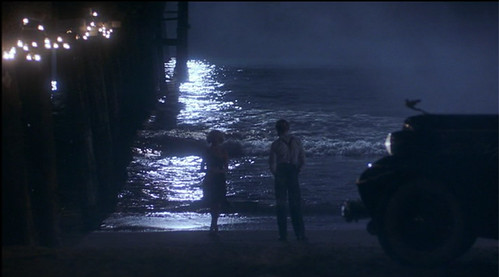
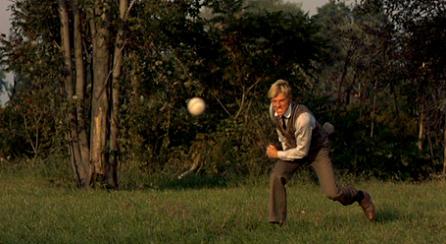
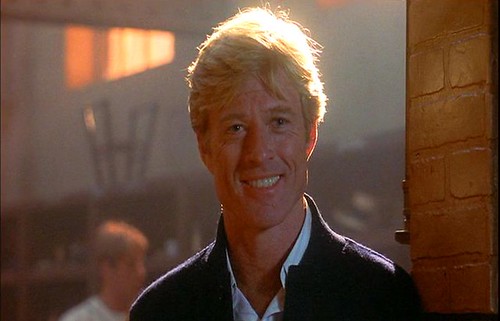
"The Natural" (Barry Levinson, 1984) Bernard Malamud's novel "The Natural" took America's penchant for mythologizing its sports-heroes, and combined it with Arthurian legend to create one of the great sports novels of all time. The tale of a baseball player, Roy Hobbs (Robert Redford) appearing in Major League Baseball, seemingly effortless of bat and glove, creating miracles in the field, has all the elements of nature and the Divine (his bat, "Wonderboy", was carved from a tree struck by lightning), the contest (he strikes out "The Whammer" (based on "Babe" Ruth), trials (his father's death, a near-fatal shooting, lost love) and battles which weaken him and threaten his reputation. Malamud completes the connection with Legend, by making Roy Hobbes vulnerable to attack from within and without, finally defeated by the passing age and his own failings.

The film made of "The Natural" is all about the myth; Caleb Deschanel's pristine picture post-card cinematography, lovingly back-lit by a dying sun makes a past perfect to the eye. There are few films as lovingly shot as "The Natural," and Barry Levinson, learning to be a pictorial director rather than just a shoot-and-run cast-coordinator of his own material, turns the film into an article of his devotion as a sports lover. In fact, despite the intrusion of some adult material—the hanky-panky with a team "widow" (Kim Basinger) and Hobbes' earlier indiscretions, it is a small child's view of baseball, where grown men playing a kids' game are larger-than-life heroes, miracles happen on one's own efforts and the glories last a life-time. From such a viewpoint—at about the strike-zoneeverything looks Legendary.

The cast is crowded with good actors doing some great work—not just Redford, whose own mythical presence of Aryan American brings its considerable WASP-ish weight to the story, but also Glenn Close, Wilford Brimley, Richard Farnsworth, Robert Duvall, Barbara Hershey, Joe Don Baker, Darren McGavin and Basinger. Layered over the top of the confection is Randy Newman's score—a combination of boogie-woogie, keening Americana and heraldic brass.*

Front-loaded with so much talent one would think of the natural as a grand-slam, the mythology built up to accentuate suspense** (Will Hobbs hit the game-winning home run? Will it kill him?
What about his new-found family? Will the gambling interests destroy him, no matter what?) It comes down to the last pitch and a finale so overblown that the only thing that could top it would be Hobbs ascending into Heaven, forget the impossibility of the stadium-wide natural fireworks display of the type pulled off by Levinson and crew. The crowd I first saw it with burst into spontaneous applause at the denouement, so, obviously it was a hit with audiences, despite what I considered an error on the play. Me? I thought the game was rigged.

For in Malamud's novel, Hobbs strikes out, is damned by the press and public and fades away, a passing moment of the age, when miracles happened unsullied by the evils of the world like
the Knights of Olde. Hobbs is defeated by the times. Not the movie-Hobbs, who is given his triumph and more, a return to simplicity, the sinking sun of previous shots now giving him a roseate glow,*** a Disneyfication of Malamud's intent.


* Redford, according to Newman, wasn't fond of the score: "I don't like horns" he was reported to have groused to the composer. Cooler heads prevailed. During an interview broadcast on Bravo, Newman said that there were half-hearted lyrics for the fanfaric Main Theme: "Look at that man/The Nat'ral/As nat'ral a man as can be/He hits the ball/And that's not all/So Na-tu-ral/Is he."

** I would put a "Spoiler Alert" on this review, but, really, the outcome is never in doubt, telegraphed by the score's hushed anticipation, and that everything joyous in the film, is presented in weighty slow-motion. Besides at that point in his career, Redford didn't want his characters to be weak—he had turned down "The Verdict," which pal Paul Newman snapped up and won a Best Actor Nomination.

*** The term used for those hours of twilight and dawn with the sun at its lowest point, providing long shadows, and a rose-colored glow is "Magic Hour."


Saturday, September 5, 2009

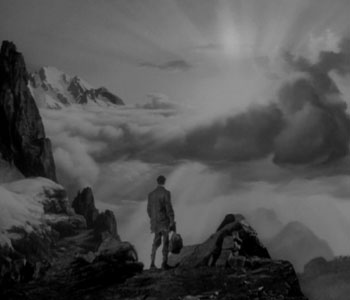
The Razor's Edge (1984)

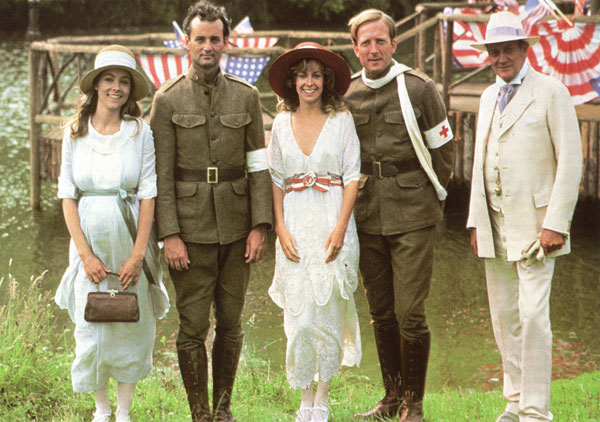
"The Razor's Edge" (John Byrum, 1984) The collaboration between Bill Murray and John Byrum on the screenplay is a case of good and bad: the screenplay's very good, respectful of Maugham, but also digging into Larry Darrell's experiences in World War I that made him a part of the "lost generation," and seek a higher truth than his social-climbing friends; the bad part is that Bill Murray stars in it.

At this point in his career, Murray was a popular comic genius,
taking a rather lackluster first year on "Saturday Night Live," and parlaying it into a film career where he virtually ad-libbed "Meatballs" into a suprise box-office success. "Stripes,""Where the Buffalo Roam,""Caddyshack,""Tootsie" (uncredited, so as not to distract) all built his reputation to where he was becoming a box-office phenomenon (and the capper, "Ghost Busters," he agreed to star in to secure "The Razor's Edge" being made).

Byrum does a fine job directing
the film: the locations (particularly the Tibetan ones) are lush and filled with color, and the performances are spot on: Theresa Russell does wonders with a role that can fall into cliche, but she brings a freshness to it that makes it all the more poignant, and Catherine Hicks makes her "Isabel" more sympathetic and far less hissable than she was in the 1946 adaptation.

The "sore thumb" is Murray—but not entirely. When called on to be dramatically appropriate he is there, but the temptation for the young star to punch up scenes with ad-libs that seem too contemporary or are dramatically inappropriate was not squelched by the director*—either because he owed Murray too much for getting it made, or because he didn't want to throw a bushel over Murray's "star-power."

And one can understand why Murray did it. Larry Darrell is supposed to be an attractive, if slightly remote and disconnected, man. There has to be a reason people care about him so much, especially as he abandons them to go off on his spiritual quest, and why Isabel takes the course of actions to keep him to herself.
Tyrone Power, in the 1946 version, employed a "thousand yard stare" to suggest deep-seated consciousness, unconvincingly—and, he was Tyrone Power, and the man's "star quality" was sufficient motivation. But, Murray turns Larry from a "party-boy" to a troubled "slacker" with a goofy sense of humor. He's always the funniest guy in the room, and his quips are his expression of affection for his friends. It's the "silver chord" that is shared by pre-war Larry and post-war Larry, and that binds him to his old friends. It's a neat solution to the problem of Murray not being Tyrone Power in looks. But, Murray's funny is a bit too hip for a 1920's room. And though it may occasionally crack up his co-stars, it also makes him the odd man out in the entire scenario.

It's too bad. Given a bit more restraint, this might have been the adaptation of one of
Maugham's best books. As its stands, it did make me dissatisfied enough to want to search out the original book, for which I'll always be grateful.

* The most egregious being Larry's empathetic subterfuge of presenting the stricken Uncle Elliott a much desired invitation to a function and Murray's ad-lib: "If it's a costume party you could wear that cute little bunny suit..." It's so out of left-field, especially at that particular juncture, that it undercuts one of the most dramatic moments of the movie, and Denholm Elliott's terrific performance, it's a bit grand-standing on Murray's part. Maybe I'm being unfair and it wasn't supposed to make the final cut and Columbia insisted there be more "Murray comedy," but it is such an artistic gaffe, that you would think that someone would have objected.


Saturday, August 29, 2009

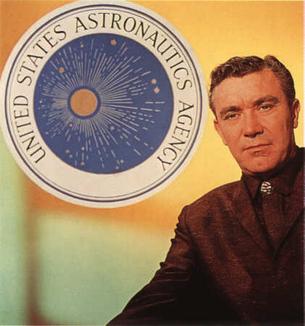
2010: The Year We Make Contact

 2010: The Year We Make Contact (Peter Hyams, 1984) 2001: A Space Odyssey took scientific precepts and used them as a launching pad for a philosophical adventure about humans and their place in the Universe in a suggestive and non-narrative way. It's "official" follow-up, "2010," however, tells you what it's going to show ya—then it shows ya—then it tells ya what it showed ya, thanks to a narration by Roy Scheider's character that explains everything but what he had for dinner. It's as far afield in style from its cinematic prequel as it could be—so much so that they feel like they've come from two different galaxies, or as one IMDB poster put it, "it's like comparing apples and concrete."

Based on
Arthur C. Clarke's "romp around the Solar System" ("2010: Odyssey Two"), it proposes a fact-finding mission by Dr. Heywood Floyd (Roy Scheider in this one) to attempt to discover precisely what happened to the Discovery Mission to Jupiter and its crew. By hitching a ride on a Soviet space-craft (commanded by er, Tanya KirbukHelen Mirren) that just happens to be passing by, Floyd and his crew—Discovery engineer Dr. Walter Curnow (John Lithgow) and Dr. Chandra (Bob Balaban), the computer scientist who developed the Hal 9000 and its twin in Urbana, Illinois—attempt to find out what went wrong with the mission that ended up with a dead crew and no information on where the signal sent by the un-mooned TMA-1 anomaly went.  Where the first film revels in the leaps of evolution foisted on Man by "the Zarathustrians" (as I call them), Hyams' film is stuck with the earth-men and women merely trying to crack "what-done-it." 


Frankly, they should have just re-played the first film.

Kirbuk...d'uh...Kubrick stayed away from the machinations, unless it was visually arresting or amusing—like the zero-gravity-walking up walls, or the gravity-making squirrel-cage aboard Discovery— but Hyams, like Clarke, is only too happy to show the nuts-and-bolts of dropping into orbit with ablating bags, the stress it has on the crew by shaking the camera, the spark-emitting panels, and the requisite astronaut who flies across the control center in zero-g. This is the stuff of sci-fi melodrama in all its cheapness, precisely what Kubrick was trying to avoid in his film.

Clarke's
ultimate Big Surprise is a nifty one—educational, too, about the configuration of Jupiter—but by granting the unseen architects in both films motivations that seem like cosmic buttinskism very much cheapens the first film and its scope, making man's Creation merely all in a monolith's day's work. And the cosmic consequence of "2010" feels like an after-thought. It is eerie to hear the voice of HAL again (Douglas Rain) and to see Keir Dullea, through some artful make-up, look as young (and as old, unnecessarily) as he once was. And working from mere screen-captures, Hyams and his art department did a meticulous job recreating the Discovery sectionsthey can't keep the ships from looking like models in the FX sections, however, which is curious for a more late-model movie. So meticulous is their work that it seems bizarre that the Russian ship would look so dfferent in its interior, than what the Americans had come up with by that time.   Again, apples and concrete.

One wonders, ultimately, if it was worth doing: it was a toe-splash for M-G-M to explore the possibilities of one of its core properties, but its utter conventionality only points to the other film's complete unconventionality in
terms of belaying cheap dramatic tricks and the standard "science fiction" obsession with mechanics. It is the only sense of wonder "2010" allows, where it's progenitor was far more about wonder than the why's and wherefore's.


Tuesday, July 29, 2008

Places in the Heart

"Places in the Heart" (Robert Benton, 1984) Robert Benton's distillation of life growing up in Waxahachie, Texas during the Depression begins with an accidental death, which expands to an act of evil, but ends, after Earthly trials, with an ambiguous epiphany that extends the simple gift of community into an expression of spiritual healing and harmony--one of the gutsiest segues from hard-scrabble reality to the Mystery of Faith ever put to film.

The cast is impeccable with unsentimental work from
Sally Field, to pitch-perfect early performances from Danny Glover and John Malkovich, to excellent work by Ed Harris, Amy Madigan and Lindsay Crouse. All portray an extended family that forgo the boundaries of blood and race to pull together and survive the deprivations of Nature and man.

Sure sounds like heavy stuff, but the artists behind and in front of the camera make it compelling drama that stays clear-eyed and rarely sinks into easy sentimentality. Quite the opposite; Glover plays the role of a poor share-cropper with a tentativeness that awaits disaster, and Malkovich makes his blind war vet a petulant jerk. Plus, there's a collection of townsfolk that includes greedy bankers, murderous racists and opportunists of every stripe. In "
To Kill a Mockingbird," racism seems like bad manners and poor up-bringing, while in "Places in the Heart" it's a way of life and charity is the exception, rather than the norm.

It's a story of perserverence in the face of great change, and, if not welcoming and embracing change, at least having the grit to roll with it. It's one of my favorite films from a fine film director.

And that ending. Gets me every time.


Thursday, May 1, 2008

Secret Honor

"Secret Honor" (Robert Altman, 1984) Okay, here's a wierd one for you. Altman, in one of his career slumps was teaching at the University of Minnesota Communications Department, and used the class to help film this one-man show with Philip Baker Hall as Richard Nixon and written by the guys who made the equally provocative but dramatically inert "Executive Action" back in 1973. Altman, in his commentary, basically begs off any credit, saying "I just pointed tha camera and came up with the video monitors, so I could cut away if I needed to." Nice strategy, though.

The play's the thing, however. And it's a bit of a toad. Nixon, post-retirement, goes into his study to record what...memoirs, instructions to the help, a defense strategy...what? All of them. He arms himself with a bottle of scotch and a gun. And starts to babble, his thoughts bouncing from one stray thought to the next, going over history, explaining his actions, sobbing over his family, railing against Kissinger, all in a stream of expletives undeleted that sound a bit like the way Nixon talked, but with far more dramatics. Nixon would speak in sentence fragments, off the cuff, in a stream of consciousness that's fascinating...and frustrating to listen to. But it was usually in a dull monotone, and certainly more cohesive. Here, Hall cranks the melodrama to eleven, and the sentence fragments are jammed into each other with much hesitation, his thoughts pinballing from thought to thought, and while it sustains the interest, it ain't too Nixonian.

But now, here's the thing. Clearly the movie was written by folks who despised the man, but more often than not, they take Nixon's side. Specifically, how Nixon post-WWII answered an ad in a California newspaper looking for a "young energetic man, preferably a veteran" to run for office. This "Gang of 100" as Nixon refers to them, are a deep-seated conspiracy of money-men, financiers, mobsters and hoity-toity's and presumably boogey-men who guide his career up to and including Watergate. Not quite the Mason's or the Illuminati, Nixon does their behest, and here he regrets his actions, including the assassination of Allende and his taking-on of the "whore-monger" Kissinger to steer his Ship of State. It becomes clear that his job for the evening is to fall on his sword for his Cabal, but by the end of the play, he has whipped himself into such a resentful state over the outcome of his life that, rather than eat a bullet, he instead raises a clenched fist in a triumphal act of stubborn defiance, shouting "Fuck 'em!!," and resembling those very anti-war protestors he so despised. For folks who didn't like the man, they sure end the thing on an heroically triumphal note. It is, after all, labeled "A Political Myth."

Still, it beats Oliver Stone's "Nixon" by a crooked mile.

Wednesday, March 19, 2008

Nausicaä of the Valley of the Wind


Imagine The Lorax as a concept album by Yes - and you get something of the flavor of Nausicaä of the Valley of the Wind (or Kaze no tani no Naushika). It is one of Hayao Miyazaki's earlier films, an environmentalist tract that, in some ways, prefigures his 1997 Princess Mononke. Nausicaä is a princess forced to fight to defend her people in a future world devastated by years of industrial pollution. Pockets of the planet's population survive but all are threatened by a toxic forest teeming with monster insects. Until the rather abrupt ending, Nausicaä has a much more straightforward narrative arc than other Miyazaki movies like Spirited Away or Howl's Moving Castle. Oh, and my kids really liked it too.