or
"I'm Tellin' Ya, It's a Hell of a Story"
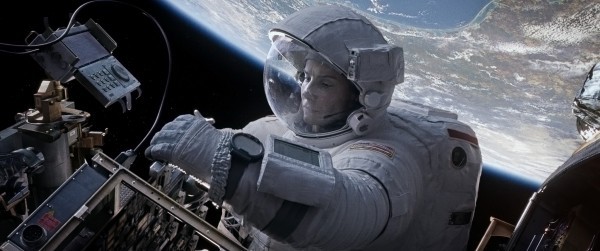
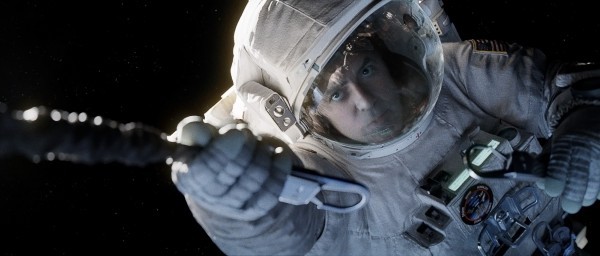
Gravity may just appear to you the shortest movie you've seen in awhile. It lasts all of ninety minutes, but it rips by, despite long, leisurely takes where nothing much is happening (The opening shot alone is 17 minutes long without a traditional edit). In that, it gets the yin-yang of space travel just so—floating at a relative leisurely pace while simultaneously moving at 16,000 mph, or as one test pilot describes the job—hours of boredom punctuated by moments of sheer terror.
Gravity pushes that out a bit, with many moments of sheer terror, but without some trumped up space monster hiding in lunar rocks (Apollo 18) or below the ice (Europa Station). No, it doesn't need anything fancy. It goes for the basics—a limitless indifferent Universe.
Up in space, aboard a futuristic space shuttle, terror comes by every 90 minutes or so, as a catastrophic collision between old Russian communication satellites causes a debris field hurtling by tearing holes through what ever fragile life-sustaining contraption we can put up there. Director Alfonso Cuarón (and his co-scenarist son Jonás) put the stakes right up front. "Life in Space is Impossible."
They, then, spend the next 90 minutes destroying whatever faith in technology and science you might have. It's an evangelist's dream come true.

That debris field starts out with a few little pieces, but like a cosmic game of "Asteroids" every collision creates more junk, sprays of it, and that just makes everything worse. Space is our garbage field—Cuarón underpins the point by showing us all the junk—pens, screws, cuff-links ("cuff-links??")—floating in zero-g inside the space stations and capsules we put up there in some sort of mad attempt to make normal life in space. It's a cosmic joke that after years of polluting the Earth, our garbage is making space uninhabitable (as if it ever was), too.
But, that's a lot of deep thought for after the film is over (as are some anomalies and plot conveniences).* In the watching, Gravity is a fun-ride on so many levels, a visual romp and roller-coaster—the dialogue being mostly tangential and matter-of-fact—as the crew of the shuttle Explorer must deal with the fact that every 90 minutes their equipment is going to take a debilitating series of hits that might burst their protective bubbles just to survive. The film is in mostly long, swooping stretches (the edits, interestingly, in dialogue situations), floating from one aspect to another, sometimes even violating the space of the astronaut's helmet, moving through the screen to get their perspective. The novel aspect of this one is that the zero-gravity that science fictions films have recently taken pains to re-create or avoid has no restrictions in this scenario, there are no walls to bump into; if you go, you go until something stops you, slows you down, or retards your progress, and everything you do, pushes you in the opposite direction. You can swim, but you'd better have an exit strategy for stopping, and spinning in place to turn around isn't going to help, because you're going to keep spinning. And the series of catastrophes, hardships, and just plain pains-in-the-ass keep piling up one after the other, you would think it was Harold Lloyd up there.

Speaking of which, Gravity, besides the scrupulous pixelization of space, also boasts a dynamite sound experience. In space, no one can hear dynamite, of course, but also no one can hear your thrusters whoosh-by, either, really. And Gravity is scrupulous about making sure you don't hear sounds in airless space, unless you absolutely have to. Sounds are restricted to radio chatter (and interference) but also, only those sounds that would transmit through an astronaut's space-suit. So, there are scenes where they're using power-tools? Only you don't hear the metallic grind of power-tools, you hear the vibration of the power-tools motors spinning. But that's it. Satellites get punctured, solar panels are torn off in bursts of shrapnel, but the most you hear is a muffled fwump if something impacts an astronaut, or vice versa. And the theater I saw it in makes use of a Dolby system called ATMOS that pin-points where to put each particular sound as it careens through the theater. It truly is an immersing experience in the theater.
For this space kid, despite some hokum here and there, it's the most fun I've had at the movies this year,** and someone is going to have to do something really exceptional to have better sound than this one.
Gravity is a Full-Price Ticket (Not only would I spring for 3-D, but try and see it in Dolby Atmos, for one of the craziest sound mixes I've ever heard).

* Three things, quibbles, anomalies, that are SPOILERS: 1) Sandra Bullock's hair is not plastered down on her head, but it's short, and would float around more than we see here (not a big deal, really, just a tech glitch, so the movie could get made); 2) At one point, we spend 10 minutes showing precisely how the whole friction-less world of Newton's laws of motion acts in zero-g, and then creates a cliffhanger situation that completely erases it, unnecessarily; and 3) Every 90 minutes that debris field shows up—IF everybody's in the same orbit, but one is STANDING STILL (which can't happen if you're actually orbiting) or they're going in opposite directions (at which point it would be every 45 minutes and very violently because they're colliding head-on). As far as the plot conveniences, those are fairly obvious.
** There are some nice little in-jokes along the way. My favorite: the unseen voice of Mission Control is Ed Harris, who played Flight Director Eugene Krantz in Apollo 13. I could imagining him having conniption fits down on Earth: "Failure is NOT an option!" "Not on MY watch!"


 Kaufman takes us into the dark-hole of the jet-engine, and inside we hear echoing voices and whistles and the sound of drums, and before we can register the change, we're not in the negative space of the engine anymore, we've transitioned to another channelled tube of energy—we're traveling through a tunnel riding atop a limousine from an astronaut's perspective...
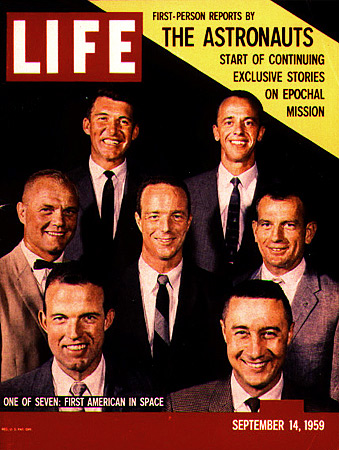
 ...as President Lyndon Johnson stands on a flag-draped stage and welcomes the seven Mercury astronauts to an out-sized barbecue in Houston--the new home for the Manned Space Center, as well as the astronauts and their families. Their homes, their furnishings are all paid for by the Houston developers who are benefitting from Johnson's earmarks. The Mercury 7 are living the good life, while the Man who Broke the Sound Barrier makes a run for space.
 Both these incidents happened and are mentioned in Wolfe's book, but they took place months apart, while Kaufman has them happening simultaneously. To what purpose will become clear later, but in the meantime, we follow Yeager (
 And in one spectacular shot, we see space bend and warp as we approach the feathery layer of a cloud-ceiling, then go through it...
 ...and the picture fades to an incident from that barbecue--an odd detail that Wolfe found funny and sad and a bit pathetic, but Kaufman turns into visual poetry. For some reason, the Houston event organizers chose as one of the entertainers stripper
  But Kaufman takes that incident and marries it with a running theme throughout the film. The Moon has been a beckoning image throughout "The Right Stuff," and now, as the clouds that Yeagher is punching through become the delicate feathers of Sally Rand's fans, she dances to an orchestral version of the melancholy "
 Kaufman stays on his images of empty space and feathers and lights, then to shots of the astronauts and their wives reacting to the irrelevence and embarrassment of it all. And then, something strange happens....
 ...and Shepard's not even watching the stage-show. He's lost in thought...
 ...as is
  Glenn turns to look at
  ...who is already looking at him.
 Grissom turns and looks at his buddy,
  ...who is his usual grinning self, but he's subdued. We transition back to Sally Rand...
 ... and a blaze of klieg-lights to Yeager trying to "punch a hole in the sky."
 Yeager reaches top altitude, then his engines give out and he's given one tantalizing glimpse of the stars in space...

 ...before his fighter-jet begins to rapidly tumble back to Earth.
 Unable to bring it under control, Yeager makes a fiery ejection...
 ...and Kaufman holds on him--trailing smoke, because as we'll see his helmet is on fire--and we watch his long, long fall through space as he tumbles through the silence--a modern Icarus...


 ...who disappears into the clouds.
 The clouds fade back to the feathers of Sally Rand.
 ...and to the astronauts, who are somewhere else.

 Glenn, on edge, looks to Grissom and Cooper...
 Grissom is wary...
 Cooper, head bowed, tentatively looks up...
 as does Slayton...
 And Shepard cranes his gaze to the ceiling...
 We transition to Sally Rand, and on the soundtrack we hear a distant boom.
 With a hard cut, we're back in the California desert.
 Reverse angle to an ambulance approaching in the shimmering desert heat.
 The driver points ahead "Sir? Is that a man?"
 Amid the smoke and heat-waves, a silvery shape emerges.
 "Yeah," says Ridley (
 As the music swells, Yeager carrying his parachute, his face burned, but still chewing gum, approaches the ambulance.