Wednesday, October 9, 2013
Gravity
or
"I'm Tellin' Ya, It's a Hell of a Story"
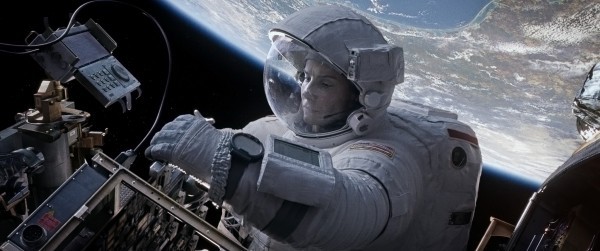
Gravity may just appear to you the shortest movie you've seen in awhile. It lasts all of ninety minutes, but it rips by, despite long, leisurely takes where nothing much is happening (The opening shot alone is 17 minutes long without a traditional edit). In that, it gets the yin-yang of space travel just so—floating at a relative leisurely pace while simultaneously moving at 16,000 mph, or as one test pilot describes the job—hours of boredom punctuated by moments of sheer terror.
Gravity pushes that out a bit, with many moments of sheer terror, but without some trumped up space monster hiding in lunar rocks (Apollo 18) or below the ice (Europa Station). No, it doesn't need anything fancy. It goes for the basics—a limitless indifferent Universe.
Up in space, aboard a futuristic space shuttle, terror comes by every 90 minutes or so, as a catastrophic collision between old Russian communication satellites causes a debris field hurtling by tearing holes through what ever fragile life-sustaining contraption we can put up there. Director Alfonso Cuarón (and his co-scenarist son Jonás) put the stakes right up front. "Life in Space is Impossible."
They, then, spend the next 90 minutes destroying whatever faith in technology and science you might have. It's an evangelist's dream come true.
That debris field starts out with a few little pieces, but like a cosmic game of "Asteroids" every collision creates more junk, sprays of it, and that just makes everything worse. Space is our garbage field—Cuarón underpins the point by showing us all the junk—pens, screws, cuff-links ("cuff-links??")—floating in zero-g inside the space stations and capsules we put up there in some sort of mad attempt to make normal life in space. It's a cosmic joke that after years of polluting the Earth, our garbage is making space uninhabitable (as if it ever was), too.
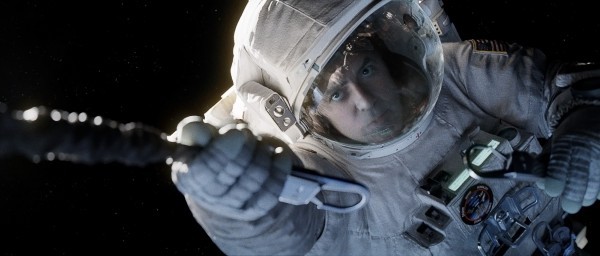
But, that's a lot of deep thought for after the film is over (as are some anomalies and plot conveniences).* In the watching, Gravity is a fun-ride on so many levels, a visual romp and roller-coaster—the dialogue being mostly tangential and matter-of-fact—as the crew of the shuttle Explorer must deal with the fact that every 90 minutes their equipment is going to take a debilitating series of hits that might burst their protective bubbles just to survive. The film is in mostly long, swooping stretches (the edits, interestingly, in dialogue situations), floating from one aspect to another, sometimes even violating the space of the astronaut's helmet, moving through the screen to get their perspective. The novel aspect of this one is that the zero-gravity that science fictions films have recently taken pains to re-create or avoid has no restrictions in this scenario, there are no walls to bump into; if you go, you go until something stops you, slows you down, or retards your progress, and everything you do, pushes you in the opposite direction. You can swim, but you'd better have an exit strategy for stopping, and spinning in place to turn around isn't going to help, because you're going to keep spinning. And the series of catastrophes, hardships, and just plain pains-in-the-ass keep piling up one after the other, you would think it was Harold Lloyd up there.
Speaking of which, Gravity, besides the scrupulous pixelization of space, also boasts a dynamite sound experience. In space, no one can hear dynamite, of course, but also no one can hear your thrusters whoosh-by, either, really. And Gravity is scrupulous about making sure you don't hear sounds in airless space, unless you absolutely have to. Sounds are restricted to radio chatter (and interference) but also, only those sounds that would transmit through an astronaut's space-suit. So, there are scenes where they're using power-tools? Only you don't hear the metallic grind of power-tools, you hear the vibration of the power-tools motors spinning. But that's it. Satellites get punctured, solar panels are torn off in bursts of shrapnel, but the most you hear is a muffled fwump if something impacts an astronaut, or vice versa. And the theater I saw it in makes use of a Dolby system called ATMOS that pin-points where to put each particular sound as it careens through the theater. It truly is an immersing experience in the theater.
For this space kid, despite some hokum here and there, it's the most fun I've had at the movies this year,** and someone is going to have to do something really exceptional to have better sound than this one.
Gravity is a Full-Price Ticket (Not only would I spring for 3-D, but try and see it in Dolby Atmos, for one of the craziest sound mixes I've ever heard).
* Three things, quibbles, anomalies, that are SPOILERS: 1) Sandra Bullock's hair is not plastered down on her head, but it's short, and would float around more than we see here (not a big deal, really, just a tech glitch, so the movie could get made); 2) At one point, we spend 10 minutes showing precisely how the whole friction-less world of Newton's laws of motion acts in zero-g, and then creates a cliffhanger situation that completely erases it, unnecessarily; and 3) Every 90 minutes that debris field shows up—IF everybody's in the same orbit, but one is STANDING STILL (which can't happen if you're actually orbiting) or they're going in opposite directions (at which point it would be every 45 minutes and very violently because they're colliding head-on). As far as the plot conveniences, those are fairly obvious.
** There are some nice little in-jokes along the way. My favorite: the unseen voice of Mission Control is Ed Harris, who played Flight Director Eugene Krantz in Apollo 13. I could imagining him having conniption fits down on Earth: "Failure is NOT an option!" "Not on MY watch!"
Wednesday, February 15, 2012
Extremely Loud and Incredibly Close
The Schell Game
or
An Irrational Fear of the Irrational
Not sure what the problem with young Oskar Schell (Thomas Horn) is: it could be borderline autism, or as is brought up, Asperger Syndrome ("the tests were inconclusive," he deadpans). It could be "mean world syndrome" or "fusion paranoia," or something as simple as shock or grief, maybe even survivor's guilt. But, coached by his father (Tom Hanks) who died in the Twin Towers on 9/11, he is on a mission to find answers by the same empirical methods Dad used to create scavengers' hunts throughout the city of New York.
To the young Schell, the events that took his father, literally before his eyes, yet in an abstract undefinable way (he literally vanishes, but there is no body to bury), it is all horrifyingly absurd, and the only way to wrap his mind around it is a quest, in the same way that his father distracted him from his fears, which are plentiful (closed spaces, crowded places, tubes and tunnels, things that fly, things that are loud, bridges that could collapse) all things that keep his logical, compartmentalized fact-file of a mind focussed on the task at hand, to the rhythm of the tamborine that he shakes to keep his own mind from being rattled by anything else.
One day, after visiting the shrine he's constructed for his father, he confronts for the first time his father's room and closet kept undisturbed since the Al Qaida attacks, smelling his clothes, trying to recall the sense-memory of him, when by happenstance, he finds an envelope (marked "Black") containing a single key. Thinking it to be the ultimate of one of his father's challenges, he embarks to find the one lock in all of New York mated to that key.
It's a tortured, torturing metaphor. What he's really looking for is something...anything...that might give him solace for his loss, an answer to why his beloved, obliquely protecting father might vanish so completely, without even the cold reality of a corpse to ground him to reality. In the process, he neglects his mother (Sandra Bullock), his schooling, his life...for the ultimate answer of purpose, and thereby complete the education cut short by the death of his father. It's a risky premise, one that, ultimately, can have no real resolution, but only absolve him of any complicity in the events of his father's death.
What Oskar is actually looking for is his own penance.
Movies come in cycles, not only because of the economic consequences of box-office (nothing in Hollywood succeeds like excess), but also with the nation's zeitgeist. Is it any coincidence that Extremely Loud and Incredibly Close is a modern day version of New York film-maker Martin Scorsese's Hugo...about another boy's father-quest involving a key and finding something else more than himself? Hard to say...anymore than that Hugo and The Artist are both explorations and celebrations of the era of visual story-telling displayed by the dawn of moving pictures. But, EL&IC has the disadvantage of being a little too close to the theme without the benefit of artistic distance, while being a little too obvious about what it's trying to say...which, as it turns out, isn't much...other than "what are you worried about, kid, when you might be hit by a bus tomorrow." Or dharma works, when runaway karma runs over your dogma. Thanks, but I'd rather have Méliès be a cure for my malaise.
But, what a cast...Hanks, Bullock (basically in the background for most of the movie but allowed to shine at the film's resolution), John Goodman, Viola Davis, Jeffrey Wright and a steady stream of fine character actors as Oskar's many encounters and tough-stones on his journey. But, the finest of the bunch is Max von Sydow as the Campbellian "helper by the side of the road" that he plays mutely without a word of dialog. Again, the part is a little obvious and a little tortured, but von Sydow once again provides an actor's master class in taking a role os lightness and making it breathe with life and truth.
Extremely Loud and Incredibly Close is a Matinee.
![]() |
| Does Max Vo Sydow stand a chance of taking the "Best Supporting Actor" Oscar from Christopher Plummer? |
Friday, August 12, 2011
Justify My Shitty Taste: Don't Hate, Hate Hate Me Because I Like Crash
Mike Lippert of the much-read movie blog "You Talking to Me?" is having a blog-a-thon—one of those community drum-circles, where we pound on a theme and and listen to the echoes it creates. I don't participate very often in these, but when something inspires a surge in heart-beats, I plunge in. This time, the theme is "Justify Your Shitty Taste:" find a movie that has been given short-shrift and explain why you like it—defend yourself and your contrary opinion. Well, I had a piece in the hopper that I wrote years ago to a film that has had its share of acclaim—even winning Best Picture at the Oscars—but meets with such condescending sneers every time it gets mentioned in "movie circles" that I've always felt the need to defend it—up to a point...and then I give up. There's only so many times you can hit your head against a brick wall without doing damage to your own exquisite taste (that was written with sarcasm, btw). Here, from the depths of my ignorance (and my ever-growing "Draft" pile) is my justification of Crash.
Hello, my name is Yojimbo, and I like Crash (Paul Haggis, 2004).
("Hi, Yojimbo")
It's really funny...really funny, to the point of out-loud chuckles...the extreme reactions Crash gets from its many, many detractors. When Jim Emerson mentioned it as one of his least favorite movies (he has, in the past, listed it as one of his "sociopathic barbarites")* in a recent blog post, the comments section went up in arms with lemming-like ferocity. "I HATE HATE HATE Crash!" yelled (caps indicative) one of the comments.**
I don't. I like it. With the same rictus smile that I appreciate other cynical films. And the more extreme the reaction to it, the more I smile, because it only drives home the film's point further, and exposes it as true.
Now, some (but only some) of the hatred of Crash comes from folks who consider Crash the usurper that took the "Best Picture" Oscar from *sigh* Brokeback Mountain (as if the Oscars are ever truly the indicator of quality). Now, I didn't mind "Brokeback"--there was much to admire--the stunning cinematography, Larry McMurtry and Diana Ossana's cruel, no-holds-barred/no-feelings-spared screenplay, and Heath Ledger's performance--someone finally captured the essence of the archetypal head-strong, mumbling western dude (and the guy was Australian, fer cryin' out loud!). Plus, there was something altogether shattering about his memorial to his lost love, in lieu of grave-stone. But, there was nothing in Brokeback Mountain that hasn't been done in every sudsy straight soap of the last eighty years. Nathan Lee of the Village Voice put it far better than I: Ann Proulx's bitter post-Oscar diatribe has a lot of empty fire to it, but, c'mon, honey, you were borrowing Faulkner's pen and you know it. And for anyone who thinks gay cowboys are revolutionary, skip right over the Village People and Jon Voigt for a moment and go directly to Red River. Howard Hawks knew it. Lenny Bruce knew it. Montgomery Clift, no doubt, knew it.
But Crash is the better movie. Crash is the subtler movie, believe it or not. Crash deserved that Best Picture Oscar, because it pulled off a great trick: it pissed off a lot of people, only proving its point.
Let me just say one thing about Crash: It's not "about" racism.
Yes, yes, I know, racism is all over the thing, morally repugnant, down and dirty, pig-ignorant racism. From all sides, and all races. And if racism was all it was about, yeah, some of the hatred for the film might have a point, because all the movie does is say "racism exists, and there's nothing you can do about it," which doesn't make it the Feel-Good Movie of the Year. If it was only about racism, then it would truly be committing that great movie sin "exemplifying what it rails against" like, say, Rollerball that says violence is a terrible thing and then rubs your nose in it for two hours. Or an "anti-war" movie--that relishes its battle sequences. If it were so, 'twas a grievous fault.
But Crash is not just about racism. Racism is a symptom in it, but it's not the "end-all, be-all."Myopia is. The denizens of Crash are all folks (with very few significant exceptions) who've got it all figured out. Entrenched in their lives, in their jobs, in their bureaucracies, they think they've seen it all and they act appropriately. We've seen their type in movies before. Like Bogart's Richard Blaine in Casablanca who "sticks (his) neck out for nobody." Or Jack Nicholson's J.J. Gittes in Chinatown,*** who when asked what he did as a cop down there replies "as little as possible." They're not people of color, they're all gray, walking around with blinders on (which is why the movie's called Crash and not, say, Clash.) They all know "the score" and so they've stopped thinking. They live their cloistered, blindered lives in the grids of L.A. in their own little boxes of assumptions and none of them will try to see beyond them. They are numb to the world, and the cultural clashes are battles over turf, amplified rhetoric and action so (as Don Cheadle—who also produced the film—playing Detective Graham Waters says in the opening line of dialogue) "they can feel something."
Except...except. Haggis has been accused of manipulation (and like, duh, all movies are manipulative, hate to break it to you) but the most egregious examples are the pretty obvious incident of the "invisible cloak." I think every viewer above a third grade education knew what was coming--the kid was going to get "whacked" with her invisible cloak, because, hey, we're all cynics, and the movie has been pretty cynical up to that point--actually the characters IN the movie have been pretty cynical. But not the kid. In an altruistic, completely naive and childlike way, the kid goes beyond what any of the adults would do and makes a sacrifice to save her father. We all assume that to her doom, and Haggis milks the anguish, and delays the inevitable reveal. The kid's not dead. Why? Because the daughter of the angry shop-keeper has also thought outside the box, and bought her old man blank cartridges. Both those individuals have gone beyond the "I stick my neck out for nobody" syndrome, and the synchronicity has pulled off a miracle, or at least, prevented a tragedy, brought on by short-sightedness.
Myopia is all over the movie--even when racism isn't. Because there's more than racism going on. It's blacks against whites, whites against blacks, cops against civilians, politicians against the cops, the bureaucrats against the trench-fighters, upper class against lower class, and the reciprocal vice-versa. Myopia is ever-present, and everybody stops thinking when they reach their assumptions...and look no further. The insurance worker thinks the guy on the line is a dead-beat, the guy on the line thinks she's a bitchy negro. They both have drawn lines in the sand and will go no further. Matt Dillon's bad cop just assumes all the minorities are scum, so he treats them accordingly. Ryan Phillippe's good cop takes the high road and assumes he'll never act like that in any given circumstances. They're both short-sighted fools. And they won't consider any other possibility. They're two sides of the same coin.
For me, Crash plays like a post-modern film-noir, where the world is crummy, people are tarnished (whether they're rich or poor), but there is no "slumming angel" (as Ross McDonald put it) to try and make things temporarily right—all the characters in Crash have that ability if they choose, if they will, and there is no hand-holding narrator or Stage Manager bringing perspective, merely the dispassionate view from on high. The good that people do are mere slats of light in an all-enveloping darkness, not unlike the the noir's traditional backdrop, the venetian blind, or as the de-focused headlights in the film's credit sequence.
Another criticism: Too many coincidences in Crash? Yep, but that's to be expected with an ensemble cast in a limited area whether it's La Ronde, or Grand Hotel, or even...the acclaimed Babel where the coincidences are hemispheres apart (those butterflies are mighty powerful!). But Crash isn't like any of these films. The one I compare it to, both in tenor and reaction is The Rules of the Game, Jean Renoir's condemnation of pre-WWII French society going to its ruin in selfishness and self-involvement. French folk hated The Rules of the Game, too. In fact, riots broke out in theaters, and to try and save his investment Renoir kept cutting it and cutting it to try to assuage the angry mob. As a result, after the war when the hysteria died down, it was difficult to find an unexpurgated version of The Rules of the Game until...1958. The tyranny of the mob had done its damage and its only by the luck and a little hard work that a longer copy of this classic exists. Fortunately Crash hasn't had to go that far. Maybe people are just more passive-aggressive these days, content to HATE HATE HATE in the relative anonymity of a bogus screen-name--like, say, "Yojimbo_5." Maybe that's progress.
So, if I'm in a crowd of people and Crash comes up, and folks get angry about it because it's "about" racism but doesn't "do" anything about it (I suppose a cameo by Rodney King might help...?), I don't say anything. It won't do any good. Folks have already made up their minds about Crash and if I try to point out they might be wrong and consider that possibility...no, no, that won't happen. Their thoughts stop at "racism" and go no further, thus proving the movie's point all over again, and proving, once again, why it's such a good film.
Ultimately it's a tough and pointless duty to watch a film with blinders on. It's no way to see a film, and it's no way to lead a life...as Crash, for all its flaws, so ably demonstrates.
* ...which is a far cry from what he wrote in 2006: "As restrictive as the rules of this cycle may be, “Crash” still manages to be an unusually mechanical instance of it. With numbing predictability, every positive character is revealed to have a negative side (the good, tolerant cop, played by Ryan Phillippe, commits an impulsive, racially-triggered murder), while ever negative character is revealed to have his or her positive (the racist cop, played by Matt Dillon, risks his life to save a black woman trapped in a wrecked car). Just about everyone is an instinctive racist, and just about everyone is a victim of racism, who learns his or her lesson when the tables are turned. Haggis piles up the coincidences that bring his characters together without shame or the slightest restraint; he seems to feel that by emphasizing the contrivances of his plotting, he is in fact revealing a hidden pattern, a secret will, that organizes the world. Turning bad writing into a metaphysical principle is indeed an accomplishment, and one that might well deserve an award – though Best Picture of 2005 is going a bit too far."
From this to "sociopathic barbarity" is quite the change of opinion. The above is reasoned analysis. The latter is just hectoring screed. Hating Crash became easier and more comfortable, then racheted up to the extreme. Now, what was Crash saying again?
Emerson does this at times—I'll be shocked if there is ever a Christopher Nolan film that he will praise, rather than merely dismiss it, and he condemned Clint Eastwood's Flags of Our Fathers (without even seeing it) merely because Haggis had a hand in the screenplay—to his credit, after actually seeing it, he praised it. This may sound like bashing the man, but Emerson's is a great voice in film criticism, and I love reading his output, whether I agree with it or not. His is an essential voice in the understanding of the mechanics of how film can touch the eye and the brain and move the heart. If he ever stops writing, I will mourn that day.
** Which reminds me of the George Clooney retort to the web-site that said he was "GAY GAY GAY:" "Two GAY's, maybe, but the third's a little extreme."
*** Chinatown also makes a point of using prejudice, not just racial, but class prejudice, as a distinctive example of reactive, rather than thinking, behavior.
Thursday, December 10, 2009
The Blind Side
"98% Protective Instincts
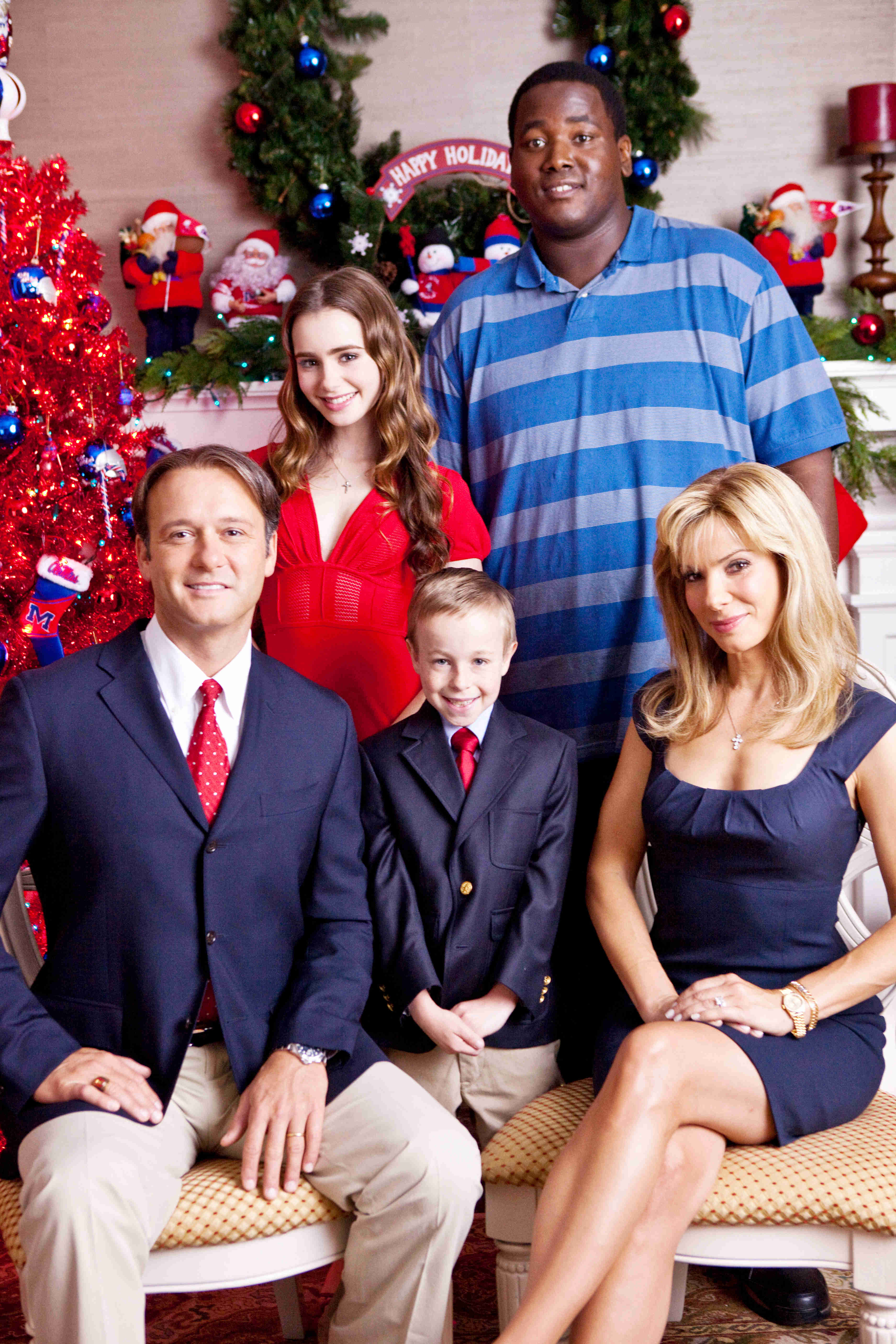
The true story of All-American Michael Oher is the very stuff of feel-good uplifting movies. Impoverished son of a crack-addict mother and disappearing father gets a break by being so damned good at sports that a religious prep school is willing to look past his abysmal GPA (0.6 in the movie, 0.4 in real life). While attending, the homeless kid is given a place to flop for the night by Leigh Anne and Sean Tuohey, and, basically, stays on, becomes family, and with their tutorship and support, gets his grades up enough to join sports, and the opportunities fall from the sky like linebackers.
The ads and the poster make it look icky, like Oher is the stray dog who just needs love from the do-gooder white folk, or worse, one of those "reverse Oreo" movies where the compelling stories of minority struggles are overshadowed by the white stars playing earnest observers.*
Fortunately, the movie is written and directed by John Lee Hancock, who made one of the best sports movies a few years back—"The Rookie"—and managed to salvage a bit of the abandoned "Alamo" project. As screenwriter of "Midnight in the Garden of Good and Evil," and "A Perfect World" (both for Clint Eastwood), he's shown himself to be a writer who embraced quirk, then moved on to write compelling characters rather than walking exploited stereotypes. You like his unsentimental people and root for them no matter their hurdles.
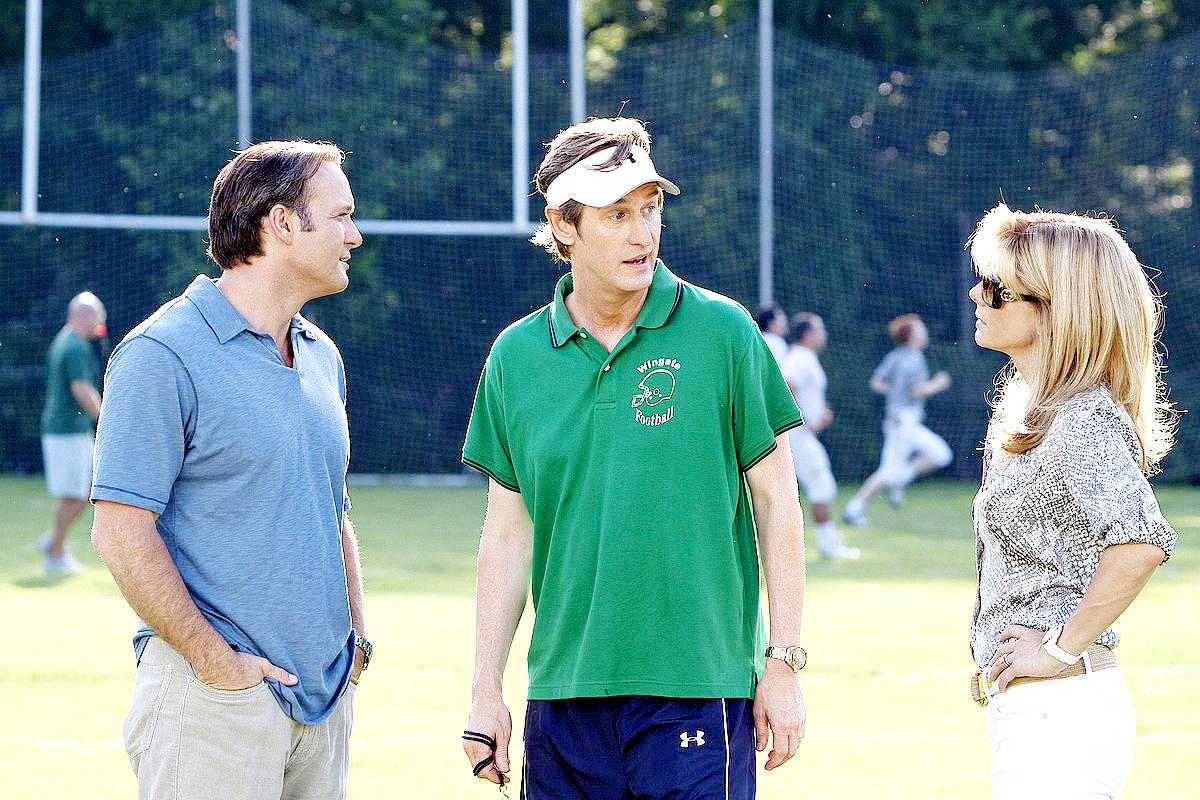
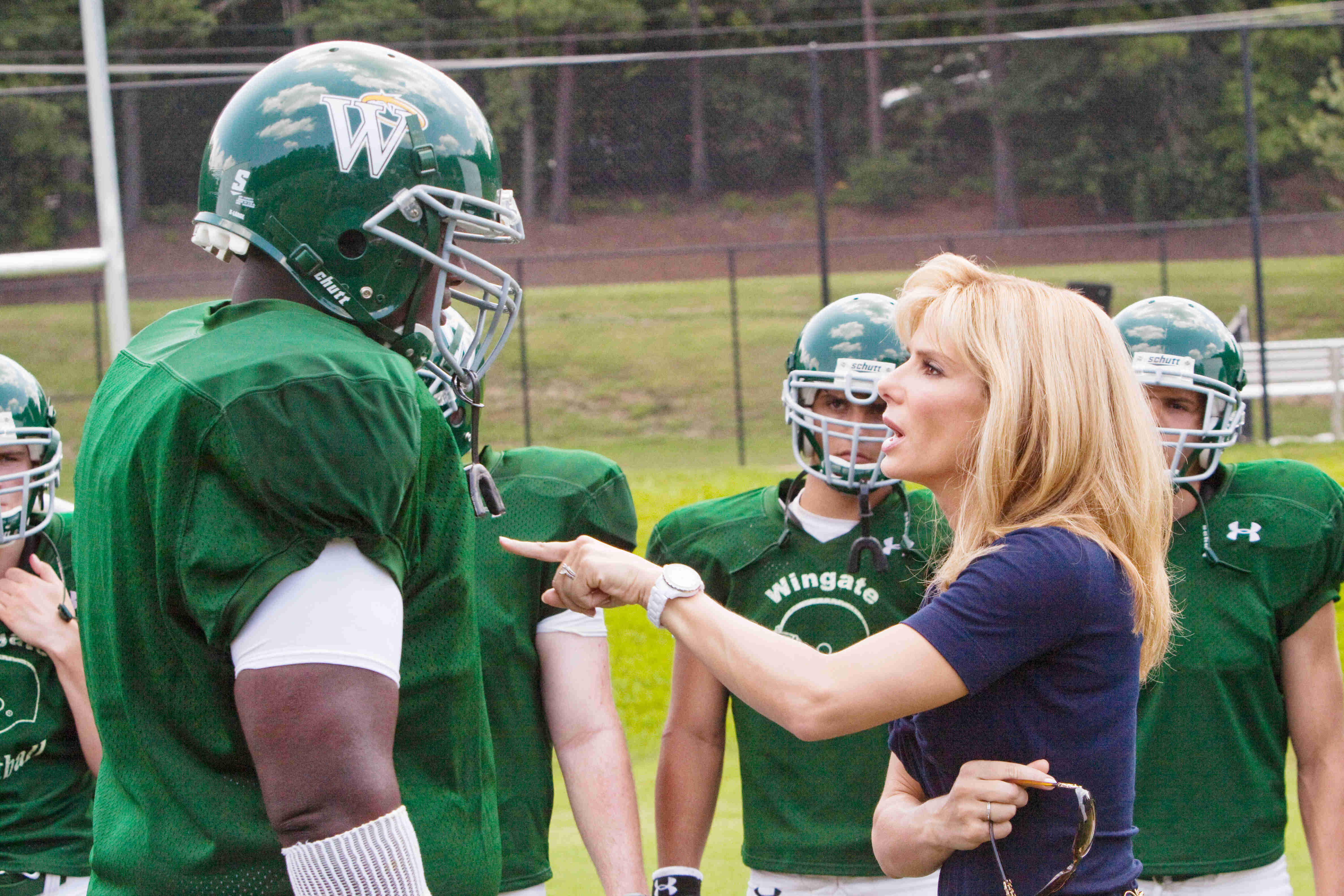
It comes in handy in "The Blind Side." Once Oher (Quinton Aaron) sleeps over one night, that's it, he's a part of the Tuohey family, no if's, and's and but's, and the matriarch, Leigh Anne (played by Sandra Bullock like a Kathy Lee Gifford with sass and a laser-eyes—she's what y'all call a "spit-fire"), walks the talk of her Christian upbringing in providing a practical resource for his needs. No argument is broached, no catty remark is left unchallenged, and schmaltz avoided at all costs. Bullock's Leigh Anne Tuohey is a Mama Tiger, the like not seen since Susan Sarandon's "Michaela Odone" in "Lorenzo's Oil," to the point where all Hancock has to do is keep her in frame when she walks up to her kid's coach from the background and one begins to feel genuine fear. A revelation of the extent of Oher's poverty elicits a polite "Excuse me," a walk down the hall to her room, shutting the door and an erect sitting posture to indicate that no amount of bad news is going to get to her or deter her. Bullock isn't afraid to make her character cold or a bitch. She just is, take it or leave it.
But it's Oher's story, his character has more screen-time than Bullock, though far less dialogue, and Hancock found a god-send in Aron, who has a face the camera loves. Since he has to carry a hefty amount of the drama silent, it serves him well, and is a nice fit with Bullock's all-talk, but reserved expression, counter-point.
At passing glance, it looks awful, but in its straight-forward, unpretentious and un-preachy style, "The Blind Side" wins over any cynicism.
"The Blind Side" is a Matinee.
* I'm sure you can name one—"Mississippi Burning," "Glory," "Amistad," "Come See the Paradise," "Snow Falling on Cedars" ... the list goes on, ad nauseum.
Friday, January 25, 2008
A Tale of Two Trumans
or:
The Back-Stabber, Back-to-Back
Infamous(Douglas McGrath, 2006) There've been competing underwater worker movies, meteor movies, volcano movies, Mars movies, Wyatt Earp movies (and we just barely avoided competing King Kong and Alexander the Great movies) but of all the subjects in all the world for Hollywood to glom onto in a feeding frenzy of competition, the unlikeliest is the story of Truman Capote's self-possessed tussle writing "In Cold Blood." The first released was "Capote" featuring Phillip Seymour Hoffman's Oscar-winning performance. The last out of the gate was "Infamous" with Toby
Jones' portrayal of the writer far more flamboyant and less "interior," even though the British Jones is more the stature and timbre of the real Capote. Even though Jones doesn't have that far to stretch, he does, and his Capote is such a flagrant little creep that you wonder why anyone in Kansas would trust him with any details of the Clutter Family murder, much less give him the unprecedented access that he recieved. There are just as many well-known actors in both movies, but "Infamous" feels like stunt-casting, with Sandra Bullock as "Nell" Lee, Sigourney Weaver as the socialite wife of William Paley, and an out-there Juliet Stevenson as Diana Vreeland. Daniel Craig is all wrong as Perry Smith in age, power and accent. Ultimately, both films leave the distinct impression that Capote (the person) is a selfish bastard willing to sacrifice anything (including himself) for fame and fortune, but "Capote" (the film) drives the point home more fiercely, and with just the appropriate amount of a sense of tragedy. "Infamous" merely wallows. Speaking of which...
Capote (Bennett Miller, 2005)
Phillip Seymour Hoffman is a big guy, with a big head and a massive frame, but dressed in too-big clothes and a girdling way of holding himself, he more than suggests Truman Capote's small stature with just a hint of his persuasive power ("Infamous" goes out of its way to show Capote swaying the Kansas-folk with his championship arm-wrestling--Hoffman never goes there, as that would ruin his "contained" illusion. Where "Infamous" is loud and obvious, "Capote" is quiet and persuasive, less sentimental and also less brutish. The same people shared in "Infamous" and "Capote" are quieter in the latter, Catherine Keener a quiet, decent, supporting Harper Lee, and Chris Cooper, concern etched into every line of his face, is a more dignified Sheriff
Dewey than Jeff Daniels' more brusque version. And there is less melodrama in "Capote," and a cold persuasiveness and cruelty in the way Capote insinuates himself into the lives of Dick Hickox and Perry Smith to get their story, then leaves them hanging (very literally!) while he dawdles writing, awash in an anticipation of the acclaim he is sure he will garner. At one point, Smith asks if "In Cold Blood" refers to their murder, or Capote's behavior. It's a fair question. One wonders ruefully how Capote (the little creep) could live with himself for the remainder of his life. One has little sympathy for the plight of Hickox and Smith (though Perry is played very effectively by Clifton Collins), but Capote's treatment of them, while simultaneously playing the victim himself, bordered on the monstrous. But that was evidently a role he relished (see picture).