Showing posts with label Toby Jones. Show all posts

Friday, January 13, 2012

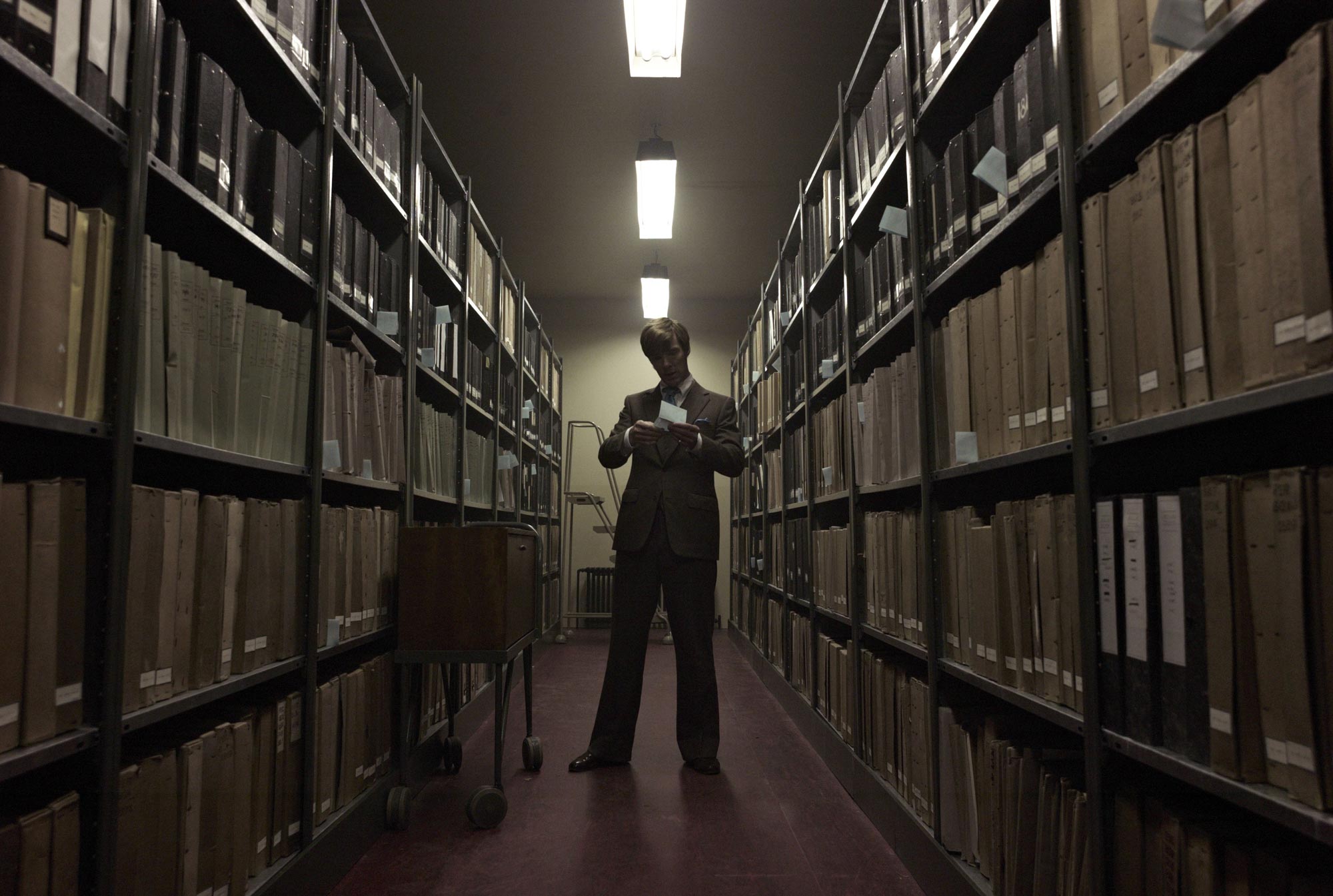
Tinker Tailor Soldier Spy

Spies Like Us
or
Eyes Wide Shut* (The Fine Art of Concealment)

I love spy movies.  Growing up in the 1960's, with the advent of the James Bond films—an amalgamation of Ian Fleming's novels and the films of Alfred Hitchcock (particularly North By Northwest)—and concurrent with the 60's embrace of the "anti-hero," my perceptions of movies were warped and laser-beamed with the image of duplicity, secrecy and emotional coolness.  Spies are not nice people—it doesn't matter what kind of cars they drive—they are both untrustworthy and trustworthy, they make moral judgements (sometimes snap decisions) of who is worthy of each.  Keepers of secrets, cataloguers and manipulators of weakness, spies use people as weapons, ignore collateral damage and sleep the sleep of the just knowing that the ends justify the means.  Fleming's secret agent was the last vestige of the romantic spy (despite the many imitations that ensued), a double-crossroads between the old and the new—a "gentleman-spy," chivalrous, but more than willing to plunder the spoils of war, and a thug...but with exquisite taste.

But the gold standard ("finger"-less division) for the times, which embraced the Cold War** were the novels of John le Carré (French for "The Square," which reflected the author's choice of creating novels around the moral rectitude of naive and sentimental men in an amoral world) who wrote about spies as functionaries and bureaucrats, rather than super-men with toys, and the epitome of those was "Tinker, Tailor, Soldier, Spy," the first novel in "The Karla Trilogy,*** which pitted two spymasters against each other in a fight to The Brandenburg Gate—the mysterious Russian, Karla, and George Smiley, an agent for British Intelligence (which le Carré dubbed "The Circus").  Smiley had appeared as a minor character in previous le Carré books, but with "Tinker..." he became the focal point, not only the best man in the service, but also its weakest link, intellectually smart as a whip, but emotionally dull as a stump.  In it, he is called upon to investigate his own former Intelligence agency, as there is suspicion that there is a "mole"—a double agent—very high up in the ranks.****  A thick book, filled with intricate detail and Dickensian characterizations with deep motivations, it was adapted (like the film, without commas in the title) in 1979 into a 7-part mini-series by the BBC and director John Irvin with Alec Guinness as Smiley, a version which was considered definitive.

When word that Peter Morgan had scripted a film version, it seemed inconceivable that such a compressed time-frame could do the novel justice.

And, incredibly, it does...even at times going the mini-series one or two better...by integrating sequences that le Carré never bothered with or thought of that throw in a lot of information in a very short space of time, the difference between a novelistic and cinematic experience: a Christmas party at the Circus, where knowing glances are exchanged between brother-spies and covert operations are, even there, in effect;***** the shooting of Jim Prideaux (Mark Strong, quite different from how we've seen him before in his villainous roles of late) on a secret mission from Control (John Hurt) to try to learn the identity of "the mole" in their ranks; a warning to Peter Guillam (Benedict Cumberbatch) to "get his house in order" that leads to a painful personal decision that reflects certain issues among the suspects; and an interrogation scene that adds tragic ramifications to the story of Ricki Tarr (Tom Hardy), but also illuminates the cruel humor of the Russian Karla.

And the "Cold War" scenario gets even chillier given Swedish director Tomas Alfredson's handling of the film.  The men investigating and being investigated (Ciarán Hinds, Colin Firth, Toby Jones, and David Dencik) are already cold fish, but with the script and Alfredson's direction, they're almost completely cyphers, the only glimpses of a personal life are revelatory of each man's weaknesses.  Also, Alfredson's framing schemes involve as much mis-direction as direction, shooting above, over, around and through as many obstacles and distractions, frames and panes of glass, a maze of obfuscations that confuse the path to true seeing, putting us in the same position as the story's primary Truth-Seeker, George Smiley (Gary Oldman).

Early on, Smiley visits an oculist to get a new pair of huge owl-like glasses to see more clearly before embarking on his secret mission for the government.  Those glasses also provide another barrier to his eyes, the window to his soul.  Oldman's performance is brilliant, deceptively simple—but that's not the point.  One is struck, perpetually, throughout the film, of how much Oldman conveys with the simplest—and smallest—of movements.  It is to the actor's credit (and Alfredson's) that so much of the actor's performance is seen from behind, his face unseen, but it matters not; George Smiley is not given to overt actions, but covert ones, minor moves of chess-pieces that mark the battles in intellectual wars.  His brevity and economy in everything—that weighs so heavily on his personal life and makes him vulnerable, comes to the fore here, making this odd performance a perfect encapsulation of the role and is a further refinement and definition of the character of le Carré's greatest creation—George Smiley—betraying nothing, always betrayed.

Tinker Tailor Soldier Spy is a Full-Price Ticket.


* The origin of the phrase "Eyes Wide Shut," the title of Stanley Kubrick's last film, originates as a colorful turn of phrase in le Carré's original novel "Tinker Tailor Soldier Spy" (Kubrick and David Cornwell— le Carré's real name—were good friends, although Kubrick never enticed him to work on a script with him). It's the scene where Connie Sachs is explaining what happened to the Russian double-agent Polyakov and how he was seduced by a "honey trap" (le Carré spy-code for a female counter-agent) and how Polyakov, against his better judgement, walked in with "his eyes wide shut."  That turn of phrase is not in the movie, probably BECAUSE of the association with the Kubrick film.

** When detente eased the tensions between the West and East, le Carré presciently set his rifle-sights on the next enemies of the state—capitalists and industrialists who pledged allegiance to the almighty dollar rather than to any flag or deity.  Supposedly, trade partners don't war against each other (hence, the genesis of the EU and NAFTA), but has the damage those entities wrought on the world economy really been beneficial?  Is anyone winning, when we all go down together?

*** The others in the series are "The Honourable Schoolboy" and "Smiley's People."

**** This parallels the true life upheaval MI-6 went through in the 1950's, with the Cambridge Five scandal.

***** One inspired touch is The Circus Crowd singing along with an old song that I only thought I remembered—the title tune from a long-forgotten Bond knock-off (sung by Sammy Davis, Jr.) called The Second Best Secret Agent in the Whole Wide World, which nicely plays in with British Intelligence's subordinate view of themselves as "also-ran's" to their American "Cousins" in the CIA.

Thursday, April 21, 2011

Your Highness

"Du-uh..."
or
"Natalie Portman's Post-Oscar Slump, Part 1"

I've needed a laugh lately.  I've been second-and third-guessing myself, not sure which way to go on all sorts of matters.  And after seeing two movies, good and bad, in which anyone can be tread upon by the Government (The Conspirator and this Saturday's "Take Out the Trash" entry), I needed something light, something frothy, something not Hanna or The Lincoln Lawyer.

I needed a comedy, dammit!  After playing pin-ball in my head for a week and a half, I wanted a new thought to tilt me out of my doldrums. It would be appropriate, too, as every scene we've looked at Sundays of this April Fools Month has been a comedy (this week will be no exception), so a comedy might be just the thing to kick my torpor in the ass, or at least make it slip on a banana peel.

Wish I'd found one, because this isn't it.

Your Highness, in fact, makes me wish I was living in a different era—not the one depicted in the film, of course, but also not in a time when such a movie, with big stars (every Briton who isn't in the "Harry Potter" series, like Charles Dance and Damian Lewis), sumptuous locales and elaborate costuming can be so sloppily put-together that one gets the impression that at every stage the film-makers said "Eh...good enough" and moved on.  I noticed myself laughing exactly twice, and longing for something—anything—to be half-way clever or even half-way executed.*  I like my comedy to have a brain in its head, and something to say besides what could shock your grandmother.  Despite the cast, this one has so little going for it, you start to worry that at least the cast were well compensated.  Because it couldn't have been for love.

I'm a fan of James Franco, Natalie Portman and Zooey Deschanel, but why they should play second-fiddle to Danny McBride (who's usually lousy...Land of the Lost...and who barely registered as the reluctant groom in Up in the Air) is beyond me  Sure, Franco probably owes director David Gordon Green for his role in Pineapple Express (which I haven't seen, but have heard good things about), but he seems a bit lost in this, although gamely appearing cluelessly cheery throughout.  

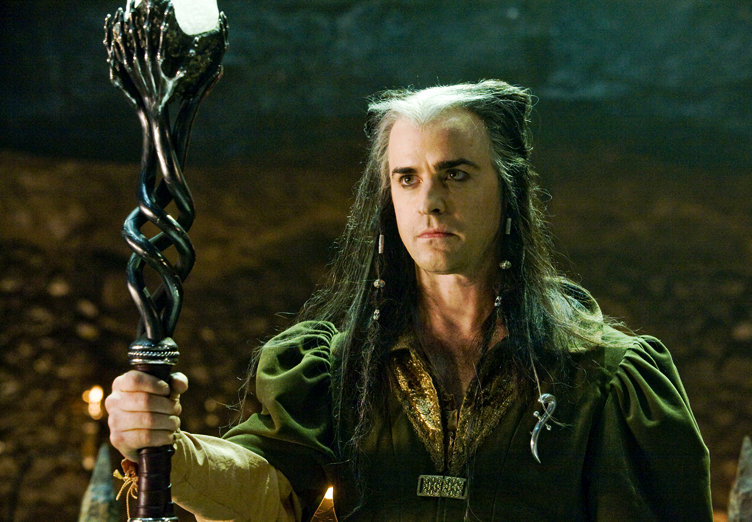
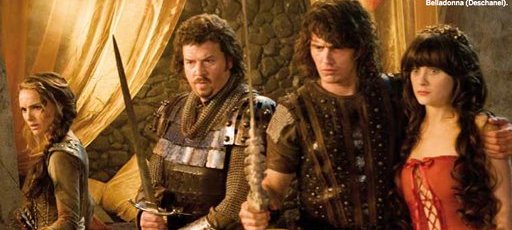
Borrowing heavily from every fantasy-adventure movie from the last 20 years (and liberally from Star Wars—their take on Yoda is particularly nasty, and they have a clockwork bird-familiar after the original Clash of the Titans), Highness tells the story of the sons of King Tallious (Dance) and his two sons—the heir to the throne, Fabious (Franco), and the ne'er-do-well younger Thadeous (McBride) who would appear to be "Your Lowness."  Fabious' bride Belladonna (Deschanel) is kidnapped by the evil sorcerer Leezar (Justin Theroux, who co-wrote Tropic Thunder, another high-concept low-result comedy) for his own nefarious plans.  Fabious recruits Thadeous to go on the search for Lezar, despite the fact that the younger Prince can't fight, doesn't travel well, and is in all things incompetent.  Plus, he's the "troop griper/whiner."  Good planning.  Dick jokes ensue.

Between the puerile humor there are some action sequences, but Green has a hard time deciding whether he's playing them for laughs or for jolts.  Not that it matters, as they succeed in neither, not even in the way that competent directors can achieve both or even one.  And, although things are accomplished, nobody really learns anything so character arcs are as flat as a crushed pixie (the only clever idea I saw in the whole thing).

But, one thing Your Highness did accomplish: I had no second thoughts about it.

Maybe Hanna would have had more laughs.

Your Highness is a Waste of Everybody's Time.

* A complete execution...of me...was what I wanted after seeing this movie!  One thing that is mentioned in all the write-ups I've seen is that the crew went into production with  only a story and everything was adlibbed on-set.  Really, they shouldn't be boasting about that.

Friday, June 26, 2009

The Mist

"The Mist" (Frank Darabont, 2008) A horror pastiche bubbled up from many long-crusted cauldrons, "The Mist" wouldn't cross anyone's radar as a "must-see." But considering it's writer-director Frank Darabont ("The Shawshank Redemption," "The Green Mile") revisiting Stephen King territory (usually Maine) with top-tier actors like Andre Braugher, Marcia Gay Harden, and Toby Jones, it's worth a look*

A night's damaging electrical storm produces a dawn mist that begins to seep down from the mountains. A trip into town for provisions traps a motley crew of citizens inside "The Food House" keeping the enveloping mist outside. Conspicuous consumption proceeds inside when a man bleeding from his head runs in screaming that "the mist" killed his companion, confirming that consumption is going on outside, as well. It becomes apparent that the lives of the people in the store amounts to a can of beans (
in Aisle 5), with roughly the same position on the food chain.

At that point,
to pass the time everyone starts playing "The Blame Game" falling in line between the scientific, the religious and the superstitious. But, whatever "it" is, "it's a problem of some magnitude"—several magnitudes, in fact, what with giant killer locusts (for the religious), flesh-eating pterodactyls (for the scientific) and big hairy spiders shooting acid webs (for the superstitious). Not to mention the towering Lovecraftian dromedaries (for the English majors). They all have nasty invasive ways to kill you and the rest of the movie boils down to whatever bone-headed motivation it takes to get people outside for the near-occasions of carnage that break out every fifteen minutes. Go down the checklist—hubris, zealotry, rationalization, drunkenness, or even "doing it for the kids." Then there are the defense measures that feel more like offense for the other side; how smart is it to douse a flying creature with gasoline in an enclosed space...lit by torches?

Darabont shoots things in a faux cinema-verite style, light on the hand-held, and does some quick cutting (but not too quick) to hop up the urgency (and discourages thinking too much—the store doesn't have a radio? Not even for muzak?). And tries to justify it all with a minute discussion of how folks are rational "as long as the machines are working and they can call 9-1-1." (Points for working sociology and political science into one sentence").

The execution is tried and true, but then there are a lot of sources to draw from: 50's atomic monster movies, "
The Fog," "The Thing," "Night of the Living Dead," as well as waves to "28 Days," "Planet of the Apes," "The Birds," "Alien," "Stargate," and King's own "Maximum Overdrive," which is about folks trapped in a diner while outside is a raging...18 wheeler. The ending has drawn a lot of criticism in some parts from some who though it was a "mist" opportunity, but it's a satisfying/disatisfying ending that also has cinematic precedence, whether you like it or not.

The lesson, once the smoke clears, seems to be: "Don't be so myopic, ye of little faith."

Either that, or always take more bullets.

* Starring is Thomas Jane, late of "The Punisher" films, and he proves to be a credible, believable leading man of the Harrison Ford School.

Tuesday, November 4, 2008

W.

"Somethin' 'Bout Bein' in the Barrel"

The Writer's Prejudice Up Front : I've never liked George W. Bush. He's the type of guy I'd like to sit down and have a beer with...thrown in his face. I've always considered him woefully unprepared to be President: a rich man's son who aspired downward; a dilletante who'd never had a successful business that his Dad's cronies didn't bail out; an oil-man, who excelled at digging dry holes; the most bald of hypocrites, pious when the microphone's on, but profane when they're off; who believed in sacrifice as long it was somebody else; possessed of the ethics of a snake-oil salesman, he'd made so many promises and held so many I.O.U.'s that putting him in charge of the Treasury was like putting Dracula in charge of the Blood Bank. Or as Maureen Dowd once famously wrote: "He's the guy who would rent a hotel room, and then ask you to the prom." One by one, Bush and his co-conspirators undermined every aspect of American life to the point where his own Administration, which contained so many of them, should be considered its own National Disaster. There isn't penance enough in this world to make up for the harm that this vain-glorious underachiever did. And once he leaves office, he'll go back to the only job he's had success at: Influence-peddling. Writing about him in the past tense is the only pleasure one can take in writing about him.

He is the Shame of our Nation.

Having said that, "So, Mrs. Lincoln...how'd you like the play?"

Oliver Stone is no one's idea of an objective film-maker, if there is such a thing. Once a screenwriter puts pen to paper, they've already started manipulating the movie to their point-of-view, whether it's from the left, right, center or upside-down (Why do you think they're called "directors?"). So, no one should be surprised that Stone has an axe to grind, with "W.".

Stone is a director of heart, but he frequently by-passes his brain when making his points. So, "
Platoon," still his best film, hi-jacks the gritty depiction of grunt jungle-fighting with Stone's own conflicted "Daddy" issues, his "Pvt. Chris Taylor" having to choose between two superiors with different moral ways of engaging the enemy. Lincoln and every fantasist depicting moral choice has put angels and devils on our shoulders. Stone burdens us with His Old Man. That same scenario was transferred to High Finance, with his very next film "Wall Street." I haven't seen every film of Stone's, but most of them are concerned, in some capacity, with paternal conflicts. And because he's a better propagandist than scenarist, most Stone films stop dead whenever we get to each Stone "thesis," invariably a Message being presented by a single character who has center-stage and our undivided attention. "JFK," a dazzling technical exercise of photography and editing, comes positively unglued in its presentation of conflicting conspiracy scenarios for Pres. Kennedy's assassination (Kennedy being another Stone father figure--"Our murdered King," as he's described in the screenplay--completely by-passing any thought that we might, you know, be living in a democracy with a representative government), until Kevin Costner's prosecutor Jim Garrison places in his summation a theory on military-industrial conspiracy behind the Vietnam War--a Stone obsession.* (In "W." Dick Cheney--Richard Dreyfuss clearly enjoys being given the opportunity to play him--stops an Iraq War strategy session to pontificate on securing Middle East interests for oil exploitation for a hundred years). Give the man points for passion, but his movies become such a glut of emotion that the point becomes lost in the gnashing of teeth and the wringing of hands. His bio-pic of "Nixon" was such a slap-dash affair, it seemed like a badly-cast TV-movie gloss-over, skipping from high-light to low-light in time to shoe-horn the next commercial (A weirdly fictional conversation between Chairman Mao and Nixon was Stone's show-stopper there). By the end, with its End-Credits playing over a Mormon Tabernacle Choir-rendition of "Shenandoah," one almost felt some sympathy for the man. Nixon, not Stone.

"
W." (his too-early summation of the second Bush Administration) suffers the same problems. It's a gloss of recent events, interspersed with flash-backs to the wastrel days of the young George W. Bush,** drunk with entitlement and just about anything else he could find. Particular heed is paid to his relationship with "Pappy" George H.W. Bush (James Cromwell, though he seems nothing like Bush the Elder, displays quiet bluster and submerged weakness), in which the good-for-nothing son is particularly eaten up, not by his own failures, but by his father's view of them.

The best part of the film--oddly for Stone--is Bush's conversion to The Faith. Struggling with his alcoholism, determined to become a Public Figure (as private industry success constantly eludes him), he is converted by Pastor Earl Hudd (
Stacy Keach, playing it straight, and doing some of the best work of his long career), introducing Bush to the second "Daddy," the Divine One, slotting this film into the standard Stone scenario. One knew, as soon as Bob Woodward revealed that Bush, prior to the invasion of Iraq, didn't consult his father/former President, but, instead, relied on the advice of a "Higher Father to appeal to," that Stone would obsess on it and exploit it. The film-maker takes the one relationship as far as it will go, creating a fantasy sequence where Bush 41 challenges Bush 43 to fisticuffs, but Stone doesn't have "the stones" to have W. duking it out with his Savior, J.C.


That battle's still to come.

Stone starts "W." with a Sergio Leone close-up of Bush's steely gaze, what impressionist Frank Caliendo says "like he's always got the sun in his eyes." It's another fantasy sequence, where W. acknowledges the cheers of an empty baseball stadium from center-field--what he'll later reveal as "his favorite place on Earth." The movie will end back on those eyes, searching, confused, disoriented--having lost a pop-fly "in the lights." Those distorted lights show up twice more in the movie--in that previously mentioned conversion scene, as well as when a hung-over Bush collapses while jogging. That's it? That's what we get? A half-assed light show? Is Stone saying he's abandoned by God, or that Bush is overwhelmed by his circumstances? The metaphor's too half-baked to communicate as solid concept clearly.

One could look at W.'s story in Shakespearean terms, as a modern day Prince Hal, whoring and wenching in his oats-sewing days to become the Monarch his father couldn't be. The difference is Hal had Falstaff as guide to the back-alleys of Agincourt. George W. Bush is his own King. And his own Fool.

But Oliver Stone is too busy making room for his "Daddy" theories to create a proper condemnation. As with "Nixon," you start to actually sympathize with the man. Any illumination into the man or the effect of his Administration is lost in the lights. To Stone, he is just another Yalie "poor little lamb who has lost his way."

Bah. Bah...and Bah.

"W." is a weak-kneed, squinty-eyed moron of a cable-watcher.


* Any judge would have gaveled the irrelevancy, but Stone's judge was played by the real-life Garrison.

**Josh Brolin does fine work, but the performance feels a bit "one-note," having to nail the too-familiar Bush mannerisms and vocal tendencies.

Friday, January 25, 2008

A Tale of Two Trumans

A Tale of Two Trumans
or:
The Back-Stabber, Back-to-Back

Infamous(Douglas McGrath, 2006) There've been competing underwater worker movies, meteor movies, volcano movies, Mars movies, Wyatt Earp movies (and we just barely avoided competing King Kong and Alexander the Great movies) but of all the subjects in all the world for Hollywood to glom onto in a feeding frenzy of competition, the unlikeliest is the story of Truman Capote's self-possessed tussle writing "In Cold Blood." The first released was "Capote" featuring Phillip Seymour Hoffman's Oscar-winning performance. The last out of the gate was "Infamous" with Toby Jones' portrayal of the writer far more flamboyant and less "interior," even though the British Jones is more the stature and timbre of the real Capote. Even though Jones doesn't have that far to stretch, he does, and his Capote is such a flagrant little creep that you wonder why anyone in Kansas would trust him with any details of the Clutter Family murder, much less give him the unprecedented access that he recieved. There are just as many well-known actors in both movies, but "Infamous" feels like stunt-casting, with Sandra Bullock as "Nell" Lee, Sigourney Weaver as the socialite wife of William Paley, and an out-there Juliet Stevenson as Diana Vreeland. Daniel Craig is all wrong as Perry Smith in age, power and accent. Ultimately, both films leave the distinct impression that Capote (the person) is a selfish bastard willing to sacrifice anything (including himself) for fame and fortune, but "Capote" (the film) drives the point home more fiercely, and with just the appropriate amount of a sense of tragedy. "Infamous" merely wallows. 

Speaking of which...

Capote (Bennett Miller, 2005) Phillip Seymour Hoffman is a big guy, with a big head and a massive frame, but dressed in too-big clothes and a girdling way of holding himself, he more than suggests Truman Capote's small stature with just a hint of his persuasive power ("Infamous" goes out of its way to show Capote swaying the Kansas-folk with his championship arm-wrestling--Hoffman never goes there, as that would ruin his "contained" illusion. Where "Infamous" is loud and obvious, "Capote" is quiet and persuasive, less sentimental and also less brutish. The same people shared in "Infamous" and "Capote" are quieter in the latter, Catherine Keener a quiet, decent, supporting Harper Lee, and Chris Cooper, concern etched into every line of his face, is a more dignified Sheriff Dewey than Jeff Daniels' more brusque version. And there is less melodrama in "Capote," and a cold persuasiveness and cruelty in the way Capote insinuates himself into the lives of Dick Hickox and Perry Smith to get their story, then leaves them hanging (very literally!) while he dawdles writing, awash in an anticipation of the acclaim he is sure he will garner. At one point, Smith asks if "In Cold Blood" refers to their murder, or Capote's behavior. It's a fair question. One wonders ruefully how Capote (the little creep) could live with himself for the remainder of his life. One has little sympathy for the plight of Hickox and Smith (though Perry is played very effectively by Clifton Collins), but Capote's treatment of them, while simultaneously playing the victim himself, bordered on the monstrous. But that was evidently a role he relished (see picture).