Showing posts with label Mark Strong. Show all posts

Wednesday, January 9, 2013

Zero Dark Thirty

"You Know That Thing We Talked About"
or
How Are Things in Tora Bora?

Writer Mark Boal and director Katheryn Bigelow have made the two most important dramatic films about The War on Terror: the 2009 Best Picture Oscar Winner The Hurt Locker and now, Zero Dark Thirty, which covers the behind the scenes investigations to track down Usama bin Laden and the subsequent Operation Neptune Spear in Abottabad, Pakistan.

The film originally started as a feature about the carpet bombing of Tora Bora, and the field work leading to the decision and was scheduled to begin filming when the raid occurred.  Immediately, the other film was shelved, and Boal began writing this, incorporating his research from the previous work which dovetailed with the earlier effort.  It's a fascinating, troubling story of human beings waging war on an intimate level, trying to secure threads of information on a specific target, while also trying to keep track of new terror acts that might occur any time, any where.


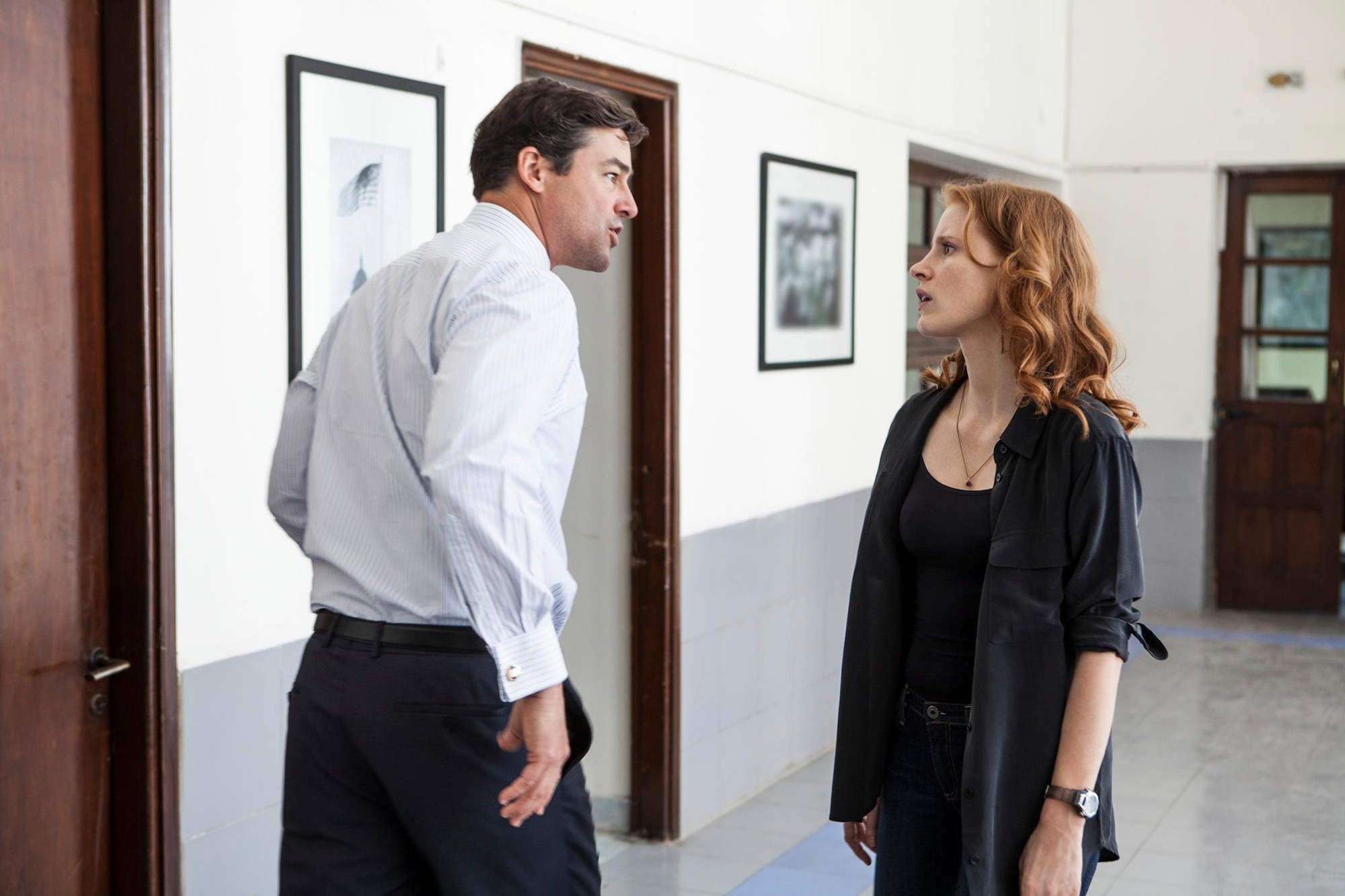
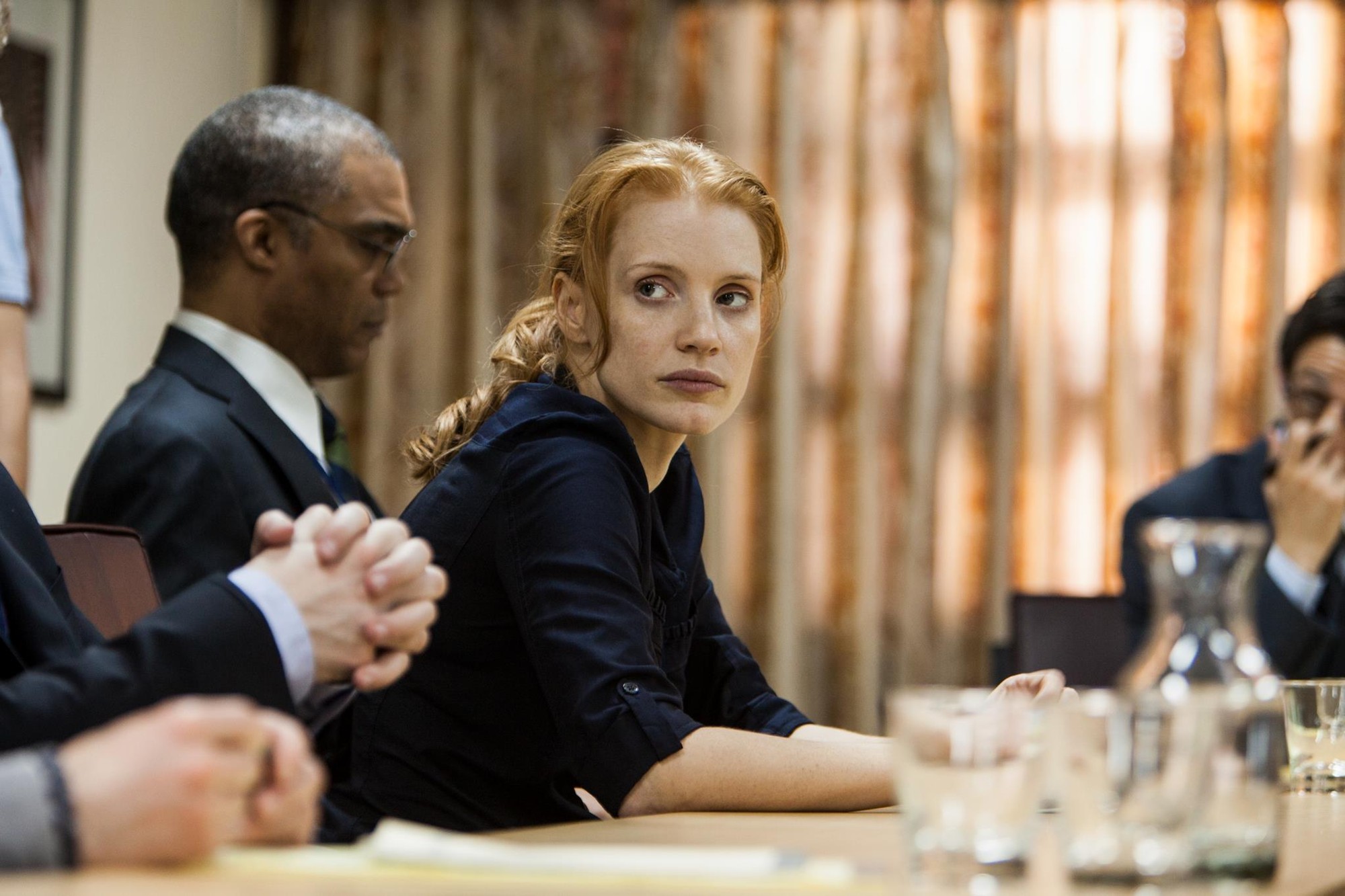
It focuses on one woman, a CIA analyst named Maya (played by Jessica Chastain)—her IM handle is "Maya173", but "Mark Owen," the nom de plume of one of the Navy Seals participating in the raid, refers to her in his book "No Easy Day," as "Jen." Maya is book-smart, street-savvy, but must learn "the ropes," literally, of interrogation by any means necessary.  She is trained in the way of torture by Dan (Jason Clarke), who has been at this for awhile and has it down to a science—the speech "If you lie to me, I will hurt you," the loss of control, the humiliation, the physical and mental stresses, the releases from which information may come.  Dan offers to keep Maya out of it, but she demurs.  She will participate.  She will actively sweat information out of the "detainees" in the euphemisms for prisons like "CIA Black Sites."  "You are not being fulsome in your replies" she yells as she slams her hand in the interrogation table.  And when she's not participating, she's poring over other interrogations, reams of intelligence, and being a general pain in the rear to her superiors and colleagues.  For station chief Joseph Bradley (Kyle Chandler), the job is to walk the razor's edge of politics and prevent more terrorism—he doesn't even care about bin Laden anymore, as there are too many attacks he's trying to prevent—every attempt that gets by is a failure.


But, for Maya, bin Laden is an obsession, her white Muslim whale, and it takes a zealot to find another zealot.  She'll veer off into other investigations, particularly when some of her own are killed in an attack, but time only intensifies her resolve, almost becoming a mania, and her patient investigation is off-set by a gloves-off approach to her superiors (when asked her role in the briefing by Leon Panetta, played by James Gandolfini, she replies "I'm the m#####-f##### who found this place, sir"), almost as if her persistent pressure torture techniques are being applied up the chain.The Obama White House dithers over action until absolute proof is obtained that bin Laden is held up at the Abottabad compound, but Maya is resolute.  When more cautionary analysts give the odds at 60%, she defiantly ups the odds to 100%—"Okay, 95%, because I know certainty freaks you guys out."  But, it's that certainty that fuels Seal Team 6 in their mission—in the videos below, she's specifically mentioned and lauded in Mark Owen's account.

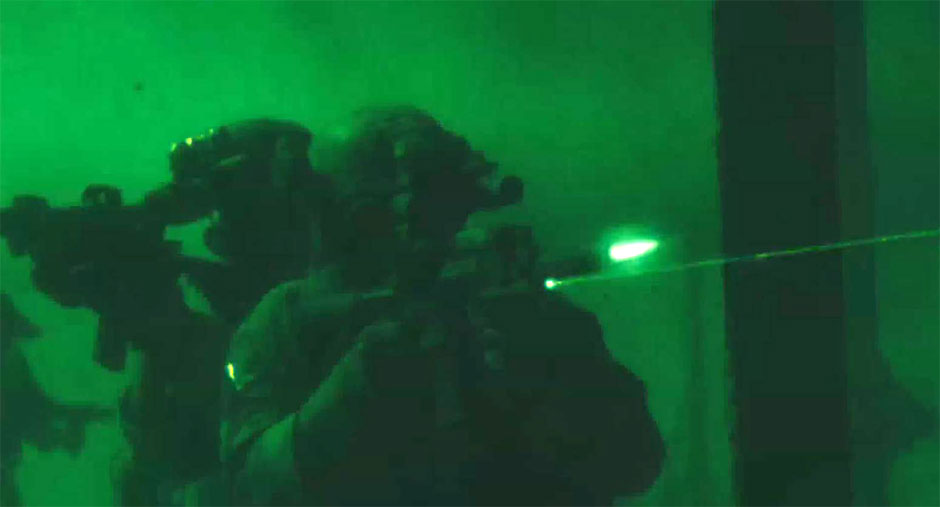
It is a fascinating movie, but a draining one, starting with torture scenes and ending with a recreation of the raid as it went down, shot mostly in tense disorienting night-vision.  The character of Maya, or "Jen" or whoever she is, is a fascinating one, a portrait of obsession and the toll it bears—she's repeatedly told that she looks "terrible" throughout the movie—and when she lashes out at her superiors for their lassitude, or just plain pusillanimaty, there is a definite sense of someone unhinged—controlled, but pushed to the breaking point.  A fury waiting to unleash, she is our version of a Holy Terror, a match for her enemies, and one can't help but wish her peace...suspecting that it will never happen.

Zero Dark Thirty is a Matinee.


The FBI's notice of bin Laden's death and the Situation Room during the raid.
Bear in mind, one helicopter went down during the raid.


* There are torture scenes, but they're not commented on, and any politicizing of it is so much hot-air—one can see in the film any position they want.  It walks a very fine line, merely presenting, and if someone tries to see their point of view in it, they're merely counter-projecting.  

Friday, January 13, 2012

Tinker Tailor Soldier Spy

Spies Like Us
or
Eyes Wide Shut* (The Fine Art of Concealment)

I love spy movies.  Growing up in the 1960's, with the advent of the James Bond films—an amalgamation of Ian Fleming's novels and the films of Alfred Hitchcock (particularly North By Northwest)—and concurrent with the 60's embrace of the "anti-hero," my perceptions of movies were warped and laser-beamed with the image of duplicity, secrecy and emotional coolness.  Spies are not nice people—it doesn't matter what kind of cars they drive—they are both untrustworthy and trustworthy, they make moral judgements (sometimes snap decisions) of who is worthy of each.  Keepers of secrets, cataloguers and manipulators of weakness, spies use people as weapons, ignore collateral damage and sleep the sleep of the just knowing that the ends justify the means.  Fleming's secret agent was the last vestige of the romantic spy (despite the many imitations that ensued), a double-crossroads between the old and the new—a "gentleman-spy," chivalrous, but more than willing to plunder the spoils of war, and a thug...but with exquisite taste.

But the gold standard ("finger"-less division) for the times, which embraced the Cold War** were the novels of John le Carré (French for "The Square," which reflected the author's choice of creating novels around the moral rectitude of naive and sentimental men in an amoral world) who wrote about spies as functionaries and bureaucrats, rather than super-men with toys, and the epitome of those was "Tinker, Tailor, Soldier, Spy," the first novel in "The Karla Trilogy,*** which pitted two spymasters against each other in a fight to The Brandenburg Gate—the mysterious Russian, Karla, and George Smiley, an agent for British Intelligence (which le Carré dubbed "The Circus").  Smiley had appeared as a minor character in previous le Carré books, but with "Tinker..." he became the focal point, not only the best man in the service, but also its weakest link, intellectually smart as a whip, but emotionally dull as a stump.  In it, he is called upon to investigate his own former Intelligence agency, as there is suspicion that there is a "mole"—a double agent—very high up in the ranks.****  A thick book, filled with intricate detail and Dickensian characterizations with deep motivations, it was adapted (like the film, without commas in the title) in 1979 into a 7-part mini-series by the BBC and director John Irvin with Alec Guinness as Smiley, a version which was considered definitive.

When word that Peter Morgan had scripted a film version, it seemed inconceivable that such a compressed time-frame could do the novel justice.

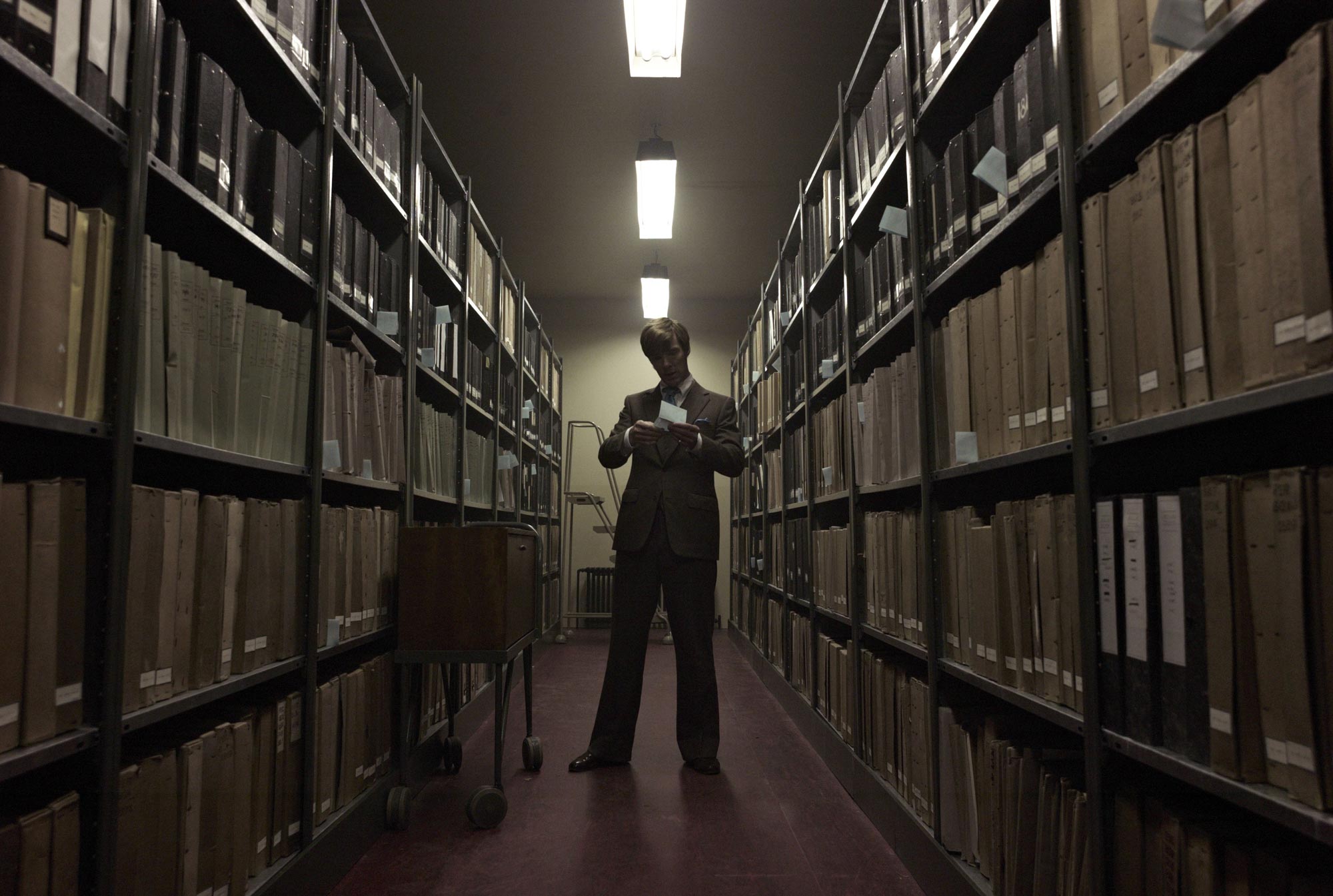
And, incredibly, it does...even at times going the mini-series one or two better...by integrating sequences that le Carré never bothered with or thought of that throw in a lot of information in a very short space of time, the difference between a novelistic and cinematic experience: a Christmas party at the Circus, where knowing glances are exchanged between brother-spies and covert operations are, even there, in effect;***** the shooting of Jim Prideaux (Mark Strong, quite different from how we've seen him before in his villainous roles of late) on a secret mission from Control (John Hurt) to try to learn the identity of "the mole" in their ranks; a warning to Peter Guillam (Benedict Cumberbatch) to "get his house in order" that leads to a painful personal decision that reflects certain issues among the suspects; and an interrogation scene that adds tragic ramifications to the story of Ricki Tarr (Tom Hardy), but also illuminates the cruel humor of the Russian Karla.

And the "Cold War" scenario gets even chillier given Swedish director Tomas Alfredson's handling of the film.  The men investigating and being investigated (Ciarán Hinds, Colin Firth, Toby Jones, and David Dencik) are already cold fish, but with the script and Alfredson's direction, they're almost completely cyphers, the only glimpses of a personal life are revelatory of each man's weaknesses.  Also, Alfredson's framing schemes involve as much mis-direction as direction, shooting above, over, around and through as many obstacles and distractions, frames and panes of glass, a maze of obfuscations that confuse the path to true seeing, putting us in the same position as the story's primary Truth-Seeker, George Smiley (Gary Oldman).

Early on, Smiley visits an oculist to get a new pair of huge owl-like glasses to see more clearly before embarking on his secret mission for the government.  Those glasses also provide another barrier to his eyes, the window to his soul.  Oldman's performance is brilliant, deceptively simple—but that's not the point.  One is struck, perpetually, throughout the film, of how much Oldman conveys with the simplest—and smallest—of movements.  It is to the actor's credit (and Alfredson's) that so much of the actor's performance is seen from behind, his face unseen, but it matters not; George Smiley is not given to overt actions, but covert ones, minor moves of chess-pieces that mark the battles in intellectual wars.  His brevity and economy in everything—that weighs so heavily on his personal life and makes him vulnerable, comes to the fore here, making this odd performance a perfect encapsulation of the role and is a further refinement and definition of the character of le Carré's greatest creation—George Smiley—betraying nothing, always betrayed.

Tinker Tailor Soldier Spy is a Full-Price Ticket.


* The origin of the phrase "Eyes Wide Shut," the title of Stanley Kubrick's last film, originates as a colorful turn of phrase in le Carré's original novel "Tinker Tailor Soldier Spy" (Kubrick and David Cornwell— le Carré's real name—were good friends, although Kubrick never enticed him to work on a script with him). It's the scene where Connie Sachs is explaining what happened to the Russian double-agent Polyakov and how he was seduced by a "honey trap" (le Carré spy-code for a female counter-agent) and how Polyakov, against his better judgement, walked in with "his eyes wide shut."  That turn of phrase is not in the movie, probably BECAUSE of the association with the Kubrick film.

** When detente eased the tensions between the West and East, le Carré presciently set his rifle-sights on the next enemies of the state—capitalists and industrialists who pledged allegiance to the almighty dollar rather than to any flag or deity.  Supposedly, trade partners don't war against each other (hence, the genesis of the EU and NAFTA), but has the damage those entities wrought on the world economy really been beneficial?  Is anyone winning, when we all go down together?

*** The others in the series are "The Honourable Schoolboy" and "Smiley's People."

**** This parallels the true life upheaval MI-6 went through in the 1950's, with the Cambridge Five scandal.

***** One inspired touch is The Circus Crowd singing along with an old song that I only thought I remembered—the title tune from a long-forgotten Bond knock-off (sung by Sammy Davis, Jr.) called The Second Best Secret Agent in the Whole Wide World, which nicely plays in with British Intelligence's subordinate view of themselves as "also-ran's" to their American "Cousins" in the CIA.

Saturday, June 18, 2011

Green Lantern

"In Dullest Day, the Weakest Light..."
or
"Oa, the Humanity!"

When the silver-age of comics began in the late 1950's, the '40's age of super-heroes were being replaced with westerns, horror and science-fiction tales.  So, those earlier mystery-men were re-incarnated with sciency origins that no longer depended on mystic powers and a sense of right-and-wrong.  Befitting the times, the original Green Lantern was a railroad engineer, who happened upon a mystic rune that gave him extraordinary powers.  The modern GL was a test-pilot, bequeathed a magic ring by a dying alien who'd crash-landed his spacecraft while on patrol.  As the story progressed, the pilot Hal Jordan, found he had been made a part of an intergalactic police corps (based in no small part on E.E. Smith's "Lensmen" series and its "Galactic Patrol") led by a clutch of identical blue-skinned big-headed "Guardians of the Universe," who supervised the Corps on a planet in the middle of the Universe, Oa, where was built the Corps central battery from where all green power originated.  There are a lot of Green Lanterns, patrolling every corner of the Galaxy.  And they had two weaknesses: you had to recharge the ring or it would run out of juice after 24 hours, and it didn't work on anything yellow.

That's a lot of back-story.  Probably too much for one movie, and it pushes the credibility envelope that science-fiction movies can push before leaving general audiences in an anti-matter cloud of skepticism, if not downright derision.*  And the movie version of Green Lantern, written by a bullpen of the comics' writers crams enough emerald exposition to make any viewer green around the gills.  I know there are a lot of fan-boys out there who will probably cry crocodile tears if their favorite Lantern isn't in the movie (where's Ch'p?  And G'nort?), but it's only a two hour flick—you can't put the whole Universe (and Mogo) in it, though this one tries (Me, I just wanted to see that staple of Hal Jordan tricks—he can create anything he wants, and the thing he uses the most is a boxing-glove—I was not disappointed).


It took the rest of the movie to do that.  TMI is the least of this movie's problems.  As much as it pains me to say it, Green Lantern just isn't very good.  Casting is fine: Ryan Reynolds makes a great Hal Jordan, Blake Lively is merely okay as over-dependent on-again/off-again g-f Carol Ferris, and Peter Sarsgaard has a fun time screwing around with arch-villain Hector Hammond, affecting a John Malkovich whine before he turns into an über-brained cross between Joseph Merrick and Truman CapoteMark Strong does nice work as the devilish looking "bad" Lantern Sinestro.  And with that, it's a kick to see some of these characters brought to life.

But...it needs a bit of a power battery charge.  The pace is a little sluggish**—with all the global and galactic goings-on, there's a little too much Carol Ferris interaction for the movie's own good—she's not as integral as, say, Lois Lane is to Superman, and she never really came into her own as a character until she became a super-hero, too (don't ask), and it's not as if Blake Lively was demanding that she had more to do.  Fact is, the scenes between Reynolds and Lively are the worst of the picture, as they're stuck with Screenwriter 101 dialog*** and little chemistry between them to make it in any way interesting.****  The tone is just a little too proud of itself—the Corps is taken VERY seriously, even though that's the part that should have been the most fun, and although Hal Jordan has the most wise-cracks with his "fish-out-of-water" learning curve, this is the latter-day mythos Jordan, suffering from "The Marvel Curse" of being angst-ridden over some lack in his life, in this case "absent-father" syndrome.

And The Guardians are even worse useless ideologues than they are in the comics, their pretentious dithering and superiority making their scenes sound like they were transcripts from the U.N.

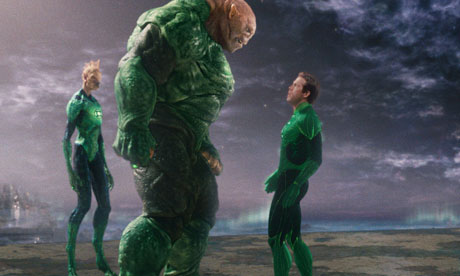
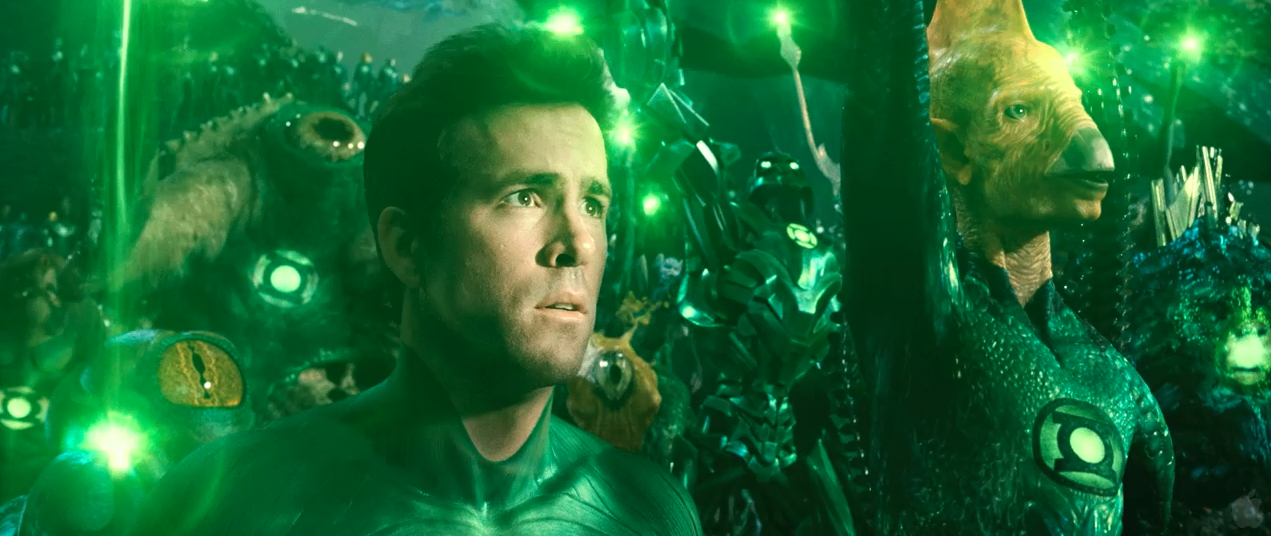
But, there's something else about The Guardians that solved the riddle of what bothered me about the movie from the start.  It's one of the darkest movies I've ever seen, as if it was a 100 watt movie projected with a 20 watt bulb (I saw it flat, so I can't imagine what the 3-D version, which is always less bright, must be like).  There is just no "brightest day" in Green Lantern. It's when The Guardians show up on their too-high-seats (that should give you a clue about them) and you can barely make them out—they look plasticine and animatronic, less life-like than the Lincoln at Disneyland.  But that's not the worst of it, the sight of the entire Corps must surely be impressive, but you get the sense that the crowd scenes are merely composed of randomly moving blobs, and the design of the main bad-thing, Parallax—a Guardian possessed of the essence of fear—looks like a particularly gnarly piece of Brillo-pad that's been set on fire, with a blocky Mt. Rushmore face in the middle of it.  It all points to one thing—the FX shots are substandard enough that the film-makers—partcularly director Martin Campbell, who directed (and invigorated) the two best Bond movies of the past 20 years had so little confidence in so many of these shots that the entire film has been desaturated to keep the bad shots from standing out from the goodIt's not all bad.  The FX-wizards did impressive work with the GL costumes (completely CGI) and the couple of Lanterns that we see wellTomar-Re (voiced by Geoffrey Rush) and D.I. Kilowog (Michael Clarke Duncan)—some of the flying works, but the landings are a little rocky.  But the ring-constructs are kinda dull (that's the scripters' fault)...lasso's and jets and guns and...Hot-Wheels tracks???  If we're doing product placement how about beating people over the head with a bottle of Coke (label out)?  "The only limits are what you can imagine."  Earth is in trouble.  But the retailers should do fine.

But, I think the worst thing about Green Lantern is that nothing resonates, nothing inspires, nothing evokes a sense of wonder or service.  Nothing even made me crack a smile—except that the green energy coming from the most powerful accessory in the world is apparently painful (as well it should be).  As a fan of the comics who wanted it to be good, watching the movie was painful for me.

Now, if you would, please repeat after me Yojimbo's empowering adaptation of the Green Lantern oath:


"In dullest day, the weakest light,
the SFX might look all right.
To cure the need to see the sight
of comic-flicks...
Green Lantern might."

Because it's just a Cable-Watcher.


"Green Lantern ponders the Universal Question: "why is there so much yellow paint in the world?"


* The secret is to couch your sci-fi in legend or familiar genres—so Star Wars gets a pass because it borrows liberally from westerns, samurai movies and old sci-fi, but A.I. Artificial Intelligence featuring robot-mother-love, melted ice-caps and "the mechas will inherit the Earth" provokes superior chortling.
** But then, so's Hal.  A couple of times during battle scenes I was thinking, "This guy can jet across the Galaxy.  Shouldn't he be showing up now, before anybody gets killed?"

*** "Nice." "Impressive, isn't it?"  "I was talking about your dress."  Really?  Is that a line they use at Comic-con's?

**** The only interesting aspect to her is that she sees GL is Jordan almost immediately: "I've seen you naked, you think I wouldn't recognize you by hiding your cheek-bones?"  Good point.  Although he DOES lower his voice as is par for the course in superhero movies.