Showing posts with label Afghanistan War. Show all posts

Wednesday, January 9, 2013

Zero Dark Thirty

"You Know That Thing We Talked About"
or
How Are Things in Tora Bora?

Writer Mark Boal and director Katheryn Bigelow have made the two most important dramatic films about The War on Terror: the 2009 Best Picture Oscar Winner The Hurt Locker and now, Zero Dark Thirty, which covers the behind the scenes investigations to track down Usama bin Laden and the subsequent Operation Neptune Spear in Abottabad, Pakistan.

The film originally started as a feature about the carpet bombing of Tora Bora, and the field work leading to the decision and was scheduled to begin filming when the raid occurred.  Immediately, the other film was shelved, and Boal began writing this, incorporating his research from the previous work which dovetailed with the earlier effort.  It's a fascinating, troubling story of human beings waging war on an intimate level, trying to secure threads of information on a specific target, while also trying to keep track of new terror acts that might occur any time, any where.


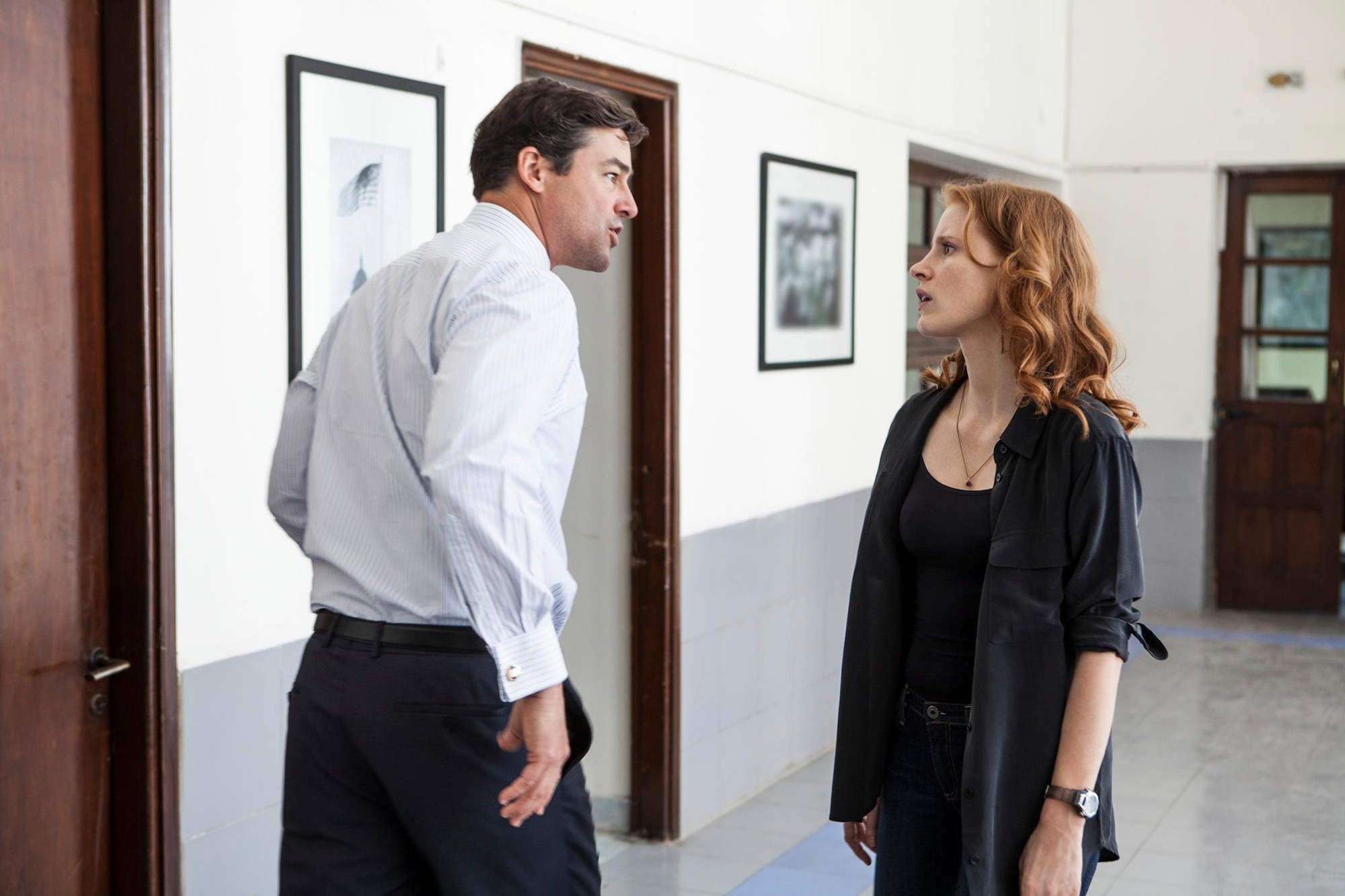
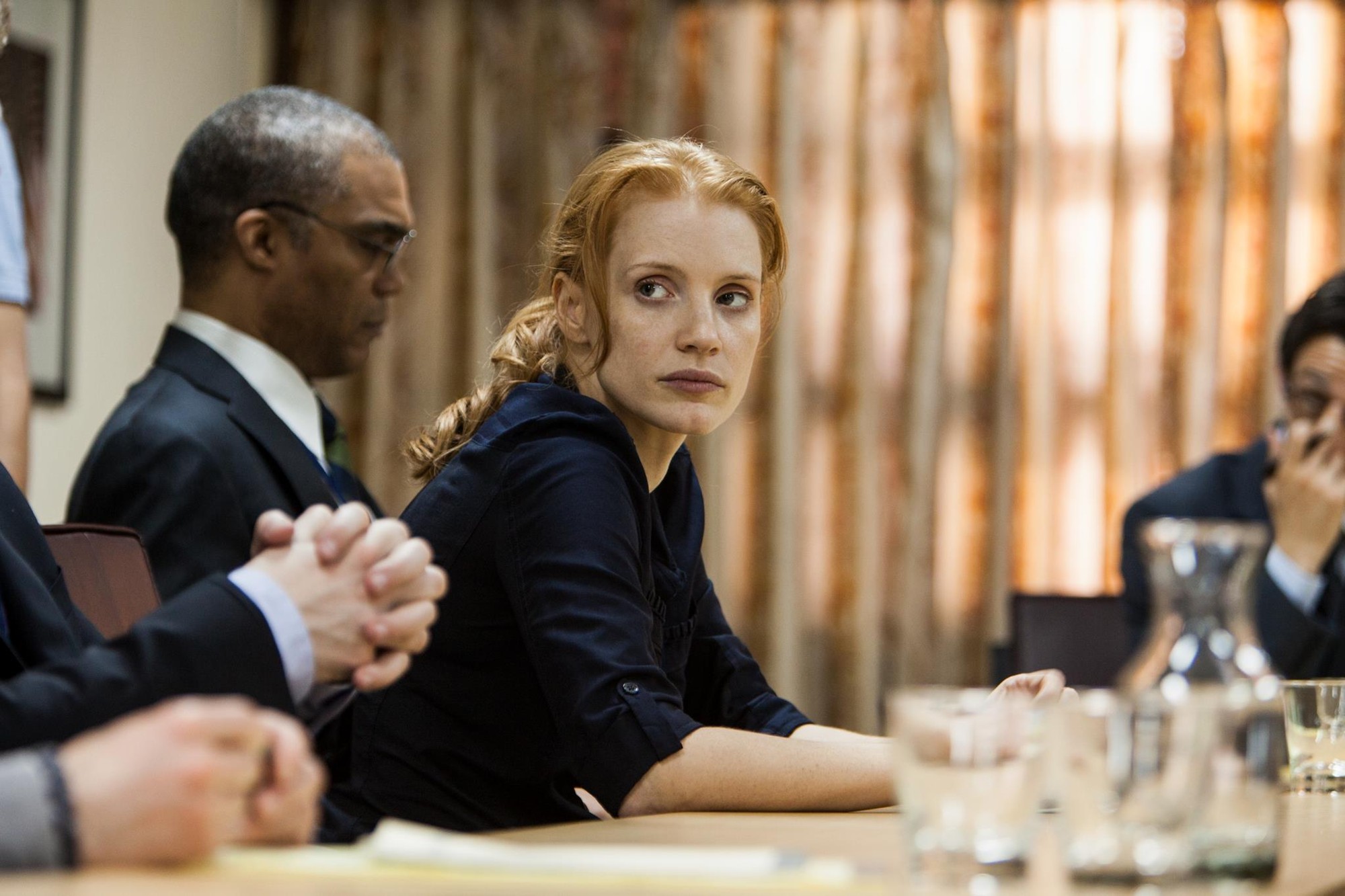
It focuses on one woman, a CIA analyst named Maya (played by Jessica Chastain)—her IM handle is "Maya173", but "Mark Owen," the nom de plume of one of the Navy Seals participating in the raid, refers to her in his book "No Easy Day," as "Jen." Maya is book-smart, street-savvy, but must learn "the ropes," literally, of interrogation by any means necessary.  She is trained in the way of torture by Dan (Jason Clarke), who has been at this for awhile and has it down to a science—the speech "If you lie to me, I will hurt you," the loss of control, the humiliation, the physical and mental stresses, the releases from which information may come.  Dan offers to keep Maya out of it, but she demurs.  She will participate.  She will actively sweat information out of the "detainees" in the euphemisms for prisons like "CIA Black Sites."  "You are not being fulsome in your replies" she yells as she slams her hand in the interrogation table.  And when she's not participating, she's poring over other interrogations, reams of intelligence, and being a general pain in the rear to her superiors and colleagues.  For station chief Joseph Bradley (Kyle Chandler), the job is to walk the razor's edge of politics and prevent more terrorism—he doesn't even care about bin Laden anymore, as there are too many attacks he's trying to prevent—every attempt that gets by is a failure.


But, for Maya, bin Laden is an obsession, her white Muslim whale, and it takes a zealot to find another zealot.  She'll veer off into other investigations, particularly when some of her own are killed in an attack, but time only intensifies her resolve, almost becoming a mania, and her patient investigation is off-set by a gloves-off approach to her superiors (when asked her role in the briefing by Leon Panetta, played by James Gandolfini, she replies "I'm the m#####-f##### who found this place, sir"), almost as if her persistent pressure torture techniques are being applied up the chain.The Obama White House dithers over action until absolute proof is obtained that bin Laden is held up at the Abottabad compound, but Maya is resolute.  When more cautionary analysts give the odds at 60%, she defiantly ups the odds to 100%—"Okay, 95%, because I know certainty freaks you guys out."  But, it's that certainty that fuels Seal Team 6 in their mission—in the videos below, she's specifically mentioned and lauded in Mark Owen's account.

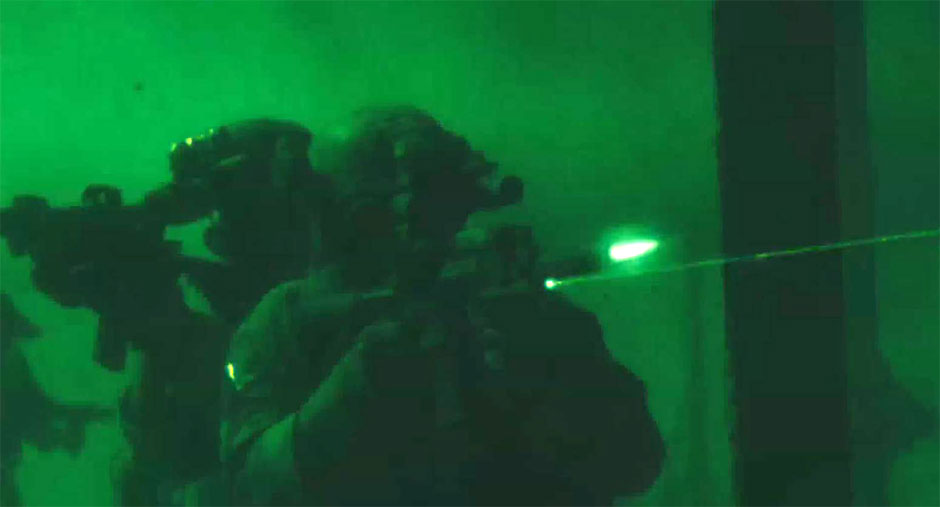
It is a fascinating movie, but a draining one, starting with torture scenes and ending with a recreation of the raid as it went down, shot mostly in tense disorienting night-vision.  The character of Maya, or "Jen" or whoever she is, is a fascinating one, a portrait of obsession and the toll it bears—she's repeatedly told that she looks "terrible" throughout the movie—and when she lashes out at her superiors for their lassitude, or just plain pusillanimaty, there is a definite sense of someone unhinged—controlled, but pushed to the breaking point.  A fury waiting to unleash, she is our version of a Holy Terror, a match for her enemies, and one can't help but wish her peace...suspecting that it will never happen.

Zero Dark Thirty is a Matinee.


The FBI's notice of bin Laden's death and the Situation Room during the raid.
Bear in mind, one helicopter went down during the raid.


* There are torture scenes, but they're not commented on, and any politicizing of it is so much hot-air—one can see in the film any position they want.  It walks a very fine line, merely presenting, and if someone tries to see their point of view in it, they're merely counter-projecting.  

Wednesday, September 14, 2011

Restrepo

This week, we're re-publishing some reviews of the films from the post 9-11 environment.


"Where the Road Ends, The Taliban Begins..."

There have been two exceptional documentaries coming out of the Bush War years, No End in Sight, the clinical analysis documenting the rememberances of the caring people who were stymied trying to bring some stability to the Iran conflict, and this, Restrepo, filmed by Tim Harrington and author Sebastian Junger ("The Perfect Storm"), about one year in the life of a troop in the deadliest section of the Afghanistan War, the Korengal Valley.

It's what they call a "killing zone" in war, the lowest spot in a valley surrounded by treacherous hills and mountains that defy any sense of uniqueness, with just enough green-belt to defy easy targetting.  When the soldiers of Battle Company first see it, their response is sickeningly bleak, their brio dissipating in the dust kicked up by the rotors of the Chinook delivering them to the sight.  "This is a shit-hole," says one of the men (boys, really), "And I thought 'I am going to die here.'"

They deploy with such bravado, broken and stripped down in basic training to become efficient weapons of our nation, only to see themselves further broken down by the constant beat-down of war.

And then the casualties come.  First one, and then Juan "Doc" Restrepo, who we meet at the beginning of the film, drunkenly, defiantly flexing his war-attitude on the way to deployment, a demoralizing blow to the Corps, as he was considered the best, most capable of the troop.  "Not this guy.  Not this guy.  Not this guy," mantras one of the soldiers in the post-rotation interviews.  If the Enemy could kill their best, what chance did they have?

To get more of an upper-hand, the soldiers, under the cover of night and snipers, hurriedly build a new operational post on high-ground, an "eagle's nest" with rudimentary protection—shells of dirt, basically—and their most powerful weapons to give them a vantage point, and an advantage to take them out of the bowl of death the original outpost is, strategically.  An Alamo, if you will. In simultaneous respect and defiance, they named the outpost after Restrepo, bringing a sense of permanence to his sacrifice, his first memorial, which is described as an up-raised middle digit to the unseen forces trying to kill them.

The shots are extreme hand-held moving with the nervous panic of war and long, carefully composed telephoto shots of the countryside, the plumes of explosions, while, in a reminder of where it all stands in The Scheme of Things, predator-birds glide through the shots.  Ever want to see what it's like to be inside an armored vehicle when it's up-ended by an IED?  It's here.  The language is raw as are the emotions, the cinematography iffy, often filmed in low-light conditions that defy clarity.  But, this is a necessary document of the Armed Forces in Afghanistan, showing how hope is also a casualty of war, and the evidence of it are in the haunted, even dead, eyes of the men in post-deployment interviews.  One can't look into them, without thinking that governments should be careful...as a sanctified task...to avoid such situations in the future.

In The Big Red One, Samuel Fuller's end statement was that the only victory in war was surviving it. True enough, simple as that is. But, it goes deeper than that, and is more complex. For war does more than kill the living, it also kills the future of the survivors, the wounds are internal, festering, healing far too slowly, leaving them—if total victory is not achieved—with the sense of no accomplishment, despite throwing their all, their "last full measure" into the blades of the abattoir.

Restrepo is often difficult to watch, but as an unvarnished, declassified document in the on-going revelation of the effect of war on men (and women), it is the kind of tough love it takes to quell the savage beast.

Restrepo is a Matinee.

His buddies and the filmmakers made sure he would not be forgotten.
May none of them be...

Co-director Tim Harrington was killed April 20, 2011 in Misrata, Libya
covering the uprising there. 


Tuesday, August 17, 2010

Restrepo

"Where the Road Ends, The Taliban Begins..."

There have been two exceptional documentaries coming out of the Bush War years, "No End in Sight," the clinical analysis documenting the rememberances of the caring people who were stymied trying to bring some stability to the Iran conflict, and this, "Restrepo," filmed by Tim Harrington and author Sebastian Junger ("The Perfect Storm"), about one year in the life of a troop in the deadliest section of the Afghanistan War, the Korengal Valley.


It's what they call a "killing zone" in war, the lowest spot in a valley surrounded by treacherous hills and mountains that defy any sense of uniqueness, with just enough green-belt to defy easy targetting.  When the soldiers of Battle Company first see it, their response is sickeningly bleak, their brio dissipating in the dust kicked up by the rotors of the Chinook delivering them to the sight.  "This is a shit-hole," says one of the men (boys, really), "And I thought 'I am going to die here.'"

They deploy with such bravado, broken and stripped down in basic training to become efficient weapons of our nation, only to see themselves further broken down by the constant beat-down of war.

And then the casualties come.  First one, and then Juan "Doc" Restrepo, who we meet at the beginning of the film, drunkenly, defiantly flexing his war-attitude on the way to deployment, a demoralizing blow to the Corps, as he was considered the best, most capable of the troop.  "Not this guy.  Not this guy.  Not this guy," mantras one of the soldiers in the post-rotation interviews.  If the Enemy could kill their best, what chance did they have?


To get more of an upper-hand, the soldiers, under the cover of night and snipers, hurriedly build a new operational post on high-ground, an "eagle's nest" with rudimentary protection—shells of dirt, basically—and their most powerful weapons to give them a vantage point, and an advantage to take them out of the bowl of death the original outpost is, strategically.  An Alamo, if you will. In simultaneous respect and defiance, they named the outpost after Restrepo, bringing a sense of permanence to his sacrifice, his first memorial, which is described as an up-raised middle digit to the unseen forces trying to kill them.  
The shots are extreme hand-held moving with the nervous panic of war and long, carefully composed telephoto shots of the countryside, the plumes of explosions, while, in a reminder of where it all stands in The Scheme of Things, predator-birds glide through the shots.  Ever want to see what it's like to be inside an armored vehicle when it's up-ended by an IED?  It's here.  The language is raw as are the emotions, the cinematography iffy, often filmed in low-light conditions that defy clarity.  But, this is a necessary document of the Armed Forces in Afghanistan, showing how hope is also a casualty of war, and the evidence of it are in the haunted, even dead, eyes of the men in post-deployment interviews.  One can't look into them, without thinking that governments should be careful...as a sanctified task...to avoid such situations in the future.

In "The Big Red One," Samuel Fuller's end statement was that the only victory in war was surviving it.  True enough, simple as that is.  But, it goes deeper than that, and is more complex.  For war does more than kill the living, it also kills the future of the survivors, the wounds are internal, festering, healing far too slowly, leaving them—if total victory is not achieved—with the sense of no accomplishment, despite throwing their all, their "last full measure" into the blades of the abattoir.


"Restrepo" is often difficult to watch, but as an unvarnished, declassified document in the on-going revelation of the effect of war on men (and women), it is the kind of tough love it takes to quell the savage beast.  

"Restrepo" is a Matinee.

His buddies and the filmmakers made sure he would not be forgotten.
May none of them be...