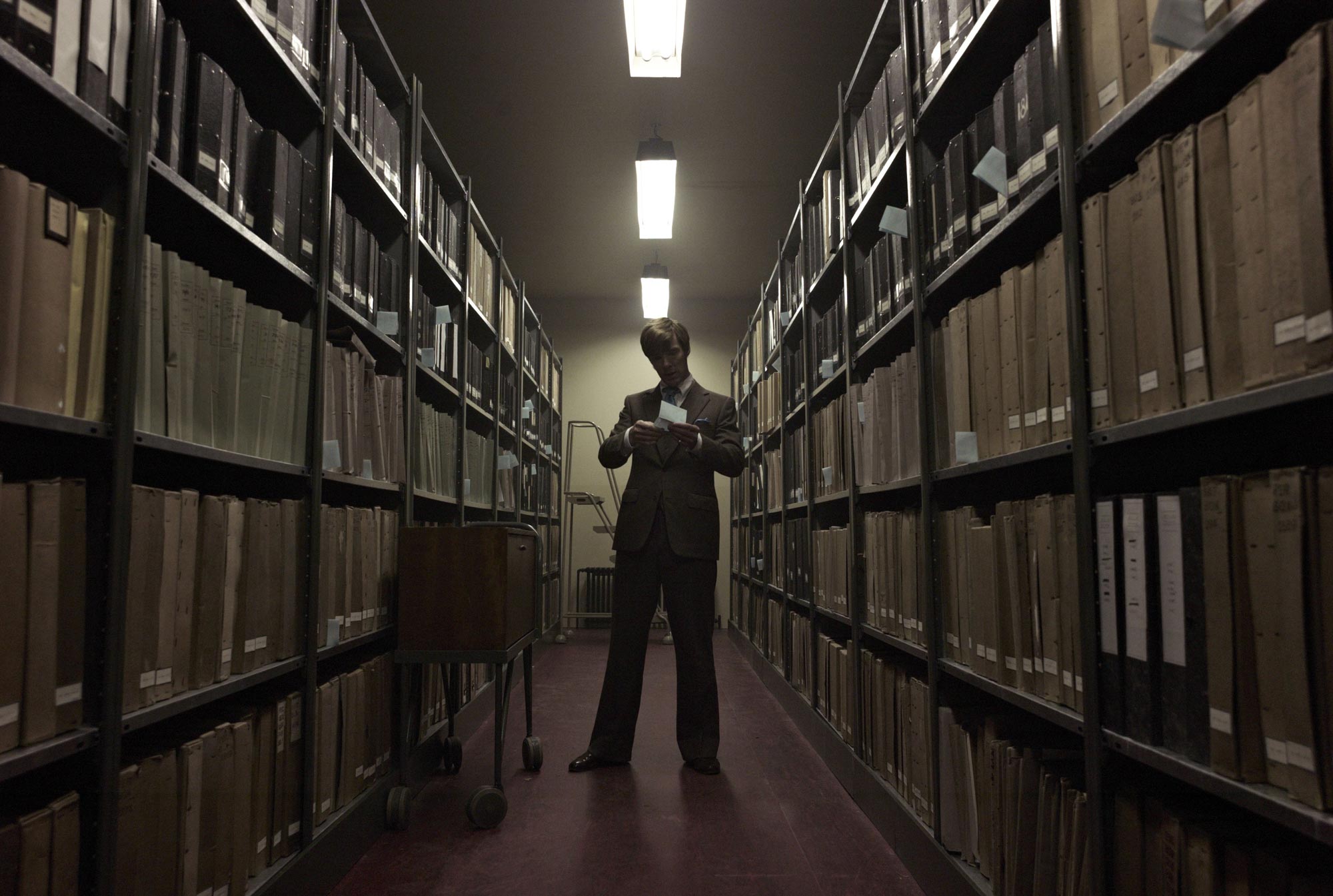
Spies Like Us
or
Eyes Wide Shut* (The Fine Art of Concealment)
I love spy movies. Growing up in the 1960's, with the advent of the James Bond films—an amalgamation of Ian Fleming's novels and the films of Alfred Hitchcock (particularly North By Northwest)—and concurrent with the 60's embrace of the "anti-hero," my perceptions of movies were warped and laser-beamed with the image of duplicity, secrecy and emotional coolness. Spies are not nice people—it doesn't matter what kind of cars they drive—they are both untrustworthy and trustworthy, they make moral judgements (sometimes snap decisions) of who is worthy of each. Keepers of secrets, cataloguers and manipulators of weakness, spies use people as weapons, ignore collateral damage and sleep the sleep of the just knowing that the ends justify the means. Fleming's secret agent was the last vestige of the romantic spy (despite the many imitations that ensued), a double-crossroads between the old and the new—a "gentleman-spy," chivalrous, but more than willing to plunder the spoils of war, and a thug...but with exquisite taste.
But the gold standard ("finger"-less division) for the times, which embraced the Cold War** were the novels of John le Carré (French for "The Square," which reflected the author's choice of creating novels around the moral rectitude of naive and sentimental men in an amoral world) who wrote about spies as functionaries and bureaucrats, rather than super-men with toys, and the epitome of those was "Tinker, Tailor, Soldier, Spy," the first novel in "The Karla Trilogy,*** which pitted two spymasters against each other in a fight to The Brandenburg Gate—the mysterious Russian, Karla, and George Smiley, an agent for British Intelligence (which le Carré dubbed "The Circus"). Smiley had appeared as a minor character in previous le Carré books, but with "Tinker..." he became the focal point, not only the best man in the service, but also its weakest link, intellectually smart as a whip, but emotionally dull as a stump. In it, he is called upon to investigate his own former Intelligence agency, as there is suspicion that there is a "mole"—a double agent—very high up in the ranks.**** A thick book, filled with intricate detail and Dickensian characterizations with deep motivations, it was adapted (like the film, without commas in the title) in 1979 into a 7-part mini-series by the BBC and director John Irvin with Alec Guinness as Smiley, a version which was considered definitive.
When word that Peter Morgan had scripted a film version, it seemed inconceivable that such a compressed time-frame could do the novel justice.
And, incredibly, it does...even at times going the mini-series one or two better...by integrating sequences that le Carré never bothered with or thought of that throw in a lot of information in a very short space of time, the difference between a novelistic and cinematic experience: a Christmas party at the Circus, where knowing glances are exchanged between brother-spies and covert operations are, even there, in effect;***** the shooting of Jim Prideaux (Mark Strong, quite different from how we've seen him before in his villainous roles of late) on a secret mission from Control (John Hurt) to try to learn the identity of "the mole" in their ranks; a warning to Peter Guillam (Benedict Cumberbatch) to "get his house in order" that leads to a painful personal decision that reflects certain issues among the suspects; and an interrogation scene that adds tragic ramifications to the story of Ricki Tarr (Tom Hardy), but also illuminates the cruel humor of the Russian Karla.
And the "Cold War" scenario gets even chillier given Swedish director Tomas Alfredson's handling of the film. The men investigating and being investigated (Ciarán Hinds, Colin Firth, Toby Jones, and David Dencik) are already cold fish, but with the script and Alfredson's direction, they're almost completely cyphers, the only glimpses of a personal life are revelatory of each man's weaknesses. Also, Alfredson's framing schemes involve as much mis-direction as direction, shooting above, over, around and through as many obstacles and distractions, frames and panes of glass, a maze of obfuscations that confuse the path to true seeing, putting us in the same position as the story's primary Truth-Seeker, George Smiley (Gary Oldman).
Early on, Smiley visits an oculist to get a new pair of huge owl-like glasses to see more clearly before embarking on his secret mission for the government. Those glasses also provide another barrier to his eyes, the window to his soul. Oldman's performance is brilliant, deceptively simple—but that's not the point. One is struck, perpetually, throughout the film, of how much Oldman conveys with the simplest—and smallest—of movements. It is to the actor's credit (and Alfredson's) that so much of the actor's performance is seen from behind, his face unseen, but it matters not; George Smiley is not given to overt actions, but covert ones, minor moves of chess-pieces that mark the battles in intellectual wars. His brevity and economy in everything—that weighs so heavily on his personal life and makes him vulnerable, comes to the fore here, making this odd performance a perfect encapsulation of the role and is a further refinement and definition of the character of le Carré's greatest creation—George Smiley—betraying nothing, always betrayed.
Tinker Tailor Soldier Spy is a Full-Price Ticket.
* The origin of the phrase "Eyes Wide Shut," the title of Stanley Kubrick's last film, originates as a colorful turn of phrase in le Carré's original novel "Tinker Tailor Soldier Spy" (Kubrick and David Cornwell— le Carré's real name—were good friends, although Kubrick never enticed him to work on a script with him). It's the scene where Connie Sachs is explaining what happened to the Russian double-agent Polyakov and how he was seduced by a "honey trap" (le Carré spy-code for a female counter-agent) and how Polyakov, against his better judgement, walked in with "his eyes wide shut." That turn of phrase is not in the movie, probably BECAUSE of the association with the Kubrick film.
** When detente eased the tensions between the West and East, le Carré presciently set his rifle-sights on the next enemies of the state—capitalists and industrialists who pledged allegiance to the almighty dollar rather than to any flag or deity. Supposedly, trade partners don't war against each other (hence, the genesis of the EU and NAFTA), but has the damage those entities wrought on the world economy really been beneficial? Is anyone winning, when we all go down together?
*** The others in the series are "The Honourable Schoolboy" and "Smiley's People."
**** This parallels the true life upheaval MI-6 went through in the 1950's, with the Cambridge Five scandal.
***** One inspired touch is The Circus Crowd singing along with an old song that I only thought I remembered—the title tune from a long-forgotten Bond knock-off (sung by Sammy Davis, Jr.) called The Second Best Secret Agent in the Whole Wide World, which nicely plays in with British Intelligence's subordinate view of themselves as "also-ran's" to their American "Cousins" in the CIA.