"Prefontaine" (Steve James, 1997) The first of the two movies (the other being Robert Towne's "Without Limits") lionizing the patron saint of the running culture (especially in the Northwest) Steve Prefontaine. I've mentioned in the review of the other, some particulars and "Prefontaine" covers the same territory, but owing to who's telling the story and who gave rights to be portrayed, some of the emphases are different for bragging and story-rights. For instance, more is made of "the girl he left behind" in Coos Bay, "Pre's" relationship with fellow track team members (especially Mr. Shot-Put Guy), and the assistant coach. Because the film was produced by the producer-director team of the documentary "Hoop Dreams," the film is staged with scripted "interviews" with actors aged with not-too-convincing make-up, and a reliance on "found footage" of the real Prefontaine (and fortunately, Jared Leto looks just like him so there's no disconnect between the two sources). More emphasis is put on the college recruitment process (a main theme in "Hoop Dreams"). But it is pretty much the same story. Bill Bowerman as portrayed by R. Lee Ermey is more of a military hard-ass than Donald Sutherland's crazy-like-a-fox mystic in "Without Limits."
Towne's film is more assured, technically and scriptually, and the "Hoop Dreams" team can't avoid over-dramatising certain things...like changing Prefontaine's accident the night of his accomplishing the goal of staging an amateur track competition in Eugene. Does "Pre" have to look one of the Black September terrorists in the eye across their balconies at the '72 Munich Olympics? Does Ermey have to emphasize the point at the final race by looking at the camera and saying "I want all the people to know that what they are looking is the kind of runner who comes along only once in a lifetime." Thanks for the tip, but a little unnecessary.
"Prefontaine" was filmed in Tacoma, so quite a few Seattle sports reporters have quick-as-a-blink cameos.
But, when it comes to the finish line, "Without Limits" comes out a few lengths ahead as the better "Pre" film.
Tuesday, April 27, 2010
Prefontaine

Saturday, January 24, 2009
Midnight in the Garden of Good and Evil
 "Midnight in the Garden of Good and Evil" (Clint Eastwood, 1997) This may seem like an oddball project for Eastwood, but truth to tell, it fits him like a wolfish scowl. He's always been interested in "true-crime" stories, and John Berendt's fictional non-fiction book about the Jim Williams trials fills that bill. Eastwood loves to shoot in the South, and Savannah, Georgia provides a wonderful backdrop for the jazz afficianado, who can use the music of the tangentially related Johnny Mercer.
And most importantly, it's a story of outsiders and iconoclasts, and that's where Eastwood excels. He was obviously having the time of his life fitting in the kooks and eccentrics who flit about the story like one of Luther Driggers' lassooed flies. For Eastwood, it must have seemed like filming "Every Which Way But Loose" with a murder trial thrown in. And he clearly loves working with drag queen The Lady Chablis working her into as much as the movie as he can, no matter how illogically--he squawked about getting more money, Eastwood probably figured he'd better earn it. During an extended comedic set-piece where Chablis crashes a very posh debutante ball and shocks the locals you can almost hear Eastwood chuckling--John Cusack is encouraged to mug just a bit too much.
And the cast, though not so stellar, is filled with great character actors: Eastwood crony Geoffrey Lewis, Kim Hunter, Jack Thompson, Dorothy Loudon, Richard Herd, Bob Gunton, Michael Rosenbaum, and the irrepressible Irma P. Hall. Doesn't matter if you've heard of them or not, you'll recognize them from other things. Heading the cast alongside Cusack is a sly and reserved Kevin Spacey, with molasses running through his veins. The only sour note is the one struck by Jude Law as the murder victim. You only wish there were more bullets.
It was the perfect tonic for Eastwood, coming between the "Absolute Power," and "True Crime."
Friday, November 7, 2008
Contact

"There are only two ways to live your life. One is as though nothing is a miracle. The other is as though everything is a miracle."

"Contact" is a scaled-back version of the Carl Sagan novel about humankind's First Contact: we get a series of blips from Deep Space via The Very Large Array*** and translate them to create a means of meeting. The focus of the film is an agnostic SETI scientist named Elanor Arroway (Jodie Foster) who is a brilliant scientist, but a lousy politician. She struggles with the question of Faith throughout the movie to her detriment and comes away from the experience questioning, but filled with belief.


Religion and Science do not sit in the same pew, but to possess a sense of wonder implies some kind of faith. When he asked what he thought about while waiting to be launched into orbit, John Glenn replied, "I just sat there thinking that every part and instrument was contracted to the lowest bidder."
You have to believe in some-thing. Arroway is confronted by a crisis of Faith and finds out what it's like to be on the recieving end of a bunch of Doubting Thomas's. And the entire movie becomes a reverse of its galaxy-spanning opening shot**** (reminscent of "The Powers of Ten"), as we start from Earth orbit with a cacophony of broadcast data, and as we accelerate away past the speed of light, we catch up with the transmissions we have sent out in space throughout the 20th century until we reach the extent of our influence and the Universe goes quiet. We roam through star-clusters and birthing star-systems amidst nebulae, until we reach the goal--the eyes of a child, Ellie Arroway's eyes, specifically. Those eyes will dim in wonder and with worry when Jodie Foster takes over the role (from young Jena Malone). But, in space, when confronted with the sheer splendor of the Universe, Zemeckis will morph Foster's face into Malone's as she stammers "So beautiful. No words. They should have sent a poet."
Perhaps they already did. For at film's end, as we leave Arroway to ponder her journey of Belief and the Mystery of Faith, she picks up a palm-full of New Mexico sand, and sees a pattern that she has seen before.

And a heaven in a wild flower,
Hold infinity in the palm of your hand,
And eternity in an hour.
William Blake "Auguries of Innocence"
** "2069 June 08 GMT 1537. Message 6943. Sequence 2. Starglider to Earth:"
"The hypothesis you refer to as God, thought not disprovable by logic alone, is unnecessary for the following reason."
"If you assume that the universe can be quote explained unquote as the creation of an entity known as God, he must obviously be of a higher degree of organization than his product. Thus you have more than doubled the size of the original problem, and have taken the first step on a diverging infinite regress. William of Ockham pointed out as recently as your fourteenth century that entities should not be multiplied unnecessarily. I cannot therefore understand why this debate continues."
*** When dealing with landscapes cosmic, it always helps to capitalize...a lot.
****
Monday, February 4, 2008
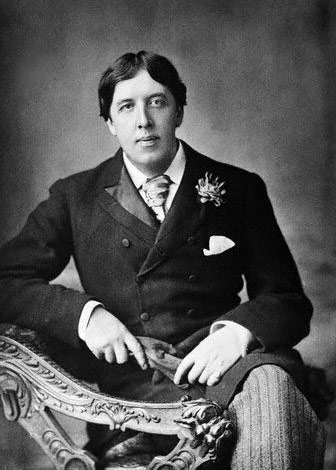
Wilde
 A nearly definitive biographical film of the scholar and playwight whose career was destroyed and life shortened by the spiteful trial and imprisonment for "indecent acts" directly relating to his gay trysts. Stephen Fry plays Wilde, and he's a bit too old for the part but the resemblance is there, and his bulk and refinement put you in the sphere of what it must be like to be a bull in a china shop. Vanessa Redgrave (wonderful, as always) plays Mother Wilde, Jennifer Ehle as his wife Constance, and as the earnest young men in Wilde's affections, a virtual parade of young British heart-throbs--Orlando Bloom (for 3 s., tops), Ioan Gruffud, Michael Sheen, and as Wilde's obsession Lord Alfred "Bosie" Douglas, Jude Law in full schizophrenic movie mode. One becomes aware all too quickly that Wilde's problems stem from a bad match and his tragedy is that he could never stop going back no matter the cost to him or those around him. Frye communicates the "struck dumb" quality that must have evoked, which for a man of Wilde's intellect and eloquence must have been over-powering. Tom Wilkinson is hissingly malevolent as "Bosie's" father, The Marquess of Queensbury, the acknowledged "rule setter" for the subtle art of bashing someone's brain in. Here he forgets his own rule about hitting below the belt. The film is a cautionary tale of how reaching the heights of fame guarantee the hardest of falls, and how hubris has a remarkable way of proving to be one's undoing.