"Greed...(For Lack of a Better Movie)...is Good"
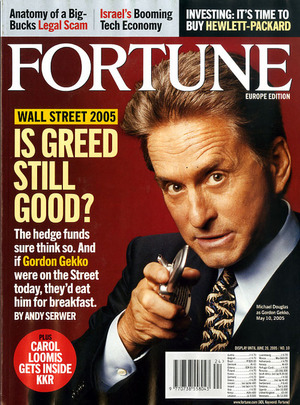
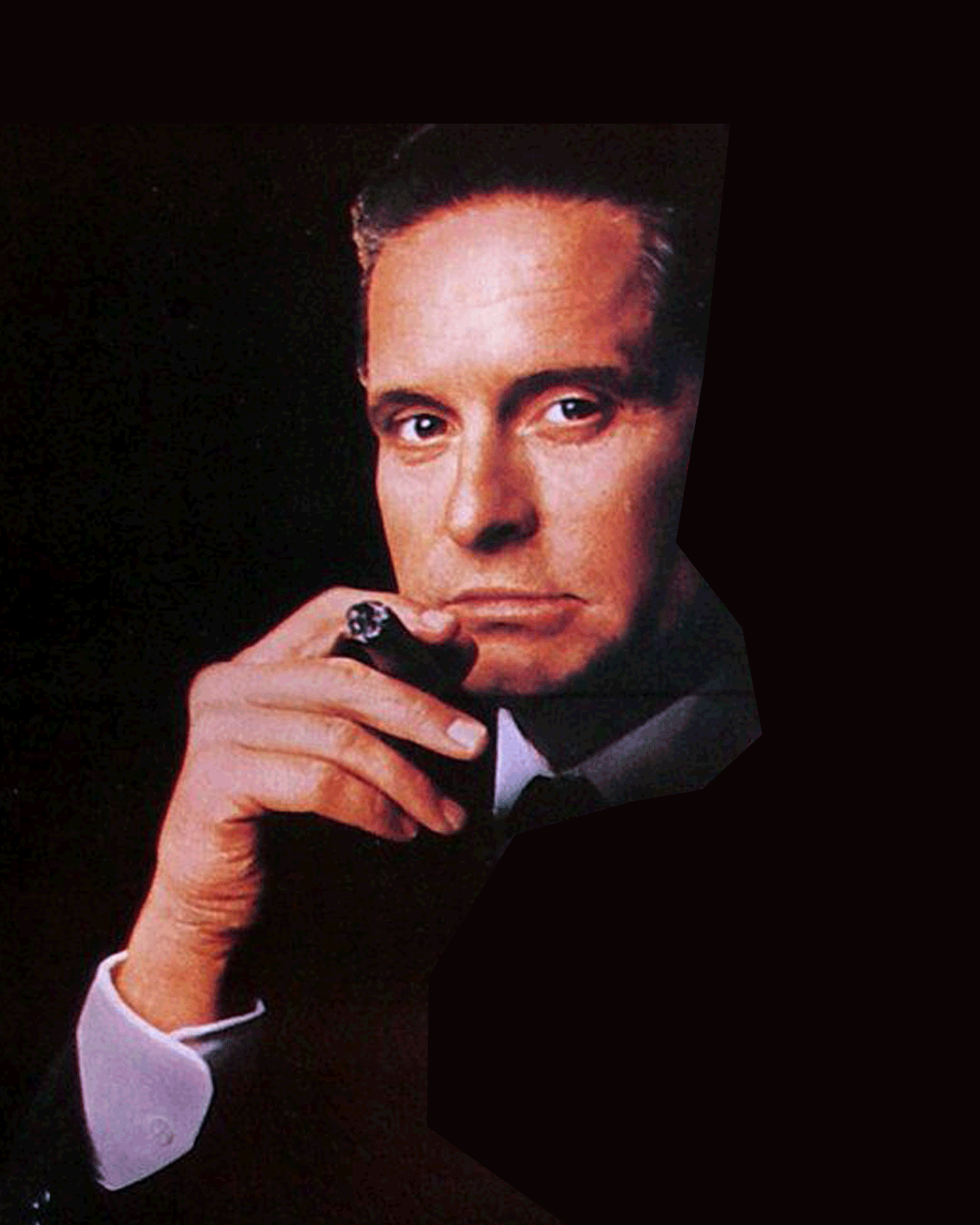
Entering into the third year of the Great Bank Swindle, it was only natural that someone in Hollywood would try and make hay off of it. Enter Oliver Stone, with a sequel of sorts to his "Wall Street" film of 1987: "Wall Street: Money Never Sleeps" (a rather loopy title, in my eyes). Wall Street high-roller Gordon Gekko (Michael Douglas) is released from prison to find himself alone, short of cash, and unable to get back into the game—the rules, such as they are, have changed, and prison never looks good on the resumĂ©.
Seven years after Gekko is sprung, young Wall Street investment trader Jake Moore (Shia LaBoeuf) finds himself in the middle of the banking crisis, his company folding and his mentor (Frank Langella) commits suicide as a result. The rootless Moore is then determined to avenge the death of both his Father Figure and livelihood by taking on the entities that led to his firm's collapse. It was only a matter of time before he ran into Gekko, on a promotional tour for his new book, describing his life on top and behind bars. Their stars are due to collide for another reason; is engaged to Gekko's daughter (Carey Mulligan), estranged from her father for his sociopathic wheeling-dealings and the subsequent overdose death of her brother.
Already it starts to feel icky. Stone's original was, much like his "Platoon," less about their subjects (Vietnam, insider trading) and more about the writer-director's coming to terms with Daddy issues. His protagonist in both films (played by Charlie Sheen) had to choose between good and bad fathers in both situations (Tom Berenger and Willem Dafoe in the first, and Douglas and Martin Sheen in the second), hovering about his shoulders like angel-demons, prodding him to go one way or the other, making him choose which Father Knows Best.
Everybody has Daddy problems in this one, to the point where that seems to be the only issue concerned. Oh, there's some touching on of Green Energy and of the Banking conspiracy, but for the most part it is of the characters pin balling between Male Authority Figures, and the Mentor-ProtegĂ© thing (right down to Josh Brolin's character's favorite art-piece). The only thing left is the kinda squeaky relationship between LaBoeuf and Mulligan, with Gecko acting like some Yojimbo playing all sides against each other. It's a little disappointing to see Douglas' Gekko-monster being soft-pedalled in this manner—like finding out that Darth Vader (another Dark Father figure!) is merely Hayden Christensen in disguise. Disappointing if one could get a handle on the character at all. Douglas vacillates between being a tough-as-nails financier with all the answers and vulnerable Fair-Market Father trying to win back his little girl—that transformation gives Douglas and Mulligan a well-played if ultimately hollow scene in which they come to tearful terms. He has never been better than that scene, and takes chances that recall his father Kirk's fearlessness in hitting for the bleachers.
If only that were true of Oliver Stone.
For the fact of the matter is, despite being one of our more (self-professed)radical film-makers, the once angry young man has made one of the most conventional of movies. To be fair, he didn't write it, so the personal complications among the characters that one can see coming a mile away are not his fault. And though he may trick the movie up with visual legerdemain (including a simple use of split-screen that he abandons fairly early on), pervasive songs by David Byrne and Brian Eno (that are banal), and "cuting" it up with several visual and aural "in-jokes," the film couldn't be more "safe," preaching to the choir, and goo-ing the whole thing up in a veneer of soap-scum.
If one wants to be a truly innovative film-maker, to push the limits of visual story-telling, tell us something we don't already know.
"Wall Street: Money Never Sleeps" is a low-yield Cable-Watcher.
Saturday, October 2, 2010
Wall Street: Money Never Sleeps
Saturday, April 4, 2009
Alexander
"Alexander" (Oliver Stone, 2004) In the two-way race getting the story of Alexander the Great to the screen between Baz Luhrmann and Oliver Stone, the latter got there first, having worked on a screen-play since 1989. Luhrmann's announcement of an "Alexander" project was probably just the thing Stone's film needed to get off the ground, and his thorough planning shows (historical inaccuracies aside): this is one of Stone's deftest film--a combination of his macho liberal ethics and his pre-disposition to turn everything into braying Myth. Here he's dealing with Gods and Titans and men who reach beyond their grasp, and if one thinks this one has a political agenda talking about a King wanting to chase his Persian prey into the mountains, you're only scanning the surface for easy targets.*Stone's going for epic statements here of dreamers and the pains they inflict on Society** and a pretty good tying up of some major themes in several of his films without descending into his fall-back of the "Good and Bad Fathers of our Soul." Oh, there is familial stress going on constantly with two of the more watchable stars as Alexander's warring father and mother King Phillip and Olympias (Val Kilmer and Angelina Jolie***). Their battles for the betterment of Alexander (Colin Farrell) make up the intrigue that Stone keeps flashing back to once Alexander reaches Babylon and established his first Alexandria city-state. But the main focus is Alexander and his battles from
The film is so full of "rules of thumb," you begin to wonder if there's not a training manual with the thing ("A commander never gives an order he wouldn't carry out himself," "Don't surrender your reason to passion," "Moderation in all things" and the film's mantra "Fortune favors the bold"), and as gritty as Stone makes it (and there's a lot of blood-spatter flying through the battle scenes), it has the pristine quality of those Hollywood sword-and-sandal epics where even the Persian city of Babylon seems immaculately free of dust. Stone seemed inspired by the look of "The Lord of the Rings" and its way around a vast story-line, but seems to favor his Myths well-scrubbed.
Still, it's an epic that was filmed in 93 days, despite far-flung locations and looks miraculous despite the tight schedule. For all the things that could conceivably have gone wrong, Stone's Cecil B. DeMille styled dream project managed a lot of things right.
* Stone's "W." biography would show up at the end of 2008, looking rushed and a little wasted and without much to say. You can't satirize a political satire, and the joke ceased being funny a long time ago.
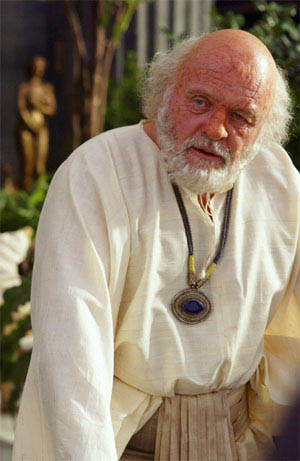
** In an odd post-mortem, Alexander's kinsman Ptolemy (Anthony Hopkins) supposes that Societies are inspired by dreamers and then exhausted by them to the point of wishing them failure, if not death. That's an interesting thought coming from Mr. Conspiracy Theory. Stone's also one of those liberals who likes to include all of us to enjoy his guilt—"It's all out faults." Hey, speak for yourself, mack!
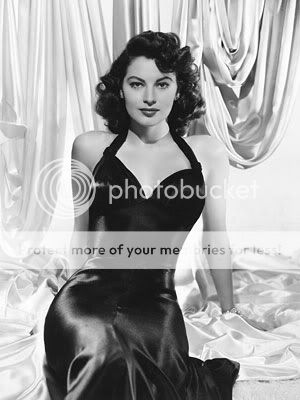
*** Stone is particularly praise-worthy of his actors on the commentary track of this film and with good cause--Farrell shows off the promise that his over-hyped career has only suggested, Kilmer is as boisterously good as he's been in years, and Jolie again shows why she's one of the most commanding actors on the screen these days. She has a line reading ("Loves. Loves!") that wheels between conflicting emotions with such quick-silver speed that it nearly whips your head around. One would be tempted to see that she's the latter day Ava Gardner if not for one thing—she's a better actor than Gardner. Stone loves a touch of madness in his actors. Jolie is his perfect match.
**** Farrell doesn't disguise his Irish accent, and the kid who plays him (very well) in the early sections of the movie does a fair register of Farrell's brogue. But most of the actors have Irish accents that at times is distracting, but somehow seems fitting for the folk-tale blarney with which Stone tells the story. You go with it, as it feels right. Kilmer's accent is American. Jolie's is faux-Greek.
Tuesday, November 4, 2008
W.
"Somethin' 'Bout Bein' in the Barrel"
The Writer's Prejudice Up Front : I've never liked George W. Bush. He's the type of guy I'd like to sit down and have a beer with...thrown in his face. I've always considered him woefully unprepared to be President: a rich man's son who aspired downward; a dilletante who'd never had a successful business that his Dad's cronies didn't bail out; an oil-man, who excelled at digging dry holes; the most bald of hypocrites, pious when the microphone's on, but profane when they're off; who believed in sacrifice as long it was somebody else; possessed of the ethics of a snake-oil salesman, he'd made so many promises and held so many I.O.U.'s that putting him in charge of the Treasury was like putting Dracula in charge of the Blood Bank. Or as Maureen Dowd once famously wrote: "He's the guy who would rent a hotel room, and then ask you to the prom." One by one, Bush and his co-conspirators undermined every aspect of American life to the point where his own Administration, which contained so many of them, should be considered its own National Disaster. There isn't penance enough in this world to make up for the harm that this vain-glorious underachiever did. And once he leaves office, he'll go back to the only job he's had success at: Influence-peddling. Writing about him in the past tense is the only pleasure one can take in writing about him.
He is the Shame of our Nation.
Having said that, "So, Mrs. Lincoln...how'd you like the play?"
Oliver Stone is no one's idea of an objective film-maker, if there is such a thing. Once a screenwriter puts pen to paper, they've already started manipulating the movie to their point-of-view, whether it's from the left, right, center or upside-down (Why do you think they're called "directors?"). So, no one should be surprised that Stone has an axe to grind, with "W.".
Stone is a director of heart, but he frequently by-passes his brain when making his points. So, "Platoon," still his best film, hi-jacks the gritty depiction of grunt jungle-fighting with Stone's own conflicted "Daddy" issues, his "Pvt. Chris Taylor" having to choose between two superiors with different moral ways of engaging the enemy. Lincoln and every fantasist depicting moral choice has put angels and devils on our shoulders. Stone burdens us with His Old Man. That same scenario was transferred to High Finance, with his very next film "Wall Street." I haven't seen every film of Stone's, but most of them are concerned, in some capacity, with paternal conflicts. And because he's a better propagandist than scenarist, most Stone films stop dead whenever we get to each Stone "thesis," invariably a Message being presented by a single character who has center-stage and our undivided attention. "JFK," a dazzling technical exercise of photography and editing, comes positively unglued in its presentation of conflicting conspiracy scenarios for Pres. Kennedy's assassination (Kennedy being another Stone father figure--"Our murdered King," as he's described in the screenplay--completely by-passing any thought that we might, you know, be living in a democracy with a representative government), until Kevin Costner's prosecutor Jim Garrison places in his summation a theory on military-industrial conspiracy behind the Vietnam War--a Stone obsession.* (In "W." Dick Cheney--Richard Dreyfuss clearly enjoys being given the opportunity to play him--stops an Iraq War strategy session to pontificate on securing Middle East interests for oil exploitation for a hundred years). Give the man points for passion, but his movies become such a glut of emotion that the point becomes lost in the gnashing of teeth and the wringing of hands. His bio-pic of "Nixon" was such a slap-dash affair, it seemed like a badly-cast TV-movie gloss-over, skipping from high-light to low-light in time to shoe-horn the next commercial (A weirdly fictional conversation between Chairman Mao and Nixon was Stone's show-stopper there). By the end, with its End-Credits playing over a Mormon Tabernacle Choir-rendition of "Shenandoah," one almost felt some sympathy for the man. Nixon, not Stone.
"W." (his too-early summation of the second Bush Administration) suffers the same problems. It's a gloss of recent events, interspersed with flash-backs to the wastrel days of the young George W. Bush,** drunk with entitlement and just about anything else he could find. Particular heed is paid to his relationship with "Pappy" George H.W. Bush (James Cromwell, though he seems nothing like Bush the Elder, displays quiet bluster and submerged weakness), in which the good-for-nothing son is particularly eaten up, not by his own failures, but by his father's view of them.
The best part of the film--oddly for Stone--is Bush's conversion to The Faith. Struggling with his alcoholism, determined to become a Public Figure (as private industry success constantly eludes him), he is converted by Pastor Earl Hudd (Stacy Keach, playing it straight, and doing some of the best work of his long career), introducing Bush to the second "Daddy," the Divine One, slotting this film into the standard Stone scenario. One knew, as soon as Bob Woodward revealed that Bush, prior to the invasion of Iraq, didn't consult his father/former President, but, instead, relied on the advice of a "Higher Father to appeal to," that Stone would obsess on it and exploit it. The film-maker takes the one relationship as far as it will go, creating a fantasy sequence where Bush 41 challenges Bush 43 to fisticuffs, but Stone doesn't have "the stones" to have W. duking it out with his Savior, J.C.
That battle's still to come.
Stone starts "W." with a Sergio Leone close-up of Bush's steely gaze, what impressionist Frank Caliendo says "like he's always got the sun in his eyes." It's another fantasy sequence, where W. acknowledges the cheers of an empty baseball stadium from center-field--what he'll later reveal as "his favorite place on Earth." The movie will end back on those eyes, searching, confused, disoriented--having lost a pop-fly "in the lights." Those distorted lights show up twice more in the movie--in that previously mentioned conversion scene, as well as when a hung-over Bush collapses while jogging. That's it? That's what we get? A half-assed light show? Is Stone saying he's abandoned by God, or that Bush is overwhelmed by his circumstances? The metaphor's too half-baked to communicate as solid concept clearly.
One could look at W.'s story in Shakespearean terms, as a modern day Prince Hal, whoring and wenching in his oats-sewing days to become the Monarch his father couldn't be. The difference is Hal had Falstaff as guide to the back-alleys of Agincourt. George W. Bush is his own King. And his own Fool.
But Oliver Stone is too busy making room for his "Daddy" theories to create a proper condemnation. As with "Nixon," you start to actually sympathize with the man. Any illumination into the man or the effect of his Administration is lost in the lights. To Stone, he is just another Yalie "poor little lamb who has lost his way."
Bah. Bah...and Bah.
"W." is a weak-kneed, squinty-eyed moron of a cable-watcher.
* Any judge would have gaveled the irrelevancy, but Stone's judge was played by the real-life Garrison.
**Josh Brolin does fine work, but the performance feels a bit "one-note," having to nail the too-familiar Bush mannerisms and vocal tendencies.